Conservation Genetics of the Blueface Darter
(Etheostoma sp. cf. zonistium), a rare
undescribed fish in northwest Alabama
Kenny Jones
Brook L. Fluker
Bernard R. Kuhajda
Distribution and Characteristics
Bandfin Darter, Etheostoma zonistium
Blueface Darter, Etheostoma cf. zonistium
Fish art: Joseph R. Tomelleri
AL
MS
TN
KY
Gulf Coastal
Plain
Cumberland
Plateau
Bailey and Etnier (1988); Kuhajda and Mayden (upubl. data)
Blueface Darter description is forthcoming (Kuhajda and Mayden).
Once formally recognized, conservation status will need to be determined.
Previous Work
 Phylogenetic analysis of
cytochrome b (mtDNA) data
identified Blueface Darters
as a monophyletic group
 Sister to E. zonistium sp.
group
 Approximately 3% sequence
divergence
Kuhajda and Fluker (2009)
An Isolated Distribution
 Natural isolation: The
Hubbard Creek population is
potentially isolated from
other populations via natural
isolation.
 Reservoir-induced isolation:
The Upper Bear Creek
systems are possibly
isolated due to the
construction of the Upper
Bear Cr. Reservoir (1978).
Extant
Possibly extirpated
Kuhajda and Mayden (2002)
Tennessee River
Drainage
Black Warrior River
Drainage (Mobile Basin)
Upper Bear
Cr. Reservoir
10.2 km
5.4 km
Questions
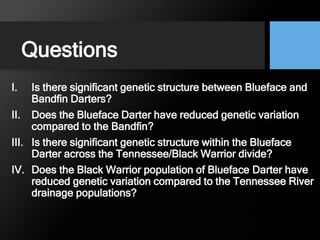
I. Is there significant genetic structure between Blueface and
Bandfin Darters?
II. Does the Blueface Darter have reduced genetic variation
compared to the Bandfin?
III. Is there significant genetic structure within the Blueface
Darter across the Tennessee/Black Warrior divide?
IV. Does the Black Warrior population of Blueface Darter have
reduced genetic variation compared to the Tennessee River
drainage populations?
Methods: Sample collection
Upper Bear
Cr. Reservoir
2
AL
MS
TN
KY
Tennessee River
Drainage
Black Warrior River
Drainage (Mobile Basin)
1
3
5
Upper Bear
Cr. Reservoir 2
6
47
8
9
Kinlock Falls, Hubbard Creek
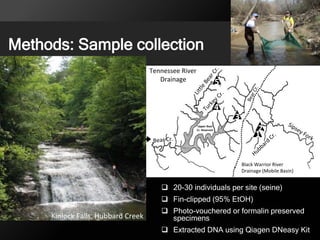
 20-30 individuals per site (seine)
 Fin-clipped (95% EtOH)
 Photo-vouchered or formalin preserved
specimens
 Extracted DNA using Qiagen DNeasy Kit
Methods: Microsatellite DNA analyses
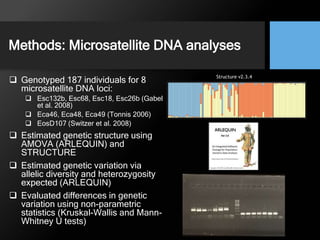
 Genotyped 187 individuals for 8
microsatellite DNA loci:
 Esc132b, Esc68, Esc18, Esc26b (Gabel
et al. 2008)
 Eca46, Eca48, Eca49 (Tonnis 2006)
 EosD107 (Switzer et al. 2008)
 Estimated genetic structure using
AMOVA (ARLEQUIN) and
STRUCTURE
 Estimated genetic variation via
allelic diversity and heterozygosity
expected (ARLEQUIN)
 Evaluated differences in genetic
variation using non-parametric
statistics (Kruskal-Wallis and Mann-
Whitney U tests)
Structure v2.3.4
Results
Upper Bear
Cr. Reservoir
2
AL
MS
TN
KY
Tennessee River
Drainage
Black Warrior River
Drainage (Mobile Basin)
1
3
4
Upper Bear
Cr. Reservoir 2
6
57
8
9
Results
1 63 4
Blueface Darter Bandfin Darter
2 5 7 8 9
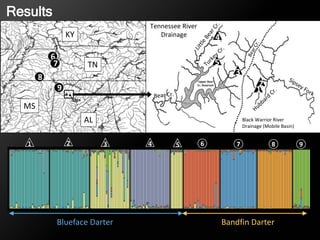
 FCT= 0.02, and an overall P-value of 0.03
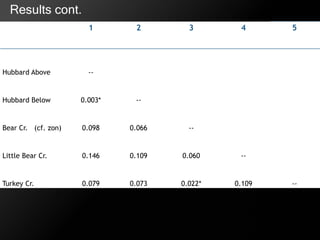
1 2 3 4 5 6 7 8 9
Hubbard
Above --
Hubbard
Below 0.003* --
Bear Cr.
(cf. zon) 0.098 0.066 --
Little Bear
Cr. 0.146 0.109 0.060 --
Turkey Cr. 0.079 0.073 0.022* 0.109 --
Big Sandy 0.070 0.041 0.033 0.067 0.064 --
Birdsong 0.073 0.056 0.034 0.076 0.070 0.023 --
Hatchie 0.247 0.228 0.205 0.234 0.247 0.176 0.155 --
Bear Cr. (E.
zon) 0.168 0.140 0.119 0.162 0.158 0.090 0.104 0.246 --
Results cont.
Blueface Darters
Bandfin Darters
Results
0
5
10
15
20
25
Blueface darters show a 23% reduction in
genetic variation compared to Bandfin, but not
significant (P = 0.084)
MeanAllelesPerLocus
Results
Upper Bear
Cr. Reservoir
2
AL
MS
TN
KY
Tennessee River
Drainage
Black Warrior River
Drainage (Mobile Basin)
1
3
4
Upper Bear
Cr. Reservoir 2
6
57
8
9
Results
1 63 4
Blueface Darter Bandfin Darter
2 5 7 8 9
1 2 3 4 5
Hubbard Above --
Hubbard Below 0.003* --
Bear Cr. (cf. zon) 0.098 0.066 --
Little Bear Cr. 0.146 0.109 0.060 --
Turkey Cr. 0.079 0.073 0.022* 0.109 --
Results cont.
MeanAllelesPerLocus
Genetic diversity differed between Blueface populations
(P=0.018). Turkey Creek lower than all others.
0
5
10
15
20
25
Hubbard Above Hubbard Below Bear Cr. Little Bear Cr Turkey Cr.
Results
Conclusions
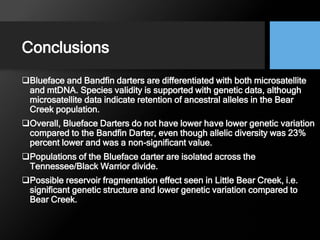
Blueface and Bandfin darters are differentiated with both microsatellite
and mtDNA. Species validity is supported with genetic data, although
microsatellite data indicate retention of ancestral alleles in the Bear
Creek population.
Overall, Blueface Darters do not have lower have lower genetic variation
compared to the Bandfin Darter, even though allelic diversity was 23%
percent lower and was a non-significant value.
Populations of the Blueface darter are isolated across the
Tennessee/Black Warrior divide.
Possible reservoir fragmentation effect seen in Little Bear Creek, i.e.
significant genetic structure and lower genetic variation compared to
Bear Creek.
Conservation implications
 After being formally described,
the results generated from this
study can inform state and
federal agencies about the
conservation needs of the
Blueface darter
 Conservation units
 Hubbard Creek
 Bear Creek system
 Conservation priorities
1. Turkey Creek
2. Hubbard Creek
3. Little Bear Creek
4. Bear Creek (source for PTRA)
Acknowledgements
 Funding
 Arkansas State University Faculty
Research Award Committee (FRAC).
 Tennessee Aquarium Conservation
Institute.
 Field and Lab Assistance
 Alexandra Hook
 Taylor Lee
 Brittany McCall
 Dave Neely
 Collecting Permits
 Alabama Dept. of Conservation and
Natural Resources
 Tennessee Wildlife Resources Agency
Closing Statement

Blueface presentation (kj)

  • 1.
    Conservation Genetics ofthe Blueface Darter (Etheostoma sp. cf. zonistium), a rare undescribed fish in northwest Alabama Kenny Jones Brook L. Fluker Bernard R. Kuhajda
  • 2.
    Distribution and Characteristics BandfinDarter, Etheostoma zonistium Blueface Darter, Etheostoma cf. zonistium Fish art: Joseph R. Tomelleri AL MS TN KY Gulf Coastal Plain Cumberland Plateau Bailey and Etnier (1988); Kuhajda and Mayden (upubl. data) Blueface Darter description is forthcoming (Kuhajda and Mayden). Once formally recognized, conservation status will need to be determined.
  • 3.
    Previous Work  Phylogeneticanalysis of cytochrome b (mtDNA) data identified Blueface Darters as a monophyletic group  Sister to E. zonistium sp. group  Approximately 3% sequence divergence Kuhajda and Fluker (2009)
  • 4.
    An Isolated Distribution Natural isolation: The Hubbard Creek population is potentially isolated from other populations via natural isolation.  Reservoir-induced isolation: The Upper Bear Creek systems are possibly isolated due to the construction of the Upper Bear Cr. Reservoir (1978). Extant Possibly extirpated Kuhajda and Mayden (2002) Tennessee River Drainage Black Warrior River Drainage (Mobile Basin) Upper Bear Cr. Reservoir 10.2 km 5.4 km
  • 5.
    Questions I. Is theresignificant genetic structure between Blueface and Bandfin Darters? II. Does the Blueface Darter have reduced genetic variation compared to the Bandfin? III. Is there significant genetic structure within the Blueface Darter across the Tennessee/Black Warrior divide? IV. Does the Black Warrior population of Blueface Darter have reduced genetic variation compared to the Tennessee River drainage populations?
  • 6.
    Methods: Sample collection UpperBear Cr. Reservoir 2 AL MS TN KY Tennessee River Drainage Black Warrior River Drainage (Mobile Basin) 1 3 5 Upper Bear Cr. Reservoir 2 6 47 8 9 Kinlock Falls, Hubbard Creek  20-30 individuals per site (seine)  Fin-clipped (95% EtOH)  Photo-vouchered or formalin preserved specimens  Extracted DNA using Qiagen DNeasy Kit
  • 7.
    Methods: Microsatellite DNAanalyses  Genotyped 187 individuals for 8 microsatellite DNA loci:  Esc132b, Esc68, Esc18, Esc26b (Gabel et al. 2008)  Eca46, Eca48, Eca49 (Tonnis 2006)  EosD107 (Switzer et al. 2008)  Estimated genetic structure using AMOVA (ARLEQUIN) and STRUCTURE  Estimated genetic variation via allelic diversity and heterozygosity expected (ARLEQUIN)  Evaluated differences in genetic variation using non-parametric statistics (Kruskal-Wallis and Mann- Whitney U tests) Structure v2.3.4
  • 8.
    Results Upper Bear Cr. Reservoir 2 AL MS TN KY TennesseeRiver Drainage Black Warrior River Drainage (Mobile Basin) 1 3 4 Upper Bear Cr. Reservoir 2 6 57 8 9 Results 1 63 4 Blueface Darter Bandfin Darter 2 5 7 8 9
  • 9.
     FCT= 0.02,and an overall P-value of 0.03 1 2 3 4 5 6 7 8 9 Hubbard Above -- Hubbard Below 0.003* -- Bear Cr. (cf. zon) 0.098 0.066 -- Little Bear Cr. 0.146 0.109 0.060 -- Turkey Cr. 0.079 0.073 0.022* 0.109 -- Big Sandy 0.070 0.041 0.033 0.067 0.064 -- Birdsong 0.073 0.056 0.034 0.076 0.070 0.023 -- Hatchie 0.247 0.228 0.205 0.234 0.247 0.176 0.155 -- Bear Cr. (E. zon) 0.168 0.140 0.119 0.162 0.158 0.090 0.104 0.246 -- Results cont.
  • 10.
    Blueface Darters Bandfin Darters Results 0 5 10 15 20 25 Bluefacedarters show a 23% reduction in genetic variation compared to Bandfin, but not significant (P = 0.084) MeanAllelesPerLocus
  • 11.
    Results Upper Bear Cr. Reservoir 2 AL MS TN KY TennesseeRiver Drainage Black Warrior River Drainage (Mobile Basin) 1 3 4 Upper Bear Cr. Reservoir 2 6 57 8 9 Results 1 63 4 Blueface Darter Bandfin Darter 2 5 7 8 9
  • 12.
    1 2 34 5 Hubbard Above -- Hubbard Below 0.003* -- Bear Cr. (cf. zon) 0.098 0.066 -- Little Bear Cr. 0.146 0.109 0.060 -- Turkey Cr. 0.079 0.073 0.022* 0.109 -- Results cont.
  • 13.
    MeanAllelesPerLocus Genetic diversity differedbetween Blueface populations (P=0.018). Turkey Creek lower than all others. 0 5 10 15 20 25 Hubbard Above Hubbard Below Bear Cr. Little Bear Cr Turkey Cr. Results
  • 14.
    Conclusions Blueface and Bandfindarters are differentiated with both microsatellite and mtDNA. Species validity is supported with genetic data, although microsatellite data indicate retention of ancestral alleles in the Bear Creek population. Overall, Blueface Darters do not have lower have lower genetic variation compared to the Bandfin Darter, even though allelic diversity was 23% percent lower and was a non-significant value. Populations of the Blueface darter are isolated across the Tennessee/Black Warrior divide. Possible reservoir fragmentation effect seen in Little Bear Creek, i.e. significant genetic structure and lower genetic variation compared to Bear Creek.
  • 15.
    Conservation implications  Afterbeing formally described, the results generated from this study can inform state and federal agencies about the conservation needs of the Blueface darter  Conservation units  Hubbard Creek  Bear Creek system  Conservation priorities 1. Turkey Creek 2. Hubbard Creek 3. Little Bear Creek 4. Bear Creek (source for PTRA)
  • 16.
    Acknowledgements  Funding  ArkansasState University Faculty Research Award Committee (FRAC).  Tennessee Aquarium Conservation Institute.  Field and Lab Assistance  Alexandra Hook  Taylor Lee  Brittany McCall  Dave Neely  Collecting Permits  Alabama Dept. of Conservation and Natural Resources  Tennessee Wildlife Resources Agency
  • 17.

Editor's Notes

  • #2 Change Display Fluker notes: I would remove the animation (picture appearing). I’ve changed the font, you can change it if you like, but you typically want to use a Sans-serif font in presentations.
  • #3 Fluker notes: Bandfin is distributed in the Gulf Coastal Plain (Tennessee River tribs and Hatchie R). In the original description of the Bandfin Dater, Bailey and Etnier (1988) noted meristic differences in upper Bear Creek and Black Warrior populations, but did not consider them distinct. Kuhajda and Mayden (unpublished) revealed coloration (lack of red ocellus), meristic, and morphometric differences and are in the process of describing the Blueface Darter. The Blueface Darter is found in upland habitats of the Cumberland Plateau only in the upper Bear Creek system and the Sipsey Fork of the Black Warrior River Drainage.
  • #4 In addition to the morphological differences, this provides additional support for the distinctiveness of the Blueface Darter.
  • #5 Bigger Map Fluker Notes: I’ve updated the map. Some things to focus on (1) this represents the species’ entire distribution; (2) Potential isolation between drainage basins (natural?); (2) potential isolation between tribs by Upper Bear Creek Reservoir. Note that Kuhajda and Mayden (2002) were not able to find Blueface Darters at historic localities at and below the reservoir.
  • #7 I’ve added the waterfall pic to appear on click so that you can mention that we sampled above and below to test for any waterfall isolation effect within Hubbard Creek.
  • #8 Keep it short. Maybe you can add a good gel picture? I’ve put one here as a placeholder for now.
  • #9 Relate results on this page to Question #1. We will show Structure Bar Plot and Fst values from the AMOVA. This is the old barplot, we will need to update it with the new one and update the numbers. We will also want to fit everything on the screen better.
  • #10 Relate results on this page to Question #1. We will show Fst values from the AMOVA. 3 decimels, Fewer lines, 0 replaced with dash
  • #11 Relate results on this page to Question #2. We will show standard bar plots of genetic variation. This is old, we will add a new one.
  • #12 Relate results on this page to Question #1. We will show Structure Bar Plot and Fst values from the AMOVA. This is the old barplot, we will need to update it with the new one and update the numbers. We will also want to fit everything on the screen better.
  • #13 Relate results on this page to Question #1. We will show Fst values from the AMOVA. 3 decimels, Fewer lines, 0 replaced with dash
  • #14 Relate results on this page to Question #4. We will show standard bar plots of genetic variation. This is old, we will add a new one.
  • #15 What are the main findings as related to your questions?
  • #16 How can your results guide conservation for the Blueface?