Project Scope
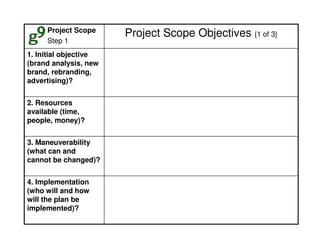
Step 1
1. Initial objective
(brand analysis, new
brand, rebranding,
advertising)?
2. Resources
available (time,
people, money)?
3. Maneuverability
(what can and
cannot be changed)?
4. Implementation
(who will and how
will the plan be
implemented)?

Project Scope Objectives {1 of 3}
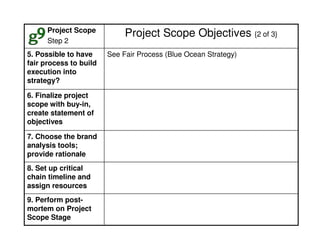
Project Scope
Step 2
5. Possible to have
fair process to build
execution into
strategy?
6. Finalize project
scope with buy-in,
create statement of
objectives
7. Choose the brand
analysis tools;
provide rationale
8. Set up critical
chain timeline and
assign resources
9. Perform postmortem on Project
Scope Stage

Project Scope Objectives {2 of 3}
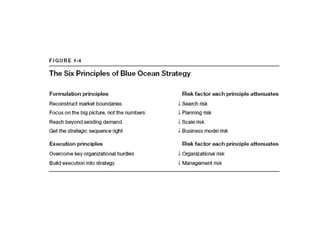
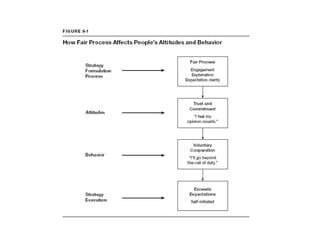
See Fair Process (Blue Ocean Strategy)
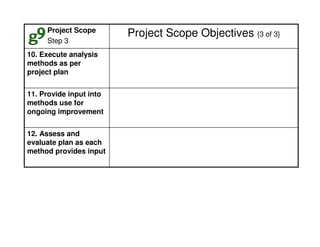
Project Scope
Step 3
10. Execute analysis
methods as per
project plan
11. Provide input into
methods use for
ongoing improvement
12. Assess and
evaluate plan as each
method provides input

Project Scope Objectives {3 of 3}
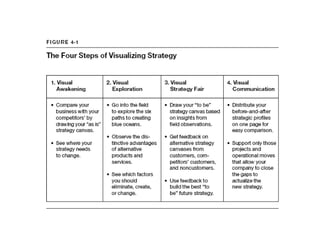
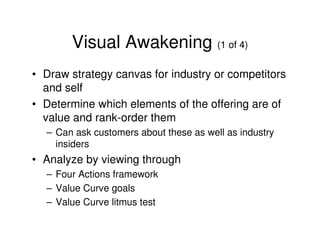
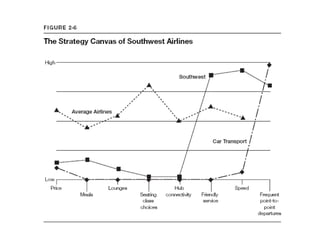
Visual Awakening (1 of 4)
• Draw strategy canvas for industry or competitors
and self
• Determine which elements of the offering are of
value and rank-order them
– Can ask customers about these as well as industry
insiders

• Analyze by viewing through
– Four Actions framework
– Value Curve goals
– Value Curve litmus test
Strategy Map
• Excel template
Visual Exploration (2 of 4)
• Go into the field to explore the 6 paths
–
–
–
–
–
–

Industry
Strategic group
Buyer group
Scope of product or service offering
Functional-emotional orientation
Time

• Observe the distinctive advatages of alternative
products and services
• See which factors you should elminate, create,
or change (the four actions framework)
Visual Exploration (2 of 4)
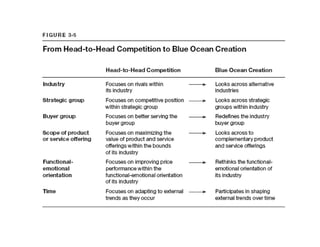
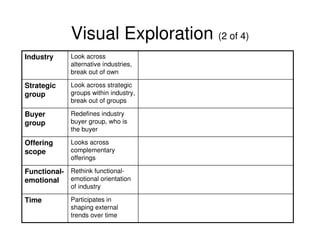
Industry

Look across
alternative industries,
break out of own

Strategic
group

Look across strategic
groups within industry,
break out of groups

Buyer
group

Redefines industry
buyer group, who is
the buyer

Offering
scope

Looks across
complementary
offerings

Functional- Rethink functionalemotional orientation
emotional
of industry

Time

Participates in
shaping external
trends over time
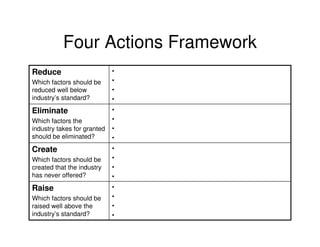
Four Actions Framework
Reduce
Which factors should be
reduced well below
industry’s standard?

Eliminate
Which factors the
industry takes for granted
should be eliminated?

Create
Which factors should be
created that the industry
has never offered?

Raise
Which factors should be
raised well above the
industry’s standard?

•
•
•
•
•
•
•
•
•
•
•
•
•
•
•
•
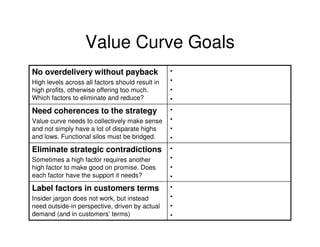
Value Curve Goals
No overdelivery without payback
High levels across all factors should result in
high profits, otherwise offering too much.
Which factors to eliminate and reduce?

Need coherences to the strategy
Value curve needs to collectively make sense
and not simply have a lot of disparate highs
and lows. Functional silos must be bridged.

Eliminate strategic contradictions
Sometimes a high factor requires another
high factor to make good on promise. Does
each factor have the support it needs?

Label factors in customers terms
Insider jargon does not work, but instead
need outside-in perspective, driven by actual
demand (and in customers’ terms)

•
•
•
•
•
•
•
•
•
•
•
•
•
•
•
•
Initial Litmus Test for Value Curve
• Focus
– Focus drives cost factors down
– Lack of focus indicates complex business plan

• Divergence
– Value curve diverges from industry standards
– Strategy must deviate from me-too-ism
– Need to stand apart in the marketplace

• Compelling tag line
– Without, it is a sign of innovation for own sake
Visual Strategy Fair (3 of 4)
• Draw your “to be” strategy canvas based
on insights from field observations
• Get feedback on alternative strategy
canvases from customers, competitors’
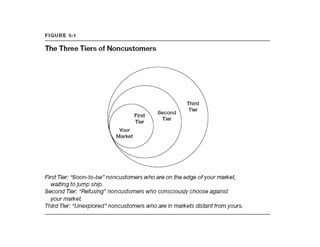
customers, and noncustomers
• Use feedback to build the best “to be”
future strategy
Visual Strategy Fair Feedback
• Feedback form
Visual Communication (4 of 4)
• Distribute before-and-after strategic
profiles on one page for easy comparison
• Support only those projects and
operational moves that allow your
company to close the gaps to actualize the
new strategy
Project Evaluation Support Form
• Form including projects, evaluation of
those projects in terms of moving the
strategy forward (closing gap between
current and future value curve)
• Go or no go on projects based on
evaluation
• (Note: not needed for our class project)
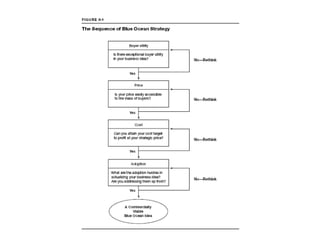
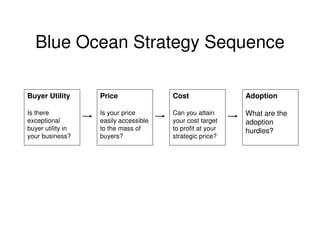
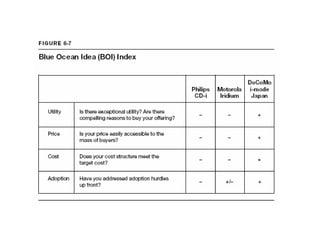
Blue Ocean Strategy Sequence
Buyer Utility

Price

Cost

Adoption

Is there
exceptional
buyer utility in
your business?

Is your price
easily accessible
to the mass of
buyers?

Can you attain
your cost target
to profit at your
strategic price?

What are the
adoption
hurdles?
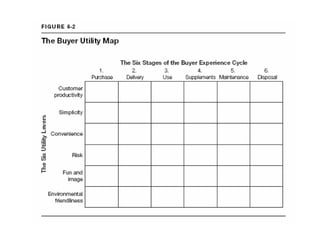
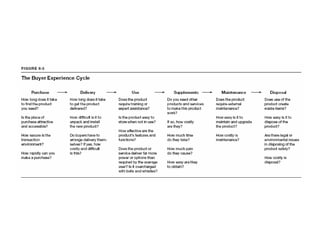
Buyer Experience Grid
• Create form based on previous slide
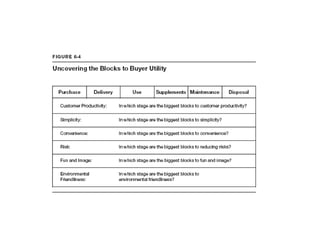
Location of biggest blocks to
customer utility
• Create form based on previous slide
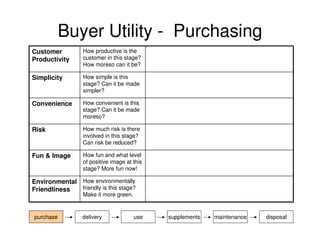
Buyer Utility - Purchasing
Customer
Productivity

How productive is the
customer in this stage?
How moreso can it be?

Simplicity

How simple is this
stage? Can it be made
simpler?

Convenience

How convenient is this
stage? Can it be made
moreso?

Risk

How much risk is there
involved in this stage?
Can risk be reduced?

Fun & Image

How fun and what level
of positive image at this
stage? More fun now!

Environmental How environmentally
friendly is this stage?
Friendliness
Make it more green.

purchase

delivery

use

supplements

maintenance

disposal
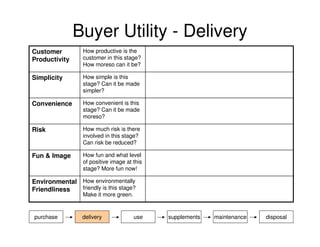
Buyer Utility - Delivery
Customer
Productivity

How productive is the
customer in this stage?
How moreso can it be?

Simplicity

How simple is this
stage? Can it be made
simpler?

Convenience

How convenient is this
stage? Can it be made
moreso?

Risk

How much risk is there
involved in this stage?
Can risk be reduced?

Fun & Image

How fun and what level
of positive image at this
stage? More fun now!

Environmental How environmentally
friendly is this stage?
Friendliness
Make it more green.

purchase

delivery

use

supplements

maintenance

disposal
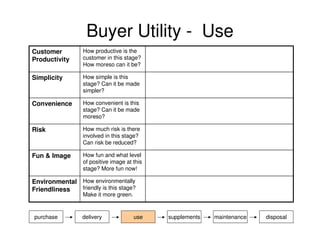
Buyer Utility - Use
Customer
Productivity

How productive is the
customer in this stage?
How moreso can it be?

Simplicity

How simple is this
stage? Can it be made
simpler?

Convenience

How convenient is this
stage? Can it be made
moreso?

Risk

How much risk is there
involved in this stage?
Can risk be reduced?

Fun & Image

How fun and what level
of positive image at this
stage? More fun now!

Environmental How environmentally
friendly is this stage?
Friendliness
Make it more green.

purchase

delivery

use

supplements

maintenance

disposal
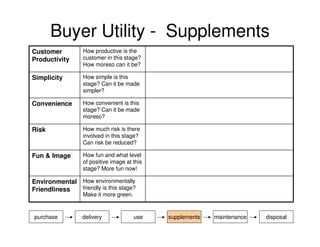
Buyer Utility - Supplements
Customer
Productivity

How productive is the
customer in this stage?
How moreso can it be?

Simplicity

How simple is this
stage? Can it be made
simpler?

Convenience

How convenient is this
stage? Can it be made
moreso?

Risk

How much risk is there
involved in this stage?
Can risk be reduced?

Fun & Image

How fun and what level
of positive image at this
stage? More fun now!

Environmental How environmentally
friendly is this stage?
Friendliness
Make it more green.

purchase

delivery

use

supplements

maintenance

disposal
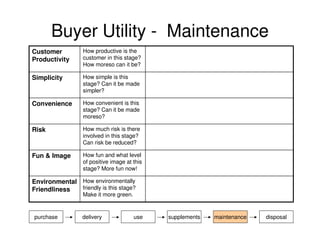
Buyer Utility - Maintenance
Customer
Productivity

How productive is the
customer in this stage?
How moreso can it be?

Simplicity

How simple is this
stage? Can it be made
simpler?

Convenience

How convenient is this
stage? Can it be made
moreso?

Risk

How much risk is there
involved in this stage?
Can risk be reduced?

Fun & Image

How fun and what level
of positive image at this
stage? More fun now!

Environmental How environmentally
friendly is this stage?
Friendliness
Make it more green.

purchase

delivery

use

supplements

maintenance

disposal
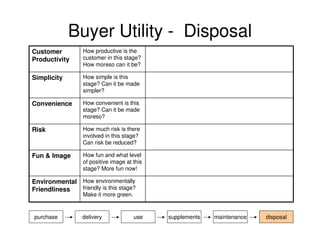
Buyer Utility - Disposal
Customer
Productivity

How productive is the
customer in this stage?
How moreso can it be?

Simplicity

How simple is this
stage? Can it be made
simpler?

Convenience

How convenient is this
stage? Can it be made
moreso?

Risk

How much risk is there
involved in this stage?
Can risk be reduced?

Fun & Image

How fun and what level
of positive image at this
stage? More fun now!

Environmental How environmentally
friendly is this stage?
Friendliness
Make it more green.

purchase

delivery

use

supplements

maintenance

disposal
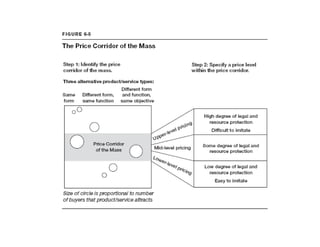
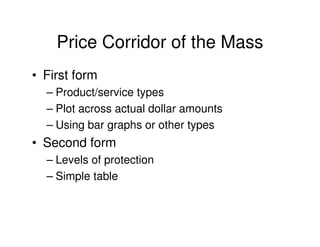
Price Corridor of the Mass
• First form
– Product/service types
– Plot across actual dollar amounts
– Using bar graphs or other types

• Second form
– Levels of protection
– Simple table
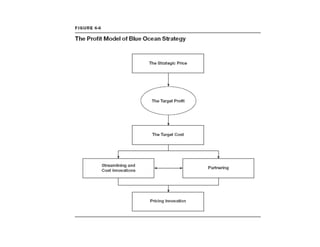
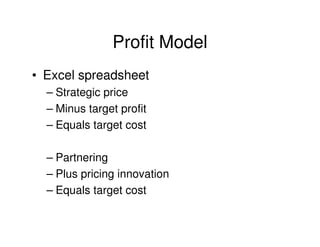
Profit Model
• Excel spreadsheet
– Strategic price
– Minus target profit
– Equals target cost
– Partnering
– Plus pricing innovation
– Equals target cost
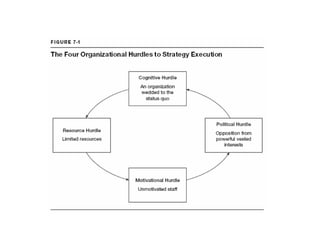
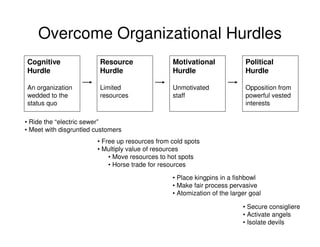
Overcome Organizational Hurdles
Cognitive
Hurdle

Resource
Hurdle

Motivational
Hurdle

Political
Hurdle

An organization
wedded to the
status quo

Limited
resources

Unmotivated
staff

Opposition from
powerful vested
interests

• Ride the “electric sewer”
• Meet with disgruntled customers
• Free up resources from cold spots
• Multiply value of resources
• Move resources to hot spots
• Horse trade for resources
• Place kingpins in a fishbowl
• Make fair process pervasive
• Atomization of the larger goal
• Secure consigliere
• Activate angels
• Isolate devils
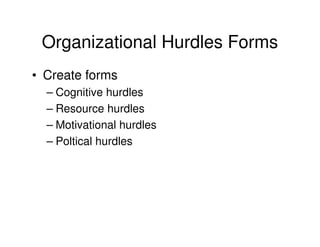
Organizational Hurdles Forms
• Create forms
– Cognitive hurdles
– Resource hurdles
– Motivational hurdles
– Poltical hurdles
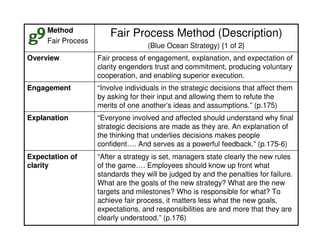
Method
Fair Process

Fair Process Method (Description)
(Blue Ocean Strategy) {1 of 2}

Overview

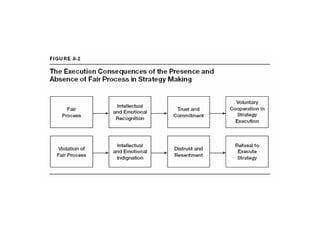
Fair process of engagement, explanation, and expectation of
clarity engenders trust and commitment, producing voluntary
cooperation, and enabling superior execution.

Engagement

“Involve individuals in the strategic decisions that affect them
by asking for their input and allowing them to refute the
merits of one another’s ideas and assumptions.” (p.175)

Explanation

“Everyone involved and affected should understand why final
strategic decisions are made as they are. An explanation of
the thinking that underlies decisions makes people
confident…. And serves as a powerful feedback.” (p.175-6)

Expectation of
clarity

“After a strategy is set, managers state clearly the new rules
of the game…. Employees should know up front what
standards they will be judged by and the penalties for failure.
What are the goals of the new strategy? What are the new
targets and milestones? Who is responsible for what? To
achieve fair process, it matters less what the new goals,
expectations, and responsibilities are and more that they are
clearly understood.” (p.176)
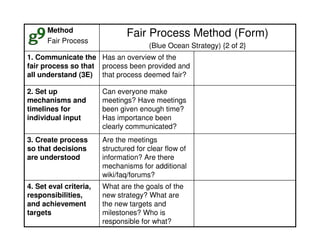
Method
Fair Process

Fair Process Method (Form)
(Blue Ocean Strategy) {2 of 2}

1. Communicate the Has an overview of the
fair process so that process been provided and
all understand (3E) that process deemed fair?
2. Set up
mechanisms and
timelines for
individual input

Can everyone make
meetings? Have meetings
been given enough time?
Has importance been
clearly communicated?

3. Create process
so that decisions
are understood

Are the meetings
structured for clear flow of
information? Are there
mechanisms for additional
wiki/faq/forums?

4. Set eval criteria,
responsibilities,
and achievement
targets

What are the goals of the
new strategy? What are
the new targets and
milestones? Who is
responsible for what?
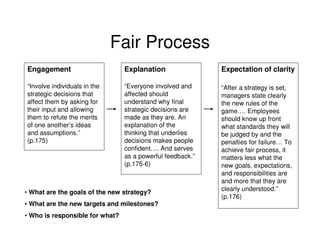
Fair Process
Engagement

Explanation

Expectation of clarity

“Involve individuals in the
strategic decisions that
affect them by asking for
their input and allowing
them to refute the merits
of one another’s ideas
and assumptions.”
(p.175)

“Everyone involved and
affected should
understand why final
strategic decisions are
made as they are. An
explanation of the
thinking that underlies
decisions makes people
confident…. And serves
as a powerful feedback.”
(p.175-6)

“After a strategy is set,
managers state clearly
the new rules of the
game…. Employees
should know up front
what standards they will
be judged by and the
penalties for failure… To
achieve fair process, it
matters less what the
new goals, expectations,
and responsibilities are
and more that they are
clearly understood.”
(p.176)

• What are the goals of the new strategy?
• What are the new targets and milestones?
• Who is responsible for what?
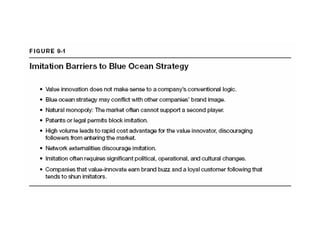
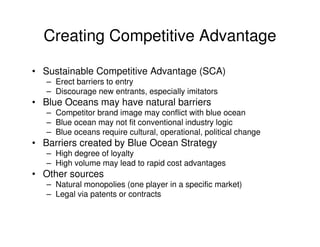
Creating Competitive Advantage
• Sustainable Competitive Advantage (SCA)
– Erect barriers to entry
– Discourage new entrants, especially imitators

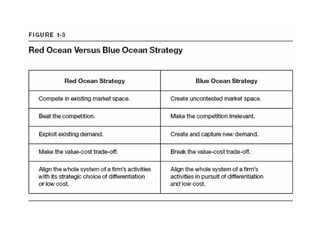
• Blue Oceans may have natural barriers
– Competitor brand image may conflict with blue ocean
– Blue ocean may not fit conventional industry logic
– Blue oceans require cultural, operational, political change

• Barriers created by Blue Ocean Strategy
– High degree of loyalty
– High volume may lead to rapid cost advantages

• Other sources
– Natural monopolies (one player in a specific market)
– Legal via patents or contracts

Blue ocean-strategy-method-templates4062

  • 1.
    Project Scope Step 1 1.Initial objective (brand analysis, new brand, rebranding, advertising)? 2. Resources available (time, people, money)? 3. Maneuverability (what can and cannot be changed)? 4. Implementation (who will and how will the plan be implemented)? Project Scope Objectives {1 of 3}
  • 2.
    Project Scope Step 2 5.Possible to have fair process to build execution into strategy? 6. Finalize project scope with buy-in, create statement of objectives 7. Choose the brand analysis tools; provide rationale 8. Set up critical chain timeline and assign resources 9. Perform postmortem on Project Scope Stage Project Scope Objectives {2 of 3} See Fair Process (Blue Ocean Strategy)
  • 3.
    Project Scope Step 3 10.Execute analysis methods as per project plan 11. Provide input into methods use for ongoing improvement 12. Assess and evaluate plan as each method provides input Project Scope Objectives {3 of 3}
  • 8.
    Visual Awakening (1of 4) • Draw strategy canvas for industry or competitors and self • Determine which elements of the offering are of value and rank-order them – Can ask customers about these as well as industry insiders • Analyze by viewing through – Four Actions framework – Value Curve goals – Value Curve litmus test
  • 10.
  • 12.
    Visual Exploration (2of 4) • Go into the field to explore the 6 paths – – – – – – Industry Strategic group Buyer group Scope of product or service offering Functional-emotional orientation Time • Observe the distinctive advatages of alternative products and services • See which factors you should elminate, create, or change (the four actions framework)
  • 13.
    Visual Exploration (2of 4) Industry Look across alternative industries, break out of own Strategic group Look across strategic groups within industry, break out of groups Buyer group Redefines industry buyer group, who is the buyer Offering scope Looks across complementary offerings Functional- Rethink functionalemotional orientation emotional of industry Time Participates in shaping external trends over time
  • 15.
    Four Actions Framework Reduce Whichfactors should be reduced well below industry’s standard? Eliminate Which factors the industry takes for granted should be eliminated? Create Which factors should be created that the industry has never offered? Raise Which factors should be raised well above the industry’s standard? • • • • • • • • • • • • • • • •
  • 16.
    Value Curve Goals Nooverdelivery without payback High levels across all factors should result in high profits, otherwise offering too much. Which factors to eliminate and reduce? Need coherences to the strategy Value curve needs to collectively make sense and not simply have a lot of disparate highs and lows. Functional silos must be bridged. Eliminate strategic contradictions Sometimes a high factor requires another high factor to make good on promise. Does each factor have the support it needs? Label factors in customers terms Insider jargon does not work, but instead need outside-in perspective, driven by actual demand (and in customers’ terms) • • • • • • • • • • • • • • • •
  • 17.
    Initial Litmus Testfor Value Curve • Focus – Focus drives cost factors down – Lack of focus indicates complex business plan • Divergence – Value curve diverges from industry standards – Strategy must deviate from me-too-ism – Need to stand apart in the marketplace • Compelling tag line – Without, it is a sign of innovation for own sake
  • 18.
    Visual Strategy Fair(3 of 4) • Draw your “to be” strategy canvas based on insights from field observations • Get feedback on alternative strategy canvases from customers, competitors’ customers, and noncustomers • Use feedback to build the best “to be” future strategy
  • 19.
    Visual Strategy FairFeedback • Feedback form
  • 20.
    Visual Communication (4of 4) • Distribute before-and-after strategic profiles on one page for easy comparison • Support only those projects and operational moves that allow your company to close the gaps to actualize the new strategy
  • 21.
    Project Evaluation SupportForm • Form including projects, evaluation of those projects in terms of moving the strategy forward (closing gap between current and future value curve) • Go or no go on projects based on evaluation • (Note: not needed for our class project)
  • 23.
    Blue Ocean StrategySequence Buyer Utility Price Cost Adoption Is there exceptional buyer utility in your business? Is your price easily accessible to the mass of buyers? Can you attain your cost target to profit at your strategic price? What are the adoption hurdles?
  • 26.
    Buyer Experience Grid •Create form based on previous slide
  • 28.
    Location of biggestblocks to customer utility • Create form based on previous slide
  • 29.
    Buyer Utility -Purchasing Customer Productivity How productive is the customer in this stage? How moreso can it be? Simplicity How simple is this stage? Can it be made simpler? Convenience How convenient is this stage? Can it be made moreso? Risk How much risk is there involved in this stage? Can risk be reduced? Fun & Image How fun and what level of positive image at this stage? More fun now! Environmental How environmentally friendly is this stage? Friendliness Make it more green. purchase delivery use supplements maintenance disposal
  • 30.
    Buyer Utility -Delivery Customer Productivity How productive is the customer in this stage? How moreso can it be? Simplicity How simple is this stage? Can it be made simpler? Convenience How convenient is this stage? Can it be made moreso? Risk How much risk is there involved in this stage? Can risk be reduced? Fun & Image How fun and what level of positive image at this stage? More fun now! Environmental How environmentally friendly is this stage? Friendliness Make it more green. purchase delivery use supplements maintenance disposal
  • 31.
    Buyer Utility -Use Customer Productivity How productive is the customer in this stage? How moreso can it be? Simplicity How simple is this stage? Can it be made simpler? Convenience How convenient is this stage? Can it be made moreso? Risk How much risk is there involved in this stage? Can risk be reduced? Fun & Image How fun and what level of positive image at this stage? More fun now! Environmental How environmentally friendly is this stage? Friendliness Make it more green. purchase delivery use supplements maintenance disposal
  • 32.
    Buyer Utility -Supplements Customer Productivity How productive is the customer in this stage? How moreso can it be? Simplicity How simple is this stage? Can it be made simpler? Convenience How convenient is this stage? Can it be made moreso? Risk How much risk is there involved in this stage? Can risk be reduced? Fun & Image How fun and what level of positive image at this stage? More fun now! Environmental How environmentally friendly is this stage? Friendliness Make it more green. purchase delivery use supplements maintenance disposal
  • 33.
    Buyer Utility -Maintenance Customer Productivity How productive is the customer in this stage? How moreso can it be? Simplicity How simple is this stage? Can it be made simpler? Convenience How convenient is this stage? Can it be made moreso? Risk How much risk is there involved in this stage? Can risk be reduced? Fun & Image How fun and what level of positive image at this stage? More fun now! Environmental How environmentally friendly is this stage? Friendliness Make it more green. purchase delivery use supplements maintenance disposal
  • 34.
    Buyer Utility -Disposal Customer Productivity How productive is the customer in this stage? How moreso can it be? Simplicity How simple is this stage? Can it be made simpler? Convenience How convenient is this stage? Can it be made moreso? Risk How much risk is there involved in this stage? Can risk be reduced? Fun & Image How fun and what level of positive image at this stage? More fun now! Environmental How environmentally friendly is this stage? Friendliness Make it more green. purchase delivery use supplements maintenance disposal
  • 36.
    Price Corridor ofthe Mass • First form – Product/service types – Plot across actual dollar amounts – Using bar graphs or other types • Second form – Levels of protection – Simple table
  • 38.
    Profit Model • Excelspreadsheet – Strategic price – Minus target profit – Equals target cost – Partnering – Plus pricing innovation – Equals target cost
  • 42.
    Overcome Organizational Hurdles Cognitive Hurdle Resource Hurdle Motivational Hurdle Political Hurdle Anorganization wedded to the status quo Limited resources Unmotivated staff Opposition from powerful vested interests • Ride the “electric sewer” • Meet with disgruntled customers • Free up resources from cold spots • Multiply value of resources • Move resources to hot spots • Horse trade for resources • Place kingpins in a fishbowl • Make fair process pervasive • Atomization of the larger goal • Secure consigliere • Activate angels • Isolate devils
  • 43.
    Organizational Hurdles Forms •Create forms – Cognitive hurdles – Resource hurdles – Motivational hurdles – Poltical hurdles
  • 46.
    Method Fair Process Fair ProcessMethod (Description) (Blue Ocean Strategy) {1 of 2} Overview Fair process of engagement, explanation, and expectation of clarity engenders trust and commitment, producing voluntary cooperation, and enabling superior execution. Engagement “Involve individuals in the strategic decisions that affect them by asking for their input and allowing them to refute the merits of one another’s ideas and assumptions.” (p.175) Explanation “Everyone involved and affected should understand why final strategic decisions are made as they are. An explanation of the thinking that underlies decisions makes people confident…. And serves as a powerful feedback.” (p.175-6) Expectation of clarity “After a strategy is set, managers state clearly the new rules of the game…. Employees should know up front what standards they will be judged by and the penalties for failure. What are the goals of the new strategy? What are the new targets and milestones? Who is responsible for what? To achieve fair process, it matters less what the new goals, expectations, and responsibilities are and more that they are clearly understood.” (p.176)
  • 47.
    Method Fair Process Fair ProcessMethod (Form) (Blue Ocean Strategy) {2 of 2} 1. Communicate the Has an overview of the fair process so that process been provided and all understand (3E) that process deemed fair? 2. Set up mechanisms and timelines for individual input Can everyone make meetings? Have meetings been given enough time? Has importance been clearly communicated? 3. Create process so that decisions are understood Are the meetings structured for clear flow of information? Are there mechanisms for additional wiki/faq/forums? 4. Set eval criteria, responsibilities, and achievement targets What are the goals of the new strategy? What are the new targets and milestones? Who is responsible for what?
  • 48.
    Fair Process Engagement Explanation Expectation ofclarity “Involve individuals in the strategic decisions that affect them by asking for their input and allowing them to refute the merits of one another’s ideas and assumptions.” (p.175) “Everyone involved and affected should understand why final strategic decisions are made as they are. An explanation of the thinking that underlies decisions makes people confident…. And serves as a powerful feedback.” (p.175-6) “After a strategy is set, managers state clearly the new rules of the game…. Employees should know up front what standards they will be judged by and the penalties for failure… To achieve fair process, it matters less what the new goals, expectations, and responsibilities are and more that they are clearly understood.” (p.176) • What are the goals of the new strategy? • What are the new targets and milestones? • Who is responsible for what?
  • 50.
    Creating Competitive Advantage •Sustainable Competitive Advantage (SCA) – Erect barriers to entry – Discourage new entrants, especially imitators • Blue Oceans may have natural barriers – Competitor brand image may conflict with blue ocean – Blue ocean may not fit conventional industry logic – Blue oceans require cultural, operational, political change • Barriers created by Blue Ocean Strategy – High degree of loyalty – High volume may lead to rapid cost advantages • Other sources – Natural monopolies (one player in a specific market) – Legal via patents or contracts