by
Prof. W. Chan Kim, Prof. Renee Mauborgne

                                             Edited by;
                        R. Benny Wahyuadi, M.M., MBA.
                             Hersanto, S. Kom., M.Kom.
Value Innovation
Value Innovation is created in the region where a company’s actions favorably
affect both its cost structure and its value proposition to buyers. Cost savings
are made by eliminating and reducing the factors an industry competes on.
Buyer value is lifted by raising and creating elements the industry has never
offered. Over time, costs are reduced further as scale economies kick in due to
                                                                                      Costs
the high sales volumes that superior value generates.
We call it value innovation because instead of focusing on beating the
competition, you focus on making the competition irrelevant by creating a leap in
value for buyers and your company, thereby opening up new and uncontested
                                                                                      Value
market space.
                                                                                    Innovation
Value innovation places equal emphasis on value and innovation.
Value innovation occurs when companies align innovation with utility, price, and
cost positions.
Importantly, value innovation defies one of the most commonly accepted dogmas       Buyer Value
of competition-based strategy: the value-cost trade-off. Those that seek to
create blue oceans pursue differentiation and low cost simultaneously.
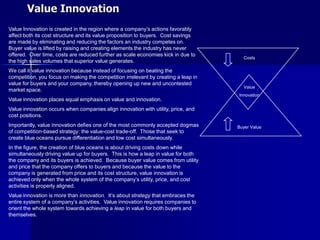
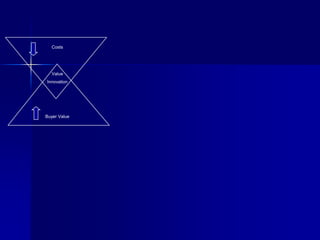
In the figure, the creation of blue oceans is about driving costs down while
simultaneously driving value up for buyers. This is how a leap in value for both
the company and its buyers is achieved. Because buyer value comes from utility
and price that the company offers to buyers and because the value to the
company is generated from price and its cost structure, value innovation is
achieved only when the whole system of the company’s utility, price, and cost
activities is properly aligned.
Value innovation is more than innovation. It’s about strategy that embraces the
entire system of a company’s activities. Value innovation requires companies to
orient the whole system towards achieving a leap in value for both buyers and
themselves.
Costs


  Value
Innovation


Buyer Value
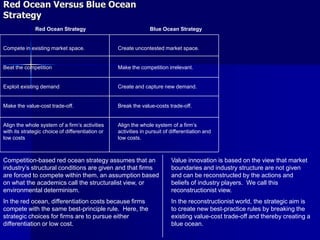
Red Ocean Versus Blue Ocean
Strategy
              Red Ocean Strategy                                 Blue Ocean Strategy


Compete in existing market space.                 Create uncontested market space.


Beat the competition                              Make the competition irrelevant.


Exploit existing demand                           Create and capture new demand.


Make the value-cost trade-off.                    Break the value-costs trade-off.


Align the whole system of a firm’s activities     Align the whole system of a firm’s
with its strategic choice of differentiation or   activities in pursuit of differentiation and
low costs                                         low costs.


Competition-based red ocean strategy assumes that an                       Value innovation is based on the view that market
industry’s structural conditions are given and that firms                  boundaries and industry structure are not given
are forced to compete within them, an assumption based                     and can be reconstructed by the actions and
on what the academics call the structuralist view, or                      beliefs of industry players. We call this
environmental determinism.                                                 reconstructionist view.
In the red ocean, differentiation costs because firms                      In the reconstructionist world, the strategic aim is
compete with the same best-principle rule. Here, the                       to create new best-practice rules by breaking the
strategic choices for firms are to pursue either                           existing value-cost trade-off and thereby creating a
differentiation or low cost.                                               blue ocean.
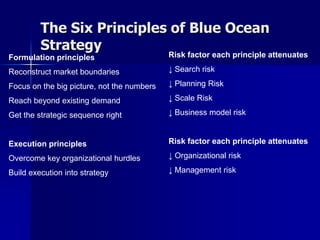
The Six Principles of Blue Ocean
         Strategy
Formulation principles                      Risk factor each principle attenuates

Reconstruct market boundaries               ↓ Search risk

Focus on the big picture, not the numbers   ↓ Planning Risk

Reach beyond existing demand                ↓ Scale Risk

Get the strategic sequence right            ↓ Business model risk


Execution principles                        Risk factor each principle attenuates

Overcome key organizational hurdles         ↓ Organizational risk

Build execution into strategy               ↓ Management risk
The Strategy Canvas (example)
High

                                                                       Premium Wines

                                                                                                                                          [yellow tail]


                                                                      Budget Wines


Low

   Price       Use of enological
               terminology and       Above-the-       Aging quality    Vineyard prestige          Wine             Wine        Easy           Ease of     Fun and
               distinction in wine   line marketing
               communication
                                                                       and legacy                 complexity       range       drinking       selection   adventure

        The strategy canvas is both a diagnostic and an action framework for building a compelling blue ocean strategy. It serves
        two purposes. First it captures the current state of play in the known market space. This allows you to understand where
        the competition is currently investing, the factors the industry currently competes on in products, service, and delivery, and
        what customers receive from the existing competitive offerings on the market.
        The horizontal axis captures the range of factors the industry competes on and invest in.
        The vertical axis of the strategy canvas, which captures the offering level that buyers receive across all these key
        competing factors. A high score means that a company offers buyers more, and hence invest more, in that factor. In the
        case of price, a higher score indicates a higher price.
        A value curve, the basic component of the strategy canvas, is a graphic depiction of a company’s relative performance
        across its industry’s factors of competition.
        To fundamentally shift the strategy canvas of an industry, you must begin by reorienting your strategic focus from
        competitors to alternatives, and from customers to noncustomers of the industry. To pursue both value and costs, you
        should resist the old logic of benchmarking competitors in the existing field and choosing between differentiation and cost
        leadership. As you shift your strategic focus from current competition to alternatives and noncustomers, you gain insight
        into how to redefine the problem the industry focuses on and thereby reconstruct buyer value elements that reside across
        industry boundaries.
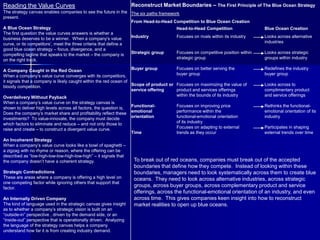
Reading the Value Curves                                            Reconstruct Market Boundaries – The First Principle of The Blue Ocean Strategy
The strategy canvas enables companies to see the future in the The six paths framework
present.
                                                                  From Head-to-Head Competition to Blue Ocean Creation
A Blue Ocean Strategy                                                                Head-to-Head Competition                 Blue Ocean Creation
The first question the value curves answers is whether a
business deserves to be a winner. When a company’s value          Industry           Focuses on rivals within its industry    Looks across alternative
curve, or its competitors’, meet the three criteria that define a                                                             industries
good blue ocean strategy – focus, divergence, and a
compelling tagline that speaks to the market – the company is     Strategic group    Focuses on competitive position within   Looks across strategic
on the right track.                                                                  strategic group                          groups within industry

A Company Caught in the Red Ocean                                  Buyer group           Focuses on better serving the        Redefines the industry
When a company’s value curve converges with its competitors,                             buyer group                          buyer group
it signals that a company is likely caught within the red ocean of
bloody competition.                                                Scope of product or   Focuses on maximizing the value of   Looks across to
                                                                   service offering      product and services offerings       complimentary product
Overdelivery Without Payback                                                             within the bounds of its industry    and service offerings
When a company’s value curve on the strategy canvas is
shown to deliver high levels across all factors, the question is,   Functional-          Focuses on improving price           Rethinks the functional-
Does the company’s market share and profitability reflect these     emotional            performance within the               emotional orientation of its
investments? To value-innovate, the company must decide             orientation          functional-emotional orientation     industry
which factors to eliminate and reduce – and not only those to                            of its industry
raise and create – to construct a divergent value curve.                                 Focuses on adapting to external      Participates in shaping
                                                                    Time                 trends as they occur                 external trends over time
An Incoherent Strategy
When a company’s value curve looks like a bowl of spaghetti –
a zigzag with no rhyme or reason, where the offering can be
described as “low-high-low-low-high-low-high” – it signals that
the company doesn’t have a coherent strategy.                        To break out of red oceans, companies must break out of the accepted
                                                                     boundaries that define how they compete. Instead of looking within these
Strategic Contradictions                                             boundaries, managers need to look systematically across them to create blue
These are areas where a company is offering a high level on          oceans. They need to look across alternative industries, across strategic
one competing factor while ignoring others that support that
factor.
                                                                     groups, across buyer groups, across complementary product and service
                                                                     offerings, across the functional-emotional orientation of an industry, and even
An Internally Driven Company                                         across time. This gives companies keen insight into how to reconstruct
The kind of language used in the strategic canvas gives insight      market realities to open up blue oceans.
as to whether a company’s strategic vision is built on an
“outside-in” perspective , driven by the demand side, or an
“inside-out” perspective that is operationally driven. Analyzing
the language of the strategy canvas helps a company
understand how far it is from creating industry demand.
The Strategy Canvas
High


Low
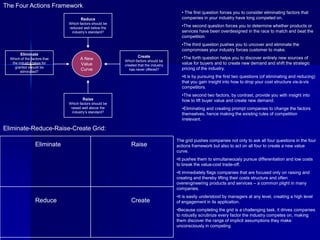
The Four Actions Framework
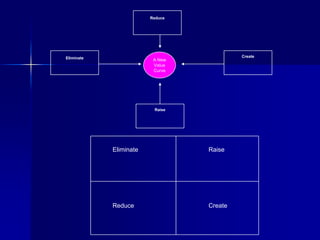
                                                                                      • The first question forces you to consider eliminating factors that
                                     Reduce                                           companies in your industry have long competed on.
                              Which factors should be
                              reduced well below the
                                                                                      •The second question forces you to determine whether products or
                                industry’s standard?                                  services have been overdesigned in the race to match and beat the
                                                                                      competition.
                                                                                      •The third question pushes you to uncover and eliminate the
                                                                                      compromises your industry forces customer to make.
        Eliminate
                                                                Create                •The forth question helps you to discover entirely new sources of
  Which of the factors that         A New               Which factors should be
   the industry takes for           Value               created that the industry
                                                                                      value for buyers and to create new demand and shift the strategic
     granted should be                                                                pricing of the industry.
        eliminated?
                                    Curve                  has never offered?

                                                                                      •It is by pursuing the first two questions (of eliminating and reducing)
                                                                                      that you gain insight into how to drop your cost structure vis-à-vis
                                                                                      competitors.
                                                                                      •The second two factors, by contrast, provide you with insight into
                                      Raise                                           how to lift buyer value and create new demand.
                              Which factors should be
                               raised well above the                                  •Eliminating and creating prompt companies to change the factors
                                industry’s standard?
                                                                                      themselves, hence making the existing rules of competition
                                                                                      irrelevant.

Eliminate-Reduce-Raise-Create Grid:
                                                                                    The grid pushes companies not only to ask all four questions in the four
                  Eliminate                                 Raise                   actions framework but also to act on all four to create a new value
                                                                                    curve.
                                                                                    •It pushes them to simultaneously pursue differentiation and low costs
                                                                                    to break the value-cost trade-off.
                                                                                    •It immediately flags companies that are focused only on raising and
                                                                                    creating and thereby lifting their costs structure and often
                                                                                    overengineering products and services – a common plight in many
                                                                                    companies.
                                                                                    •It is easily understood by managers at any level, creating a high level
                  Reduce                                    Create                  of engagement in its application.
                                                                                    •Because completing the grid is a challenging task, it drives companies
                                                                                    to robustly scrutinize every factor the industry competes on, making
                                                                                    them discover the range of implicit assumptions they make
                                                                                    unconsciously in competing
Reduce


Eliminate                                 Create
                         A New
                         Value
                         Curve


                         Raise


            Eliminate            Raise


            Reduce               Create
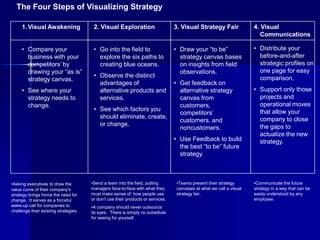
The Four Steps of Visualizing Strategy

     1. Visual Awakening                2. Visual Exploration                     3. Visual Strategy Fair              4. Visual
                                                                                                                          Communications

     • Compare your                     • Go into the field to                    • Draw your “to be”                  • Distribute your
       business with your                 explore the six paths to                  strategy canvas bases                before-and-after
       competitors’ by                    creating blue oceans.                     on insights from field               strategic profiles on
       drawing your “as is”                                                         observations.                        one page for easy
                                        • Observe the distinct                                                           comparison.
       strategy canvas.
                                          advantages of                           • Get feedback on
     • See where your                     alternative products and                  alternative strategy               • Support only those
       strategy needs to                  services.                                 canvas from                          projects and
       change.                                                                      customers,                           operational moves
                                        • See which factors you
                                                                                    competitors’                         that allow your
                                          should eliminate, create,                                                      company to close
                                                                                    customers, and
                                          or change.                                                                     the gaps to
                                                                                    noncustomers.
                                                                                                                         actualize the new
                                                                                  • Use Feedback to build                strategy.
                                                                                    the best “to be” future
                                                                                    strategy.


•Asking executives to draw the         •Send a team into the field, putting        •Teams present their strategy       •Communicate the future
value curve of their company’s         managers face-to-face with what they        canvases at what we call a visual   strategy in a way that can be
strategy brings home the need for      must make sense of: how people use          strategy fair.                      easily understood by any
change. It serves as a forceful        or don’t use their products or services.                                        employee.
wake-up call for companies to          •A company should never outsource
challenge their existing strategies.   its eyes. There is simply no substitute
                                       for seeing for yourself.
The Four Steps of Visualizing Strategy

 1. Visual Awakening   2. Visual Exploration   3. Visual Strategy Fair   4. Visual
                                                                            Communications
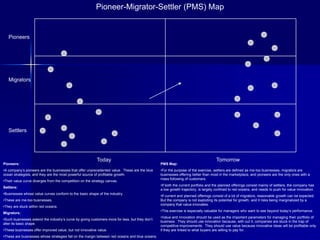
Pioneer-Migrator-Settler (PMS) Map


   Pioneers


   Migrators


   Settlers


                                                          Today                                                                      Tomorrow
Pioneers:                                                                                        PMS Map:
•A company’s pioneers are the businesses that offer unprecedented value. These are the blue      •For the purpose of the exercise, settlers are defined as me-too businesses, migrators are
ocean strategists, and they are the most powerful source of profitable growth.                   businesses offering better than most in the marketplace, and pioneers are the only ones with a
                                                                                                 mass following of customers.
•Their value curve diverges from the competition on the strategy canvas.
                                                                                                 •If both the current portfolio and the planned offerings consist mainly of settlers, the company has
Settlers:
                                                                                                 a low growth trajectory, is largely confined to red oceans, and needs to push for value innovation.
•Businesses whose value curves conform to the basic shape of the industry.
                                                                                                 •If current and planned offerings consist of a lot of migrators, reasonable growth can be expected.
•These are me-too businesses.                                                                    But the company is not exploiting its potential for growth, and it risks being marginalized by a
                                                                                                 company that value-innovates.
•They are stuck within red oceans.
                                                                                                 •This exercise is especially valuable for managers who want to see beyond today’s performance.
Migrators:
                                                                                                 •Value and innovation should be used as the important parameters for managing their portfolio of
•Such businesses extend the industry’s curve by giving customers more for less, but they don’t
                                                                                                 business. They should use innovation because, with out it, companies are stuck in the trap of
alter its basic shape.
                                                                                                 competitive improvements. They should use value because innovative ideas will be profitable only
•These businesses offer improved value, but not innovative value.                                if they are linked to what buyers are willing to pay for.
•These are businesses whose strategies fall on the margin between red oceans and blue oceans.
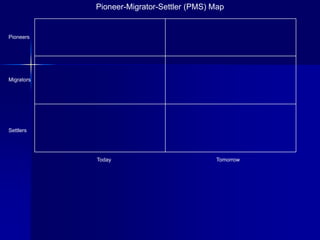
Pioneer-Migrator-Settler (PMS) Map


Pioneers


Migrators


Settlers


            Today                          Tomorrow
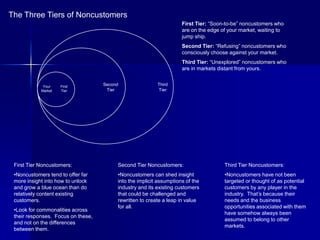
The Three Tiers of Noncustomers
                                                                     First Tier: “Soon-to-be” noncustomers who
                                                                     are on the edge of your market, waiting to
                                                                     jump ship.
                                                                     Second Tier: “Refusing” noncustomers who
                                                                     consciously choose against your market.
                                                                     Third Tier: “Unexplored” noncustomers who
                                                                     are in markets distant from yours.


             Your    First
                                    Second                Third
            Market   Tier            Tier                 Tier


 First Tier Noncustomers:                Second Tier Noncustomers:                    Third Tier Noncustomers:
 •Noncustomers tend to offer far         •Noncustomers can shed insight               •Noncustomers have not been
 more insight into how to unlock         into the implicit assumptions of the         targeted or thought of as potential
 and grow a blue ocean than do           industry and its existing customers          customers by any player in the
 relatively content existing             that could be challenged and                 industry. That’s because their
 customers.                              rewritten to create a leap in value          needs and the business
                                         for all.                                     opportunities associated with them
 •Look for commonalities across
                                                                                      have somehow always been
 their responses. Focus on these,
                                                                                      assumed to belong to other
 and not on the differences
                                                                                      markets.
 between them.
The Three Tiers of Noncustomers
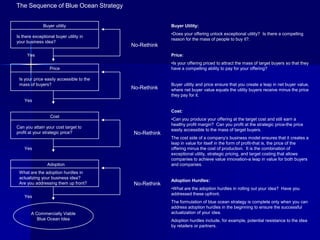
The Sequence of Blue Ocean Strategy


              Buyer utility                            Buyer Utility:
                                                       •Does your offering unlock exceptional utility? Is there a compelling
Is there exceptional buyer utility in
                                                       reason for the mass of people to buy it?.
your business idea?
                                          No-Rethink
     Yes                                               Price:
                                                       •Is your offering priced to attract the mass of target buyers so that they
                  Price                                have a compelling ability to pay for your offering?

 Is your price easily accessible to the
 mass of buyers?                                       Buyer utility and price ensure that you create a leap in net buyer value,
                                          No-Rethink   where net buyer value equals the utility buyers receive minus the price
                                                       they pay for it.
    Yes

                                                       Cost:
                  Cost
                                                       •Can you produce your offering at the target cost and still earn a
                                                       healthy profit margin? Can you profit at the strategic price-the price
Can you attain your cost target to
                                                       easily accessible to the mass of target buyers.
profit at your strategic price?           No-Rethink
                                                       The cost side of a company’s business model ensures that it creates a
                                                       leap in value for itself in the form of profit-that is, the price of the
    Yes                                                offering minus the cost of production. It is the combination of
                                                       exceptional utility, strategic pricing, and target costing that allows
                                                       companies to achieve value innovation-a leap in value for both buyers
                 Adoption                              and companies.
 What are the adoption hurdles in
 actualizing your business idea?
                                                       Adoption Hurdles:
 Are you addressing them up front?        No-Rethink
                                                       •What are the adoption hurdles in rolling out your idea? Have you
                                                       addressed these upfront.
    Yes
                                                       The formulation of blue ocean strategy is complete only when you can
                                                       address adoption hurdles in the beginning to ensure the successful
        A Commercially Viable                          actualization of your idea.
           Blue Ocean Idea                             Adoption hurdles include, for example, potential resistance to the idea
                                                       by retailers or partners.
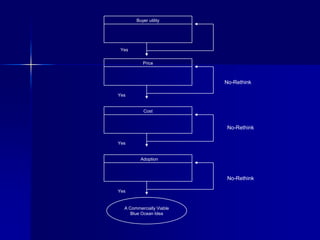
Buyer utility


 Yes


          Price


                          No-Rethink

Yes


          Cost


                          No-Rethink

Yes


         Adoption


                          No-Rethink

Yes


  A Commercially Viable
     Blue Ocean Idea
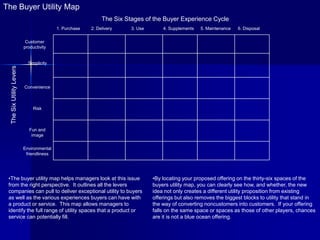
The Buyer Utility Map
                                                              The Six Stages of the Buyer Experience Cycle
                                           1. Purchase   2. Delivery    3. Use       4. Supplements   5. Maintenance   6. Disposal


                            Customer
                           productivity


                             Simplicity
  The Six Utility Levers


                           Convenience


                                Risk


                              Fun and
                               image


                           Environmental
                            friendliness


 •The buyer utility map helps managers look at this issue                        •By locating your proposed offering on the thirty-six spaces of the
 from the right perspective. It outlines all the levers                          buyers utility map, you can clearly see how, and whether, the new
 companies can pull to deliver exceptional utility to buyers                     idea not only creates a different utility proposition from existing
 as well as the various experiences buyers can have with                         offerings but also removes the biggest blocks to utility that stand in
 a product or service. This map allows managers to                               the way of converting noncustomers into customers. If your offering
 identify the full range of utility spaces that a product or                     falls on the same space or spaces as those of other players, chances
 service can potentially fill.                                                   are it is not a blue ocean offering.
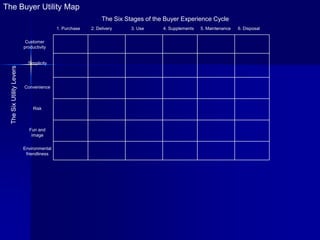
The Buyer Utility Map
                                                              The Six Stages of the Buyer Experience Cycle
                                           1. Purchase   2. Delivery    3. Use     4. Supplements   5. Maintenance   6. Disposal


                            Customer
                           productivity


                             Simplicity
  The Six Utility Levers


                           Convenience


                                Risk


                              Fun and
                               image


                           Environmental
                            friendliness
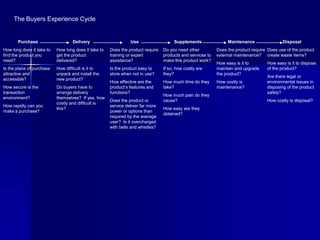
The Buyers Experience Cycle


       Purchase                    Delivery                     Use                   Supplements                Maintenance                Disposal
How long does it take to   How long does it take to   Does the product require   Do you need other          Does the product require Does use of the product
find the product you       get the product            training or expert         products and services to   external maintenance? create waste items?
need?                      delivered?                 assistance?                make this product work?
                                                                                                            How easy is it to       How easy is it to dispose
Is the place of purchase   How difficult is it to     Is the product easy to     If so, how costly are      maintain and upgrade    of the product?
attractive and             unpack and install the     store when not in use?     they?                      the product?
                                                                                                                                    Are there legal or
accessible?                new product?
                                                      How effective are the      How much time do they      How costly is           environmental issues in
How secure is the          Do buyers have to          product’s features and     take?                      maintenance?            disposing of the product
transaction                arrange delivery           functions?                                                                    safely?
                                                                                 How much pain do they
environment?               themselves? If yes, how
                                                      Does the product or        cause?                                             How costly is disposal?
                           costly and difficult is
How rapidly can you                                   service deliver far more
                           this?                                                 How easy are they
make a purchase?                                      power or options than
                                                                                 obtained?
                                                      required by the average
                                                      user? Is it overcharged
                                                      with bells and whistles?
The Buyers Experience Cycle


 Purchase          Delivery   Use   Supplements   Maintenance
Uncovering the Blocks to Buyers Utility


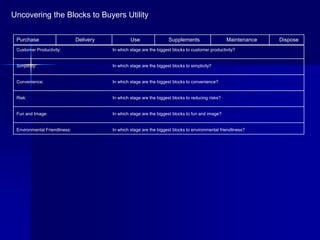
 Purchase                      Delivery            Use                 Supplements                   Maintenance   Dispose
 Customer Productivity:                   In which stage are the biggest blocks to customer productivity?


 Simplicity:                              In which stage are the biggest blocks to simplicity?


 Convenience:                             In which stage are the biggest blocks to convenience?


 Risk:                                    In which stage are the biggest blocks to reducing risks?


 Fun and Image:                           In which stage are the biggest blocks to fun and image?


 Environmental Friendliness:              In which stage are the biggest blocks to environmental friendliness?
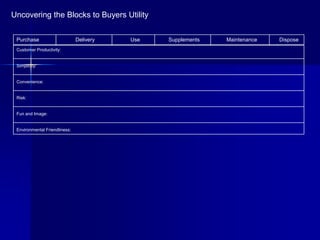
Uncovering the Blocks to Buyers Utility


 Purchase                      Delivery   Use   Supplements   Maintenance   Dispose
 Customer Productivity:


 Simplicity:


 Convenience:


 Risk:


 Fun and Image:


 Environmental Friendliness:
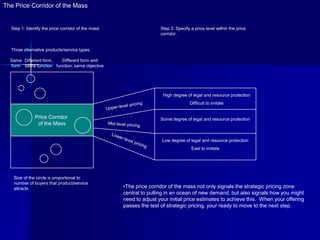
The Price Corridor of the Mass


  Step 1: Identify the price corridor of the mass                   Step 2: Specify a price level within the price
                                                                    corridor.


  Three alternative products/service types:

  Same Different form,  Different form and
  form same function function, same objective


                                                                     High degree of legal and resource protection
                                                                                   Difficult to imitate


              Price Corridor                                        Some degree of legal and resource protection
               of the Mass


                                                                     Low degree of legal and resource protection
                                                                                    East to imitate


   Size of the circle is proportional to
   number of buyers that product/service
   attracts                                         •The price corridor of the mass not only signals the strategic pricing zone
                                                    central to pulling in an ocean of new demand, but also signals how you might
                                                    need to adjust your initial price estimates to achieve this. When your offering
                                                    passes the test of strategic pricing, your ready to move to the next step.
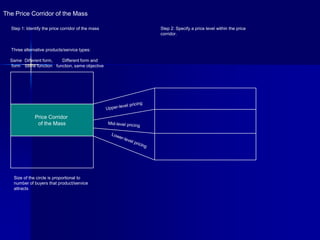
The Price Corridor of the Mass

  Step 1: Identify the price corridor of the mass   Step 2: Specify a price level within the price
                                                    corridor.


  Three alternative products/service types:

  Same Different form,  Different form and
  form same function function, same objective


              Price Corridor
               of the Mass


   Size of the circle is proportional to
   number of buyers that product/service
   attracts
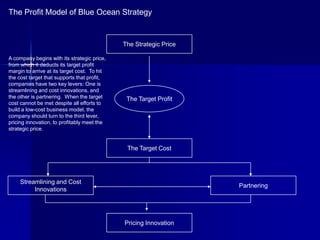
The Profit Model of Blue Ocean Strategy


                                              The Strategic Price

A company begins with its strategic price,
from which it deducts its target profit
margin to arrive at its target cost. To hit
the cost target that supports that profit,
companies have two key levers: One is
streamlining and cost innovations, and
the other is partnering. When the target       The Target Profit
cost cannot be met despite all efforts to
build a low-cost business model, the
company should turn to the third lever,
pricing innovation, to profitably meet the
strategic price.


                                               The Target Cost


     Streamlining and Cost
                                                                    Partnering
          Innovations


                                              Pricing Innovation
The Profit Model of Blue Ocean Strategy
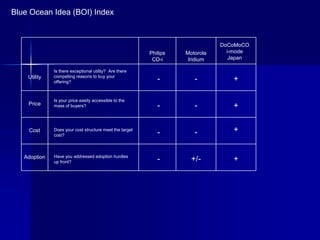
Blue Ocean Idea (BOI) Index


                                                                              DoCoMoCO
                                                         Philips   Motorola     i-mode
                                                          CD-i      Iridium      Japan

              Is there exceptional utility? Are there
    Utility   compelling reasons to buy your
              offering?                                     -         -          +

              Is your price easily accessible to the
    Price     mass of buyers?                               -         -          +


    Cost      Does your cost structure meet the target
                                                            -         -          +
              cost?


   Adoption   Have you addressed adoption hurdles
              up front?                                     -        +/-         +
Blue Ocean Idea (BOI) Index


              Is there exceptional utility? Are there
    Utility   compelling reasons to buy your
              offering?                                  -    -    +

              Is your price easily accessible to the
    Price     mass of buyers?                            -    -    +


    Cost      Does your cost structure meet the target
                                                         -    -    +
              cost?


   Adoption   Have you addressed adoption hurdles
              up front?                                  -   +/-   +

Blue Ocean Strategy Unpam-350

  • 1.
    by Prof. W. ChanKim, Prof. Renee Mauborgne Edited by; R. Benny Wahyuadi, M.M., MBA. Hersanto, S. Kom., M.Kom.
  • 2.
    Value Innovation Value Innovationis created in the region where a company’s actions favorably affect both its cost structure and its value proposition to buyers. Cost savings are made by eliminating and reducing the factors an industry competes on. Buyer value is lifted by raising and creating elements the industry has never offered. Over time, costs are reduced further as scale economies kick in due to Costs the high sales volumes that superior value generates. We call it value innovation because instead of focusing on beating the competition, you focus on making the competition irrelevant by creating a leap in value for buyers and your company, thereby opening up new and uncontested Value market space. Innovation Value innovation places equal emphasis on value and innovation. Value innovation occurs when companies align innovation with utility, price, and cost positions. Importantly, value innovation defies one of the most commonly accepted dogmas Buyer Value of competition-based strategy: the value-cost trade-off. Those that seek to create blue oceans pursue differentiation and low cost simultaneously. In the figure, the creation of blue oceans is about driving costs down while simultaneously driving value up for buyers. This is how a leap in value for both the company and its buyers is achieved. Because buyer value comes from utility and price that the company offers to buyers and because the value to the company is generated from price and its cost structure, value innovation is achieved only when the whole system of the company’s utility, price, and cost activities is properly aligned. Value innovation is more than innovation. It’s about strategy that embraces the entire system of a company’s activities. Value innovation requires companies to orient the whole system towards achieving a leap in value for both buyers and themselves.
  • 3.
  • 4.
    Red Ocean VersusBlue Ocean Strategy Red Ocean Strategy Blue Ocean Strategy Compete in existing market space. Create uncontested market space. Beat the competition Make the competition irrelevant. Exploit existing demand Create and capture new demand. Make the value-cost trade-off. Break the value-costs trade-off. Align the whole system of a firm’s activities Align the whole system of a firm’s with its strategic choice of differentiation or activities in pursuit of differentiation and low costs low costs. Competition-based red ocean strategy assumes that an Value innovation is based on the view that market industry’s structural conditions are given and that firms boundaries and industry structure are not given are forced to compete within them, an assumption based and can be reconstructed by the actions and on what the academics call the structuralist view, or beliefs of industry players. We call this environmental determinism. reconstructionist view. In the red ocean, differentiation costs because firms In the reconstructionist world, the strategic aim is compete with the same best-principle rule. Here, the to create new best-practice rules by breaking the strategic choices for firms are to pursue either existing value-cost trade-off and thereby creating a differentiation or low cost. blue ocean.
  • 5.
    The Six Principlesof Blue Ocean Strategy Formulation principles Risk factor each principle attenuates Reconstruct market boundaries ↓ Search risk Focus on the big picture, not the numbers ↓ Planning Risk Reach beyond existing demand ↓ Scale Risk Get the strategic sequence right ↓ Business model risk Execution principles Risk factor each principle attenuates Overcome key organizational hurdles ↓ Organizational risk Build execution into strategy ↓ Management risk
  • 6.
    The Strategy Canvas(example) High Premium Wines [yellow tail] Budget Wines Low Price Use of enological terminology and Above-the- Aging quality Vineyard prestige Wine Wine Easy Ease of Fun and distinction in wine line marketing communication and legacy complexity range drinking selection adventure The strategy canvas is both a diagnostic and an action framework for building a compelling blue ocean strategy. It serves two purposes. First it captures the current state of play in the known market space. This allows you to understand where the competition is currently investing, the factors the industry currently competes on in products, service, and delivery, and what customers receive from the existing competitive offerings on the market. The horizontal axis captures the range of factors the industry competes on and invest in. The vertical axis of the strategy canvas, which captures the offering level that buyers receive across all these key competing factors. A high score means that a company offers buyers more, and hence invest more, in that factor. In the case of price, a higher score indicates a higher price. A value curve, the basic component of the strategy canvas, is a graphic depiction of a company’s relative performance across its industry’s factors of competition. To fundamentally shift the strategy canvas of an industry, you must begin by reorienting your strategic focus from competitors to alternatives, and from customers to noncustomers of the industry. To pursue both value and costs, you should resist the old logic of benchmarking competitors in the existing field and choosing between differentiation and cost leadership. As you shift your strategic focus from current competition to alternatives and noncustomers, you gain insight into how to redefine the problem the industry focuses on and thereby reconstruct buyer value elements that reside across industry boundaries.
  • 7.
    Reading the ValueCurves Reconstruct Market Boundaries – The First Principle of The Blue Ocean Strategy The strategy canvas enables companies to see the future in the The six paths framework present. From Head-to-Head Competition to Blue Ocean Creation A Blue Ocean Strategy Head-to-Head Competition Blue Ocean Creation The first question the value curves answers is whether a business deserves to be a winner. When a company’s value Industry Focuses on rivals within its industry Looks across alternative curve, or its competitors’, meet the three criteria that define a industries good blue ocean strategy – focus, divergence, and a compelling tagline that speaks to the market – the company is Strategic group Focuses on competitive position within Looks across strategic on the right track. strategic group groups within industry A Company Caught in the Red Ocean Buyer group Focuses on better serving the Redefines the industry When a company’s value curve converges with its competitors, buyer group buyer group it signals that a company is likely caught within the red ocean of bloody competition. Scope of product or Focuses on maximizing the value of Looks across to service offering product and services offerings complimentary product Overdelivery Without Payback within the bounds of its industry and service offerings When a company’s value curve on the strategy canvas is shown to deliver high levels across all factors, the question is, Functional- Focuses on improving price Rethinks the functional- Does the company’s market share and profitability reflect these emotional performance within the emotional orientation of its investments? To value-innovate, the company must decide orientation functional-emotional orientation industry which factors to eliminate and reduce – and not only those to of its industry raise and create – to construct a divergent value curve. Focuses on adapting to external Participates in shaping Time trends as they occur external trends over time An Incoherent Strategy When a company’s value curve looks like a bowl of spaghetti – a zigzag with no rhyme or reason, where the offering can be described as “low-high-low-low-high-low-high” – it signals that the company doesn’t have a coherent strategy. To break out of red oceans, companies must break out of the accepted boundaries that define how they compete. Instead of looking within these Strategic Contradictions boundaries, managers need to look systematically across them to create blue These are areas where a company is offering a high level on oceans. They need to look across alternative industries, across strategic one competing factor while ignoring others that support that factor. groups, across buyer groups, across complementary product and service offerings, across the functional-emotional orientation of an industry, and even An Internally Driven Company across time. This gives companies keen insight into how to reconstruct The kind of language used in the strategic canvas gives insight market realities to open up blue oceans. as to whether a company’s strategic vision is built on an “outside-in” perspective , driven by the demand side, or an “inside-out” perspective that is operationally driven. Analyzing the language of the strategy canvas helps a company understand how far it is from creating industry demand.
  • 8.
  • 9.
    The Four ActionsFramework • The first question forces you to consider eliminating factors that Reduce companies in your industry have long competed on. Which factors should be reduced well below the •The second question forces you to determine whether products or industry’s standard? services have been overdesigned in the race to match and beat the competition. •The third question pushes you to uncover and eliminate the compromises your industry forces customer to make. Eliminate Create •The forth question helps you to discover entirely new sources of Which of the factors that A New Which factors should be the industry takes for Value created that the industry value for buyers and to create new demand and shift the strategic granted should be pricing of the industry. eliminated? Curve has never offered? •It is by pursuing the first two questions (of eliminating and reducing) that you gain insight into how to drop your cost structure vis-à-vis competitors. •The second two factors, by contrast, provide you with insight into Raise how to lift buyer value and create new demand. Which factors should be raised well above the •Eliminating and creating prompt companies to change the factors industry’s standard? themselves, hence making the existing rules of competition irrelevant. Eliminate-Reduce-Raise-Create Grid: The grid pushes companies not only to ask all four questions in the four Eliminate Raise actions framework but also to act on all four to create a new value curve. •It pushes them to simultaneously pursue differentiation and low costs to break the value-cost trade-off. •It immediately flags companies that are focused only on raising and creating and thereby lifting their costs structure and often overengineering products and services – a common plight in many companies. •It is easily understood by managers at any level, creating a high level Reduce Create of engagement in its application. •Because completing the grid is a challenging task, it drives companies to robustly scrutinize every factor the industry competes on, making them discover the range of implicit assumptions they make unconsciously in competing
  • 10.
    Reduce Eliminate Create A New Value Curve Raise Eliminate Raise Reduce Create
  • 11.
    The Four Stepsof Visualizing Strategy 1. Visual Awakening 2. Visual Exploration 3. Visual Strategy Fair 4. Visual Communications • Compare your • Go into the field to • Draw your “to be” • Distribute your business with your explore the six paths to strategy canvas bases before-and-after competitors’ by creating blue oceans. on insights from field strategic profiles on drawing your “as is” observations. one page for easy • Observe the distinct comparison. strategy canvas. advantages of • Get feedback on • See where your alternative products and alternative strategy • Support only those strategy needs to services. canvas from projects and change. customers, operational moves • See which factors you competitors’ that allow your should eliminate, create, company to close customers, and or change. the gaps to noncustomers. actualize the new • Use Feedback to build strategy. the best “to be” future strategy. •Asking executives to draw the •Send a team into the field, putting •Teams present their strategy •Communicate the future value curve of their company’s managers face-to-face with what they canvases at what we call a visual strategy in a way that can be strategy brings home the need for must make sense of: how people use strategy fair. easily understood by any change. It serves as a forceful or don’t use their products or services. employee. wake-up call for companies to •A company should never outsource challenge their existing strategies. its eyes. There is simply no substitute for seeing for yourself.
  • 12.
    The Four Stepsof Visualizing Strategy 1. Visual Awakening 2. Visual Exploration 3. Visual Strategy Fair 4. Visual Communications
  • 13.
    Pioneer-Migrator-Settler (PMS) Map Pioneers Migrators Settlers Today Tomorrow Pioneers: PMS Map: •A company’s pioneers are the businesses that offer unprecedented value. These are the blue •For the purpose of the exercise, settlers are defined as me-too businesses, migrators are ocean strategists, and they are the most powerful source of profitable growth. businesses offering better than most in the marketplace, and pioneers are the only ones with a mass following of customers. •Their value curve diverges from the competition on the strategy canvas. •If both the current portfolio and the planned offerings consist mainly of settlers, the company has Settlers: a low growth trajectory, is largely confined to red oceans, and needs to push for value innovation. •Businesses whose value curves conform to the basic shape of the industry. •If current and planned offerings consist of a lot of migrators, reasonable growth can be expected. •These are me-too businesses. But the company is not exploiting its potential for growth, and it risks being marginalized by a company that value-innovates. •They are stuck within red oceans. •This exercise is especially valuable for managers who want to see beyond today’s performance. Migrators: •Value and innovation should be used as the important parameters for managing their portfolio of •Such businesses extend the industry’s curve by giving customers more for less, but they don’t business. They should use innovation because, with out it, companies are stuck in the trap of alter its basic shape. competitive improvements. They should use value because innovative ideas will be profitable only •These businesses offer improved value, but not innovative value. if they are linked to what buyers are willing to pay for. •These are businesses whose strategies fall on the margin between red oceans and blue oceans.
  • 14.
  • 15.
    The Three Tiersof Noncustomers First Tier: “Soon-to-be” noncustomers who are on the edge of your market, waiting to jump ship. Second Tier: “Refusing” noncustomers who consciously choose against your market. Third Tier: “Unexplored” noncustomers who are in markets distant from yours. Your First Second Third Market Tier Tier Tier First Tier Noncustomers: Second Tier Noncustomers: Third Tier Noncustomers: •Noncustomers tend to offer far •Noncustomers can shed insight •Noncustomers have not been more insight into how to unlock into the implicit assumptions of the targeted or thought of as potential and grow a blue ocean than do industry and its existing customers customers by any player in the relatively content existing that could be challenged and industry. That’s because their customers. rewritten to create a leap in value needs and the business for all. opportunities associated with them •Look for commonalities across have somehow always been their responses. Focus on these, assumed to belong to other and not on the differences markets. between them.
  • 16.
    The Three Tiersof Noncustomers
  • 17.
    The Sequence ofBlue Ocean Strategy Buyer utility Buyer Utility: •Does your offering unlock exceptional utility? Is there a compelling Is there exceptional buyer utility in reason for the mass of people to buy it?. your business idea? No-Rethink Yes Price: •Is your offering priced to attract the mass of target buyers so that they Price have a compelling ability to pay for your offering? Is your price easily accessible to the mass of buyers? Buyer utility and price ensure that you create a leap in net buyer value, No-Rethink where net buyer value equals the utility buyers receive minus the price they pay for it. Yes Cost: Cost •Can you produce your offering at the target cost and still earn a healthy profit margin? Can you profit at the strategic price-the price Can you attain your cost target to easily accessible to the mass of target buyers. profit at your strategic price? No-Rethink The cost side of a company’s business model ensures that it creates a leap in value for itself in the form of profit-that is, the price of the Yes offering minus the cost of production. It is the combination of exceptional utility, strategic pricing, and target costing that allows companies to achieve value innovation-a leap in value for both buyers Adoption and companies. What are the adoption hurdles in actualizing your business idea? Adoption Hurdles: Are you addressing them up front? No-Rethink •What are the adoption hurdles in rolling out your idea? Have you addressed these upfront. Yes The formulation of blue ocean strategy is complete only when you can address adoption hurdles in the beginning to ensure the successful A Commercially Viable actualization of your idea. Blue Ocean Idea Adoption hurdles include, for example, potential resistance to the idea by retailers or partners.
  • 18.
    Buyer utility Yes Price No-Rethink Yes Cost No-Rethink Yes Adoption No-Rethink Yes A Commercially Viable Blue Ocean Idea
  • 19.
    The Buyer UtilityMap The Six Stages of the Buyer Experience Cycle 1. Purchase 2. Delivery 3. Use 4. Supplements 5. Maintenance 6. Disposal Customer productivity Simplicity The Six Utility Levers Convenience Risk Fun and image Environmental friendliness •The buyer utility map helps managers look at this issue •By locating your proposed offering on the thirty-six spaces of the from the right perspective. It outlines all the levers buyers utility map, you can clearly see how, and whether, the new companies can pull to deliver exceptional utility to buyers idea not only creates a different utility proposition from existing as well as the various experiences buyers can have with offerings but also removes the biggest blocks to utility that stand in a product or service. This map allows managers to the way of converting noncustomers into customers. If your offering identify the full range of utility spaces that a product or falls on the same space or spaces as those of other players, chances service can potentially fill. are it is not a blue ocean offering.
  • 20.
    The Buyer UtilityMap The Six Stages of the Buyer Experience Cycle 1. Purchase 2. Delivery 3. Use 4. Supplements 5. Maintenance 6. Disposal Customer productivity Simplicity The Six Utility Levers Convenience Risk Fun and image Environmental friendliness
  • 21.
    The Buyers ExperienceCycle Purchase Delivery Use Supplements Maintenance Disposal How long does it take to How long does it take to Does the product require Do you need other Does the product require Does use of the product find the product you get the product training or expert products and services to external maintenance? create waste items? need? delivered? assistance? make this product work? How easy is it to How easy is it to dispose Is the place of purchase How difficult is it to Is the product easy to If so, how costly are maintain and upgrade of the product? attractive and unpack and install the store when not in use? they? the product? Are there legal or accessible? new product? How effective are the How much time do they How costly is environmental issues in How secure is the Do buyers have to product’s features and take? maintenance? disposing of the product transaction arrange delivery functions? safely? How much pain do they environment? themselves? If yes, how Does the product or cause? How costly is disposal? costly and difficult is How rapidly can you service deliver far more this? How easy are they make a purchase? power or options than obtained? required by the average user? Is it overcharged with bells and whistles?
  • 22.
    The Buyers ExperienceCycle Purchase Delivery Use Supplements Maintenance
  • 23.
    Uncovering the Blocksto Buyers Utility Purchase Delivery Use Supplements Maintenance Dispose Customer Productivity: In which stage are the biggest blocks to customer productivity? Simplicity: In which stage are the biggest blocks to simplicity? Convenience: In which stage are the biggest blocks to convenience? Risk: In which stage are the biggest blocks to reducing risks? Fun and Image: In which stage are the biggest blocks to fun and image? Environmental Friendliness: In which stage are the biggest blocks to environmental friendliness?
  • 24.
    Uncovering the Blocksto Buyers Utility Purchase Delivery Use Supplements Maintenance Dispose Customer Productivity: Simplicity: Convenience: Risk: Fun and Image: Environmental Friendliness:
  • 25.
    The Price Corridorof the Mass Step 1: Identify the price corridor of the mass Step 2: Specify a price level within the price corridor. Three alternative products/service types: Same Different form, Different form and form same function function, same objective High degree of legal and resource protection Difficult to imitate Price Corridor Some degree of legal and resource protection of the Mass Low degree of legal and resource protection East to imitate Size of the circle is proportional to number of buyers that product/service attracts •The price corridor of the mass not only signals the strategic pricing zone central to pulling in an ocean of new demand, but also signals how you might need to adjust your initial price estimates to achieve this. When your offering passes the test of strategic pricing, your ready to move to the next step.
  • 26.
    The Price Corridorof the Mass Step 1: Identify the price corridor of the mass Step 2: Specify a price level within the price corridor. Three alternative products/service types: Same Different form, Different form and form same function function, same objective Price Corridor of the Mass Size of the circle is proportional to number of buyers that product/service attracts
  • 27.
    The Profit Modelof Blue Ocean Strategy The Strategic Price A company begins with its strategic price, from which it deducts its target profit margin to arrive at its target cost. To hit the cost target that supports that profit, companies have two key levers: One is streamlining and cost innovations, and the other is partnering. When the target The Target Profit cost cannot be met despite all efforts to build a low-cost business model, the company should turn to the third lever, pricing innovation, to profitably meet the strategic price. The Target Cost Streamlining and Cost Partnering Innovations Pricing Innovation
  • 28.
    The Profit Modelof Blue Ocean Strategy
  • 29.
    Blue Ocean Idea(BOI) Index DoCoMoCO Philips Motorola i-mode CD-i Iridium Japan Is there exceptional utility? Are there Utility compelling reasons to buy your offering? - - + Is your price easily accessible to the Price mass of buyers? - - + Cost Does your cost structure meet the target - - + cost? Adoption Have you addressed adoption hurdles up front? - +/- +
  • 30.
    Blue Ocean Idea(BOI) Index Is there exceptional utility? Are there Utility compelling reasons to buy your offering? - - + Is your price easily accessible to the Price mass of buyers? - - + Cost Does your cost structure meet the target - - + cost? Adoption Have you addressed adoption hurdles up front? - +/- +