BLUE BRAINBLUE BRAIN
TECHNOLOGYTECHNOLOGY
BLUE BRAIN PROJECT
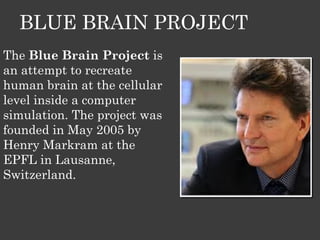
The Blue Brain Project is
an attempt to recreate
human brain at the cellular
level inside a computer
simulation. The project was
founded in May 2005 by
Henry Markram at the
EPFL in Lausanne,
Switzerland.
THEVIRTUALBRAINTHEVIRTUALBRAIN
• IBM is developing world’s first virtual brain
known as Blue Brain.
• Virtual brain is an artificial brain which act
like as the brain to great extent.
• It’s aim is to upload human brain into a
machine.
• One of the advantage of virtual brain is that
even after death of a person we will not loose
the knowledge, intelligence, personalities,
feelings and memories of that man that can be
used for the development of human society.
• It is possible by using a super
computer, with a huge amount
of storage capacity, processing
power and an interface between
human brain and the artificial
one.
• It will not only enhance one’s intelligence
but will be very useful in remembering
things easily which we mostly tend to
forget.
Like remembering people’s names, their
birthdays, important dates, history facts,
spellings, proper grammar, etc.
STEPS TO BUILD VIRTUAL BRAINSTEPS TO BUILD VIRTUAL BRAIN
• Data acquisition involves taking brain slices, placing
them under a microscope, and measuring the shape and
electrical activity of individual neurons. This is how the
different types of neuron are studied and catalogued. The
neurons are typed by morphology (i.e. their shape),
electrophysiological behavior, location within the cortex,
and their population density
• . The tissue is stained with biolytic and viewed through a
bright field microscope. Neuronal 3D morphologies are
then reconstructed using the Neurolucida software
package (pictured below, far right) which runs on
Windows workstations
RTNEURON:RTNEURON:
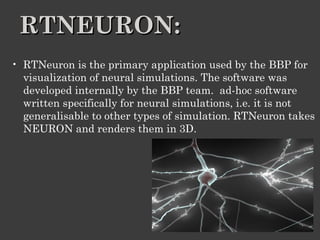
• RTNeuron is the primary application used by the BBP for
visualization of neural simulations. The software was
developed internally by the BBP team. ad-hoc software
written specifically for neural simulations, i.e. it is not
generalisable to other types of simulation. RTNeuron takes
NEURON and renders them in 3D.
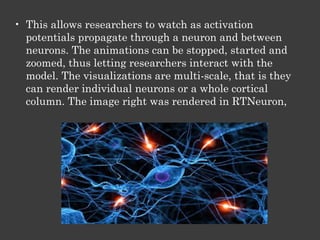
• This allows researchers to watch as activation
potentials propagate through a neuron and between
neurons. The animations can be stopped, started and
zoomed, thus letting researchers interact with the
model. The visualizations are multi-scale, that is they
can render individual neurons or a whole cortical
column. The image right was rendered in RTNeuron,
VIDEOVIDEO
BLUE GENE :SUPERCOMPUTERSBLUE GENE :SUPERCOMPUTERS
• The primary
machine used by
the Blue Brain
Project is a
Blue Gene
supercomputer
built by IBM.
This is where the
name “Blue
Brain” originates
from
FUNCTIONING OF BLUE BRAINFUNCTIONING OF BLUE BRAIN
• Small robots known as nanorobots travel
throughout our circulatory system.
•  Travelling into the spine and brain, they will be
able to monitor the activity and structure of our
central nervous system. Nanobots scan the structure
of our brain, providing a complete readout of the
connections between each neuron.
IT’S OBJECTIVESIT’S OBJECTIVES
• Search for insights into how human beings
think and remember .
• To enable better and faster development of
brain disease treatments, like Parkinsons
disease.
• To understand the complex working of human
brain which will lead to new breed of super
computers .
• The short term memory loss and a volatile
memory at old age can be avoided.
ADVANTAGESADVANTAGES
• Using intelligence of a person after death.
• Possibility to attain immortality.
• Remembering things without any effort.
• Making decision without the presence of a person.
• Allowing deaf to hear via direct nerve stimulation.
DISADVANTAGESDISADVANTAGES
• Complete dependency on the computer.
• Control of mind, thoughts and memories in hands of
others.
• A very costly procedure.
• Loss of humanity and most importantly against the
laws of the nature.
Blue brain technology

Blue brain technology

  • 1.
  • 2.
    BLUE BRAIN PROJECT TheBlue Brain Project is an attempt to recreate human brain at the cellular level inside a computer simulation. The project was founded in May 2005 by Henry Markram at the EPFL in Lausanne, Switzerland.
  • 3.
    THEVIRTUALBRAINTHEVIRTUALBRAIN • IBM isdeveloping world’s first virtual brain known as Blue Brain. • Virtual brain is an artificial brain which act like as the brain to great extent. • It’s aim is to upload human brain into a machine. • One of the advantage of virtual brain is that even after death of a person we will not loose the knowledge, intelligence, personalities, feelings and memories of that man that can be used for the development of human society.
  • 4.
    • It ispossible by using a super computer, with a huge amount of storage capacity, processing power and an interface between human brain and the artificial one. • It will not only enhance one’s intelligence but will be very useful in remembering things easily which we mostly tend to forget. Like remembering people’s names, their birthdays, important dates, history facts, spellings, proper grammar, etc.
  • 5.
    STEPS TO BUILDVIRTUAL BRAINSTEPS TO BUILD VIRTUAL BRAIN • Data acquisition involves taking brain slices, placing them under a microscope, and measuring the shape and electrical activity of individual neurons. This is how the different types of neuron are studied and catalogued. The neurons are typed by morphology (i.e. their shape), electrophysiological behavior, location within the cortex, and their population density • . The tissue is stained with biolytic and viewed through a bright field microscope. Neuronal 3D morphologies are then reconstructed using the Neurolucida software package (pictured below, far right) which runs on Windows workstations
  • 7.
    RTNEURON:RTNEURON: • RTNeuron isthe primary application used by the BBP for visualization of neural simulations. The software was developed internally by the BBP team. ad-hoc software written specifically for neural simulations, i.e. it is not generalisable to other types of simulation. RTNeuron takes NEURON and renders them in 3D.
  • 8.
    • This allowsresearchers to watch as activation potentials propagate through a neuron and between neurons. The animations can be stopped, started and zoomed, thus letting researchers interact with the model. The visualizations are multi-scale, that is they can render individual neurons or a whole cortical column. The image right was rendered in RTNeuron,
  • 9.
  • 10.
    BLUE GENE :SUPERCOMPUTERSBLUEGENE :SUPERCOMPUTERS • The primary machine used by the Blue Brain Project is a Blue Gene supercomputer built by IBM. This is where the name “Blue Brain” originates from
  • 11.
    FUNCTIONING OF BLUEBRAINFUNCTIONING OF BLUE BRAIN • Small robots known as nanorobots travel throughout our circulatory system. •  Travelling into the spine and brain, they will be able to monitor the activity and structure of our central nervous system. Nanobots scan the structure of our brain, providing a complete readout of the connections between each neuron.
  • 15.
    IT’S OBJECTIVESIT’S OBJECTIVES •Search for insights into how human beings think and remember . • To enable better and faster development of brain disease treatments, like Parkinsons disease. • To understand the complex working of human brain which will lead to new breed of super computers . • The short term memory loss and a volatile memory at old age can be avoided.
  • 16.
    ADVANTAGESADVANTAGES • Using intelligenceof a person after death. • Possibility to attain immortality. • Remembering things without any effort. • Making decision without the presence of a person. • Allowing deaf to hear via direct nerve stimulation.
  • 17.
    DISADVANTAGESDISADVANTAGES • Complete dependencyon the computer. • Control of mind, thoughts and memories in hands of others. • A very costly procedure. • Loss of humanity and most importantly against the laws of the nature.