Collage Name:-
Shree P.M.Patel Collage of Computer
Science & Technology
Managed By:
Anand People Medicare Society,
Anand
Prepared By,
Kavankumar Nileshkumar. Solanki
TY BCA Sem.VI
Roll No. 15
Seminar on
Project Blue Brain
Date:-28/12/2018
Index
Chapter No Description of Topic
1 Introduction
2 Goal
3 Progress
4 Computer Hardware/Super computer
5 Digital reconstruction
6 Importance
7 Next Step
8 Motivation
9 Bibliography
1. Introduction
• The Blue Brain, a Swiss national brain initiative, aims to create a digital reconstruction of the
brain by reverse engineering mammalian brain circuitry.
• The mission of the project, founded in May 2005 by the Brain and Mind
• Institute of the École Polytechnique Fédérale de Lausanne (EPFL) in Switzerland, is to use
biologically-detailed digital reconstructions and simulations of the mammalian brain (brain
simulation) to identify the fundamental principles of brain structure and function in health and
disease.
• The project is headed by the founding director Henry Markram, who also launched the
European Human Brain Project, and codirected by Felix Schürmann and Sean Hill.
• Using a Blue Gene supercomputer running Michael Hines's NEURON software, the
simulation does not consist simply of an artificial neural network, but involves a biologically
realistic model of neurons, and an empirically reconstructed model connectome. It is hoped
that it will eventually shed light on the nature of consciousness.
• There are a number of subprojects, including the Cajal Blue Brain, coordinated by the
Supercomputing and Visualization Center of Madrid (CeSViMa), and others run by
universities and independent laboratories.
École Polytechnique Fédérale de Lausanne
(EPFL)
• The École polytechnique fédérale de Lausanne (EPFL) is a
research institute and university in Lausanne, Switzerland,
that specializes in natural sciences and engineering. It is one
of the two Swiss Federal Institutes of Technology, and it has
three main missions: education, research and technology
transfer at the highest international level.
• EPFL is widely regarded as a world leading university.
The QS World University Rankings ranks EPFL 12th in the
world across all fields in their 2017/2018 ranking,
whilst Times Higher Education World University
Rankings ranks EPFL as the world's 11th best school for
Engineering and Technology.
•EPFL is located in the French-speaking part of Switzerland; the sister institution in the German-
speaking part of Switzerland is the Swiss Federal Institute of Technology in Zurich (ETH Zurich).
Associated with several specialized research institutes, the two universities form the Swiss Federal
Institutes of Technology Domain (ETH Domain), which is directly dependent on the Federal
Department of Economic Affairs, Education and Research. In connection with research and
teaching activities, EPFL operates a nuclear reactor CROCUS, a Tokamak Fusion reactor, a Blue
Gene/Q Supercomputer[ and P3 bio-hazard facilities.
2.Goal
• The initial goal of the project, completed in December 2006,[4] was the simulation of a rat
neocortical column, which is considered by some researchers to be the smallest functional
unit of the neocortex (the part of the brain thought to be responsible for higher functions such
as conscious thought).
• In humans, each column is about 2 mm in length, has a diameter of 0.5 mm and contains
about 60,000 neurons; rat neocortical columns are very similar in structure but contain only
10,000 neurons (and 108 synapses). Between 1995 and 2005, Markram mapped the types of
neurons and their connections in such a column.
Neocortical column modeling
3.Progress
• Recently, Blue Brain Project releases first ever digital 3D brain cell atlas: The Blue Brain Cell
Atlas is like 'going from handdrawn maps to Google Earth' providing previously unavailable
information on major cell types, numbers and positions in all 737 brain regions.
• This comprehensive, interactive and dynamic online resource allows anyone to visualize every
region in the mouse brain, cell-by-cell and in 3D, and freely download data for new analyses
and modeling. It can also be continuously be updated with new findings.
• The project is funded primarily by the Swiss government and the Future and
Emerging Technologies (FET) Flagship grant from the European Commission, and
secondarily by grants and some donations from private individuals.
• The EPFL bought the Blue Gene computer at a reduced cost because at that stage it
was still a prototype and IBM was interested in exploring how different applications
would perform on the machine. BBP was viewed a validation of the Blue Gene
supercomputer concept.
4. Computer Hardware / Super Computers
Cajal Blue Brain (Spain)
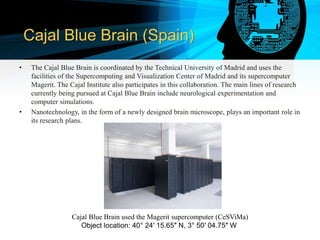
• The Cajal Blue Brain is coordinated by the Technical University of Madrid and uses the
facilities of the Supercomputing and Visualization Center of Madrid and its supercomputer
Magerit. The Cajal Institute also participates in this collaboration. The main lines of research
currently being pursued at Cajal Blue Brain include neurological experimentation and
computer simulations.
• Nanotechnology, in the form of a newly designed brain microscope, plays an important role in
its research plans.
Cajal Blue Brain used the Magerit supercomputer (CeSViMa)
Object location: 40° 24′ 15.65″ N, 3° 50′ 04.75″ W
Blue Gene/P
• The primary machine used by the Blue Brain Project is
a Blue Gene supercomputer built by IBM.
• This is where the name "Blue Brain" originates from. IBM
agreed in June 2005 to supply EPFL with a Blue Gene/L
as a "technology demonstrator".
• In June 2010 this machine was upgraded to a Blue
Gene/P. The machine is installed on the EPFL campus in
Lausanne (Google map) and is managed
by CADMOS (Center for Advanced Modelling Science).
• The computer is used by a number of different research
groups, not exclusively by the Blue Brain Project. In mid-
2012 the BBP was consuming about 20% of the compute
time.
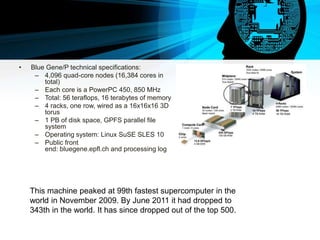
• Blue Gene/P technical specifications:
– 4,096 quad-core nodes (16,384 cores in
total)
– Each core is a PowerPC 450, 850 MHz
– Total: 56 teraflops, 16 terabytes of memory
– 4 racks, one row, wired as a 16x16x16 3D
torus
– 1 PB of disk space, GPFS parallel file
system
– Operating system: Linux SuSE SLES 10
– Public front
end: bluegene.epfl.ch and processing log
This machine peaked at 99th fastest supercomputer in the
world in November 2009. By June 2011 it had dropped to
343th in the world. It has since dropped out of the top 500.
DEEP - Dynamical Exascale Entry
Platform
• DEEP (deep-project.eu) is an exascale
supercomputer to be built at the Jülich Research
Center in Germany. The project started in December
2011 and is funded by the European Union's 7th
framework programme.
• The three-year protoype phase of the project has
received €8.5 million. A prototype supercomputer
that will perform at 100 petaflops is hoped to be built
by the end of 2014.
• The Blue Brain Project simulations will be ported to
the DEEP prototype to help test the system's
performance.
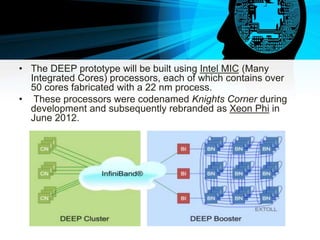
• The DEEP prototype will be built using Intel MIC (Many
Integrated Cores) processors, each of which contains over
50 cores fabricated with a 22 nm process.
• These processors were codenamed Knights Corner during
development and subsequently rebranded as Xeon Phi in
June 2012.
5.Digital reconstruction
• With its 100 billion neurons (brain cells) and its 100 trillion
synapses, the human brain is a complex multi-level system.
• The connections among the neurons form a hierarchy of
circuits, from local micro-circuitry up to the level of the whole
brain. Meanwhile at a lower level, every neuron and every
synapse is a complex molecular machine in its own right. It is
the interactions between these levels, which give rise to
human behavior, human emotion and human cognition.
• The Blue Brain Project (BBP) aims to build comprehensive
digital reconstructions (computer models) of the brain, which
include the brain’s different levels of organization and their
interactions, and which are compatible with the available
experimental data.
6. Importance
• Understanding the brain is vital, not just to understand the
biological mechanisms which give us our thoughts and
emotions and which make us human, but for practical
reasons.
• Understanding how the brain processes information can make
a fundamental contribution to the development of new
computing technology – neurorobotics and neuromorphic
computing.
• Even a brain that is much smaller than the human brain, like
the brain of a rat, is so complex that may never be possible to
exhaustively measure all its anatomical features or to fully
characterize the physiological interactions within and between
its different levels of organization.
• The structure of the brain and the physiology of its
components are subject to tight biological constraints, which
are reflected in experimental measurements.
7. Next Step
• Current BBP reconstructions omit many features of neural anatomy
and physiology that are known to play an important role in brain
function. Future BBP work will enrich the reconstructions with
models of the neuro-vascular glia system, neuromodulation, different
forms of plasticity, gap-junctions, and couple them to neurorobotics
systems, enabling in silico studies of perception, cognition and
behaviour.
• The Blue Brain team is already working with communities in the
Human Brain Project and beyond, to build digital reconstructions of
whole brain regions (somatosensory cortex, hippocampus,
cerebellum, basal ganglia) and eventually the whole mouse brain.
• This work will prepare the way for reconstructions of the human
brain, on different scales and with different levels of detail.
8. Motivation
• Four broad motivations behind the Blue Brain
Project are:
– Brain disease treatments
– Scientific curiosity about consciousness and
the human mind
– Integration of all neuroscientific research
results worldwide
– Progress towards building thinking machines
9. Bibliography
• Research papers
– List of research papers on the Blue Brain Project website
– Emergent properties of in silico synaptic transmission in a model of the rat
neocortical column December 2011
• Weblinks
– Blue Brain Project -Homepage
– Cajal Blue Brain Project Spanish homepage, and Twitter feed
– Wikipedia article
– Google+ page
– GitHub code repository and project dependencies diagram
– FET Flagships homepage and the Facebook page
– Human Brain Project Preparatory study report, April 2012
– Article and photos on Boing Boing May 2011
– Evaluation of the Blue Brain Project April 2011
Blue Brain Project
Blue Brain Project

Blue Brain Project

  • 1.
    Collage Name:- Shree P.M.PatelCollage of Computer Science & Technology Managed By: Anand People Medicare Society, Anand Prepared By, Kavankumar Nileshkumar. Solanki TY BCA Sem.VI Roll No. 15 Seminar on Project Blue Brain Date:-28/12/2018
  • 2.
    Index Chapter No Descriptionof Topic 1 Introduction 2 Goal 3 Progress 4 Computer Hardware/Super computer 5 Digital reconstruction 6 Importance 7 Next Step 8 Motivation 9 Bibliography
  • 3.
    1. Introduction • TheBlue Brain, a Swiss national brain initiative, aims to create a digital reconstruction of the brain by reverse engineering mammalian brain circuitry. • The mission of the project, founded in May 2005 by the Brain and Mind • Institute of the École Polytechnique Fédérale de Lausanne (EPFL) in Switzerland, is to use biologically-detailed digital reconstructions and simulations of the mammalian brain (brain simulation) to identify the fundamental principles of brain structure and function in health and disease. • The project is headed by the founding director Henry Markram, who also launched the European Human Brain Project, and codirected by Felix Schürmann and Sean Hill. • Using a Blue Gene supercomputer running Michael Hines's NEURON software, the simulation does not consist simply of an artificial neural network, but involves a biologically realistic model of neurons, and an empirically reconstructed model connectome. It is hoped that it will eventually shed light on the nature of consciousness. • There are a number of subprojects, including the Cajal Blue Brain, coordinated by the Supercomputing and Visualization Center of Madrid (CeSViMa), and others run by universities and independent laboratories.
  • 4.
    École Polytechnique Fédéralede Lausanne (EPFL) • The École polytechnique fédérale de Lausanne (EPFL) is a research institute and university in Lausanne, Switzerland, that specializes in natural sciences and engineering. It is one of the two Swiss Federal Institutes of Technology, and it has three main missions: education, research and technology transfer at the highest international level. • EPFL is widely regarded as a world leading university. The QS World University Rankings ranks EPFL 12th in the world across all fields in their 2017/2018 ranking, whilst Times Higher Education World University Rankings ranks EPFL as the world's 11th best school for Engineering and Technology. •EPFL is located in the French-speaking part of Switzerland; the sister institution in the German- speaking part of Switzerland is the Swiss Federal Institute of Technology in Zurich (ETH Zurich). Associated with several specialized research institutes, the two universities form the Swiss Federal Institutes of Technology Domain (ETH Domain), which is directly dependent on the Federal Department of Economic Affairs, Education and Research. In connection with research and teaching activities, EPFL operates a nuclear reactor CROCUS, a Tokamak Fusion reactor, a Blue Gene/Q Supercomputer[ and P3 bio-hazard facilities.
  • 5.
    2.Goal • The initialgoal of the project, completed in December 2006,[4] was the simulation of a rat neocortical column, which is considered by some researchers to be the smallest functional unit of the neocortex (the part of the brain thought to be responsible for higher functions such as conscious thought). • In humans, each column is about 2 mm in length, has a diameter of 0.5 mm and contains about 60,000 neurons; rat neocortical columns are very similar in structure but contain only 10,000 neurons (and 108 synapses). Between 1995 and 2005, Markram mapped the types of neurons and their connections in such a column. Neocortical column modeling
  • 6.
    3.Progress • Recently, BlueBrain Project releases first ever digital 3D brain cell atlas: The Blue Brain Cell Atlas is like 'going from handdrawn maps to Google Earth' providing previously unavailable information on major cell types, numbers and positions in all 737 brain regions. • This comprehensive, interactive and dynamic online resource allows anyone to visualize every region in the mouse brain, cell-by-cell and in 3D, and freely download data for new analyses and modeling. It can also be continuously be updated with new findings. • The project is funded primarily by the Swiss government and the Future and Emerging Technologies (FET) Flagship grant from the European Commission, and secondarily by grants and some donations from private individuals. • The EPFL bought the Blue Gene computer at a reduced cost because at that stage it was still a prototype and IBM was interested in exploring how different applications would perform on the machine. BBP was viewed a validation of the Blue Gene supercomputer concept.
  • 7.
    4. Computer Hardware/ Super Computers
  • 8.
    Cajal Blue Brain(Spain) • The Cajal Blue Brain is coordinated by the Technical University of Madrid and uses the facilities of the Supercomputing and Visualization Center of Madrid and its supercomputer Magerit. The Cajal Institute also participates in this collaboration. The main lines of research currently being pursued at Cajal Blue Brain include neurological experimentation and computer simulations. • Nanotechnology, in the form of a newly designed brain microscope, plays an important role in its research plans. Cajal Blue Brain used the Magerit supercomputer (CeSViMa) Object location: 40° 24′ 15.65″ N, 3° 50′ 04.75″ W
  • 9.
    Blue Gene/P • Theprimary machine used by the Blue Brain Project is a Blue Gene supercomputer built by IBM. • This is where the name "Blue Brain" originates from. IBM agreed in June 2005 to supply EPFL with a Blue Gene/L as a "technology demonstrator". • In June 2010 this machine was upgraded to a Blue Gene/P. The machine is installed on the EPFL campus in Lausanne (Google map) and is managed by CADMOS (Center for Advanced Modelling Science). • The computer is used by a number of different research groups, not exclusively by the Blue Brain Project. In mid- 2012 the BBP was consuming about 20% of the compute time.
  • 10.
    • Blue Gene/Ptechnical specifications: – 4,096 quad-core nodes (16,384 cores in total) – Each core is a PowerPC 450, 850 MHz – Total: 56 teraflops, 16 terabytes of memory – 4 racks, one row, wired as a 16x16x16 3D torus – 1 PB of disk space, GPFS parallel file system – Operating system: Linux SuSE SLES 10 – Public front end: bluegene.epfl.ch and processing log This machine peaked at 99th fastest supercomputer in the world in November 2009. By June 2011 it had dropped to 343th in the world. It has since dropped out of the top 500.
  • 11.
    DEEP - DynamicalExascale Entry Platform • DEEP (deep-project.eu) is an exascale supercomputer to be built at the Jülich Research Center in Germany. The project started in December 2011 and is funded by the European Union's 7th framework programme. • The three-year protoype phase of the project has received €8.5 million. A prototype supercomputer that will perform at 100 petaflops is hoped to be built by the end of 2014. • The Blue Brain Project simulations will be ported to the DEEP prototype to help test the system's performance.
  • 12.
    • The DEEPprototype will be built using Intel MIC (Many Integrated Cores) processors, each of which contains over 50 cores fabricated with a 22 nm process. • These processors were codenamed Knights Corner during development and subsequently rebranded as Xeon Phi in June 2012.
  • 13.
    5.Digital reconstruction • Withits 100 billion neurons (brain cells) and its 100 trillion synapses, the human brain is a complex multi-level system. • The connections among the neurons form a hierarchy of circuits, from local micro-circuitry up to the level of the whole brain. Meanwhile at a lower level, every neuron and every synapse is a complex molecular machine in its own right. It is the interactions between these levels, which give rise to human behavior, human emotion and human cognition. • The Blue Brain Project (BBP) aims to build comprehensive digital reconstructions (computer models) of the brain, which include the brain’s different levels of organization and their interactions, and which are compatible with the available experimental data.
  • 14.
    6. Importance • Understandingthe brain is vital, not just to understand the biological mechanisms which give us our thoughts and emotions and which make us human, but for practical reasons. • Understanding how the brain processes information can make a fundamental contribution to the development of new computing technology – neurorobotics and neuromorphic computing. • Even a brain that is much smaller than the human brain, like the brain of a rat, is so complex that may never be possible to exhaustively measure all its anatomical features or to fully characterize the physiological interactions within and between its different levels of organization. • The structure of the brain and the physiology of its components are subject to tight biological constraints, which are reflected in experimental measurements.
  • 15.
    7. Next Step •Current BBP reconstructions omit many features of neural anatomy and physiology that are known to play an important role in brain function. Future BBP work will enrich the reconstructions with models of the neuro-vascular glia system, neuromodulation, different forms of plasticity, gap-junctions, and couple them to neurorobotics systems, enabling in silico studies of perception, cognition and behaviour. • The Blue Brain team is already working with communities in the Human Brain Project and beyond, to build digital reconstructions of whole brain regions (somatosensory cortex, hippocampus, cerebellum, basal ganglia) and eventually the whole mouse brain. • This work will prepare the way for reconstructions of the human brain, on different scales and with different levels of detail.
  • 16.
    8. Motivation • Fourbroad motivations behind the Blue Brain Project are: – Brain disease treatments – Scientific curiosity about consciousness and the human mind – Integration of all neuroscientific research results worldwide – Progress towards building thinking machines
  • 17.
    9. Bibliography • Researchpapers – List of research papers on the Blue Brain Project website – Emergent properties of in silico synaptic transmission in a model of the rat neocortical column December 2011 • Weblinks – Blue Brain Project -Homepage – Cajal Blue Brain Project Spanish homepage, and Twitter feed – Wikipedia article – Google+ page – GitHub code repository and project dependencies diagram – FET Flagships homepage and the Facebook page – Human Brain Project Preparatory study report, April 2012 – Article and photos on Boing Boing May 2011 – Evaluation of the Blue Brain Project April 2011