RED BLOOD CELLS


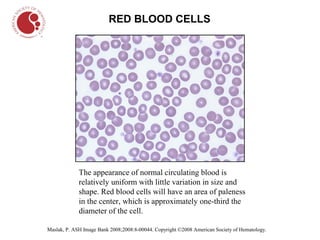
             The appearance of normal circulating blood is
             relatively uniform with little variation in size and
             shape. Red blood cells will have an area of paleness
             in the center, which is approximately one-third the
             diameter of the cell.

Maslak, P. ASH Image Bank 2008;2008:8-00044. Copyright ©2008 American Society of Hematology.
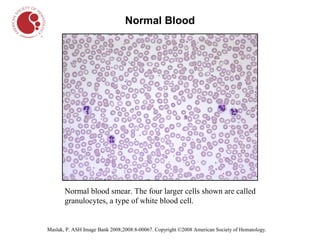
Normal Blood


       Normal blood smear. The four larger cells shown are called
       granulocytes, a type of white blood cell.


Maslak, P. ASH Image Bank 2008;2008:8-00067. Copyright ©2008 American Society of Hematology.
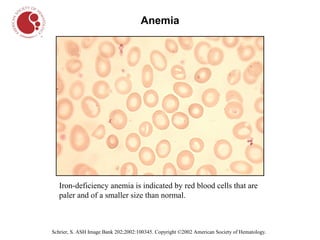
Anemia


   Iron-deficiency anemia is indicated by red blood cells that are
   paler and of a smaller size than normal.


Schrier, S. ASH Image Bank 202;2002:100345. Copyright ©2002 American Society of Hematology.
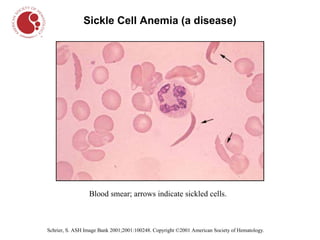
Sickle Cell Anemia (a disease)


                 Blood smear; arrows indicate sickled cells.


Schrier, S. ASH Image Bank 2001;2001:100248. Copyright ©2001 American Society of Hematology.
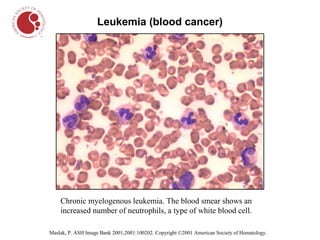
Leukemia (blood cancer)


    Chronic myelogenous leukemia. The blood smear shows an
    increased number of neutrophils, a type of white blood cell.

Maslak, P. ASH Image Bank 2001;2001:100202. Copyright ©2001 American Society of Hematology.
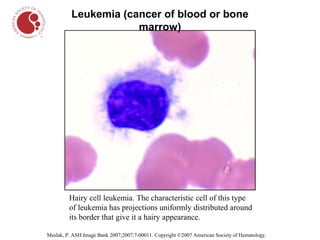
Leukemia (cancer of blood or bone
                      marrow)


         Hairy cell leukemia. The characteristic cell of this type
         of leukemia has projections uniformly distributed around
         its border that give it a hairy appearance.

Maslak, P. ASH Image Bank 2007;2007:7-00011. Copyright ©2007 American Society of Hematology.
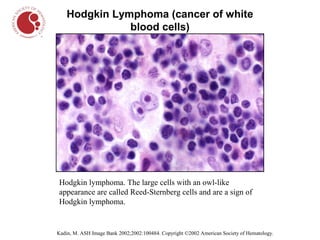
Hodgkin Lymphoma (cancer of white
               blood cells)


Hodgkin lymphoma. The large cells with an owl-like
appearance are called Reed-Sternberg cells and are a sign of
Hodgkin lymphoma.


Kadin, M. ASH Image Bank 2002;2002:100484. Copyright ©2002 American Society of Hematology.

Blood slides

  • 1.
    RED BLOOD CELLS The appearance of normal circulating blood is relatively uniform with little variation in size and shape. Red blood cells will have an area of paleness in the center, which is approximately one-third the diameter of the cell. Maslak, P. ASH Image Bank 2008;2008:8-00044. Copyright ©2008 American Society of Hematology.
  • 2.
    Normal Blood Normal blood smear. The four larger cells shown are called granulocytes, a type of white blood cell. Maslak, P. ASH Image Bank 2008;2008:8-00067. Copyright ©2008 American Society of Hematology.
  • 3.
    Anemia Iron-deficiency anemia is indicated by red blood cells that are paler and of a smaller size than normal. Schrier, S. ASH Image Bank 202;2002:100345. Copyright ©2002 American Society of Hematology.
  • 4.
    Sickle Cell Anemia(a disease) Blood smear; arrows indicate sickled cells. Schrier, S. ASH Image Bank 2001;2001:100248. Copyright ©2001 American Society of Hematology.
  • 5.
    Leukemia (blood cancer) Chronic myelogenous leukemia. The blood smear shows an increased number of neutrophils, a type of white blood cell. Maslak, P. ASH Image Bank 2001;2001:100202. Copyright ©2001 American Society of Hematology.
  • 6.
    Leukemia (cancer ofblood or bone marrow) Hairy cell leukemia. The characteristic cell of this type of leukemia has projections uniformly distributed around its border that give it a hairy appearance. Maslak, P. ASH Image Bank 2007;2007:7-00011. Copyright ©2007 American Society of Hematology.
  • 7.
    Hodgkin Lymphoma (cancerof white blood cells) Hodgkin lymphoma. The large cells with an owl-like appearance are called Reed-Sternberg cells and are a sign of Hodgkin lymphoma. Kadin, M. ASH Image Bank 2002;2002:100484. Copyright ©2002 American Society of Hematology.