BLOCKCHAIN
TECHNOLOGY
Submitted by-
KULDEEP TRIPATHI
Submitted to-
Mr. AMIT SINGH
INDEX
Sr. No. Topic
1. What is Blockchain Technology?
2. Mathedology
3. Types of Blockchain Technology
4. Why is Blockchain important?
5. How does Blockchain Work?
6. Transaction process in Blockchain
7. Decentralization in Blockchain
8. Why is decentralization important?
9. Applications of Blockchain
10. History of Blockchain Technology
11. Bitcoin vs. Blockchain
12. Advantages and Disadvantages of Blockchain Technology
13. Conclusion
14. References
What is Blockchain Technology?
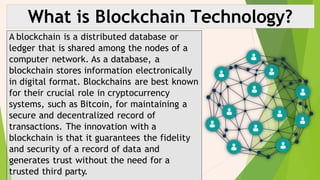
A blockchain is a distributed database or
ledger that is shared among the nodes of a
computer network. As a database, a
blockchain stores information electronically
in digital format. Blockchains are best known
for their crucial role in cryptocurrency
systems, such as Bitcoin, for maintaining a
secure and decentralized record of
transactions. The innovation with a
blockchain is that it guarantees the fidelity
and security of a record of data and
generates trust without the need for a
trusted third party.
Fundamentals of Blockchain
1. Public Distributed Ledgers
•A blockchain is a decentralized public distributed ledger that is used to record
transactions across many computers.
• A distributed ledger is a database that is shared among the users of the
blockchain network.
• The transactions are accessed and verified by users associated with the bitcoin
network, thereby making it less prone to cyberattack.
2. Encryption
•Blockchain eliminates unauthorized access by using the cryptographic algorithm
(SHA256) to ensure the blocks are kept secure.
• Each user in the blockchain has their key.
M E T H O D O L O G Y
3. Proof of Work
Proof of work (PoW) is a method to validate transactions in a blockchain
network by solving a complex mathematical puzzle called mining.
Note: Users trying to solve the puzzle are called miners.
4. Mining
In Blockchain, when miners use their resources (time, money, electricity,
etc.) to validate a new transaction and record them on the public ledger,
they are given a reward.
Note: As a reward, the miner gets 12.5 BTC (bitcoins)
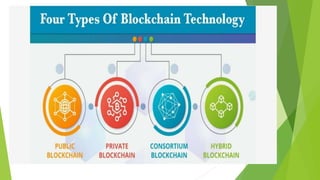
2. Private Blockchain
These blockchains are not as decentralized as the public blockchain only selected nodes
can participate in the process, making it more secure than the others.
3. Consortium Blockchain
It is a creative approach that solves the needs of the organization. This blockchain
validates the transaction and also initiates or receives transactions. It is also known as
Federated Blockchain.
4. Hybrid Blockchain
It is the mixed content of the private and public blockchain, where some part is controlled
by some organization and other makes are made visible as a public blockchain.
Why Blockchain is important?
Blockchain is an especially promising and
revolutionary technology because it helps
reduce security risks, stamp out fraud and
bring transparency in a scalable way.
Originally popularized in the 2010s by its
association with cryptocurrency and NFTs,
blockchain technology has since evolved to
become a management solution for all types
of global industries. Today, you can find
blockchain technology providing
transparency for the food supply
chain, securing healthcare data, innovating
gaming and overall changing how we handle
data and ownership on a large scale.
How Does Blockchain Work?
The goal of blockchain is to allow digital information to be
recorded and distributed, but not edited. In this way, a
blockchain is the foundation for immutable ledgers, or records of
transactions that cannot be altered, deleted, or destroyed. This is
why blockchains are also known as a distributed ledger
technology (DLT).
First proposed as a research project in 1991, the blockchain
concept predated its first widespread application in use: Bitcoin,
in 2009. In the years since, the use of blockchains has exploded
via the creation of various cryptocurrencies, decentralized
finance (DeFi) applications, non-fungible tokens (NFTs), and smart
contracts.
Decentralization in Blockchain
In the blockchain, decentralization
alludes to the transfer of supervision
and decision-making from a
centralized association (individual,
corporation, or group of people) to a
dispersed network. Decentralized
networks endeavor to decrease the
degree of trust that members should
put in each other and dissuade their
capacity to put forth authority or
command over each other in manners
that corrupt the potency of the
network.
Why decentralization
is important?
behind the
The original concept
invention of blockchain technology is
still a great application. Money
transfers using blockchain can be less
expensive and faster than using existing
money transfer services.
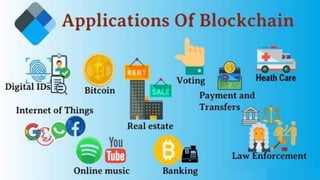
1. Money transfers
customers and insurance
Recording
providers.
all claims on a blockchain
would keep customers from making
duplicate claims for the same event.
2. Financial exchanges
Many companies have popped up over
the past few years offering
decentralized cryptocurrency
exchanges. Using blockchain for
exchanges allows for faster and less
expensive transactions.
3. Lending
Lenders can use blockchain to execute
collateralized loans through smart
contracts. Smart contracts built on the
blockchain allow certain events to
automatically trigger things like a
service payment, a margin call.
4. Insurance
Using smart contracts on a blockchain
can provide greater transparency for
Bitcoin vs. Blockchain
Blockchain technology was first outlined in
1991 by Stuart Haber and W. Scott Stornetta,
two researchers who wanted to implement a
system where document timestamps could
not be tampered with. But it wasn’t until
almost two decades later, with the launch of
Bitcoin in January 2009, that blockchain had
its first real-world application.
The Bitcoin protocol is built on a blockchain.
In a research paper introducing the digital
currency, Bitcoin’s pseudonymous
creator, Satoshi Nakamoto, referred to it as
“a new electronic cash system that’s fully
peer-to-peer, with no trusted third party.”
1.Open: One of the major advantages of blockchain technology is that it is accessible to all
means anyone can become a participant in the contribution to blockchain technology.
2.Verifiable: Blockchain technology is used to store information in a decentralized manner so
everyone can verify the correctness of the information by using zero-knowledge.
3.Permanent: Records or information which is stored using blockchain technology is permanent
means one needs not worry about losing the data.
4.Tighter Security: Blockchain uses hashing techniques to store each transaction on a block
that is connected to each other so it has tighter security.
5.Efficiency: Blockchain removes any third-party intervention between transactions and
removes the mistake making the system efficient and faster. Settlement is made easier and
smooth.
6.Cost Reduction: As blockchain needs no third man it reduces the cost for the businesses and
gives trust to the other partner.
1.Scalability: It is one of the biggest drawbacks of blockchain technology as it cannot be scaled
due to the fixed size of the block for storing information.
2.Energy Consuming: For verifying any transaction a lot of energy is used so it becomes a
problem according to the survey it is considered that 0.3 percent of the world’s electricity had
been used by 2018 in the verification of transactions done using blockchain technology.
3.Time-Consuming: To add the next block in the chain miners need to compute nonce values
many times so this is a time-consuming process and needs to be speed up to be used for
industrial purposes.
4.Legal Formalities: In some countries, the use of blockchain technology applications is banned
like cryptocurrency due to some environmental issues.
5.Storage: Blockchain databases are stored on all the nodes of the network creates an issue
with the storage, increasing number of transactions will require more storage.
Conclusion
The Bitcoin is the first successful implementation of blockchain. Today,
the world has found applications of blockchain technology in several
industries, where the trust without the involvement of a centralized
authority is desired. So welcome to the world of Blockchain.
Blockchain technology is only going to grow in the fields of business,
finance, law, medicine, and real estate. Whether you’re an
experienced Blockchain developer, or you’re aspiring to break into this
exciting industry, enrolling in our Blockchain Certification
Training program will help individuals with all levels of experience to
learn Blockchain developer techniques and strategies.
REFERENCES
1. https://en.wikipedia.org/wiki/Blockchain
2. https://www.investopedia.com/terms/b/blockchain.asp
3. https://www.pngegg.com/en/search?q=blockchain+Technology
4. https://www.simplilearn.com/tutorials/blockchain-
tutorial/why-is-blockchain-important
5. https://www.geeksforgeeks.org/advantages-and-disadvantages-
of-blockchain/
6. https://builtin.com/blockchain
THANK YOU!

BLOCKCHAIN.pptx

  • 2.
  • 3.
    INDEX Sr. No. Topic 1.What is Blockchain Technology? 2. Mathedology 3. Types of Blockchain Technology 4. Why is Blockchain important? 5. How does Blockchain Work? 6. Transaction process in Blockchain 7. Decentralization in Blockchain 8. Why is decentralization important? 9. Applications of Blockchain 10. History of Blockchain Technology 11. Bitcoin vs. Blockchain 12. Advantages and Disadvantages of Blockchain Technology 13. Conclusion 14. References
  • 4.
    What is BlockchainTechnology? A blockchain is a distributed database or ledger that is shared among the nodes of a computer network. As a database, a blockchain stores information electronically in digital format. Blockchains are best known for their crucial role in cryptocurrency systems, such as Bitcoin, for maintaining a secure and decentralized record of transactions. The innovation with a blockchain is that it guarantees the fidelity and security of a record of data and generates trust without the need for a trusted third party.
  • 5.
    Fundamentals of Blockchain 1.Public Distributed Ledgers •A blockchain is a decentralized public distributed ledger that is used to record transactions across many computers. • A distributed ledger is a database that is shared among the users of the blockchain network. • The transactions are accessed and verified by users associated with the bitcoin network, thereby making it less prone to cyberattack. 2. Encryption •Blockchain eliminates unauthorized access by using the cryptographic algorithm (SHA256) to ensure the blocks are kept secure. • Each user in the blockchain has their key. M E T H O D O L O G Y
  • 6.
    3. Proof ofWork Proof of work (PoW) is a method to validate transactions in a blockchain network by solving a complex mathematical puzzle called mining. Note: Users trying to solve the puzzle are called miners. 4. Mining In Blockchain, when miners use their resources (time, money, electricity, etc.) to validate a new transaction and record them on the public ledger, they are given a reward. Note: As a reward, the miner gets 12.5 BTC (bitcoins)
  • 8.
    2. Private Blockchain Theseblockchains are not as decentralized as the public blockchain only selected nodes can participate in the process, making it more secure than the others. 3. Consortium Blockchain It is a creative approach that solves the needs of the organization. This blockchain validates the transaction and also initiates or receives transactions. It is also known as Federated Blockchain. 4. Hybrid Blockchain It is the mixed content of the private and public blockchain, where some part is controlled by some organization and other makes are made visible as a public blockchain.
  • 9.
    Why Blockchain isimportant? Blockchain is an especially promising and revolutionary technology because it helps reduce security risks, stamp out fraud and bring transparency in a scalable way. Originally popularized in the 2010s by its association with cryptocurrency and NFTs, blockchain technology has since evolved to become a management solution for all types of global industries. Today, you can find blockchain technology providing transparency for the food supply chain, securing healthcare data, innovating gaming and overall changing how we handle data and ownership on a large scale.
  • 10.
    How Does BlockchainWork? The goal of blockchain is to allow digital information to be recorded and distributed, but not edited. In this way, a blockchain is the foundation for immutable ledgers, or records of transactions that cannot be altered, deleted, or destroyed. This is why blockchains are also known as a distributed ledger technology (DLT). First proposed as a research project in 1991, the blockchain concept predated its first widespread application in use: Bitcoin, in 2009. In the years since, the use of blockchains has exploded via the creation of various cryptocurrencies, decentralized finance (DeFi) applications, non-fungible tokens (NFTs), and smart contracts.
  • 11.
    Decentralization in Blockchain Inthe blockchain, decentralization alludes to the transfer of supervision and decision-making from a centralized association (individual, corporation, or group of people) to a dispersed network. Decentralized networks endeavor to decrease the degree of trust that members should put in each other and dissuade their capacity to put forth authority or command over each other in manners that corrupt the potency of the network.
  • 12.
  • 14.
    behind the The originalconcept invention of blockchain technology is still a great application. Money transfers using blockchain can be less expensive and faster than using existing money transfer services. 1. Money transfers customers and insurance Recording providers. all claims on a blockchain would keep customers from making duplicate claims for the same event. 2. Financial exchanges Many companies have popped up over the past few years offering decentralized cryptocurrency exchanges. Using blockchain for exchanges allows for faster and less expensive transactions. 3. Lending Lenders can use blockchain to execute collateralized loans through smart contracts. Smart contracts built on the blockchain allow certain events to automatically trigger things like a service payment, a margin call. 4. Insurance Using smart contracts on a blockchain can provide greater transparency for
  • 15.
    Bitcoin vs. Blockchain Blockchaintechnology was first outlined in 1991 by Stuart Haber and W. Scott Stornetta, two researchers who wanted to implement a system where document timestamps could not be tampered with. But it wasn’t until almost two decades later, with the launch of Bitcoin in January 2009, that blockchain had its first real-world application. The Bitcoin protocol is built on a blockchain. In a research paper introducing the digital currency, Bitcoin’s pseudonymous creator, Satoshi Nakamoto, referred to it as “a new electronic cash system that’s fully peer-to-peer, with no trusted third party.”
  • 16.
    1.Open: One ofthe major advantages of blockchain technology is that it is accessible to all means anyone can become a participant in the contribution to blockchain technology. 2.Verifiable: Blockchain technology is used to store information in a decentralized manner so everyone can verify the correctness of the information by using zero-knowledge. 3.Permanent: Records or information which is stored using blockchain technology is permanent means one needs not worry about losing the data. 4.Tighter Security: Blockchain uses hashing techniques to store each transaction on a block that is connected to each other so it has tighter security. 5.Efficiency: Blockchain removes any third-party intervention between transactions and removes the mistake making the system efficient and faster. Settlement is made easier and smooth. 6.Cost Reduction: As blockchain needs no third man it reduces the cost for the businesses and gives trust to the other partner.
  • 17.
    1.Scalability: It isone of the biggest drawbacks of blockchain technology as it cannot be scaled due to the fixed size of the block for storing information. 2.Energy Consuming: For verifying any transaction a lot of energy is used so it becomes a problem according to the survey it is considered that 0.3 percent of the world’s electricity had been used by 2018 in the verification of transactions done using blockchain technology. 3.Time-Consuming: To add the next block in the chain miners need to compute nonce values many times so this is a time-consuming process and needs to be speed up to be used for industrial purposes. 4.Legal Formalities: In some countries, the use of blockchain technology applications is banned like cryptocurrency due to some environmental issues. 5.Storage: Blockchain databases are stored on all the nodes of the network creates an issue with the storage, increasing number of transactions will require more storage.
  • 18.
    Conclusion The Bitcoin isthe first successful implementation of blockchain. Today, the world has found applications of blockchain technology in several industries, where the trust without the involvement of a centralized authority is desired. So welcome to the world of Blockchain. Blockchain technology is only going to grow in the fields of business, finance, law, medicine, and real estate. Whether you’re an experienced Blockchain developer, or you’re aspiring to break into this exciting industry, enrolling in our Blockchain Certification Training program will help individuals with all levels of experience to learn Blockchain developer techniques and strategies.
  • 19.
    REFERENCES 1. https://en.wikipedia.org/wiki/Blockchain 2. https://www.investopedia.com/terms/b/blockchain.asp 3.https://www.pngegg.com/en/search?q=blockchain+Technology 4. https://www.simplilearn.com/tutorials/blockchain- tutorial/why-is-blockchain-important 5. https://www.geeksforgeeks.org/advantages-and-disadvantages- of-blockchain/ 6. https://builtin.com/blockchain
  • 20.