TECHNICAL SEMINAR ON
OVERVIEW OF
BLOCKCHAIN
By S.LALITHA PRASANNA
Why Blockchain ?
Transactions - Everything around is a Transaction
● Payment of Bills
● Purchasing Tickets for travel
● Ordering Food
● Online shopping
Transactions are stored in Ledgers!
But where are the ledgers stored?
Drawbacks of Centralized Authority maintaining the Ledgers:
● Security breach
● Service charges
● Manipulation
● Permissions
● Natural disasters
What could be possible alternative for centralized ledgers ?
What is Blockchain?
● It is the technology behind the bitcoin
● A chain of blocks!
Flashback of blockchain:
1991: Stuart Haber and W. Scott Stornetta cryptographically described secure
chain of blocks.
1992:Bayer, Haber and Stornetta incorporated Merkle trees to the design,
which improved its efficiency by allowing several documents to be collected
into one block.
2008:The first blockchain was conceptualised by an anonymous person or
group known as Satoshi Nakamoto in 2008.
2008-Till date????
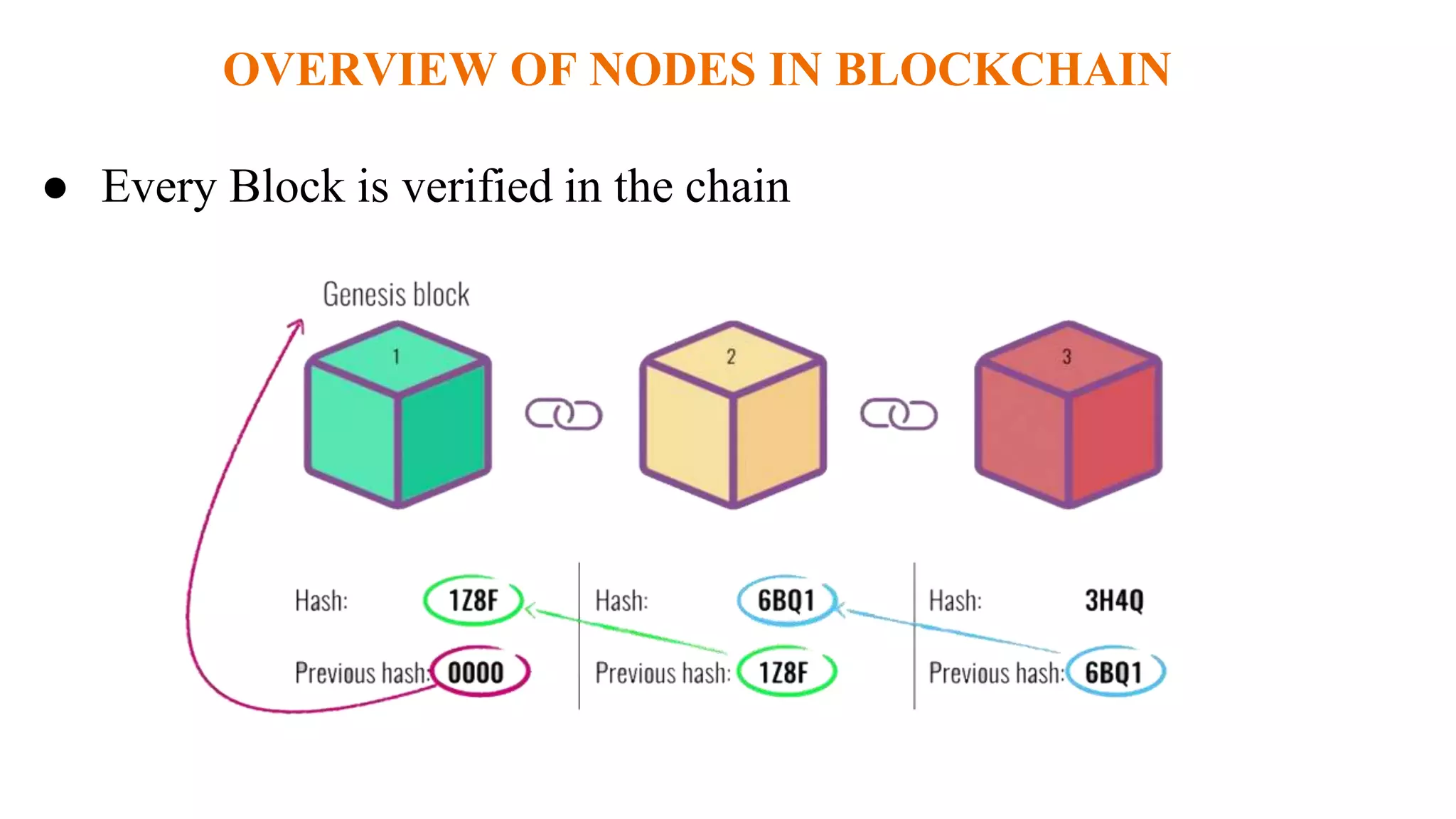
OVERVIEW OF NODES IN BLOCKCHAIN
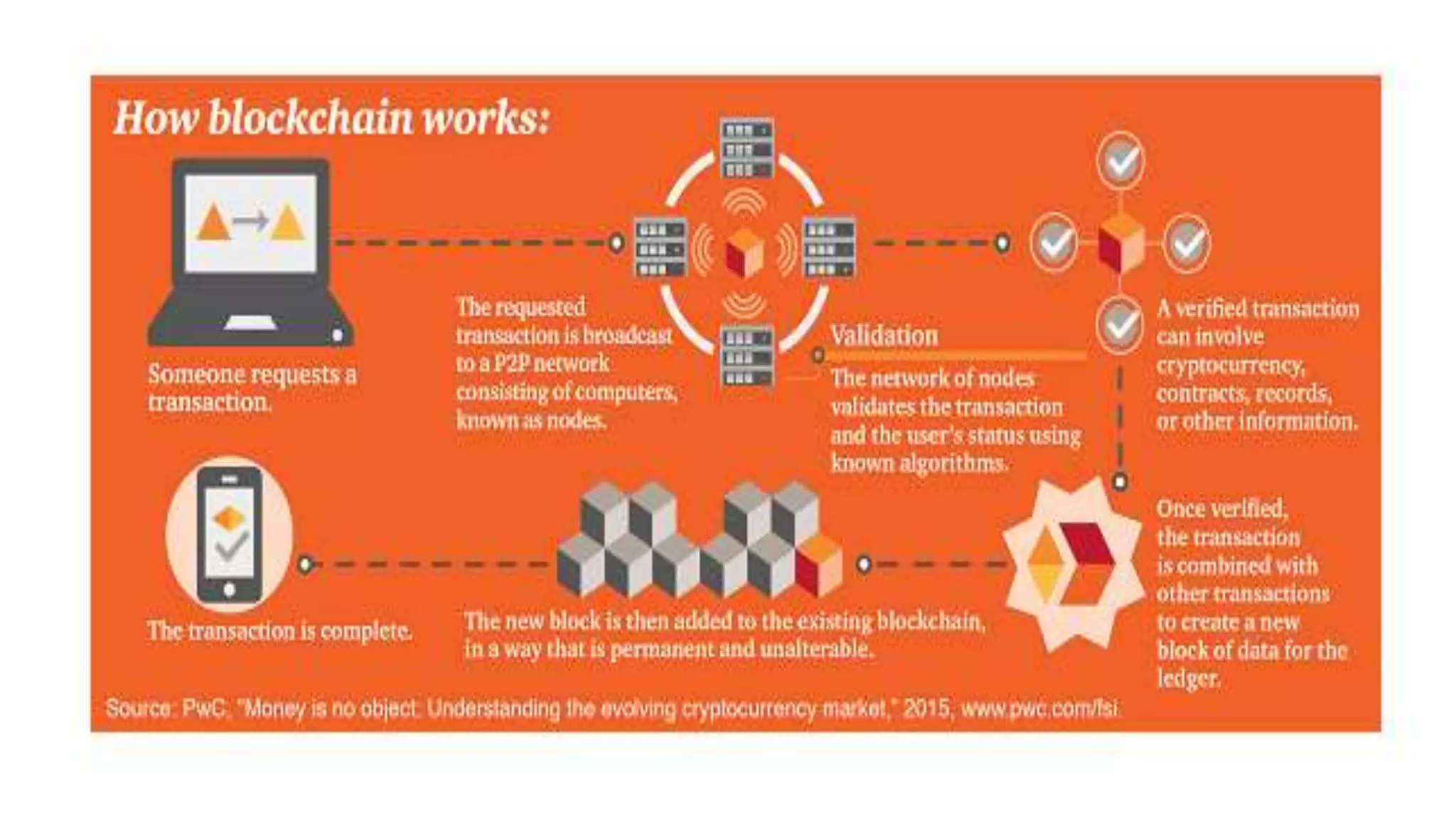
● Every Block is verified in the chain
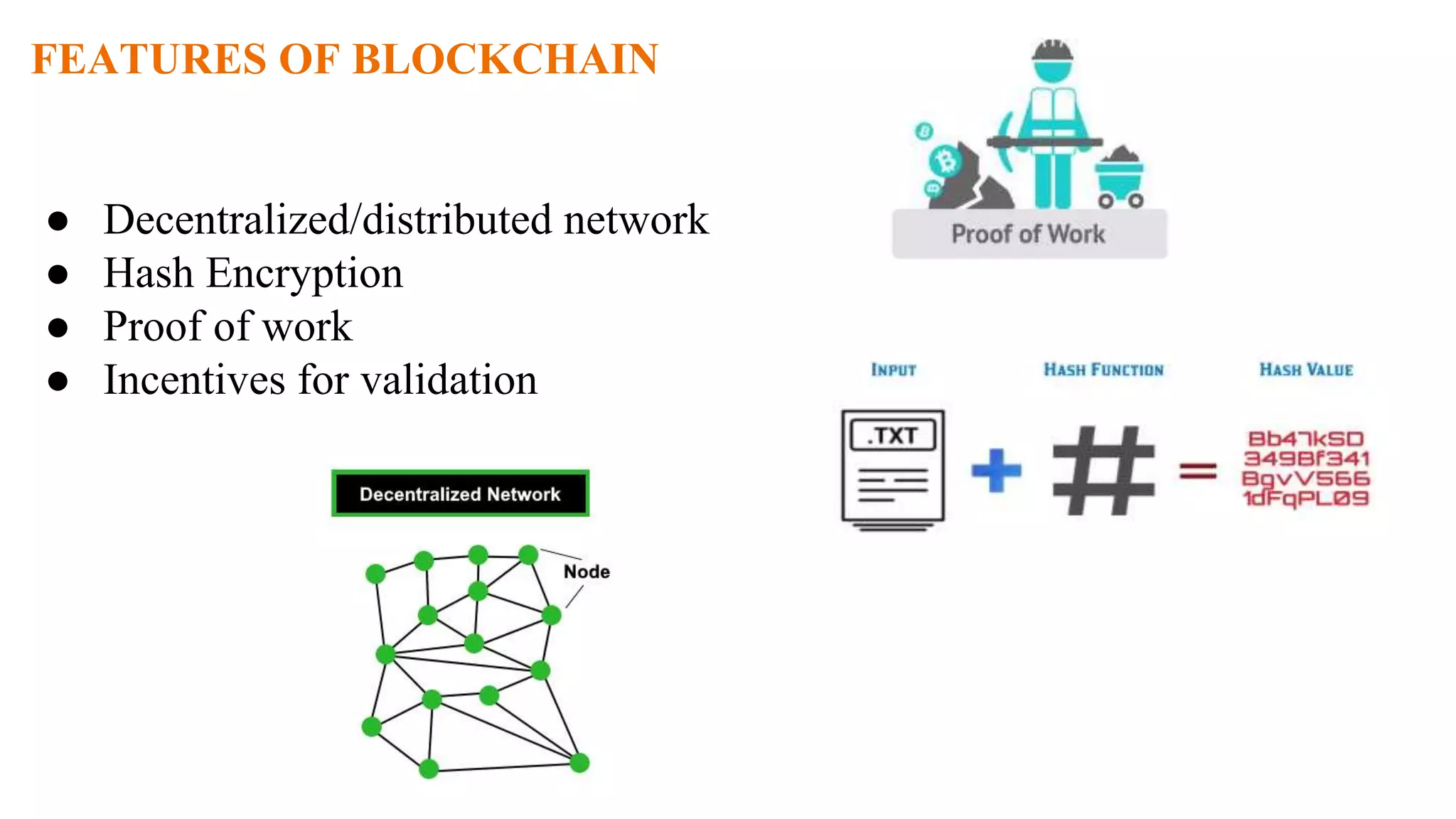
FEATURES OF BLOCKCHAIN
● Decentralized/distributed network
● Hash Encryption
● Proof of work
● Incentives for validation
Decentralization/Distributed ledger
● Decentralization is the process of redistributing or dispersing
functions, powers, people or things away from a central location or
authority.
● Decentralization enables disintermediation (it cuts out the
middleman)
● Decentralization eliminates inefficiencies inherent to centralized
institutions.
Hashing in Blockchain
Imagine a chunk of data is stored in a blockchain, such as a string of
characters.
● The digital data is chopped, minced and encrypted in a series of
alphabets and digits. This is called Hashing.
● Hashing makes the data unrecognisable which provides authenticity
to the data stored as each block of data has a unique hashing and the
validation takes place by comparing the hash of a block with the
previous hash stored in the subsequent block
Proof of Work
Consensus is the process by which block gets added to the Blockchain
after being validated by nodes.
● Bitcoin miners who validate have to solve complex mathematical
puzzle to add a block to the blockchain.
● Proof-of-Work involves solving computationally expensive puzzle
which is to solve but easy to verify.
● Miners search for specific nonce which gives the desired hash
which is predetermined
Incentives for validation
● Every miner who successfully validates a block is paid the incentive
● The current income is 12.1 BTC($25,170/ Rs.16,20,088) approx
● Bitcoin incentives is the only way to generate new currency into the
system.
● By 2140, all 21 million bitcoins will be mined.
VARIOUS PLATFORMS TO BUILD AND DEPLOY D-APPS:
Ethereum:
● Ethereum is a technology platform for decentralization
● Ethereum enables the creation of decentralized apps or“dapps”
● Scope: Apps run on the whole of the Internet
● Combines blockchain technology + smart contracts (self-executing, self-
enforcing agreements)
● Ethereum blockchain enables automated consensus between parties of a
contract Decentralization On a large scale
Smart Contract:
A smart contract is an agreement whose execution is both automatic and enforceable.
• The actual “transaction” among parties is expressed through and independently
executed by computer code,no party can block it or otherwise tamper with.
• It constitutes legally binding rights and obligations of the involved parties.
Advantages:
• Parties are in consensus at all times as to the existence, nature and evolution of the
facts shared among them, which are governed by the program.
• Used to satisfy common contractual conditions
• lower transaction costs and risk, and eliminate the need for trusted intermediaries.
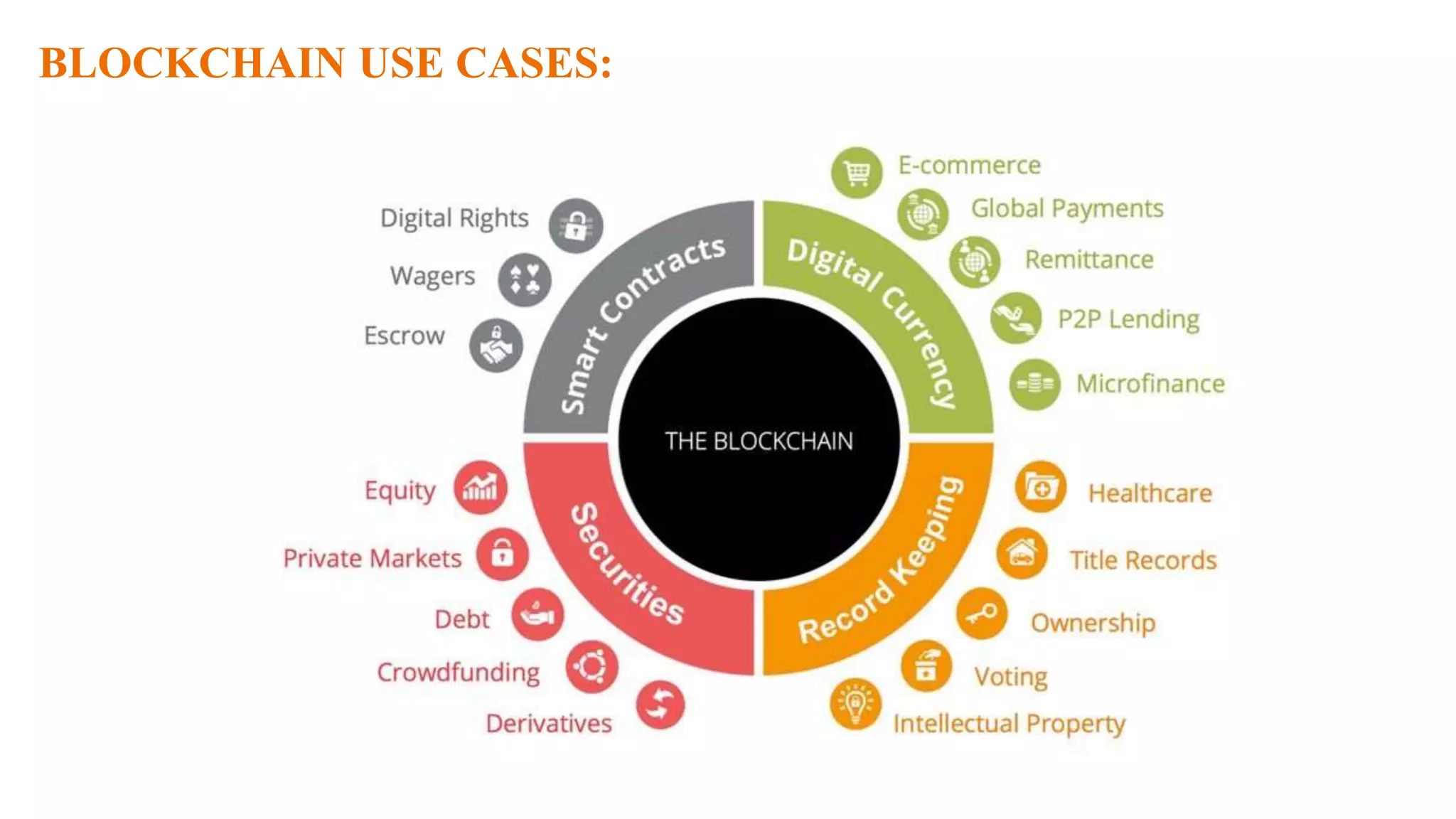
BLOCKCHAIN USE CASES:
Blockchain Banking use case:
● Blockchain can cut upto $20billion middle man costs per year.
● Hacking into banking ledgers becomes close to impossible.
● Faster bank payments.
Eg: Goldman sachs,Barclays.
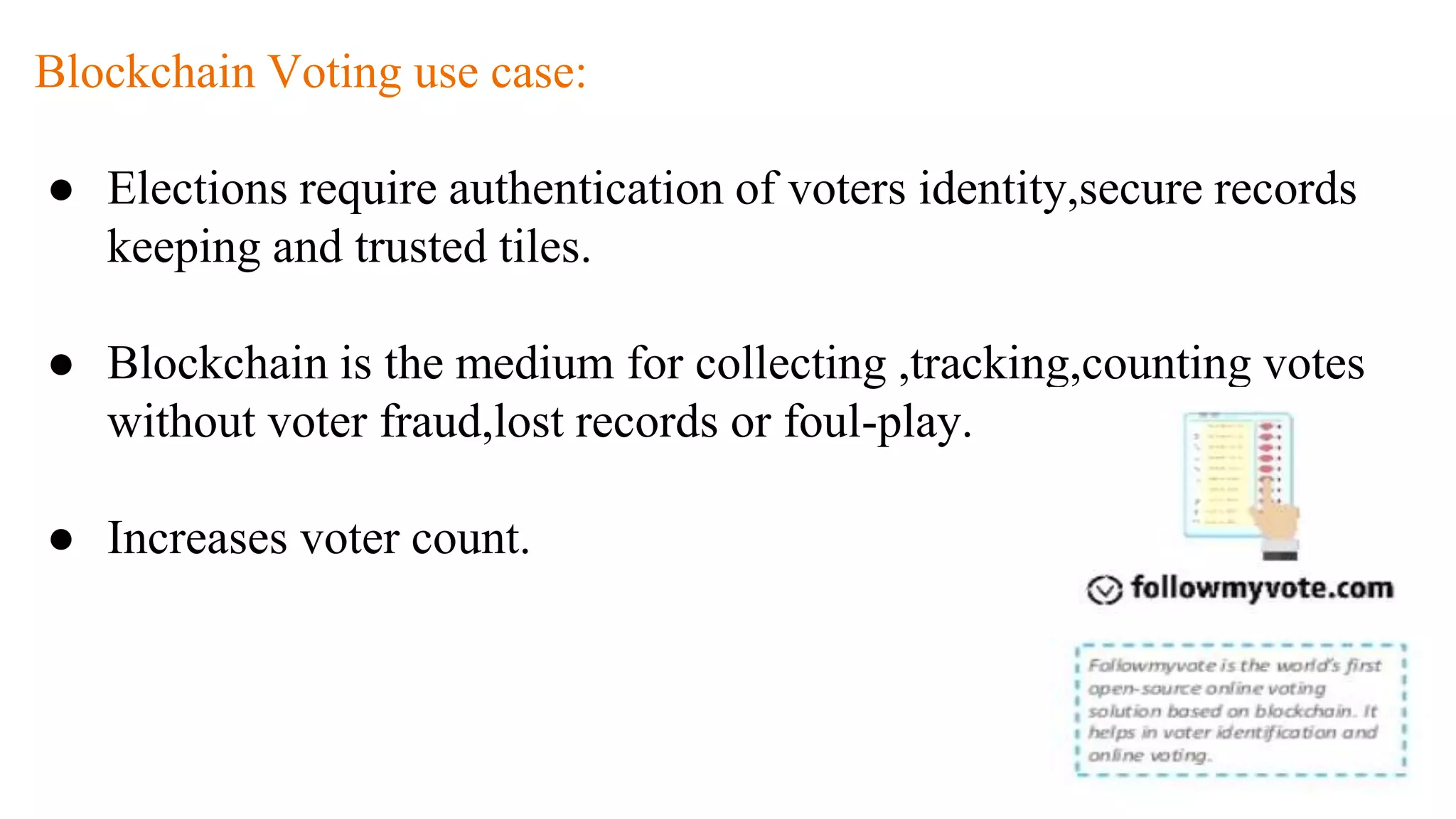
Blockchain Voting use case:
● Elections require authentication of voters identity,secure records
keeping and trusted tiles.
● Blockchain is the medium for collecting ,tracking,counting votes
without voter fraud,lost records or foul-play.
● Increases voter count.
BLOCKCHAIN APPLICATIONS:
● Brooklyn microgrid
● Chitmonks
● Bitgive
● Shocard
● Skuchain
● stamp.io
And many more….
THANK YOU

Blockchain technology Overview

  • 1.
    TECHNICAL SEMINAR ON OVERVIEWOF BLOCKCHAIN By S.LALITHA PRASANNA
  • 2.
    Why Blockchain ? Transactions- Everything around is a Transaction ● Payment of Bills ● Purchasing Tickets for travel ● Ordering Food ● Online shopping Transactions are stored in Ledgers! But where are the ledgers stored?
  • 3.
    Drawbacks of CentralizedAuthority maintaining the Ledgers: ● Security breach ● Service charges ● Manipulation ● Permissions ● Natural disasters What could be possible alternative for centralized ledgers ?
  • 4.
    What is Blockchain? ●It is the technology behind the bitcoin ● A chain of blocks! Flashback of blockchain: 1991: Stuart Haber and W. Scott Stornetta cryptographically described secure chain of blocks. 1992:Bayer, Haber and Stornetta incorporated Merkle trees to the design, which improved its efficiency by allowing several documents to be collected into one block. 2008:The first blockchain was conceptualised by an anonymous person or group known as Satoshi Nakamoto in 2008. 2008-Till date????
  • 5.
    OVERVIEW OF NODESIN BLOCKCHAIN ● Every Block is verified in the chain
  • 6.
    FEATURES OF BLOCKCHAIN ●Decentralized/distributed network ● Hash Encryption ● Proof of work ● Incentives for validation
  • 7.
    Decentralization/Distributed ledger ● Decentralizationis the process of redistributing or dispersing functions, powers, people or things away from a central location or authority. ● Decentralization enables disintermediation (it cuts out the middleman) ● Decentralization eliminates inefficiencies inherent to centralized institutions.
  • 8.
    Hashing in Blockchain Imaginea chunk of data is stored in a blockchain, such as a string of characters. ● The digital data is chopped, minced and encrypted in a series of alphabets and digits. This is called Hashing. ● Hashing makes the data unrecognisable which provides authenticity to the data stored as each block of data has a unique hashing and the validation takes place by comparing the hash of a block with the previous hash stored in the subsequent block
  • 9.
    Proof of Work Consensusis the process by which block gets added to the Blockchain after being validated by nodes. ● Bitcoin miners who validate have to solve complex mathematical puzzle to add a block to the blockchain. ● Proof-of-Work involves solving computationally expensive puzzle which is to solve but easy to verify. ● Miners search for specific nonce which gives the desired hash which is predetermined
  • 10.
    Incentives for validation ●Every miner who successfully validates a block is paid the incentive ● The current income is 12.1 BTC($25,170/ Rs.16,20,088) approx ● Bitcoin incentives is the only way to generate new currency into the system. ● By 2140, all 21 million bitcoins will be mined.
  • 12.
    VARIOUS PLATFORMS TOBUILD AND DEPLOY D-APPS:
  • 13.
    Ethereum: ● Ethereum isa technology platform for decentralization ● Ethereum enables the creation of decentralized apps or“dapps” ● Scope: Apps run on the whole of the Internet ● Combines blockchain technology + smart contracts (self-executing, self- enforcing agreements) ● Ethereum blockchain enables automated consensus between parties of a contract Decentralization On a large scale
  • 14.
    Smart Contract: A smartcontract is an agreement whose execution is both automatic and enforceable. • The actual “transaction” among parties is expressed through and independently executed by computer code,no party can block it or otherwise tamper with. • It constitutes legally binding rights and obligations of the involved parties. Advantages: • Parties are in consensus at all times as to the existence, nature and evolution of the facts shared among them, which are governed by the program. • Used to satisfy common contractual conditions • lower transaction costs and risk, and eliminate the need for trusted intermediaries.
  • 15.
  • 16.
    Blockchain Banking usecase: ● Blockchain can cut upto $20billion middle man costs per year. ● Hacking into banking ledgers becomes close to impossible. ● Faster bank payments. Eg: Goldman sachs,Barclays.
  • 17.
    Blockchain Voting usecase: ● Elections require authentication of voters identity,secure records keeping and trusted tiles. ● Blockchain is the medium for collecting ,tracking,counting votes without voter fraud,lost records or foul-play. ● Increases voter count.
  • 18.
    BLOCKCHAIN APPLICATIONS: ● Brooklynmicrogrid ● Chitmonks ● Bitgive ● Shocard ● Skuchain ● stamp.io And many more….
  • 19.