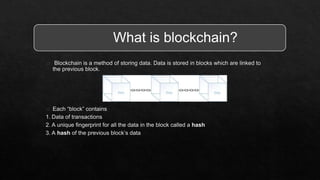
What is blockchain?
Uses of blockchain
Types of blockchain
 1991 - A cryptographically secured chain of blocks is described for the first time by Stuart
Haber and W Scott Stornetta
 1998 - Computer scientist Nick Szabo works on ‘bit gold’, a decentralised digital currency
 2000 - Stefan Konst publishes his theory of cryptographic secured chains, plus ideas for
implementation.
 2008 - Developer(s) working under the pseudonym Satoshi Nakamoto release a white paper
establishing the model for a blockchain
 2009 - Nakamoto implements the first blockchain as the public ledger for transactions made
using bitcoin.
 2014 - Blockchain technology is separated from the currency and its potential for other
financial, inter organisational transactions is explored. Blockchain 2.0 is born, referring to
applications beyond currency
History of blockchain
Key features of blockchain
 Write-only, immutable, transparent data
storage.
 Decentralised, no need for intermediaries.
 Consistent state across all participants.
 Resistant against malicious participants.
 Open to everyone.
Challenges
 The high energy consumption- Bitcoin uses a lot
of energy.
 Lack of scalability
 Fake block generation
 Lack of privacy
 Lack of latency

basics to blockchain

  • 3.
  • 4.
  • 5.
  • 6.
     1991 -A cryptographically secured chain of blocks is described for the first time by Stuart Haber and W Scott Stornetta  1998 - Computer scientist Nick Szabo works on ‘bit gold’, a decentralised digital currency  2000 - Stefan Konst publishes his theory of cryptographic secured chains, plus ideas for implementation.  2008 - Developer(s) working under the pseudonym Satoshi Nakamoto release a white paper establishing the model for a blockchain  2009 - Nakamoto implements the first blockchain as the public ledger for transactions made using bitcoin.  2014 - Blockchain technology is separated from the currency and its potential for other financial, inter organisational transactions is explored. Blockchain 2.0 is born, referring to applications beyond currency History of blockchain
  • 7.
    Key features ofblockchain  Write-only, immutable, transparent data storage.  Decentralised, no need for intermediaries.  Consistent state across all participants.  Resistant against malicious participants.  Open to everyone.
  • 8.
    Challenges  The highenergy consumption- Bitcoin uses a lot of energy.  Lack of scalability  Fake block generation  Lack of privacy  Lack of latency