Blockchain in Higher
education
Francisco Cordoba Otalora
University College London
January 2016
www.pachoman.com
The problem
“In a world of proliferating digital credentials the
potential for exaggeration, misrepresentation,
credential inflation and fraud is high” (1).
Therefore the transcripts validation process for
higher education institutions and companies take
a big amount of resources in staff, time and
money.
(1)https://www.pearsoned.com/wp-content/uploads/Open-Badges-for-Higher-Education.pdf
The solution
A Blockchain Higher Education Degree system.
How it works
The Higher Education
Institution:
1) Creates the transcripts
2) Using the Public key
encrypts transcripts.
3) Send the encrypted
transcripts to the
Public Ledger and to
the government.
4) Send the private key
Step 1
How it works
The student:
1) Receives the
private keys from
each HEI
2) Store the private
keys on the
academic wallet
3) In this way the
student could
store his lifelong
Step 2
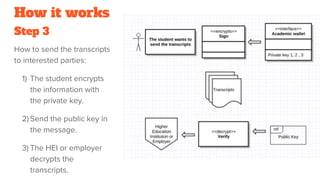
How it works
How to send the transcripts
to interested parties:
1) The student encrypts
the information with
the private key.
2) Send the public key in
the message.
3) The HEI or employer
decrypts the
transcripts.
Step 3
Technical problems
- Malicious party creating multiple identities adding data.
- The process of changing a transcript.
- There is not a problem of scalability since the transcripts
are registered in a bimonthly basis.
- The development of the public ledgers within each HEI.
- The solution could involve a definition or rules including
type of encryption, the broadcast of transactions to the
Social problems
Convince the Higher Education Institutions (HEI)
into getting in this new kind of approach it would
not be easy. However if it is possible to
demonstrate the advantages and if we can
convince one of the ministries of the government
to promote as the new channel for a better
educational system, this could be done.
Beneficiaries
The student's: Reduction on bureaucratic procedures to obtain
transcripts. A verified and recognized academic wallet.
The Higher Education Institutions: They will reduce the
administrative costs.
The employers: Instant verification of candidates transcripts.
The government: More accurate data for further analysis by
different institutions.
Resources
Throughout the community select the best open
source blockchain technology to implement.
Adapt the blockchain technology within the
technical requirements.
Expert developers on cryptography.
Consulting on government laws and privacy.

Blockchain in higher education

  • 1.
    Blockchain in Higher education FranciscoCordoba Otalora University College London January 2016 www.pachoman.com
  • 2.
    The problem “In aworld of proliferating digital credentials the potential for exaggeration, misrepresentation, credential inflation and fraud is high” (1). Therefore the transcripts validation process for higher education institutions and companies take a big amount of resources in staff, time and money. (1)https://www.pearsoned.com/wp-content/uploads/Open-Badges-for-Higher-Education.pdf
  • 3.
    The solution A BlockchainHigher Education Degree system.
  • 4.
    How it works TheHigher Education Institution: 1) Creates the transcripts 2) Using the Public key encrypts transcripts. 3) Send the encrypted transcripts to the Public Ledger and to the government. 4) Send the private key Step 1
  • 5.
    How it works Thestudent: 1) Receives the private keys from each HEI 2) Store the private keys on the academic wallet 3) In this way the student could store his lifelong Step 2
  • 6.
    How it works Howto send the transcripts to interested parties: 1) The student encrypts the information with the private key. 2) Send the public key in the message. 3) The HEI or employer decrypts the transcripts. Step 3
  • 7.
    Technical problems - Maliciousparty creating multiple identities adding data. - The process of changing a transcript. - There is not a problem of scalability since the transcripts are registered in a bimonthly basis. - The development of the public ledgers within each HEI. - The solution could involve a definition or rules including type of encryption, the broadcast of transactions to the
  • 8.
    Social problems Convince theHigher Education Institutions (HEI) into getting in this new kind of approach it would not be easy. However if it is possible to demonstrate the advantages and if we can convince one of the ministries of the government to promote as the new channel for a better educational system, this could be done.
  • 9.
    Beneficiaries The student's: Reductionon bureaucratic procedures to obtain transcripts. A verified and recognized academic wallet. The Higher Education Institutions: They will reduce the administrative costs. The employers: Instant verification of candidates transcripts. The government: More accurate data for further analysis by different institutions.
  • 10.
    Resources Throughout the communityselect the best open source blockchain technology to implement. Adapt the blockchain technology within the technical requirements. Expert developers on cryptography. Consulting on government laws and privacy.