Blockchain for Digital
Identifiers
Improving Data Openness, Security and Persistence
in the modern world.
Dr Mirek Sopek MakoLab SA, Poland
Presentation plan
 Digital Identifiers and their challenges
 Why Blockchain?
 Examples of Blockchain use for Identification
 Our Case Studies: DOI (Digital Object Identifier) and LEI (Legal
Entity Identifier)
 LEI Proof-of-Concept – fully functional software
 Lessons learned from the POC
 Conclusions
2
Digital Identifiers and their challenges
 Uniqueness – “Who is Who” without doubts
 Openness - accessible free of charge as a “broad public
good ”
 Decentralization of their generation/assignment
 Bi-directional non-repudiation
 Authenticity
 Resilience to system failures
3
Digital Identifiers Examples
 LEI – Legal Entity Identifiers
 ISIN – International Securities Identification Number (by ANNA)
 Financial Instrument Global Identifier (Bloomberg FIGI)
 Companies Registration Numbers (CRN)
 VAT Numbers
 Electronic Product Codes (EPC: GS1, EAN codes, etc)
 DOI – Digital Object Identifiers
 VIN – Vehicle Identification Number
 GPII – Global Patient Identifier
4
Why Blockchain? - I
 Non-repudiation of identities and transactions
 Immutability of data
 Data openness
 Decentralization of processing
 Lowering the transactions costs in distributed
organizations
 Transparency to internal stakeholders and regulators
 Resilience to system failures
5
Why Blockchain? - II
 Trust guaranteed by mathematics
 Efficient replication mechanisms
 Far-reaching democratization of Digital Identifiers
generation (for specific types of identifiers)
 Ability to restrict generation of identifiers to authorized
agents or institutions.
 Diversification of targets: institutions, legal and real
persons, datasets and devices.
6
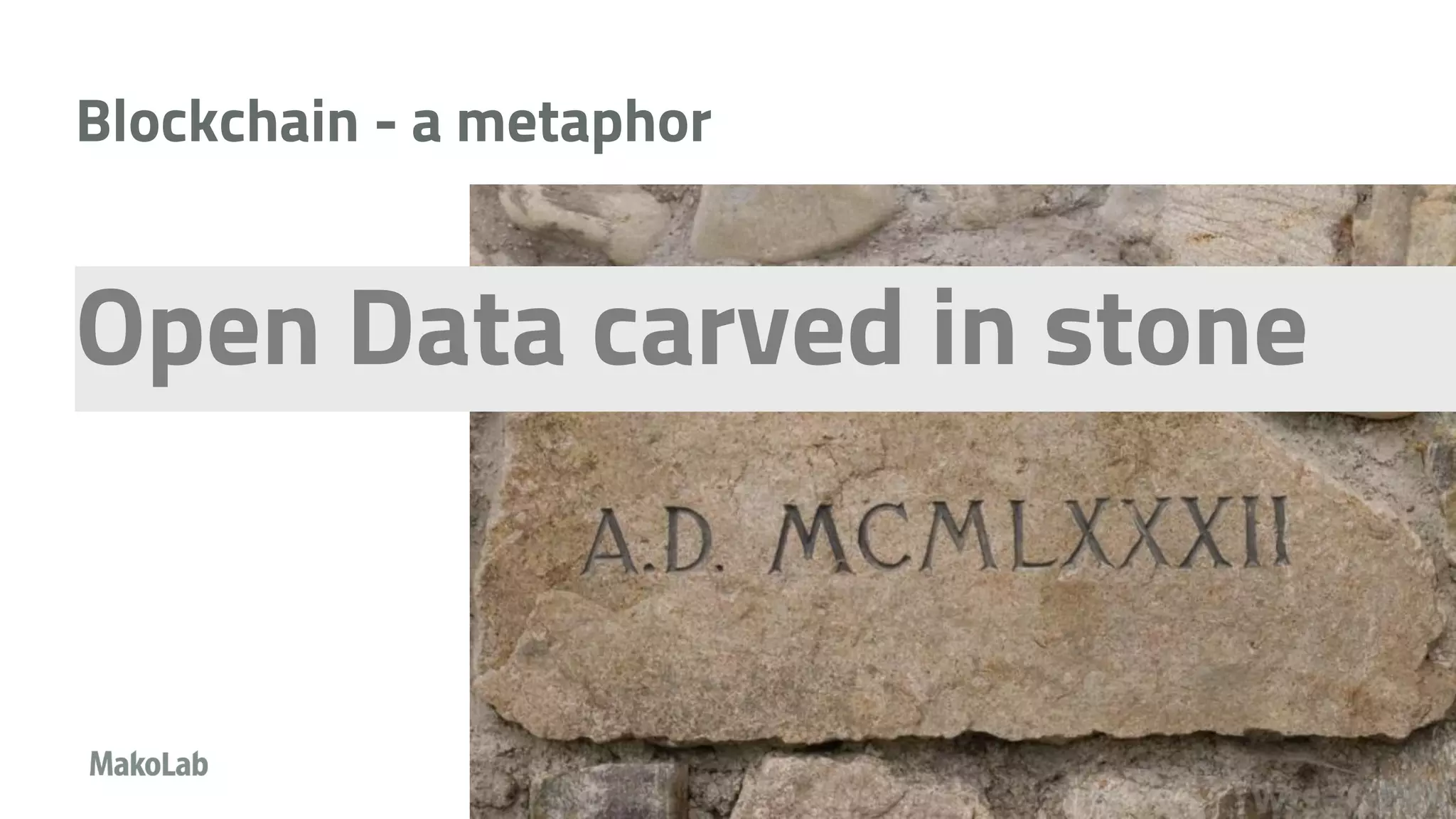
Blockchain - a metaphor
7
Open Data carved in stone
Existing uses of Blockchain for Identifiers
 Blockstack (“ …the first implementation of a decentralized DNS system on
top of the Bitcoin blockchain”)
 Namecoin (The cryptocurrency with applications for naming ( .bit domain) )
 … and more: ShoCard, Hypr, BlockAuth, CryptID …
8
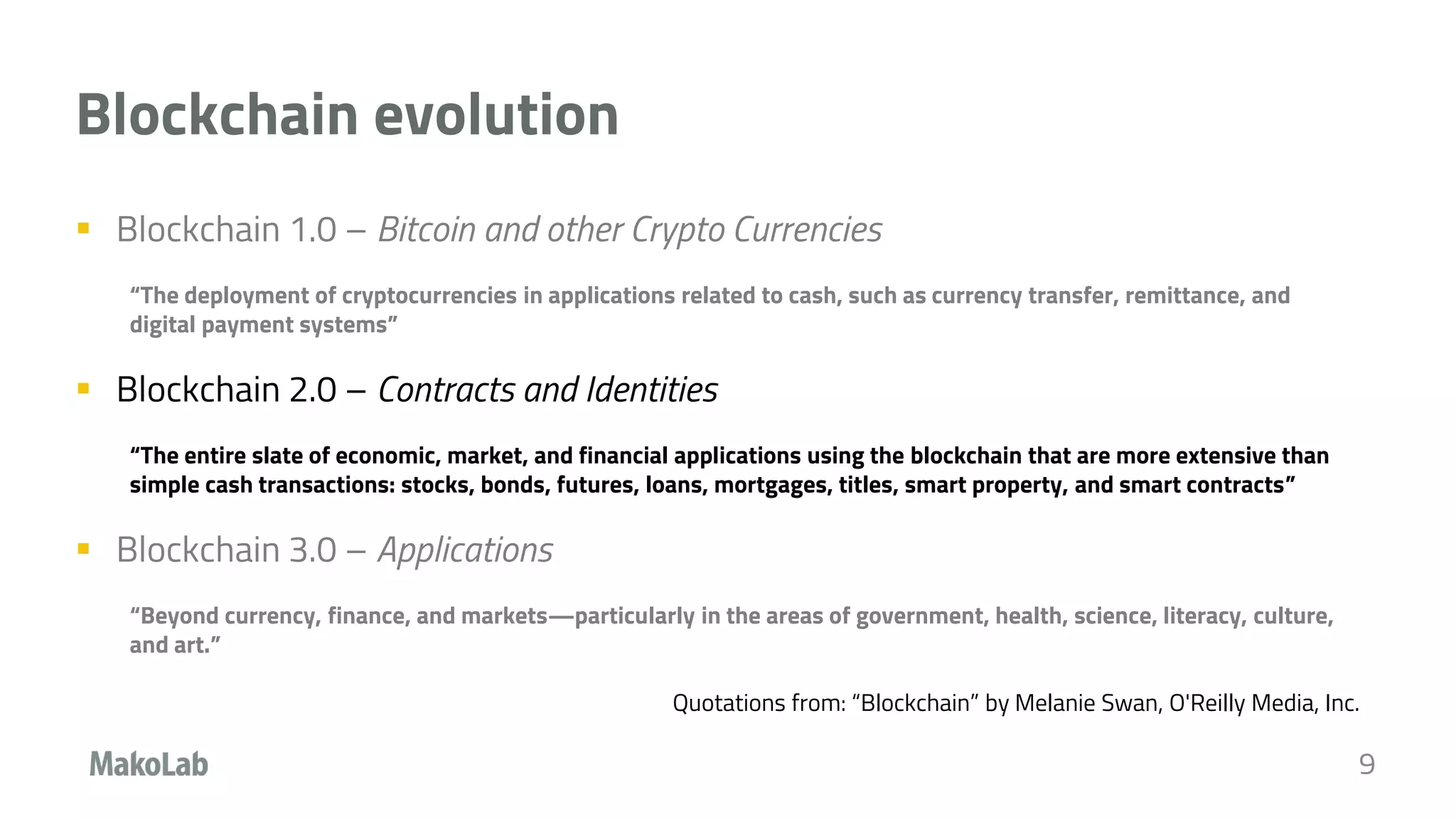
Blockchain evolution
 Blockchain 1.0 – Bitcoin and other Crypto Currencies
“The deployment of cryptocurrencies in applications related to cash, such as currency transfer, remittance, and
digital payment systems”
 Blockchain 2.0 – Contracts and Identities
“The entire slate of economic, market, and financial applications using the blockchain that are more extensive than
simple cash transactions: stocks, bonds, futures, loans, mortgages, titles, smart property, and smart contracts”
 Blockchain 3.0 – Applications
“Beyond currency, finance, and markets—particularly in the areas of government, health, science, literacy, culture,
and art.”
Quotations from: “Blockchain” by Melanie Swan, O'Reilly Media, Inc.
9
The idea of using
Blockchain 2.0 Smart Contracts
for Identification Services
Using Blockchain 2.0 Smart Contracts for
Identification Services. I
The central tenet of our approach is to treat a single record
for any entity to be identified by some KEY as "atomic", in
the sense of being curated as a single unit of data, by the
authority that assigns the KEYs.
Then, the representation of a single “atomic” record can be
considered as a state for a single smart contract.
11
Using Blockchain 2.0 Smart Contracts for
Identification Services. II
Each such contract would offer a method for accessing the
representation, and a dynamic data structure that holds
"revisions" of the representation. That is, when the record
changes globally, its new representation would be added
to the state of the contract. Such contract can hold many
revisions of the representation, bound only by the
capabilities of the network’s global storage. We call such
contract "entity contract".
12
Using Blockchain 2.0 Smart Contracts for
Identification Services. III
Together with entity contracts, someone can devise one or
more "master contracts", that keep track of individual entity
contracts and make accessing an easier process.
One must remember, however, about the trade-off between
complexity of such contracts and their cost of creation and
execution.
13
Using Blockchain 2.0 Smart Contracts for
Identification Services. IV
The suggested architecture for the Digital Identifiers on the
blockchain is: Consortium blockchains
Vitalik Buterin - https://blog.ethereum.org/2015/08/07/on-public-and-private-blockchains/ :
A consortium blockchain is a blockchain where the consensus process is controlled by a pre-selected set of
nodes; for example, one might imagine a consortium of 15 financial institutions, each of which operates a
node and of which 10 must sign every block in order for the block to be valid. The right to read the
blockchain may be public, or restricted to the participants, and there are also hybrid routes such as the root
hashes of the blocks being public together with an API that allows members of the public to make a limited
number of queries and get back cryptographic proofs of some parts of the blockchain state. These
blockchains may be considered “partially decentralized”.
14
Case studies:
DOI – Digital Object Identifiers
LEI – Legal Entity Identifiers
Case Study I – DOI – Digital Object Identifiers
The Digital Object Identifier (DOI) system is a generic framework
allowing for the identification of any digital object across global
computer networks. The key features of the DOI system include
persistence, fault-tolerant operation, security and ability to resolve its
identifiers to different forms, including metadata about objects and
pointers to their object location.
The DOI system is part of an ISO standard (ISO 26324).
Example: https://doi.org/10.1109/5.771073
16
DOI infrastructure today – HANDLE system
17
The Handle System, is a set of protocols concerned with
assignment, resolution and management of persistent
identifiers for digital objects and other resources on a network.
The system was originally developed by Bob Kahn, (contributor
to the invention of the TCP/IP protocol), with active
participation of DARPA in the framework of CNRI. CNRI
develops and manages the system through today.
Our current activity
18
The main idea behind the case study is the way we envision the use of
Blockchain technology as the back-end infrastructure for the DOI (Digital
Object Identifier) system, effectively improving or replacing the aging
Handle system.
The project has been proposed to US National Science Foundation by our
American Joint-Venture: Chemical Semantics, Inc.
Two case studies:
DOI – Digital Object Identifiers
LEI – Legal Entity Identifiers
Case Study I – LEI – Legal Entity Identifier
„The Legal Entity Identifier (LEI) is a 20-digit, alpha-numeric code based
on the ISO 17442 standard developed by the International Organization
for Standardization (ISO). It connects to key reference information that
enables clear and unique identification of legal entities participating in
financial transactions.
Simply put, the publicly available LEI data pool can be regarded as a
global directory, which greatly enhances transparency in the global
marketplace.”
https://www.gleif.org/en/lei-focus/introducing-the-legal-entity-identifier-lei
20
MakoLab LEI Resolver – how does it work?
5493001KJTIIGC8Y1R12
Create URI
http://lei.info/5493001KJTIIGC8Y1R12
Visual for Human Web Media (HTML)
Data for Machine consumption (RDF)
Picture for Paper Media (QR-Code)
1
2 http://lei.info/5493001KJTIIGC8Y1R12
21
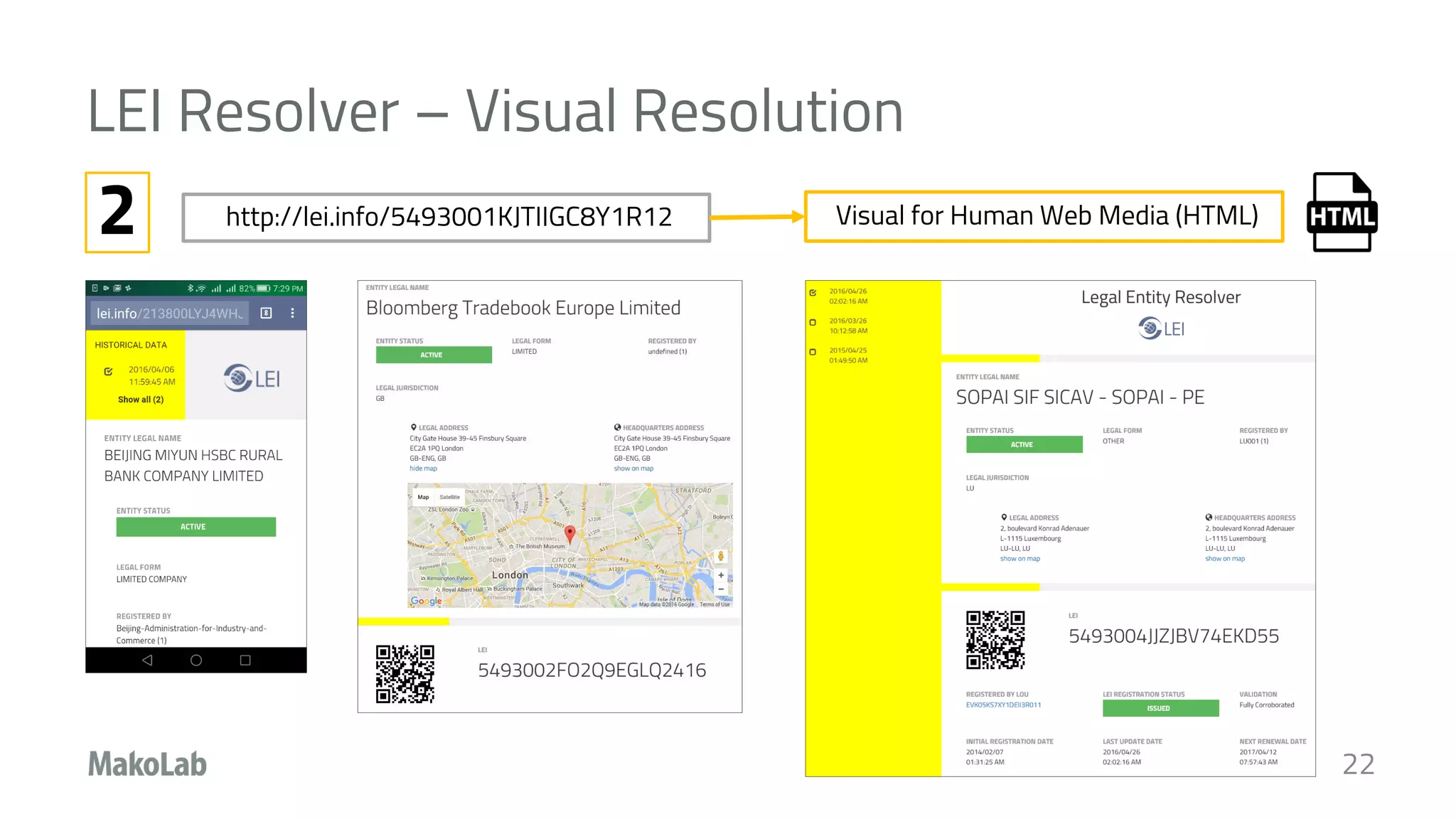
LEI Resolver – Visual Resolution
http://lei.info/5493001KJTIIGC8Y1R12 Visual for Human Web Media (HTML)2
22
LEI Resolver – Data for machine consumption
http://lei.info/5493001KJTIIGC8Y1R12 Data for Machine consumption (RDF)
RDF Graphs can be returned
in multiple formats:
2
 rdf+xml
 x-turtle
 n-triples
 Trig
 rdf+n3
 n-quads
 ld+json
 owl+xml
 turtle
 trix
 n3
 text/plain
 x-nquads
23
MakoLab LEI Blockchain Proof of Concept
The fundamental principles for the POC:
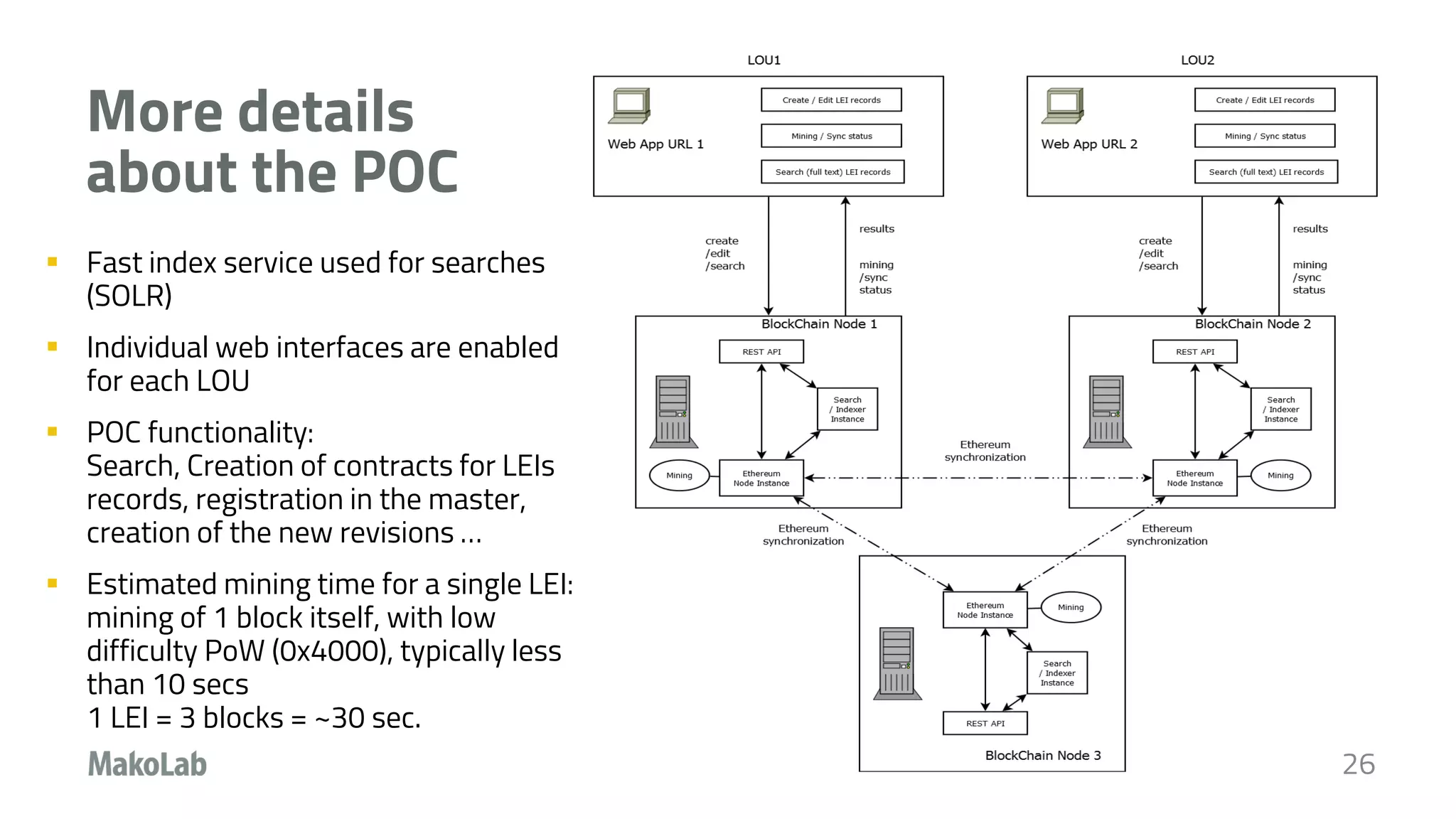
 Modelling a small consortium blockchain (only 3 nodes for the POC)
 Using Ethereum as smart contract platform
 Ethereum clients form a private network of participants
 Each client synchronizes its blockchain with others
 Three LOUs (Local Operating Units) modelled
 Clients are connected in a distributed cluster
24
MakoLab’s LEI
Proof-of-Concept
 Ethereum nodes (run as GETH
processes) are interfaced using
WEB3.js library
 node.js is used as a primary layer on
top of GETH and as a web server to
access the blockchain
 Additional logic is delivered by a layer
of Python scripts
 LEI data is represented as JSON-LD
objects
 Web application Front-End JS code
allows for retrieval, entry and update
of data
 Single node is: 8GB/4 cores/ 3,2
GHz/Intel i7
25
More details
about the POC
 Fast index service used for searches
(SOLR)
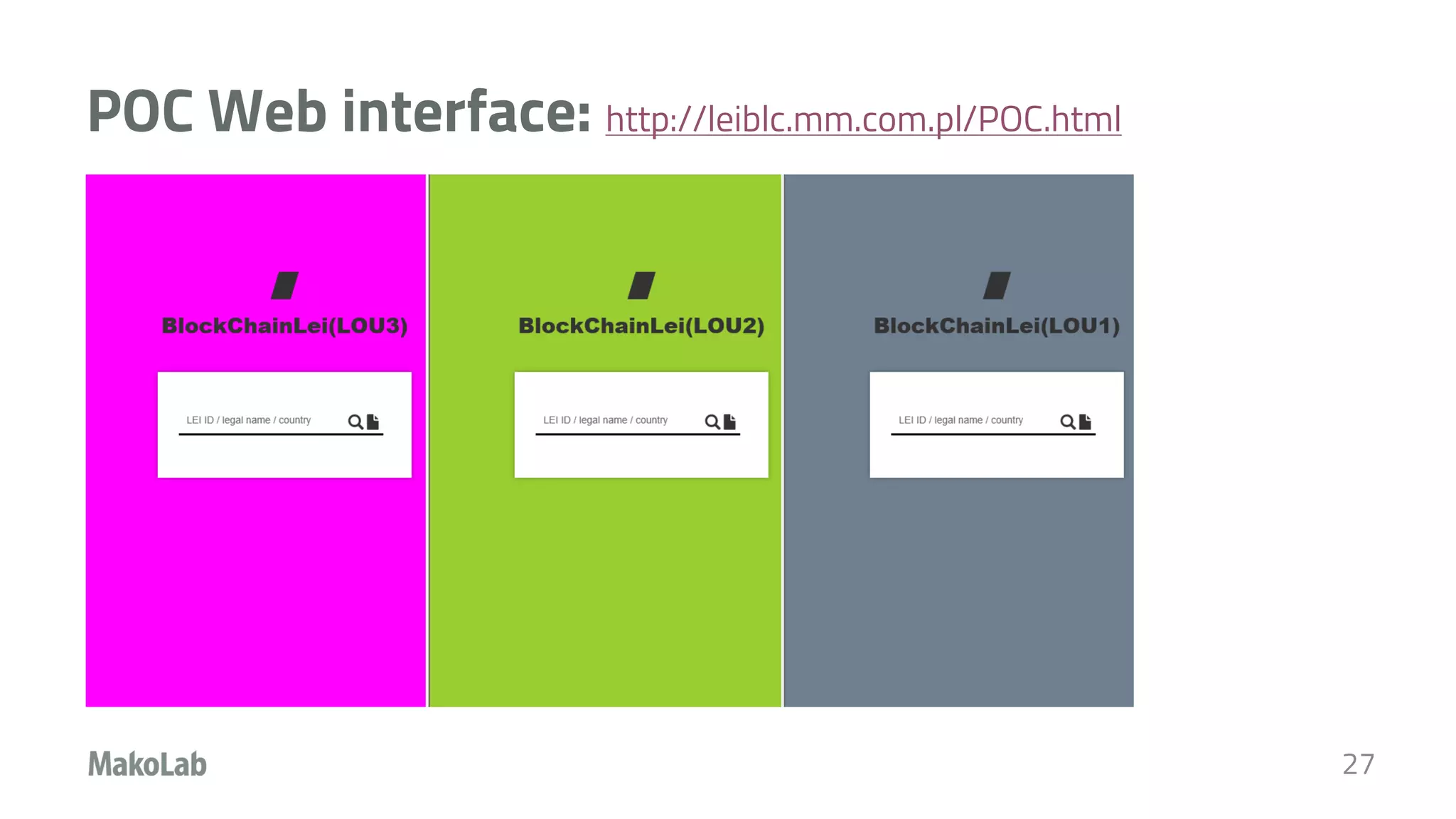
 Individual web interfaces are enabled
for each LOU
 POC functionality:
Search, Creation of contracts for LEIs
records, registration in the master,
creation of the new revisions …
 Estimated mining time for a single LEI:
mining of 1 block itself, with low
difficulty PoW (0x4000), typically less
than 10 secs
1 LEI = 3 blocks = ~30 sec.
26
POC Web interface: http://leiblc.mm.com.pl/POC.html
27
POC Web interface and JSON-LD LEI representation
28
Lessons Learned from the LEI POC
 Ethereum is a very good platform for building a Digital Identifiers Blockchain based
system
 However, Blockchain software is not enough to build a fully functional identification
system
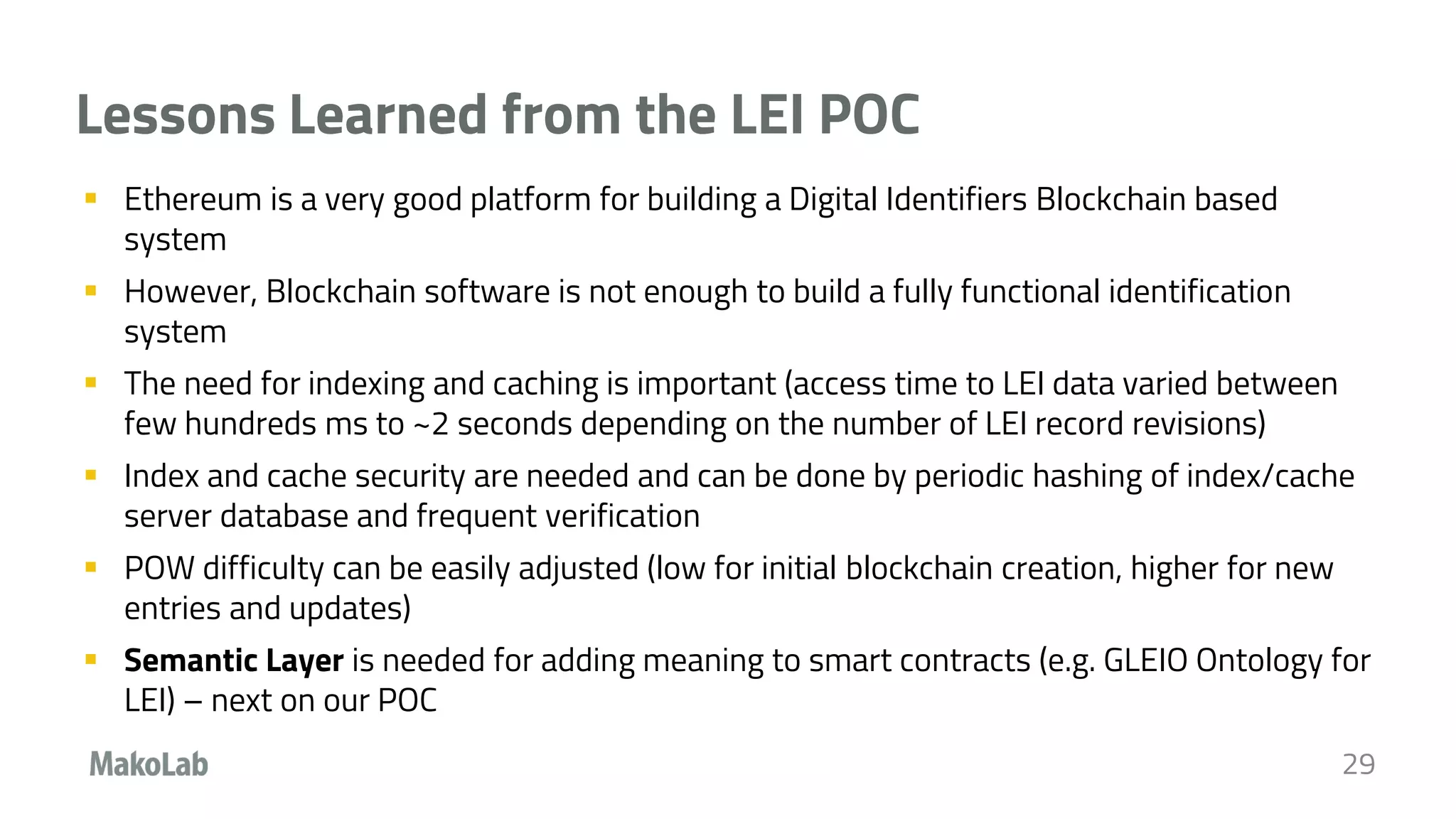
 The need for indexing and caching is important (access time to LEI data varied between
few hundreds ms to ~2 seconds depending on the number of LEI record revisions)
 Index and cache security are needed and can be done by periodic hashing of index/cache
server database and frequent verification
 POW difficulty can be easily adjusted (low for initial blockchain creation, higher for new
entries and updates)
 Semantic Layer is needed for adding meaning to smart contracts (e.g. GLEIO Ontology for
LEI) – next on our POC
29
Conclusions
 Blockchain technology is the ideal choice for Digital Identifiers working in the public space
 Blockchain offers non-repudiation, persistence, fault-tolerant operation, security
(authenticity), trust and low-cost decentralized management
 For Identifiers assigned by distributed system of affiliated organizations (like RAs for DOI
or LOUs for LEI) – the consortium Blockchains form the ideal organizational framework
 The ability to resolve the identifiers to different forms requires additional software
solutions
 Next steps in our Blockchain research will include:
 Adding a semantic layer to blockchain data
 Adding linked data resolution mechanisms
 Moving the interface layer to Ethereum to .net technology
 Getting ALL current LEI data to the blockchain
30
31
Contact
Dominik Kuziński
MakoLab SA
Rzgowska 30
93-172 Łódź
Poland
dominik.kuzinski@makolab.com
Brandon Pate
MakoLab USA Inc.
20 West University Ave.,
Gainesville, FL 32601
USA
brandon.pate@makolab.com
Mirek Sopek
MakoLab SA
Demokratyczna 46
93-430 Lodz
Poland
+48 600 814 537
sopek@makolab.com

Blockchain for Digital Identifiers

  • 1.
    Blockchain for Digital Identifiers ImprovingData Openness, Security and Persistence in the modern world. Dr Mirek Sopek MakoLab SA, Poland
  • 2.
    Presentation plan  DigitalIdentifiers and their challenges  Why Blockchain?  Examples of Blockchain use for Identification  Our Case Studies: DOI (Digital Object Identifier) and LEI (Legal Entity Identifier)  LEI Proof-of-Concept – fully functional software  Lessons learned from the POC  Conclusions 2
  • 3.
    Digital Identifiers andtheir challenges  Uniqueness – “Who is Who” without doubts  Openness - accessible free of charge as a “broad public good ”  Decentralization of their generation/assignment  Bi-directional non-repudiation  Authenticity  Resilience to system failures 3
  • 4.
    Digital Identifiers Examples LEI – Legal Entity Identifiers  ISIN – International Securities Identification Number (by ANNA)  Financial Instrument Global Identifier (Bloomberg FIGI)  Companies Registration Numbers (CRN)  VAT Numbers  Electronic Product Codes (EPC: GS1, EAN codes, etc)  DOI – Digital Object Identifiers  VIN – Vehicle Identification Number  GPII – Global Patient Identifier 4
  • 5.
    Why Blockchain? -I  Non-repudiation of identities and transactions  Immutability of data  Data openness  Decentralization of processing  Lowering the transactions costs in distributed organizations  Transparency to internal stakeholders and regulators  Resilience to system failures 5
  • 6.
    Why Blockchain? -II  Trust guaranteed by mathematics  Efficient replication mechanisms  Far-reaching democratization of Digital Identifiers generation (for specific types of identifiers)  Ability to restrict generation of identifiers to authorized agents or institutions.  Diversification of targets: institutions, legal and real persons, datasets and devices. 6
  • 7.
    Blockchain - ametaphor 7 Open Data carved in stone
  • 8.
    Existing uses ofBlockchain for Identifiers  Blockstack (“ …the first implementation of a decentralized DNS system on top of the Bitcoin blockchain”)  Namecoin (The cryptocurrency with applications for naming ( .bit domain) )  … and more: ShoCard, Hypr, BlockAuth, CryptID … 8
  • 9.
    Blockchain evolution  Blockchain1.0 – Bitcoin and other Crypto Currencies “The deployment of cryptocurrencies in applications related to cash, such as currency transfer, remittance, and digital payment systems”  Blockchain 2.0 – Contracts and Identities “The entire slate of economic, market, and financial applications using the blockchain that are more extensive than simple cash transactions: stocks, bonds, futures, loans, mortgages, titles, smart property, and smart contracts”  Blockchain 3.0 – Applications “Beyond currency, finance, and markets—particularly in the areas of government, health, science, literacy, culture, and art.” Quotations from: “Blockchain” by Melanie Swan, O'Reilly Media, Inc. 9
  • 10.
    The idea ofusing Blockchain 2.0 Smart Contracts for Identification Services
  • 11.
    Using Blockchain 2.0Smart Contracts for Identification Services. I The central tenet of our approach is to treat a single record for any entity to be identified by some KEY as "atomic", in the sense of being curated as a single unit of data, by the authority that assigns the KEYs. Then, the representation of a single “atomic” record can be considered as a state for a single smart contract. 11
  • 12.
    Using Blockchain 2.0Smart Contracts for Identification Services. II Each such contract would offer a method for accessing the representation, and a dynamic data structure that holds "revisions" of the representation. That is, when the record changes globally, its new representation would be added to the state of the contract. Such contract can hold many revisions of the representation, bound only by the capabilities of the network’s global storage. We call such contract "entity contract". 12
  • 13.
    Using Blockchain 2.0Smart Contracts for Identification Services. III Together with entity contracts, someone can devise one or more "master contracts", that keep track of individual entity contracts and make accessing an easier process. One must remember, however, about the trade-off between complexity of such contracts and their cost of creation and execution. 13
  • 14.
    Using Blockchain 2.0Smart Contracts for Identification Services. IV The suggested architecture for the Digital Identifiers on the blockchain is: Consortium blockchains Vitalik Buterin - https://blog.ethereum.org/2015/08/07/on-public-and-private-blockchains/ : A consortium blockchain is a blockchain where the consensus process is controlled by a pre-selected set of nodes; for example, one might imagine a consortium of 15 financial institutions, each of which operates a node and of which 10 must sign every block in order for the block to be valid. The right to read the blockchain may be public, or restricted to the participants, and there are also hybrid routes such as the root hashes of the blocks being public together with an API that allows members of the public to make a limited number of queries and get back cryptographic proofs of some parts of the blockchain state. These blockchains may be considered “partially decentralized”. 14
  • 15.
    Case studies: DOI –Digital Object Identifiers LEI – Legal Entity Identifiers
  • 16.
    Case Study I– DOI – Digital Object Identifiers The Digital Object Identifier (DOI) system is a generic framework allowing for the identification of any digital object across global computer networks. The key features of the DOI system include persistence, fault-tolerant operation, security and ability to resolve its identifiers to different forms, including metadata about objects and pointers to their object location. The DOI system is part of an ISO standard (ISO 26324). Example: https://doi.org/10.1109/5.771073 16
  • 17.
    DOI infrastructure today– HANDLE system 17 The Handle System, is a set of protocols concerned with assignment, resolution and management of persistent identifiers for digital objects and other resources on a network. The system was originally developed by Bob Kahn, (contributor to the invention of the TCP/IP protocol), with active participation of DARPA in the framework of CNRI. CNRI develops and manages the system through today.
  • 18.
    Our current activity 18 Themain idea behind the case study is the way we envision the use of Blockchain technology as the back-end infrastructure for the DOI (Digital Object Identifier) system, effectively improving or replacing the aging Handle system. The project has been proposed to US National Science Foundation by our American Joint-Venture: Chemical Semantics, Inc.
  • 19.
    Two case studies: DOI– Digital Object Identifiers LEI – Legal Entity Identifiers
  • 20.
    Case Study I– LEI – Legal Entity Identifier „The Legal Entity Identifier (LEI) is a 20-digit, alpha-numeric code based on the ISO 17442 standard developed by the International Organization for Standardization (ISO). It connects to key reference information that enables clear and unique identification of legal entities participating in financial transactions. Simply put, the publicly available LEI data pool can be regarded as a global directory, which greatly enhances transparency in the global marketplace.” https://www.gleif.org/en/lei-focus/introducing-the-legal-entity-identifier-lei 20
  • 21.
    MakoLab LEI Resolver– how does it work? 5493001KJTIIGC8Y1R12 Create URI http://lei.info/5493001KJTIIGC8Y1R12 Visual for Human Web Media (HTML) Data for Machine consumption (RDF) Picture for Paper Media (QR-Code) 1 2 http://lei.info/5493001KJTIIGC8Y1R12 21
  • 22.
    LEI Resolver –Visual Resolution http://lei.info/5493001KJTIIGC8Y1R12 Visual for Human Web Media (HTML)2 22
  • 23.
    LEI Resolver –Data for machine consumption http://lei.info/5493001KJTIIGC8Y1R12 Data for Machine consumption (RDF) RDF Graphs can be returned in multiple formats: 2  rdf+xml  x-turtle  n-triples  Trig  rdf+n3  n-quads  ld+json  owl+xml  turtle  trix  n3  text/plain  x-nquads 23
  • 24.
    MakoLab LEI BlockchainProof of Concept The fundamental principles for the POC:  Modelling a small consortium blockchain (only 3 nodes for the POC)  Using Ethereum as smart contract platform  Ethereum clients form a private network of participants  Each client synchronizes its blockchain with others  Three LOUs (Local Operating Units) modelled  Clients are connected in a distributed cluster 24
  • 25.
    MakoLab’s LEI Proof-of-Concept  Ethereumnodes (run as GETH processes) are interfaced using WEB3.js library  node.js is used as a primary layer on top of GETH and as a web server to access the blockchain  Additional logic is delivered by a layer of Python scripts  LEI data is represented as JSON-LD objects  Web application Front-End JS code allows for retrieval, entry and update of data  Single node is: 8GB/4 cores/ 3,2 GHz/Intel i7 25
  • 26.
    More details about thePOC  Fast index service used for searches (SOLR)  Individual web interfaces are enabled for each LOU  POC functionality: Search, Creation of contracts for LEIs records, registration in the master, creation of the new revisions …  Estimated mining time for a single LEI: mining of 1 block itself, with low difficulty PoW (0x4000), typically less than 10 secs 1 LEI = 3 blocks = ~30 sec. 26
  • 27.
    POC Web interface:http://leiblc.mm.com.pl/POC.html 27
  • 28.
    POC Web interfaceand JSON-LD LEI representation 28
  • 29.
    Lessons Learned fromthe LEI POC  Ethereum is a very good platform for building a Digital Identifiers Blockchain based system  However, Blockchain software is not enough to build a fully functional identification system  The need for indexing and caching is important (access time to LEI data varied between few hundreds ms to ~2 seconds depending on the number of LEI record revisions)  Index and cache security are needed and can be done by periodic hashing of index/cache server database and frequent verification  POW difficulty can be easily adjusted (low for initial blockchain creation, higher for new entries and updates)  Semantic Layer is needed for adding meaning to smart contracts (e.g. GLEIO Ontology for LEI) – next on our POC 29
  • 30.
    Conclusions  Blockchain technologyis the ideal choice for Digital Identifiers working in the public space  Blockchain offers non-repudiation, persistence, fault-tolerant operation, security (authenticity), trust and low-cost decentralized management  For Identifiers assigned by distributed system of affiliated organizations (like RAs for DOI or LOUs for LEI) – the consortium Blockchains form the ideal organizational framework  The ability to resolve the identifiers to different forms requires additional software solutions  Next steps in our Blockchain research will include:  Adding a semantic layer to blockchain data  Adding linked data resolution mechanisms  Moving the interface layer to Ethereum to .net technology  Getting ALL current LEI data to the blockchain 30
  • 31.
    31 Contact Dominik Kuziński MakoLab SA Rzgowska30 93-172 Łódź Poland dominik.kuzinski@makolab.com Brandon Pate MakoLab USA Inc. 20 West University Ave., Gainesville, FL 32601 USA brandon.pate@makolab.com Mirek Sopek MakoLab SA Demokratyczna 46 93-430 Lodz Poland +48 600 814 537 sopek@makolab.com