OpenCrypto
Unchaining the
JavaCard Ecosystem
https://boucycrypto.com
Who we are
Vasilios Mavroudis
Doctoral Researcher, UCL
George Danezis
Professor, UCL
Petr Svenda
Assistant Professor, MUNI
Co-founder, Enigma Bridge
Dan Cvrcek
Co-founder, Enigma Bridge
Contents
1.  Smart Cards
2.  Java Cards
3.  What’s the problem?
4.  Our solution
5.  Tools for developers
6.  More to come...
SmartCards
- GSM SIM modules
- Digital signatures
- Bank payment card (EMV standard)
- System authentication
- Operations authorizations
- ePassports
- Secure storage and encryption device
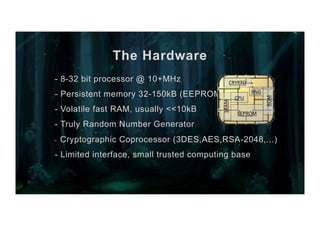
The Hardware
- 8-32 bit processor @ 10+MHz
- Persistent memory 32-150kB (EEPROM)
- Volatile fast RAM, usually <<10kB
- Truly Random Number Generator
-  Cryptographic Coprocessor (3DES,AES,RSA-2048,...)
- Limited interface, small trusted computing base
EEPROM	
CPU	
CRYPTO	
SRAM	
ROM	
RNG
The Hardware
Intended for physically unprotected environment
- NIST FIPS140-2 standard, Level 4
- Common Criteria EAL4+/5+/6
Tamper protection
- Tamper-evidence (visible if physically manipulated)
- Tamper-resistance (can withstand physical attack)
- Tamper-response (erase keys…)
Protection against side-channel attacks (power,EM,fault)
Periodic tests of TRNG functionality
Why we like smartcards
§  Number of vendors and independent HW platforms
§  High-level of security (CC EAL5+, FIPS 140-2)
§  Secure memory and storage
§  Fast cryptographic coprocessor
§  Programmable secure execution environment
§  High-quality and very fast RNG
§  On-card asymmetric key generation
Operating Systems
.NET for smartcards
- Similar to JavaCard, but C#
- Limited market penetration
JavaCard
- Open platform from Sun/
Oracle
- Applets portable between
cards
MultOS
- Multiple supported languages
- Native compilation
- Certified to high-levels
- Often used in bank cards
javacard
History
Until 1996:
- Every major smart card vendor had a proprietary solution
- Smart card issuers were asking for interoperability between vendors
In 1997:
- The Java Card Forum was founded
- Sun Microsystems was invited as owner of the Java technology
- And smart card vendors became Java Card licensees
The Java Card Spec is born
Sun was responsible for managing:
§  The Java Card Platform Specification
§  The reference implementation
§  A compliance kit
Today, 20 years after:
§  Oracle releases the Java Card specifications (VM, RE, API)
§  and provides the SDK for applet development
The API Specification
-  Encryption, authentication, & other algorithms
-  Ensures interoperability
-  JC straightforward to use
- Implementations are certified for functionality and security
A full ecosystem with laboratories & certification authorities
A success!
20 Billion Java Cards sold in total
3 Billion Javacards sold per year
1 Billion contactless cards in 2016
Common Use Cases:
- Telecommunications
- Payments
- Loyalty Cards
JavaCardForum
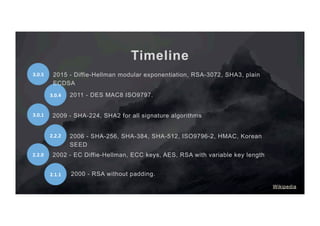
Timeline
3.0.5	
3.0.4	
3.0.1	
2.2.2	
2.2.0	
2.1.1	
2015 - Diffie-Hellman modular exponentiation, RSA-3072, SHA3, plain
ECDSA
2011 - DES MAC8 ISO9797.
Wikipedia
2009 - SHA-224, SHA2 for all signature algorithms
2006 - SHA-256, SHA-384, SHA-512, ISO9796-2, HMAC, Korean
SEED
2002 - EC Diffie-Hellman, ECC keys, AES, RSA with variable key length
2000 - RSA without padding.
Bad Omens I
Compliance
§  RMI introduced in Java Card Spec. 2.2 (2003) → never adopted
§  Java Card 3.0 Connected (2009) → never implemented
§  Annotation framework for security interoperability → not adopted
-  Vendors implement a subset of the Java Card specification:
q  No list of algorithms supported
q  The specific card must be tested
Bad Omens II
Three years late
- 1 year to develop the new platform after the release of a specification
- 1 year to get functional and security certification
- 1 year to produce and deploy the cards
Interoperability
- Most cards run a single applet
- Most applets written & tested for a single card
- Most applets run only on a single vendor’s cards
Walled Gardens
Proprietary APIs
- Additional classes offering various desirable features
- Newer Algorithms, Math, Elliptic Curves…
- Vendor specific, interoperability is lost
-  Only for large customers
-  Small dev houses rarely gain access
- Very secretive: NDAs, Very limited info on the internet
Open crypto
Motivation
- Technology moves increasingly fast, 3 years is a long time
- Patchy coverage of the latest crypto algorithms
-  in-the-spec ≠ in-the-market
A new landscape:
-  IoT needs a platform with these characteristics
-  Lots of small dev. houses
-  Java devs in awe → No Integers, Primitive Garbage Collection
- People want to build new things!!
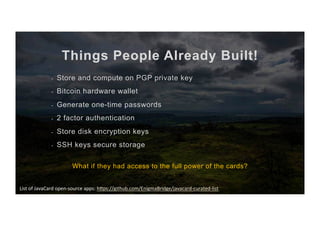
Things People Already Built!
-  Store and compute on PGP private key
-  Bitcoin hardware wallet
-  Generate one-time passwords
-  2 factor authentication
-  Store disk encryption keys
-  SSH keys secure storage
What if they had access to the full power of the cards?
List	of	JavaCard	open-source	apps:	hBps://github.com/EnigmaBridge/javacard-curated-list
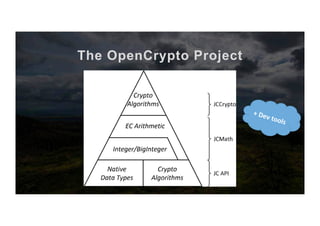
The OpenCrypto Project
+	Dev	tools
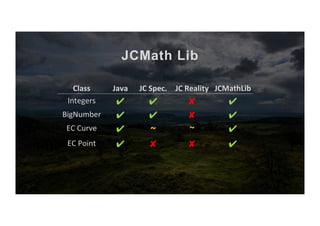
JCMath Lib
Class	 Java	 JC	Spec.	 JC	Reality	 JCMathLib	
Integers	 ✔	 ✔	 ✘	 ✔	
BigNumber	 ✔	 ✔	 ✘	 ✔	
EC	Curve	 ✔	 ~	 ~	 ✔	
EC	Point	 ✔	 ✘	 ✘	 ✔
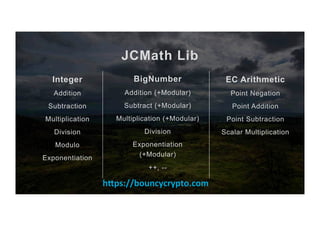
JCMath Lib
Integer
Addition
Subtraction
Multiplication
Division
Modulo
Exponentiation
BigNumber
Addition (+Modular)
Subtract (+Modular)
Multiplication (+Modular)
Division
Exponentiation
(+Modular)
++, --
EC Arithmetic
Point Negation
Point Addition
Point Subtraction
Scalar Multiplication
h?ps://bouncycrypto.com
package opencrypto.jcmathlib;
public class ECExample extends javacard.framework.Applet {
final static byte[] ECPOINT = {(byte)0x04, (byte) 0x3B… };
final static byte[] SCALAR = {(byte) 0xE8, (byte) 0x05… };
MLConfig mlc;
ECCurve curve;
ECPoint point1, point2;
public ECExample() {
// Pre-allocate all helper structures
mlc = new MLConfig((short) 256);
// Pre-allocate standard SecP256r1 curve and two EC points on this curve
curve = new ECCurve(false, SecP256r1.p, SecP256r1.a,
SecP256r1.b, SecP256r1.G, SecP256r1.r, mlc);
point1 = new ECPoint(curve, mlc);
point2 = new ECPoint(curve, mlc);
}
…
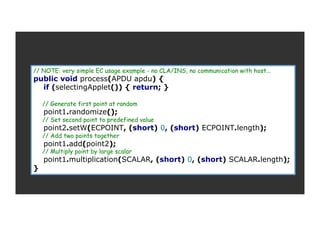
// NOTE: very simple EC usage example - no CLA/INS, no communication with host...
public void process(APDU apdu) {
if (selectingApplet()) { return; }
// Generate first point at random
point1.randomize();
// Set second point to predefined value
point2.setW(ECPOINT, (short) 0, (short) ECPOINT.length);
// Add two points together
point1.add(point2);
// Multiply point by large scalar
point1.multiplication(SCALAR, (short) 0, (short) SCALAR.length);
}
Building the Building Blocks
CPU is programmable! → But very slow ✘
Coprocessor is fast! → No direct access ✘
Hybrid solution
- Exploit API calls known to use the coprocessor
- CPU for everything else
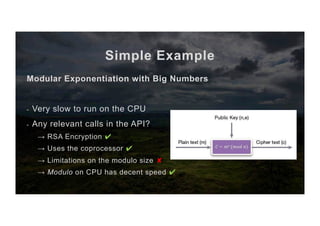
Simple Example
Modular Exponentiation with Big Numbers
-  Very slow to run on the CPU
-  Any relevant calls in the API?
→ RSA Encryption ✔
→ Uses the coprocessor ✔
→ Limitations on the modulo size ✘
→ Modulo on CPU has decent speed ✔
EC Point-scalar multiplication
Elliptic Curves in 30
seconds:
-  P, Q are elliptic curve points
-  Each point has coordinates
(x,y)
-  P+Q: Just draw two lines
-  P+P: Very similar
-  P+P = 2P
-  What about 3P, 4P, 1000P?
EC Point-scalar multiplication
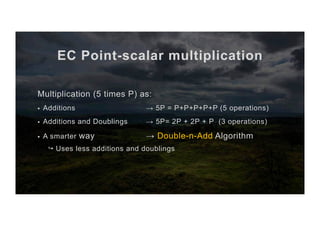
Multiplication (5 times P) as:
§  Additions → 5P = P+P+P+P+P (5 operations)
§  Additions and Doublings → 5P= 2P + 2P + P (3 operations)
§  A smarter way → Double-n-Add Algorithm
↪ Uses less additions and doublings
EC Point-scalar multiplication
-  Double & Add → Too many operations to use the CPU
-  We need another operation that will use the coprocessor
Fail	
Double	
&	
Add
EC Point-scalar multiplication
-  Double & Add → Too many operations to use the CPU
-  We need another operation that will use the coprocessor
-  Back to the API specification…
API?	
Fail	
Double	
&	
Add
EC Point-scalar multiplication
-  Key agreement using ECDH *is* scalar multiplication!
-  API Method: ALG_EC_DH_PLAIN
- Description: Diffie-Hellman (DH) secret value derivation
primitive as per NIST Special Publication 800-56Ar2.
API?	
ECDH	
Fail	
Double	
&	
Add
EC Point-scalar multiplication
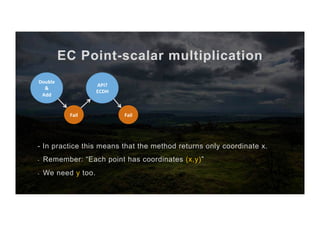
- In practice this means that the method returns only coordinate x.
-  Remember: “Each point has coordinates (x,y)”
-  We need y too.
API?	
ECDH	
Fail	
Double	
&	
Add	
Fail
EC Point-scalar multiplication
-  Can we somehow infer y?
-  EC formula: y2=x3+Ax+B
-  We know all unknown variables except y!
API?	
ECDH	
Fail	
Double	
&	
Add	
Fail	
y?
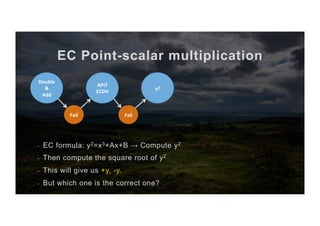
EC Point-scalar multiplication
-  EC formula: y2=x3+Ax+B → Compute y2
-  Then compute the square root of y2
-  This will give us +y, -y.
-  But which one is the correct one?
API?	
ECDH	
Fail	
Double	
&	
Add	
Fail	
y?
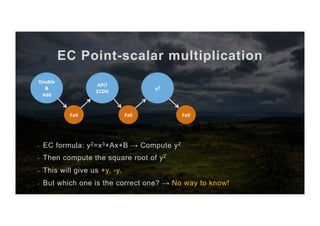
EC Point-scalar multiplication
-  EC formula: y2=x3+Ax+B → Compute y2
-  Then compute the square root of y2
-  This will give us +y, -y.
-  But which one is the correct one? → No way to know!
API?	
ECDH	
Fail	
Double	
&	
Add	
Fail	
y?	
Fail
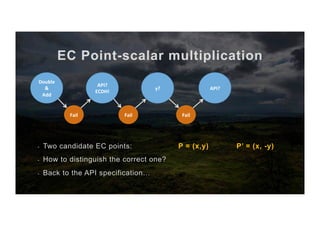
EC Point-scalar multiplication
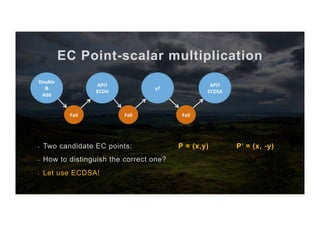
-  Two candidate EC points: P = (x,y) P’ = (x, -y)
-  How to distinguish the correct one?
-  Back to the API specification…
API?	
ECDH!	
Fail	
Double	
&	
Add	
Fail	
y?	
Fail	
API?
EC Point-scalar multiplication
-  Two candidate EC points: P = (x,y) P’ = (x, -y)
-  How to distinguish the correct one?
-  Let use ECDSA!
API?	
ECDH	
Fail	
Double	
&	
Add	
Fail	
y?	
Fail	
API?	
ECDSA
EC Point-scalar multiplication
-  ECDSA uses:
→ A private key to sign a plaintext.
→ A public key to verify a signature.
Two candidate EC points P = (x,y) P’ = (x, -y) and a scalar x
API?	
ECDH	
Fail	
Double	
&	
Add	
Fail	
y?	
Fail	
API?	
ECDSA
EC Point-scalar multiplication
-  Two candidate EC points P = (x,y) P’ = (x, -y) and a scalar x
-  ECDSA abuse:
→ A private key to sign a plaintext ← This is our scalar
→ A public key to verify a signature. ← This is our P and P’
- 
API?	
ECDH	
Fail	
Double	
&	
Add	
Fail	
y?	
Fail	
API?	
ECDSA
EC Point-scalar multiplication
-  Two candidate EC points P = (x,y) P’ = (x, -y) and a scalar x
-  ECDSA abuse:
→ A private key to sign a plaintext ← This is our scalar
→ A public key to verify a signature. ← This is our P and P’
-  Then try to verify with the two points and see which one it is. ■
API?	
ECDH	
Fail	
Double	
&	
Add	
Fail	
y?	
Fail	
API?	
ECDSA	
Done!
EC Point-scalar multiplication
The full algorithm
1.  Input scalar x and point P
2.  Abuse ECDH key exchange to get [x,+y,-y]
3.  Compute the two candidate points P, P’
4.  Sign with scalar x as priv key
5.  Try to verify with P as pub key
6.  If it works → It’s P
else → It’s P’
7.  return P or P’
(co-processor)
(CPU)
(co-processor)
(co-processor)
JCMathLib Performance
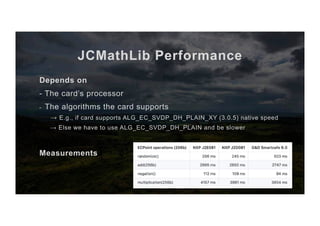
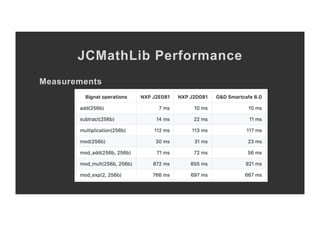
Depends on
- The card’s processor
-  The algorithms the card supports
→ E.g., if card supports ALG_EC_SVDP_DH_PLAIN_XY (3.0.5) native speed
→ Else we have to use ALG_EC_SVDP_DH_PLAIN and be slower
Measurements
JCMathLib Performance
Measurements
JCMathLib Convenience Features
- We take care of the low-level/dirty stuff:
q  Unified memory management of shared objects
q  Safe reuse of pre-allocated arrays with locking and automated
erasure
q  Adapt placement of data in RAM or EEPROM for optimal
performance
-  Supports both physical cards and simulators
q  JCardSim pull requests
Profiler
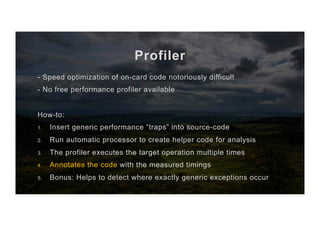
- Speed optimization of on-card code notoriously difficult
- No free performance profiler available
How-to:
1.  Insert generic performance “traps” into source-code
2.  Run automatic processor to create helper code for analysis
3.  The profiler executes the target operation multiple times
4.  Annotates the code with the measured timings
5.  Bonus: Helps to detect where exactly generic exceptions occur
Performance profiler
private short multiplication_x_KA(Bignat scalar, byte[] outBuffer, short outBufferOffset) {
priv.setS(scalar.as_byte_array(), (short) 0, scalar.length());
keyAgreement.init(priv);
short len = this.getW(point_arr1, (short) 0);
len = keyAgreement.generateSecret(point_arr1, (short) 0, len, outBuffer, outBufferOffset);
return COORD_SIZE;
}	
private short multiplication_x_KA(Bignat scalar, byte[] outBuffer, short outBufferOffset) {
PM.check(PM.TRAP_ECPOINT_MULT_X_0);
priv.setS(scalar.as_byte_array(), (short) 0, scalar.length());
PM.check(PM.TRAP_ECPOINT_MULT_X_0);
keyAgreement.init(priv);
PM.check(PM.TRAP_ECPOINT_MULT_X_0);
short len = this.getW(point_arr1, (short) 0);
PM.check(PM.TRAP_ECPOINT_MULT_X_0);
len = keyAgreement.generateSecret(point_arr1, (short) 0, len, outBuffer, outBufferOffset);
PM.check(PM.TRAP_ECPOINT_MULT_X_0);
return COORD_SIZE;
}	
private short multiplication_x_KA(Bignat scalar, byte[] outBuffer, short outBufferOffset) {
PM.check(PM.TRAP_ECPOINT_MULT_X_1);
priv.setS(scalar.as_byte_array(), (short) 0, scalar.length());
PM.check(PM.TRAP_ECPOINT_MULT_X_2);
keyAgreement.init(priv);
PM.check(PM.TRAP_ECPOINT_MULT_X_3);
short len = this.getW(point_arr1, (short) 0);
PM.check(PM.TRAP_ECPOINT_MULT_X_4);
len = keyAgreement.generateSecret(point_arr1, (short) 0, len, outBuffer, outBufferOffset);
PM.check(PM.TRAP_ECPOINT_MULT_X_5);
return COORD_SIZE;
}	
Client-side	tesQng	code	
private short multiplication_x_KA(Bignat scalar, byte[] outBuffer, short outBufferOffset) {
PM.check(PM.TRAP_ECPOINT_MULT_X_1); // 40 ms (gd60,1500968219581)
priv.setS(scalar.as_byte_array(), (short) 0, scalar.length());
PM.check(PM.TRAP_ECPOINT_MULT_X_2); // 12 ms (gd60,1500968219581)
keyAgreement.init(priv);
PM.check(PM.TRAP_ECPOINT_MULT_X_3); // 120 ms (gd60,1500968219581)
short len = this.getW(point_arr1, (short) 0);
PM.check(PM.TRAP_ECPOINT_MULT_X_4); // 9 ms (gd60,1500968219581)
len = keyAgreement.generateSecret(point_arr1, (short) 0, len, outBuffer, outBufferOffset);
PM.check(PM.TRAP_ECPOINT_MULT_X_5); // 186 ms (gd60,1500968219581)
return COORD_SIZE;
}
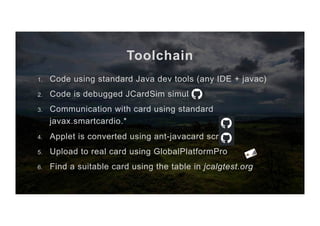
Toolchain
1.  Code using standard Java dev tools (any IDE + javac)
2.  Code is debugged JCardSim simulator
3.  Communication with card using standard
javax.smartcardio.*
4.  Applet is converted using ant-javacard scripts
5.  Upload to real card using GlobalPlatformPro
6.  Find a suitable card using the table in jcalgtest.org
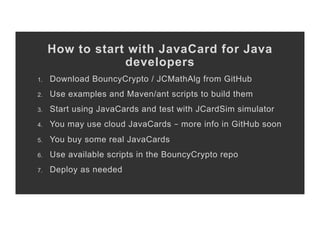
How to start with JavaCard for Java
developers
1.  Download BouncyCrypto / JCMathAlg from GitHub
2.  Use examples and Maven/ant scripts to build them
3.  Start using JavaCards and test with JCardSim simulator
4.  You may use cloud JavaCards – more info in GitHub soon
5.  You buy some real JavaCards
6.  Use available scripts in the BouncyCrypto repo
7.  Deploy as needed
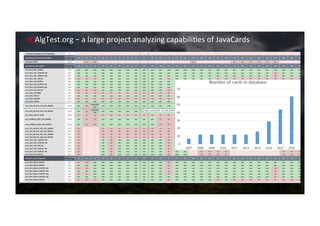
JCAlgTest.org	–	a	large	project	analyzing	capabiliNes	of	JavaCards
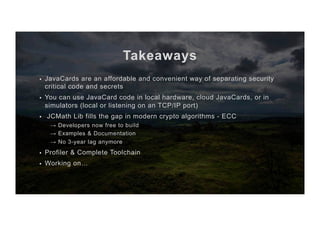
Takeaways
§  JavaCards are an affordable and convenient way of separating security
critical code and secrets
§  You can use JavaCard code in local hardware, cloud JavaCards, or in
simulators (local or listening on an TCP/IP port)
§  JCMath Lib fills the gap in modern crypto algorithms - ECC
→ Developers now free to build
→ Examples & Documentation
→ No 3-year lag anymore
§  Profiler & Complete Toolchain
§  Working on…
Takeaways
§  JavaCards are an affordable and convenient way of separating security
critical code and secrets
§  You can use JavaCard code in local hardware, cloud JavaCards, or in
simulators (local or listening on an TCP/IP port)
§  JCMath Lib fills the gap in modern crypto algorithms - ECC
→ Developers now free to build
→ Examples & Documentation
→ No 3-year lag anymore
§  Profiler & Complete Toolchain
§  Working on…
§  Toolchain, examples, quick get-started integration scenarios and templates
Q & A
OpenCrypto
Unchaining the JavaCard
Ecosystem
https://bouncycrypto.com
Related Work
Features	 Details	
	
Big	Natural	Class	
•  Uses	CPU	
•  Card-specific	
•  Not	maintained	
Similar	to	Java	BigInteger	 •  Part	of	project	
•  Source	code	dump	
MutableBigInteger	Class	 •  Part	of	project	
•  Source	code	dump

One library for all Java encryption

  • 1.
  • 2.
    Who we are VasiliosMavroudis Doctoral Researcher, UCL George Danezis Professor, UCL Petr Svenda Assistant Professor, MUNI Co-founder, Enigma Bridge Dan Cvrcek Co-founder, Enigma Bridge
  • 3.
    Contents 1.  Smart Cards 2. Java Cards 3.  What’s the problem? 4.  Our solution 5.  Tools for developers 6.  More to come...
  • 4.
    SmartCards - GSM SIMmodules - Digital signatures - Bank payment card (EMV standard) - System authentication - Operations authorizations - ePassports - Secure storage and encryption device
  • 5.
    The Hardware - 8-32bit processor @ 10+MHz - Persistent memory 32-150kB (EEPROM) - Volatile fast RAM, usually <<10kB - Truly Random Number Generator -  Cryptographic Coprocessor (3DES,AES,RSA-2048,...) - Limited interface, small trusted computing base EEPROM CPU CRYPTO SRAM ROM RNG
  • 6.
    The Hardware Intended forphysically unprotected environment - NIST FIPS140-2 standard, Level 4 - Common Criteria EAL4+/5+/6 Tamper protection - Tamper-evidence (visible if physically manipulated) - Tamper-resistance (can withstand physical attack) - Tamper-response (erase keys…) Protection against side-channel attacks (power,EM,fault) Periodic tests of TRNG functionality
  • 7.
    Why we likesmartcards §  Number of vendors and independent HW platforms §  High-level of security (CC EAL5+, FIPS 140-2) §  Secure memory and storage §  Fast cryptographic coprocessor §  Programmable secure execution environment §  High-quality and very fast RNG §  On-card asymmetric key generation
  • 8.
    Operating Systems .NET forsmartcards - Similar to JavaCard, but C# - Limited market penetration JavaCard - Open platform from Sun/ Oracle - Applets portable between cards MultOS - Multiple supported languages - Native compilation - Certified to high-levels - Often used in bank cards
  • 9.
  • 10.
    History Until 1996: - Everymajor smart card vendor had a proprietary solution - Smart card issuers were asking for interoperability between vendors In 1997: - The Java Card Forum was founded - Sun Microsystems was invited as owner of the Java technology - And smart card vendors became Java Card licensees
  • 11.
    The Java CardSpec is born Sun was responsible for managing: §  The Java Card Platform Specification §  The reference implementation §  A compliance kit Today, 20 years after: §  Oracle releases the Java Card specifications (VM, RE, API) §  and provides the SDK for applet development
  • 12.
    The API Specification - Encryption, authentication, & other algorithms -  Ensures interoperability -  JC straightforward to use - Implementations are certified for functionality and security A full ecosystem with laboratories & certification authorities
  • 13.
    A success! 20 BillionJava Cards sold in total 3 Billion Javacards sold per year 1 Billion contactless cards in 2016 Common Use Cases: - Telecommunications - Payments - Loyalty Cards JavaCardForum
  • 14.
    Timeline 3.0.5 3.0.4 3.0.1 2.2.2 2.2.0 2.1.1 2015 - Diffie-Hellmanmodular exponentiation, RSA-3072, SHA3, plain ECDSA 2011 - DES MAC8 ISO9797. Wikipedia 2009 - SHA-224, SHA2 for all signature algorithms 2006 - SHA-256, SHA-384, SHA-512, ISO9796-2, HMAC, Korean SEED 2002 - EC Diffie-Hellman, ECC keys, AES, RSA with variable key length 2000 - RSA without padding.
  • 15.
    Bad Omens I Compliance § RMI introduced in Java Card Spec. 2.2 (2003) → never adopted §  Java Card 3.0 Connected (2009) → never implemented §  Annotation framework for security interoperability → not adopted -  Vendors implement a subset of the Java Card specification: q  No list of algorithms supported q  The specific card must be tested
  • 16.
    Bad Omens II Threeyears late - 1 year to develop the new platform after the release of a specification - 1 year to get functional and security certification - 1 year to produce and deploy the cards Interoperability - Most cards run a single applet - Most applets written & tested for a single card - Most applets run only on a single vendor’s cards
  • 17.
    Walled Gardens Proprietary APIs -Additional classes offering various desirable features - Newer Algorithms, Math, Elliptic Curves… - Vendor specific, interoperability is lost -  Only for large customers -  Small dev houses rarely gain access - Very secretive: NDAs, Very limited info on the internet
  • 18.
  • 19.
    Motivation - Technology movesincreasingly fast, 3 years is a long time - Patchy coverage of the latest crypto algorithms -  in-the-spec ≠ in-the-market A new landscape: -  IoT needs a platform with these characteristics -  Lots of small dev. houses -  Java devs in awe → No Integers, Primitive Garbage Collection - People want to build new things!!
  • 20.
    Things People AlreadyBuilt! -  Store and compute on PGP private key -  Bitcoin hardware wallet -  Generate one-time passwords -  2 factor authentication -  Store disk encryption keys -  SSH keys secure storage What if they had access to the full power of the cards? List of JavaCard open-source apps: hBps://github.com/EnigmaBridge/javacard-curated-list
  • 21.
  • 22.
    JCMath Lib Class Java JC Spec. JC Reality JCMathLib Integers ✔ ✔ ✘ ✔ BigNumber ✔ ✔ ✘ ✔ EC Curve ✔ ~ ~ ✔ EC Point ✔ ✘ ✘ ✔
  • 23.
    JCMath Lib Integer Addition Subtraction Multiplication Division Modulo Exponentiation BigNumber Addition (+Modular) Subtract(+Modular) Multiplication (+Modular) Division Exponentiation (+Modular) ++, -- EC Arithmetic Point Negation Point Addition Point Subtraction Scalar Multiplication h?ps://bouncycrypto.com
  • 24.
    package opencrypto.jcmathlib; public classECExample extends javacard.framework.Applet { final static byte[] ECPOINT = {(byte)0x04, (byte) 0x3B… }; final static byte[] SCALAR = {(byte) 0xE8, (byte) 0x05… }; MLConfig mlc; ECCurve curve; ECPoint point1, point2; public ECExample() { // Pre-allocate all helper structures mlc = new MLConfig((short) 256); // Pre-allocate standard SecP256r1 curve and two EC points on this curve curve = new ECCurve(false, SecP256r1.p, SecP256r1.a, SecP256r1.b, SecP256r1.G, SecP256r1.r, mlc); point1 = new ECPoint(curve, mlc); point2 = new ECPoint(curve, mlc); } …
  • 25.
    // NOTE: verysimple EC usage example - no CLA/INS, no communication with host... public void process(APDU apdu) { if (selectingApplet()) { return; } // Generate first point at random point1.randomize(); // Set second point to predefined value point2.setW(ECPOINT, (short) 0, (short) ECPOINT.length); // Add two points together point1.add(point2); // Multiply point by large scalar point1.multiplication(SCALAR, (short) 0, (short) SCALAR.length); }
  • 26.
    Building the BuildingBlocks CPU is programmable! → But very slow ✘ Coprocessor is fast! → No direct access ✘ Hybrid solution - Exploit API calls known to use the coprocessor - CPU for everything else
  • 27.
    Simple Example Modular Exponentiationwith Big Numbers -  Very slow to run on the CPU -  Any relevant calls in the API? → RSA Encryption ✔ → Uses the coprocessor ✔ → Limitations on the modulo size ✘ → Modulo on CPU has decent speed ✔
  • 28.
    EC Point-scalar multiplication EllipticCurves in 30 seconds: -  P, Q are elliptic curve points -  Each point has coordinates (x,y) -  P+Q: Just draw two lines -  P+P: Very similar -  P+P = 2P -  What about 3P, 4P, 1000P?
  • 29.
    EC Point-scalar multiplication Multiplication(5 times P) as: §  Additions → 5P = P+P+P+P+P (5 operations) §  Additions and Doublings → 5P= 2P + 2P + P (3 operations) §  A smarter way → Double-n-Add Algorithm ↪ Uses less additions and doublings
  • 30.
    EC Point-scalar multiplication - Double & Add → Too many operations to use the CPU -  We need another operation that will use the coprocessor Fail Double & Add
  • 31.
    EC Point-scalar multiplication - Double & Add → Too many operations to use the CPU -  We need another operation that will use the coprocessor -  Back to the API specification… API? Fail Double & Add
  • 32.
    EC Point-scalar multiplication - Key agreement using ECDH *is* scalar multiplication! -  API Method: ALG_EC_DH_PLAIN - Description: Diffie-Hellman (DH) secret value derivation primitive as per NIST Special Publication 800-56Ar2. API? ECDH Fail Double & Add
  • 33.
    EC Point-scalar multiplication -In practice this means that the method returns only coordinate x. -  Remember: “Each point has coordinates (x,y)” -  We need y too. API? ECDH Fail Double & Add Fail
  • 34.
    EC Point-scalar multiplication - Can we somehow infer y? -  EC formula: y2=x3+Ax+B -  We know all unknown variables except y! API? ECDH Fail Double & Add Fail y?
  • 35.
    EC Point-scalar multiplication - EC formula: y2=x3+Ax+B → Compute y2 -  Then compute the square root of y2 -  This will give us +y, -y. -  But which one is the correct one? API? ECDH Fail Double & Add Fail y?
  • 36.
    EC Point-scalar multiplication - EC formula: y2=x3+Ax+B → Compute y2 -  Then compute the square root of y2 -  This will give us +y, -y. -  But which one is the correct one? → No way to know! API? ECDH Fail Double & Add Fail y? Fail
  • 37.
    EC Point-scalar multiplication - Two candidate EC points: P = (x,y) P’ = (x, -y) -  How to distinguish the correct one? -  Back to the API specification… API? ECDH! Fail Double & Add Fail y? Fail API?
  • 38.
    EC Point-scalar multiplication - Two candidate EC points: P = (x,y) P’ = (x, -y) -  How to distinguish the correct one? -  Let use ECDSA! API? ECDH Fail Double & Add Fail y? Fail API? ECDSA
  • 39.
    EC Point-scalar multiplication - ECDSA uses: → A private key to sign a plaintext. → A public key to verify a signature. Two candidate EC points P = (x,y) P’ = (x, -y) and a scalar x API? ECDH Fail Double & Add Fail y? Fail API? ECDSA
  • 40.
    EC Point-scalar multiplication - Two candidate EC points P = (x,y) P’ = (x, -y) and a scalar x -  ECDSA abuse: → A private key to sign a plaintext ← This is our scalar → A public key to verify a signature. ← This is our P and P’ -  API? ECDH Fail Double & Add Fail y? Fail API? ECDSA
  • 41.
    EC Point-scalar multiplication - Two candidate EC points P = (x,y) P’ = (x, -y) and a scalar x -  ECDSA abuse: → A private key to sign a plaintext ← This is our scalar → A public key to verify a signature. ← This is our P and P’ -  Then try to verify with the two points and see which one it is. ■ API? ECDH Fail Double & Add Fail y? Fail API? ECDSA Done!
  • 42.
    EC Point-scalar multiplication Thefull algorithm 1.  Input scalar x and point P 2.  Abuse ECDH key exchange to get [x,+y,-y] 3.  Compute the two candidate points P, P’ 4.  Sign with scalar x as priv key 5.  Try to verify with P as pub key 6.  If it works → It’s P else → It’s P’ 7.  return P or P’ (co-processor) (CPU) (co-processor) (co-processor)
  • 43.
    JCMathLib Performance Depends on -The card’s processor -  The algorithms the card supports → E.g., if card supports ALG_EC_SVDP_DH_PLAIN_XY (3.0.5) native speed → Else we have to use ALG_EC_SVDP_DH_PLAIN and be slower Measurements
  • 44.
  • 45.
    JCMathLib Convenience Features -We take care of the low-level/dirty stuff: q  Unified memory management of shared objects q  Safe reuse of pre-allocated arrays with locking and automated erasure q  Adapt placement of data in RAM or EEPROM for optimal performance -  Supports both physical cards and simulators q  JCardSim pull requests
  • 46.
    Profiler - Speed optimizationof on-card code notoriously difficult - No free performance profiler available How-to: 1.  Insert generic performance “traps” into source-code 2.  Run automatic processor to create helper code for analysis 3.  The profiler executes the target operation multiple times 4.  Annotates the code with the measured timings 5.  Bonus: Helps to detect where exactly generic exceptions occur
  • 47.
    Performance profiler private shortmultiplication_x_KA(Bignat scalar, byte[] outBuffer, short outBufferOffset) { priv.setS(scalar.as_byte_array(), (short) 0, scalar.length()); keyAgreement.init(priv); short len = this.getW(point_arr1, (short) 0); len = keyAgreement.generateSecret(point_arr1, (short) 0, len, outBuffer, outBufferOffset); return COORD_SIZE; } private short multiplication_x_KA(Bignat scalar, byte[] outBuffer, short outBufferOffset) { PM.check(PM.TRAP_ECPOINT_MULT_X_0); priv.setS(scalar.as_byte_array(), (short) 0, scalar.length()); PM.check(PM.TRAP_ECPOINT_MULT_X_0); keyAgreement.init(priv); PM.check(PM.TRAP_ECPOINT_MULT_X_0); short len = this.getW(point_arr1, (short) 0); PM.check(PM.TRAP_ECPOINT_MULT_X_0); len = keyAgreement.generateSecret(point_arr1, (short) 0, len, outBuffer, outBufferOffset); PM.check(PM.TRAP_ECPOINT_MULT_X_0); return COORD_SIZE; } private short multiplication_x_KA(Bignat scalar, byte[] outBuffer, short outBufferOffset) { PM.check(PM.TRAP_ECPOINT_MULT_X_1); priv.setS(scalar.as_byte_array(), (short) 0, scalar.length()); PM.check(PM.TRAP_ECPOINT_MULT_X_2); keyAgreement.init(priv); PM.check(PM.TRAP_ECPOINT_MULT_X_3); short len = this.getW(point_arr1, (short) 0); PM.check(PM.TRAP_ECPOINT_MULT_X_4); len = keyAgreement.generateSecret(point_arr1, (short) 0, len, outBuffer, outBufferOffset); PM.check(PM.TRAP_ECPOINT_MULT_X_5); return COORD_SIZE; } Client-side tesQng code private short multiplication_x_KA(Bignat scalar, byte[] outBuffer, short outBufferOffset) { PM.check(PM.TRAP_ECPOINT_MULT_X_1); // 40 ms (gd60,1500968219581) priv.setS(scalar.as_byte_array(), (short) 0, scalar.length()); PM.check(PM.TRAP_ECPOINT_MULT_X_2); // 12 ms (gd60,1500968219581) keyAgreement.init(priv); PM.check(PM.TRAP_ECPOINT_MULT_X_3); // 120 ms (gd60,1500968219581) short len = this.getW(point_arr1, (short) 0); PM.check(PM.TRAP_ECPOINT_MULT_X_4); // 9 ms (gd60,1500968219581) len = keyAgreement.generateSecret(point_arr1, (short) 0, len, outBuffer, outBufferOffset); PM.check(PM.TRAP_ECPOINT_MULT_X_5); // 186 ms (gd60,1500968219581) return COORD_SIZE; }
  • 48.
    Toolchain 1.  Code usingstandard Java dev tools (any IDE + javac) 2.  Code is debugged JCardSim simulator 3.  Communication with card using standard javax.smartcardio.* 4.  Applet is converted using ant-javacard scripts 5.  Upload to real card using GlobalPlatformPro 6.  Find a suitable card using the table in jcalgtest.org
  • 49.
    How to startwith JavaCard for Java developers 1.  Download BouncyCrypto / JCMathAlg from GitHub 2.  Use examples and Maven/ant scripts to build them 3.  Start using JavaCards and test with JCardSim simulator 4.  You may use cloud JavaCards – more info in GitHub soon 5.  You buy some real JavaCards 6.  Use available scripts in the BouncyCrypto repo 7.  Deploy as needed
  • 50.
  • 51.
    Takeaways §  JavaCards arean affordable and convenient way of separating security critical code and secrets §  You can use JavaCard code in local hardware, cloud JavaCards, or in simulators (local or listening on an TCP/IP port) §  JCMath Lib fills the gap in modern crypto algorithms - ECC → Developers now free to build → Examples & Documentation → No 3-year lag anymore §  Profiler & Complete Toolchain §  Working on…
  • 52.
    Takeaways §  JavaCards arean affordable and convenient way of separating security critical code and secrets §  You can use JavaCard code in local hardware, cloud JavaCards, or in simulators (local or listening on an TCP/IP port) §  JCMath Lib fills the gap in modern crypto algorithms - ECC → Developers now free to build → Examples & Documentation → No 3-year lag anymore §  Profiler & Complete Toolchain §  Working on… §  Toolchain, examples, quick get-started integration scenarios and templates
  • 53.
  • 54.
  • 55.
    Related Work Features Details Big Natural Class • Uses CPU •  Card-specific •  Not maintained Similar to Java BigInteger •  Part of project •  Source code dump MutableBigInteger Class •  Part of project •  Source code dump