Rajeev Soni
Entrepreneur, Product Manager & Technology Enthusiast
Workshop on "Emerging Trends in Digital World“, 08 March 2017
Blockchain
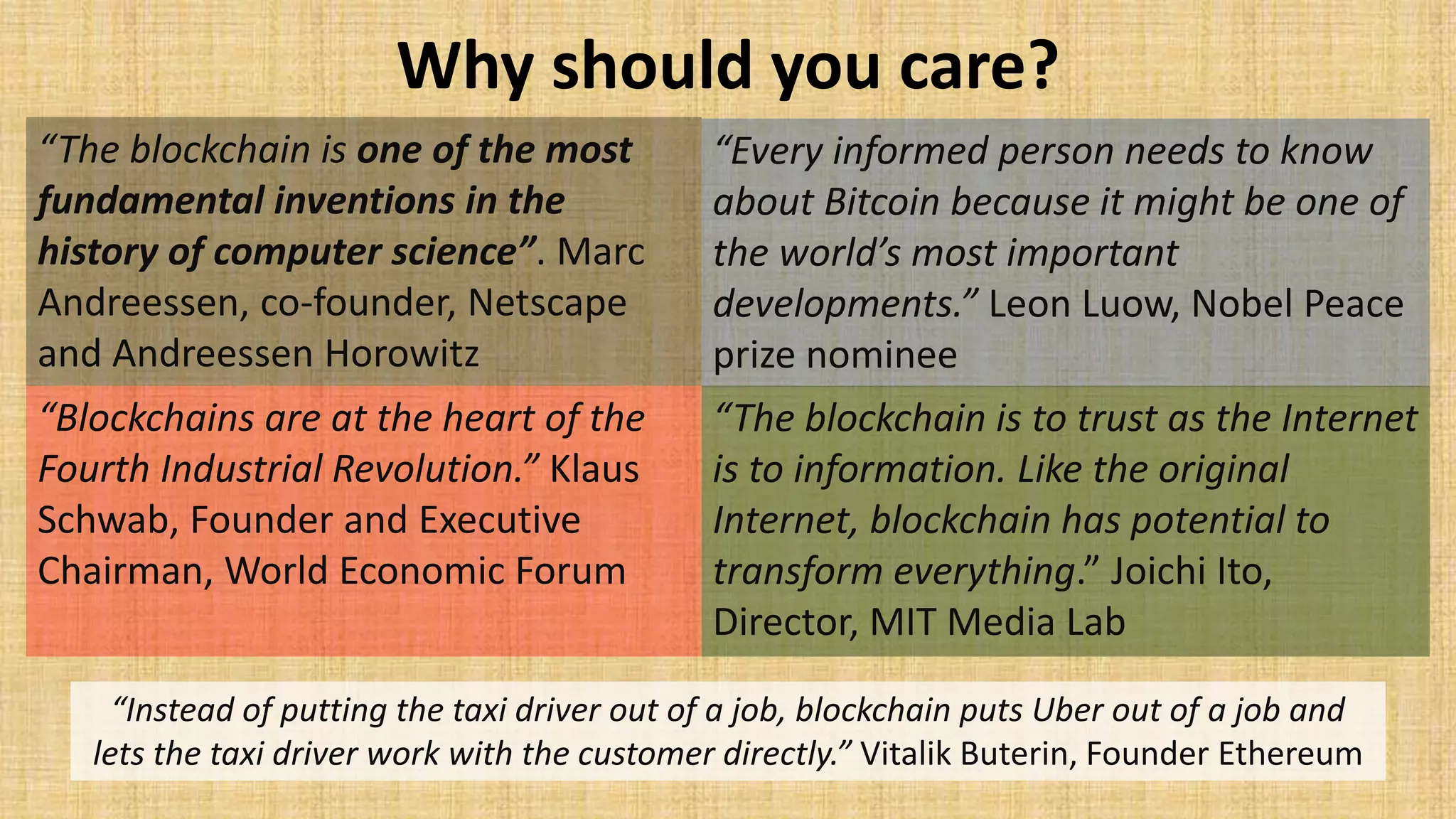
Why should you care?
“Every informed person needs to know
about Bitcoin because it might be one of
the world’s most important
developments.” Leon Luow, Nobel Peace
prize nominee
“The blockchain is one of the most
fundamental inventions in the
history of computer science”. Marc
Andreessen, co-founder, Netscape
and Andreessen Horowitz
“Blockchains are at the heart of the
Fourth Industrial Revolution.” Klaus
Schwab, Founder and Executive
Chairman, World Economic Forum
“The blockchain is to trust as the Internet
is to information. Like the original
Internet, blockchain has potential to
transform everything.” Joichi Ito,
Director, MIT Media Lab
“Instead of putting the taxi driver out of a job, blockchain puts Uber out of a job and
lets the taxi driver work with the customer directly.” Vitalik Buterin, Founder Ethereum
“In the last nine months of 2016, $1.4
billion has been invested globally in
blockchain startups.”
- PricewaterhouseCoopers (PwC)
Trust Protocol
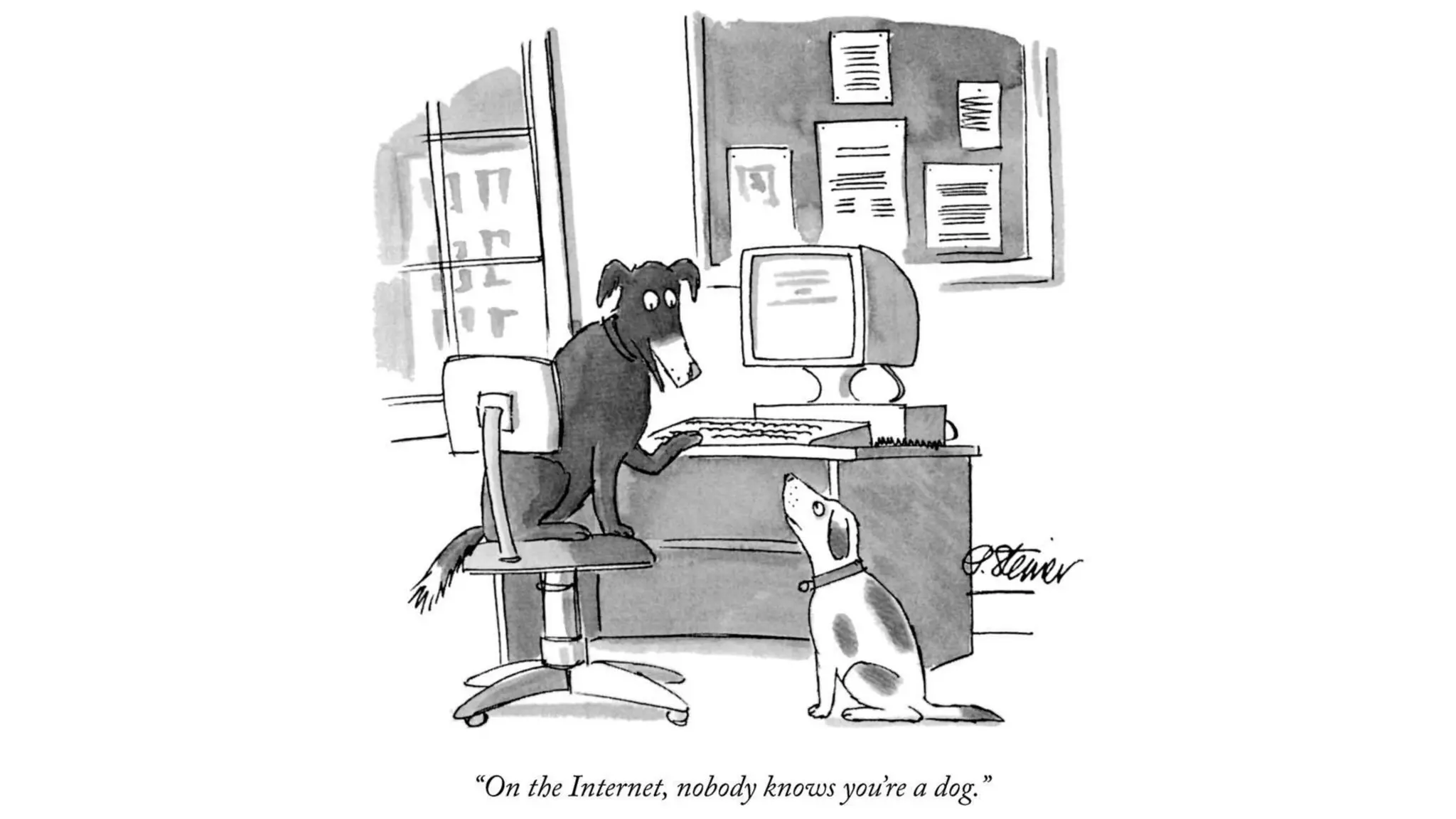
Why do you need trust on the internet?
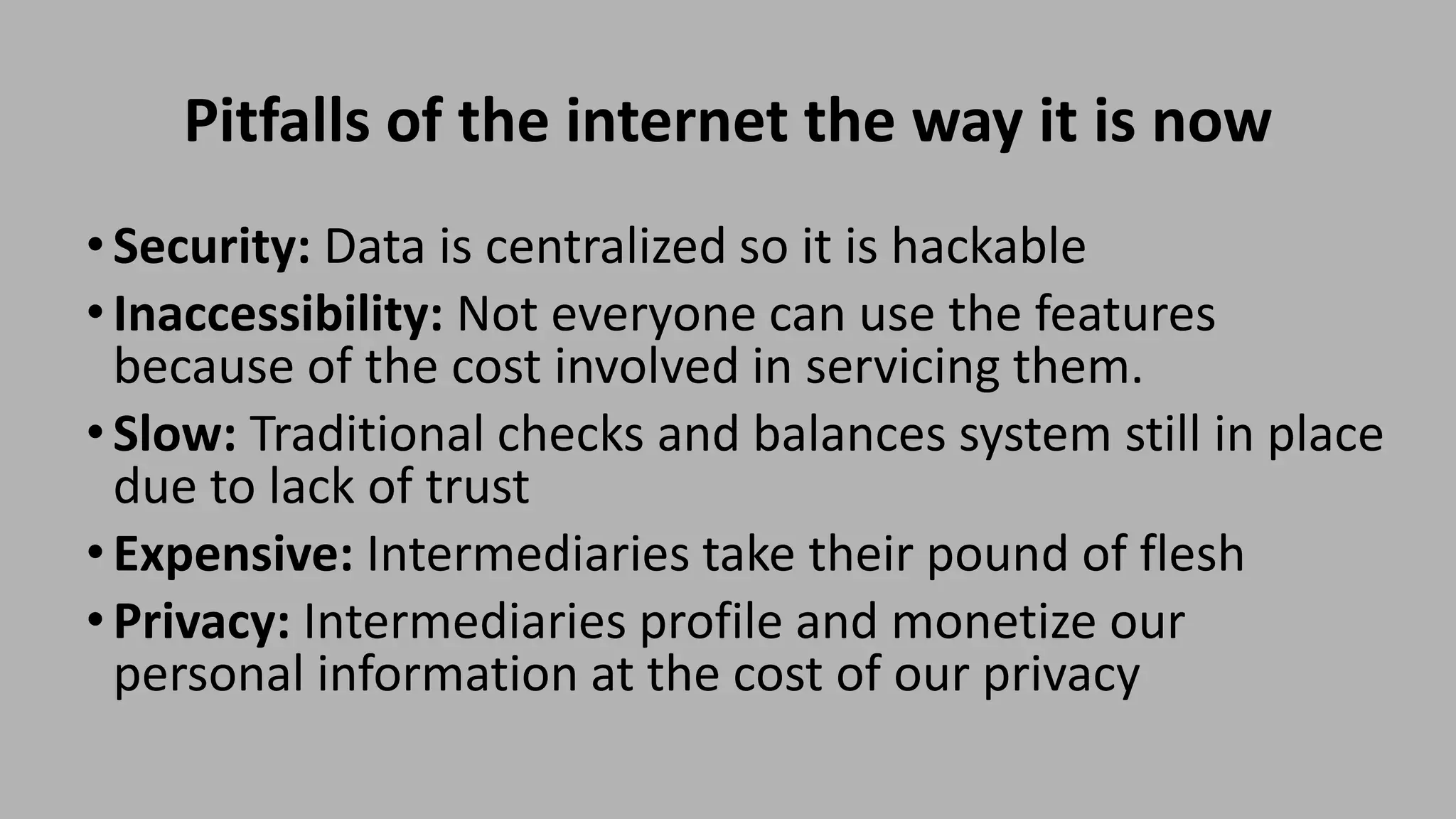
Pitfalls of the internet the way it is now
•Security: Data is centralized so it is hackable
•Inaccessibility: Not everyone can use the features

because of the cost involved in servicing them.
•Slow: Traditional checks and balances system still in place
due to lack of trust
•Expensive: Intermediaries take their pound of flesh
•Privacy: Intermediaries profile and monetize our
personal information at the cost of our privacy
Blockchain
• Based upon distributed Ledger.
• Is replicated across a number of systems in almost real-time.
• Usually exists over a peer-to-peer network.
• Uses cryptography and digital signatures to prove identity,
authenticity and enforce read/write access rights.
• Has mechanisms to make it hard to change historical records, or
at least make it easy to detect when someone is trying to do so.
Advantages of Blockchain
• Open: Every one authorized to see can see everything. Almost
(Private Blockchains)
• Distributed: All nodes on the network has same copy of Blockchain
on their system. Instead of a central authority, all stakeholders of a
Blockchain network keep a copy of all transactions done on the
network.
• Encryption: Powerful encryption and security protocols.
• Efficiency: Since transactions start with trust, no settlement
necessary. Almost realtime.
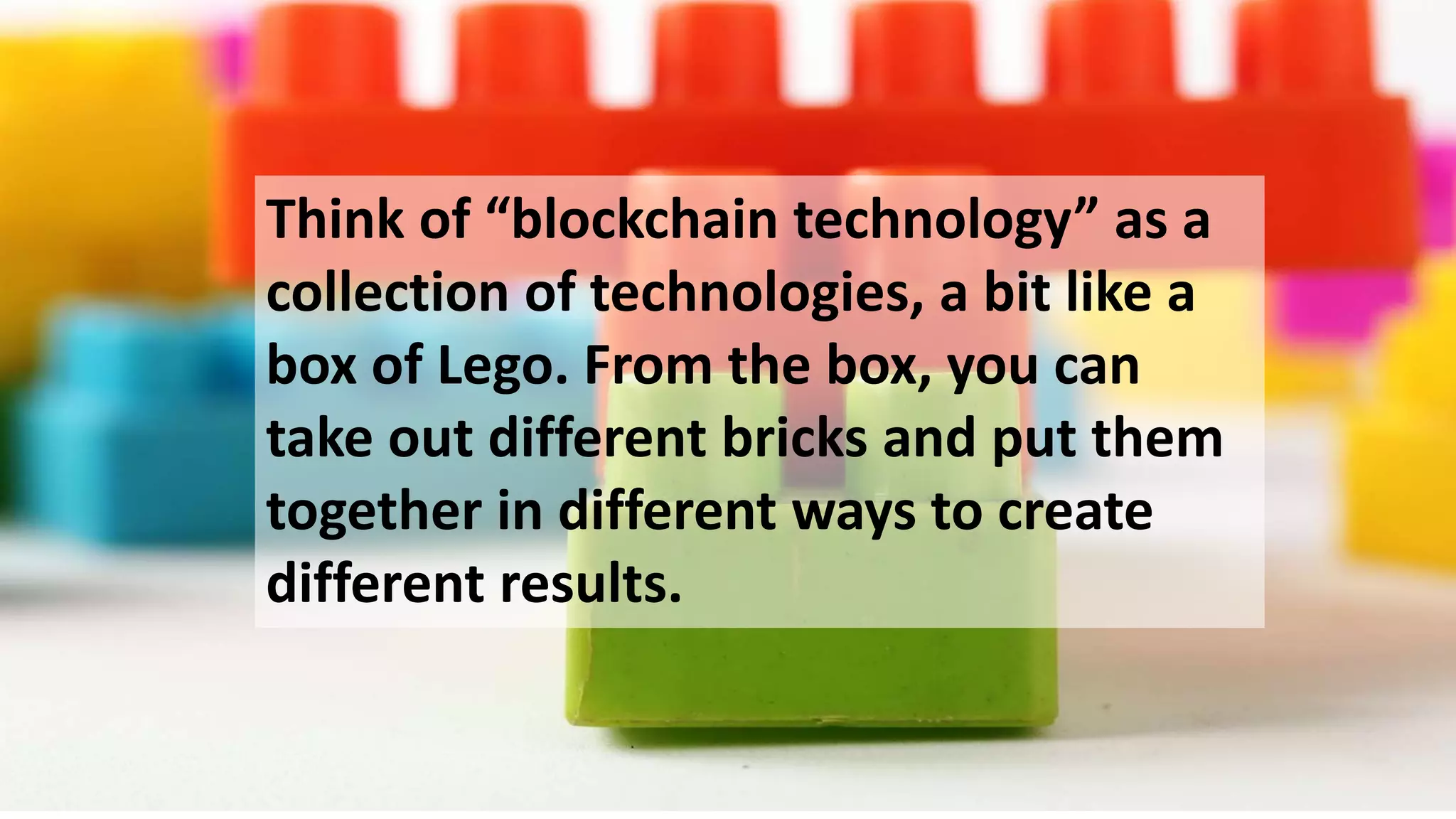
Think of “blockchain technology” as a
collection of technologies, a bit like a
box of Lego. From the box, you can
take out different bricks and put them
together in different ways to create
different results.
Ledgers can be ‘public’ in two senses:
1. Anyone, without permission granted by another
authority, can write data
2. Anyone, without permission granted by another
authority, can read data
Usually, when people talk about public blockchains, they
mean anyone-can-write.
Public Blockchains
Private Blockchains
• A ‘private’ blockchain network is where the
participants are known and trusted: for example, an
industry group, or a group of companies owned by an
umbrella company.
• Many of the mechanisms aren’t needed – or rather
they are replaced with legal contracts.
This changes the technical decisions as to which bricks
are used to build the solution.
But what the heck
is blockchain?
A blockchain is just a file
A blockchain by itself is just a data structure. That is,
how data is logically put together and stored. Other
data structures are databases (rows, columns, tables),
text files, comma separated values (csv), images, lists,
and so on. You can think of a blockchain competing
most closely with a database.
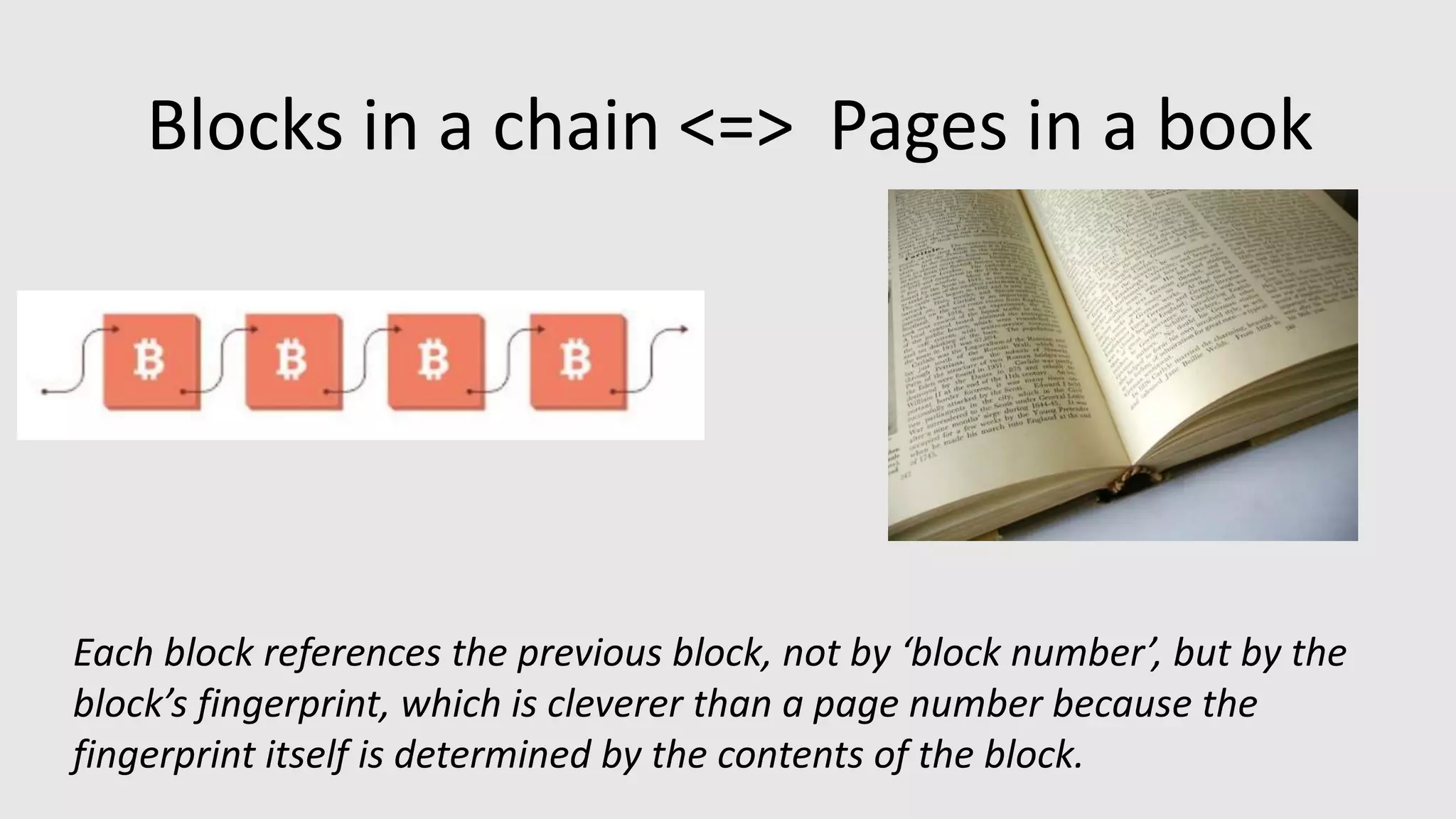
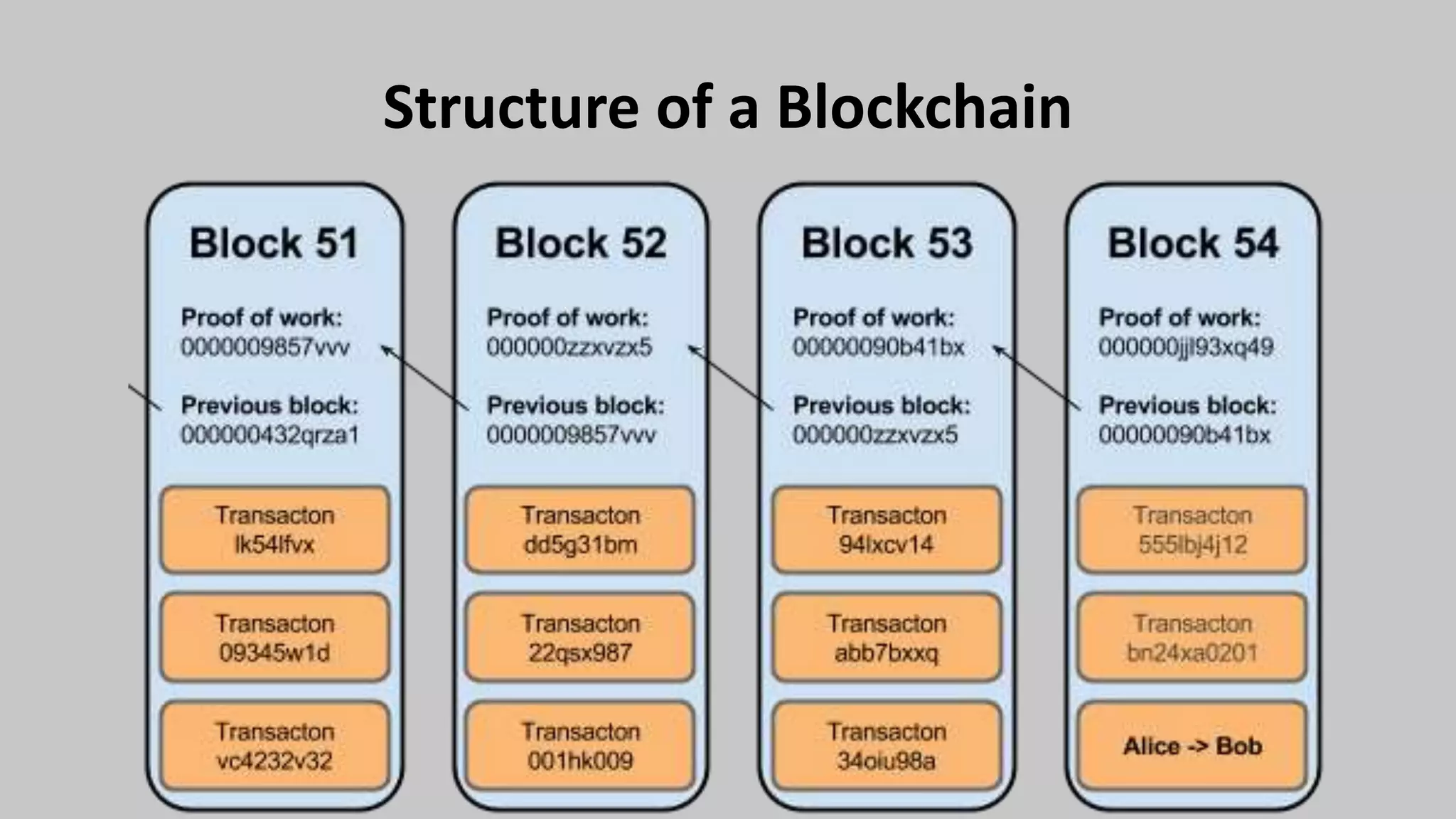
Blocks in a chain <=> Pages in a book
Each block references the previous block, not by ‘block number’, but by the
block’s fingerprint, which is cleverer than a page number because the
fingerprint itself is determined by the contents of the block.
Structure of a Blockchain
Base Cryptographic techniques used
1. Hashes: A Hash is a mathematical function which is,
1. One way, easy to compute and impossible to reverse
2. Converts string of arbitrary length to string of fixed length
3. Hypersensitive: It changes its value with the slightest change in
the document. It enables easy encryption
2. Public/Private Key encryption:
1. Public & Private keys are pairs of numbers, where one number
can decrypt a string with its pair number
2. Public Key is a universally published number while the other
number is kept private
Blockchain solves specific problems
 Fully distributed – Highly fault tolerant
 No centralized authority
 3rd party trust – without trust
 Low barriers to entry: Computer + Internet = Win
 Instant global transactions capability
 No double spending
 Very low transaction costs
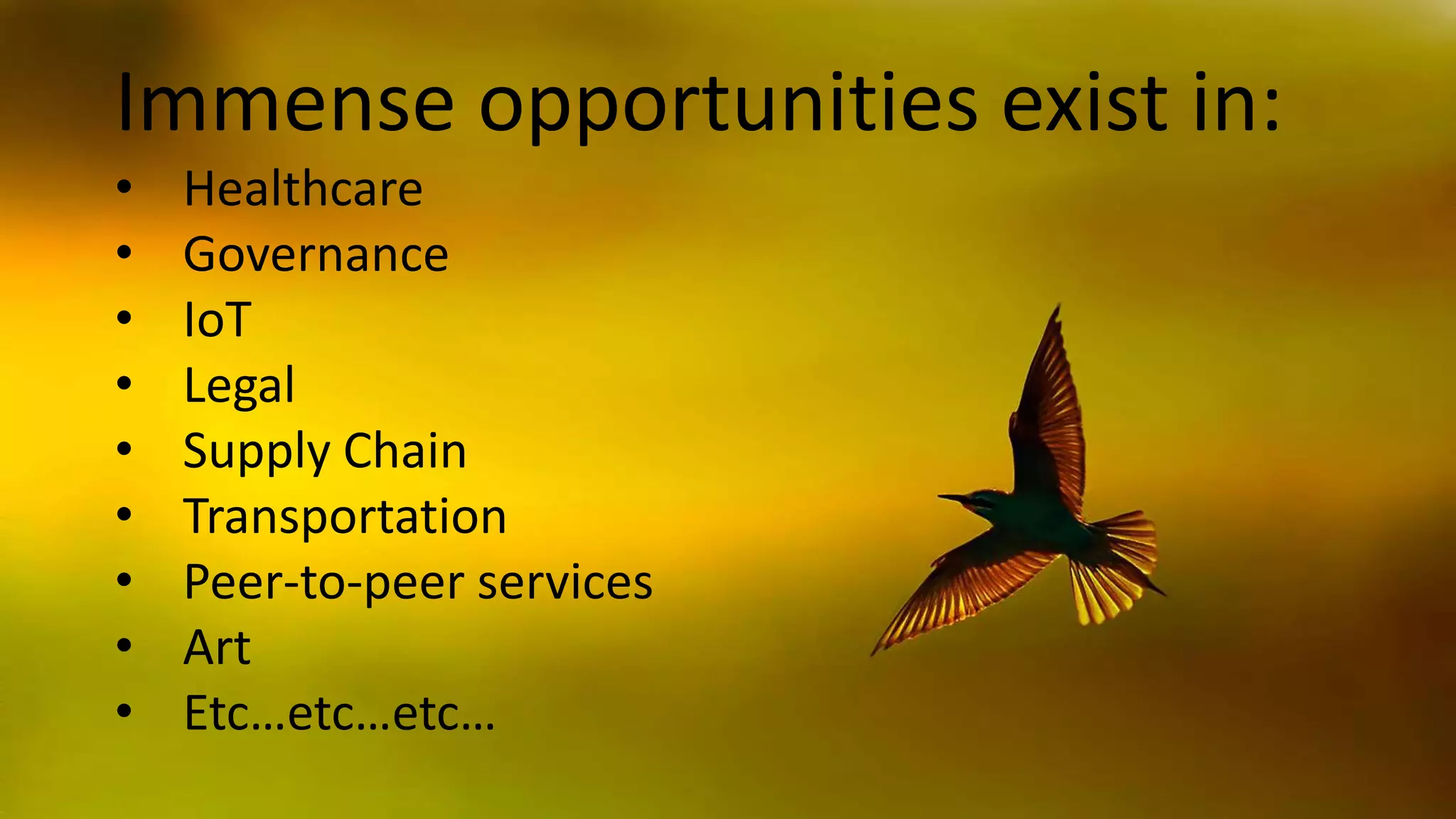
Immense opportunities exist in:
• Healthcare
• Governance
• IoT
• Legal
• Supply Chain
• Transportation
• Peer-to-peer services
• Art
• Etc…etc…etc…
Questions
Building an engaging
technology product
- Rajeev Soni
What are some of the most engaging
tech products you know and use?
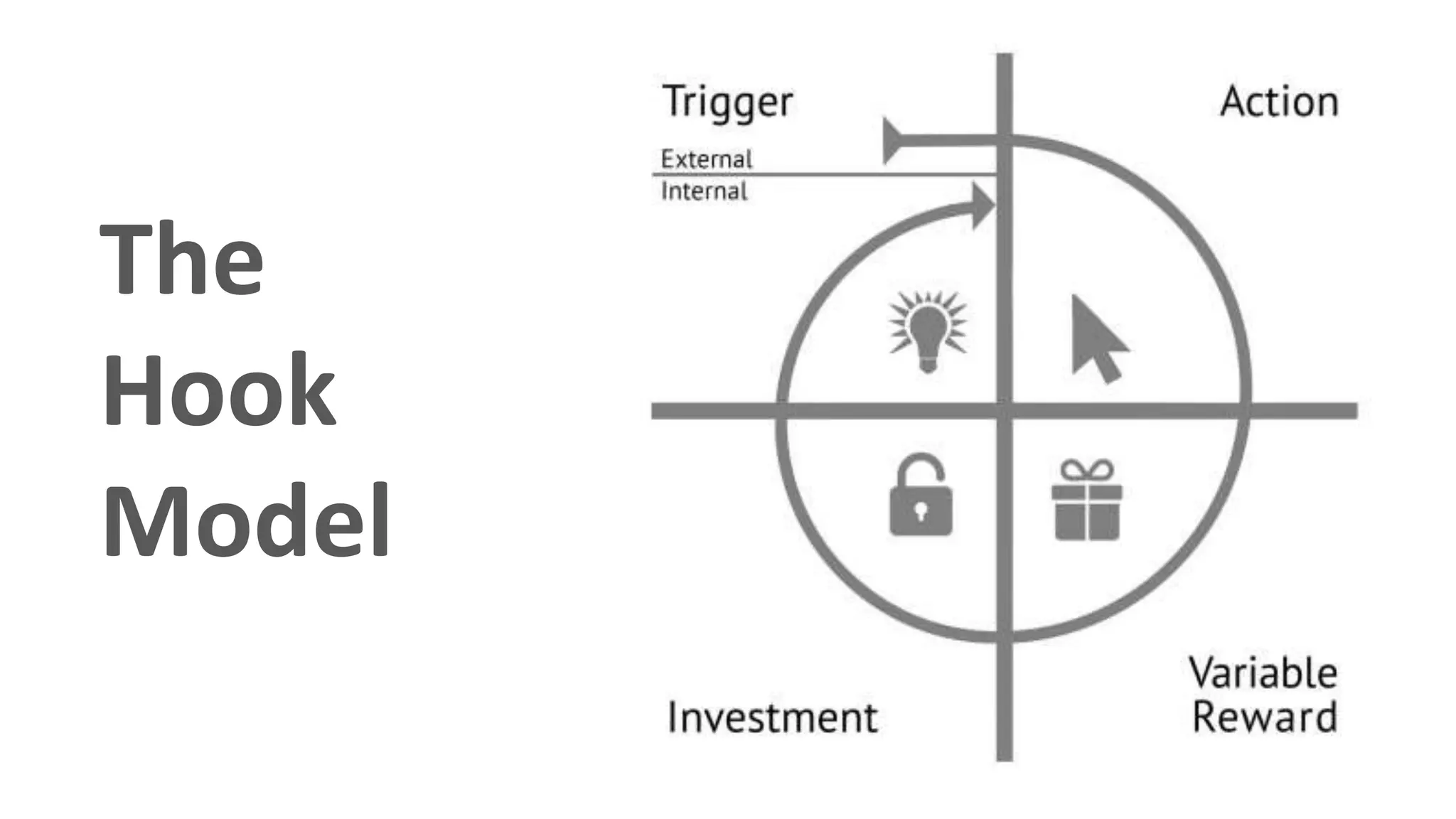
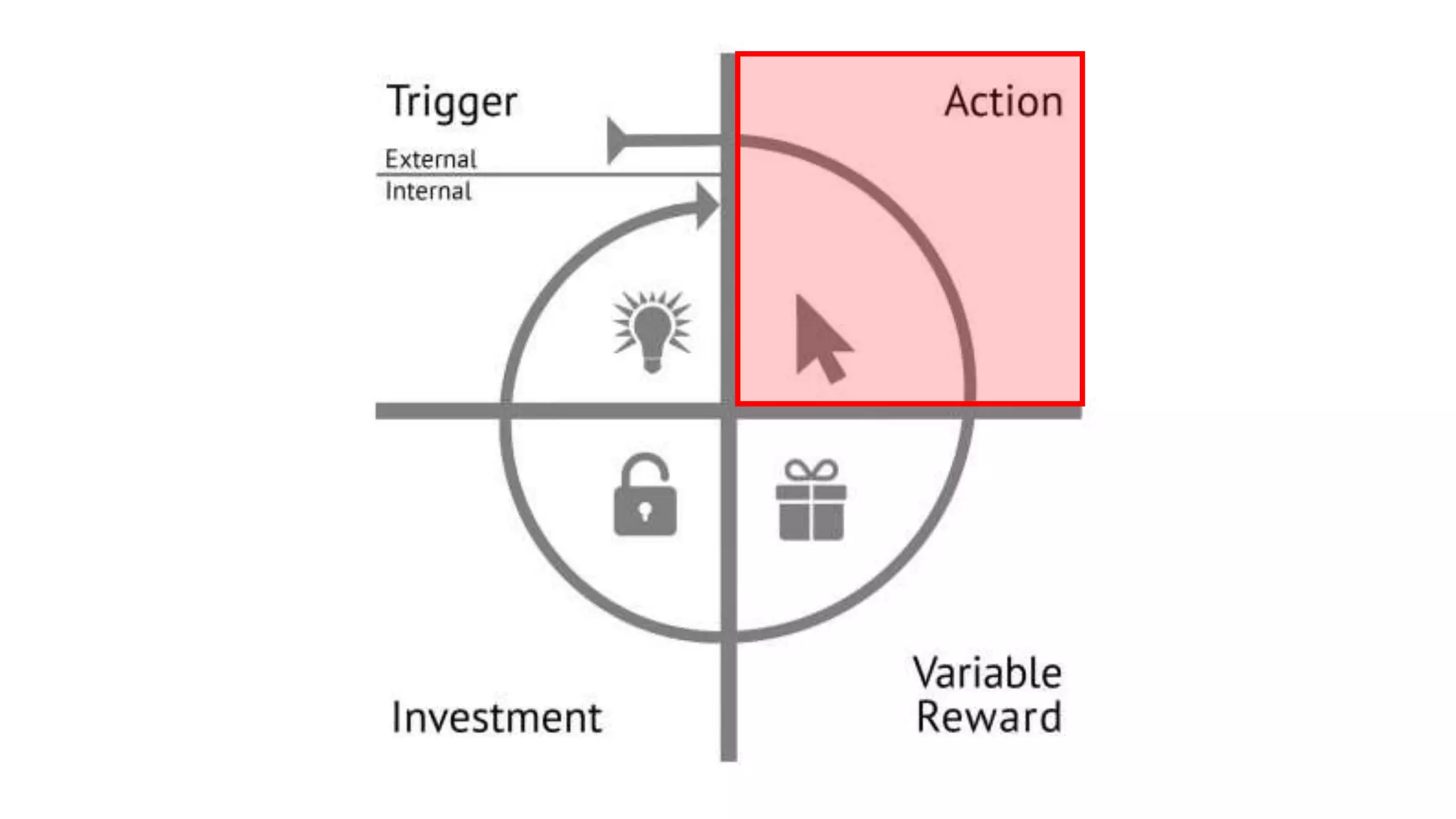
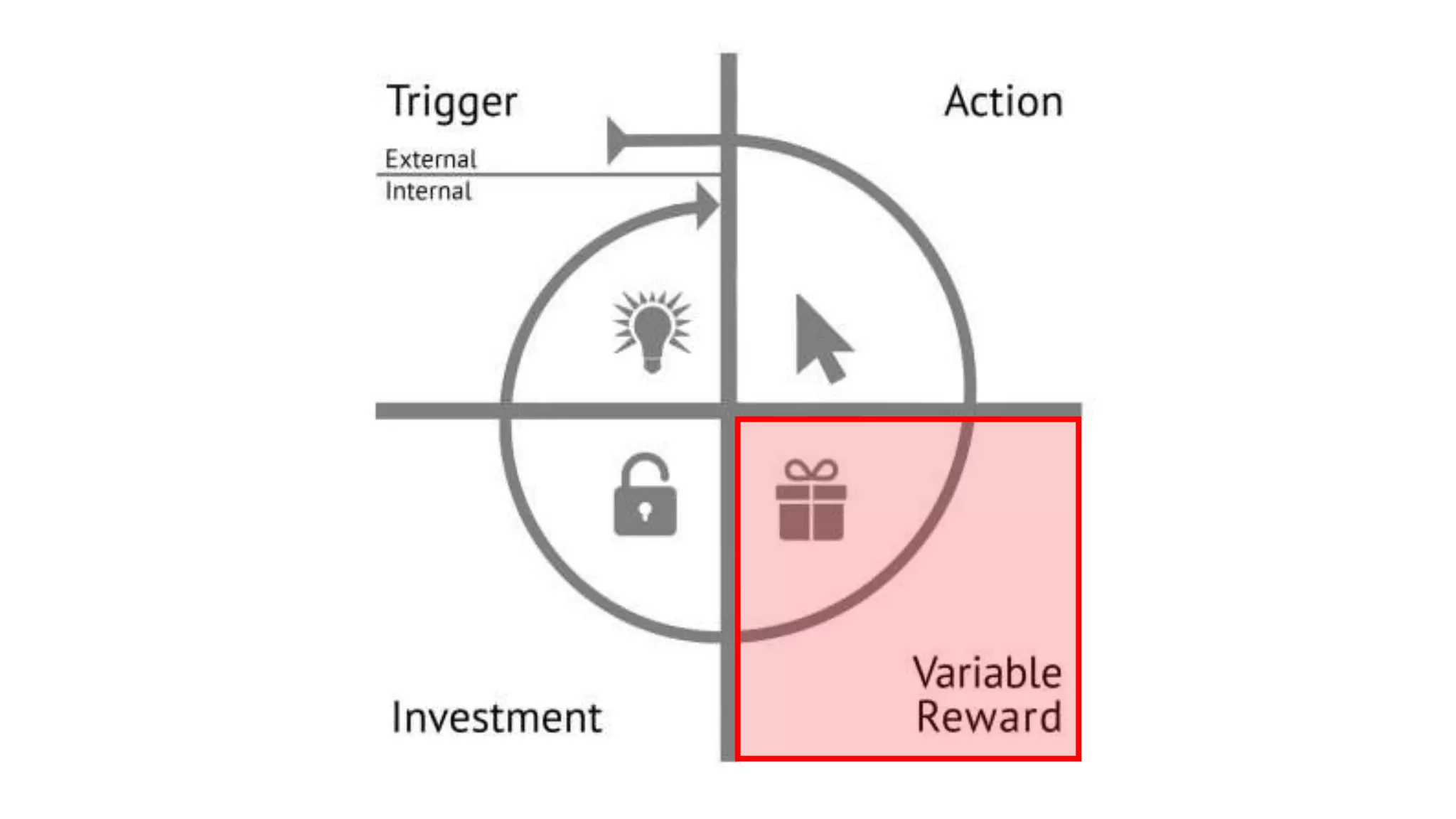
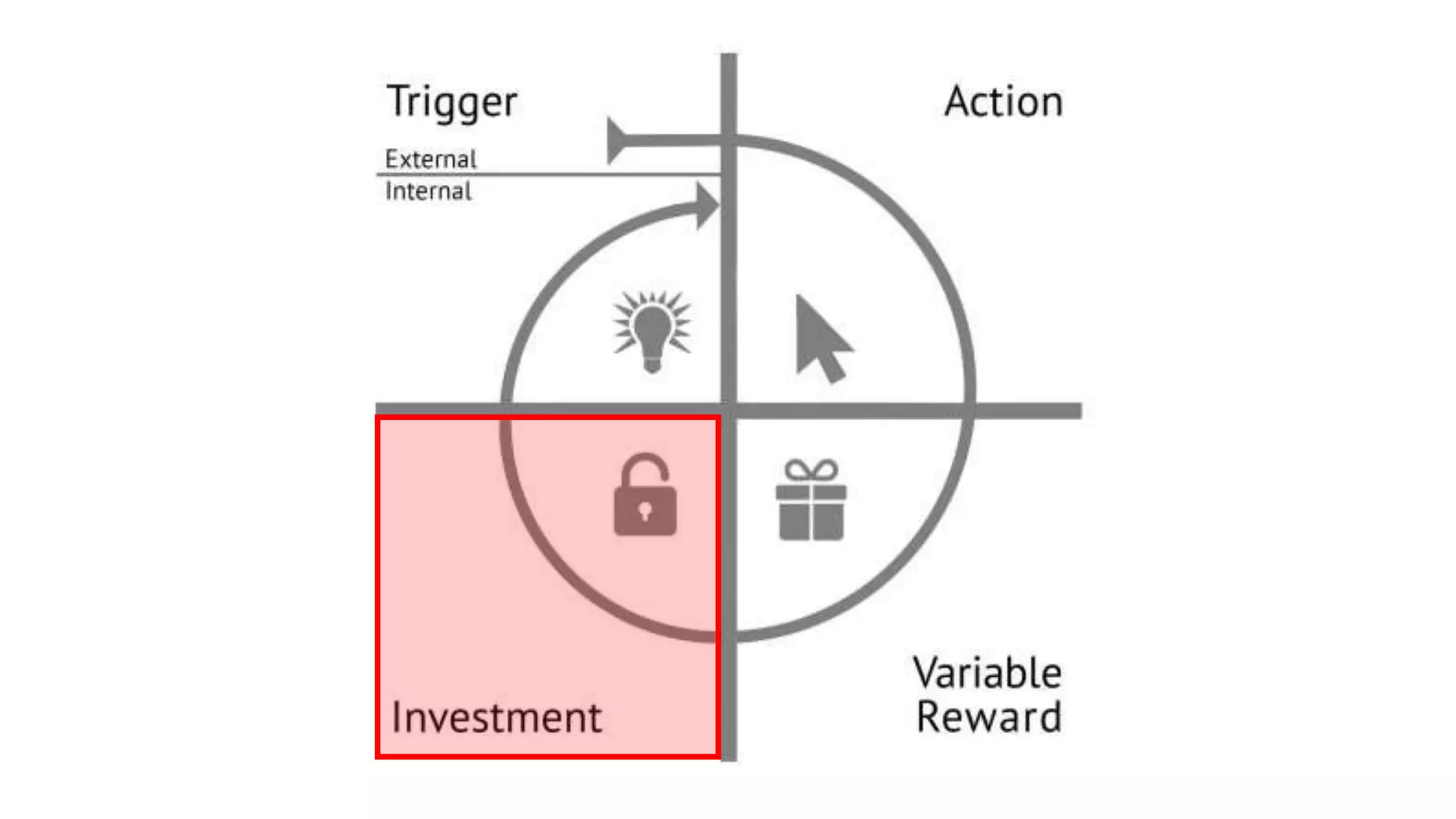
The
Hook
Model
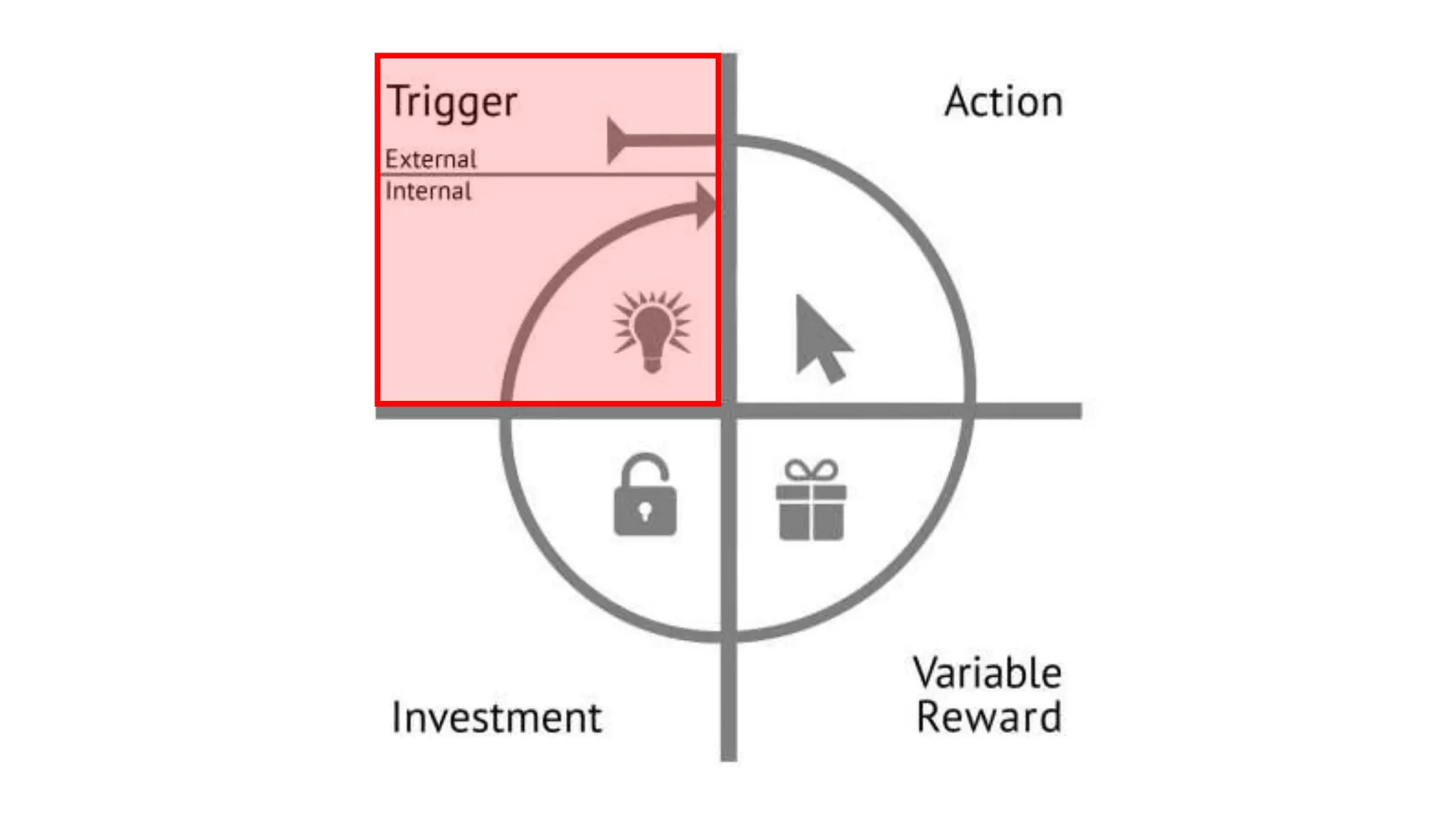
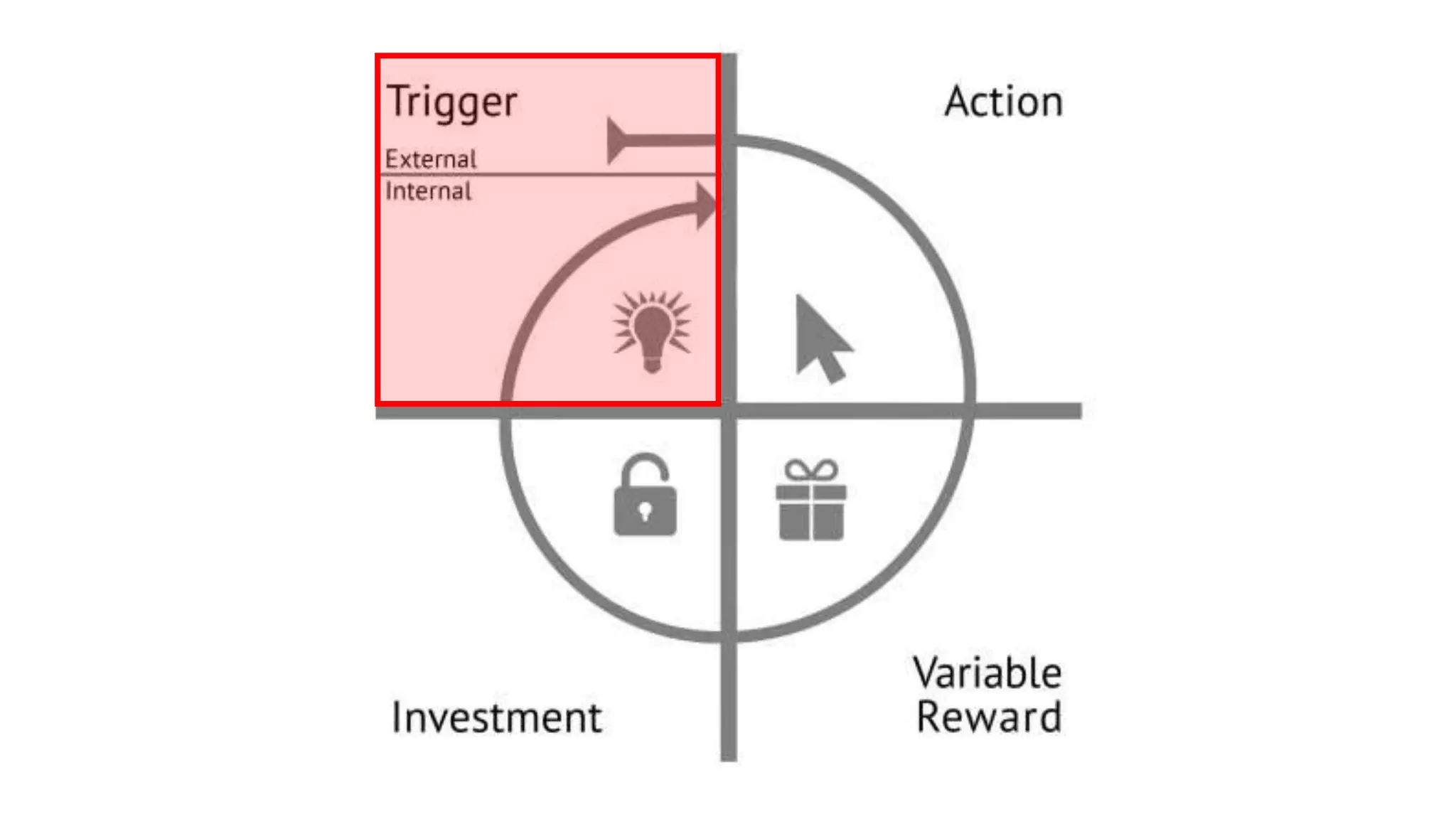
Trigger
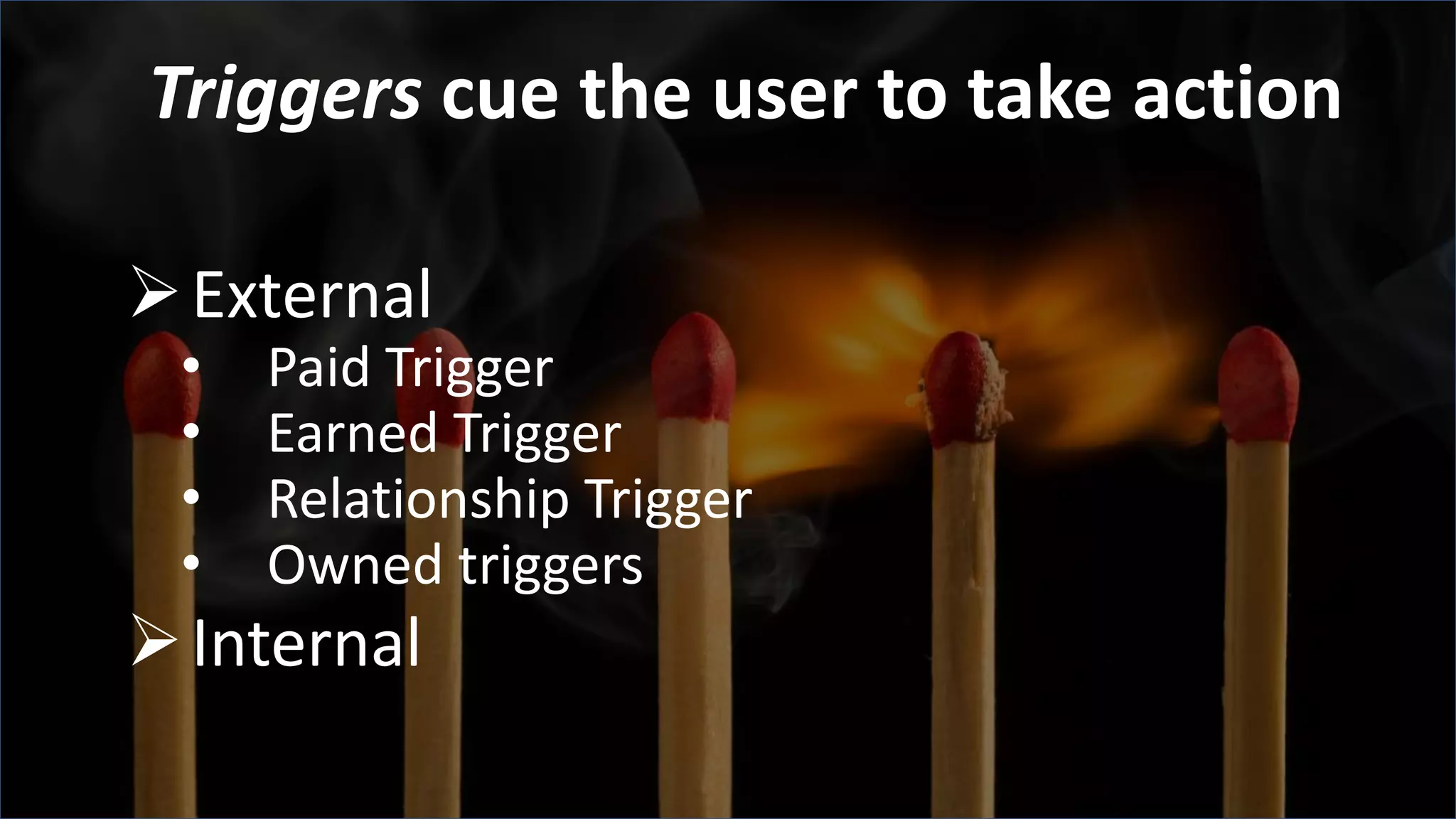
Triggers cue the user to take action
External
• Paid Trigger
• Earned Trigger
• Relationship Trigger
• Owned triggers
Internal
Exercise
•Which internal trigger do you experience
frequently?
•What might be places and times to send an
external trigger?
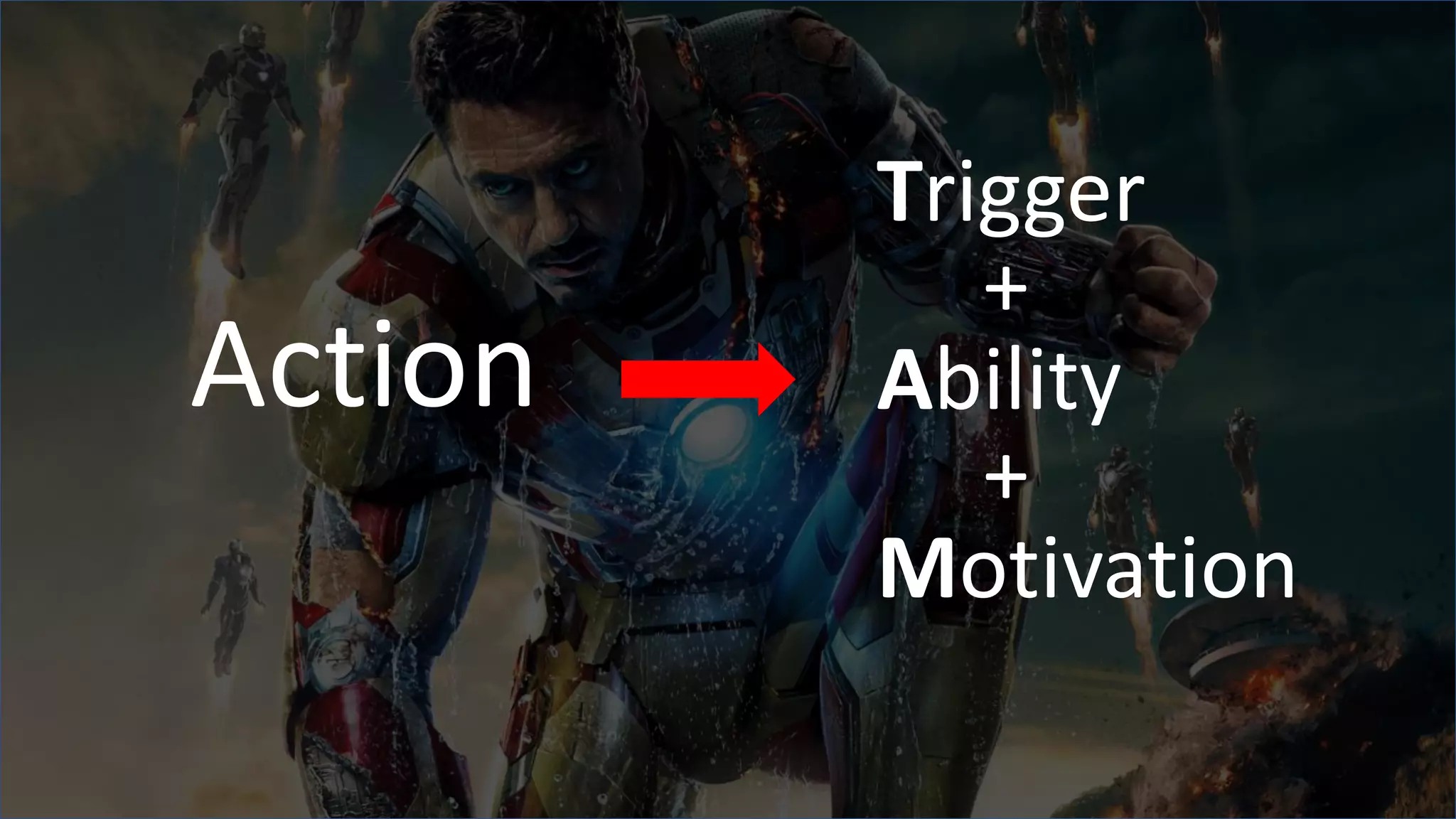
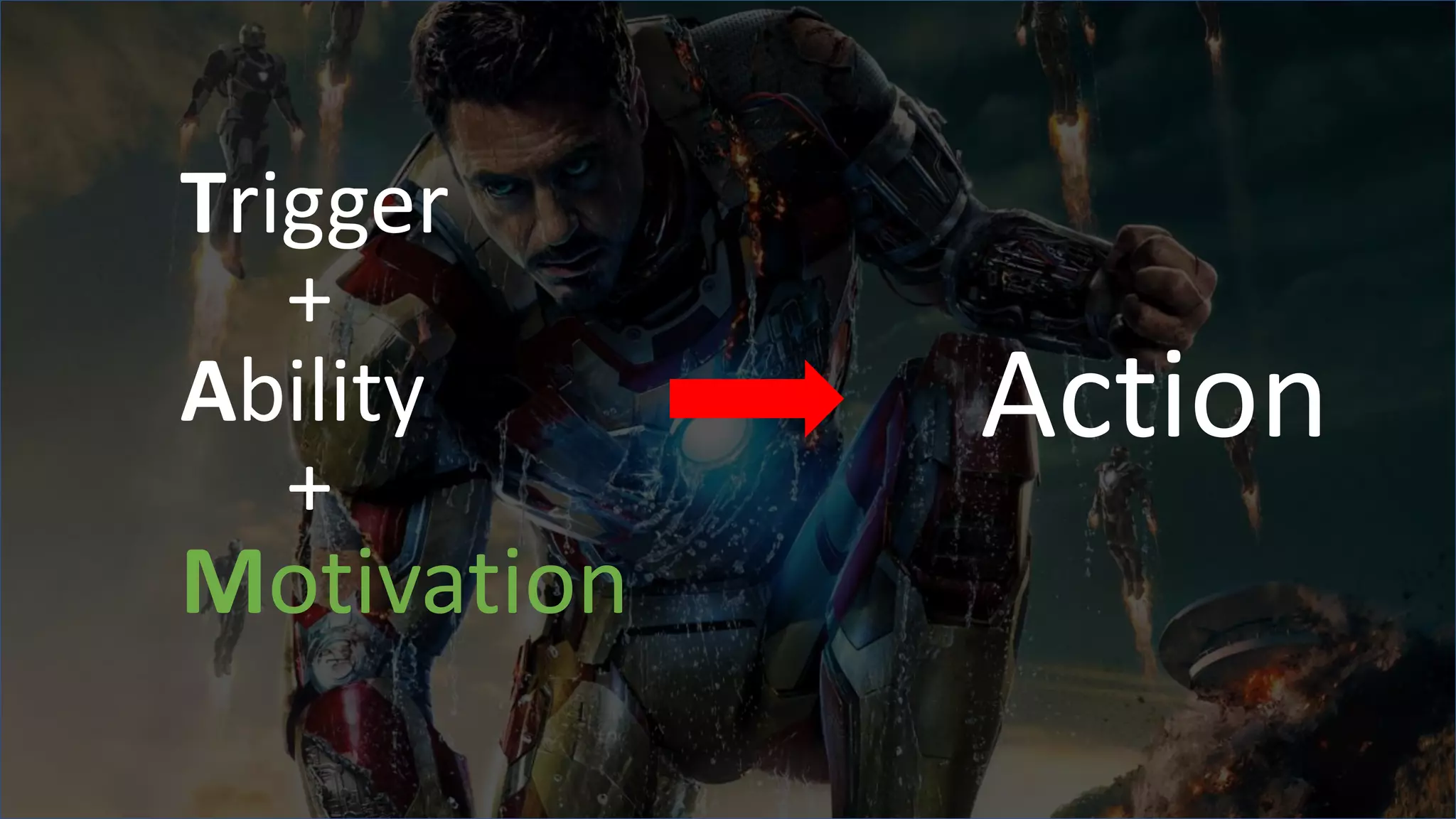
Trigger
+
Ability
+
Motivation
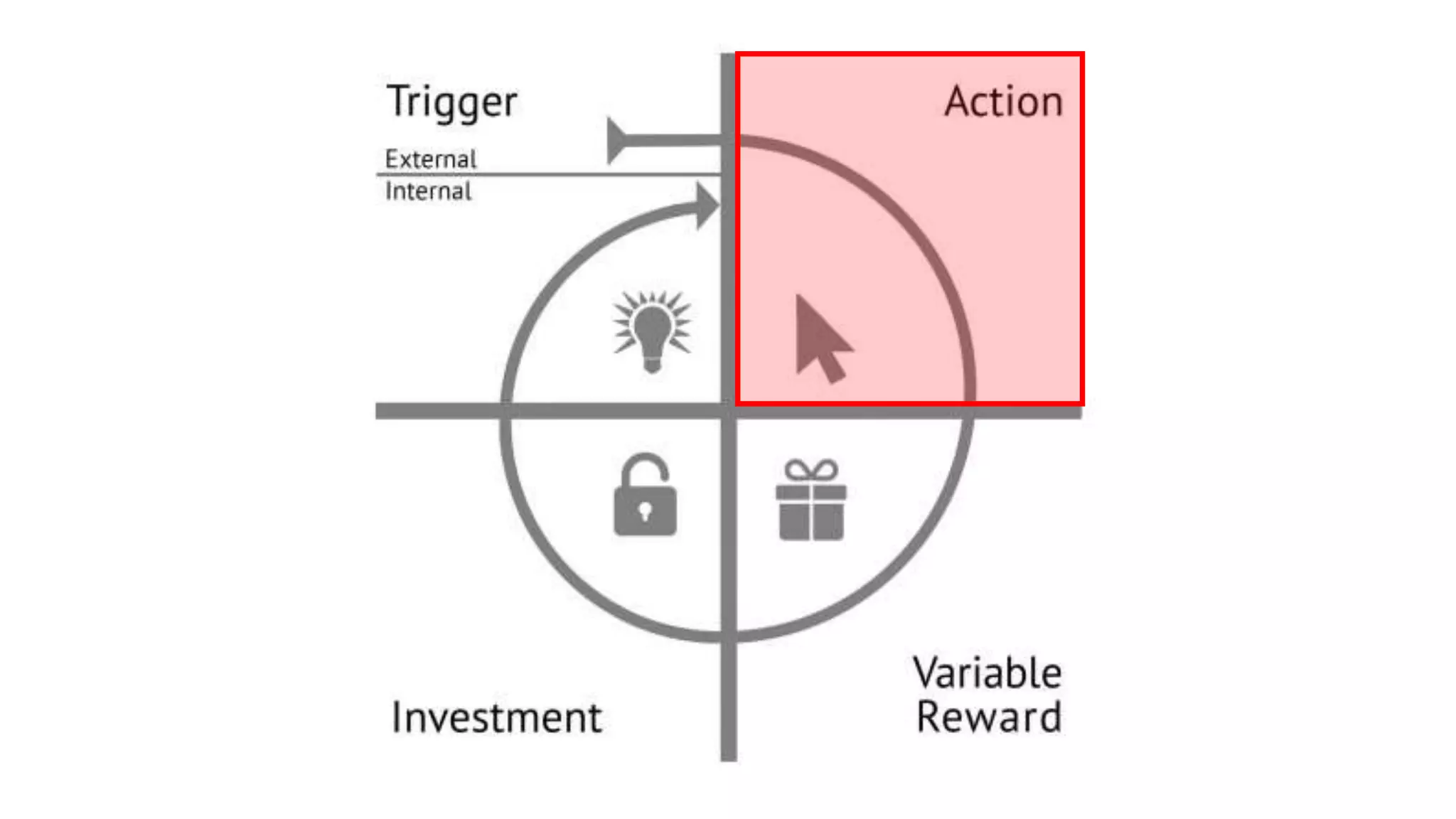
Action
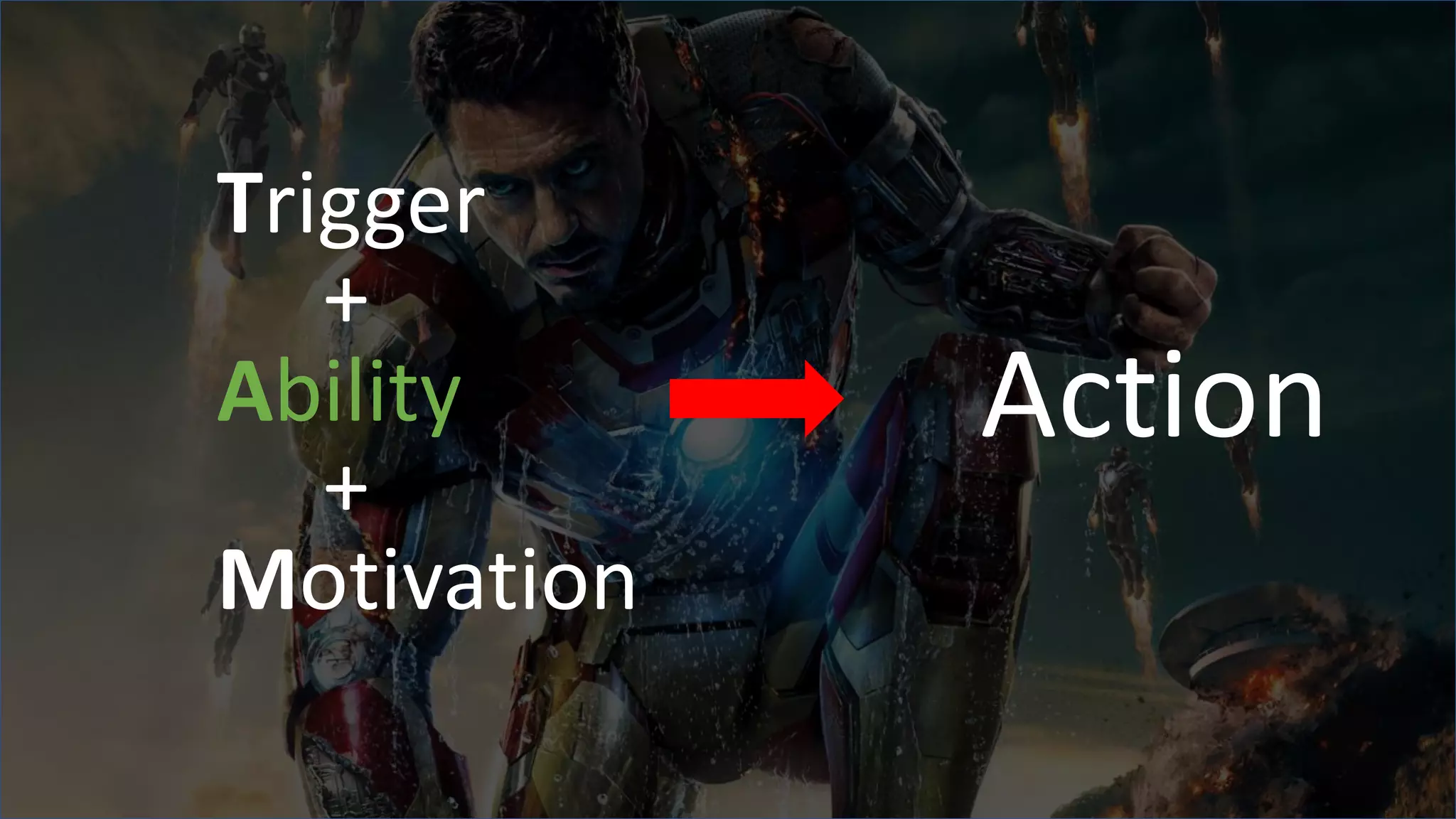
Trigger
+
Ability
+
Motivation
Action
How can you improve someone’s ability?
Make what they need to do simple.
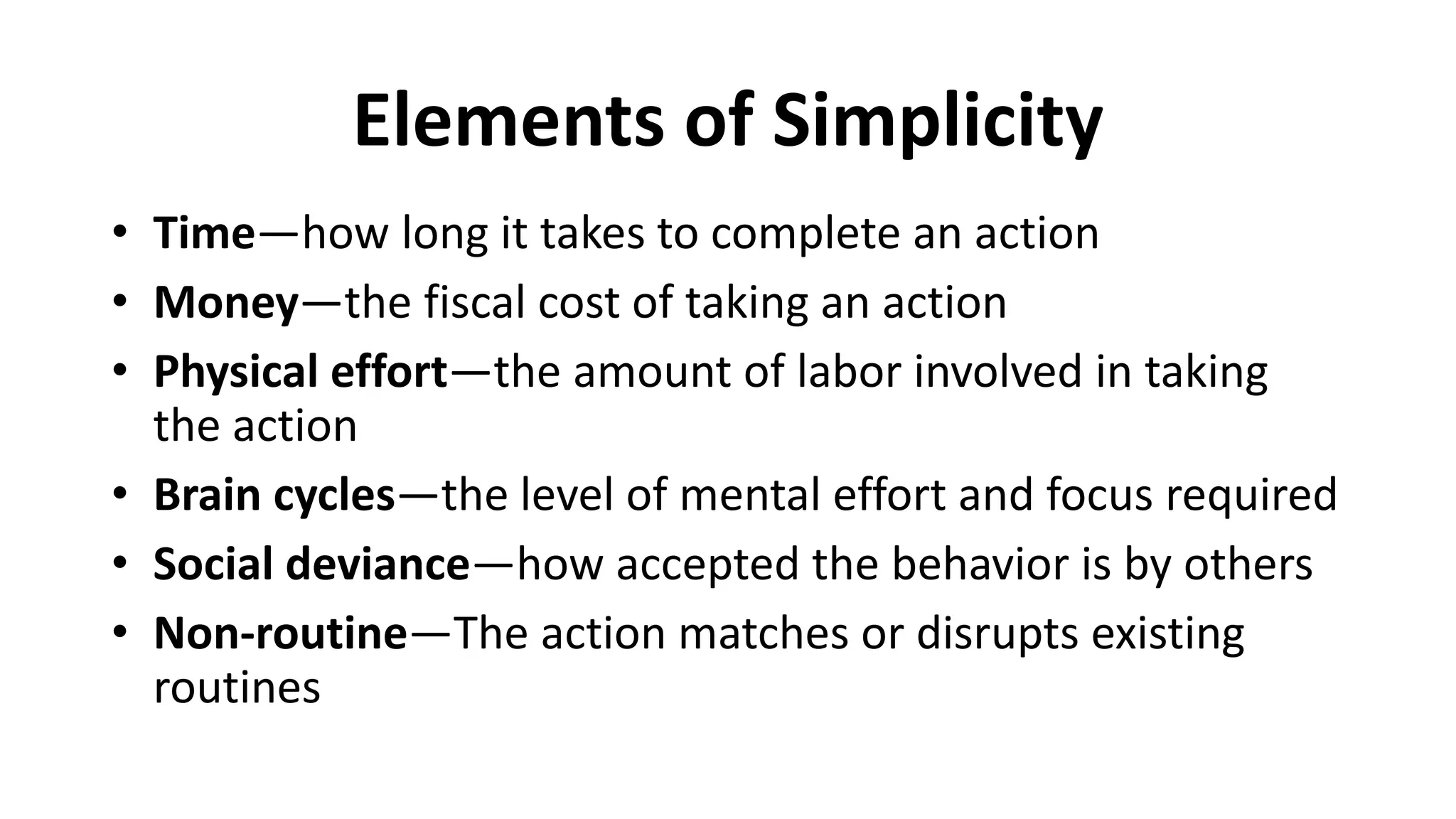
Elements of Simplicity
• Time—how long it takes to complete an action
• Money—the fiscal cost of taking an action
• Physical effort—the amount of labor involved in taking
the action
• Brain cycles—the level of mental effort and focus required
• Social deviance—how accepted the behavior is by others
• Non-routine—The action matches or disrupts existing
routines
Trigger
+
Ability
+
Motivation
Action
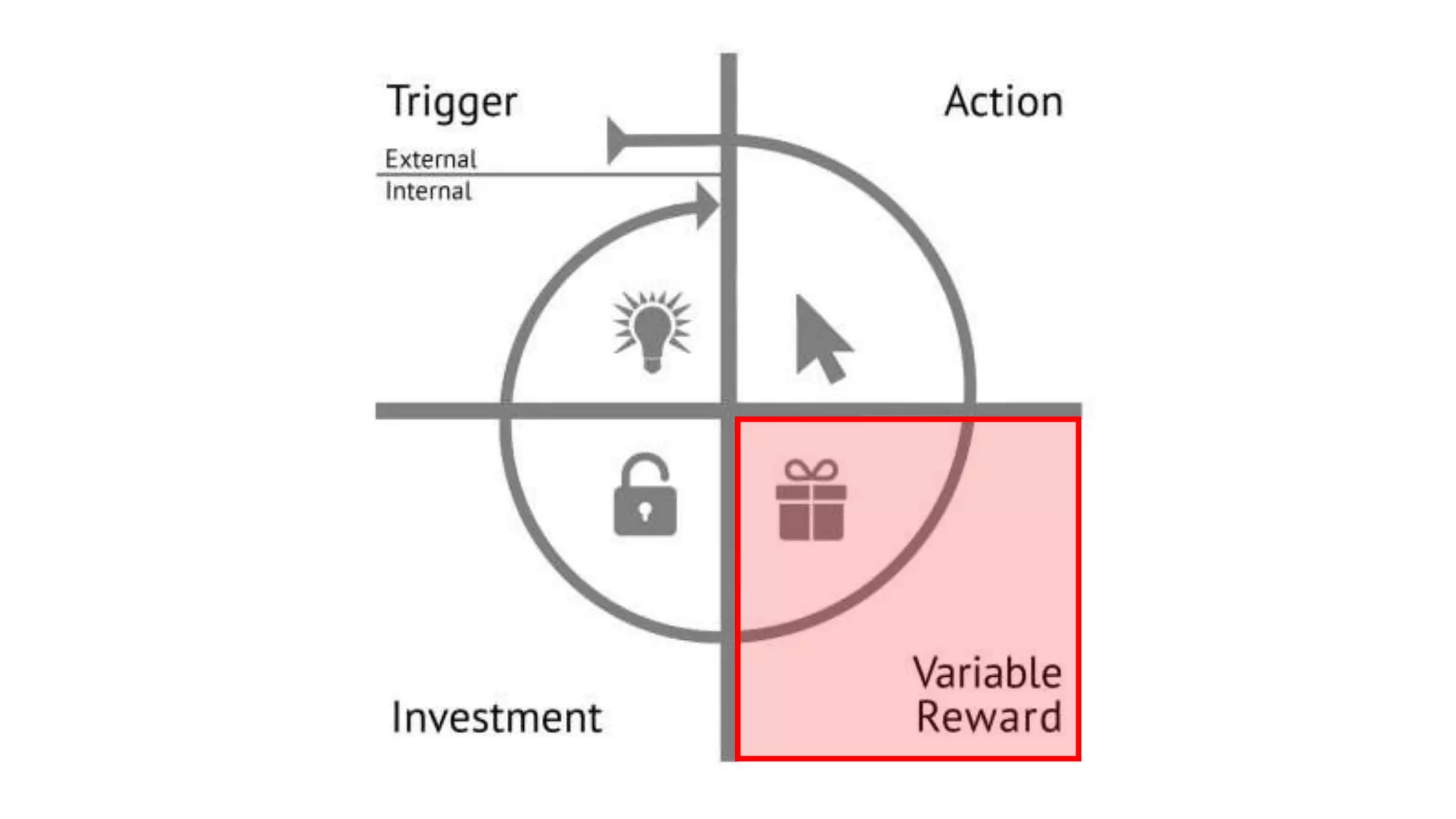
Motivation
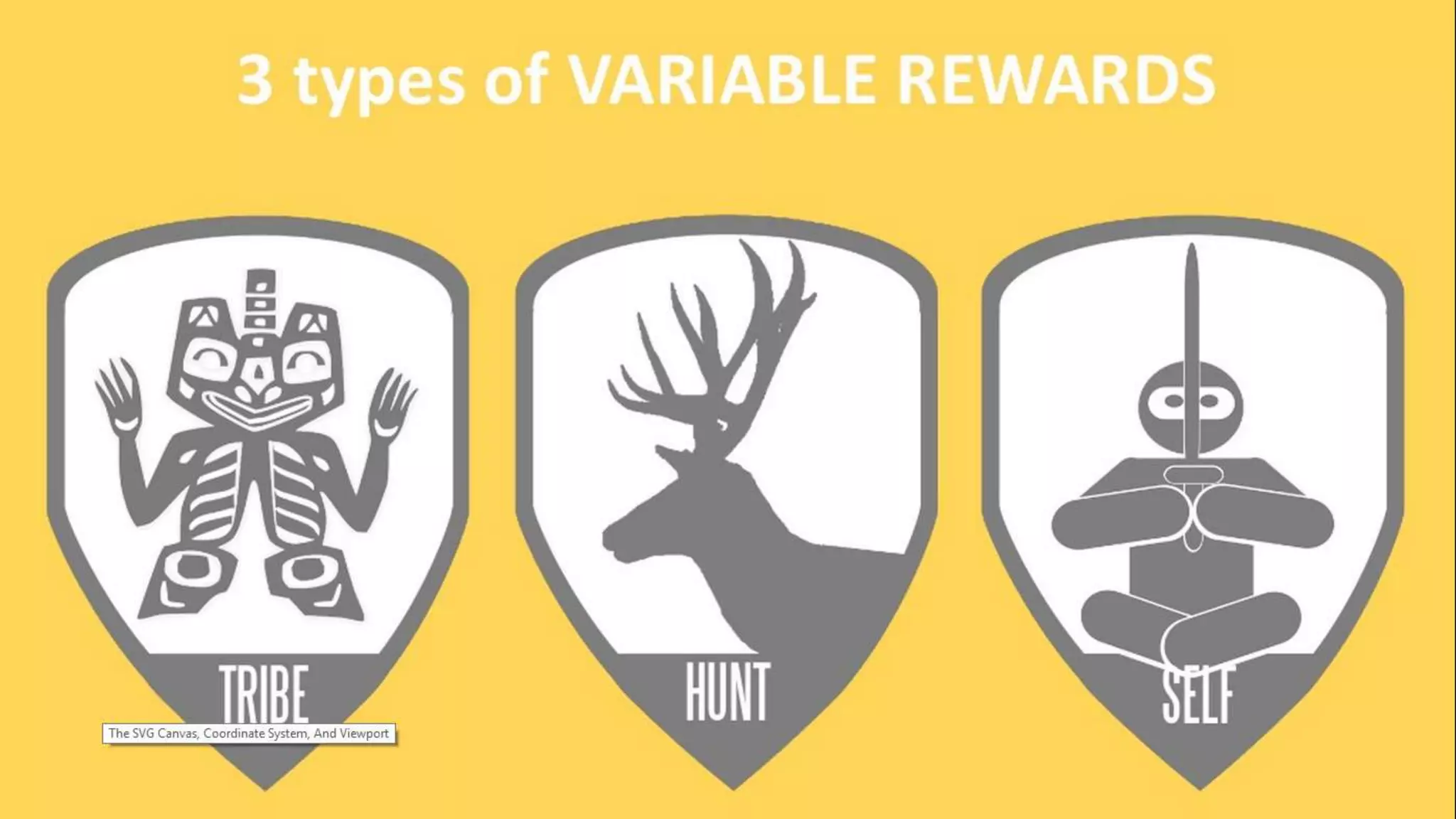
Rewards of the tribe — Gratification from others.
Rewards of the hunt — Material goods, money, or
information.
Rewards of the self — Mastery, completion,
competency, or consistency.
Exercise
•What rewards do you get from the products you
use everyday?
Investment
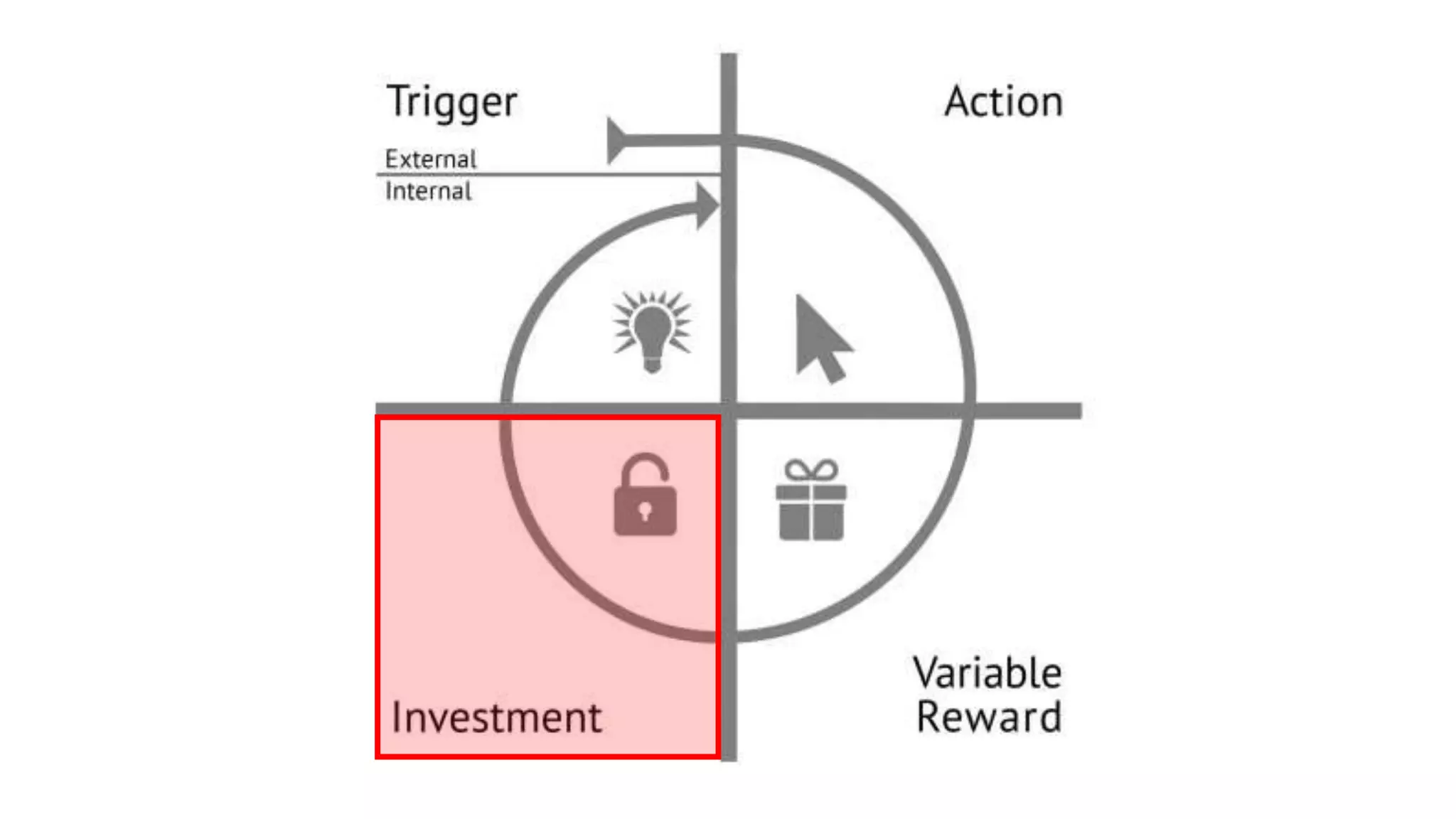
 Unlike the action phase, which delivers
immediate gratification, the investment phase
concerns the anticipation of rewards in the
future.
Can you give some examples?
Investment
 Investments in a product create preferences.
What products do you prefer? Why?
Investment
 Investments increase the likelihood of users
returning by improving the service the more it
is used. They enable the accumulation of
stored value in the form of content, data,
followers, reputation, or skill.
How do you create value for the products you use?
Investment
 Investments increase the likelihood of users
passing through the Hook again by loading the
next trigger to start the cycle all over again.
Assess your own behavior and see how you get hooked?
Thank you
Questions
rajeev@rajeevsoni.com
@rajsoni

Blockchain and Hook model of engagement

  • 1.
    Rajeev Soni Entrepreneur, ProductManager & Technology Enthusiast Workshop on "Emerging Trends in Digital World“, 08 March 2017
  • 2.
  • 3.
    Why should youcare? “Every informed person needs to know about Bitcoin because it might be one of the world’s most important developments.” Leon Luow, Nobel Peace prize nominee “The blockchain is one of the most fundamental inventions in the history of computer science”. Marc Andreessen, co-founder, Netscape and Andreessen Horowitz “Blockchains are at the heart of the Fourth Industrial Revolution.” Klaus Schwab, Founder and Executive Chairman, World Economic Forum “The blockchain is to trust as the Internet is to information. Like the original Internet, blockchain has potential to transform everything.” Joichi Ito, Director, MIT Media Lab “Instead of putting the taxi driver out of a job, blockchain puts Uber out of a job and lets the taxi driver work with the customer directly.” Vitalik Buterin, Founder Ethereum
  • 4.
    “In the lastnine months of 2016, $1.4 billion has been invested globally in blockchain startups.” - PricewaterhouseCoopers (PwC)
  • 5.
  • 6.
    Why do youneed trust on the internet?
  • 8.
    Pitfalls of theinternet the way it is now •Security: Data is centralized so it is hackable •Inaccessibility: Not everyone can use the features because of the cost involved in servicing them. •Slow: Traditional checks and balances system still in place due to lack of trust •Expensive: Intermediaries take their pound of flesh •Privacy: Intermediaries profile and monetize our personal information at the cost of our privacy
  • 9.
    Blockchain • Based upondistributed Ledger. • Is replicated across a number of systems in almost real-time. • Usually exists over a peer-to-peer network. • Uses cryptography and digital signatures to prove identity, authenticity and enforce read/write access rights. • Has mechanisms to make it hard to change historical records, or at least make it easy to detect when someone is trying to do so.
  • 10.
    Advantages of Blockchain •Open: Every one authorized to see can see everything. Almost (Private Blockchains) • Distributed: All nodes on the network has same copy of Blockchain on their system. Instead of a central authority, all stakeholders of a Blockchain network keep a copy of all transactions done on the network. • Encryption: Powerful encryption and security protocols. • Efficiency: Since transactions start with trust, no settlement necessary. Almost realtime.
  • 11.
    Think of “blockchaintechnology” as a collection of technologies, a bit like a box of Lego. From the box, you can take out different bricks and put them together in different ways to create different results.
  • 12.
    Ledgers can be‘public’ in two senses: 1. Anyone, without permission granted by another authority, can write data 2. Anyone, without permission granted by another authority, can read data Usually, when people talk about public blockchains, they mean anyone-can-write. Public Blockchains
  • 13.
    Private Blockchains • A‘private’ blockchain network is where the participants are known and trusted: for example, an industry group, or a group of companies owned by an umbrella company. • Many of the mechanisms aren’t needed – or rather they are replaced with legal contracts. This changes the technical decisions as to which bricks are used to build the solution.
  • 14.
    But what theheck is blockchain?
  • 15.
    A blockchain isjust a file A blockchain by itself is just a data structure. That is, how data is logically put together and stored. Other data structures are databases (rows, columns, tables), text files, comma separated values (csv), images, lists, and so on. You can think of a blockchain competing most closely with a database.
  • 16.
    Blocks in achain <=> Pages in a book Each block references the previous block, not by ‘block number’, but by the block’s fingerprint, which is cleverer than a page number because the fingerprint itself is determined by the contents of the block.
  • 17.
    Structure of aBlockchain
  • 18.
    Base Cryptographic techniquesused 1. Hashes: A Hash is a mathematical function which is, 1. One way, easy to compute and impossible to reverse 2. Converts string of arbitrary length to string of fixed length 3. Hypersensitive: It changes its value with the slightest change in the document. It enables easy encryption 2. Public/Private Key encryption: 1. Public & Private keys are pairs of numbers, where one number can decrypt a string with its pair number 2. Public Key is a universally published number while the other number is kept private
  • 19.
    Blockchain solves specificproblems  Fully distributed – Highly fault tolerant  No centralized authority  3rd party trust – without trust  Low barriers to entry: Computer + Internet = Win  Instant global transactions capability  No double spending  Very low transaction costs
  • 22.
    Immense opportunities existin: • Healthcare • Governance • IoT • Legal • Supply Chain • Transportation • Peer-to-peer services • Art • Etc…etc…etc…
  • 23.
  • 24.
    Building an engaging technologyproduct - Rajeev Soni
  • 25.
    What are someof the most engaging tech products you know and use?
  • 27.
  • 29.
  • 30.
    Triggers cue theuser to take action External • Paid Trigger • Earned Trigger • Relationship Trigger • Owned triggers Internal
  • 31.
    Exercise •Which internal triggerdo you experience frequently? •What might be places and times to send an external trigger?
  • 33.
  • 34.
  • 35.
    How can youimprove someone’s ability? Make what they need to do simple.
  • 36.
    Elements of Simplicity •Time—how long it takes to complete an action • Money—the fiscal cost of taking an action • Physical effort—the amount of labor involved in taking the action • Brain cycles—the level of mental effort and focus required • Social deviance—how accepted the behavior is by others • Non-routine—The action matches or disrupts existing routines
  • 37.
  • 38.
  • 42.
    Rewards of thetribe — Gratification from others. Rewards of the hunt — Material goods, money, or information. Rewards of the self — Mastery, completion, competency, or consistency.
  • 43.
    Exercise •What rewards doyou get from the products you use everyday?
  • 45.
    Investment  Unlike theaction phase, which delivers immediate gratification, the investment phase concerns the anticipation of rewards in the future. Can you give some examples?
  • 46.
    Investment  Investments ina product create preferences. What products do you prefer? Why?
  • 47.
    Investment  Investments increasethe likelihood of users returning by improving the service the more it is used. They enable the accumulation of stored value in the form of content, data, followers, reputation, or skill. How do you create value for the products you use?
  • 48.
    Investment  Investments increasethe likelihood of users passing through the Hook again by loading the next trigger to start the cycle all over again. Assess your own behavior and see how you get hooked?
  • 54.