Strategies for Integrating
Semantic and Blockchain
Technologies
DONE BY:
Héctor E. Ugarte R.
Msc. Computer Science
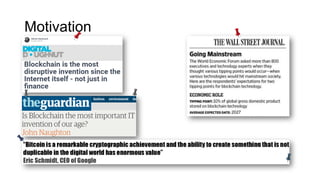
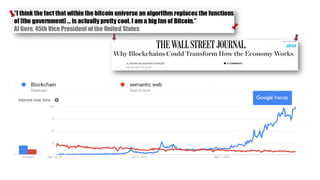
Motivation
Problem definition
 Blockchain-based platforms as the original Web, still require
interconnected data and meaning.
 Bitcoin: around 215,000 daily transactions.
 Ethereum: around 57,000 daily transactions.
 Existing Supply chain systems are not doing an optimal job,
Blockchain-based platforms can solve this issue.
Solution proposed
 Ontology BLONDiE for Bitcoin and Ethereum.
 Research how to extract data from Ethereum.
 Research how to store RDF data on Ethereum.
 Prototype DeSCA: Ethereum application.
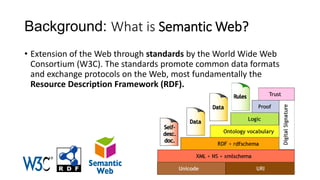
Background: What is Semantic Web?
• Extension of the Web through standards by the World Wide Web
Consortium (W3C). The standards promote common data formats
and exchange protocols on the Web, most fundamentally the
Resource Description Framework (RDF).
6
Background: Resource Description
Framework (RDF)
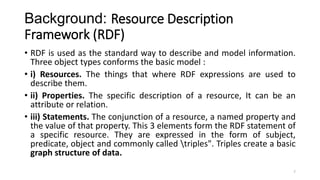
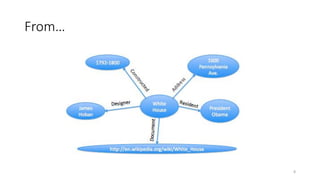
• RDF is used as the standard way to describe and model information.
Three object types conforms the basic model :
• i) Resources. The things that where RDF expressions are used to
describe them.
• ii) Properties. The specific description of a resource, It can be an
attribute or relation.
• iii) Statements. The conjunction of a resource, a named property and
the value of that property. This 3 elements form the RDF statement of
a specific resource. They are expressed in the form of subject,
predicate, object and commonly called triples". Triples create a basic
graph structure of data.
7
From…
8
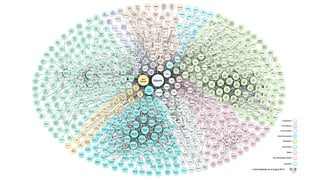
To…
9
10
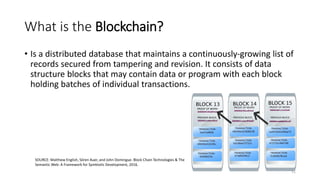
What is the Blockchain?
• Is a distributed database that maintains a continuously-growing list of
records secured from tampering and revision. It consists of data
structure blocks that may contain data or program with each block
holding batches of individual transactions.
SOURCE: Matthew English, Sören Auer, and John Domingue. Block Chain Technologies & The
Semantic Web: A Framework for Symbiotic Development, 2016.
11
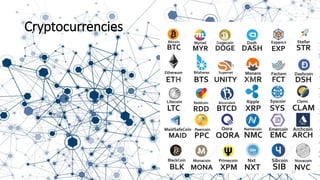
Cryptocurrencies
12
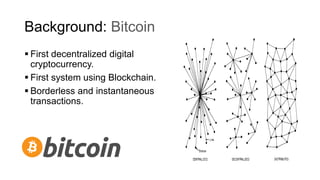
Background: Bitcoin
 First decentralized digital
cryptocurrency.
 First system using Blockchain.
 Borderless and instantaneous
transactions.
Background: Ethereum
 General purpose cryptocurrency platform that offers a Turing
complete virtual machine, based on Bitcoin technology.
 Possible to run any coin, script, or cryptocurrency project, as
implementations of smart contracts.
 SMART CONTRACT: An algorithm that can self-execute, self-
enforce, self-verify, and self-constrain the performance of a
contract.
Background: Blockchain Benefits and
Features
 Ownership of data.
 Uniqueness and proof of uniqueness.
 Immutability.
 Censorship resilient.
 Public transparency and traceability.
 Trustless and incorruptible.
 Cost-efficient.
 Guaranteed continuity.
Semantic Web benefits
• Consistency
• Standardization
• Linking and mappings
16
+
blockchain
Semantic Web + Blockchain
17
Semantic Blockchain
18
Semantic Blockchain
• Semantic Blockchain is the use of Semantic web standards on
blockchain based systems. The standards promote common data
formats and exchange protocols on the blockchain, making used of
the Resource Description Framework (RDF).
19
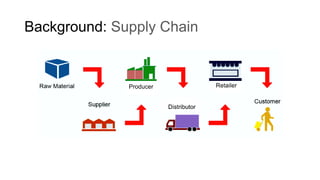
Background: Supply Chain
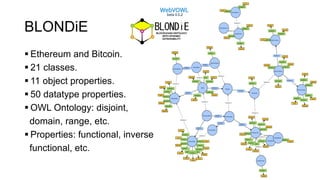
BLONDiE
 Ethereum and Bitcoin.
 21 classes.
 11 object properties.
 50 datatype properties.
 OWL Ontology: disjoint,
domain, range, etc.
 Properties: functional, inverse
functional, etc.
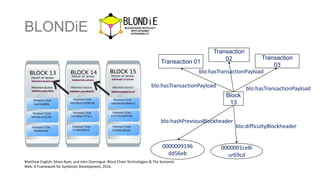
BLONDiE
Matthew English, Sören Auer, and John Domingue. Block Chain Technologies & The Semantic
Web: A Framework for Symbiotic Development, 2016.
Block
13
0000009196
dd56eb
0000001ce8i
ur69cd
blo:hasTransactionPayload
blo:difficultyBlockheader
Transaction 01
Transaction
02 Transaction
03
blo:hashPreviousBlockheader
blo:hasTransactionPayload
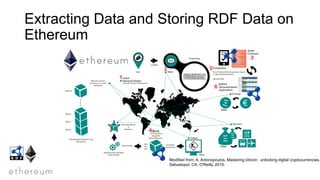
Extracting Data and Storing RDF Data on
Ethereum
Modified from: A. Antonopoulos, Mastering bitcoin : unlocking digital cryptocurrencies.
Sebastopol, CA: O'Reilly, 2015.
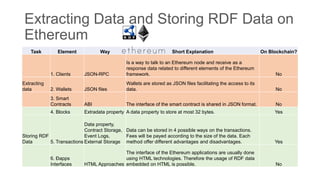
Extracting Data and Storing RDF Data on
Ethereum
Task Element Way Short Explanation On Blockchain?
1. Clients JSON-RPC
Is a way to talk to an Ethereum node and receive as a
response data related to different elements of the Ethereum
framework. No
Extracting
data 2. Wallets JSON files
Wallets are stored as JSON files facilitating the access to its
data. No
3. Smart
Contracts ABI The interface of the smart contract is shared in JSON format. No
4. Blocks Extradata property A data property to store at most 32 bytes. Yes
Storing RDF
Data 5. Transactions
Data property,
Contract Storage,
Event Logs,
External Storage
Data can be stored in 4 possible ways on the transactions.
Fees will be payed according to the size of the data. Each
method offer different advantages and disadvantages. Yes
6. Ðapps
Interfaces HTML Approaches
The interface of the Ethereum applications are usually done
using HTML technologies. Therefore the usage of RDF data
embedded on HTML is possible. No
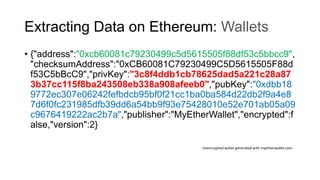
Extracting Data on Ethereum: Wallets
• {"address":"0xcb60081c79230499c5d5615505f88df53c5bbcc9",
"checksumAddress":"0xCB60081C79230499C5D5615505F88d
f53C5bBcC9","privKey":"3c8f4ddb1cb78625dad5a221c28a87
3b37cc115f8ba243508eb338a908afeeb0","pubKey":"0xdbb18
9772ec307e06242fefbdcb95bf0f21cc1ba0ba584d22db2f9a4e8
7d6f0fc231985dfb39dd6a54bb9f93e75428010e52e701ab05a09
c9676419222ac2b7a","publisher":"MyEtherWallet","encrypted":f
alse,"version":2}
Unencrypted wallet generated with myetherwallet.com
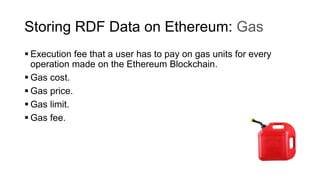
Storing RDF Data on Ethereum: Gas
 Execution fee that a user has to pay on gas units for every
operation made on the Ethereum Blockchain.
 Gas cost.
 Gas price.
 Gas limit.
 Gas fee.
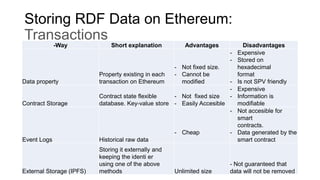
Storing RDF Data on Ethereum:
Transactions
-Way Short explanation Advantages Disadvantages
Data property
Property existing in each
transaction on Ethereum
- Not fixed size.
- Cannot be
modified
- Expensive
- Stored on
hexadecimal
format
- Is not SPV friendly
Contract Storage
Contract state flexible
database. Key-value store
- Not fixed size
- Easily Accesible
- Expensive
- Information is
modifiable
Event Logs Historical raw data
- Cheap
- Not accesible for
smart
contracts.
- Data generated by the
smart contract
External Storage (IPFS)
Storing it externally and
keeping the identi er
using one of the above
methods Unlimited size
- Not guaranteed that
data will not be removed
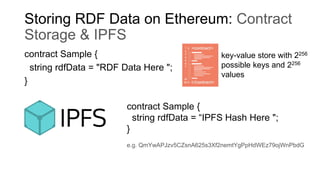
Storing RDF Data on Ethereum: Contract
Storage & IPFS
contract Sample {
string rdfData = "RDF Data Here ";
}
contract Sample {
string rdfData = “IPFS Hash Here ";
}
e.g. QmYwAPJzv5CZsnA625s3Xf2nemtYgPpHdWEz79ojWnPbdG
key-value store with 2256
possible keys and 2256
values
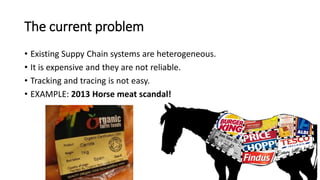
The current problem
• Existing Suppy Chain systems are heterogeneous.
• It is expensive and they are not reliable.
• Tracking and tracing is not easy.
• EXAMPLE: 2013 Horse meat scandal!
29
DeSCA prototype
 Ethereum Decentralized Application.
 Basic Supply Chain Management prototype.
 Record flow of goods.
 Record data participants.
 Record RDF data.
Architecture
G. Wood, “The ethereum experience." [Online]. Available:
http://www.slideshare.net/ethereum/the-ethereum-experience
Functionalities
 Create account
 Manage smart contract
 Register user
 Create item
 Transfer item
 Show provenance
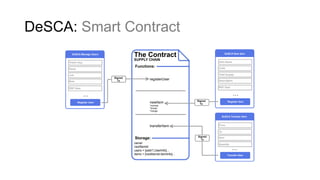
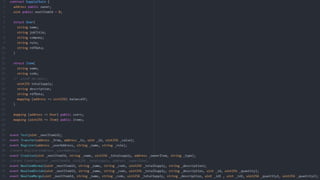
DeSCA: Smart Contract
34
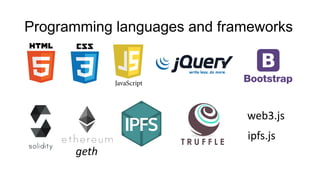
Programming languages and frameworks
web3.js
ipfs.js
geth
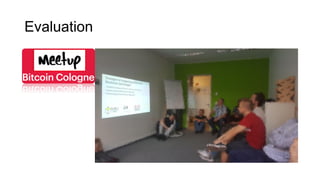
Evaluation
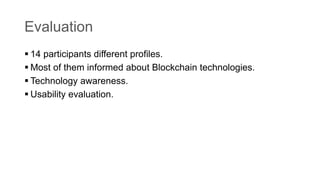
Evaluation
 14 participants different profiles.
 Most of them informed about Blockchain technologies.
 Technology awareness.
 Usability evaluation.
Evaluation: Technology awareness
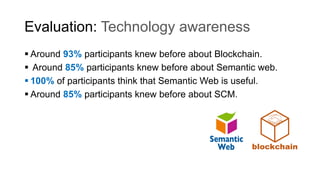
 Around 93% participants knew before about Blockchain.
 Around 85% participants knew before about Semantic web.
 100% of participants think that Semantic Web is useful.
 Around 85% participants knew before about SCM.
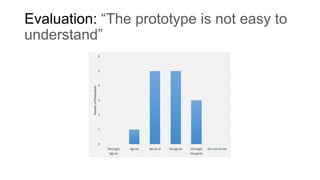
Evaluation: “The prototype is not easy to
understand”
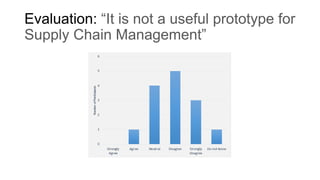
Evaluation: “It is not a useful prototype for
Supply Chain Management”
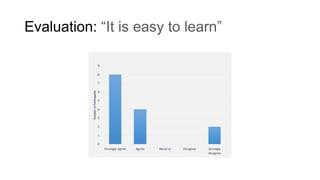
Evaluation: “It is easy to learn”
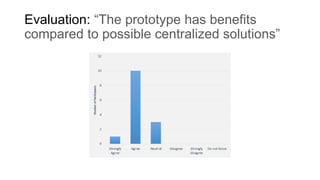
Evaluation: “The prototype has benefits
compared to possible centralized solutions”
Conclusions
 This research presented some integrations steps between
Semantic and Blockchain technologies.
 BLONDiE: OWL ontology.
 Extracting data and storing RDF data from Ethereum.
 DeSCA: Ethereum ÐApp prototype for SCM.
 DeSCA was evaluated resulting that most people think it is easy
to understand, is useful, easy to learn, and offers advantages
compared to centralized systems.
Future Work
 BLONDiE can be extended to cover more Blockchain-based
platforms (Hyperledger, NXT, etc).
 Research about more Semantic integration on Ethereum like
instead of using HTTP-URIs, start using hashes as identifiers.
 DeSCA can be extended to cover more data related to SCM. It
can be extended to allow manage of users and item data, store
certificates that prove origin of data.
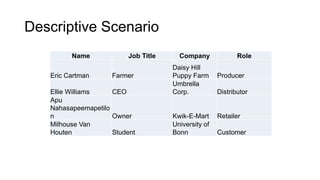
Descriptive Scenario
Name Job Title Company Role
Eric Cartman Farmer
Daisy Hill
Puppy Farm Producer
Ellie Williams CEO
Umbrella
Corp. Distributor
Apu
Nahasapeemapetilo
n Owner Kwik-E-Mart Retailer
Milhouse Van
Houten Student
University of
Bonn Customer
DeSCA
https://youtu.be/JiWDYByK5zo
Thanks

Strategies for integrating semantic and blockchain technologies

  • 1.
    Strategies for Integrating Semanticand Blockchain Technologies DONE BY: Héctor E. Ugarte R. Msc. Computer Science
  • 2.
  • 4.
    Problem definition  Blockchain-basedplatforms as the original Web, still require interconnected data and meaning.  Bitcoin: around 215,000 daily transactions.  Ethereum: around 57,000 daily transactions.  Existing Supply chain systems are not doing an optimal job, Blockchain-based platforms can solve this issue.
  • 5.
    Solution proposed  OntologyBLONDiE for Bitcoin and Ethereum.  Research how to extract data from Ethereum.  Research how to store RDF data on Ethereum.  Prototype DeSCA: Ethereum application.
  • 6.
    Background: What isSemantic Web? • Extension of the Web through standards by the World Wide Web Consortium (W3C). The standards promote common data formats and exchange protocols on the Web, most fundamentally the Resource Description Framework (RDF). 6
  • 7.
    Background: Resource Description Framework(RDF) • RDF is used as the standard way to describe and model information. Three object types conforms the basic model : • i) Resources. The things that where RDF expressions are used to describe them. • ii) Properties. The specific description of a resource, It can be an attribute or relation. • iii) Statements. The conjunction of a resource, a named property and the value of that property. This 3 elements form the RDF statement of a specific resource. They are expressed in the form of subject, predicate, object and commonly called triples". Triples create a basic graph structure of data. 7
  • 8.
  • 9.
  • 10.
  • 11.
    What is theBlockchain? • Is a distributed database that maintains a continuously-growing list of records secured from tampering and revision. It consists of data structure blocks that may contain data or program with each block holding batches of individual transactions. SOURCE: Matthew English, Sören Auer, and John Domingue. Block Chain Technologies & The Semantic Web: A Framework for Symbiotic Development, 2016. 11
  • 12.
  • 13.
    Background: Bitcoin  Firstdecentralized digital cryptocurrency.  First system using Blockchain.  Borderless and instantaneous transactions.
  • 14.
    Background: Ethereum  Generalpurpose cryptocurrency platform that offers a Turing complete virtual machine, based on Bitcoin technology.  Possible to run any coin, script, or cryptocurrency project, as implementations of smart contracts.  SMART CONTRACT: An algorithm that can self-execute, self- enforce, self-verify, and self-constrain the performance of a contract.
  • 15.
    Background: Blockchain Benefitsand Features  Ownership of data.  Uniqueness and proof of uniqueness.  Immutability.  Censorship resilient.  Public transparency and traceability.  Trustless and incorruptible.  Cost-efficient.  Guaranteed continuity.
  • 16.
    Semantic Web benefits •Consistency • Standardization • Linking and mappings 16
  • 17.
  • 18.
  • 19.
    Semantic Blockchain • SemanticBlockchain is the use of Semantic web standards on blockchain based systems. The standards promote common data formats and exchange protocols on the blockchain, making used of the Resource Description Framework (RDF). 19
  • 20.
  • 21.
    BLONDiE  Ethereum andBitcoin.  21 classes.  11 object properties.  50 datatype properties.  OWL Ontology: disjoint, domain, range, etc.  Properties: functional, inverse functional, etc.
  • 22.
    BLONDiE Matthew English, SörenAuer, and John Domingue. Block Chain Technologies & The Semantic Web: A Framework for Symbiotic Development, 2016. Block 13 0000009196 dd56eb 0000001ce8i ur69cd blo:hasTransactionPayload blo:difficultyBlockheader Transaction 01 Transaction 02 Transaction 03 blo:hashPreviousBlockheader blo:hasTransactionPayload blo:hasTransactionPayload
  • 23.
    Extracting Data andStoring RDF Data on Ethereum Modified from: A. Antonopoulos, Mastering bitcoin : unlocking digital cryptocurrencies. Sebastopol, CA: O'Reilly, 2015.
  • 24.
    Extracting Data andStoring RDF Data on Ethereum Task Element Way Short Explanation On Blockchain? 1. Clients JSON-RPC Is a way to talk to an Ethereum node and receive as a response data related to different elements of the Ethereum framework. No Extracting data 2. Wallets JSON files Wallets are stored as JSON files facilitating the access to its data. No 3. Smart Contracts ABI The interface of the smart contract is shared in JSON format. No 4. Blocks Extradata property A data property to store at most 32 bytes. Yes Storing RDF Data 5. Transactions Data property, Contract Storage, Event Logs, External Storage Data can be stored in 4 possible ways on the transactions. Fees will be payed according to the size of the data. Each method offer different advantages and disadvantages. Yes 6. Ðapps Interfaces HTML Approaches The interface of the Ethereum applications are usually done using HTML technologies. Therefore the usage of RDF data embedded on HTML is possible. No
  • 25.
    Extracting Data onEthereum: Wallets • {"address":"0xcb60081c79230499c5d5615505f88df53c5bbcc9", "checksumAddress":"0xCB60081C79230499C5D5615505F88d f53C5bBcC9","privKey":"3c8f4ddb1cb78625dad5a221c28a87 3b37cc115f8ba243508eb338a908afeeb0","pubKey":"0xdbb18 9772ec307e06242fefbdcb95bf0f21cc1ba0ba584d22db2f9a4e8 7d6f0fc231985dfb39dd6a54bb9f93e75428010e52e701ab05a09 c9676419222ac2b7a","publisher":"MyEtherWallet","encrypted":f alse,"version":2} Unencrypted wallet generated with myetherwallet.com
  • 26.
    Storing RDF Dataon Ethereum: Gas  Execution fee that a user has to pay on gas units for every operation made on the Ethereum Blockchain.  Gas cost.  Gas price.  Gas limit.  Gas fee.
  • 27.
    Storing RDF Dataon Ethereum: Transactions -Way Short explanation Advantages Disadvantages Data property Property existing in each transaction on Ethereum - Not fixed size. - Cannot be modified - Expensive - Stored on hexadecimal format - Is not SPV friendly Contract Storage Contract state flexible database. Key-value store - Not fixed size - Easily Accesible - Expensive - Information is modifiable Event Logs Historical raw data - Cheap - Not accesible for smart contracts. - Data generated by the smart contract External Storage (IPFS) Storing it externally and keeping the identi er using one of the above methods Unlimited size - Not guaranteed that data will not be removed
  • 28.
    Storing RDF Dataon Ethereum: Contract Storage & IPFS contract Sample { string rdfData = "RDF Data Here "; } contract Sample { string rdfData = “IPFS Hash Here "; } e.g. QmYwAPJzv5CZsnA625s3Xf2nemtYgPpHdWEz79ojWnPbdG key-value store with 2256 possible keys and 2256 values
  • 29.
    The current problem •Existing Suppy Chain systems are heterogeneous. • It is expensive and they are not reliable. • Tracking and tracing is not easy. • EXAMPLE: 2013 Horse meat scandal! 29
  • 30.
    DeSCA prototype  EthereumDecentralized Application.  Basic Supply Chain Management prototype.  Record flow of goods.  Record data participants.  Record RDF data.
  • 31.
    Architecture G. Wood, “Theethereum experience." [Online]. Available: http://www.slideshare.net/ethereum/the-ethereum-experience
  • 32.
    Functionalities  Create account Manage smart contract  Register user  Create item  Transfer item  Show provenance
  • 33.
  • 34.
  • 35.
    Programming languages andframeworks web3.js ipfs.js geth
  • 36.
  • 37.
    Evaluation  14 participantsdifferent profiles.  Most of them informed about Blockchain technologies.  Technology awareness.  Usability evaluation.
  • 38.
    Evaluation: Technology awareness Around 93% participants knew before about Blockchain.  Around 85% participants knew before about Semantic web.  100% of participants think that Semantic Web is useful.  Around 85% participants knew before about SCM.
  • 39.
    Evaluation: “The prototypeis not easy to understand”
  • 40.
    Evaluation: “It isnot a useful prototype for Supply Chain Management”
  • 41.
    Evaluation: “It iseasy to learn”
  • 42.
    Evaluation: “The prototypehas benefits compared to possible centralized solutions”
  • 43.
    Conclusions  This researchpresented some integrations steps between Semantic and Blockchain technologies.  BLONDiE: OWL ontology.  Extracting data and storing RDF data from Ethereum.  DeSCA: Ethereum ÐApp prototype for SCM.  DeSCA was evaluated resulting that most people think it is easy to understand, is useful, easy to learn, and offers advantages compared to centralized systems.
  • 44.
    Future Work  BLONDiEcan be extended to cover more Blockchain-based platforms (Hyperledger, NXT, etc).  Research about more Semantic integration on Ethereum like instead of using HTTP-URIs, start using hashes as identifiers.  DeSCA can be extended to cover more data related to SCM. It can be extended to allow manage of users and item data, store certificates that prove origin of data.
  • 45.
    Descriptive Scenario Name JobTitle Company Role Eric Cartman Farmer Daisy Hill Puppy Farm Producer Ellie Williams CEO Umbrella Corp. Distributor Apu Nahasapeemapetilo n Owner Kwik-E-Mart Retailer Milhouse Van Houten Student University of Bonn Customer
  • 46.
  • 47.