Capturing the Enterprise
                                                    Potential of Young
                                                    People
                                                    across the Yorkshire & Humber Region


Inside                                              BusinessLink Research
Enterprise Potential of young people                Dubit were commissioned to improve understanding of the attitudes and
still to be fully realised                          perceptions of 14-25 year olds, with a view to helping target key
6 out of 10 have business ideas they could
                                                    groupings and strengthening service delivery, especially online
explore, but only 3 out of 10 have ever looked
for information or support. 63% have never
looked for information on taking an idea            This document highlights the main               real action in the business arena.
further                                             findings from a survey of 1,261 young
                                           Pg. 5    people aged between 14 and 25, across all       Part One profiles the region’s youth
                                                    educational and occupational groupings,         landscape in terms of their potential - who
BusinessLink awareness relatively high
                                                    backed up with 9 focus groups, 20 teacher       is more suited to enterprise, and the
amongst youth audiences
                                                    interviews, and stakeholder opinion and         influences on this. This allows us to assess
54% of the survey knew of the service, yet
68% of young people don’t know where to go          involvement.                                    the main opportunities to inspire potential
with business ideas. More than half would go                                                        into action. Part Two then gives a
to their careers adviser                            Through the research, conducted in April        segmentation of the population by
                                          Pg. 8     and May 2009, Dubit and BusinessLink            potential, and we also look at how
Does FE and HE take the edge off                    developed three key indicators across the       education and occupation groupings
enterprise?                                         youth population. These provide insights        may form a channel strategy for future
Uni & college students the least likely to go       into young people’s inherent enterprise         delivery, and the opportunities within each
into business, but school pupils and young          potential; their aspiration to set up in        to engage young people.
people in employment have high potential,           business; and actual engagement with
aspiration and business engagement
                                                    enterprise. Together, these provide a           Normal distribution of
                                           Pg. 12
                                                    pathway to business - from their natural        enterprising characteristics
                                                    skills, their readiness, and through to their                                                  1
Table of Contents


Part One
Youth Enterprise Landscape
 Young People’s Enterprise Potential across the region   3
 Business Aspiration scale                               4
 Business Engagement scale                               5
 Influences on Enterprise                                6

        Enterprise Education
                                                         7
                                                         8
 Business Information - young people’s needs


Part Two
Segmentation & Channel Strategies
 Enterprise Potential segments: EPS1-4                   10
 Segmentation by Educational & Occupational Status       12
        Employed (16-25s)                                14
        School Students (14-16s)                         14
        College / 6th Form Students (16-18s)             15

        University Students (18-25s)
                                                         15
                                                         16
        NEETs (16-25s)
                                                         16
 Recommendations


                                                              2
The Youth Landscape:
Part One                                                     Enterprise Potential
                                                         Frequency                                   Mean Average 212

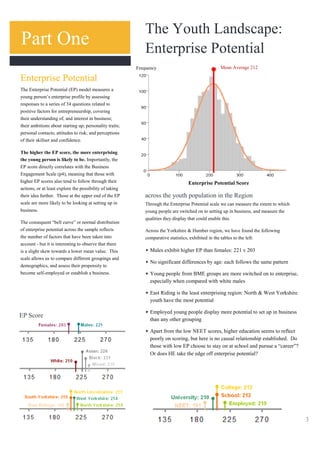
Enterprise Potential
The Enterprise Potential (EP) model measures a
young person’s enterprise profile by assessing
responses to a series of 34 questions related to
positive factors for entrepreneurship, covering
their understanding of, and interest in business;
their ambitions about starting up; personality traits;
personal contacts; attitudes to risk; and perceptions
of their skillset and confidence.

The higher the EP score, the more enterprising
the young person is likely to be. Importantly, the
EP score directly correlates with the Business
Engagement Scale (p4), meaning that those with
higher EP scores also tend to follow through their                                  Enterprise Potential Score
actions, or at least explore the possibility of taking
their idea further. Those at the upper end of the EP         across the youth population in the Region
scale are more likely to be looking at setting up in         Through the Enterprise Potential scale we can measure the extent to which
business.                                                    young people are switched on to setting up in business, and measure the
                                                             qualities they display that could enable this.
The consequent “bell curve” or normal distribution
of enterprise potential across the sample reflects           Across the Yorkshire & Humber region, we have found the following
the number of factors that have been taken into              comparative statistics, exhibited in the tables to the left:
account - but it is interesting to observe that there
is a slight skew towards a lower mean value. This              Males exhibit higher EP than females: 221 v 203
scale allows us to compare different groupings and
                                                               No significant differences by age: each follows the same pattern
demographics, and assess their propensity to
become self-employed or establish a business.                  Young people from BME groups are more switched on to enterprise,
                                                               especially when compared with white males

                                                               East Riding is the least enterprising region: North & West Yorkshire
                                                               youth have the most potential

                                                               Employed young people display more potential to set up in business
EP Score
                                                               than any other grouping

                                                               Apart from the low NEET scores, higher education seems to reflect
                                                               poorly on scoring, but here is no causal relationship established. Do
                                                               those with low EP choose to stay on at school and pursue a “career”?
                                                               Or does HE take the edge off enterprise potential?


                                                                                                                                         3
Business Aspirations:
seize the day?

Once we have assessed the population’s enterprise potential, it is interesting to
measure the thirst for setting up in business in the future, and compare results
across and within groups. Plus, whether they see enterprise as a viable
alternative to mainstream employment:

  7 out of ten young people in the survey believe that anyone can set up
  in business

  8 out of ten believe that anyone can be self-employed

There is no shortage of positive thinking about the concept of enterprise

  Nearly 60% of 14-19 year olds feel that becoming self-employed is a
  possibility for people in their 20s or even before.

  Nearly 40% of 14-19 year olds feel that setting up in business is a                Self-employment vs
  possibility for people in their 20s or even before.                                Setting up in Business
The critical question, however, is whether they think that they could do that
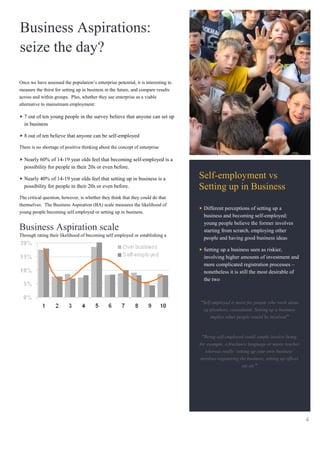
themselves. The Business Aspiration (BA) scale measures the likelihood of
                                                                                       Different perceptions of setting up a
young people becoming self employed or setting up in business.
                                                                                       business and becoming self-employed:
                                                                                       young people believe the former involves
Business Aspiration scale                                                              starting from scratch, employing other
Through rating their likelihood of becoming self employed or establishing a
                                                                                       people and having good business ideas
business in the future - from 1 (highly unlikely) to 10 (highly likely), we obtain
an overview of the youth population.                                                   Setting up a business seen as riskier,
                                                                                       involving higher amounts of investment and
Overall, the three peaks indicate that there are some totally disconnected with
                                                                                       more complicated registration processes –
the idea (1-2); some definitely looking to set up in the future (8-10); and then a
                                                                                       nonetheless it is still the most desirable of
huge amount of young people who are unsure (5), unprepared to make any
                                                                                       the two
commitment.

  Employed young people and school pupils have much higher
  business aspirations than those at University or College (p12)                     “Self employed is more for people who work alone
                                                                                      eg plumbers, consultants. Setting up a business
                                                                                          implies other people would be involved”


                                                                                      “Being self-employed could simply involve being,
                                                                                     for example, a freelance language or music teacher
                                                                                        whereas really „setting up your own business‟
                                                                                      involves registering the business, setting up offices
                                                                                                           etc etc”


                                                                                                                                              4
Business Engagement
Taking the hopes or aspirations one step further and into
action: just how many are prepared to jump in and give
enterprise a go?


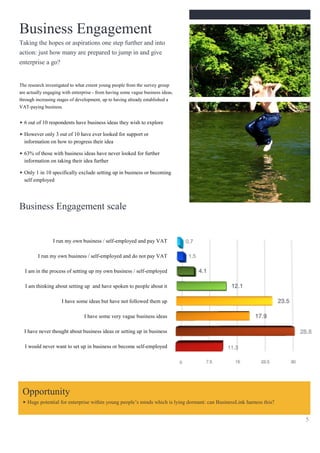
The research investigated to what extent young people from the survey group
are actually engaging with enterprise - from having some vague business ideas,
through increasing stages of development, up to having already established a
VAT-paying business.


  6 out of 10 respondents have business ideas they wish to explore

  However only 3 out of 10 have ever looked for support or
  information on how to progress their idea

  63% of those with business ideas have never looked for further
  information on taking their idea further

  Only 1 in 10 specifically exclude setting up in business or becoming
  self employed


Business Engagement scale


                 I run my own business / self-employed and pay VAT

         I run my own business / self-employed and do not pay VAT

  I am in the process of setting up my own business / self-employed

  I am thinking about setting up and have spoken to people about it

                     I have some ideas but have not followed them up

                                I have some very vague business ideas

  I have never thought about business ideas or setting up in business

  I would never want to set up in business or become self-employed


 Opportunity
    Huge potential for enterprise within young people’s minds which is lying dormant: can BusinessLink harness this?


                                                                                                                       5
Influences on Enterprise
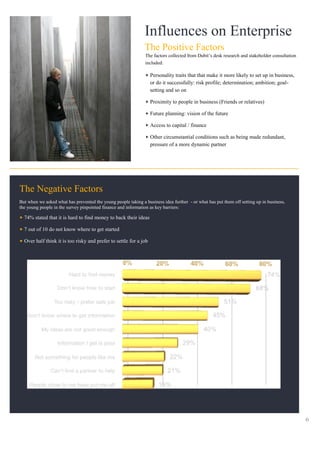
                                                               The Positive Factors
                                                               The factors collected from Dubit’s desk research and stakeholder consultation
                                                               included:

                                                                   Personality traits that that make it more likely to set up in business,
                                                                   or do it successfully: risk profile; determination; ambition; goal-
                                                                   setting and so on

                                                                   Proximity to people in business (Friends or relatives)

                                                                   Future planning: vision of the future

                                                                   Access to capital / finance

                                                                   Other circumstantial conditions such as being made redundant,
                                                                   pressure of a more dynamic partner


The Negative Factors
But when we asked what has prevented the young people taking a business idea further - or what has put them off setting up in business,
the young people in the survey pinpointed finance and information as key barriers:

  74% stated that it is hard to find money to back their ideas

  7 out of 10 do not know where to get started

  Over half think it is too risky and prefer to settle for a job


                                                                                                                                               6
Business Information (cont.)
Enterprise Education


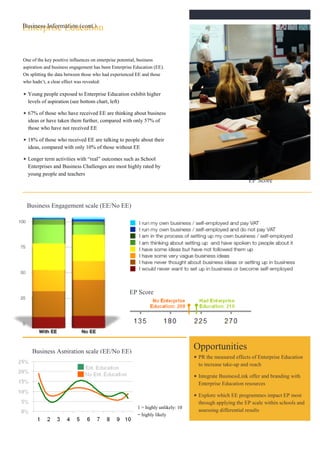
One of the key positive influences on enterprise potential, business
aspiration and business engagement has been Enterprise Education (EE).
On splitting the data between those who had experienced EE and those
who hadn’t, a clear effect was revealed:

  Young people exposed to Enterprise Education exhibit higher
  levels of aspiration (see bottom chart, left)

  67% of those who have received EE are thinking about business
  ideas or have taken them further, compared with only 57% of
  those who have not received EE

  18% of those who received EE are talking to people about their
  ideas, compared with only 10% of those without EE

  Longer term activities with “real” outcomes such as School
  Enterprises and Business Challenges are most highly rated by
  young people and teachers
                                                                                                         EP Score


 Business Engagement scale (EE/No EE)


                                                    EP Score


    Business Aspiration scale (EE/No EE)
                                                                                  Opportunities
                                                                                   PR the measured effects of Enterprise Education
                                                                                   to increase take-up and reach

                                                                                   Integrate BusinessLink offer and branding with
                                                                                   Enterprise Education resources

                                                                                   Explore which EE programmes impact EP most
                                                                                   through applying the EP scale within schools and
                                                        1 = highly unlikely: 10
                                                                                   assessing differential results
                                                        = highly likely
                                                                                                                                      7
Business Information
Young people’s resources
Given that some of the key barriers to progressing a business idea implied a
lack of information and knowledge about business, the young people in the
survey were asked where they currently would start to find such support. The
top three destinations were polled and these reveal that:


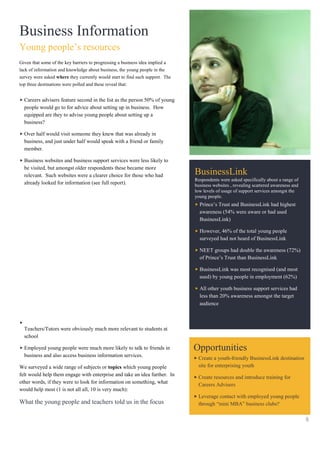
  Careers advisers feature second in the list as the person 50% of young
  people would go to for advice about setting up in business. How
  equipped are they to advise young people about setting up a
  business?

  Over half would visit someone they knew that was already in
  business, and just under half would speak with a friend or family
  member.

  Business websites and business support services were less likely to
  be visited, but amongst older respondents these became more
  relevant. Such websites were a clearer choice for those who had              BusinessLink
                                                                               Respondents were asked specifically about a range of
  already looked for information (see full report).                            business websites , revealing scattered awareness and
                                                                               low levels of usage of support services amongst the
                                                                               young people.
                                                                                 Prince’s Trust and BusinessLink had highest
                                                                                 awareness (54% were aware or had used
                                                                                 BusinessLink)

                                                                                 However, 46% of the total young people
                                                                                 surveyed had not heard of BusinessLink

                                                                                 NEET groups had double the awareness (72%)
                                                                                 of Prince’s Trust than BusinessLink

                                                                                 BusinessLink was most recognised (and most
                                                                                 used) by young people in employment (62%)

                                                                                 All other youth business support services had
                                                                                 less than 20% awareness amongst the target
                                                                                 audience


  Teachers/Tutors were obviously much more relevant to students at
  school

  Employed young people were much more likely to talk to friends in            Opportunities
  business and also access business information services.
                                                                                Create a youth-friendly BusinessLink destination
We surveyed a wide range of subjects or topics which young people               site for enterprising youth
felt would help them engage with enterprise and take an idea further. In
                                                                                Create resources and introduce training for
other words, if they were to look for information on something, what
                                                                                Careers Advisers
would help most (1 is not all all, 10 is very much):
                                                                                Leverage contact with employed young people
What the young people and teachers told us in the focus                         through “mini MBA” business clubs?

                                                                                                                                       8
Business Information (cont.)

                                                      groups:

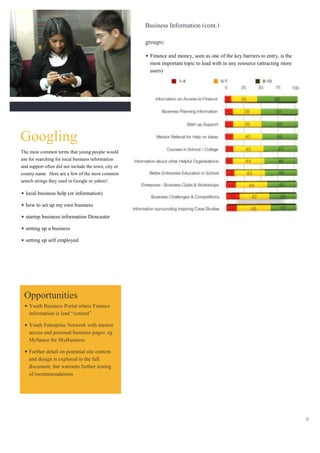
                                                       Finance and money, seen as one of the key barriers to entry, is the
                                                       most important topic to lead with in any resource (attracting more
                                                       users)

                                                                However school pupils felt that information on startups was
                                                                more important than access to finance

                                                       Case studies seen as less important overall, although teachers felt
                                                       these motivated young people more than anything else

                                                       Access to a mentor network appealed more to young people - but
                                                       they didn’t know where to go for this

Googling                                               It was felt that existing resources catered for those “already engaged”
                                                       - reflected in the low usage of business support websites. There is a
The most common terms that young people would
                                                       need for a comprehensive but simple, jargon-busting, site
use for searching for local business information
and support often did not include the town, city or    Young people and teachers suggested interactive applications and
county name. Here are a few of the most common         networks for young enterprising people to share experiences, be
search strings they used in Google or yahoo!:          introduced to mentors, learn from advice

  local business help (or information)

  how to set up my own business

  startup business information Doncaster

  setting up a business

  setting up self employed


 Opportunities
    Youth Business Portal where Finance
    information is lead “content”

    Youth Enterprise Network with mentor
    access and personal business pages: eg
    MySpace for MyBusiness

    Further detail on potential site content
    and design is explored in the full
    document, but warrants further testing
    of recommendations


                                                                                                                                 9
Segmentation Studies &
Part Two                                                  Channel Strategies
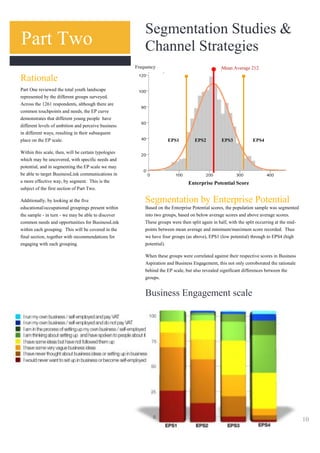
                                                      Frequency                                  Mean Average 212

Rationale
Part One reviewed the total youth landscape
represented by the different groups surveyed.
Across the 1261 respondents, although there are
common touchpoints and needs, the EP curve
demonstrates that different young people have
different levels of ambition and perceive business
in different ways, resulting in their subsequent
place on the EP scale.                                               EPS1          EPS2          EPS3             EPS4

Within this scale, then, will be certain typologies
which may be uncovered, with specific needs and
potential, and in segmenting the EP scale we may
be able to target BusinessLink communications in
a more effective way, by segment. This is the                                   Enterprise Potential Score
subject of the first section of Part Two.

Additionally, by looking at the five                      Segmentation by Enterprise Potential
educational/occupational groupings present within         Based on the Enterprise Potential scores, the population sample was segmented
the sample - in turn - we may be able to discover         into two groups, based on below average scores and above average scores.
common needs and opportunities for BusinessLink           These groups were then split again in half, with the split occurring at the mid-
within each grouping. This will be covered in the         points between mean average and minimum/maximum score recorded. Thus
final section, together with recommendations for          we have four groups (as above), EPS1 (low potential) through to EPS4 (high
engaging with each grouping.                              potential).

                                                          When these groups were correlated against their respective scores in Business
                                                          Aspiration and Business Engagement, this not only corroborated the rationale
                                                          behind the EP scale, but also revealed significant differences between the
                                                          groups.


                                                          Business Engagement scale


                                                                                                                                             10
Segmentation by Enterprise Potential (cont.)


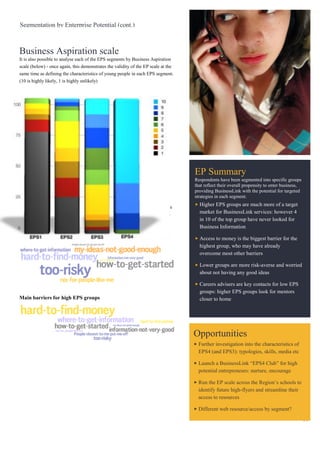
Business Aspiration scale
It is also possible to analyse each of the EPS segments by Business Aspiration
scale (below) - once again, this demonstrates the validity of the EP scale at the
same time as defining the characteristics of young people in each EPS segment.
(10 is highly likely, 1 is highly unlikely)


                                                                                    EP Summary
                                                                                    Respondents have been segmented into specific groups
                                                                                    that reflect their overall propensity to enter business,
Differential Influences on Enterprise                                               providing BusinessLink with the potential for targeted
                                                                                    strategies in each segment.
A word cloud for each group was generated from responses to the questions
about main barriers to thinking about, or actually going ahead, and setting up a
                                                                                      Higher EPS groups are much more of a target
business. The larger the phrase, the more it was mentioned by the respondents         market for BusinessLink services: however 4
in that EPS group.                                                                    in 10 of the top group have never looked for
                                                                                      Business Information
Main barriers for low EPS groups
                                                                                      Access to money is the biggest barrier for the
                                                                                      highest group, who may have already
                                                                                      overcome most other barriers

                                                                                      Lower groups are more risk-averse and worried
                                                                                      about not having any good ideas

                                                                                      Careers advisers are key contacts for low EPS
                                                                                      groups: higher EPS groups look for mentors
Main barriers for high EPS groups                                                     closer to home


                                                                                    Opportunities
                                                                                     Further investigation into the characteristics of
                                                                                     EPS4 (and EPS3): typologies, skills, media etc

                                                                                     Launch a BusinessLink “EPS4 Club” for high
                                                                                     potential entrepreneurs: nurture, encourage

                                                                                     Run the EP scale across the Region’s schools to
                                                                                     identify future high-flyers and streamline their
                                                                                     access to resources

                                                                                     Different web resource/access by segment?

                                                                                                                                               11
Segmentation by Educational &
Occupational Status

Enterprise Potential scale
This section of the research takes each grouping and sample population from
within that, and runs the previous analysis within each grouping:

- School Pupils (14-16s)

- College / 6th Form Students (16-19s)

- NEET (16-25s)

- University Students (18-25s)

- Employed (16-25s)

This resulted in different EP graphs for each grouping:


                                                                                Business Aspiration scale
                                                                                Does FE/HE take the edge off enterprise?
                                                                                  School and Employed groups most interested in the
and the line below summarises the mean scores for each grouping:                  choice of enterprise in the future

                                                                                  University students have significantly lower high
                                                                                  enterprise aspiration (even lower than NEET)

                                                                                         College students also seem to be on “career
                                                                                         path” and do not consider enterprise as a
                                                                                         serious option


  Young people in employment register the highest EP scores

  School and College students higher than University scores

  NEETs register the lowest scores

However it is important to note that the shape of the curves indicates that
within each group there is still a range of EP scores, meaning that even NEET
respondents had some in the top (EPS4) segment. Indeed, University students
have one of the highest proportions of EPS4 scores: this may point in the
direction of a more rigorous “EPS3/4 segment” strategy as opposed to a
channel/grouping strategy.


                                                                                                                                      12
Segmentation by Education/Occupation (cont.)


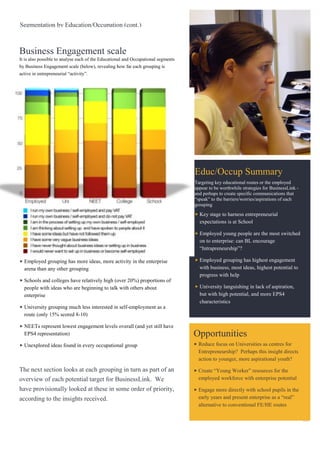
Business Engagement scale
It is also possible to analyse each of the Educational and Occupational segments
by Business Engagement scale (below), revealing how far each grouping is
active in entrepreneurial “activity”.


                                                                                   Educ/Occup Summary
                                                                                   Targeting key educational routes or the employed
                                                                                   appear to be worthwhile strategies for BusinessLink -
                                                                                   and perhaps to create specific communications that
                                                                                   “speak” to the barriers/worries/aspirations of each
                                                                                   grouping

                                                                                     Key stage to harness entrepreneurial
                                                                                     expectations is at School

                                                                                     Employed young people are the most switched
                                                                                     on to enterprise: can BL encourage
                                                                                     “Intrapreneurship”?

  Employed grouping has more ideas, more activity in the enterprise                  Employed grouping has highest engagement
  arena than any other grouping                                                      with business, most ideas, highest potential to
                                                                                     progress with help
  Schools and colleges have relatively high (over 20%) proportions of
  people with ideas who are beginning to talk with others about                      University languishing in lack of aspiration,
  enterprise                                                                         but with high potential, and more EPS4
                                                                                     characteristics
  University grouping much less interested in self-employment as a
  route (only 15% scored 8-10)

  NEETs represent lowest engagement levels overall (and yet still have
  EPS4 representation)                                                             Opportunities
  Unexplored ideas found in every occupational group                                Reduce focus on Universities as centres for
                                                                                    Entrepreneurship? Perhaps this insight directs
                                                                                    action to younger, more aspirational youth?

The next section looks at each grouping in turn as part of an                       Create “Young Worker” resources for the
overview of each potential target for BusinessLink. We                              employed workforce with enterprise potential

have provisionally looked at these in some order of priority,                       Engage more directly with school pupils in the
according to the insights received.                                                 early years and present enterprise as a “real”
                                                                                    alternative to conventional FE/HE routes

                                                                                                                                           13
Employed (16-25s)

Enterprise Potential
Highest overall (219) and largest slice of EPS4 (high potential group)

Business Aspiration & Engagement
Highest at top level (25% 8-10s) and most engaged: most business ideas to
pursue (70%) and most likely to speak to others about these. Highest level of
current business start-ups.

Perceived Barriers                                                                  Opportunities
Money and access to finance stands out from other factors (risk is the second):
                                                                                     Out-of-hours resources (such as websites,
seem to be more confident; less need to know “how to get started” than other
                                                                                     helplines, mobile units) and “outreach” more
groupings, but startup support still an issue.
                                                                                     relevant to this grouping
Information Needs                                                                    Create “Young Worker” resources for the
Business websites the key focus for their search, as well as family and friends.     employed workforce with enterprise potential
Access to finance, and business planning information cited as key
requirements. Over half felt that Business Clubs were a good idea in the             Assess accessibility and “youth-friendly” nature
survey.                                                                              of BusinessLink resources. Can we do more to
                                                                                     encourage those in employment?
BusinessLink
                                                                                     Business Clubs and online networks
Highest awareness and usage: but still only 20% have contacted.


School Students (14-16s)

Enterprise Potential
Second highest level (212) and good penetration of EPS3 & 4.

Business Aspiration & Engagement
Highest overall aspirations to enter business of all groups: one third have ideas
but not pursued them. Nearly 20% are speaking to people about their ideas.
Enterprise Education has had a huge impact on their confidence - and they are
still exposed to it at this stage.
                                                                                    Opportunities
Perceived Barriers
                                                                                     High aspiration can be harnessed by more
Only group for whom money and finance are not the most important barriers:
                                                                                     directional as well as experiential Enterprise
neither is risk a big concern. Key barrier is “not knowing how to start”. (Plus,
                                                                                     Education (eg. showing how to “start up”)
does FE/HE route dampens the potential of enterprise?)
                                                                                     Provide effective training and resources to
Information Needs                                                                    Careers Advisers & Teachers
Main sources are currently friends & family, websites and teachers / careers
advisers. They seek access to mentors (and to a lesser extent, finance). More        Create more interactive online resources &
interactive online applications & networks could provide key information &           networks for young entrepreneurs
learning resources.
                                                                                     Engage more directly with school pupils in the
                                                                                     early years and present enterprise as a “real”
BusinessLink
                                                                                     alternative to conventional FE/HE routes
Over 50% of pupils had never heard of BusinessLink
                                                                                                                                        14
College / 6th Form Students (16-18s)

Enterprise Potential
Joint second highest score (212) and second largest slice of EPS4 group

Business Aspiration & Engagement
Second largest engagement factor: 2 in 5 have vague ideas; 1 in 5 are
exploring ideas; and less than 1 in 10 exclude business as an option. However,
their aspirations are less than those in school or employment, implying a loss
of interest, and in spite of high potential and many ideas.

Perceived Barriers
                                                                                 Opportunities
Risk and “knowing how to get started” are less of an issue here, but money        Engage tutors/teachers/careers advisers with key
resurfaces as a concern (perhaps linked to risk, unconsciously)                   enterprise messages: provide resources

                                                                                  Direct online resources to those in FE to
Information Needs
                                                                                  encourage engagement and widen horizons:
Business websites and family and friends are the main sources of information.
                                                                                  educate about business opportunities in each
Access to finance, business planning information and a mentor network are
                                                                                  subject area
most needed. 60% of those who have never looked for information see
Careers Advisers as a key source of information.                                  Provide more directive enterprise education for
                                                                                  6th forms and colleges
BusinessLink
High awareness (44%) but in spite of many ideas, little contact (12%)


University Students (18-25s)

Enterprise Potential
Below average levels of EP (210), nonetheless one of the highest proportions
of the highest potential group (EPS4)

Business Aspiration & Engagement
Very low likelihood to have business ideas: 20% have had ideas but never
followed them up; 30% have never had any ideas; 10% never want to involved
in enterprise. 2nd lowest aspiration level.
                                                                                 Opportunities
Perceived Barriers
                                                                                  Reduce focus on Universities as centres for
Money less of a barrier - but highest level of concern is around risk. Career
                                                                                  Entrepreneurship? Abandon efforts in preference
and academic requirements may interfere with other aspirations.
                                                                                  to other areas?
Information Needs                                                                 Understand more about Enterprise opportunities
Business websites are as important as careers advisers, and networks of           for University students: eg business modules
mentors are more highly desired, as well as business planning. For those in       within academic courses
EPS4 groupings, access to finance is a particular motivator.
                                                                                  Recruit EPS4 students for Business Clubs,
BusinessLink                                                                      incubator units, and networking opportunities
Highest awareness but almost as low a usage as NEETs: 5%. 53% have never
heard of BusinessLink
                                                                                                                                    15
NEET (16-25s)

Enterprise Potential
Lowest overall (191) and yet some potential in higher EPS quadrants

Business Aspiration & Engagement
They link enterprise to good ideas but less likely to think that they have them.
Most believe that business is not something people would like them would do,
but 10% are progressing their business ideas and 20% have ideas they have
never shared with anyone

Perceived Barriers
Access to money, but mainly their ideas and how to get started. People they
                                                                                   Opportunities
know also are more likely to put them off thinking about enterprise                 Improve mentor network for NEETs, especially
                                                                                    profiling those from NEET backgrounds who
Information Needs                                                                   have started in business
Careers advisers seen as major sources of information and support: those who
                                                                                    Profile NEET population & find those with high
have actively looked for information (a minority) have used websites and
                                                                                    EP scores: recruit for dedicated programme
people they know in business
                                                                                    Engage more directly with school pupils in the
BusinessLink                                                                        early years with enterprise resources & guidance
Lowest awareness and usage: 58% have never heard of BusinessLink


  Summary Recommendations
     OVERALL
     Huge potential for BusinessLink to harness dormant ideas within young people’s minds: 63% of ideas unexplored. Introduce
     BusinessLink branding and resources at younger ages to improve awareness and engagement
     Improve online resources for young people: create interactive modules & (mentor) support networks: social networking for
     young entrepreneurs. Tailor to different stages of Business Engagement scale. “MySpace for MyBusiness”
     Careers Advisers are key sources of enterprise information: may require more resources, training, BLink contacts

     EPS Segments

     Investigate key typologies within EPS3/4 to tailor BusinessLink communications to these groups
     “EPS4 Club” - recruit high flyers into BusinessLink Elite Club through profiling across the region. Create enterprise “prize
     fund” for top achievers (access to finance the main psychological barrier for this group)

     Educational / Occupational Groupings

     Employed young people a key target group: Create “Young Worker” resources and networks (miniMBA club?)
     Run EP score across region’s schools to investigate differential impact of Enterprise Education programmes on pupils: which
     modules are most effective at increasing EP? Potential for more “directive” as well as experiential programmes to improve
     follow-through of ideas
     Reduce focus on Universities as centres for Entrepreneurship? Abandon efforts in preference to other areas? OR increase
     investment in University programmes and integration with academic courses

                                                                                                                                    16

Capturing the enterprise of young people

  • 1.
    Capturing the Enterprise Potential of Young People across the Yorkshire & Humber Region Inside BusinessLink Research Enterprise Potential of young people Dubit were commissioned to improve understanding of the attitudes and still to be fully realised perceptions of 14-25 year olds, with a view to helping target key 6 out of 10 have business ideas they could groupings and strengthening service delivery, especially online explore, but only 3 out of 10 have ever looked for information or support. 63% have never looked for information on taking an idea This document highlights the main real action in the business arena. further findings from a survey of 1,261 young Pg. 5 people aged between 14 and 25, across all Part One profiles the region’s youth educational and occupational groupings, landscape in terms of their potential - who BusinessLink awareness relatively high backed up with 9 focus groups, 20 teacher is more suited to enterprise, and the amongst youth audiences interviews, and stakeholder opinion and influences on this. This allows us to assess 54% of the survey knew of the service, yet 68% of young people don’t know where to go involvement. the main opportunities to inspire potential with business ideas. More than half would go into action. Part Two then gives a to their careers adviser Through the research, conducted in April segmentation of the population by Pg. 8 and May 2009, Dubit and BusinessLink potential, and we also look at how Does FE and HE take the edge off developed three key indicators across the education and occupation groupings enterprise? youth population. These provide insights may form a channel strategy for future Uni & college students the least likely to go into young people’s inherent enterprise delivery, and the opportunities within each into business, but school pupils and young potential; their aspiration to set up in to engage young people. people in employment have high potential, business; and actual engagement with aspiration and business engagement enterprise. Together, these provide a Normal distribution of Pg. 12 pathway to business - from their natural enterprising characteristics skills, their readiness, and through to their 1
  • 2.
    Table of Contents PartOne Youth Enterprise Landscape Young People’s Enterprise Potential across the region 3 Business Aspiration scale 4 Business Engagement scale 5 Influences on Enterprise 6 Enterprise Education 7 8 Business Information - young people’s needs Part Two Segmentation & Channel Strategies Enterprise Potential segments: EPS1-4 10 Segmentation by Educational & Occupational Status 12 Employed (16-25s) 14 School Students (14-16s) 14 College / 6th Form Students (16-18s) 15 University Students (18-25s) 15 16 NEETs (16-25s) 16 Recommendations 2
  • 3.
    The Youth Landscape: PartOne Enterprise Potential Frequency Mean Average 212 Enterprise Potential The Enterprise Potential (EP) model measures a young person’s enterprise profile by assessing responses to a series of 34 questions related to positive factors for entrepreneurship, covering their understanding of, and interest in business; their ambitions about starting up; personality traits; personal contacts; attitudes to risk; and perceptions of their skillset and confidence. The higher the EP score, the more enterprising the young person is likely to be. Importantly, the EP score directly correlates with the Business Engagement Scale (p4), meaning that those with higher EP scores also tend to follow through their Enterprise Potential Score actions, or at least explore the possibility of taking their idea further. Those at the upper end of the EP across the youth population in the Region scale are more likely to be looking at setting up in Through the Enterprise Potential scale we can measure the extent to which business. young people are switched on to setting up in business, and measure the qualities they display that could enable this. The consequent “bell curve” or normal distribution of enterprise potential across the sample reflects Across the Yorkshire & Humber region, we have found the following the number of factors that have been taken into comparative statistics, exhibited in the tables to the left: account - but it is interesting to observe that there is a slight skew towards a lower mean value. This Males exhibit higher EP than females: 221 v 203 scale allows us to compare different groupings and No significant differences by age: each follows the same pattern demographics, and assess their propensity to become self-employed or establish a business. Young people from BME groups are more switched on to enterprise, especially when compared with white males East Riding is the least enterprising region: North & West Yorkshire youth have the most potential Employed young people display more potential to set up in business EP Score than any other grouping Apart from the low NEET scores, higher education seems to reflect poorly on scoring, but here is no causal relationship established. Do those with low EP choose to stay on at school and pursue a “career”? Or does HE take the edge off enterprise potential? 3
  • 4.
    Business Aspirations: seize theday? Once we have assessed the population’s enterprise potential, it is interesting to measure the thirst for setting up in business in the future, and compare results across and within groups. Plus, whether they see enterprise as a viable alternative to mainstream employment: 7 out of ten young people in the survey believe that anyone can set up in business 8 out of ten believe that anyone can be self-employed There is no shortage of positive thinking about the concept of enterprise Nearly 60% of 14-19 year olds feel that becoming self-employed is a possibility for people in their 20s or even before. Nearly 40% of 14-19 year olds feel that setting up in business is a Self-employment vs possibility for people in their 20s or even before. Setting up in Business The critical question, however, is whether they think that they could do that themselves. The Business Aspiration (BA) scale measures the likelihood of Different perceptions of setting up a young people becoming self employed or setting up in business. business and becoming self-employed: young people believe the former involves Business Aspiration scale starting from scratch, employing other Through rating their likelihood of becoming self employed or establishing a people and having good business ideas business in the future - from 1 (highly unlikely) to 10 (highly likely), we obtain an overview of the youth population. Setting up a business seen as riskier, involving higher amounts of investment and Overall, the three peaks indicate that there are some totally disconnected with more complicated registration processes – the idea (1-2); some definitely looking to set up in the future (8-10); and then a nonetheless it is still the most desirable of huge amount of young people who are unsure (5), unprepared to make any the two commitment. Employed young people and school pupils have much higher business aspirations than those at University or College (p12) “Self employed is more for people who work alone eg plumbers, consultants. Setting up a business implies other people would be involved” “Being self-employed could simply involve being, for example, a freelance language or music teacher whereas really „setting up your own business‟ involves registering the business, setting up offices etc etc” 4
  • 5.
    Business Engagement Taking thehopes or aspirations one step further and into action: just how many are prepared to jump in and give enterprise a go? The research investigated to what extent young people from the survey group are actually engaging with enterprise - from having some vague business ideas, through increasing stages of development, up to having already established a VAT-paying business. 6 out of 10 respondents have business ideas they wish to explore However only 3 out of 10 have ever looked for support or information on how to progress their idea 63% of those with business ideas have never looked for further information on taking their idea further Only 1 in 10 specifically exclude setting up in business or becoming self employed Business Engagement scale I run my own business / self-employed and pay VAT I run my own business / self-employed and do not pay VAT I am in the process of setting up my own business / self-employed I am thinking about setting up and have spoken to people about it I have some ideas but have not followed them up I have some very vague business ideas I have never thought about business ideas or setting up in business I would never want to set up in business or become self-employed Opportunity Huge potential for enterprise within young people’s minds which is lying dormant: can BusinessLink harness this? 5
  • 6.
    Influences on Enterprise The Positive Factors The factors collected from Dubit’s desk research and stakeholder consultation included: Personality traits that that make it more likely to set up in business, or do it successfully: risk profile; determination; ambition; goal- setting and so on Proximity to people in business (Friends or relatives) Future planning: vision of the future Access to capital / finance Other circumstantial conditions such as being made redundant, pressure of a more dynamic partner The Negative Factors But when we asked what has prevented the young people taking a business idea further - or what has put them off setting up in business, the young people in the survey pinpointed finance and information as key barriers: 74% stated that it is hard to find money to back their ideas 7 out of 10 do not know where to get started Over half think it is too risky and prefer to settle for a job 6
  • 7.
    Business Information (cont.) EnterpriseEducation One of the key positive influences on enterprise potential, business aspiration and business engagement has been Enterprise Education (EE). On splitting the data between those who had experienced EE and those who hadn’t, a clear effect was revealed: Young people exposed to Enterprise Education exhibit higher levels of aspiration (see bottom chart, left) 67% of those who have received EE are thinking about business ideas or have taken them further, compared with only 57% of those who have not received EE 18% of those who received EE are talking to people about their ideas, compared with only 10% of those without EE Longer term activities with “real” outcomes such as School Enterprises and Business Challenges are most highly rated by young people and teachers EP Score Business Engagement scale (EE/No EE) EP Score Business Aspiration scale (EE/No EE) Opportunities PR the measured effects of Enterprise Education to increase take-up and reach Integrate BusinessLink offer and branding with Enterprise Education resources Explore which EE programmes impact EP most through applying the EP scale within schools and 1 = highly unlikely: 10 assessing differential results = highly likely 7
  • 8.
    Business Information Young people’sresources Given that some of the key barriers to progressing a business idea implied a lack of information and knowledge about business, the young people in the survey were asked where they currently would start to find such support. The top three destinations were polled and these reveal that: Careers advisers feature second in the list as the person 50% of young people would go to for advice about setting up in business. How equipped are they to advise young people about setting up a business? Over half would visit someone they knew that was already in business, and just under half would speak with a friend or family member. Business websites and business support services were less likely to be visited, but amongst older respondents these became more relevant. Such websites were a clearer choice for those who had BusinessLink Respondents were asked specifically about a range of already looked for information (see full report). business websites , revealing scattered awareness and low levels of usage of support services amongst the young people. Prince’s Trust and BusinessLink had highest awareness (54% were aware or had used BusinessLink) However, 46% of the total young people surveyed had not heard of BusinessLink NEET groups had double the awareness (72%) of Prince’s Trust than BusinessLink BusinessLink was most recognised (and most used) by young people in employment (62%) All other youth business support services had less than 20% awareness amongst the target audience Teachers/Tutors were obviously much more relevant to students at school Employed young people were much more likely to talk to friends in Opportunities business and also access business information services. Create a youth-friendly BusinessLink destination We surveyed a wide range of subjects or topics which young people site for enterprising youth felt would help them engage with enterprise and take an idea further. In Create resources and introduce training for other words, if they were to look for information on something, what Careers Advisers would help most (1 is not all all, 10 is very much): Leverage contact with employed young people What the young people and teachers told us in the focus through “mini MBA” business clubs? 8
  • 9.
    Business Information (cont.) groups: Finance and money, seen as one of the key barriers to entry, is the most important topic to lead with in any resource (attracting more users) However school pupils felt that information on startups was more important than access to finance Case studies seen as less important overall, although teachers felt these motivated young people more than anything else Access to a mentor network appealed more to young people - but they didn’t know where to go for this Googling It was felt that existing resources catered for those “already engaged” - reflected in the low usage of business support websites. There is a The most common terms that young people would need for a comprehensive but simple, jargon-busting, site use for searching for local business information and support often did not include the town, city or Young people and teachers suggested interactive applications and county name. Here are a few of the most common networks for young enterprising people to share experiences, be search strings they used in Google or yahoo!: introduced to mentors, learn from advice local business help (or information) how to set up my own business startup business information Doncaster setting up a business setting up self employed Opportunities Youth Business Portal where Finance information is lead “content” Youth Enterprise Network with mentor access and personal business pages: eg MySpace for MyBusiness Further detail on potential site content and design is explored in the full document, but warrants further testing of recommendations 9
  • 10.
    Segmentation Studies & PartTwo Channel Strategies Frequency Mean Average 212 Rationale Part One reviewed the total youth landscape represented by the different groups surveyed. Across the 1261 respondents, although there are common touchpoints and needs, the EP curve demonstrates that different young people have different levels of ambition and perceive business in different ways, resulting in their subsequent place on the EP scale. EPS1 EPS2 EPS3 EPS4 Within this scale, then, will be certain typologies which may be uncovered, with specific needs and potential, and in segmenting the EP scale we may be able to target BusinessLink communications in a more effective way, by segment. This is the Enterprise Potential Score subject of the first section of Part Two. Additionally, by looking at the five Segmentation by Enterprise Potential educational/occupational groupings present within Based on the Enterprise Potential scores, the population sample was segmented the sample - in turn - we may be able to discover into two groups, based on below average scores and above average scores. common needs and opportunities for BusinessLink These groups were then split again in half, with the split occurring at the mid- within each grouping. This will be covered in the points between mean average and minimum/maximum score recorded. Thus final section, together with recommendations for we have four groups (as above), EPS1 (low potential) through to EPS4 (high engaging with each grouping. potential). When these groups were correlated against their respective scores in Business Aspiration and Business Engagement, this not only corroborated the rationale behind the EP scale, but also revealed significant differences between the groups. Business Engagement scale 10
  • 11.
    Segmentation by EnterprisePotential (cont.) Business Aspiration scale It is also possible to analyse each of the EPS segments by Business Aspiration scale (below) - once again, this demonstrates the validity of the EP scale at the same time as defining the characteristics of young people in each EPS segment. (10 is highly likely, 1 is highly unlikely) EP Summary Respondents have been segmented into specific groups that reflect their overall propensity to enter business, Differential Influences on Enterprise providing BusinessLink with the potential for targeted strategies in each segment. A word cloud for each group was generated from responses to the questions about main barriers to thinking about, or actually going ahead, and setting up a Higher EPS groups are much more of a target business. The larger the phrase, the more it was mentioned by the respondents market for BusinessLink services: however 4 in that EPS group. in 10 of the top group have never looked for Business Information Main barriers for low EPS groups Access to money is the biggest barrier for the highest group, who may have already overcome most other barriers Lower groups are more risk-averse and worried about not having any good ideas Careers advisers are key contacts for low EPS groups: higher EPS groups look for mentors Main barriers for high EPS groups closer to home Opportunities Further investigation into the characteristics of EPS4 (and EPS3): typologies, skills, media etc Launch a BusinessLink “EPS4 Club” for high potential entrepreneurs: nurture, encourage Run the EP scale across the Region’s schools to identify future high-flyers and streamline their access to resources Different web resource/access by segment? 11
  • 12.
    Segmentation by Educational& Occupational Status Enterprise Potential scale This section of the research takes each grouping and sample population from within that, and runs the previous analysis within each grouping: - School Pupils (14-16s) - College / 6th Form Students (16-19s) - NEET (16-25s) - University Students (18-25s) - Employed (16-25s) This resulted in different EP graphs for each grouping: Business Aspiration scale Does FE/HE take the edge off enterprise? School and Employed groups most interested in the and the line below summarises the mean scores for each grouping: choice of enterprise in the future University students have significantly lower high enterprise aspiration (even lower than NEET) College students also seem to be on “career path” and do not consider enterprise as a serious option Young people in employment register the highest EP scores School and College students higher than University scores NEETs register the lowest scores However it is important to note that the shape of the curves indicates that within each group there is still a range of EP scores, meaning that even NEET respondents had some in the top (EPS4) segment. Indeed, University students have one of the highest proportions of EPS4 scores: this may point in the direction of a more rigorous “EPS3/4 segment” strategy as opposed to a channel/grouping strategy. 12
  • 13.
    Segmentation by Education/Occupation(cont.) Business Engagement scale It is also possible to analyse each of the Educational and Occupational segments by Business Engagement scale (below), revealing how far each grouping is active in entrepreneurial “activity”. Educ/Occup Summary Targeting key educational routes or the employed appear to be worthwhile strategies for BusinessLink - and perhaps to create specific communications that “speak” to the barriers/worries/aspirations of each grouping Key stage to harness entrepreneurial expectations is at School Employed young people are the most switched on to enterprise: can BL encourage “Intrapreneurship”? Employed grouping has more ideas, more activity in the enterprise Employed grouping has highest engagement arena than any other grouping with business, most ideas, highest potential to progress with help Schools and colleges have relatively high (over 20%) proportions of people with ideas who are beginning to talk with others about University languishing in lack of aspiration, enterprise but with high potential, and more EPS4 characteristics University grouping much less interested in self-employment as a route (only 15% scored 8-10) NEETs represent lowest engagement levels overall (and yet still have EPS4 representation) Opportunities Unexplored ideas found in every occupational group Reduce focus on Universities as centres for Entrepreneurship? Perhaps this insight directs action to younger, more aspirational youth? The next section looks at each grouping in turn as part of an Create “Young Worker” resources for the overview of each potential target for BusinessLink. We employed workforce with enterprise potential have provisionally looked at these in some order of priority, Engage more directly with school pupils in the according to the insights received. early years and present enterprise as a “real” alternative to conventional FE/HE routes 13
  • 14.
    Employed (16-25s) Enterprise Potential Highestoverall (219) and largest slice of EPS4 (high potential group) Business Aspiration & Engagement Highest at top level (25% 8-10s) and most engaged: most business ideas to pursue (70%) and most likely to speak to others about these. Highest level of current business start-ups. Perceived Barriers Opportunities Money and access to finance stands out from other factors (risk is the second): Out-of-hours resources (such as websites, seem to be more confident; less need to know “how to get started” than other helplines, mobile units) and “outreach” more groupings, but startup support still an issue. relevant to this grouping Information Needs Create “Young Worker” resources for the Business websites the key focus for their search, as well as family and friends. employed workforce with enterprise potential Access to finance, and business planning information cited as key requirements. Over half felt that Business Clubs were a good idea in the Assess accessibility and “youth-friendly” nature survey. of BusinessLink resources. Can we do more to encourage those in employment? BusinessLink Business Clubs and online networks Highest awareness and usage: but still only 20% have contacted. School Students (14-16s) Enterprise Potential Second highest level (212) and good penetration of EPS3 & 4. Business Aspiration & Engagement Highest overall aspirations to enter business of all groups: one third have ideas but not pursued them. Nearly 20% are speaking to people about their ideas. Enterprise Education has had a huge impact on their confidence - and they are still exposed to it at this stage. Opportunities Perceived Barriers High aspiration can be harnessed by more Only group for whom money and finance are not the most important barriers: directional as well as experiential Enterprise neither is risk a big concern. Key barrier is “not knowing how to start”. (Plus, Education (eg. showing how to “start up”) does FE/HE route dampens the potential of enterprise?) Provide effective training and resources to Information Needs Careers Advisers & Teachers Main sources are currently friends & family, websites and teachers / careers advisers. They seek access to mentors (and to a lesser extent, finance). More Create more interactive online resources & interactive online applications & networks could provide key information & networks for young entrepreneurs learning resources. Engage more directly with school pupils in the early years and present enterprise as a “real” BusinessLink alternative to conventional FE/HE routes Over 50% of pupils had never heard of BusinessLink 14
  • 15.
    College / 6thForm Students (16-18s) Enterprise Potential Joint second highest score (212) and second largest slice of EPS4 group Business Aspiration & Engagement Second largest engagement factor: 2 in 5 have vague ideas; 1 in 5 are exploring ideas; and less than 1 in 10 exclude business as an option. However, their aspirations are less than those in school or employment, implying a loss of interest, and in spite of high potential and many ideas. Perceived Barriers Opportunities Risk and “knowing how to get started” are less of an issue here, but money Engage tutors/teachers/careers advisers with key resurfaces as a concern (perhaps linked to risk, unconsciously) enterprise messages: provide resources Direct online resources to those in FE to Information Needs encourage engagement and widen horizons: Business websites and family and friends are the main sources of information. educate about business opportunities in each Access to finance, business planning information and a mentor network are subject area most needed. 60% of those who have never looked for information see Careers Advisers as a key source of information. Provide more directive enterprise education for 6th forms and colleges BusinessLink High awareness (44%) but in spite of many ideas, little contact (12%) University Students (18-25s) Enterprise Potential Below average levels of EP (210), nonetheless one of the highest proportions of the highest potential group (EPS4) Business Aspiration & Engagement Very low likelihood to have business ideas: 20% have had ideas but never followed them up; 30% have never had any ideas; 10% never want to involved in enterprise. 2nd lowest aspiration level. Opportunities Perceived Barriers Reduce focus on Universities as centres for Money less of a barrier - but highest level of concern is around risk. Career Entrepreneurship? Abandon efforts in preference and academic requirements may interfere with other aspirations. to other areas? Information Needs Understand more about Enterprise opportunities Business websites are as important as careers advisers, and networks of for University students: eg business modules mentors are more highly desired, as well as business planning. For those in within academic courses EPS4 groupings, access to finance is a particular motivator. Recruit EPS4 students for Business Clubs, BusinessLink incubator units, and networking opportunities Highest awareness but almost as low a usage as NEETs: 5%. 53% have never heard of BusinessLink 15
  • 16.
    NEET (16-25s) Enterprise Potential Lowestoverall (191) and yet some potential in higher EPS quadrants Business Aspiration & Engagement They link enterprise to good ideas but less likely to think that they have them. Most believe that business is not something people would like them would do, but 10% are progressing their business ideas and 20% have ideas they have never shared with anyone Perceived Barriers Access to money, but mainly their ideas and how to get started. People they Opportunities know also are more likely to put them off thinking about enterprise Improve mentor network for NEETs, especially profiling those from NEET backgrounds who Information Needs have started in business Careers advisers seen as major sources of information and support: those who Profile NEET population & find those with high have actively looked for information (a minority) have used websites and EP scores: recruit for dedicated programme people they know in business Engage more directly with school pupils in the BusinessLink early years with enterprise resources & guidance Lowest awareness and usage: 58% have never heard of BusinessLink Summary Recommendations OVERALL Huge potential for BusinessLink to harness dormant ideas within young people’s minds: 63% of ideas unexplored. Introduce BusinessLink branding and resources at younger ages to improve awareness and engagement Improve online resources for young people: create interactive modules & (mentor) support networks: social networking for young entrepreneurs. Tailor to different stages of Business Engagement scale. “MySpace for MyBusiness” Careers Advisers are key sources of enterprise information: may require more resources, training, BLink contacts EPS Segments Investigate key typologies within EPS3/4 to tailor BusinessLink communications to these groups “EPS4 Club” - recruit high flyers into BusinessLink Elite Club through profiling across the region. Create enterprise “prize fund” for top achievers (access to finance the main psychological barrier for this group) Educational / Occupational Groupings Employed young people a key target group: Create “Young Worker” resources and networks (miniMBA club?) Run EP score across region’s schools to investigate differential impact of Enterprise Education programmes on pupils: which modules are most effective at increasing EP? Potential for more “directive” as well as experiential programmes to improve follow-through of ideas Reduce focus on Universities as centres for Entrepreneurship? Abandon efforts in preference to other areas? OR increase investment in University programmes and integration with academic courses 16