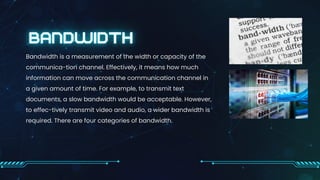
Bandwidth is ameasurement of the width or capacity of the
communica-tion channel. Effectively, it means how much
information can move across the communication channel in
a given amount of time. For example, to transmit text
documents, a slow bandwidth would be acceptable. However,
to effec-tively transmit video and audio, a wider bandwidth is
required. There are four categories of bandwidth.
3.
Voiceband, also knownas low bandwidth, is used for standard
telephone communication. Microcomputers with telephone
modems and dial-up service use this bandwidth. While
effective for transmitting text docu-ments, it is too slow for
many types of transmission, including high-quality audio and
video
4.
Medium band isused in special leased lines to
connect minicomputers and mainframes as well as
to transmit data over long distances. This band-
width is capable of very high-speed data transfer
5.
Broadband is widelyused for DSI, cable, and satellite
connections to the Internet. Several users can
simultaneously use a single broadband connection
for high-speed data transfer.
6.
Baseband is widelyused to connect individual
computers that are located close to one another. Like
broadband, it is able to support high-speed
transmission. Unlike broadband, however, baseband
can only carry a single signal at one time.
7.
For data transmissionto be successful, sending and receiving devices must
follow a set of communication rules for the exchange of information. These rules
for exchanging data between computers are known as protocols. The standard
protocol for the Internet is TCP/IP (transmission control protocol/Internet
protocol). The essential features of this protocol involve (1) identifying sending
and receiving devices and (2) breaking information into small parts for
transmission across the Internet.
8.
Identification: Every computeron the Internet has a unique numeric address called an
IP address (Internet protocol address). Similar to the way a postal service uses
addresses to deliver mail, the Internet uses IP addresses to deliver e-mail and to locate
Web sites. Because these numeric addresses are difficult for people to remember and
use, a system was developed to automatically convert text-based addresses to
numeric IP addresses. This system uses a domain name server (DNS) that con-verts
text-based addresses to IP addresses. For example, whenever you enter a URL, say
www.computing2011.com, a DNS converts this to an IP address before a connection
can be made.
9.
Information sent ortransmitted across the Internet usually travels
through numerous interconnected networks. Before the message is
sent, it is reformatted or broken down into small parts called
packets. Each packet is then sent separately over the Internet,
possibly traveling different routes to one common destination. At
the receiving end, the packets are reassembled into the correct
order. Communications and Networks