Forensic Accounting
Basics of
Forensic Accounting
What is Fraud?The book ‘A Guide to Forensic
Accounting Investigations’ by
Golden et.al., categorized fraud as a
legal concept. Hence, accounting
professionals consider the idea
foreign to them.
2
What is Fraud?Fraud constitutes four essential
features: misrepresentation or
omission of an important matter;
scanter or awareness of
misrepresentation; reliance on the
individual who obtains or acquires
the misrepresented information; and
damages or the sustained financial
consequences.
3
Types of Fraud
4
• Employee Fraud or Misappropriation of
Assets
• Financial Statement Fraud
Employee Fraud or
Misappropriation
of Assets
5
• Also known as retail fraud
• The most typical kind of fraud
• Associated with skimming revenues,
theft of cash or inventory,
embezzlement and payroll fraud
• Involves employees assisting and
instigating individuals outside the
organization to either dupe or swindle
third parties
Financial
Statement Fraud
6
• Also known as wholesale fraud
• Described with deliberate
misrepresentations or omissions of
important information in financial
reporting to mislead or delude the
user of the financial statement
• Associated with abusing the accounting
standards and guidelines on purpose in
order to manipulate the outcome
What is
Forensic
Accounting?
The Association of Certified Fraud
Examiners (ACFE) described forensic
accounting as “the application of
accounting skills to provide
quantitative financial information
about matters before the courts.”
7
What is Forensic
Accounting?
8
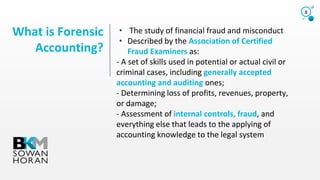
• The study of financial fraud and misconduct
• Described by the Association of Certified
Fraud Examiners as:
- A set of skills used in potential or actual civil or
criminal cases, including generally accepted
accounting and auditing ones;
- Determining loss of profits, revenues, property,
or damage;
- Assessment of internal controls, fraud, and
everything else that leads to the applying of
accounting knowledge to the legal system
What is
Forensic
Accounting?
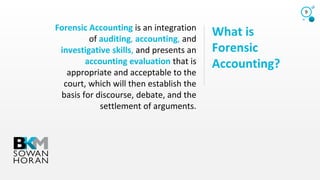
Forensic Accounting is an integration
of auditing, accounting, and
investigative skills, and presents an
accounting evaluation that is
appropriate and acceptable to the
court, which will then establish the
basis for discourse, debate, and the
settlement of arguments.
9
Components of
Forensic
Accounting
10
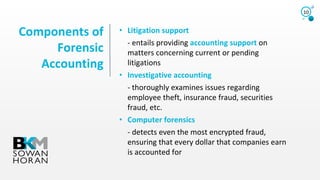
• Litigation support
- entails providing accounting support on
matters concerning current or pending
litigations
• Investigative accounting
- thoroughly examines issues regarding
employee theft, insurance fraud, securities
fraud, etc.
• Computer forensics
- detects even the most encrypted fraud,
ensuring that every dollar that companies earn
is accounted for
Objectives of
Forensic
Accounting
11
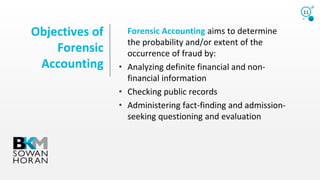
Forensic Accounting aims to determine
the probability and/or extent of the
occurrence of fraud by:
• Analyzing definite financial and non-
financial information
• Checking public records
• Administering fact-finding and admission-
seeking questioning and evaluation
Forensic
Accountants
12
• Instrumental in the design and
development of programs used in
electronic discovery
• Aside from investigative tasks, forensic
accountants are often called upon for
deterrence programs.
• Resolve criminal investigations,
partnership disputes, personal injury
claims, fraud, matrimonial disagreements,
and loss qualifications through their
findings
Forensic
Accountants
13
• Gather, analyze, and interpret complex
financial data
• Utilize different economic theories,
financial reporting systems, accounting
and auditing principles, data management
and analysis, and investigative techniques
in order to carry out their duties
• At the end of the forensic accounting
work, they will present a summary of their
findings with supporting evidence.
Good fortune is what
happens when
opportunity meets with
planning.
- Thomas Alva Edison
14
BKM Sowan Horan, LLP
15301 Dallas Parkway, Suite 960
Dallas, Texas 75001
Phone: 214-545-3965
Fax: 214-545-3966
www.bkmsh.com
For more information about Basics of Forensic Accounting, please visit: http://bit.ly/BKMSH-Basics-of-Forensic-Accounting

BKMSH Basics of Forensic Accounting

  • 1.
  • 2.
    What is Fraud?Thebook ‘A Guide to Forensic Accounting Investigations’ by Golden et.al., categorized fraud as a legal concept. Hence, accounting professionals consider the idea foreign to them. 2
  • 3.
    What is Fraud?Fraudconstitutes four essential features: misrepresentation or omission of an important matter; scanter or awareness of misrepresentation; reliance on the individual who obtains or acquires the misrepresented information; and damages or the sustained financial consequences. 3
  • 4.
    Types of Fraud 4 •Employee Fraud or Misappropriation of Assets • Financial Statement Fraud
  • 5.
    Employee Fraud or Misappropriation ofAssets 5 • Also known as retail fraud • The most typical kind of fraud • Associated with skimming revenues, theft of cash or inventory, embezzlement and payroll fraud • Involves employees assisting and instigating individuals outside the organization to either dupe or swindle third parties
  • 6.
    Financial Statement Fraud 6 • Alsoknown as wholesale fraud • Described with deliberate misrepresentations or omissions of important information in financial reporting to mislead or delude the user of the financial statement • Associated with abusing the accounting standards and guidelines on purpose in order to manipulate the outcome
  • 7.
    What is Forensic Accounting? The Associationof Certified Fraud Examiners (ACFE) described forensic accounting as “the application of accounting skills to provide quantitative financial information about matters before the courts.” 7
  • 8.
    What is Forensic Accounting? 8 •The study of financial fraud and misconduct • Described by the Association of Certified Fraud Examiners as: - A set of skills used in potential or actual civil or criminal cases, including generally accepted accounting and auditing ones; - Determining loss of profits, revenues, property, or damage; - Assessment of internal controls, fraud, and everything else that leads to the applying of accounting knowledge to the legal system
  • 9.
    What is Forensic Accounting? Forensic Accountingis an integration of auditing, accounting, and investigative skills, and presents an accounting evaluation that is appropriate and acceptable to the court, which will then establish the basis for discourse, debate, and the settlement of arguments. 9
  • 10.
    Components of Forensic Accounting 10 • Litigationsupport - entails providing accounting support on matters concerning current or pending litigations • Investigative accounting - thoroughly examines issues regarding employee theft, insurance fraud, securities fraud, etc. • Computer forensics - detects even the most encrypted fraud, ensuring that every dollar that companies earn is accounted for
  • 11.
    Objectives of Forensic Accounting 11 Forensic Accountingaims to determine the probability and/or extent of the occurrence of fraud by: • Analyzing definite financial and non- financial information • Checking public records • Administering fact-finding and admission- seeking questioning and evaluation
  • 12.
    Forensic Accountants 12 • Instrumental inthe design and development of programs used in electronic discovery • Aside from investigative tasks, forensic accountants are often called upon for deterrence programs. • Resolve criminal investigations, partnership disputes, personal injury claims, fraud, matrimonial disagreements, and loss qualifications through their findings
  • 13.
    Forensic Accountants 13 • Gather, analyze,and interpret complex financial data • Utilize different economic theories, financial reporting systems, accounting and auditing principles, data management and analysis, and investigative techniques in order to carry out their duties • At the end of the forensic accounting work, they will present a summary of their findings with supporting evidence.
  • 14.
    Good fortune iswhat happens when opportunity meets with planning. - Thomas Alva Edison 14 BKM Sowan Horan, LLP 15301 Dallas Parkway, Suite 960 Dallas, Texas 75001 Phone: 214-545-3965 Fax: 214-545-3966 www.bkmsh.com For more information about Basics of Forensic Accounting, please visit: http://bit.ly/BKMSH-Basics-of-Forensic-Accounting