SCHOOL OF GRADUATE STUDIES
DEPARTMENT OF BUSINESS ADMINISTRATION
THE EFFECT OF LEADERSHIP STYLE ON EMPLOYEE
PERFORMANCE: THE CASE OF ADDIS ABABA CITY
ADMINISTRATION HEALTH BUREAU, ETHIOPIA
Masters Thesis Defense
Advisor: SHIMELES A. (R P C S DIRECTORATE DIRECTOR)
Presenter: BIRUK CHALA SORY
June, 2023
Addis Ababa, Ethiopia
Outline of the presentation
1. Introduction
 Statement of the problem
 Research questions of the study
 Objective of the study
2. Conceptual framework
3. Methodology
 Research Approach
 Research design
 Sample and method
 Measurement of study variables
 Data collection tool
 Data analysis method
 Validity and reliability result
4. Major Findings
5. Conclusion and Major Recommendation
1. INTRODUCTION
• A leader can determine strategies, make
plans, and motivate associates to produce
effective and efficient performance
(Mihaela and Sandu, 2020).
• The contribution of leaders can determine
the success or failure of an organization.
• In other words, a leader has the ability to
draw people to him without using force,
enabling them to work with him to attain
the organization goal.
• When we come to Ethiopia's health care
system, it includes primary health centers,
clinics, and hospitals.
• For those institutes there are more than
23000 employee .
• For managing those employee, there need
best leadership strategies because if not
there happen bad thing in the city.
• This thesis conduct the AACAHB employee
performance and leadership style.
About AACAHB
• AACAHB has 406 employee, 18
directorates and 32 team leaders.
Geographically the research
conduct on 2 areas. Annual
budget is more than 16 million
birr and approximately 20 million
dollars which supported by
Global Fund, CDC, …
• Very little research were found
on leadership style and job
performance in Ethiopia,
especially in the health sector.
• No research has been done in
AACAHB on this title so, all
stockholders are beneficiaries on
this research output.
Statement of the problem
• Addis Ababa City Administration Health Bureau (AACAHB) employees are
the one who plays the major roles and make significant contribution to the
city health sector.
• For greater achievement, job outcome and customer satisfaction, leadership
is key. Because, Leader’s plays crucial role to keep employee motivated,
inspired, committed and even satisfied in performing organizational policies
and objectives effectively and efficiently.
• Based on 2022 annual report, the performance of the bureau was below the
expected. Based on this indication, we conduct a preliminary research and
we got the reason was ignore employee well-being and emphasis more on
task than employee, those leaders, especially, middle level and low level:
behave authoritatively, they put in a place set of policies, procedure, rules
and goals.
• Hence to fill the gap by investigate and recommending the effect of
leadership style and employee performance in AACAHB.
• The research also try to suggest solution to overcome unsatisfactory
employee performance to the bureau.
Research questions of the study
RQ1. Does the leadership style influence the employee
performance in Addis Ababa City Administration Health
Bureau?
RQ2. What kind of leadership styles exist in Addis Ababa City
Administration Health Bureau?
RQ3. Does leaders and employees are along with the bureau’s
goals and objectives?
RQ4. Are the employees participating on the organization
decision making?
Objective of the study
Specific Objectives:
SO1. To determine the influence of leadership
style on employees performance on Addis Ababa
City Administration Health Bureau.
SO2. To determine the type of leadership style
that exists in Addis Ababa City Administration
Health Bureau.
SO3. To investigate whether the leaders and
employees are along with bureau goals and
objectives.
SO4. To describe whether the employees are part
of organization’s decision making.
General Objective
The general objective of
this study is to
determine the effect of
leadership styles on
employee’s performance
in the Addis Ababa City
Administration Health
Bureau.
2. Conceptual Framework
Figure 2.5.1: Conceptual Framework (adapted from Renjith, Renu & George 2015, 121
Employee Performance
Dependent variable
Leadership Styles
• Laissez fair
• Monitoring than leading
• Used for guiding and motivating
• Transformational
– Create an environment for innovation
– Used for adaptability and problem solving
• Transactional
– Reward and Punishment
– Used for short term goal
• Autocratic
– Do what I say
3. Methodology
 The study conduct a descriptive research design with target population
of 406 employees and select 201 sample size using Taro Yamane
method which formulated in 1967.
 Stratified & Simple random sampling method is used to ensure all
directorates or categories are equitably represented in the sample.
 The data collected instruments are both closed and open ended
questionnaires and finally the collected data was analyzed
quantitatively and qualitatively.
 The collected data was analyzed using Statistical Package for Social
Sciences (SPSS) software version 20.
 In order to get sufficient and appropriate information for the study
both primary and secondary data collection methods was used.
 For quantitative data descriptive statistics and inferential statistics
used and the qualitative data analysis technique used should be
content analysis.
Research Approach
• Techniques or tools that are used to conduct this
research was:
• In the research mixed (both quantitative and
qualitative) methods was used.
• Qualitative research method techniques used for
conducted participant interviews.
• Quantitative research method technique used for
conducted Survey questions which involves
collecting numerical data to test answer
questions.
• Measure variables and describe frequencies,
averages, and correlations.
Research design
For the collected data,
• Descriptive and Correlational research design
was used for to measure variables and describe
relationships between them.
• Descriptive research is research designed to
provide a snapshot of the current state of affairs.
• Correlational research is research designed to
discover relationships among variables and to
allow the prediction of future events from present
knowledge.
Sample and method
• For selecting a subset of data from a
larger dataset (406 employees of the
organization) the study applied both
probability sampling (Simple and
stratified sampling technique) for
quantitative research and non-
probability sampling techniques
(Quota sampling) used.
• Yamane (1967) is used. By taking
95% precision level (e=0.05) and
inserting in the above formula gives
201.488 and by rounding 201
employees sample size will be taken
(n=201).
Measurement of study variables
• For both independent variable (Transformational Leadership Style,
Transactional Leadership Style, Autocratic Leadership Styles and
Laissez-faire Leadership Style) and dependent variable (Employees
Performance), five different types of measurement scales point are
used:
1 for Strongly disagree (SD),
2 for Disagree (D),
3 for Neutral (N),
4 for Agree (A),
5 for Strongly agree (SA)
(it’s Yousef, (2000) scale)
Data collection tool
 In order to achieve the intended objectives, data collection instruments
are very important. Thus, the research was used two common data
collection instruments that are; questionnaire and semi structural
interview for the employee respondents and semi-structured interview
to the general director of the bureau.
 The questionnaire is mixed is both self-prepared and adapted
questions from Hussein 2013.
Data analysis method
• Data Analysis is important for best decision making process.
• In this research, the data obtained from the respondents was analyzed
by using statistical packages for social science (SPSS) through the use
descriptive and inferential statistics.
• Statistical Analysis: “What happened?” two sub-categories of
statistical analysis:
1. Descriptive: works with either complete or selections of summarized
numerical data.
• It illustrates means and deviations in continuous data and percentages and
frequencies in categorical data.
2. Inferential: works with samples derived from complete data.
• An analyst can arrive at different conclusions from the same comprehensive
data set just by choosing different samplings.
• Both primary and secondary data will be analyzed and presented
quantitatively by using tools like percentile, tables, charts, graphs and
others to facilitate the interpretation of the results of the data.
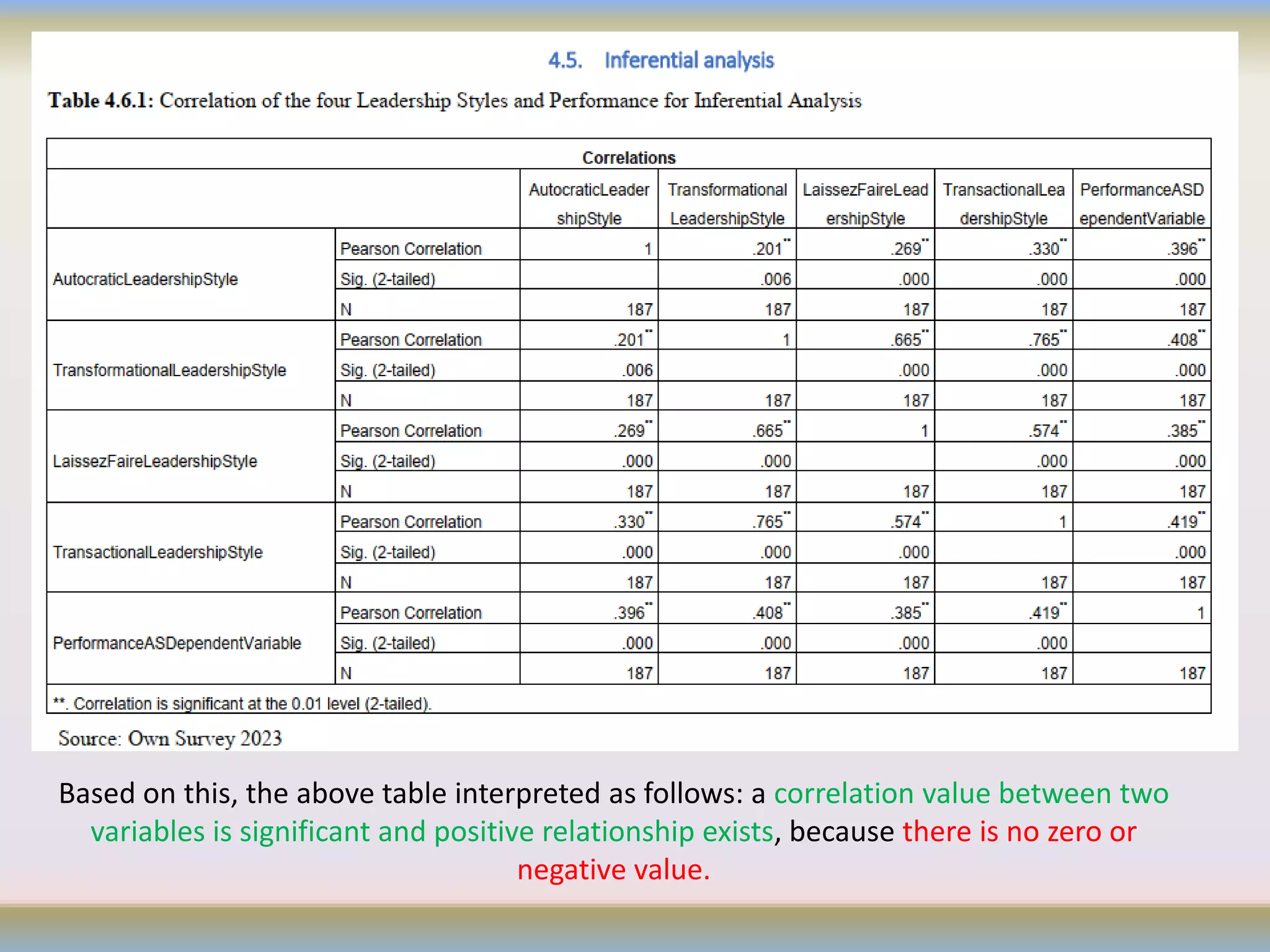
Based on this, the above table interpreted as follows: a correlation value between two
variables is significant and positive relationship exists, because there is no zero or
negative value.
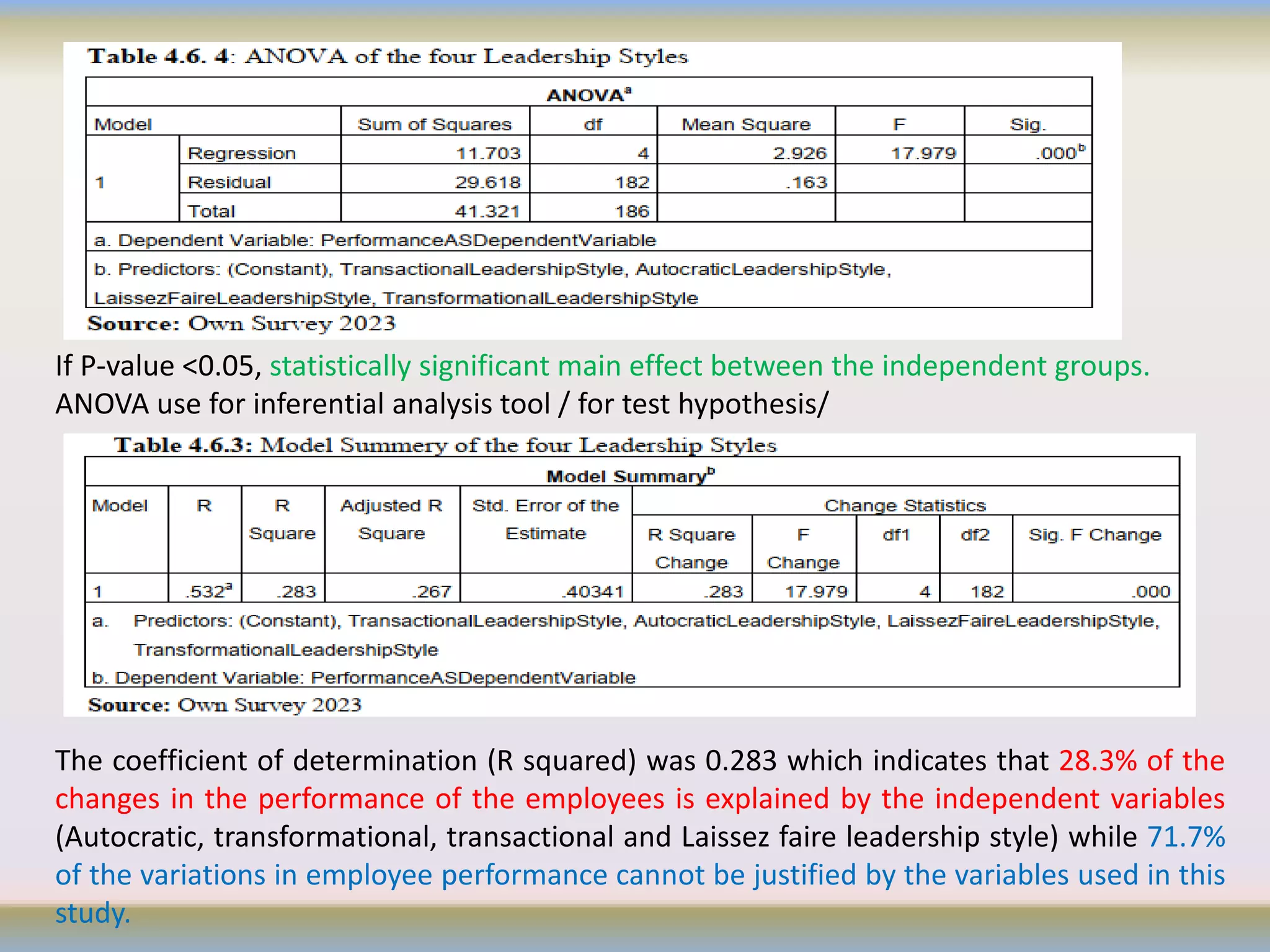
The coefficient of determination (R squared) was 0.283 which indicates that 28.3% of the
changes in the performance of the employees is explained by the independent variables
(Autocratic, transformational, transactional and Laissez faire leadership style) while 71.7%
of the variations in employee performance cannot be justified by the variables used in this
study.
If P-value <0.05, statistically significant main effect between the independent groups.
ANOVA use for inferential analysis tool / for test hypothesis/
Validity and reliability result
• Reliability and validity are both about how well a method measures
something:
• Reliability refers to the consistency of a measure.
• Validity refers to the accuracy of a measure.
• These studies will adopt Cronbach Alpha to test reliability of the
research instruments.
Where:
N = number of items
c = mean covariance between items.
v = mean item variance.
for data validity refer
Based on the Cronbach's alpha reliability
coefficient rule, the instrument was good
for internal consistency. Because, both are
>= the good scale
4. Major Findings
o The majority of respondents indicated that there is low employee
involvement in the decision-making process.
o The majority of employees who responded to the survey affirm that diverse
leadership philosophies are used by team leaders in various directorates.
o The research demonstrates that most employees are not adequately informed
about all of an organization's operations and policies.
o According to the results of an open-ended question, the organization's
employees must follow a transactional leadership style in order to improve
their performance and break down bad bureaucracy and other barriers to
communication.
o At the Health Bureau, the transactional style of leadership is the most
effective, followed by the transformational and the laissez-faire.
o Autocratic leadership style demonstrated a negligible and generally negative
association with all aspects of employee performance.
5. Conclusion
The following conclusions are reached in light of the findings above:
• The existing leadership style are not clearly indicates because the
middle and low level leaders has implemented different leadership
style. This caused by the difference level of experience, age,
educational level and so on so.
• The employee are no as such happy on the existing leadership style.
• The leaders consider themselves as democratic leadership style but the
employee reflects there are different leadership style.
• The organization's quality of service to society is not sufficient as
expected.
• Most of the employee are feels not involved in decision making
process and on creating police and procedure of the organization.
• The employees expect to inspire, motivate, demonstrate emotional
maturity, solve problems creatively, take calculated risks and other
essential leadership skills from the leader of the bureau.
Major Recommendations
• Using the recommendations, the Addis Ababa City
Administration Health Bureau should adopt a strong
transactional leadership style rather than other leadership
style.
• It should be understood that employees are the
organization's most precious asset, and that leadership
style has a significant impact on how well they perform.
• Performance will continue to increase in organizations with
strong leadership capabilities.
• Therefore, it needs to be seriously considered how to give
leadership a larger priority.
• For the researcher, fill the limitation of this research (time,
respondent willingness, cheek other leadership styles…)
Thank You!
If you have questions, please?

Biruk Chala MBA Thesis Presentation Slide (1).pdf

  • 1.
    SCHOOL OF GRADUATESTUDIES DEPARTMENT OF BUSINESS ADMINISTRATION THE EFFECT OF LEADERSHIP STYLE ON EMPLOYEE PERFORMANCE: THE CASE OF ADDIS ABABA CITY ADMINISTRATION HEALTH BUREAU, ETHIOPIA Masters Thesis Defense Advisor: SHIMELES A. (R P C S DIRECTORATE DIRECTOR) Presenter: BIRUK CHALA SORY June, 2023 Addis Ababa, Ethiopia
  • 2.
    Outline of thepresentation 1. Introduction  Statement of the problem  Research questions of the study  Objective of the study 2. Conceptual framework 3. Methodology  Research Approach  Research design  Sample and method  Measurement of study variables  Data collection tool  Data analysis method  Validity and reliability result 4. Major Findings 5. Conclusion and Major Recommendation
  • 3.
    1. INTRODUCTION • Aleader can determine strategies, make plans, and motivate associates to produce effective and efficient performance (Mihaela and Sandu, 2020). • The contribution of leaders can determine the success or failure of an organization. • In other words, a leader has the ability to draw people to him without using force, enabling them to work with him to attain the organization goal. • When we come to Ethiopia's health care system, it includes primary health centers, clinics, and hospitals. • For those institutes there are more than 23000 employee . • For managing those employee, there need best leadership strategies because if not there happen bad thing in the city. • This thesis conduct the AACAHB employee performance and leadership style. About AACAHB • AACAHB has 406 employee, 18 directorates and 32 team leaders. Geographically the research conduct on 2 areas. Annual budget is more than 16 million birr and approximately 20 million dollars which supported by Global Fund, CDC, … • Very little research were found on leadership style and job performance in Ethiopia, especially in the health sector. • No research has been done in AACAHB on this title so, all stockholders are beneficiaries on this research output.
  • 4.
    Statement of theproblem • Addis Ababa City Administration Health Bureau (AACAHB) employees are the one who plays the major roles and make significant contribution to the city health sector. • For greater achievement, job outcome and customer satisfaction, leadership is key. Because, Leader’s plays crucial role to keep employee motivated, inspired, committed and even satisfied in performing organizational policies and objectives effectively and efficiently. • Based on 2022 annual report, the performance of the bureau was below the expected. Based on this indication, we conduct a preliminary research and we got the reason was ignore employee well-being and emphasis more on task than employee, those leaders, especially, middle level and low level: behave authoritatively, they put in a place set of policies, procedure, rules and goals. • Hence to fill the gap by investigate and recommending the effect of leadership style and employee performance in AACAHB. • The research also try to suggest solution to overcome unsatisfactory employee performance to the bureau.
  • 5.
    Research questions ofthe study RQ1. Does the leadership style influence the employee performance in Addis Ababa City Administration Health Bureau? RQ2. What kind of leadership styles exist in Addis Ababa City Administration Health Bureau? RQ3. Does leaders and employees are along with the bureau’s goals and objectives? RQ4. Are the employees participating on the organization decision making?
  • 6.
    Objective of thestudy Specific Objectives: SO1. To determine the influence of leadership style on employees performance on Addis Ababa City Administration Health Bureau. SO2. To determine the type of leadership style that exists in Addis Ababa City Administration Health Bureau. SO3. To investigate whether the leaders and employees are along with bureau goals and objectives. SO4. To describe whether the employees are part of organization’s decision making. General Objective The general objective of this study is to determine the effect of leadership styles on employee’s performance in the Addis Ababa City Administration Health Bureau.
  • 7.
    2. Conceptual Framework Figure2.5.1: Conceptual Framework (adapted from Renjith, Renu & George 2015, 121 Employee Performance Dependent variable
  • 8.
    Leadership Styles • Laissezfair • Monitoring than leading • Used for guiding and motivating • Transformational – Create an environment for innovation – Used for adaptability and problem solving • Transactional – Reward and Punishment – Used for short term goal • Autocratic – Do what I say
  • 9.
    3. Methodology  Thestudy conduct a descriptive research design with target population of 406 employees and select 201 sample size using Taro Yamane method which formulated in 1967.  Stratified & Simple random sampling method is used to ensure all directorates or categories are equitably represented in the sample.  The data collected instruments are both closed and open ended questionnaires and finally the collected data was analyzed quantitatively and qualitatively.  The collected data was analyzed using Statistical Package for Social Sciences (SPSS) software version 20.  In order to get sufficient and appropriate information for the study both primary and secondary data collection methods was used.  For quantitative data descriptive statistics and inferential statistics used and the qualitative data analysis technique used should be content analysis.
  • 10.
    Research Approach • Techniquesor tools that are used to conduct this research was: • In the research mixed (both quantitative and qualitative) methods was used. • Qualitative research method techniques used for conducted participant interviews. • Quantitative research method technique used for conducted Survey questions which involves collecting numerical data to test answer questions. • Measure variables and describe frequencies, averages, and correlations.
  • 11.
    Research design For thecollected data, • Descriptive and Correlational research design was used for to measure variables and describe relationships between them. • Descriptive research is research designed to provide a snapshot of the current state of affairs. • Correlational research is research designed to discover relationships among variables and to allow the prediction of future events from present knowledge.
  • 12.
    Sample and method •For selecting a subset of data from a larger dataset (406 employees of the organization) the study applied both probability sampling (Simple and stratified sampling technique) for quantitative research and non- probability sampling techniques (Quota sampling) used. • Yamane (1967) is used. By taking 95% precision level (e=0.05) and inserting in the above formula gives 201.488 and by rounding 201 employees sample size will be taken (n=201).
  • 13.
    Measurement of studyvariables • For both independent variable (Transformational Leadership Style, Transactional Leadership Style, Autocratic Leadership Styles and Laissez-faire Leadership Style) and dependent variable (Employees Performance), five different types of measurement scales point are used: 1 for Strongly disagree (SD), 2 for Disagree (D), 3 for Neutral (N), 4 for Agree (A), 5 for Strongly agree (SA) (it’s Yousef, (2000) scale)
  • 14.
    Data collection tool In order to achieve the intended objectives, data collection instruments are very important. Thus, the research was used two common data collection instruments that are; questionnaire and semi structural interview for the employee respondents and semi-structured interview to the general director of the bureau.  The questionnaire is mixed is both self-prepared and adapted questions from Hussein 2013.
  • 15.
    Data analysis method •Data Analysis is important for best decision making process. • In this research, the data obtained from the respondents was analyzed by using statistical packages for social science (SPSS) through the use descriptive and inferential statistics. • Statistical Analysis: “What happened?” two sub-categories of statistical analysis: 1. Descriptive: works with either complete or selections of summarized numerical data. • It illustrates means and deviations in continuous data and percentages and frequencies in categorical data. 2. Inferential: works with samples derived from complete data. • An analyst can arrive at different conclusions from the same comprehensive data set just by choosing different samplings. • Both primary and secondary data will be analyzed and presented quantitatively by using tools like percentile, tables, charts, graphs and others to facilitate the interpretation of the results of the data.
  • 16.
    Based on this,the above table interpreted as follows: a correlation value between two variables is significant and positive relationship exists, because there is no zero or negative value.
  • 17.
    The coefficient ofdetermination (R squared) was 0.283 which indicates that 28.3% of the changes in the performance of the employees is explained by the independent variables (Autocratic, transformational, transactional and Laissez faire leadership style) while 71.7% of the variations in employee performance cannot be justified by the variables used in this study. If P-value <0.05, statistically significant main effect between the independent groups. ANOVA use for inferential analysis tool / for test hypothesis/
  • 18.
    Validity and reliabilityresult • Reliability and validity are both about how well a method measures something: • Reliability refers to the consistency of a measure. • Validity refers to the accuracy of a measure. • These studies will adopt Cronbach Alpha to test reliability of the research instruments. Where: N = number of items c = mean covariance between items. v = mean item variance.
  • 19.
    for data validityrefer Based on the Cronbach's alpha reliability coefficient rule, the instrument was good for internal consistency. Because, both are >= the good scale
  • 20.
    4. Major Findings oThe majority of respondents indicated that there is low employee involvement in the decision-making process. o The majority of employees who responded to the survey affirm that diverse leadership philosophies are used by team leaders in various directorates. o The research demonstrates that most employees are not adequately informed about all of an organization's operations and policies. o According to the results of an open-ended question, the organization's employees must follow a transactional leadership style in order to improve their performance and break down bad bureaucracy and other barriers to communication. o At the Health Bureau, the transactional style of leadership is the most effective, followed by the transformational and the laissez-faire. o Autocratic leadership style demonstrated a negligible and generally negative association with all aspects of employee performance.
  • 21.
    5. Conclusion The followingconclusions are reached in light of the findings above: • The existing leadership style are not clearly indicates because the middle and low level leaders has implemented different leadership style. This caused by the difference level of experience, age, educational level and so on so. • The employee are no as such happy on the existing leadership style. • The leaders consider themselves as democratic leadership style but the employee reflects there are different leadership style. • The organization's quality of service to society is not sufficient as expected. • Most of the employee are feels not involved in decision making process and on creating police and procedure of the organization. • The employees expect to inspire, motivate, demonstrate emotional maturity, solve problems creatively, take calculated risks and other essential leadership skills from the leader of the bureau.
  • 22.
    Major Recommendations • Usingthe recommendations, the Addis Ababa City Administration Health Bureau should adopt a strong transactional leadership style rather than other leadership style. • It should be understood that employees are the organization's most precious asset, and that leadership style has a significant impact on how well they perform. • Performance will continue to increase in organizations with strong leadership capabilities. • Therefore, it needs to be seriously considered how to give leadership a larger priority. • For the researcher, fill the limitation of this research (time, respondent willingness, cheek other leadership styles…)
  • 23.
    Thank You! If youhave questions, please?