POLYMERASE CHAIN REACTION
(PCR)
PCR - Polymerase Chain Reaction
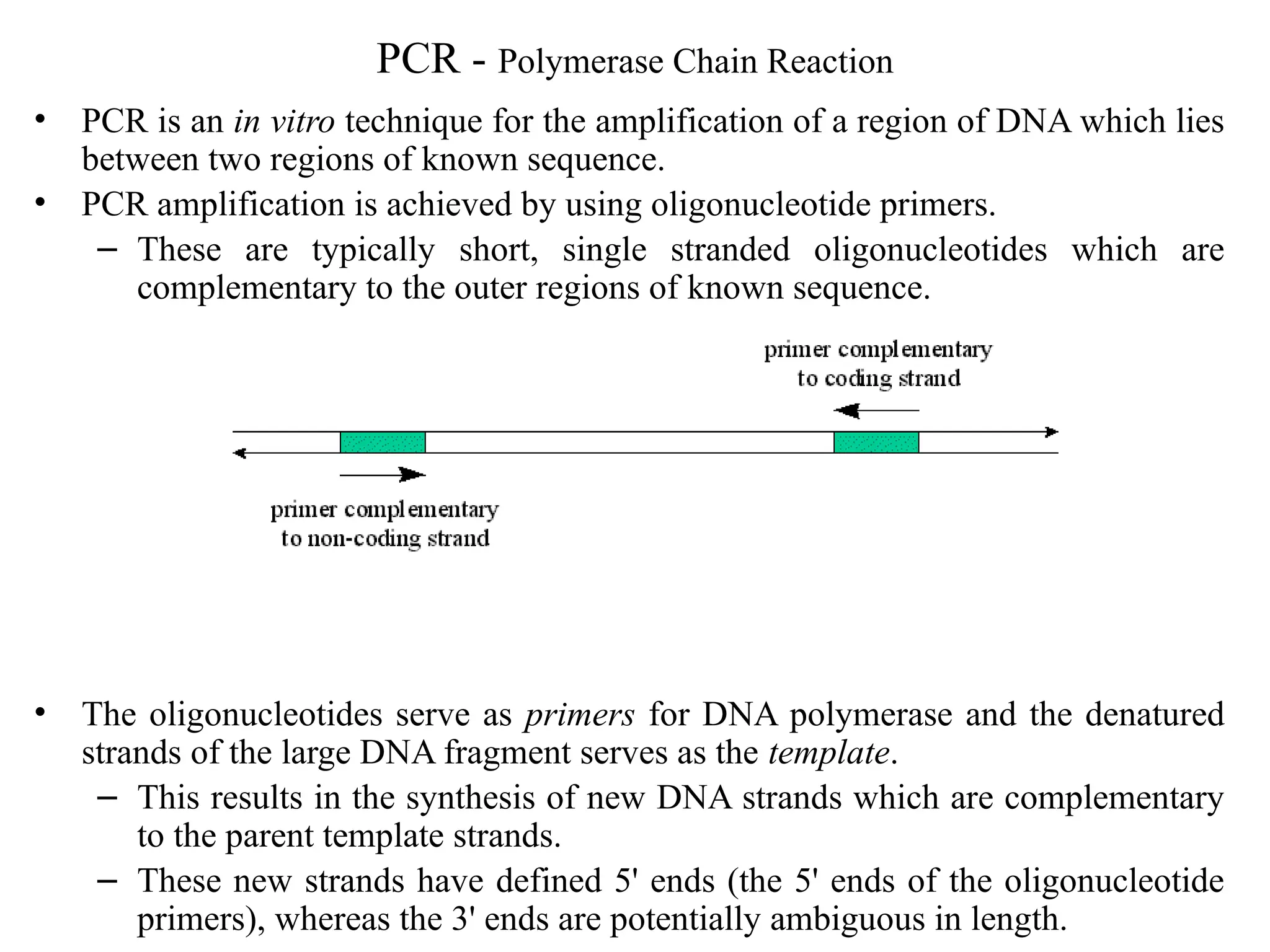
• PCR is an in vitro technique for the amplification of a region of DNA which lies
between two regions of known sequence.
• PCR amplification is achieved by using oligonucleotide primers.
– These are typically short, single stranded oligonucleotides which are
complementary to the outer regions of known sequence.
• The oligonucleotides serve as primers for DNA polymerase and the denatured
strands of the large DNA fragment serves as the template.
– This results in the synthesis of new DNA strands which are complementary
to the parent template strands.
– These new strands have defined 5' ends (the 5' ends of the oligonucleotide
primers), whereas the 3' ends are potentially ambiguous in length.
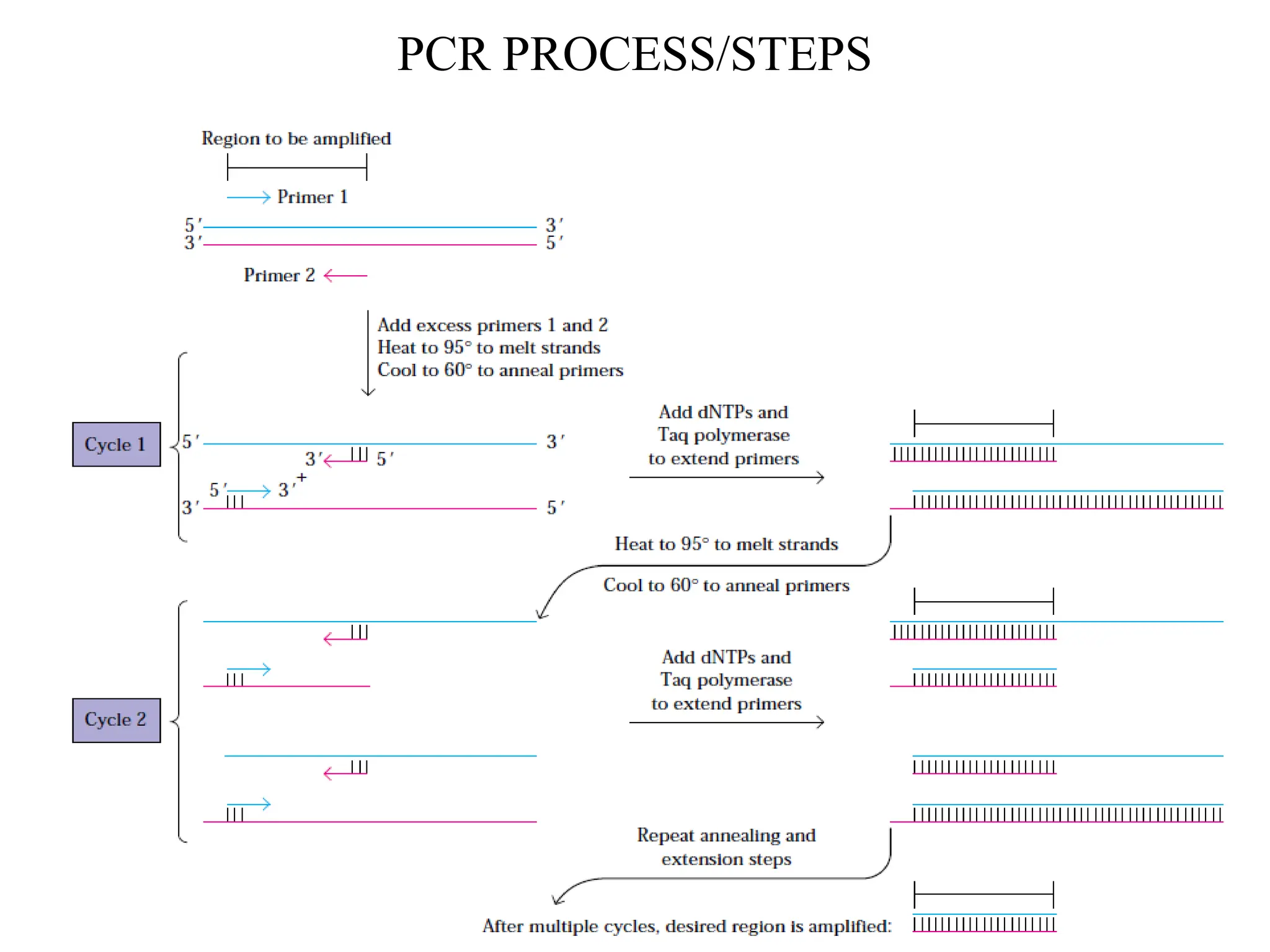
PCR PROCESS/STEPS
COMPONENTS OF PCR REACTION
The following components are require to execute the PCR reaction of a gene of
interest
• Water
• Buffer
• DNA template
• Primers
• Nucleotides
• Mg++ ions
• DNA Polymerase
PARAMERTERS TO DESIGN A GOOD PRIMER
Primer sequence
Primer length
GC%
GC clamp
Melting temperature (Tm)
Annealing temperature (Ta)
• Must be complementary to flanking sequences of target region.
• Avoid:
Complementary sequences between primers.
 Repeat(ex: ATATATAT) 
 misprime.
 Runs (ex: AGCGGGGGAT) 
 misprime.
2. Primer length:
• It is generally accepted that the optimal length of primers is 18-25 bp.
• Not too long nor too short
1. Primer Sequence:
3. GC Content:
• GC% = Number of G's and C's in the primer as a percentage of the total bases.
• Should be 40-60%.
• 4. GC clamp:
• Presence of G or C bases within the last five bases from the 3' end of primers.
• Not more than 2 G's or C's .
5. Melting temperature (Tm):
• What is Tm?
• Melting temperatures in the range of 50-60 °C generally produce the best results.
• Maximum difference between primer pairs is 5°C.
• The Tm of the primer can be calculated by the following formula:
Tm = [(G + C) x 4] + [(A + T) x 2]
6. Annealing Temperature (Ta):
• The primer melting temperature is the estimate of the DNA-DNA hybrid stability and
critical in determining the annealing temperature.
• Depends directly on length and GC composition of the primers.
• Too high Ta produce insufficient primer-template hybridization.
• Too low Ta 
 lead to non-specific products caused by a high number of base
pair mismatches.
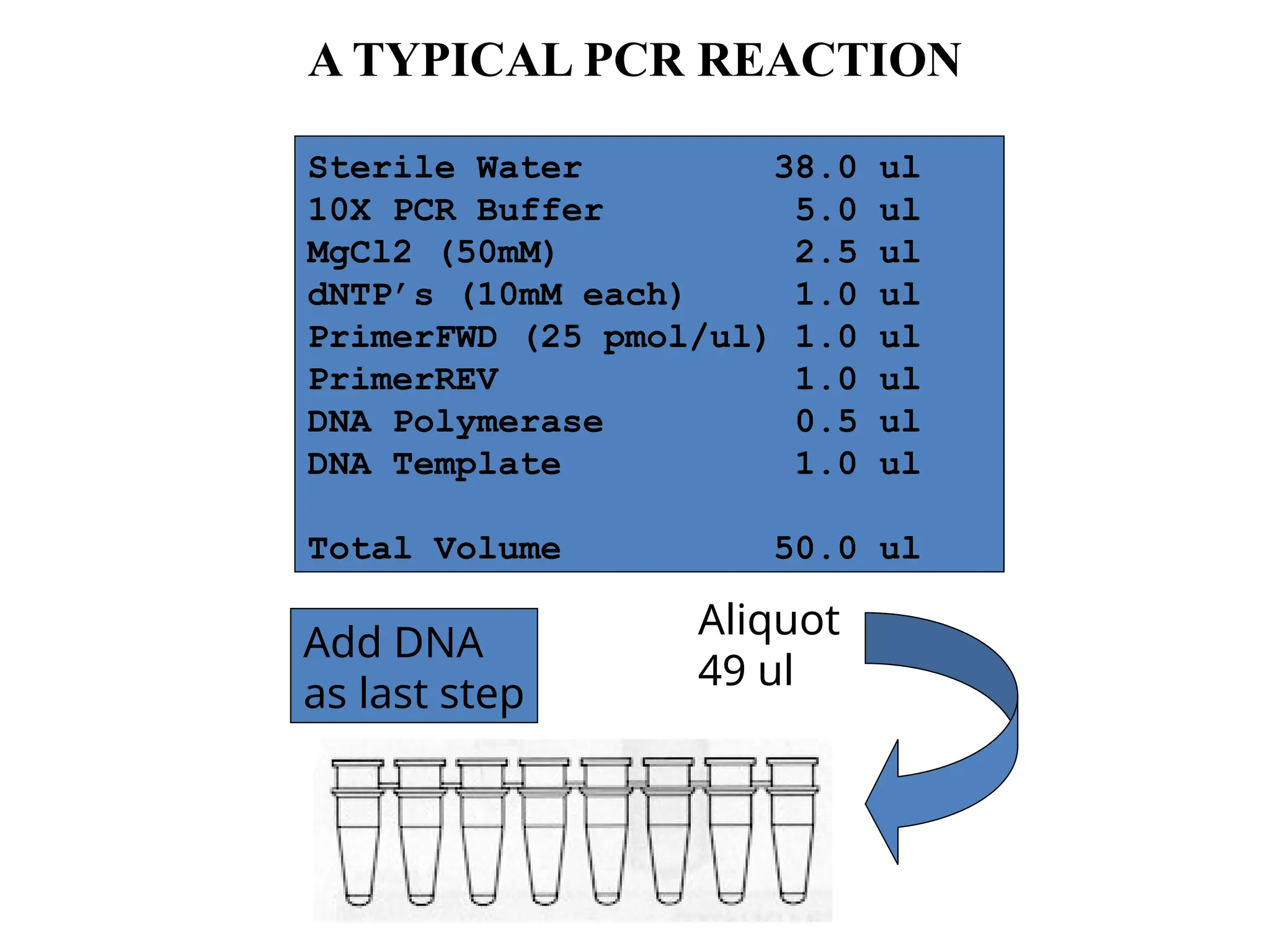
A TYPICAL PCR REACTION
Sterile Water 38.0 ul
10X PCR Buffer 5.0 ul
MgCl2 (50mM) 2.5 ul
dNTP’s (10mM each) 1.0 ul
PrimerFWD (25 pmol/ul) 1.0 ul
PrimerREV 1.0 ul
DNA Polymerase 0.5 ul
DNA Template 1.0 ul
Total Volume 50.0 ul
Aliquot
49 ul
Add DNA
as last step
TYPICAL THERMOCYCLER CONDITIONS
1. Initial Denaturation 95 C 3 min
2. DNA Denaturation 95 C 1 min
3. Primer Annealing 65 C 1 min
4. Primer Extension 72 C 1 min
5. Go to step #2, repeat 39 more times
6. End
cycle
One X 25
RESULT VISUALIZATION
 After thermal cycling, tubes are taken
out of the PCR machine.
 Contents of tubes are loaded onto an
agarose gel.
 DNA is separated by size using an
electric field.
 DNA is then stained.
 PCR products are visible as different
“bands”.
Gel running
Marker
Target sequence
PCR ADVANTAGES
• APPLICATIONS
• Simplicity, easier methodology, sensitive, extensively validated standard operating procedure and
availability of reagents and equipment

 Genotyping.

 RT-PCR.

 Cloning.

 Mutation detection.

 Sequencing.

 Microarrays.

 Forensics.

 Paternity testing.

biotechnology POLYMERASE CHAIN REACTION (PCR).pptx

  • 1.
  • 2.
    PCR - PolymeraseChain Reaction • PCR is an in vitro technique for the amplification of a region of DNA which lies between two regions of known sequence. • PCR amplification is achieved by using oligonucleotide primers. – These are typically short, single stranded oligonucleotides which are complementary to the outer regions of known sequence. • The oligonucleotides serve as primers for DNA polymerase and the denatured strands of the large DNA fragment serves as the template. – This results in the synthesis of new DNA strands which are complementary to the parent template strands. – These new strands have defined 5' ends (the 5' ends of the oligonucleotide primers), whereas the 3' ends are potentially ambiguous in length.
  • 3.
  • 4.
    COMPONENTS OF PCRREACTION The following components are require to execute the PCR reaction of a gene of interest • Water • Buffer • DNA template • Primers • Nucleotides • Mg++ ions • DNA Polymerase
  • 5.
    PARAMERTERS TO DESIGNA GOOD PRIMER Primer sequence Primer length GC% GC clamp Melting temperature (Tm) Annealing temperature (Ta)
  • 6.
    • Must becomplementary to flanking sequences of target region. • Avoid: Complementary sequences between primers.  Repeat(ex: ATATATAT)   misprime.  Runs (ex: AGCGGGGGAT)   misprime. 2. Primer length: • It is generally accepted that the optimal length of primers is 18-25 bp. • Not too long nor too short 1. Primer Sequence:
  • 7.
    3. GC Content: •GC% = Number of G's and C's in the primer as a percentage of the total bases. • Should be 40-60%. • 4. GC clamp: • Presence of G or C bases within the last five bases from the 3' end of primers. • Not more than 2 G's or C's .
  • 8.
    5. Melting temperature(Tm): • What is Tm? • Melting temperatures in the range of 50-60 °C generally produce the best results. • Maximum difference between primer pairs is 5°C. • The Tm of the primer can be calculated by the following formula: Tm = [(G + C) x 4] + [(A + T) x 2] 6. Annealing Temperature (Ta): • The primer melting temperature is the estimate of the DNA-DNA hybrid stability and critical in determining the annealing temperature. • Depends directly on length and GC composition of the primers. • Too high Ta produce insufficient primer-template hybridization. • Too low Ta   lead to non-specific products caused by a high number of base pair mismatches.
  • 9.
    A TYPICAL PCRREACTION Sterile Water 38.0 ul 10X PCR Buffer 5.0 ul MgCl2 (50mM) 2.5 ul dNTP’s (10mM each) 1.0 ul PrimerFWD (25 pmol/ul) 1.0 ul PrimerREV 1.0 ul DNA Polymerase 0.5 ul DNA Template 1.0 ul Total Volume 50.0 ul Aliquot 49 ul Add DNA as last step
  • 10.
    TYPICAL THERMOCYCLER CONDITIONS 1.Initial Denaturation 95 C 3 min 2. DNA Denaturation 95 C 1 min 3. Primer Annealing 65 C 1 min 4. Primer Extension 72 C 1 min 5. Go to step #2, repeat 39 more times 6. End cycle One X 25
  • 11.
    RESULT VISUALIZATION  Afterthermal cycling, tubes are taken out of the PCR machine.  Contents of tubes are loaded onto an agarose gel.  DNA is separated by size using an electric field.  DNA is then stained.  PCR products are visible as different “bands”. Gel running
  • 12.
  • 13.
    PCR ADVANTAGES • APPLICATIONS •Simplicity, easier methodology, sensitive, extensively validated standard operating procedure and availability of reagents and equipment   Genotyping.   RT-PCR.   Cloning.   Mutation detection.   Sequencing.   Microarrays.   Forensics.   Paternity testing.