What is Food Biotechnology?
Food biotechnology is the evolution of
traditional agricultural techniques such as
crossbreeding and fermentation.

It is an extension of the type of food
development that has provided nectarines,
tangerines and similar advancements.
Technically Speaking...

Food biotechnology employs the tools
of modern genetics to enhance
beneficial traits of plants, animals and
microorganisms for food production.
It involves adding or extracting select
genes to achieve desired traits.
The musical stylings of
   Dr. Karl Winters
There must be more to it than that, Doc
      transcription   translation

• DNA makes RNA makes PROTEIN
• Must be a protein already in existence
• A “Selectable Marker” is required to
  identify the clone.
• The selectable marker is usually
  antibiotic resistance, which does not
  make YOU antibiotic resistant.
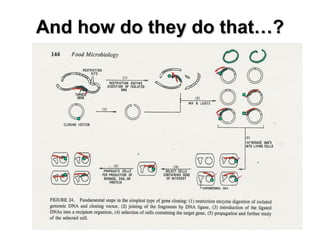
And how do they do that…?
Other types of biotechnology
• Clonal propagation
• Random mutagenisis and selection
  (directed evolution)
• Metabolic redirection
• Use of “xenophiles”
Food Biotechnology
          Applications
• Biotechnology methods are currently
  used to improve many foods.
• Food biotechnology has had a
  profound positive impact on farming
  and food security.
• At least twelve industrialized and four
  developing countries currently use
  some form of food biotechnology.
Consumer Benefits of
Food Biotechnology
Have YOU personally benefited
  from food biotechnology?

  Show of hands


 From Medical Biotechnology?
Have YOU personally benefited
  from food biotechnology?

     Show of hands

Have YOU personally eaten a biotech food?
Have YOU personally benefited
  from food biotechnology?

     Show of hands

Have YOU personally eaten a biotech food?
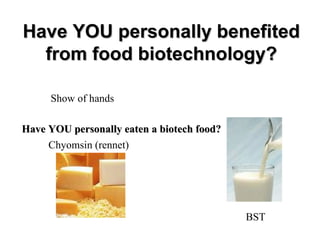
     Chyomsin (rennet)


                                            BST
The Colbert Report

Many people get their information
       from (fake) news.
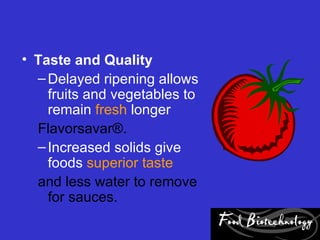
• Taste and Quality
  – Delayed ripening allows
    fruits and vegetables to
    remain fresh longer
  Flavorsavar®.
  – Increased solids give
    foods superior taste
  and less water to remove
    for sauces.
• Nutrition
  – Some oils are lower in
    saturated fat and higher in
    oleic acid, making them
    more stable for frying
    without further processing.
  – Some foods have lower
    levels of saturated fat.
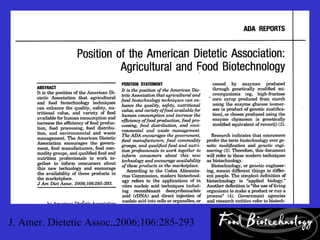
J. Amer. Dietetic Assoc.,2006;106:285-293
• Health
  – Some foods have enhanced
    nutritional profiles.
  – Biotechnology allows for the
    production of foods to help
    protect against diseases.
  – Enhanced foods will soon offer
    higher levels of antioxidant
    vitamins to reduce risk of
    cancer. Now being
    commercialized at Rutgers!
    (black tea extract).
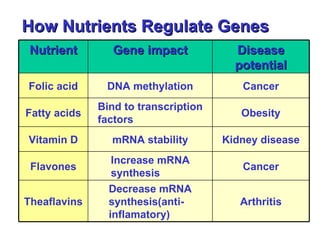
How Nutrients Regulate Genes
 Nutrient        Gene impact            Disease
                                        potential
Folic acid     DNA methylation           Cancer
              Bind to transcription
Fatty acids                              Obesity
              factors
Vitamin D       mRNA stability        Kidney disease
                 Increase mRNA
 Flavones                                Cancer
                 synthesis
                Decrease mRNA
Theaflavins     synthesis(anti-          Arthritis
                inflamatory)
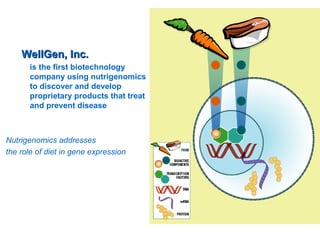
WellGen, Inc.
       is the first biotechnology
       company using nutrigenomics
       to discover and develop
       proprietary products that treat
       and prevent disease


Nutrigenomics addresses
the role of diet in gene expression
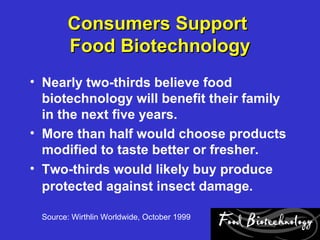
Consumers Support
       Food Biotechnology
• Nearly two-thirds believe food
  biotechnology will benefit their family
  in the next five years.
• More than half would choose products
  modified to taste better or fresher.
• Two-thirds would likely buy produce
  protected against insect damage.

 Source: Wirthlin Worldwide, October 1999
Environmental Impact of
  Agricultural Biotechnology
• Healthier plants result in higher
  yields.
• Insect-protected crops reduce the
  need for insecticides.
• Biotechnology helps protect water
  (less pesticide run off, less erosion.)
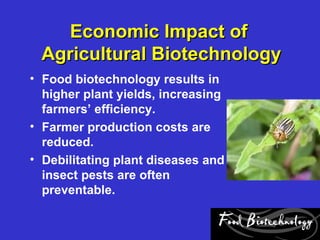
Economic Impact of
 Agricultural Biotechnology
• Food biotechnology results in
  higher plant yields, increasing
  farmers’ efficiency.
• Farmer production costs are
  reduced.
• Debilitating plant diseases and
  insect pests are often
  preventable.
Combating Hunger

• Food biotechnology allows more
  food to be produced on less land.
• Economic benefits will allow food
  biotechnology to contribute to
  combating global hunger.
Combating Hunger

• Food biotechnology allows more
  food to be produced on less land.
• Economic benefits will allow food
  biotechnology to contribute to
  combating global hunger.
FDA     Food Biotechnology
USDA
              Is Safe
       • Food biotechnology is one of
AMA
         the most extensively reviewed
IFT      agricultural advancements to
         date.
FAO/
       • Studies to date have shown
WHO
         no evidence of any harmful
ADA      effects.
What is the FDA’s
       approval procedure ?
•Regulate the product, not the process.
•Regulate the ingredient, not its method of
manufacture.
•Substances that are not GRAS or exempt
will be regulated as additives.
•Encourages “informal consultation.”
FDA’s basic paradigm
• Is the gene coming from the donor well
  characterized?
• Is the vector (plasmid) well
  characterized?
• Is the recipient of the gene well
  characterized?
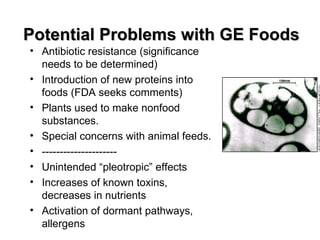
Potential Problems with GE Foods
• Antibiotic resistance (significance
  needs to be determined)
• Introduction of new proteins into
  foods (FDA seeks comments)
• Plants used to make nonfood
  substances.
• Special concerns with animal feeds.
• ---------------------
• Unintended “pleotropic” effects
• Increases of known toxins,
  decreases in nutrients
• Activation of dormant pathways,
  allergens
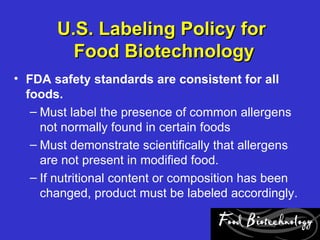
U.S. Labeling Policy for
         Food Biotechnology
• FDA safety standards are consistent for all
  foods.
   – Must label the presence of common allergens
     not normally found in certain foods
   – Must demonstrate scientifically that allergens
     are not present in modified food.
   – If nutritional content or composition has been
     changed, product must be labeled accordingly.
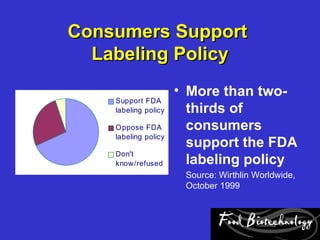
Consumers Support
  Labeling Policy
                      • More than two-
    Support FDA
    labeling policy     thirds of
    O ppose FDA         consumers
    labeling policy
                        support the FDA
    Don't
    know /refused       labeling policy
                       Source: Wirthlin Worldwide,
                       October 1999
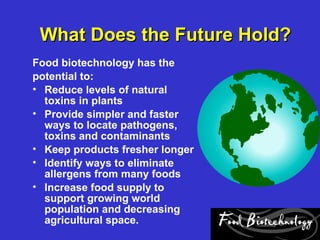
What Does the Future Hold?
Food biotechnology has the
potential to:
• Reduce levels of natural
  toxins in plants
• Provide simpler and faster
  ways to locate pathogens,
  toxins and contaminants
• Keep products fresher longer
• Identify ways to eliminate
  allergens from many foods
• Increase food supply to
  support growing world
  population and decreasing
  agricultural space.
So what’s the bottom line, Doc?

 • It depends on the use.
 • It depends on the market.
 • It depends on how you vote.

Biotechnology

  • 1.
    What is FoodBiotechnology? Food biotechnology is the evolution of traditional agricultural techniques such as crossbreeding and fermentation. It is an extension of the type of food development that has provided nectarines, tangerines and similar advancements.
  • 2.
    Technically Speaking... Food biotechnologyemploys the tools of modern genetics to enhance beneficial traits of plants, animals and microorganisms for food production. It involves adding or extracting select genes to achieve desired traits.
  • 5.
    The musical stylingsof Dr. Karl Winters
  • 6.
    There must bemore to it than that, Doc transcription translation • DNA makes RNA makes PROTEIN • Must be a protein already in existence • A “Selectable Marker” is required to identify the clone. • The selectable marker is usually antibiotic resistance, which does not make YOU antibiotic resistant.
  • 7.
    And how dothey do that…?
  • 8.
    Other types ofbiotechnology • Clonal propagation • Random mutagenisis and selection (directed evolution) • Metabolic redirection • Use of “xenophiles”
  • 9.
    Food Biotechnology Applications • Biotechnology methods are currently used to improve many foods. • Food biotechnology has had a profound positive impact on farming and food security. • At least twelve industrialized and four developing countries currently use some form of food biotechnology.
  • 10.
  • 11.
    Have YOU personallybenefited from food biotechnology? Show of hands From Medical Biotechnology?
  • 12.
    Have YOU personallybenefited from food biotechnology? Show of hands Have YOU personally eaten a biotech food?
  • 13.
    Have YOU personallybenefited from food biotechnology? Show of hands Have YOU personally eaten a biotech food? Chyomsin (rennet) BST
  • 14.
    The Colbert Report Manypeople get their information from (fake) news.
  • 15.
    • Taste andQuality – Delayed ripening allows fruits and vegetables to remain fresh longer Flavorsavar®. – Increased solids give foods superior taste and less water to remove for sauces.
  • 16.
    • Nutrition – Some oils are lower in saturated fat and higher in oleic acid, making them more stable for frying without further processing. – Some foods have lower levels of saturated fat.
  • 17.
    J. Amer. DieteticAssoc.,2006;106:285-293
  • 18.
    • Health – Some foods have enhanced nutritional profiles. – Biotechnology allows for the production of foods to help protect against diseases. – Enhanced foods will soon offer higher levels of antioxidant vitamins to reduce risk of cancer. Now being commercialized at Rutgers! (black tea extract).
  • 19.
    How Nutrients RegulateGenes Nutrient Gene impact Disease potential Folic acid DNA methylation Cancer Bind to transcription Fatty acids Obesity factors Vitamin D mRNA stability Kidney disease Increase mRNA Flavones Cancer synthesis Decrease mRNA Theaflavins synthesis(anti- Arthritis inflamatory)
  • 20.
    WellGen, Inc. is the first biotechnology company using nutrigenomics to discover and develop proprietary products that treat and prevent disease Nutrigenomics addresses the role of diet in gene expression
  • 21.
    Consumers Support Food Biotechnology • Nearly two-thirds believe food biotechnology will benefit their family in the next five years. • More than half would choose products modified to taste better or fresher. • Two-thirds would likely buy produce protected against insect damage. Source: Wirthlin Worldwide, October 1999
  • 22.
    Environmental Impact of Agricultural Biotechnology • Healthier plants result in higher yields. • Insect-protected crops reduce the need for insecticides. • Biotechnology helps protect water (less pesticide run off, less erosion.)
  • 23.
    Economic Impact of Agricultural Biotechnology • Food biotechnology results in higher plant yields, increasing farmers’ efficiency. • Farmer production costs are reduced. • Debilitating plant diseases and insect pests are often preventable.
  • 24.
    Combating Hunger • Foodbiotechnology allows more food to be produced on less land. • Economic benefits will allow food biotechnology to contribute to combating global hunger.
  • 25.
    Combating Hunger • Foodbiotechnology allows more food to be produced on less land. • Economic benefits will allow food biotechnology to contribute to combating global hunger.
  • 26.
    FDA Food Biotechnology USDA Is Safe • Food biotechnology is one of AMA the most extensively reviewed IFT agricultural advancements to date. FAO/ • Studies to date have shown WHO no evidence of any harmful ADA effects.
  • 27.
    What is theFDA’s approval procedure ? •Regulate the product, not the process. •Regulate the ingredient, not its method of manufacture. •Substances that are not GRAS or exempt will be regulated as additives. •Encourages “informal consultation.”
  • 28.
    FDA’s basic paradigm •Is the gene coming from the donor well characterized? • Is the vector (plasmid) well characterized? • Is the recipient of the gene well characterized?
  • 29.
    Potential Problems withGE Foods • Antibiotic resistance (significance needs to be determined) • Introduction of new proteins into foods (FDA seeks comments) • Plants used to make nonfood substances. • Special concerns with animal feeds. • --------------------- • Unintended “pleotropic” effects • Increases of known toxins, decreases in nutrients • Activation of dormant pathways, allergens
  • 31.
    U.S. Labeling Policyfor Food Biotechnology • FDA safety standards are consistent for all foods. – Must label the presence of common allergens not normally found in certain foods – Must demonstrate scientifically that allergens are not present in modified food. – If nutritional content or composition has been changed, product must be labeled accordingly.
  • 32.
    Consumers Support Labeling Policy • More than two- Support FDA labeling policy thirds of O ppose FDA consumers labeling policy support the FDA Don't know /refused labeling policy Source: Wirthlin Worldwide, October 1999
  • 33.
    What Does theFuture Hold? Food biotechnology has the potential to: • Reduce levels of natural toxins in plants • Provide simpler and faster ways to locate pathogens, toxins and contaminants • Keep products fresher longer • Identify ways to eliminate allergens from many foods • Increase food supply to support growing world population and decreasing agricultural space.
  • 34.
    So what’s thebottom line, Doc? • It depends on the use. • It depends on the market. • It depends on how you vote.

Editor's Notes

  • #2 2 We know that 73% of Americans have heard something about biotechnology, but what exactly is it? Food biotechnology is the latest advancement building on knowledge gained over the last 10,000 years of plant production. It is a process that has resulted in improved nutrition, taste, quality and freshness of many foods today.
  • #3 3 Food biotechnology is a safe, more efficient way to improve crops. Selecting specific genes to add or extract is a more precise method of plant breeding, offering farmers more ways to improve crops. Because of these and many benefits, use of biotechnology is becoming increasingly popular. It is estimated that in 1999, 57% of the soybeans, 38% of the cotton and 30% of the corn planted in the United States used some form of biotechnology.
  • #10 5 There are many applications for food biotechnology, including improving the taste, safety, nutritional profile and quality of many foods. Food biotechnology ultimately benefits consumers by providing safer, tastier, more nutritious food choices. Food biotechnology offers farmers a more efficient way to produce safer products in greater numbers. Through food biotechnology, the risk of food security worldwide is greatly reduced. Because of these and many other benefits, applications of food biotechnology are currently used in twelve industrialized and four developing countries.
  • #11 6 Let’s review some of the many consumer benefits of food biotechnology in depth.
  • #16 7 Food biotechnology allows fruits and vegetables to remain in their natural environment longer, positively impacting taste and freshness. The additional solids give foods superior taste and they often perform better when they are cooked or processed.
  • #17 8 Since the amount of saturated fat used to process some foods is reduced, we now have more healthful products available. Future advances in biotechnology will yield more healthful cooking oils, potatoes with greater solids that absorb less oil and yield lower fat french fries and even peanuts containing less of the proteins that cause allergies.
  • #19 9 In addition to the health benefits that have already been discovered, food biotechnology offers potential to further improve our nation’s health and the health of developing nations. Scientists have recently discovered how to enhance rice (called “golden rice”), enriching it with vitamin A. This advancement may end vitamin A deficiency, one of the leading causes of blindness and other health problems for 124 million children worldwide. Applications are now being researched that will result in foods that deliver disease-preventing vaccines. These will be particularly valuable in developing countries that cannot afford or do not have access to modern medical treatments. Edible vaccines may alleviate the significant problem of providing sufficient, less costly and effective medicine for intestinal diseases in developing nations. The World Health Organization estimates that diarrhea caused by bacteria is a major cause of infant mortality worldwide, with nearly three million deaths per year. Thanks to food biotechnology, in the near future some foods will offer higher levels of antioxidant vitamins such as C and E to reduce our risk of cancer.
  • #22 10 American consumers remain positive about the many benefits of food biotechnology, despite a three-fold increase in media coverage of food biotechnology and confusion in the international marketplace. A telephone survey conducted in October 1999 among 1000 adults revealed the following: Nearly two-thirds of those surveyed believe food biotechnology will provide benefits for their family in the next five years. More than half would choose products modified to taste better or fresher. Food biotechnology helps protect against insect damage, reducing the need for pesticides on fresh produce. Reduced pesticide use is important to many consumers. Two-thirds of those surveyed would likely buy produce that has been enhanced via biotechnology, resulting in fewer pesticide applications.
  • #23 12 The positive impact on plant health results in more productive crops, conserving land use. Through agricultural biotechnology, crops are reared to be more tolerant to infectious diseases caused by fungi, viruses and bacteria. This dramatically reduces the need for pesticides. The development of herbicide-tolerant crops allows for more no-till farming, conserving topsoil and reducing farm runoff. Less runoff helps keep water safe and contributes to a healthier environment. Insect-protected crops reduce the need for insecticides.
  • #24 13 The current and potential economic impact of biotechnology is tremendous for both farmers and consumers. Generally speaking, farmers have the potential of being more profitable. Since they get more food out of their crops, there is a greater return on their investment. Their production costs are lower since they can reduce pesticide and energy inputs. Additionally, food biotechnology helps prevent debilitating plant diseases and insect pests, ensuring a healthy supply to meet consumers’ ongoing demands.
  • #25 15 Simply put, the use of biotechnology results in more food produced on less land to feed this rapidly growing population. One researcher, Florence Wambugu of Kenya Agricultural Research Institute, employed biotechnology to produce sweet potatoes that resist the “feathery mottle” virus. This resulted in 20-80 percent more food, and is projected to offer the potential to improve food security and the health of millions of African families. Ms. Wambugu says that there is the potential to double African crop production through the use of food biotechnology to control viral diseases.
  • #26 15 Simply put, the use of biotechnology results in more food produced on less land to feed this rapidly growing population. One researcher, Florence Wambugu of Kenya Agricultural Research Institute, employed biotechnology to produce sweet potatoes that resist the “feathery mottle” virus. This resulted in 20-80 percent more food, and is projected to offer the potential to improve food security and the health of millions of African families. Ms. Wambugu says that there is the potential to double African crop production through the use of food biotechnology to control viral diseases.
  • #27 16 A few opponents of biotechnology question the safety of foods produced using biotechnology. However, much of the criticism is based on emotion, not grounded in fact. In fact, several government agencies including the U.S. Food and Drug Administration, the United States Department of Agriculture and the Environmental Protection Agency are committed to ensuring the safety of these foods. A number of other health and food organizations also support the use food biotechnology. These include The American Dietetic Association, the American Medical Association and the Institute of Food Technologists. There have been over 1,700 field tests at more than 6,500 sites in the United States, and to date there is no evidence of any harmful effects. Recently, more than 1,000 leading scientists, including two Nobel Prize winners, signed a declaration endorsing food biotechnology as a safe, environmentally-friendly and useful tool to help feed the developing world.
  • #32 17 The FDA classifies foods produced using biotechnology the same as products that are not enhanced. This means they are held to the same high labeling standards as all other foods. All common allergens not normally found in certain foods must be listed. However, no such products derived from biotechnology are currently on the market. Any nutritional changes to the food as a result of biotechnology - such as increased vitamins or minerals or reduced fat content - must be detailed on the label.
  • #33 18 Most American consumers are comfortable with the FDA policy just described. A recent survey shows 7 out of 10 consumers support the current guidelines. While some critics feel that the FDA should require a special label to indicate that a food has been produced through biotechnology, the FDA continues to believe this has no scientific basis and it would be confusing to consumers. Labeling would also require extreme measures. Consider, for example, that one bottle of ketchup may contain a dozen tomato varieties provided by just as many suppliers. Keeping the varieties separate throughout production and labeling accordingly, if even possible, would be an overwhelming task and very costly. Most people (81%) say that they would prefer to get more detailed information about food biotechnology through brochures, websites and 800-numbers (Wirthlin Worldwide, October 1999).
  • #34 19 The future for food biotechnology is tremendous. Food biotechnology will continue to reduce toxins in plants and help to detect plant contaminants more efficiently, thus improving the healthfulness of our food supply. Fruits and vegetables will stay fresh for longer periods of time. It will soon be possible to eliminate a number of common allergens from many foods. Our food supply will increase and we will be better able to support the rapidly growing world population.