Outline
1) Introduction toBiosensors
2) Bioreceptors
3) Immobilization of Bioreceptors
4) Transduction methods and example
devices
3.
Recognition
Transduction
Signal Processing
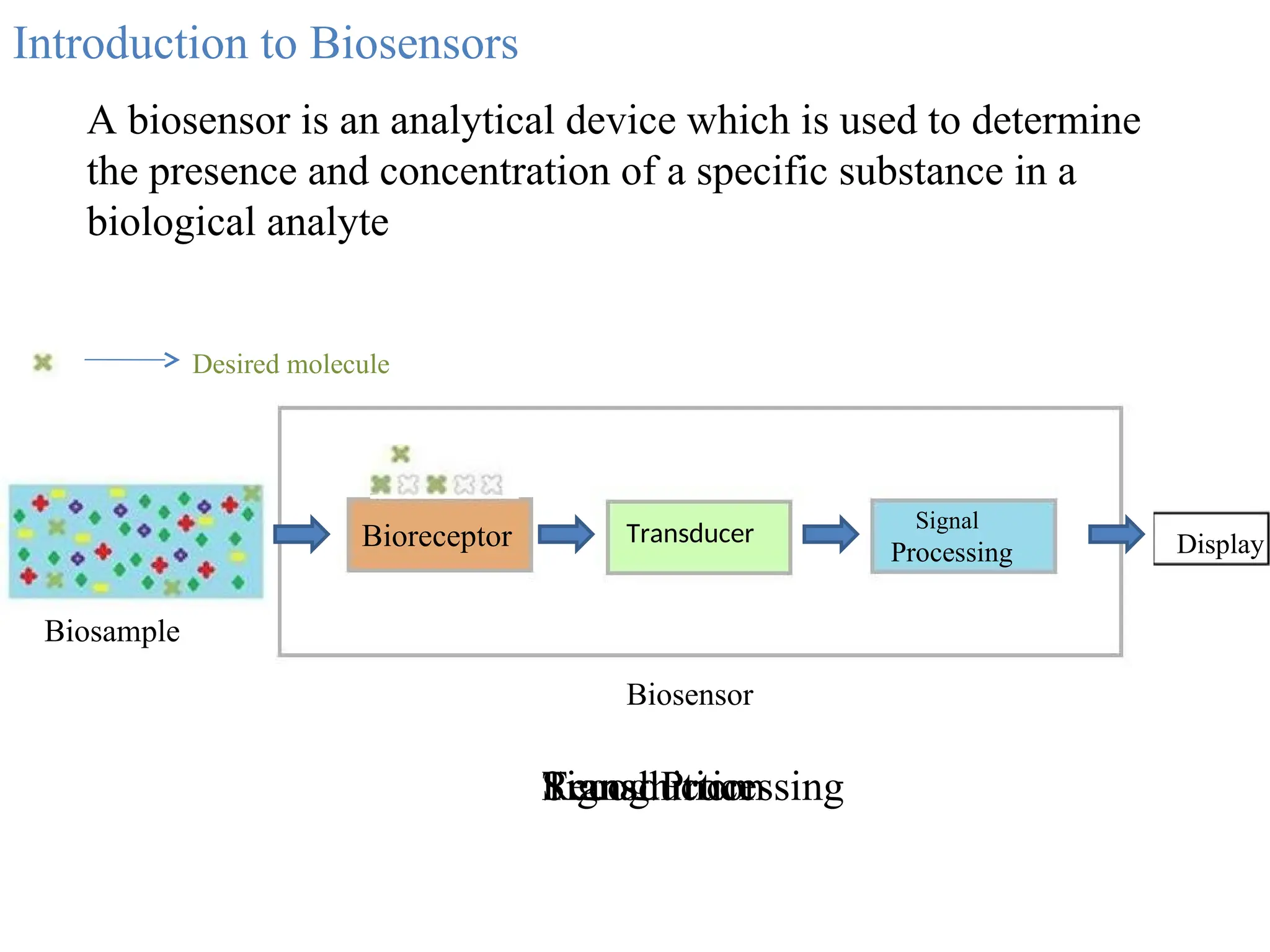
A biosensoris an analytical device which is used to determine
the presence and concentration of a specific substance in a
biological analyte
Biosensor
Display
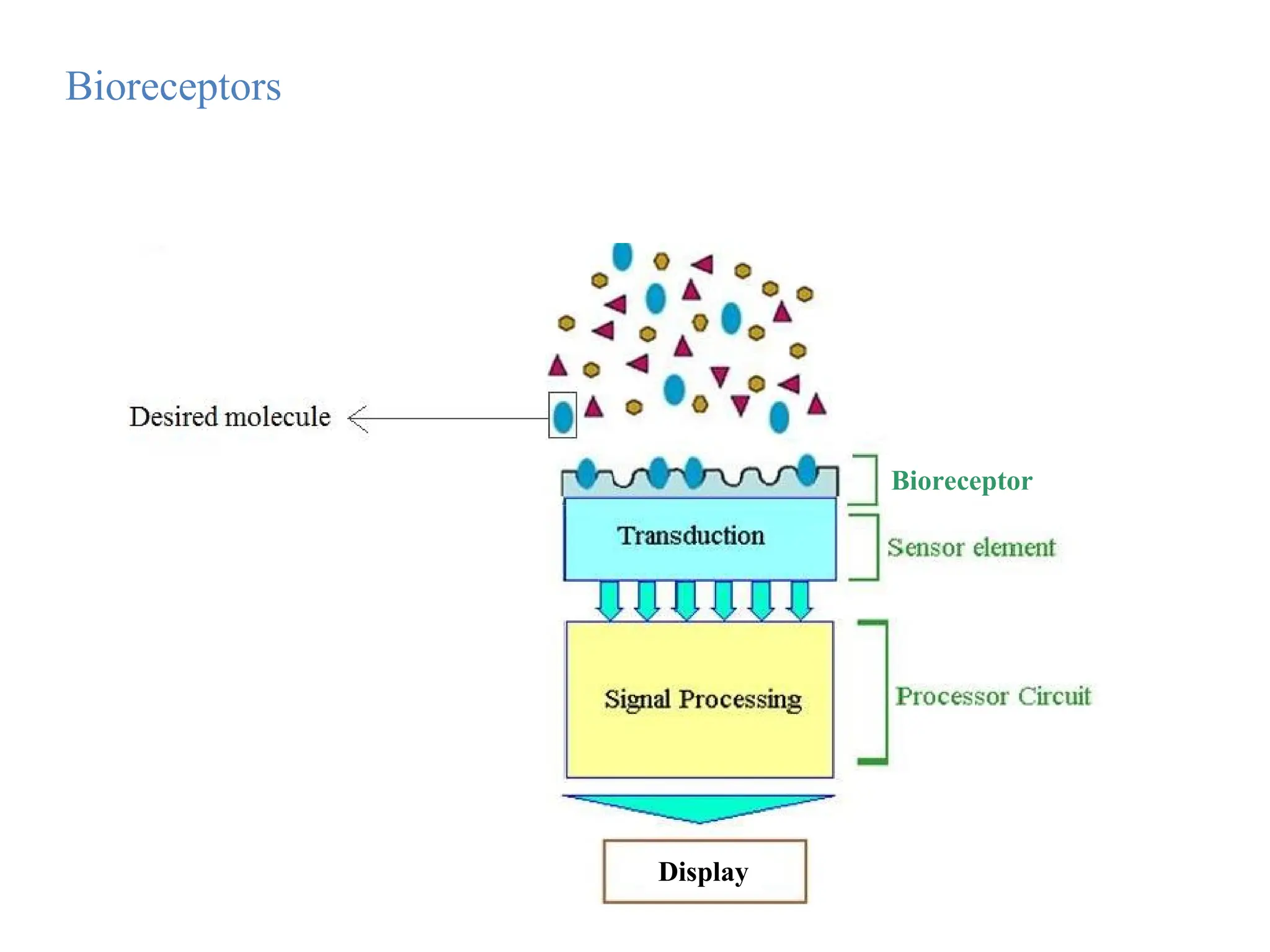
Bioreceptor Transducer Signal
Processing
Desired molecule
Introduction to Biosensors
Biosample
4.
Introduction to Biosensors
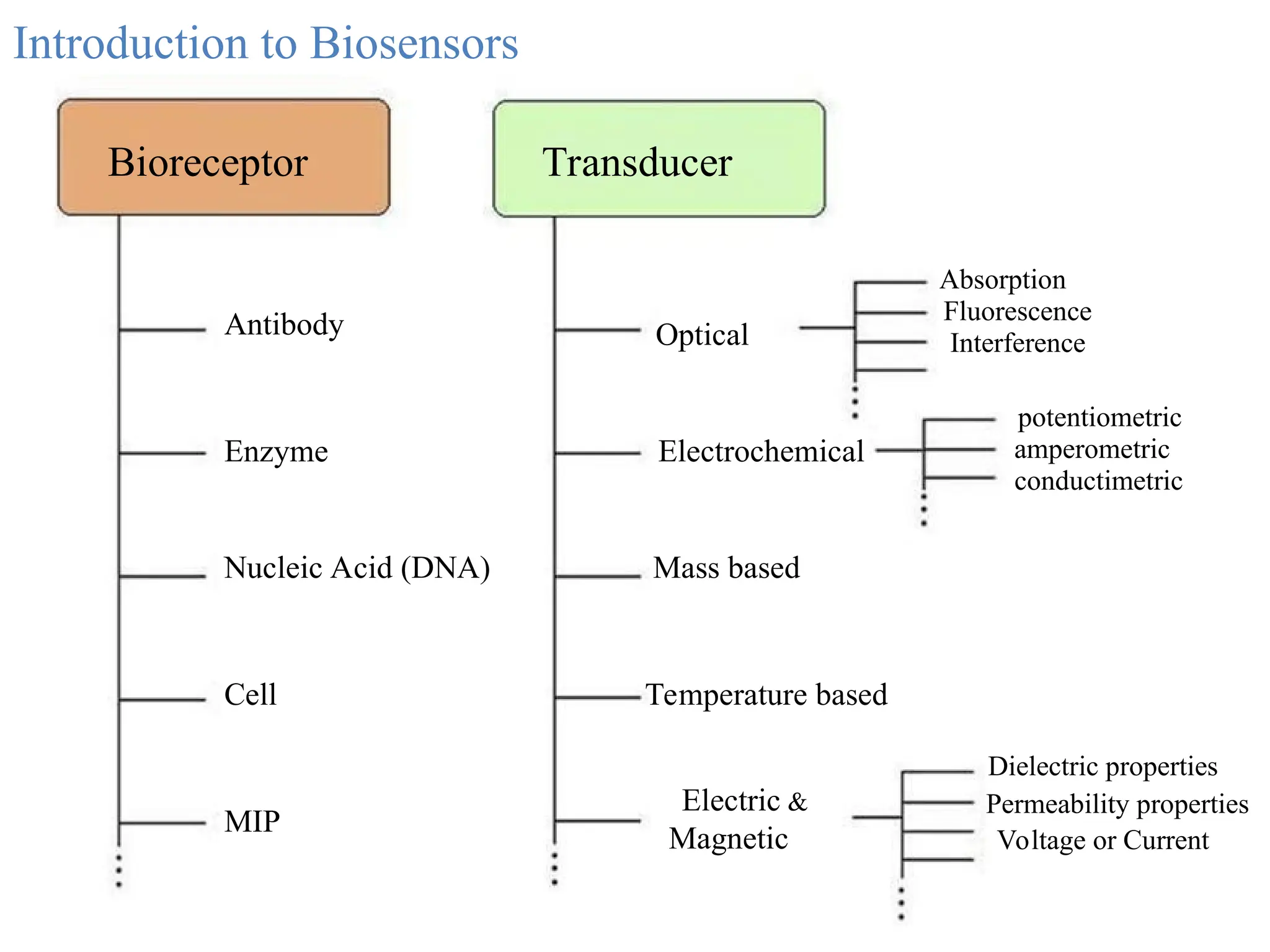
BioreceptorTransducer
Antibody
Enzyme
Nucleic Acid (DNA)
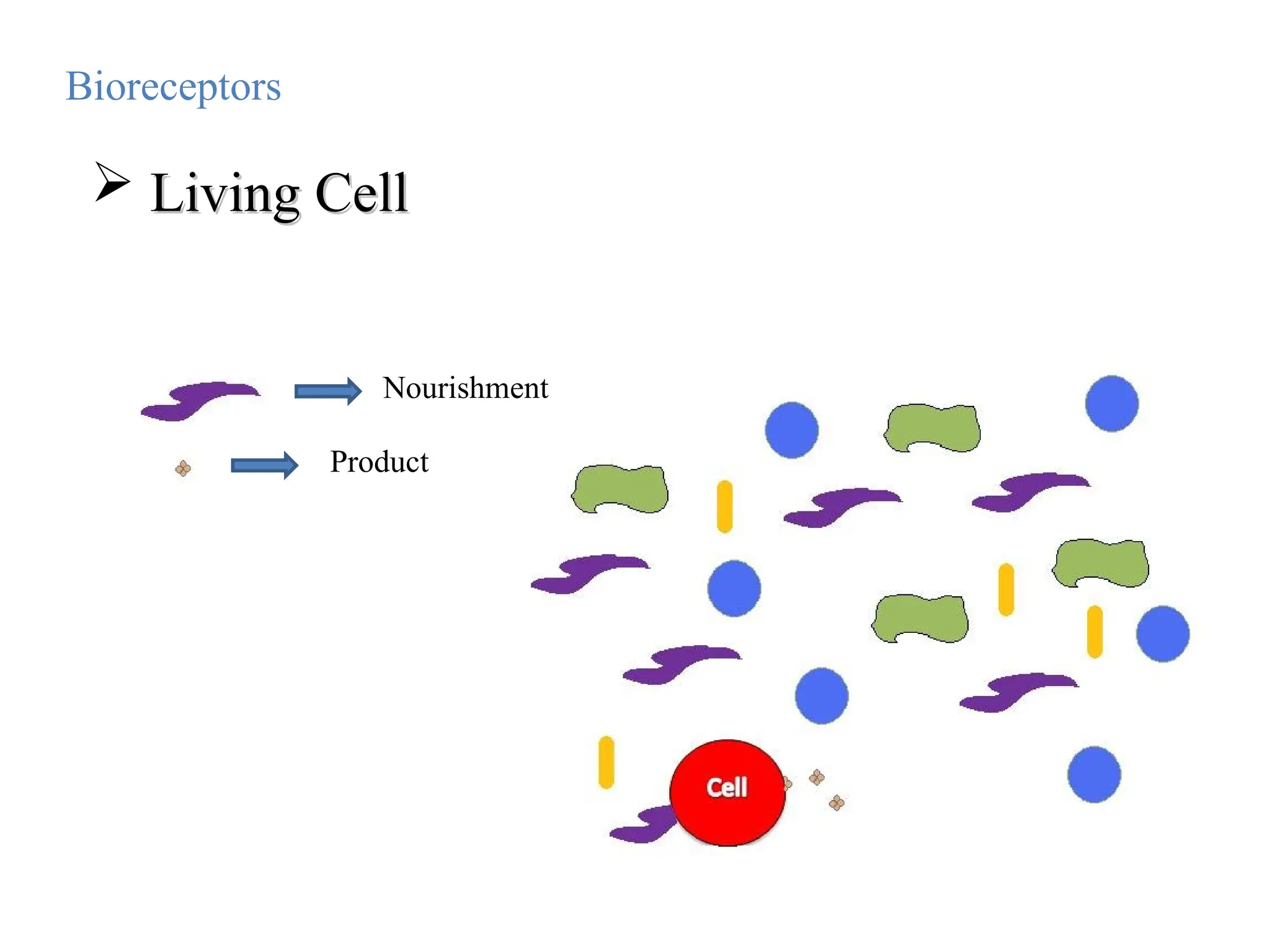
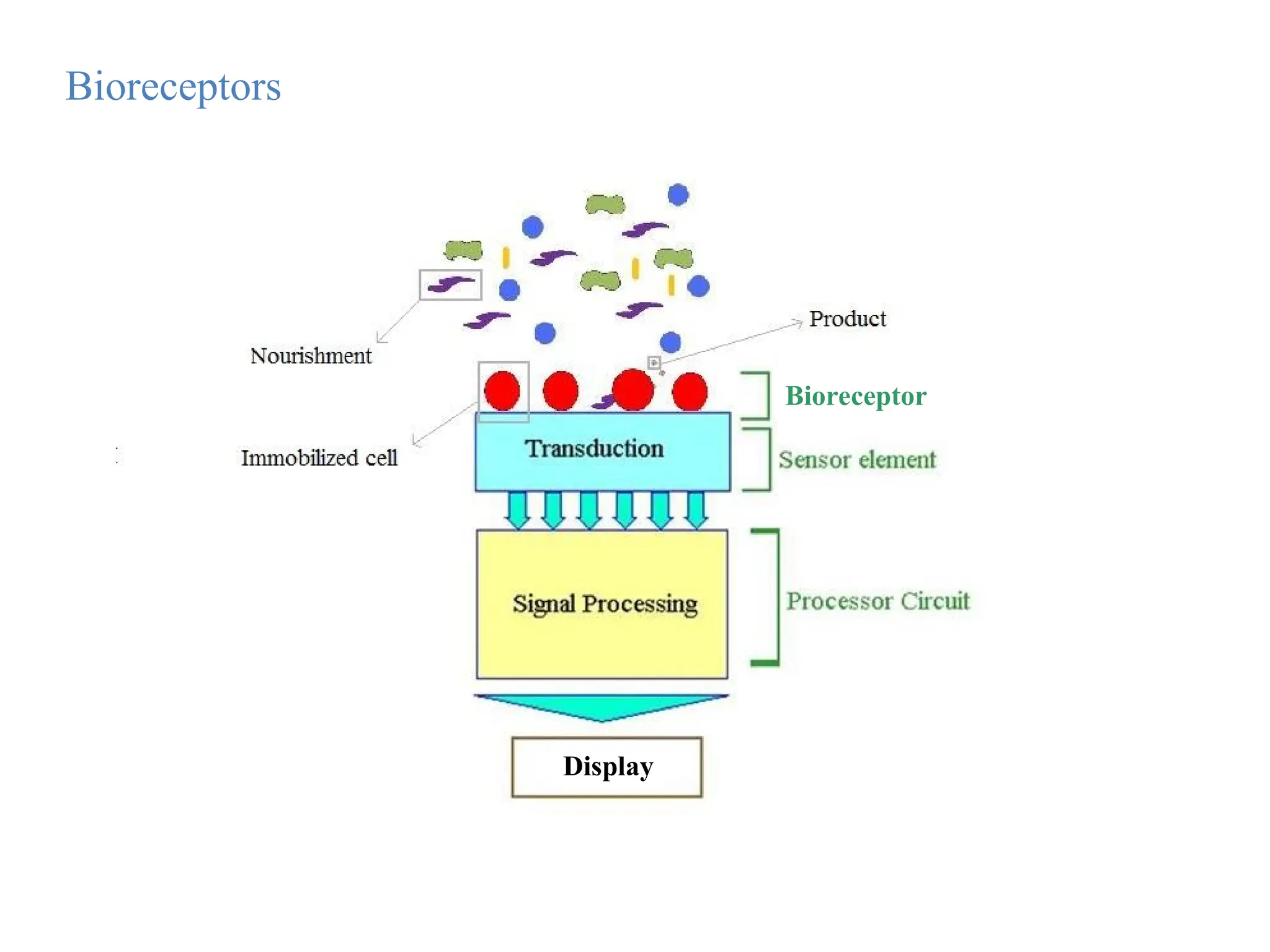
Cell
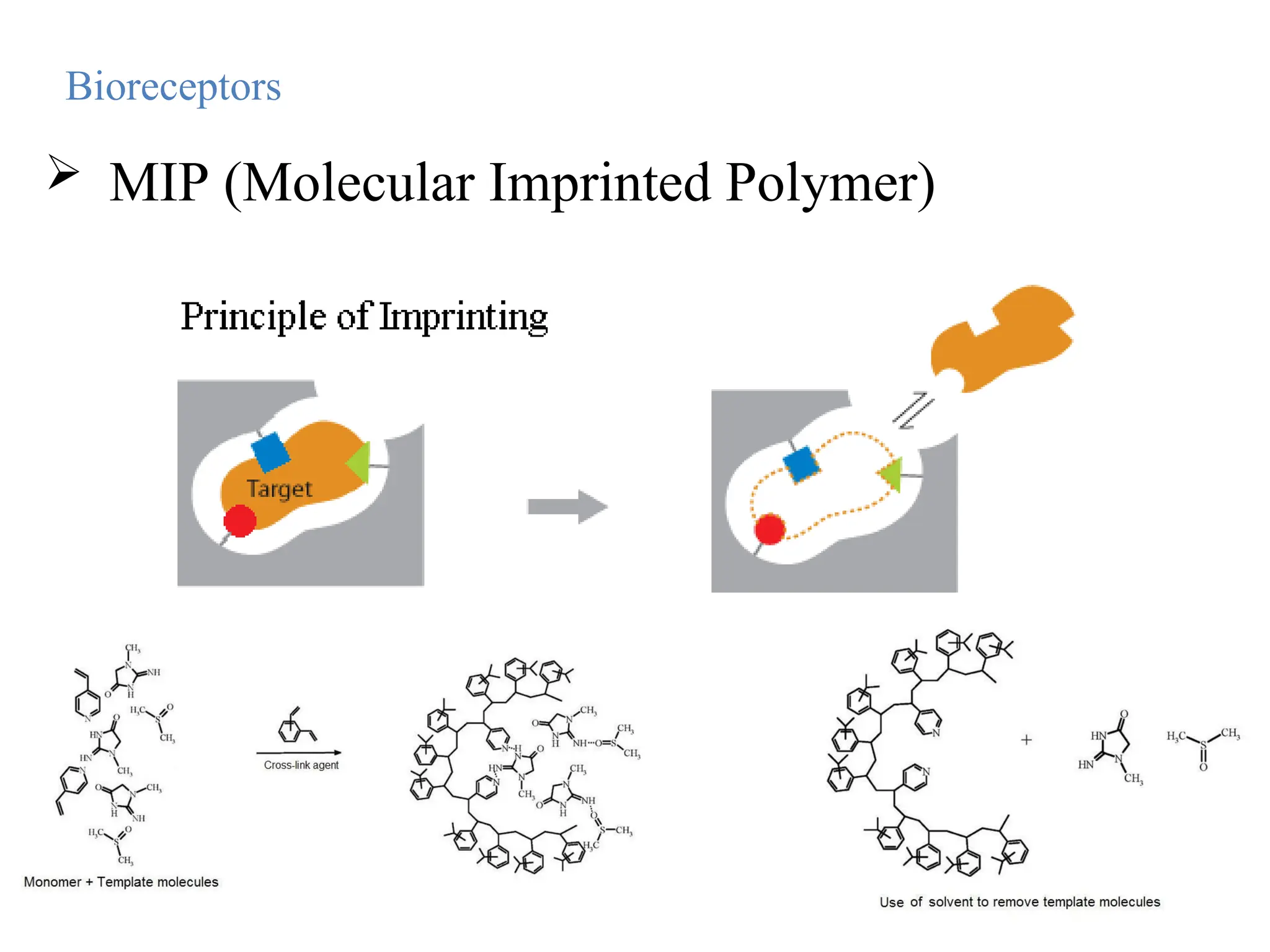
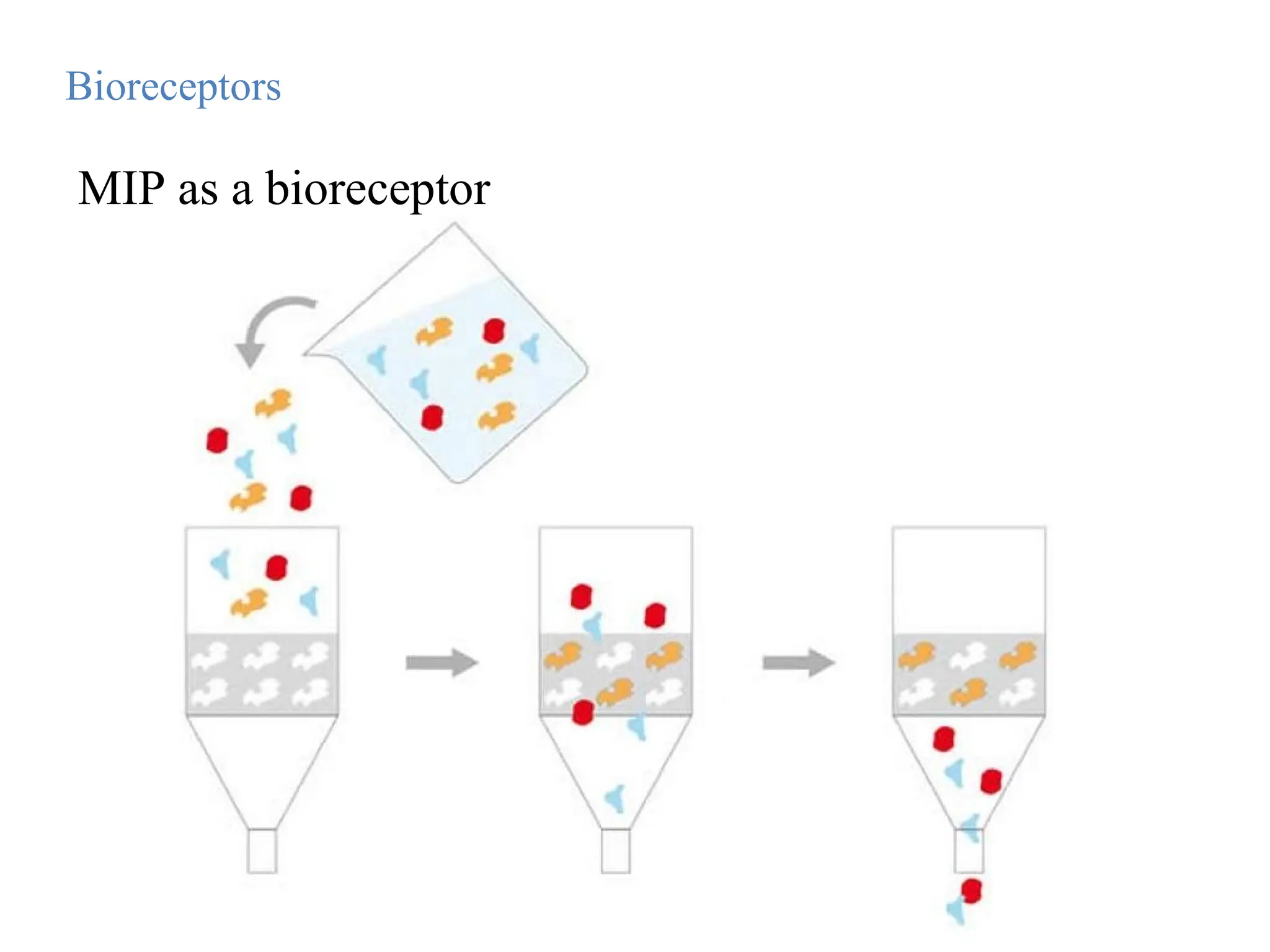
MIP
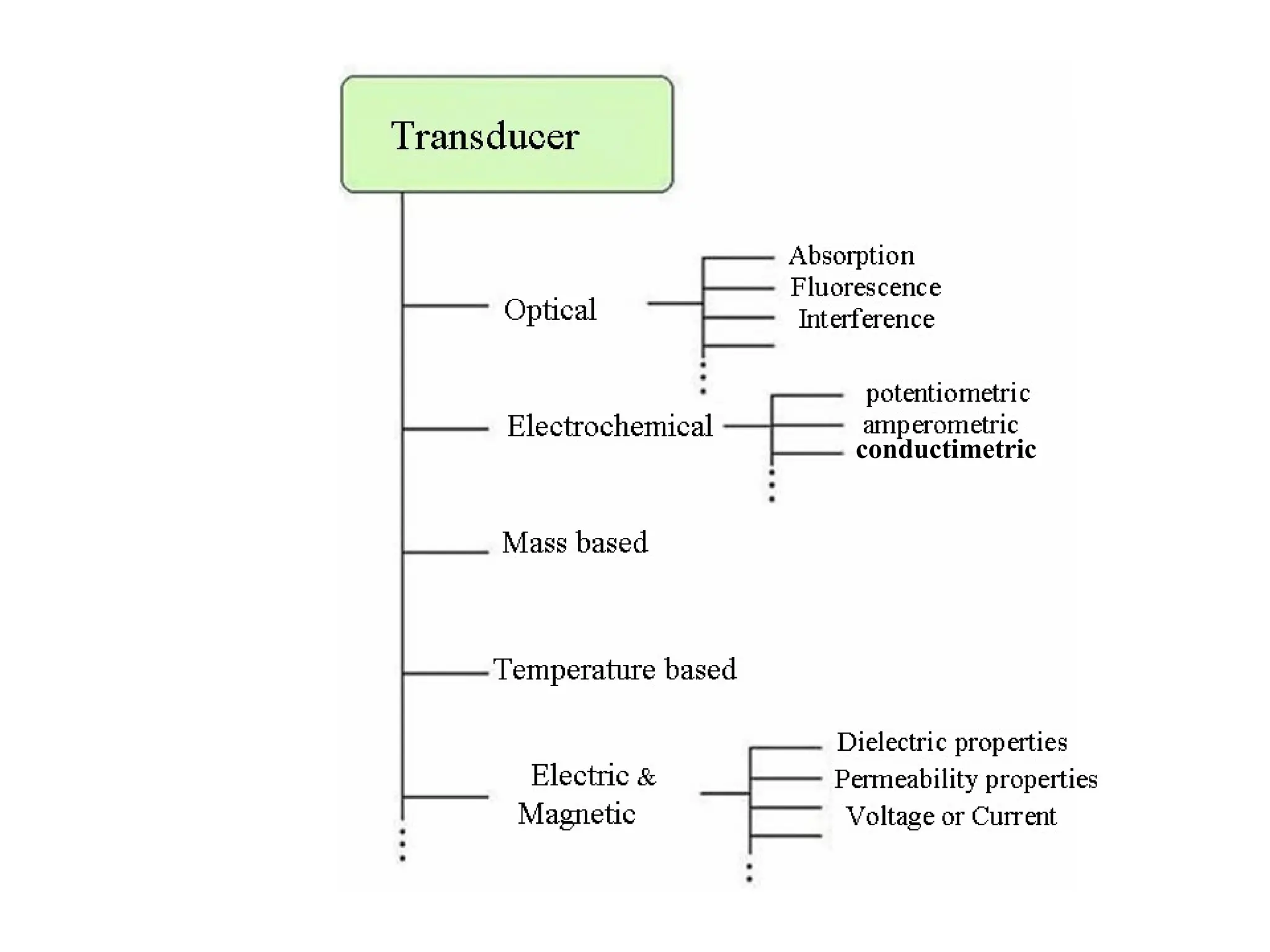
Optical
Electrochemical
Mass based
Temperature based
potentiometric
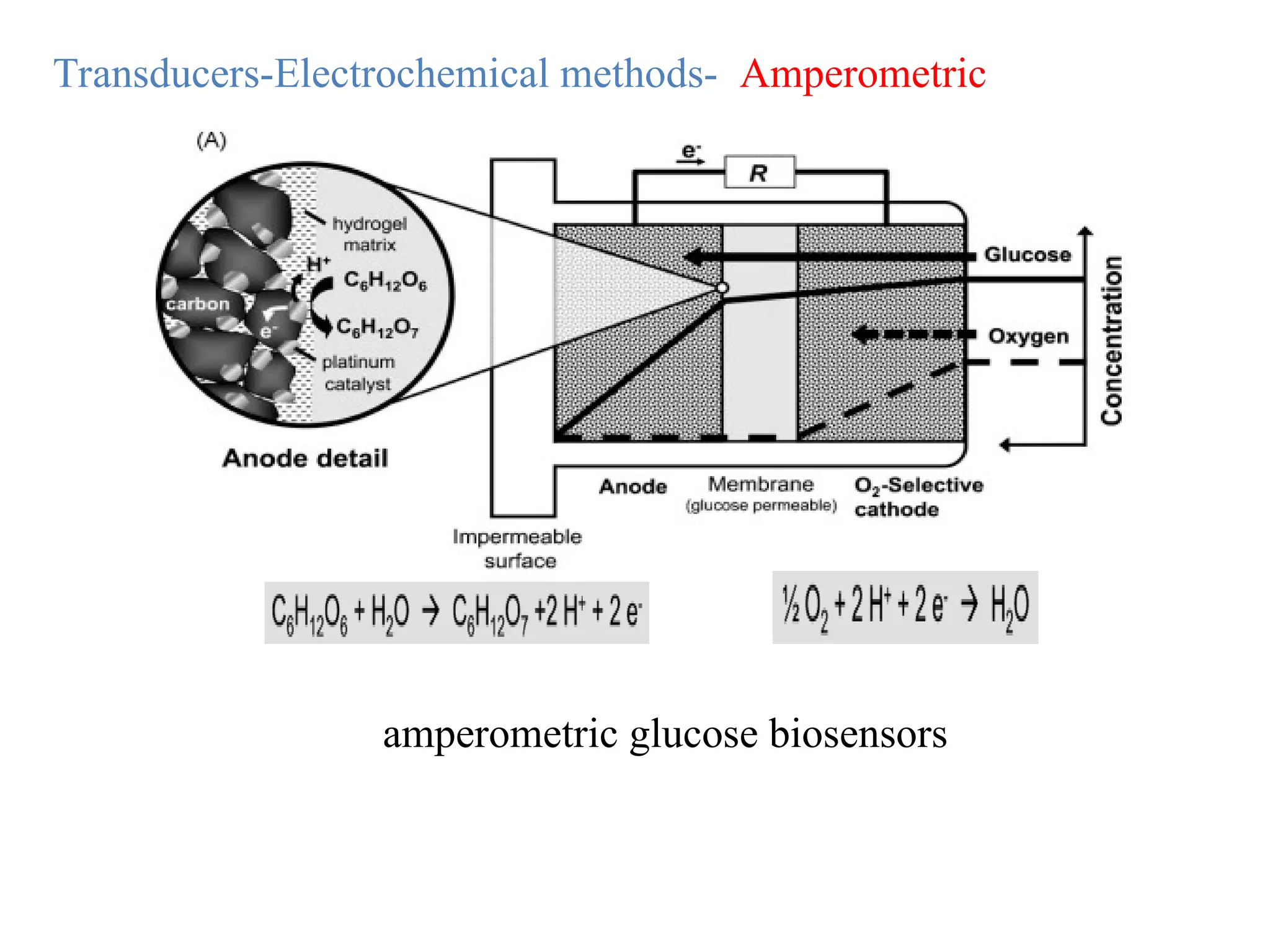
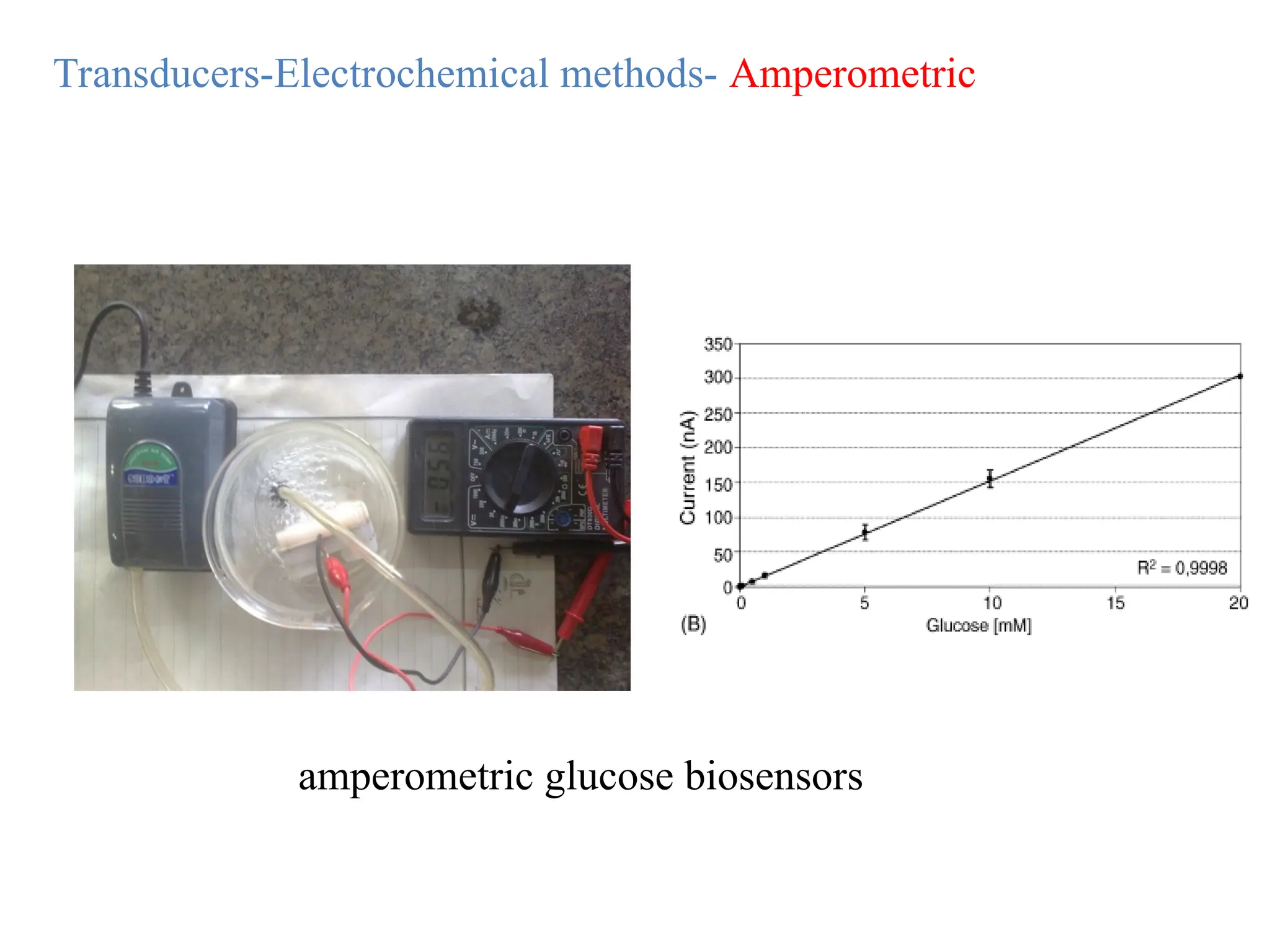
amperometric
conductimetric
Electric &
Magnetic
Dielectric properties
Permeability properties
Voltage or Current
Fluorescence
Interference
Absorption
5.
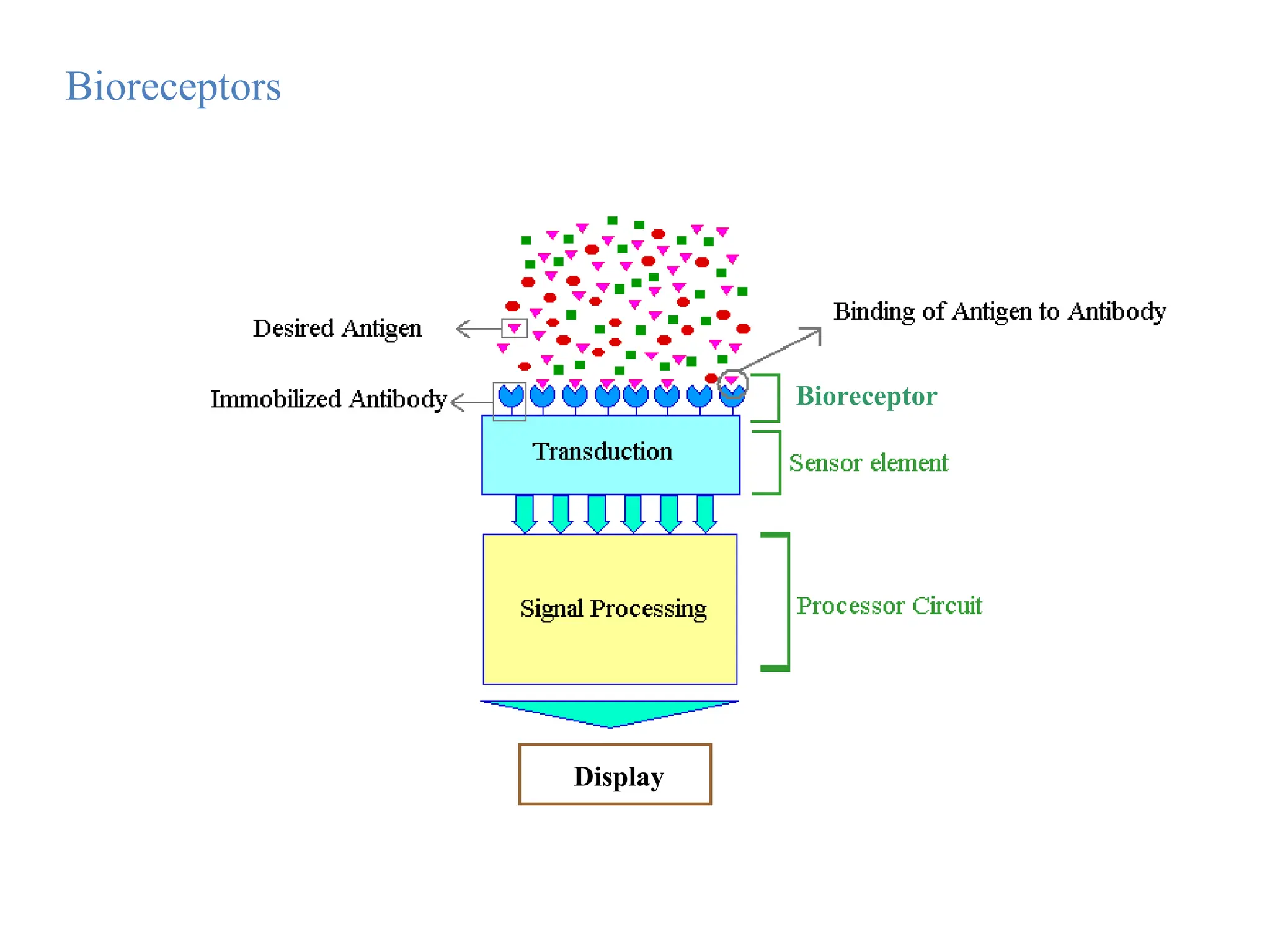
Antibody
Antibody Antibodiesare biological molecules that exhibit
very specific binding capabilities for specific
structure (antigens).
Antigen It can be recognized by antibody.
Bioreceptors
membrane
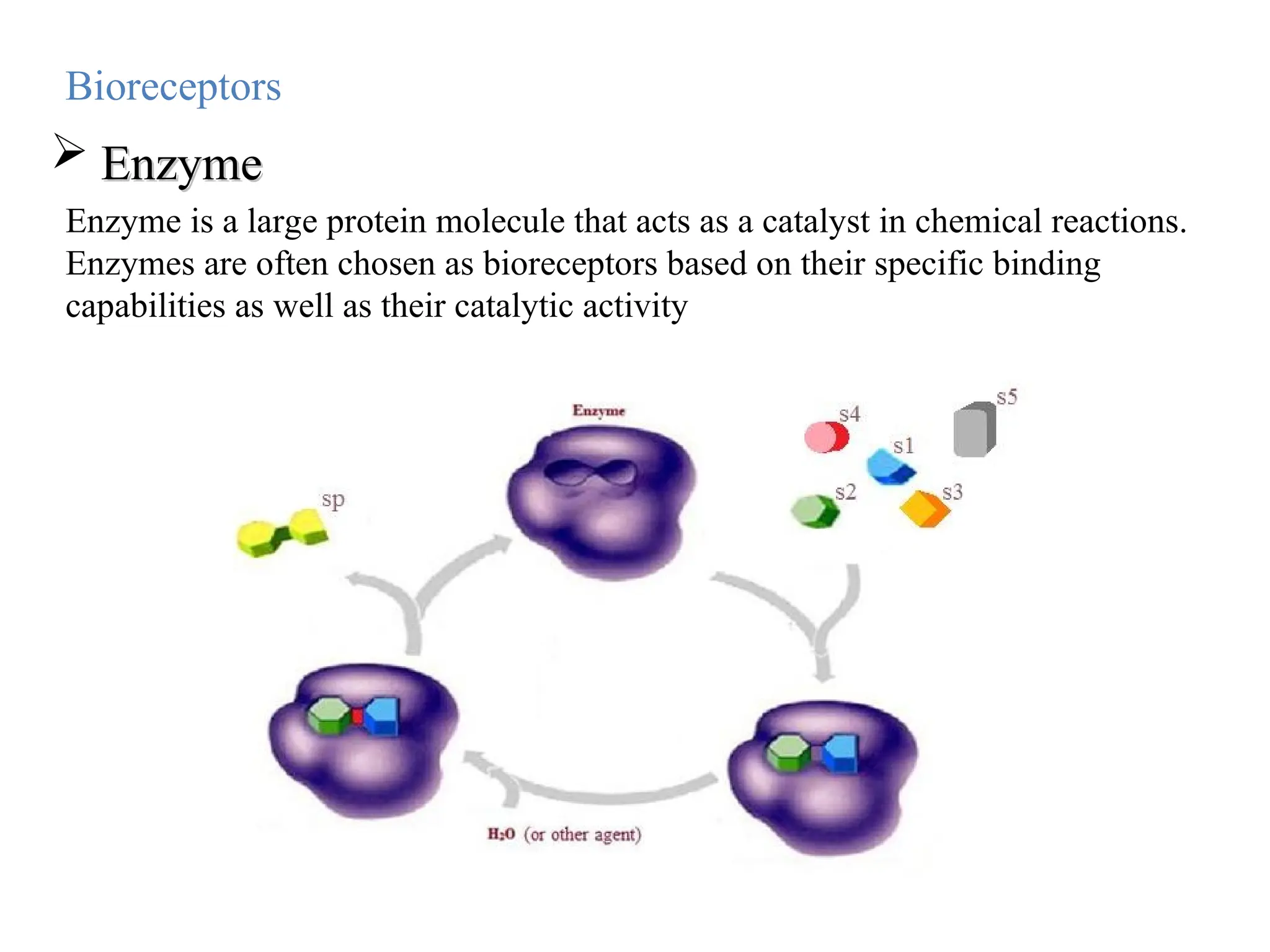
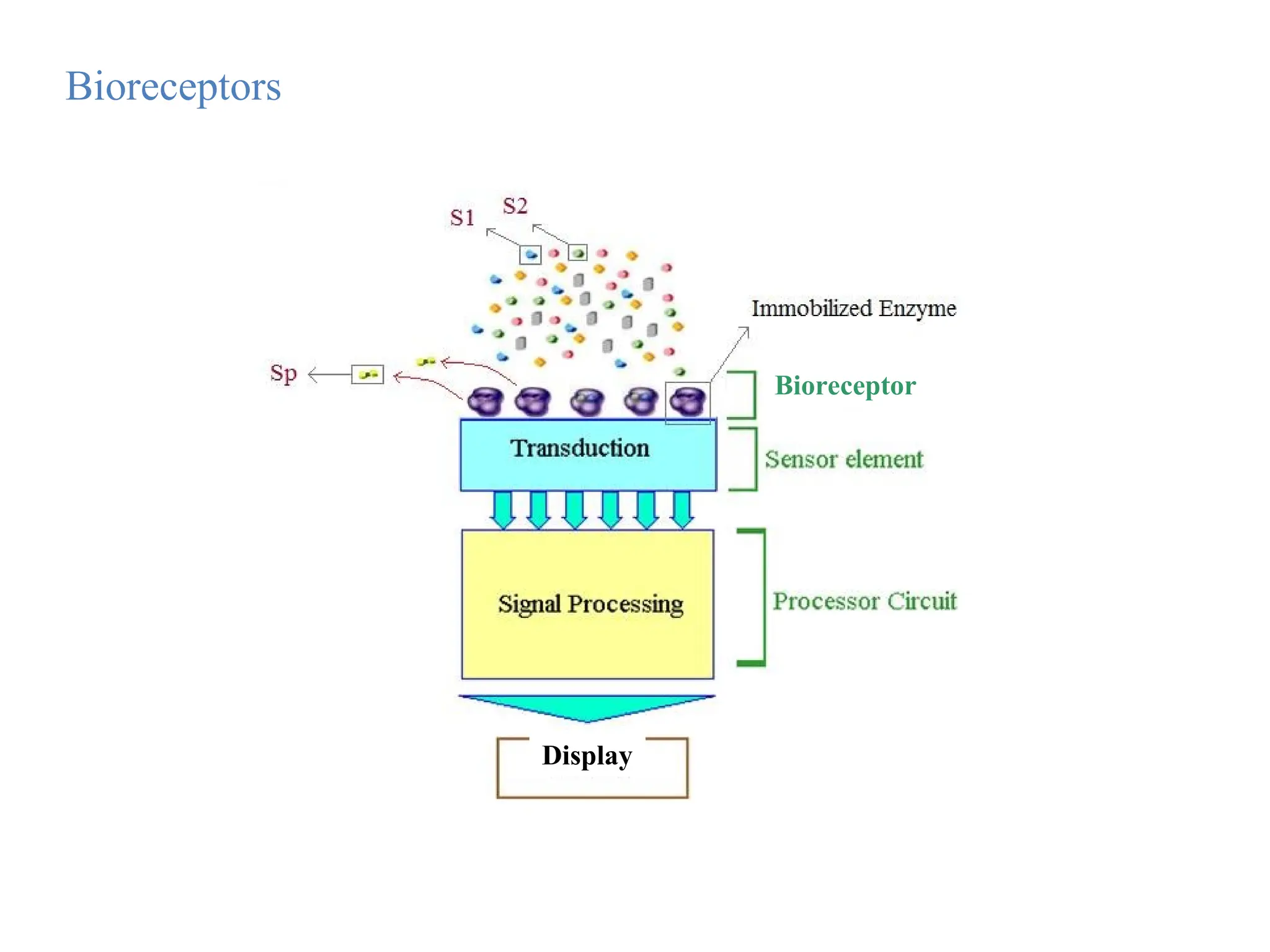
Enzyme is alarge protein molecule that acts as a catalyst in chemical reactions.
Enzymes are often chosen as bioreceptors based on their specific binding
capabilities as well as their catalytic activity
Bioreceptors
Enzyme
Enzyme
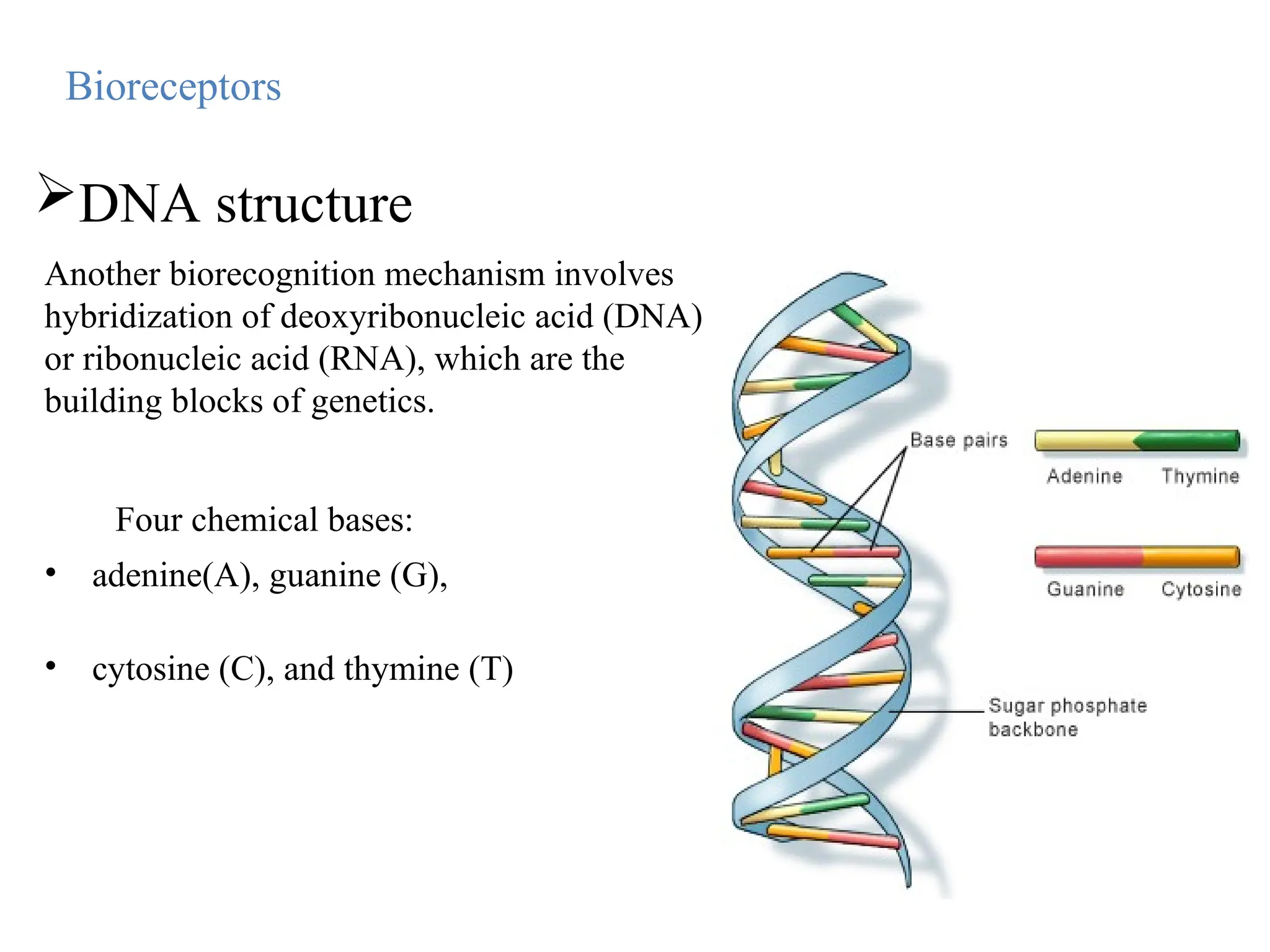
Four chemical bases:
•adenine(A), guanine (G),
• cytosine (C), and thymine (T)
Bioreceptors
DNA structure
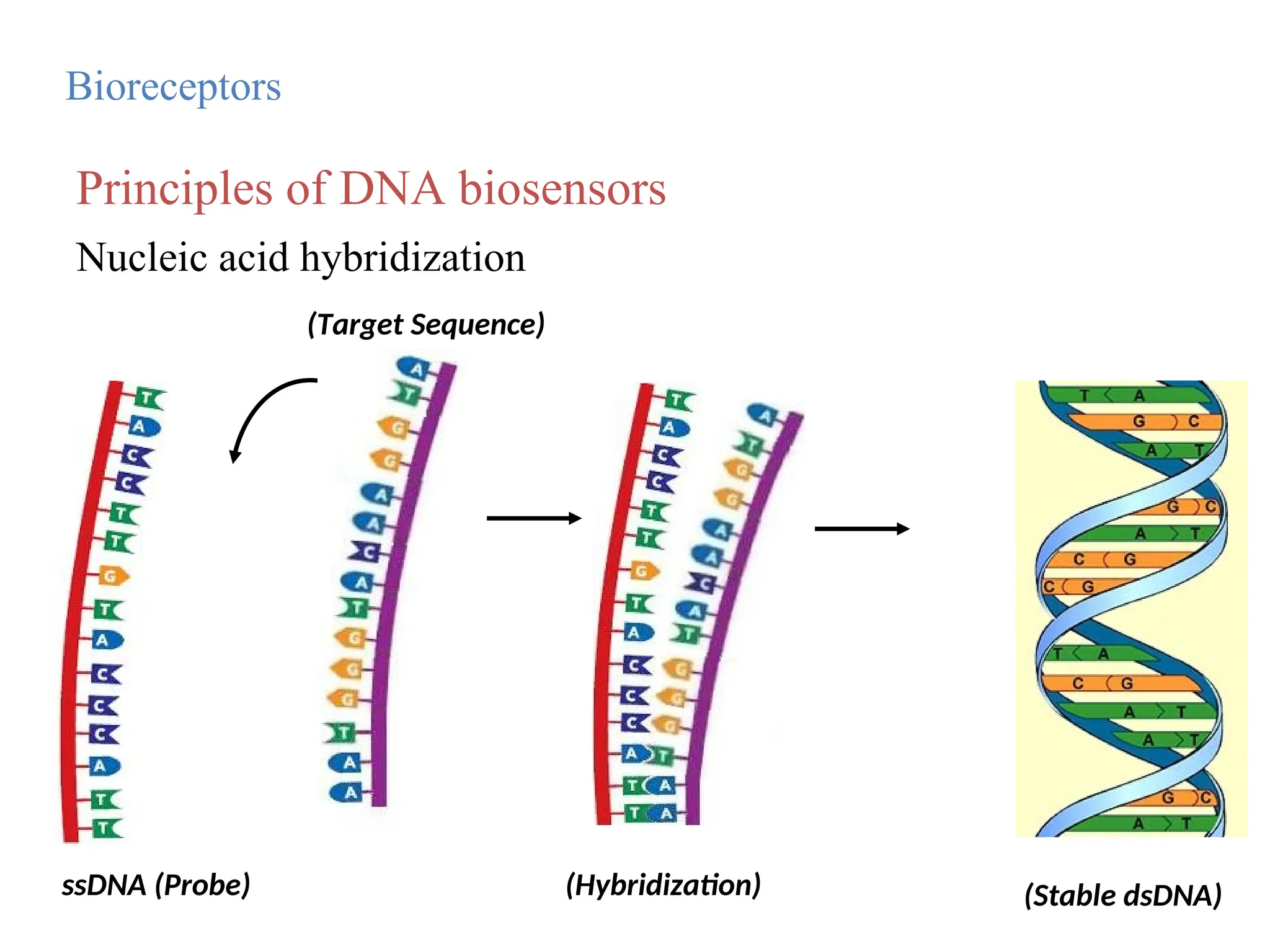
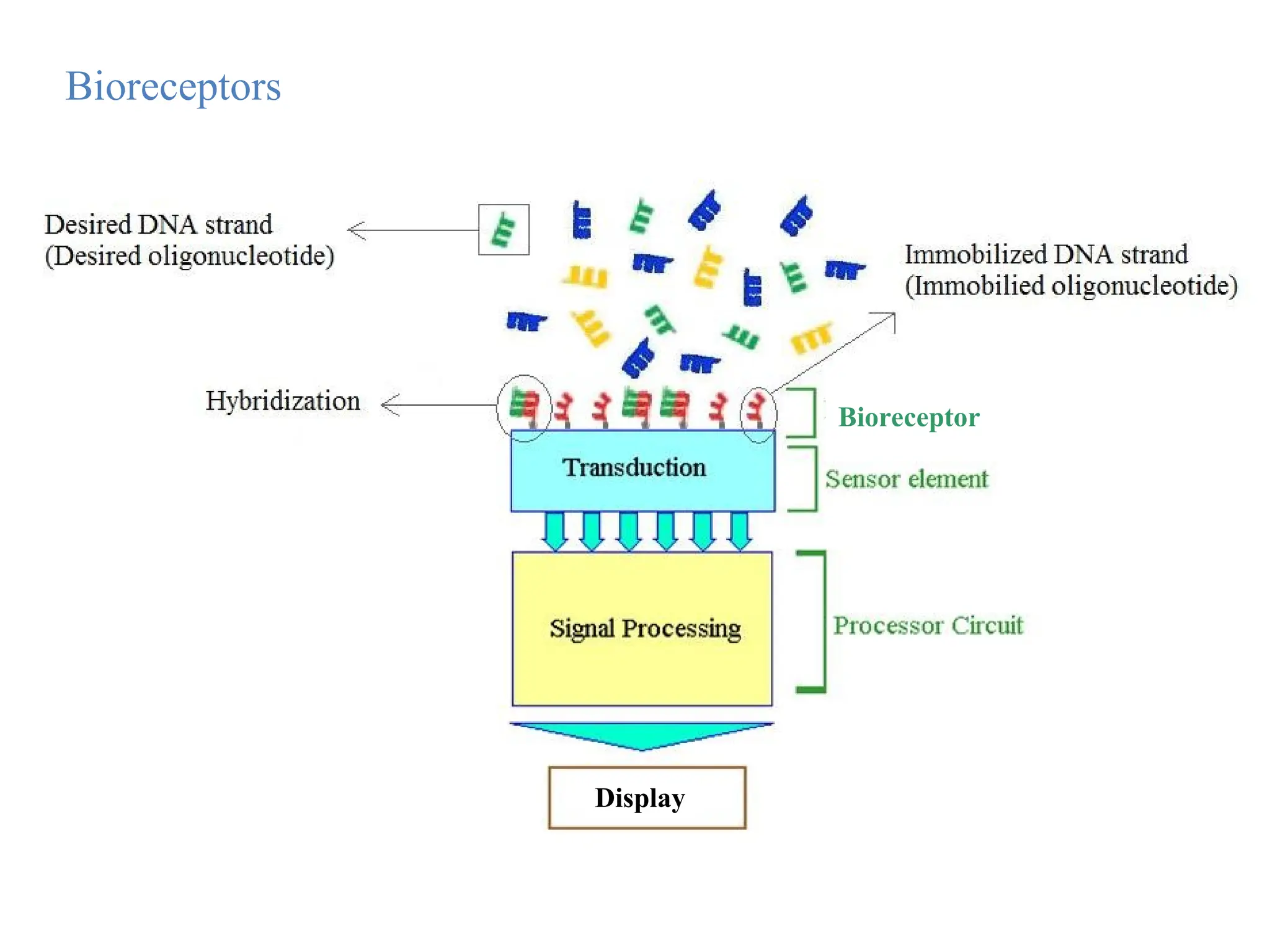
Another biorecognition mechanism involves
hybridization of deoxyribonucleic acid (DNA)
or ribonucleic acid (RNA), which are the
building blocks of genetics.
10.
Nucleic acid hybridization
ssDNA(Probe)
(Target Sequence)
(Hybridization) (Stable dsDNA)
Principles of DNA biosensors
Bioreceptors
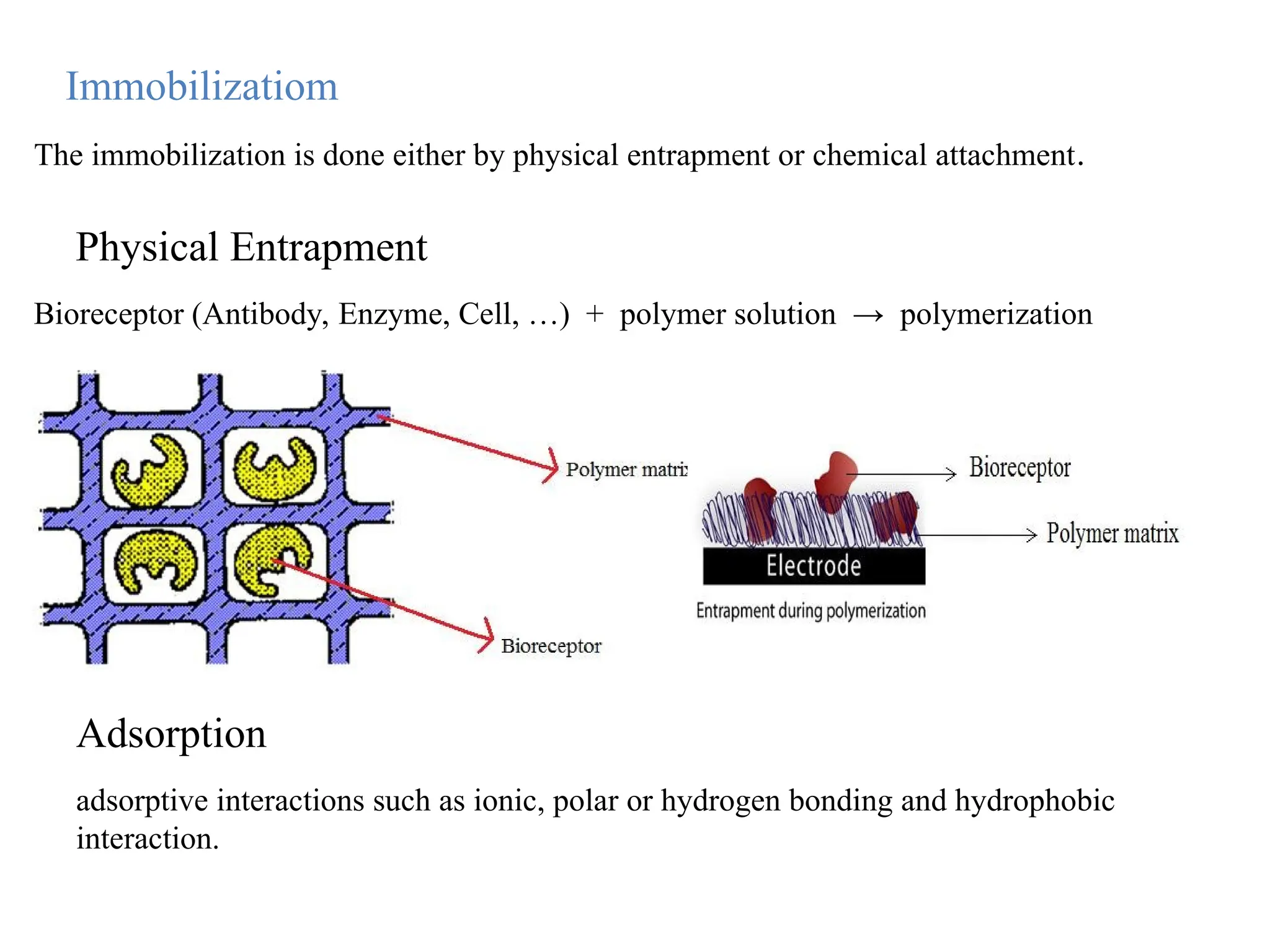
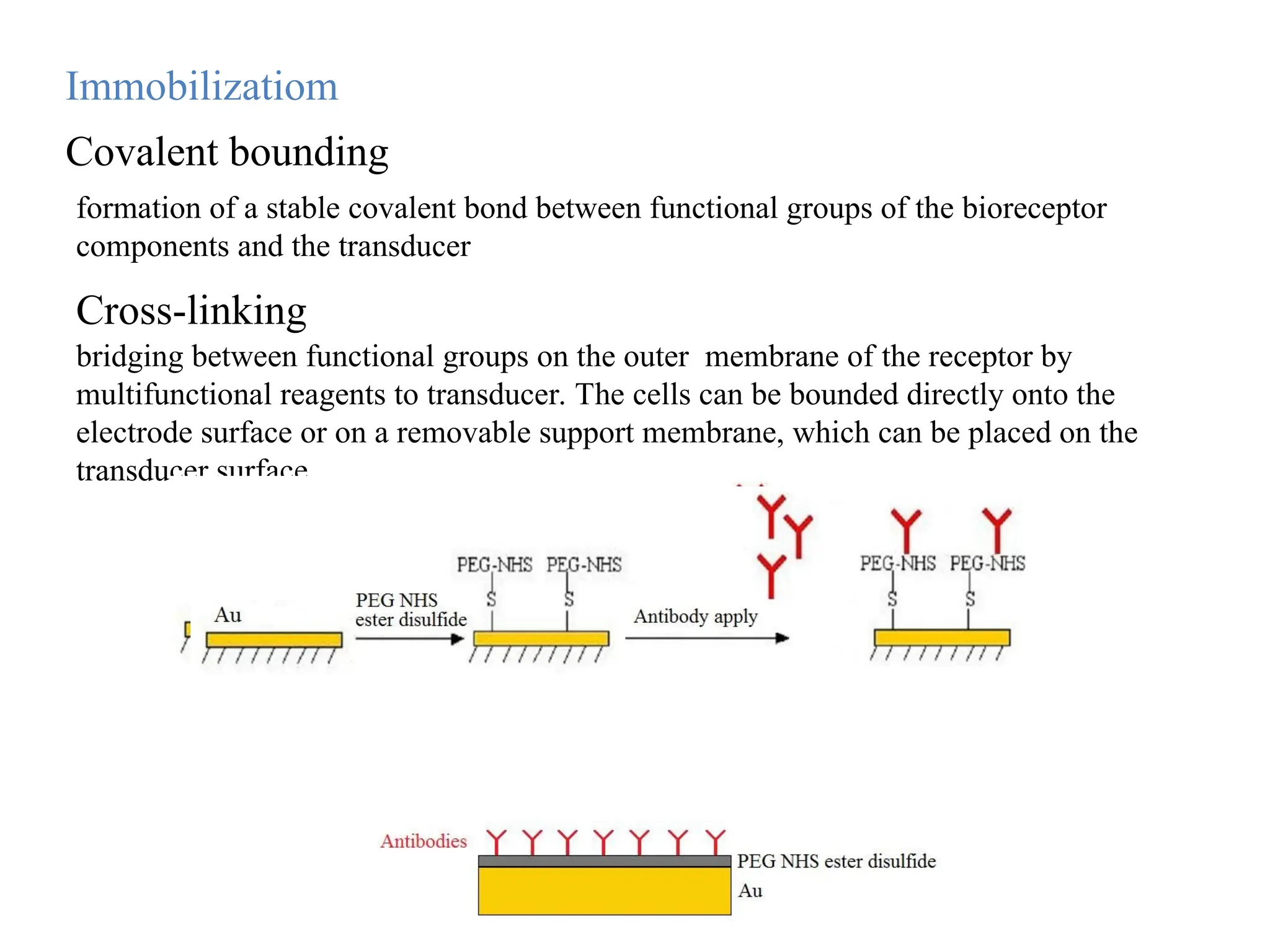
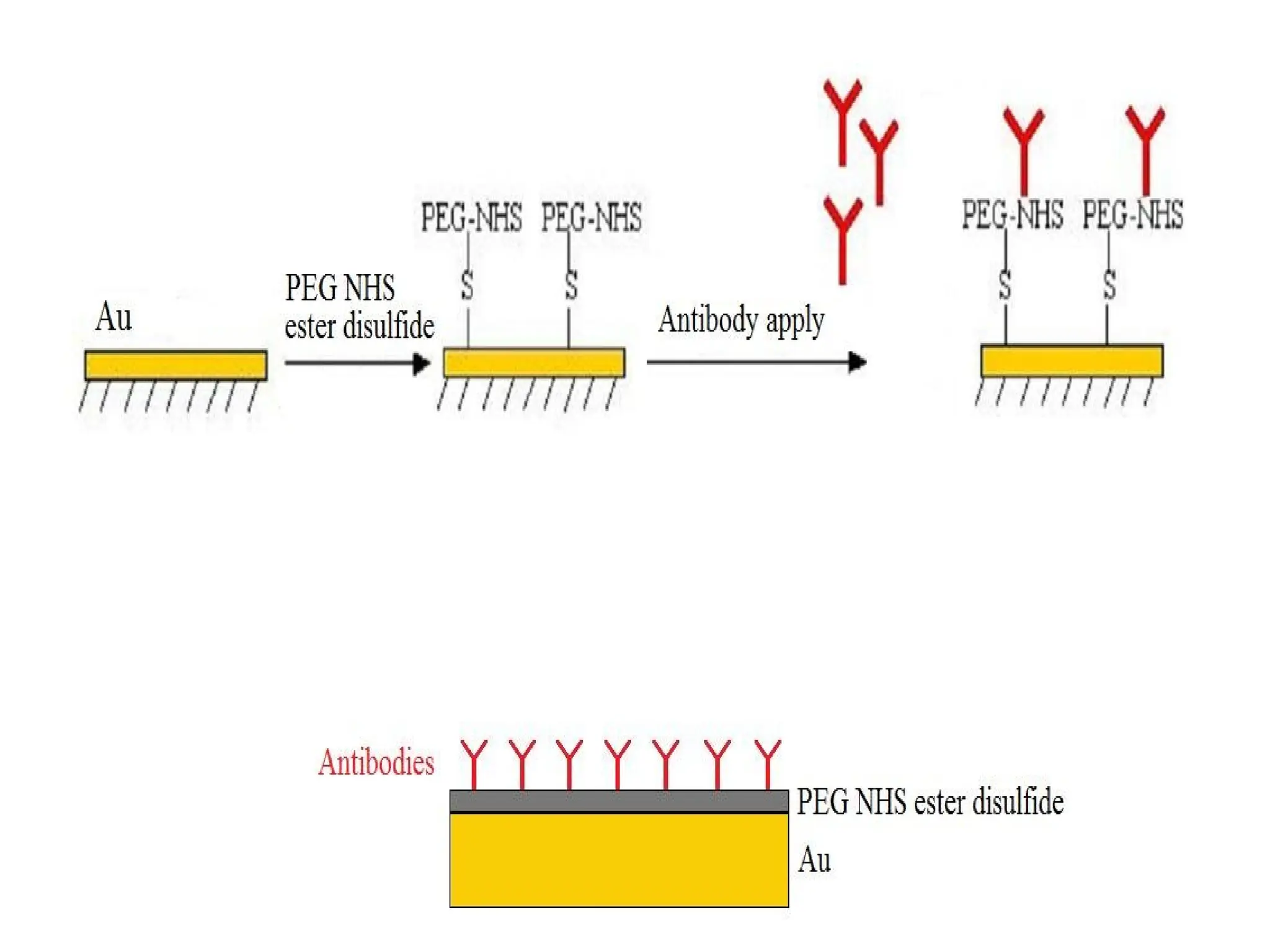
The immobilization isdone either by physical entrapment or chemical attachment.
Immobilizatiom
Bioreceptor (Antibody, Enzyme, Cell, …) + polymer solution → polymerization
Physical Entrapment
adsorptive interactions such as ionic, polar or hydrogen bonding and hydrophobic
interaction.
Adsorption
18.
Immobilizatiom
Cross-linking
bridging between functionalgroups on the outer membrane of the receptor by
multifunctional reagents to transducer. The cells can be bounded directly onto the
electrode surface or on a removable support membrane, which can be placed on the
transducer surface
Covalent bounding
formation of a stable covalent bond between functional groups of the bioreceptor
components and the transducer
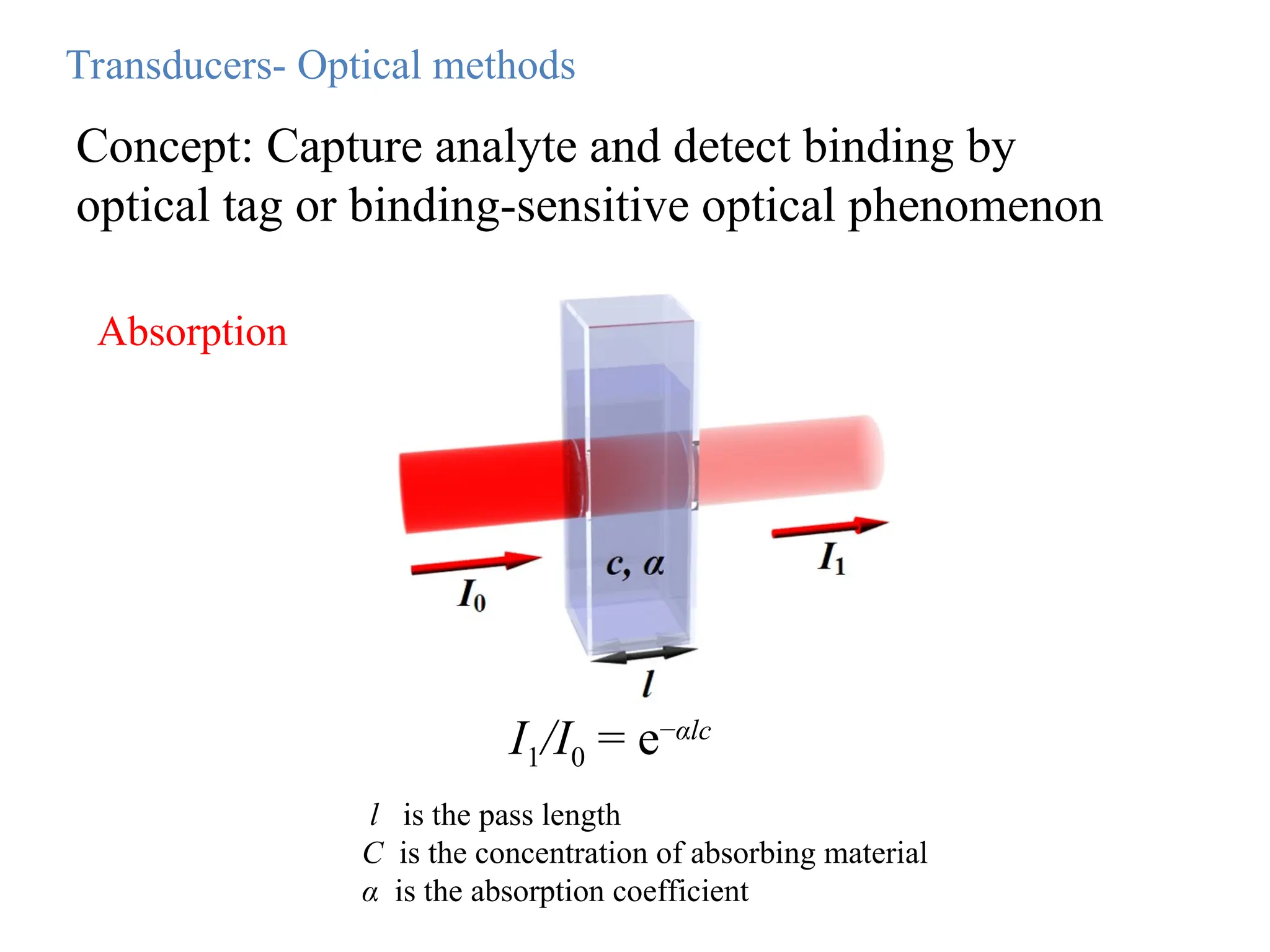
I1/I0 = e−αlc
lis the pass length
C is the concentration of absorbing material
α is the absorption coefficient
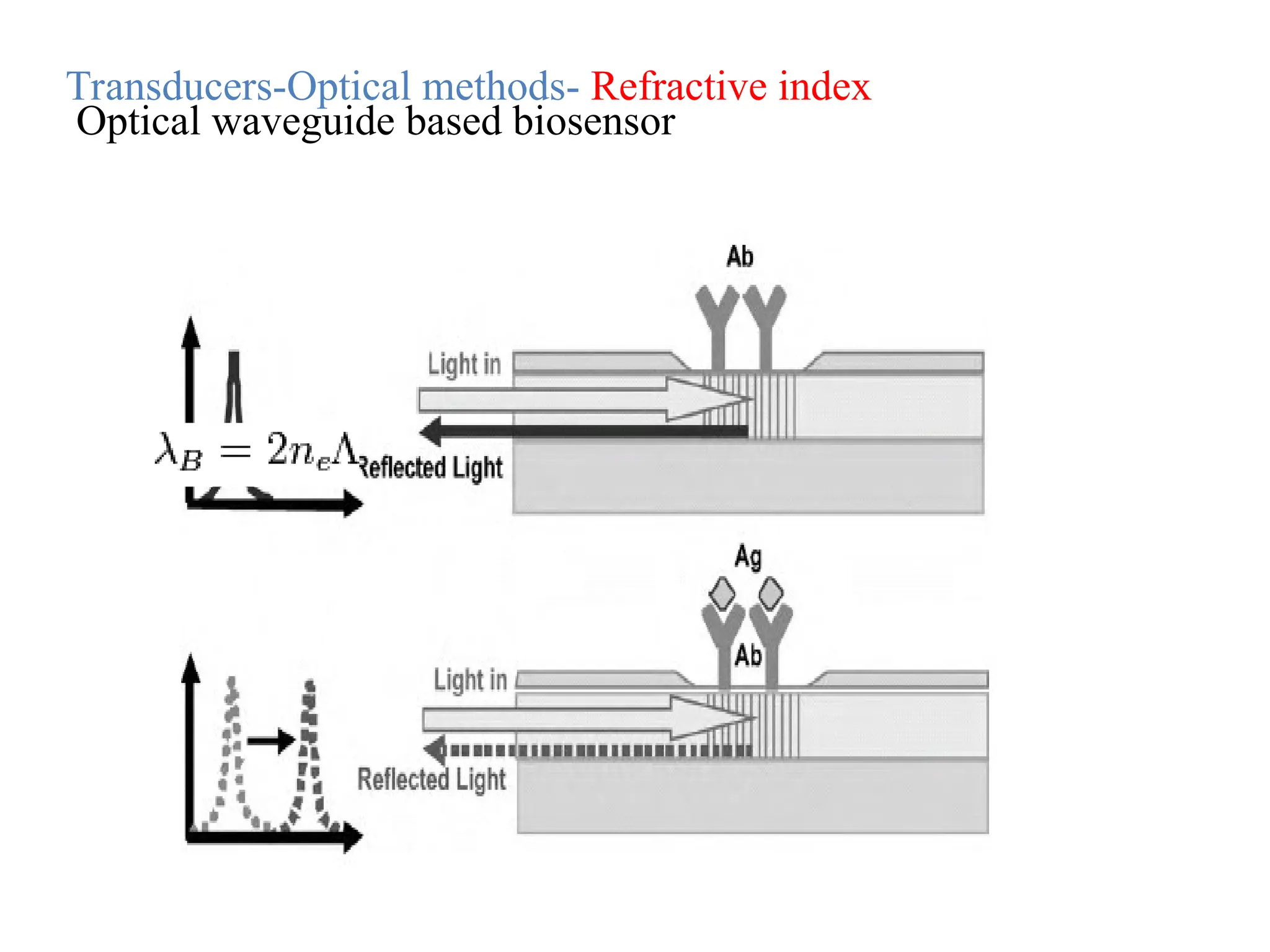
Transducers- Optical methods
Concept: Capture analyte and detect binding by
optical tag or binding-sensitive optical phenomenon
Absorption
22.
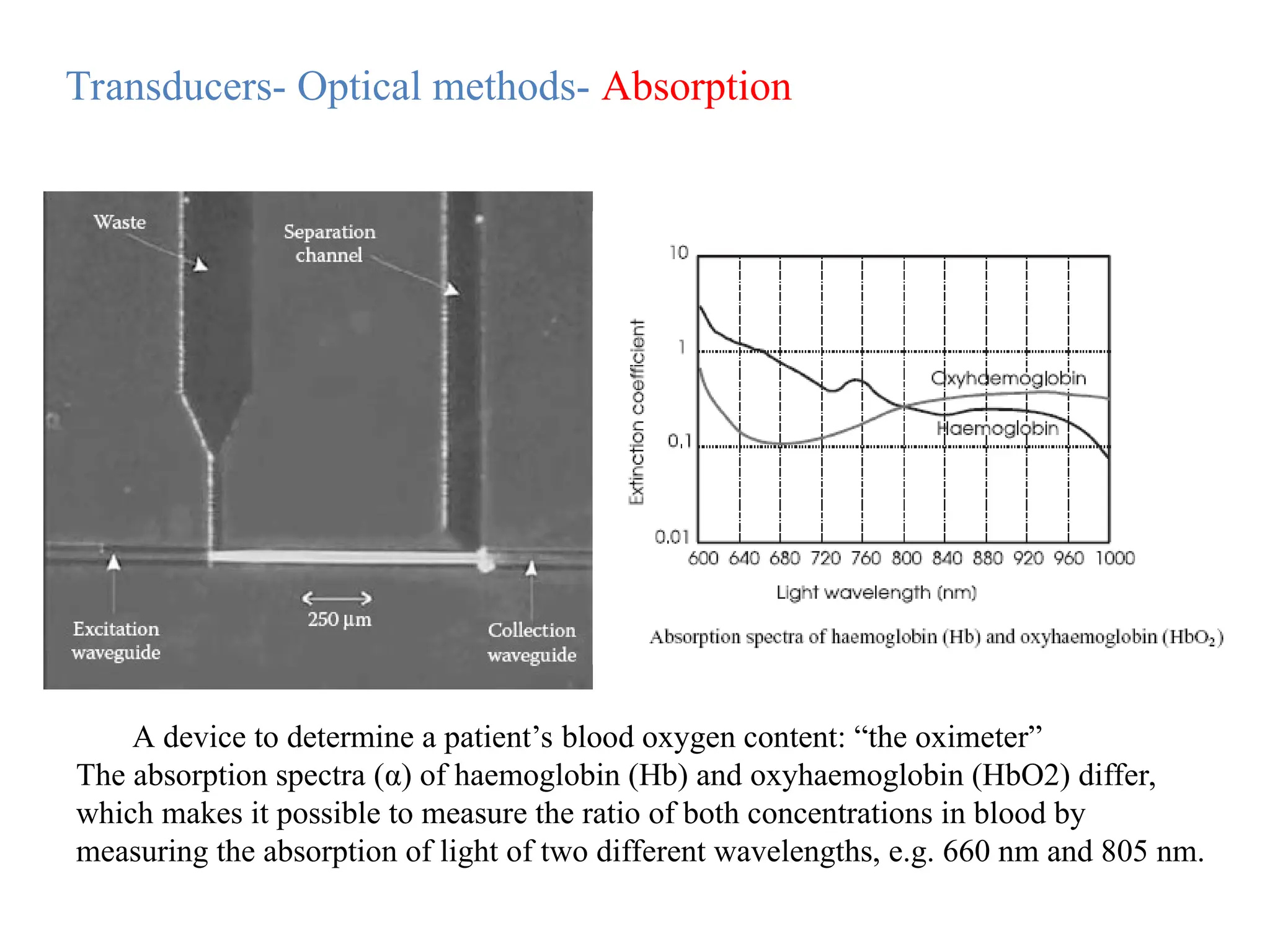
A device todetermine a patient’s blood oxygen content: “the oximeter”
The absorption spectra (α) of haemoglobin (Hb) and oxyhaemoglobin (HbO2) differ,
which makes it possible to measure the ratio of both concentrations in blood by
measuring the absorption of light of two different wavelengths, e.g. 660 nm and 805 nm.
Transducers- Optical methods- Absorption
23.
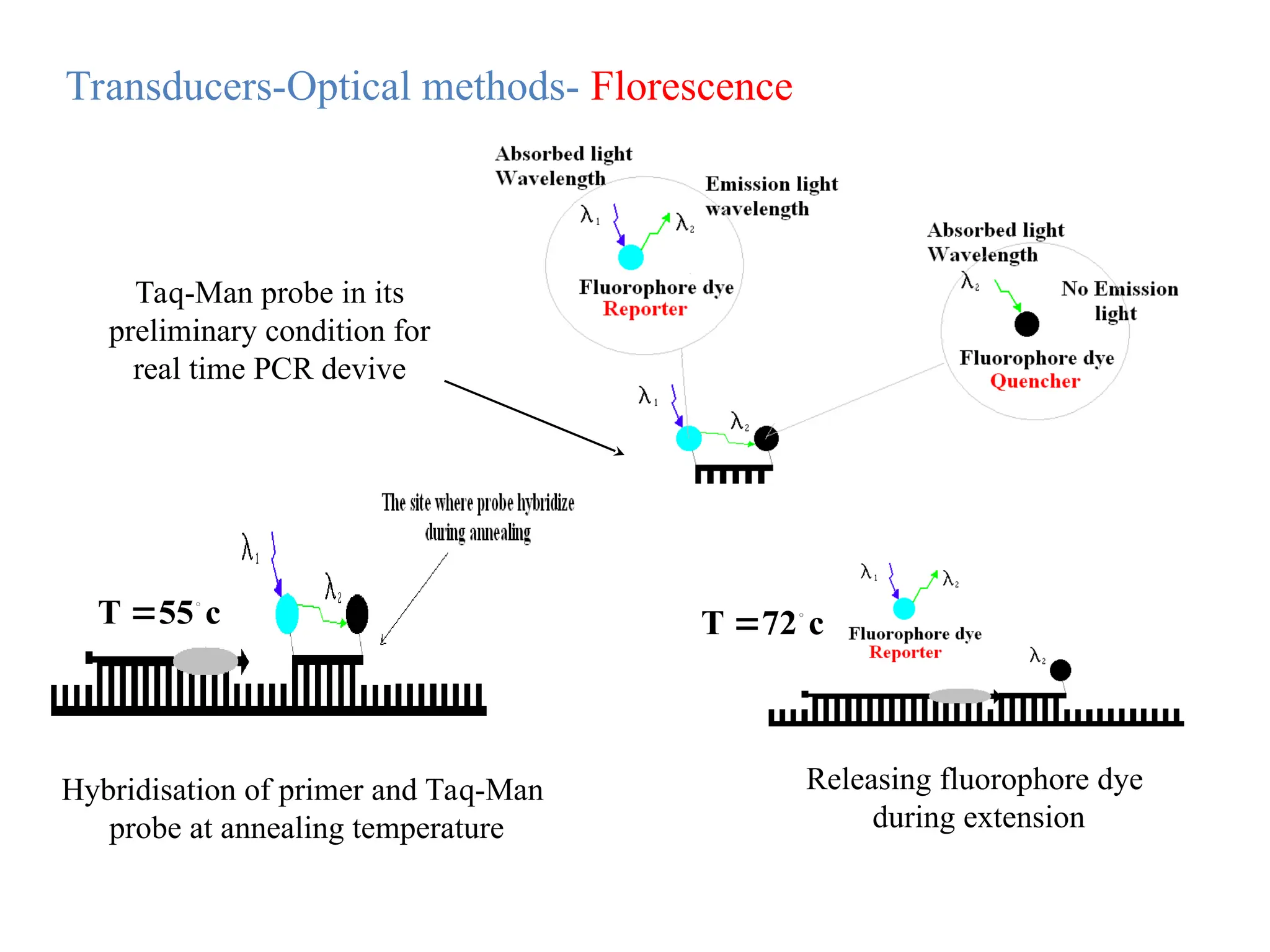
Transducers-Optical methods- Fluorescence
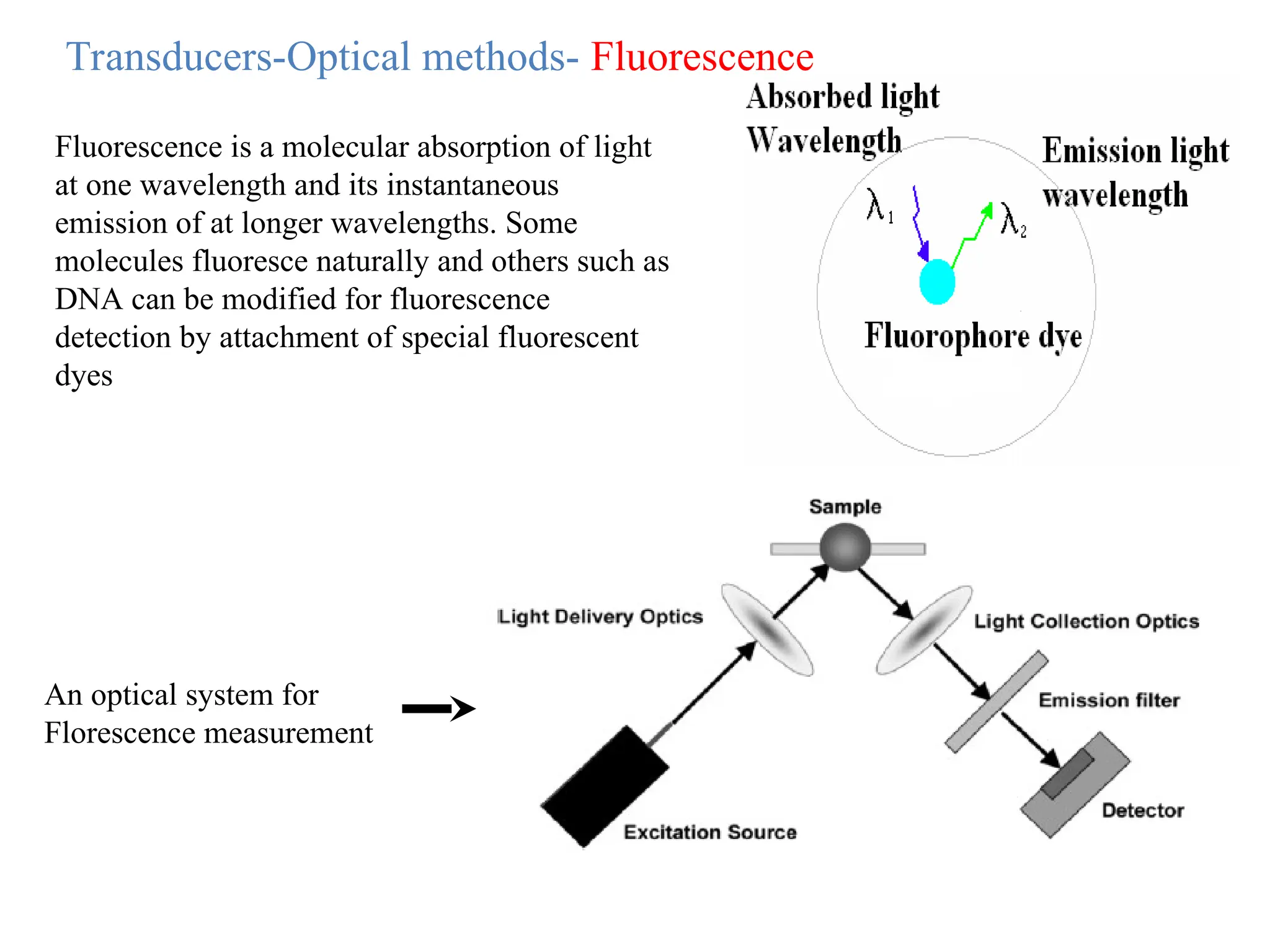
Fluorescenceis a molecular absorption of light
at one wavelength and its instantaneous
emission of at longer wavelengths. Some
molecules fluoresce naturally and others such as
DNA can be modified for fluorescence
detection by attachment of special fluorescent
dyes
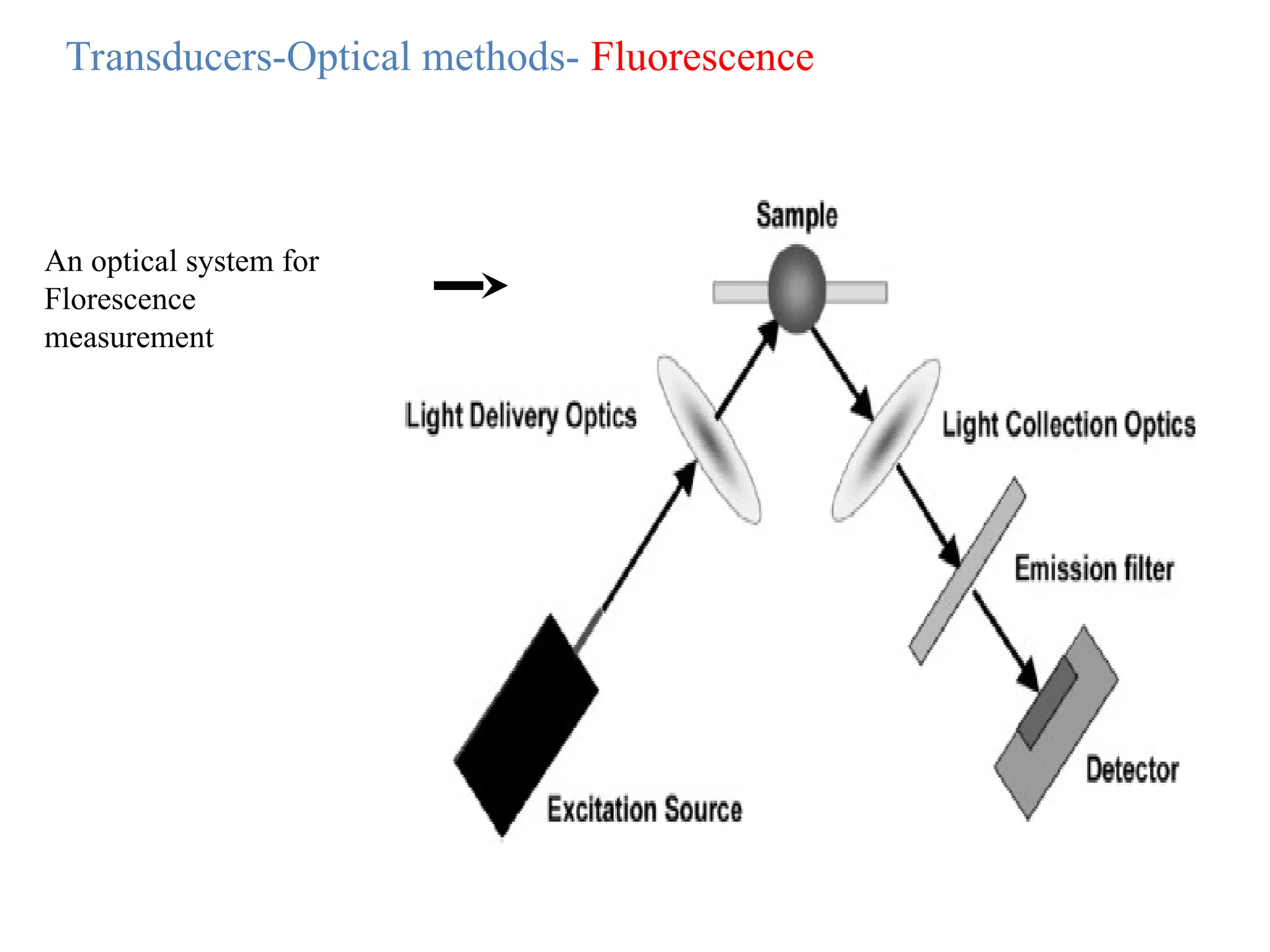
An optical system for
Florescence measurement
Transducers-Optical methods- Florescence
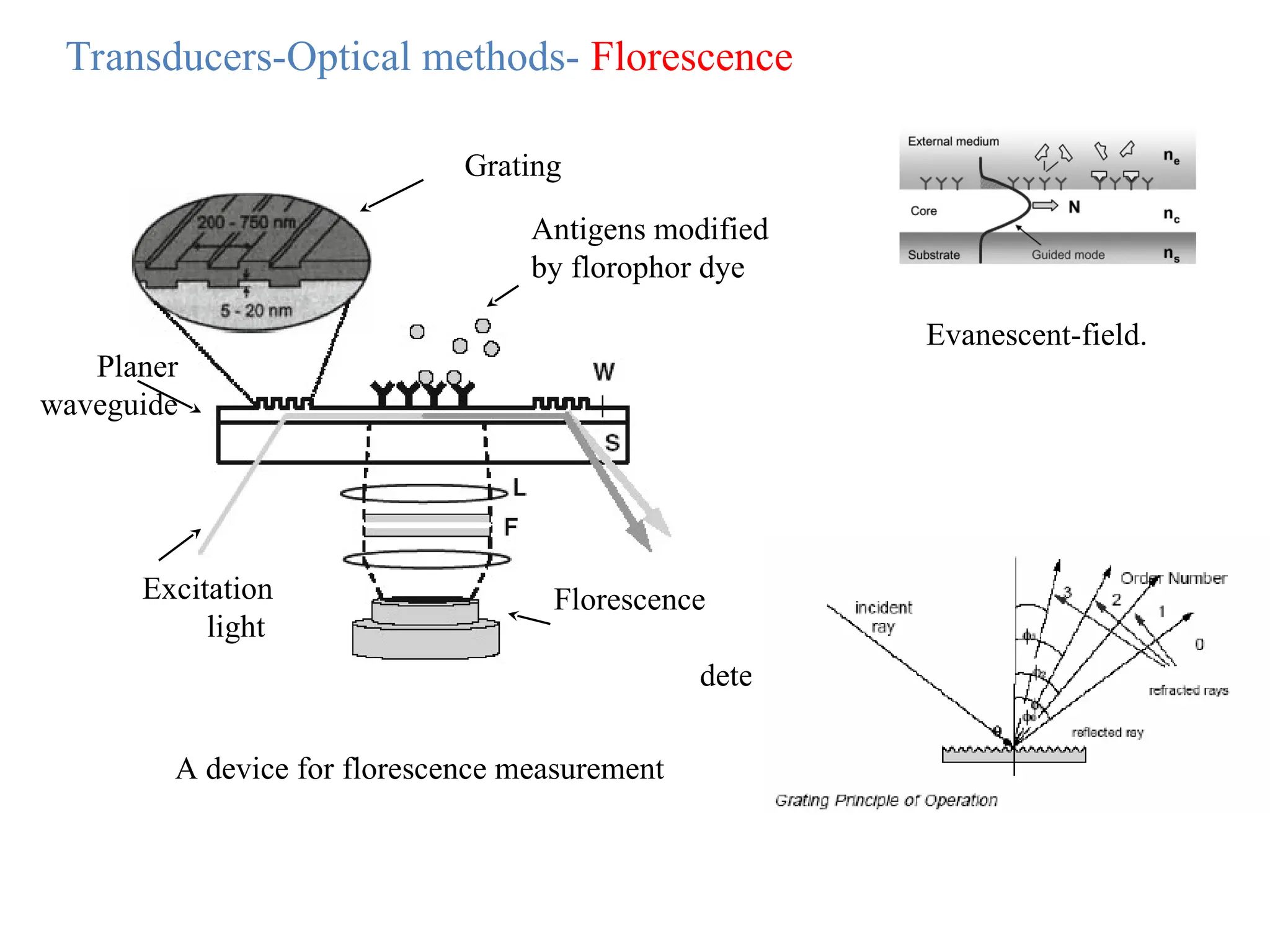
Adevice for florescence measurement
Excitation
light
Florescence
detector
Planer
waveguide
Grating
Antigens modified
by florophor dye
Evanescent-field.
26.
Transducers-Optical methods- Florescence
Taq-Manprobe in its
preliminary condition for
real time PCR devive
Hybridisation of primer and Taq-Man
probe at annealing temperature
Releasing fluorophore dye
during extension
c
55
T
c
72
T
27.
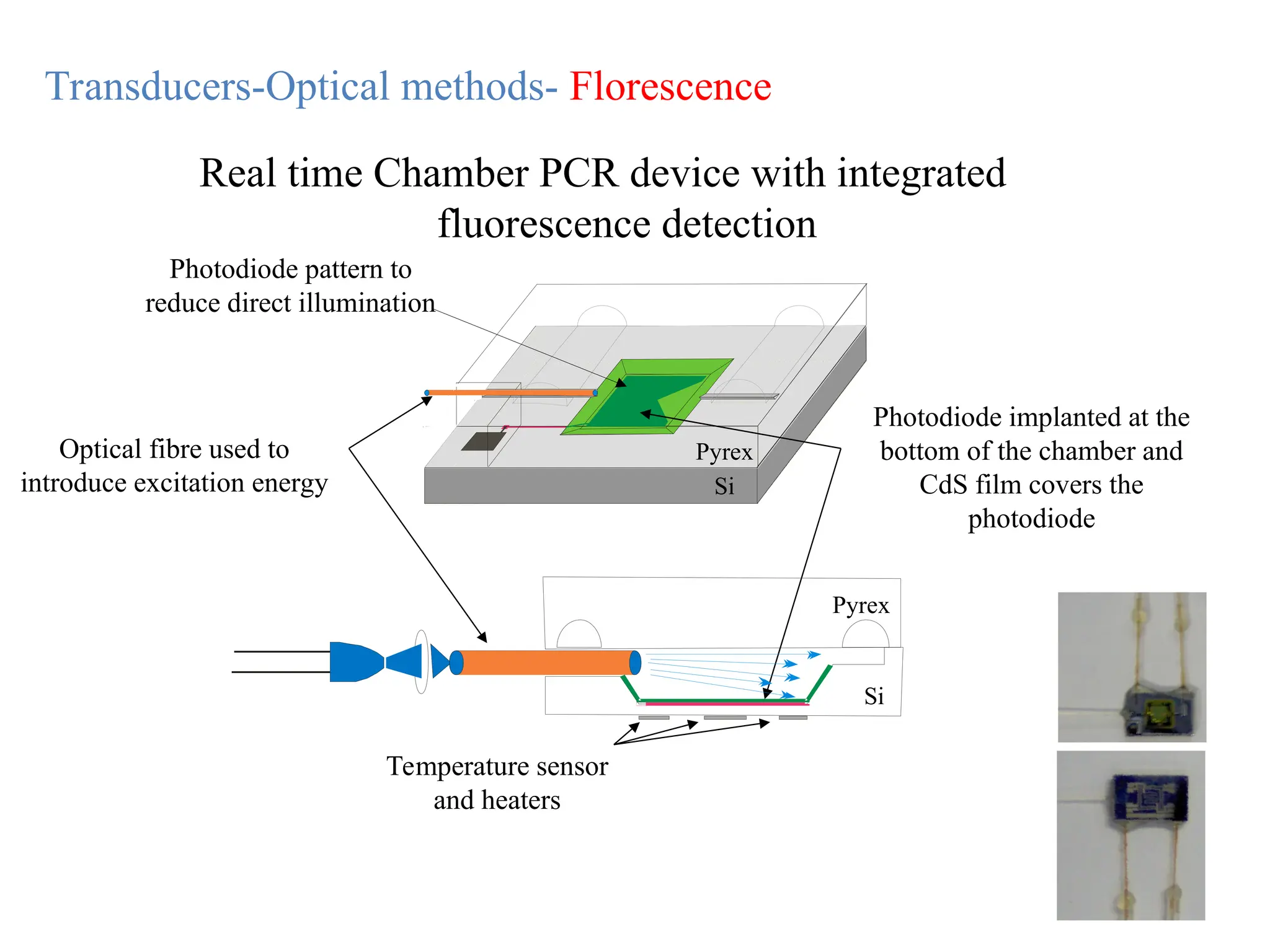
Real time ChamberPCR device with integrated
fluorescence detection
Photodiode implanted at the
bottom of the chamber and
CdS film covers the
photodiode
Optical fibre used to
introduce excitation energy
Temperature sensor
and heaters
Si
Si
Pyrex
Pyrex
Photodiode pattern to
reduce direct illumination
Transducers-Optical methods- Florescence
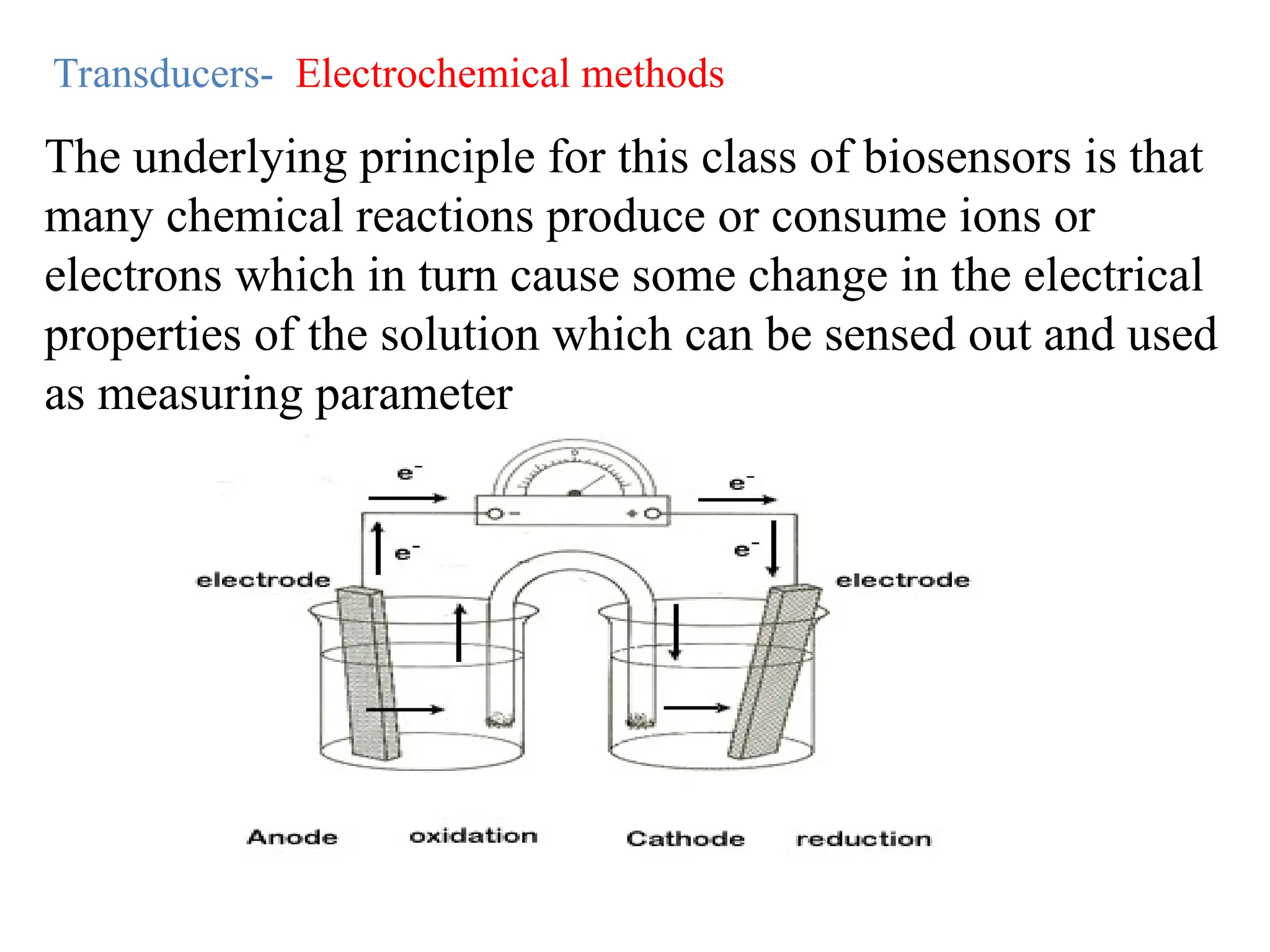
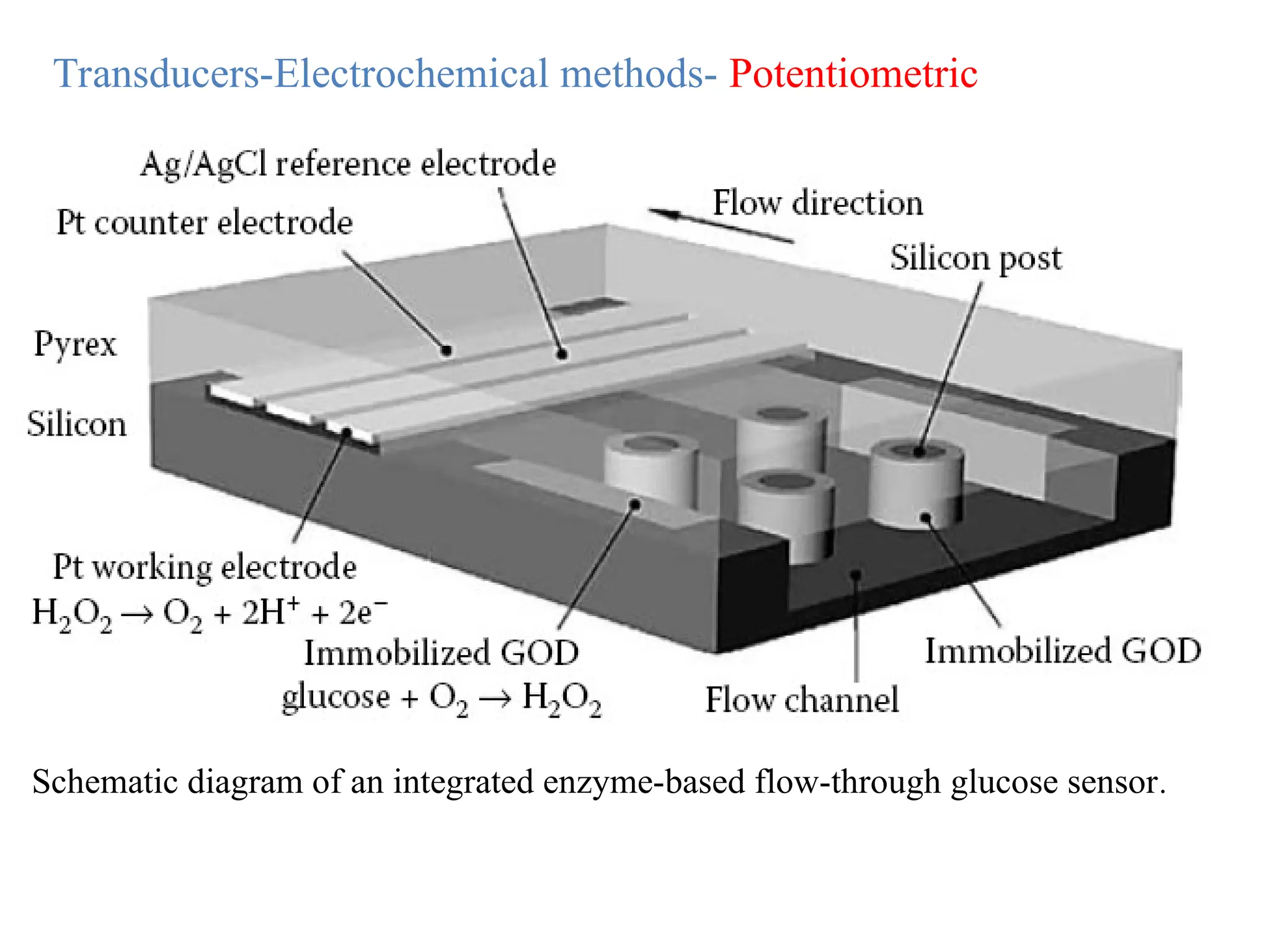
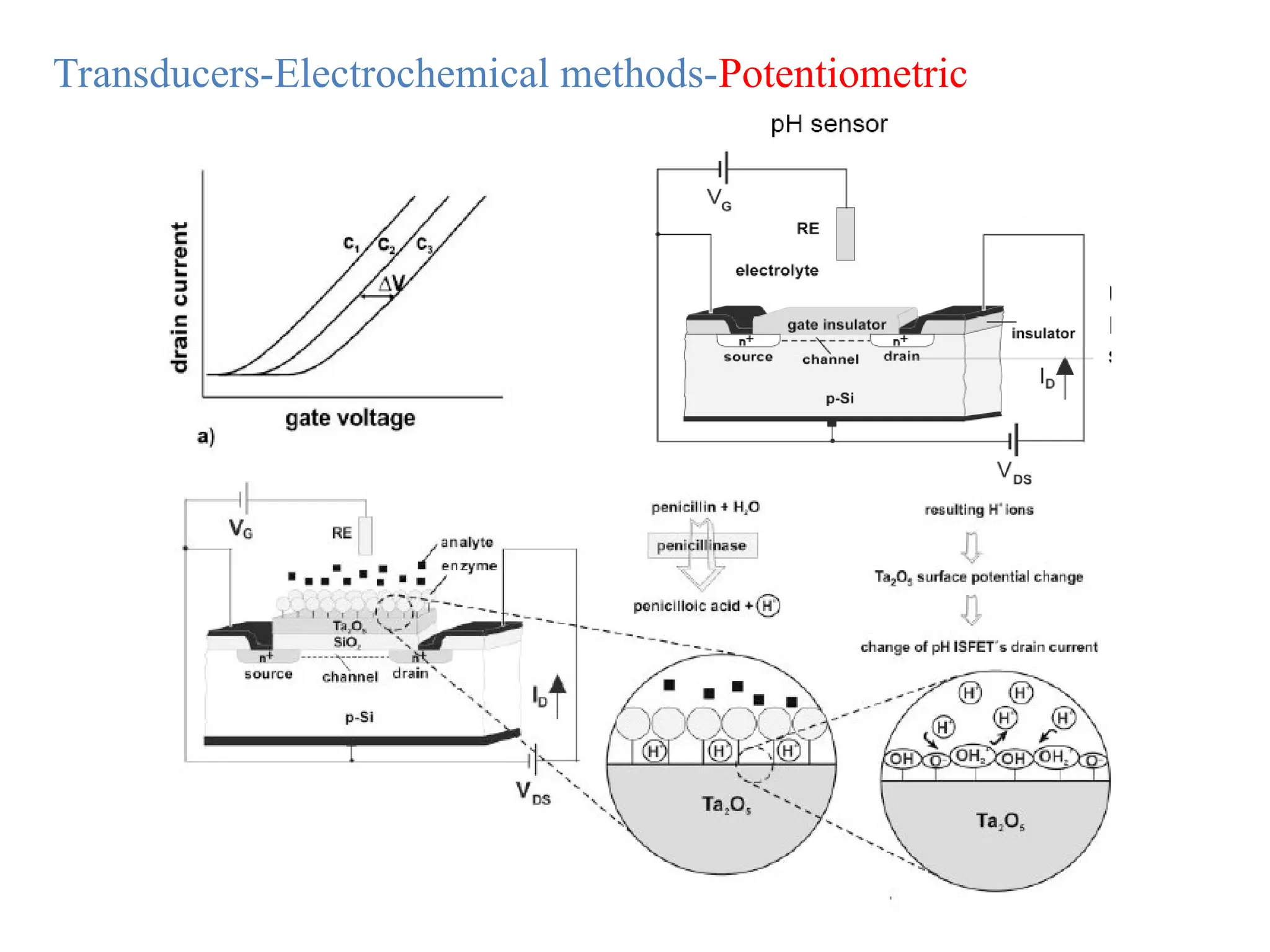
Transducers- Electrochemical methods
Theunderlying principle for this class of biosensors is that
many chemical reactions produce or consume ions or
electrons which in turn cause some change in the electrical
properties of the solution which can be sensed out and used
as measuring parameter
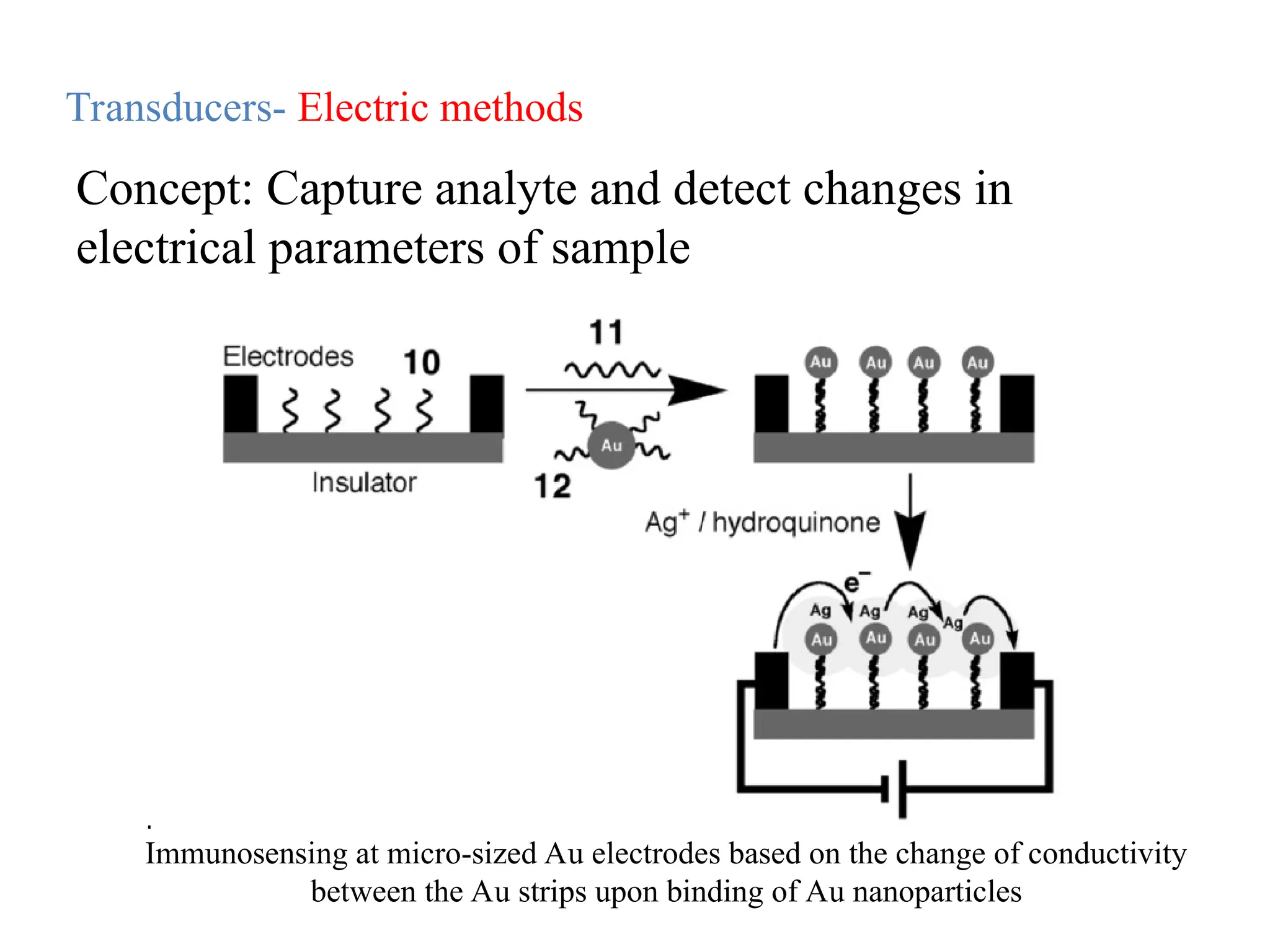
Immunosensing at micro-sizedAu electrodes based on the change of conductivity
between the Au strips upon binding of Au nanoparticles
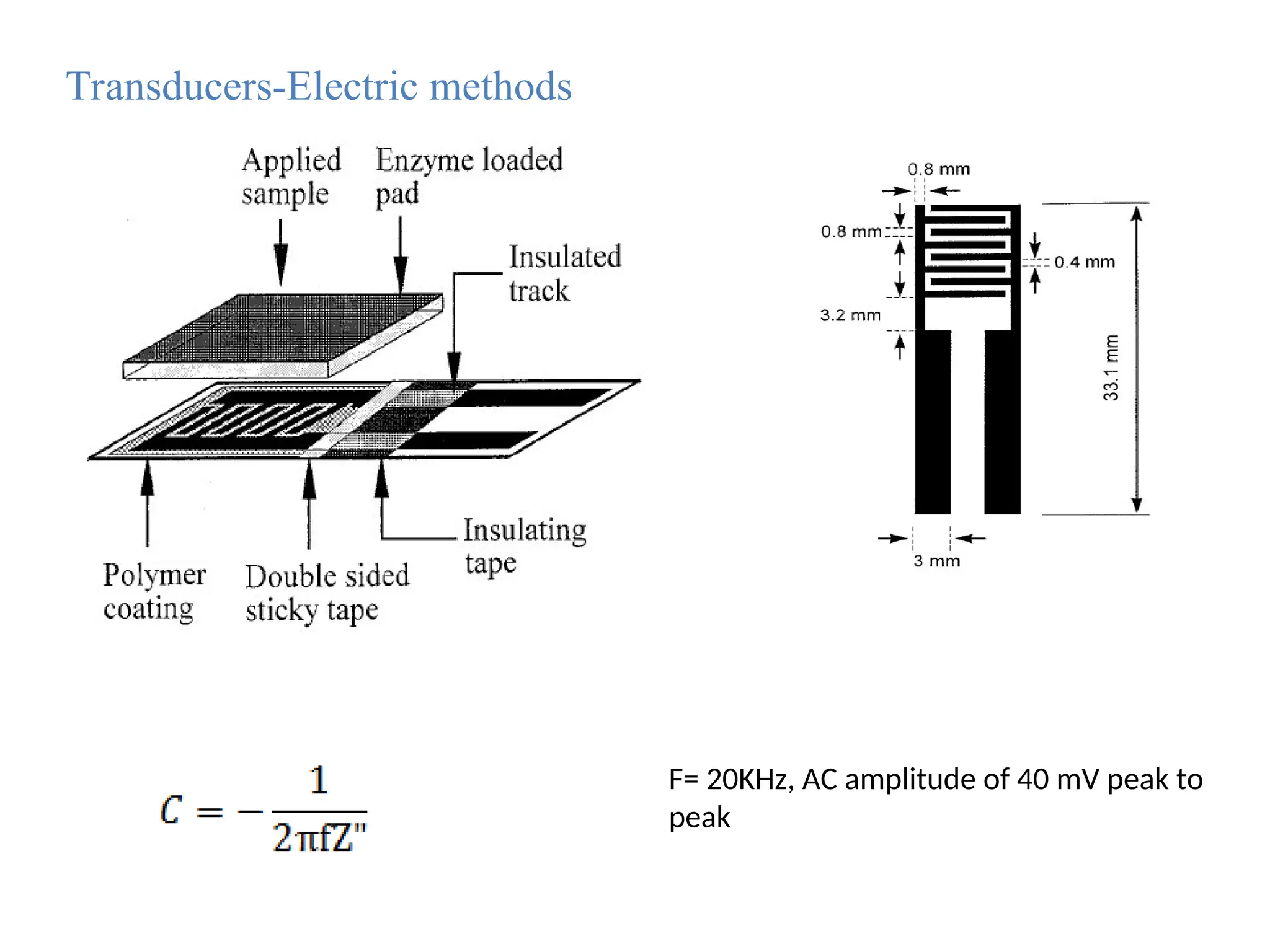
Transducers- Electric methods
Concept: Capture analyte and detect changes in
electrical parameters of sample
F= 20KHz, ACamplitude of 40 mV peak to
peak
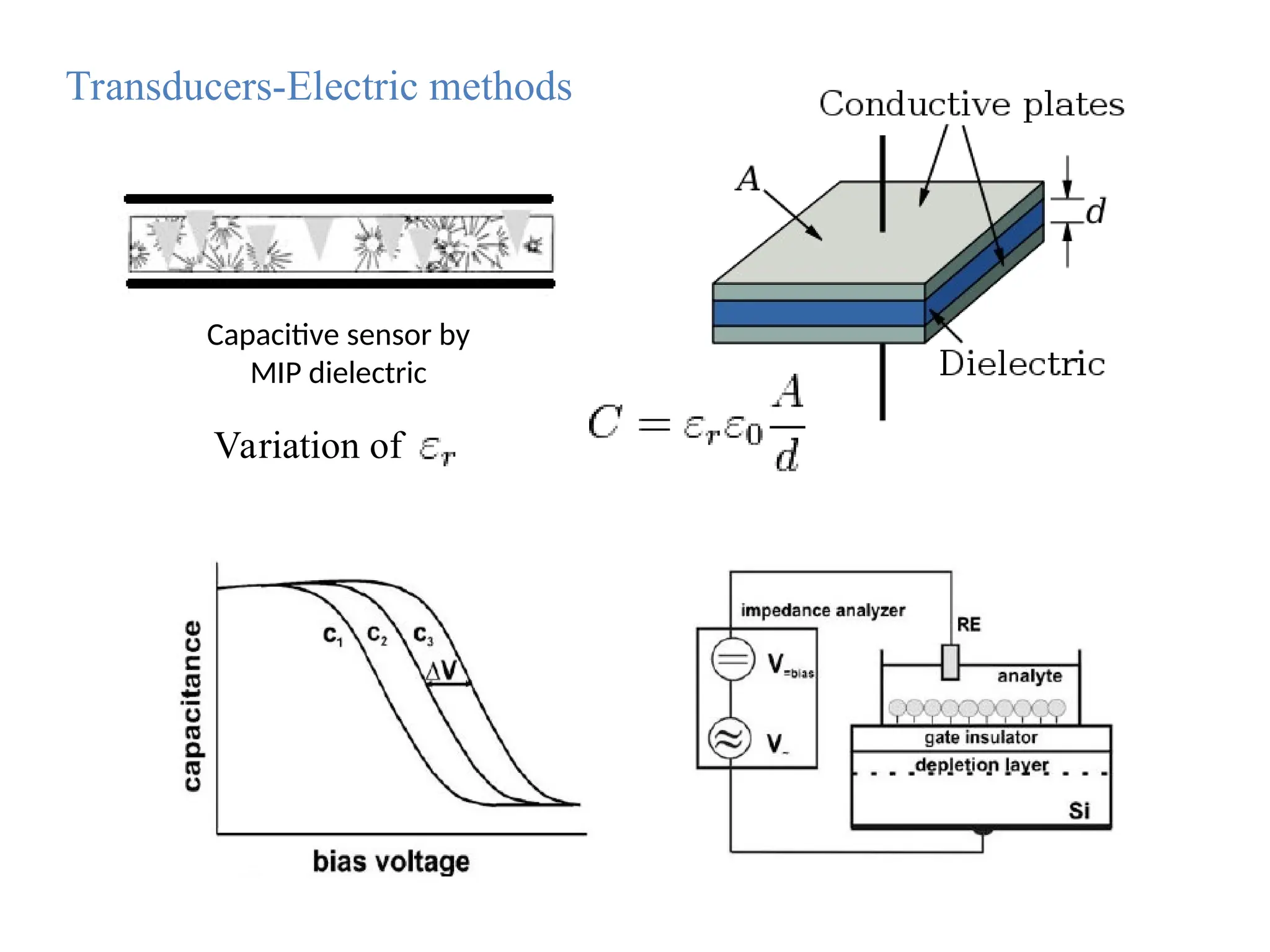
Transducers-Electric methods
39.
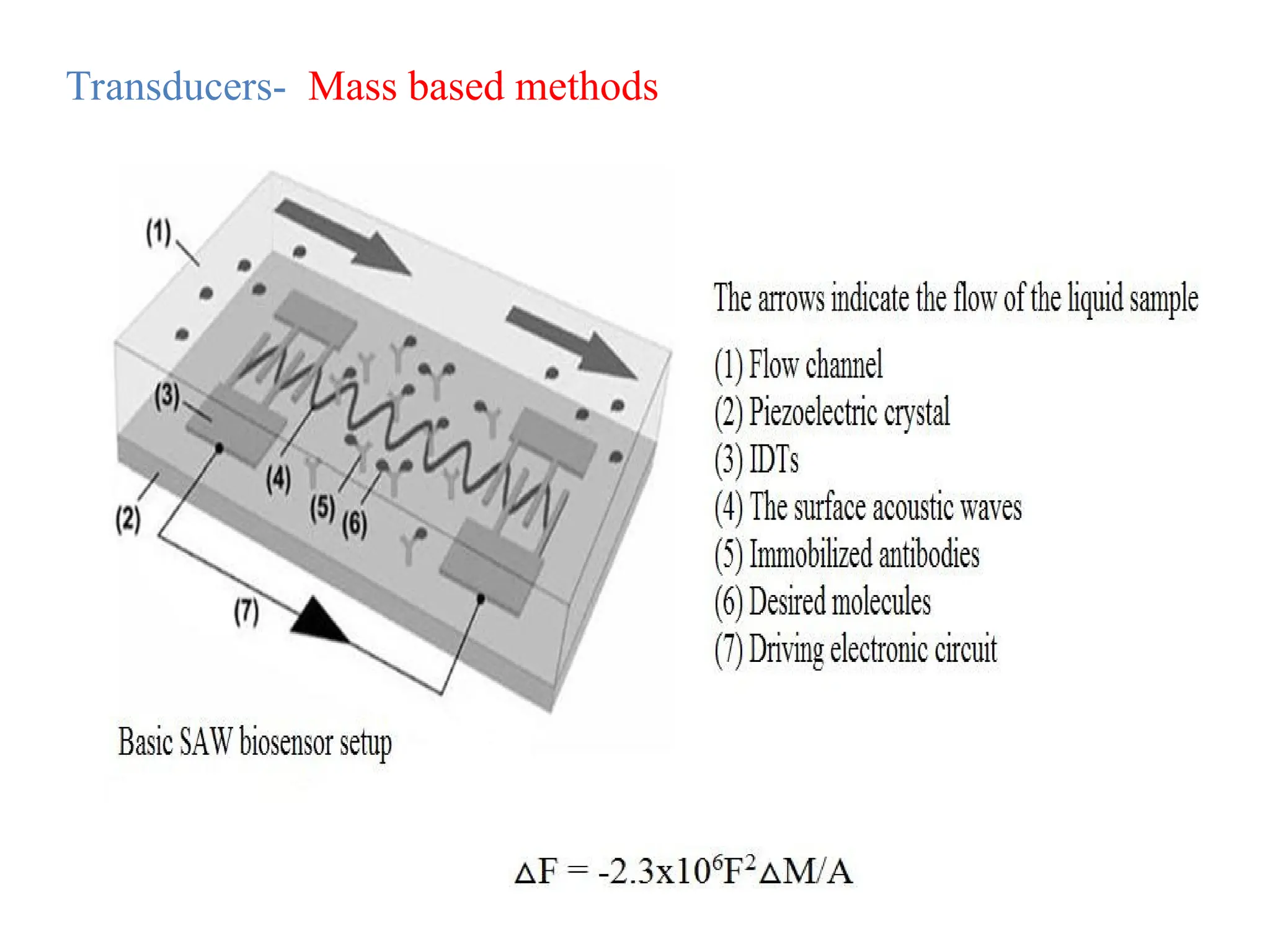
The principle isto change in the frequency of vibrating
element. when the mass increases due to binding of
chemicals, the oscillation frequency of the device
changes and the resulting change can be measured
electrically and be used to determine the additional mass.
Transducers-Mass based methods
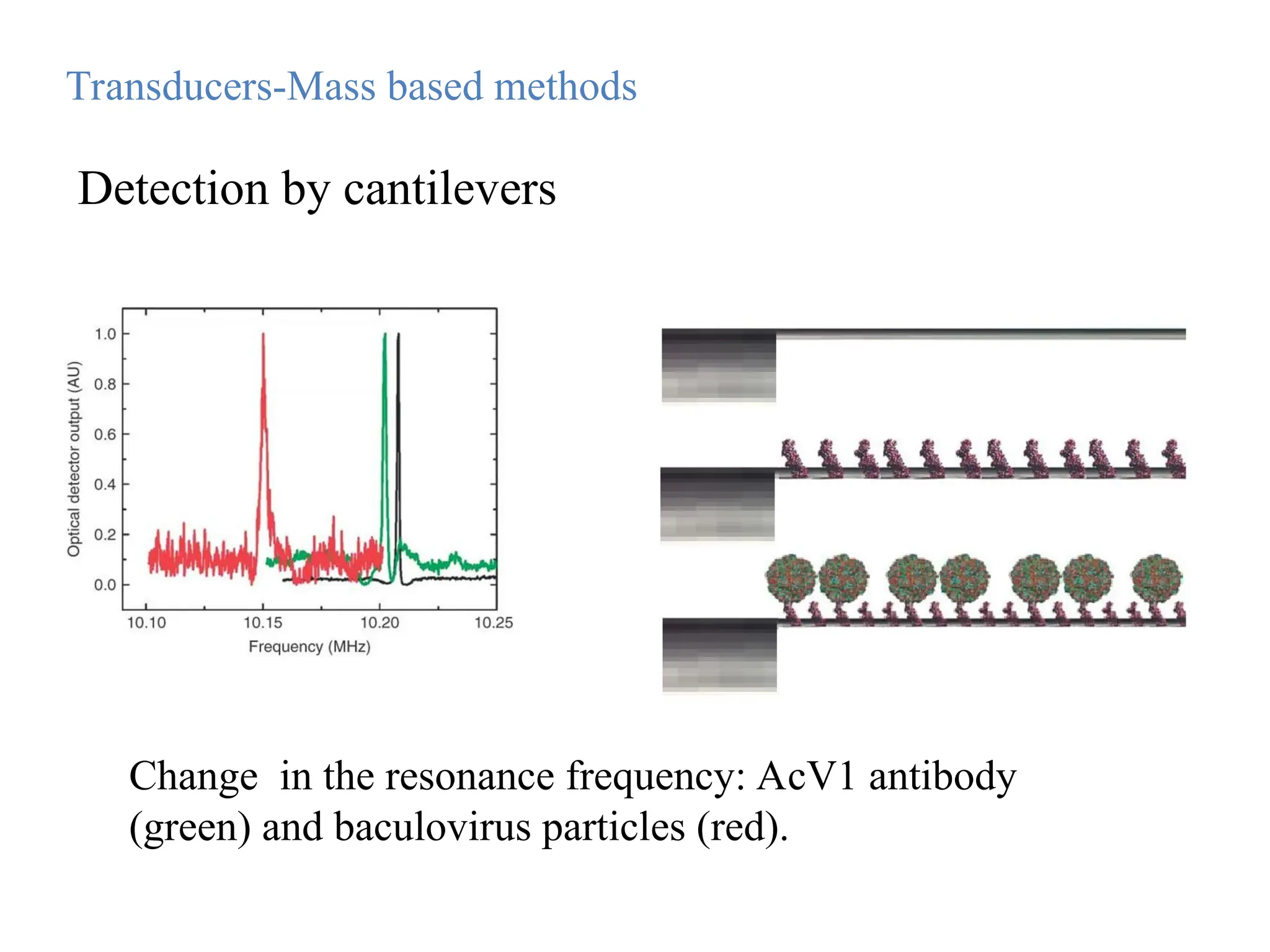
Change in theresonance frequency: AcV1 antibody
(green) and baculovirus particles (red).
Transducers-Mass based methods
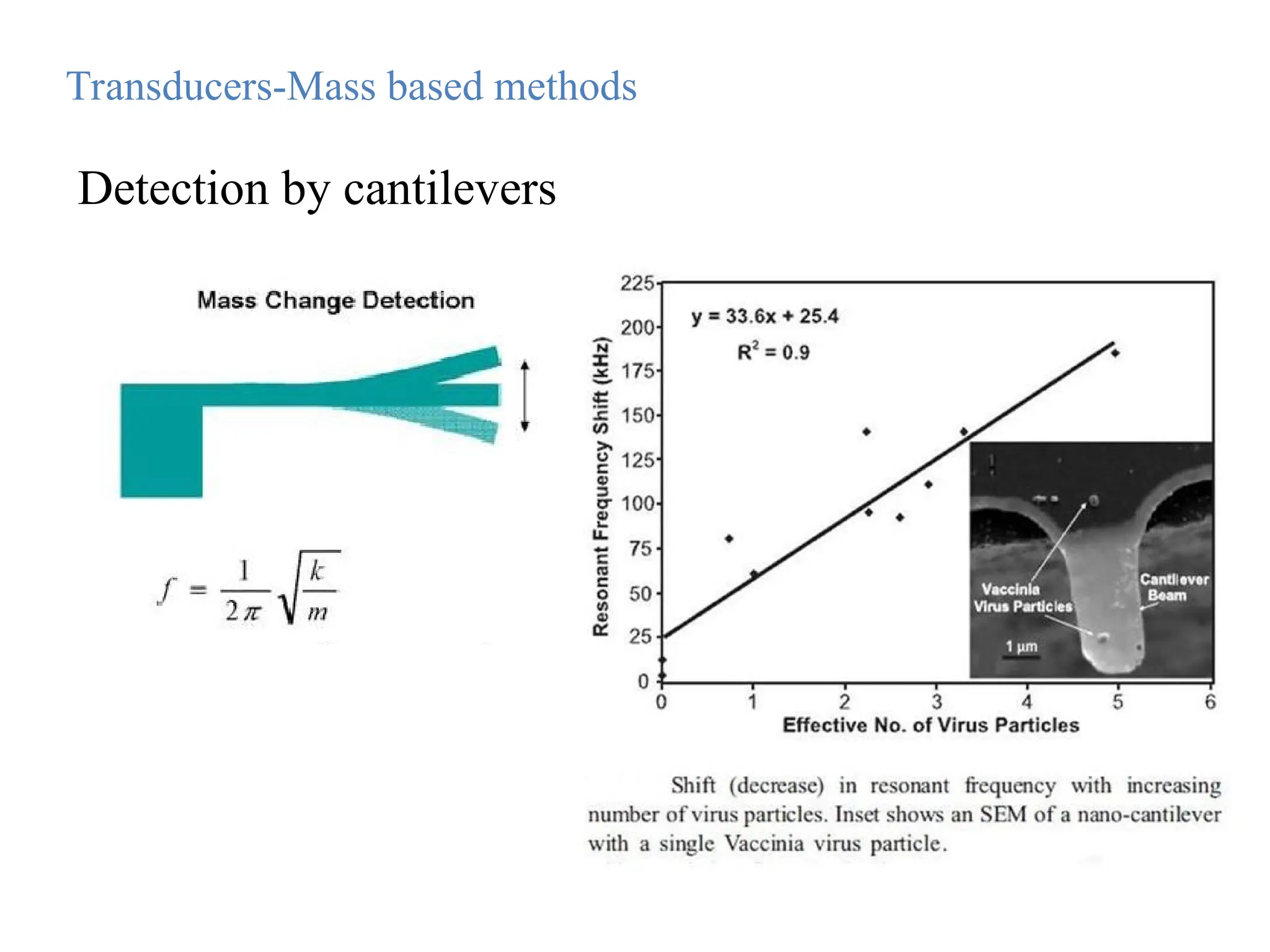
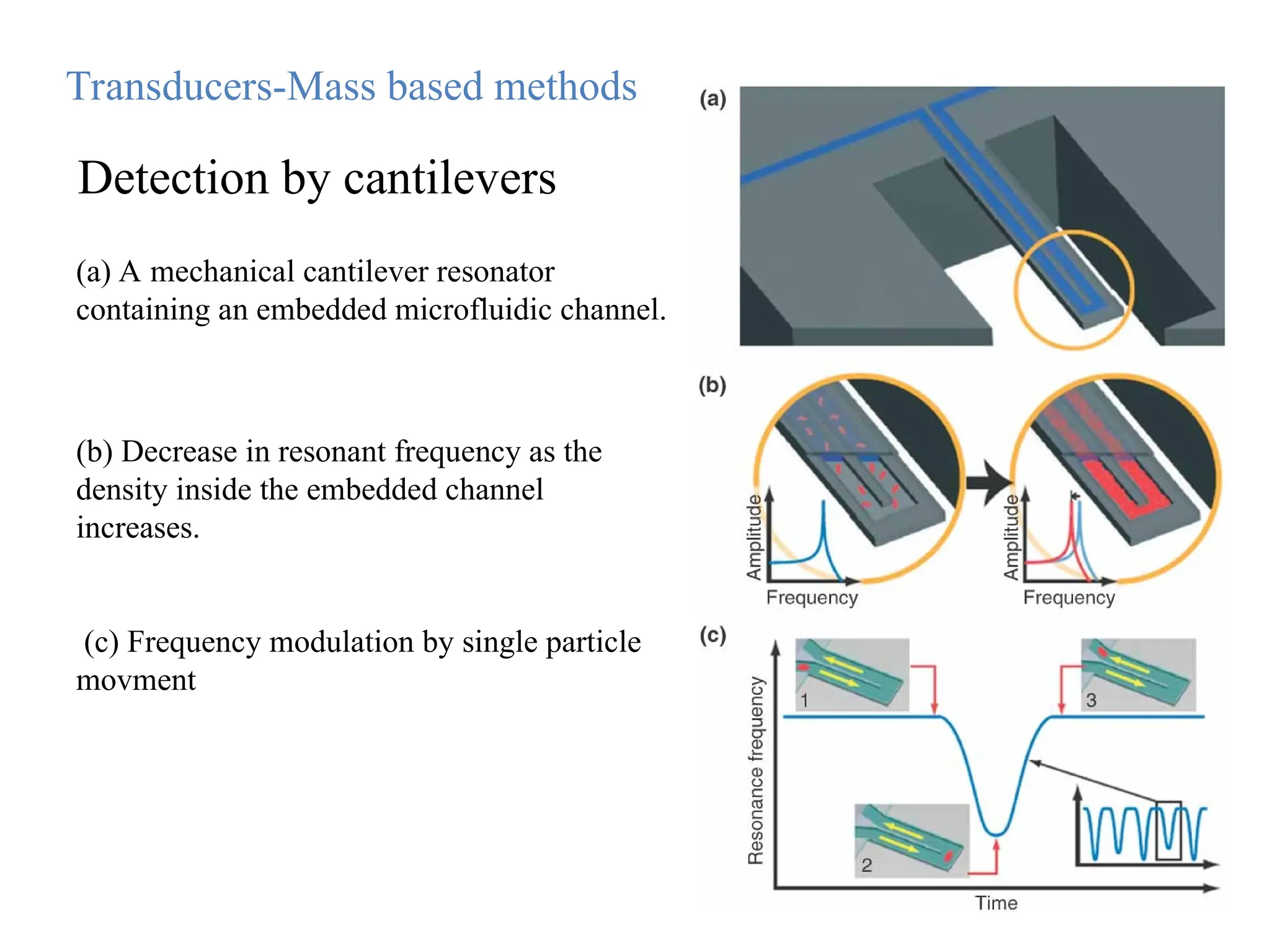
Detection by cantilevers
42.
(b) Decrease inresonant frequency as the
density inside the embedded channel
increases.
(c) Frequency modulation by single particle
movment
(a) A mechanical cantilever resonator
containing an embedded microfluidic channel.
Transducers-Mass based methods
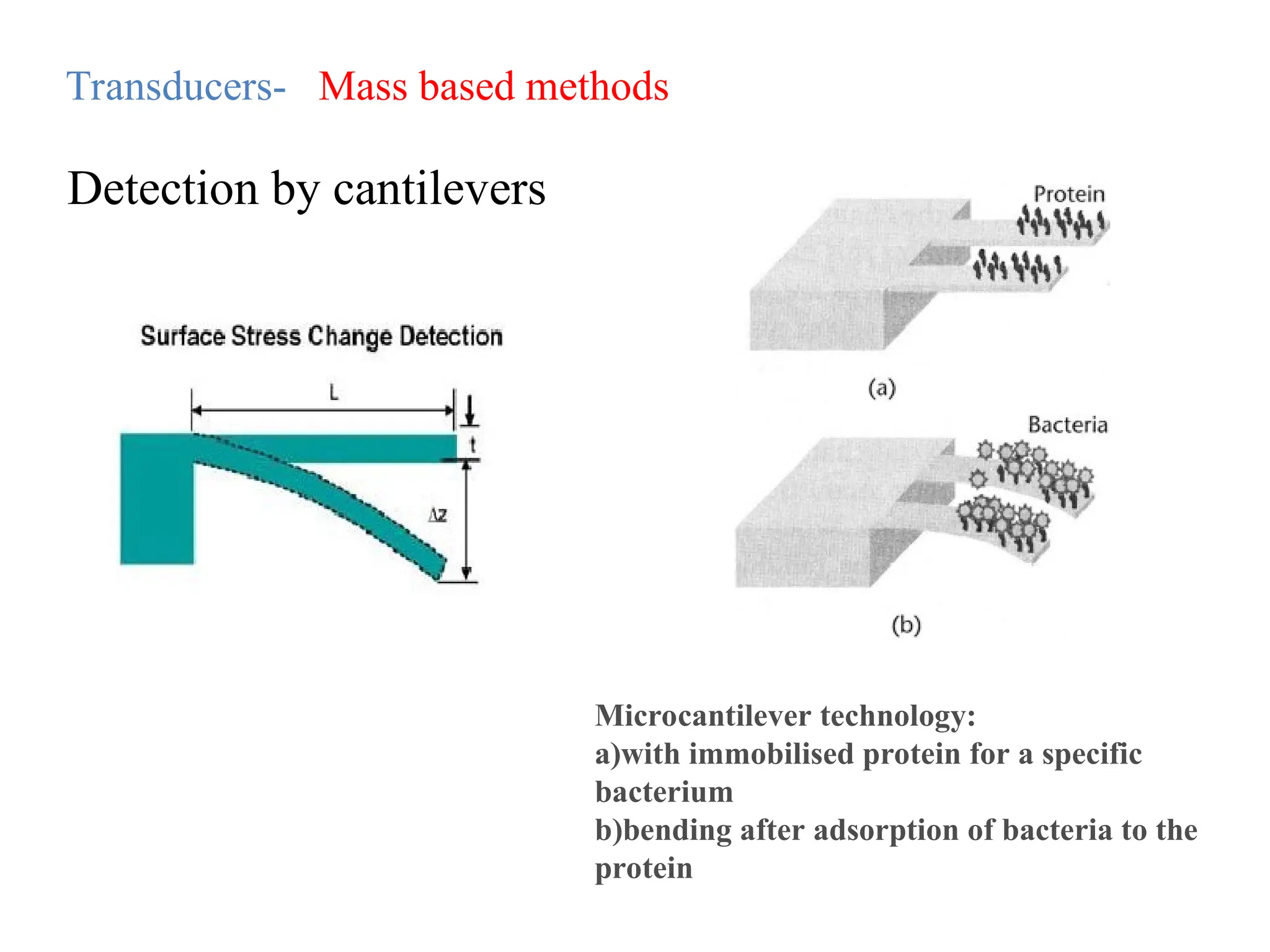
Detection by cantilevers
43.
Transducers- Mass basedmethods
Microcantilever technology:
a)with immobilised protein for a specific
bacterium
b)bending after adsorption of bacteria to the
protein
Detection by cantilevers
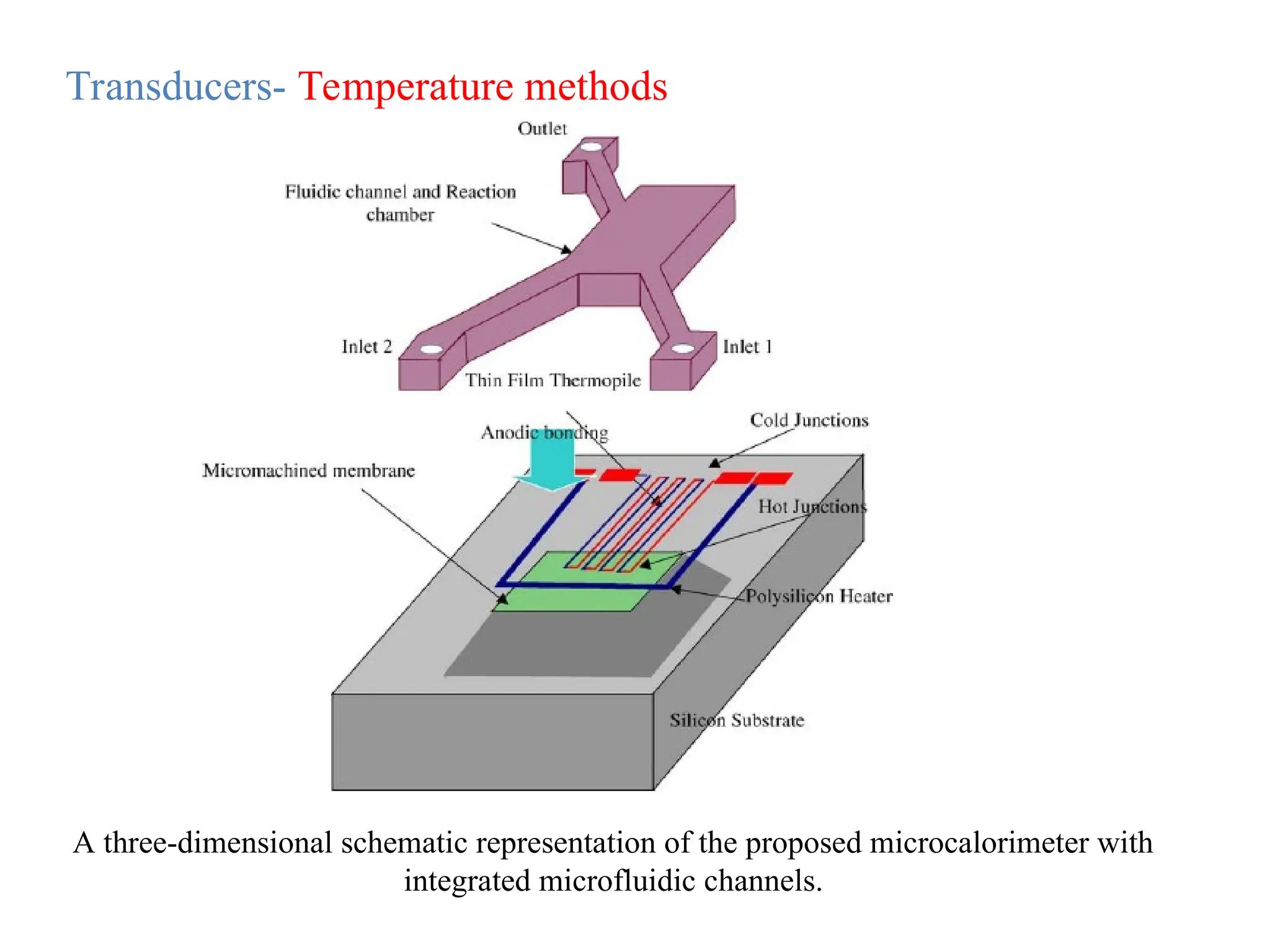
This type ofbiosensor is exploiting one of the
fundamental properties of biological reactions, namely
absorption or production of heat, which in turn changes
the temperature of the medium in which the reaction takes
place. They are constructed by combining immobilized
enzyme molecules with temperature sensors. When the
analyte comes in contact with the enzyme, the heat
reaction of the enzyme is measured and is calibrated
against the analyte concentration. The total heat produced
or absorbed is proportional to the molar enthalpy and the
total number of molecules in the reaction
Transducers-Temperature methods
46.
A three-dimensional schematicrepresentation of the proposed microcalorimeter with
integrated microfluidic channels.
Transducers- Temperature methods