Biology Terms
Sylvana Finbeiner
Adaption of an Animal
Use of physical or behavior
characteristics by the animal that will
help it survive in its environment.
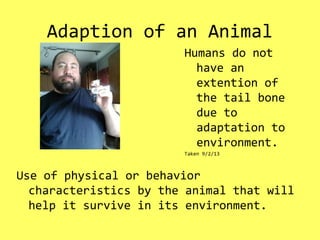
Humans do not
have an
extention of
the tail bone
due to
adaptation to
environment.
Taken 9/2/13
Adaption of an Plant
Use of physical or behavior
characteristics by the plant that will
help it survive in its environment.
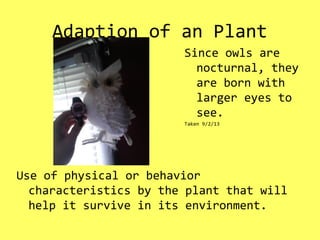
Since owls are
nocturnal, they
are born with
larger eyes to
see.
Taken 9/2/13
Actin
A protein that aids in muscle tissue,
platelet shape, edocytosis, cell
motility, cell division, metastasis,
and cell signaling.
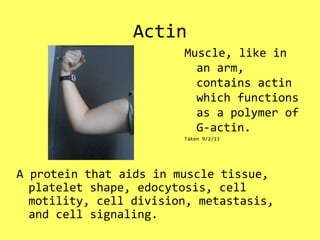
Muscle, like in
an arm,
contains actin
which functions
as a polymer of
G-actin.
Taken 9/2/13
Amniotic Egg
An egg with a water-impermeable amniotic
membrance made for protection of a
fluid-filled cavity.
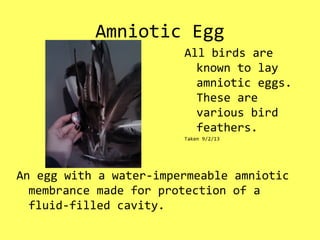
All birds are
known to lay
amniotic eggs.
These are
various bird
feathers.
Taken 9/2/13
Angiosperm
Plants whose seeds are secluded in
a fruit. They are also known as
Division Adnthophyta.
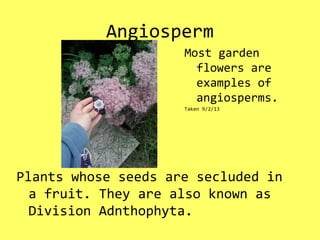
Most garden
flowers are
examples of
angiosperms.
Taken 9/2/13
Animal That Has a Segmented
Body
An animal with a series of similar
functioning parts usually divided
into groups.
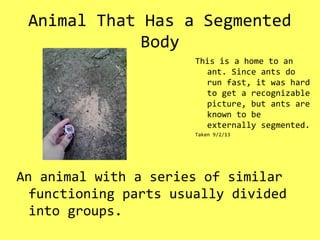
This is a home to an
ant. Since ants do
run fast, it was hard
to get a recognizable
picture, but ants are
known to be
externally segmented.
Taken 9/2/13
Echinoderm
Sea animals with spiny skin that
are visually symmetric.
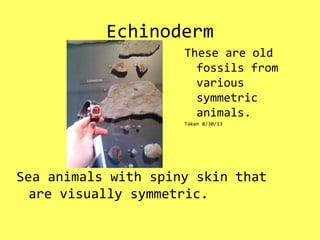
These are old
fossils from
various
symmetric
animals.
Taken 8/30/13
Anther & Filament
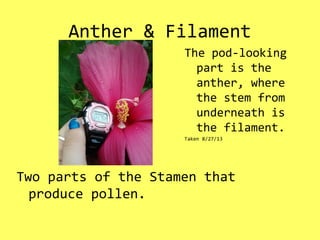
Two parts of the Stamen that
produce pollen.
The pod-looking
part is the
anther, where
the stem from
underneath is
the filament.
Taken 8/27/13
Arthropod
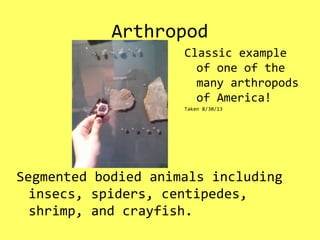
Segmented bodied animals including
insecs, spiders, centipedes,
shrimp, and crayfish.
Classic example
of one of the
many arthropods
of America!
Taken 8/30/13
Archaebacteria
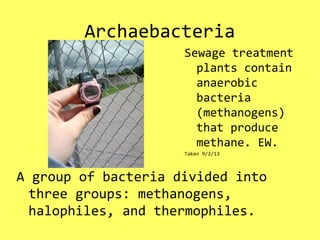
A group of bacteria divided into
three groups: methanogens,
halophiles, and thermophiles.
Sewage treatment
plants contain
anaerobic
bacteria
(methanogens)
that produce
methane. EW.
Taken 9/2/13
Autotrophs
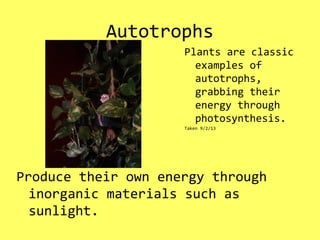
Produce their own energy through
inorganic materials such as
sunlight.
Plants are classic
examples of
autotrophs,
grabbing their
energy through
photosynthesis.
Taken 9/2/13
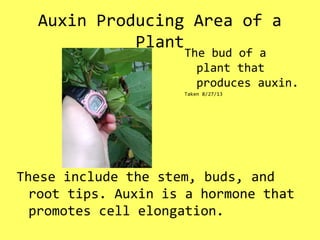
Auxin Producing Area of a
Plant
These include the stem, buds, and
root tips. Auxin is a hormone that
promotes cell elongation.
The bud of a
plant that
produces auxin.
Taken 8/27/13
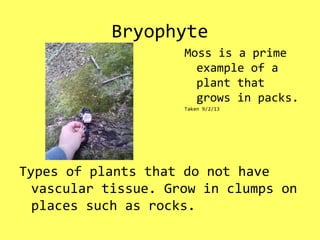
Bryophyte
Types of plants that do not have
vascular tissue. Grow in clumps on
places such as rocks.
Moss is a prime
example of a
plant that
grows in packs.
Taken 9/2/13
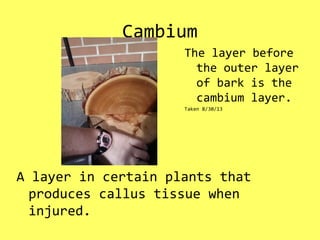
Cambium
A layer in certain plants that
produces callus tissue when
injured.
The layer before
the outer layer
of bark is the
cambium layer.
Taken 8/30/13
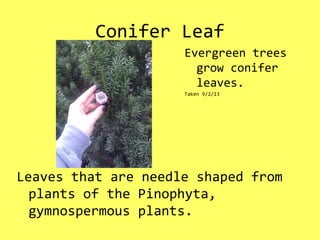
Conifer Leaf
Leaves that are needle shaped from
plants of the Pinophyta,
gymnospermous plants.
Evergreen trees
grow conifer
leaves.
Taken 9/2/13
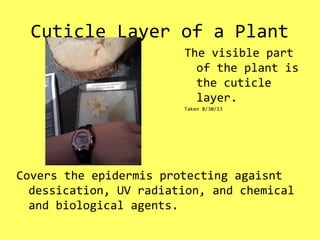
Cuticle Layer of a Plant
Covers the epidermis protecting agaisnt
dessication, UV radiation, and chemical
and biological agents.
The visible part
of the plant is
the cuticle
layer.
Taken 8/30/13
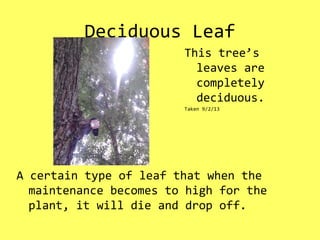
Deciduous Leaf
A certain type of leaf that when the
maintenance becomes to high for the
plant, it will die and drop off.
This tree’s
leaves are
completely
deciduous.
Taken 9/2/13
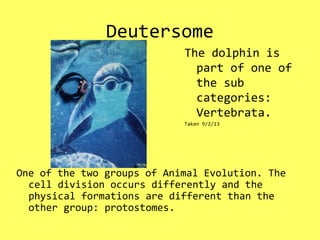
Deutersome
One of the two groups of Animal Evolution. The
cell division occurs differently and the
physical formations are different than the
other group: protostomes.
The dolphin is
part of one of
the sub
categories:
Vertebrata.
Taken 9/2/13
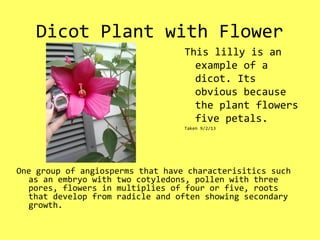
Dicot Plant with Flower
One group of angiosperms that have characterisitics such
as an embryo with two cotyledons, pollen with three
pores, flowers in multiplies of four or five, roots
that develop from radicle and often showing secondary
growth.
This lilly is an
example of a
dicot. Its
obvious because
the plant flowers
five petals.
Taken 9/2/13
Ectotherm
A cold blooded animal whose
homeostasis of body temperature
depends on EXTERNAL sources.
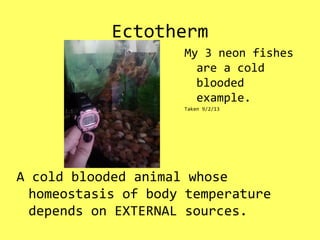
My 3 neon fishes
are a cold
blooded
example.
Taken 9/2/13
Endosperm
A tissue that aids the embryo of angiosperms
that requires coming together of one or more
nucleui in embryo sac with a sperm nucleus
form the pollen grain.
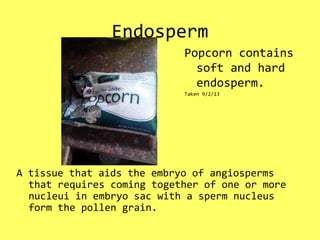
Popcorn contains
soft and hard
endosperm.
Taken 9/2/13
Fruit Dry with Seed
UseFruit that has been dried
naturally or artificially by a
machine.
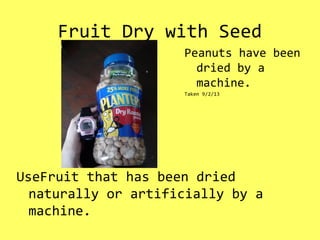
Peanuts have been
dried by a
machine.
Taken 9/2/13
Fruit Fleshy With Seed
The part of the plant can either come
from a single flower or multiple
groups. The fleshy part holds the seed.
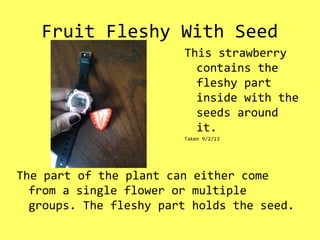
This strawberry
contains the
fleshy part
inside with the
seeds around
it.
Taken 9/2/13
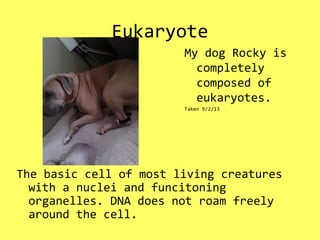
Eukaryote
The basic cell of most living creatures
with a nuclei and funcitoning
organelles. DNA does not roam freely
around the cell.
My dog Rocky is
completely
composed of
eukaryotes.
Taken 9/2/13
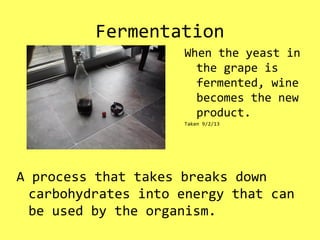
Fermentation
A process that takes breaks down
carbohydrates into energy that can
be used by the organism.
When the yeast in
the grape is
fermented, wine
becomes the new
product.
Taken 9/2/13
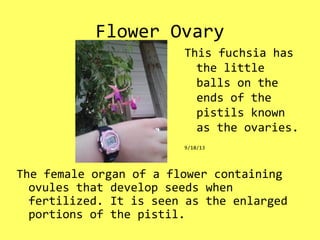
Flower Ovary
The female organ of a flower containing
ovules that develop seeds when
fertilized. It is seen as the enlarged
portions of the pistil.
This fuchsia has
the little
balls on the
ends of the
pistils known
as the ovaries.
9/18/13
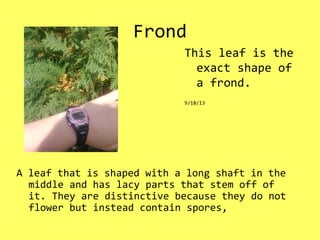
Frond
A leaf that is shaped with a long shaft in the
middle and has lacy parts that stem off of
it. They are distinctive because they do not
flower but instead contain spores,
This leaf is the
exact shape of
a frond.
9/18/13
Gastropods
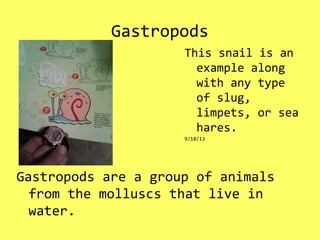
Gastropods are a group of animals
from the molluscs that live in
water.
This snail is an
example along
with any type
of slug,
limpets, or sea
hares.
9/18/13
Genetically Modified
Organisms
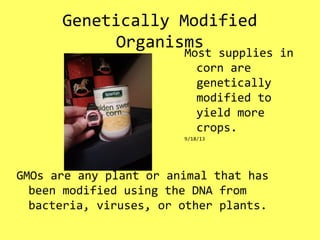
GMOs are any plant or animal that has
been modified using the DNA from
bacteria, viruses, or other plants.
Most supplies in
corn are
genetically
modified to
yield more
crops.
9/18/13
Gibberellins
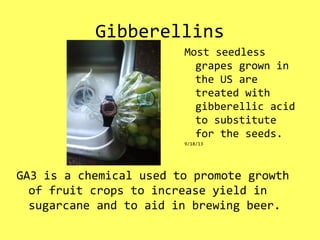
GA3 is a chemical used to promote growth
of fruit crops to increase yield in
sugarcane and to aid in brewing beer.
Most seedless
grapes grown in
the US are
treated with
gibberellic acid
to substitute
for the seeds.
9/18/13
Gymnosperms
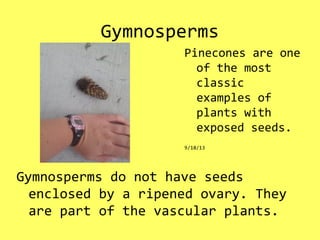
Gymnosperms do not have seeds
enclosed by a ripened ovary. They
are part of the vascular plants.
Pinecones are one
of the most
classic
examples of
plants with
exposed seeds.
9/18/13
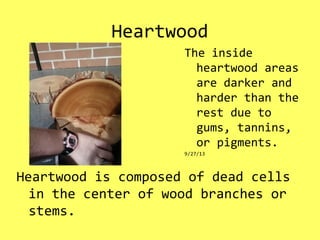
Heartwood
Heartwood is composed of dead cells
in the center of wood branches or
stems.
The inside
heartwood areas
are darker and
harder than the
rest due to
gums, tannins,
or pigments.
9/27/13
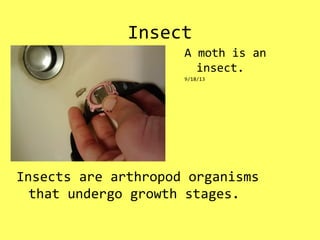
Insect
Insects are arthropod organisms
that undergo growth stages.
A moth is an
insect.
9/18/13
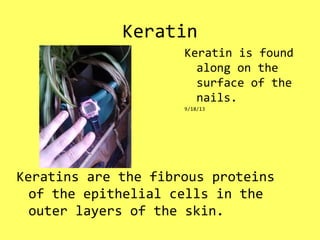
Keratin
Keratins are the fibrous proteins
of the epithelial cells in the
outer layers of the skin.
Keratin is found
along on the
surface of the
nails.
9/18/13
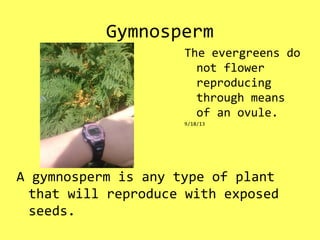
Gymnosperm
A gymnosperm is any type of plant
that will reproduce with exposed
seeds.
The evergreens do
not flower
reproducing
through means
of an ovule.
9/18/13
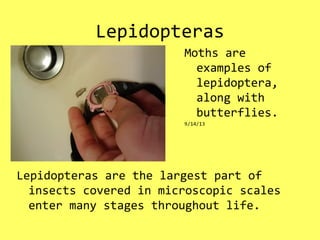
Lepidopteras
Lepidopteras are the largest part of
insects covered in microscopic scales
enter many stages throughout life.
Moths are
examples of
lepidoptera,
along with
butterflies.
9/14/13
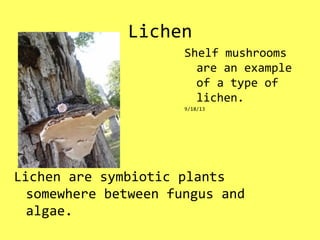
Lichen
Lichen are symbiotic plants
somewhere between fungus and
algae.
Shelf mushrooms
are an example
of a type of
lichen.
9/18/13
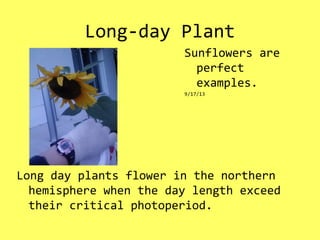
Long-day Plant
Long day plants flower in the northern
hemisphere when the day length exceed
their critical photoperiod.
Sunflowers are
perfect
examples.
9/17/13
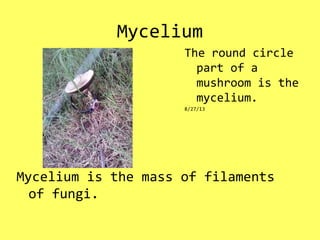
Mycelium
Mycelium is the mass of filaments
of fungi.
The round circle
part of a
mushroom is the
mycelium.
8/27/13
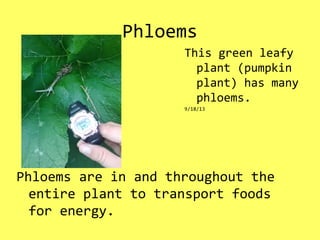
Phloems
Phloems are in and throughout the
entire plant to transport foods
for energy.
This green leafy
plant (pumpkin
plant) has many
phloems.
9/18/13
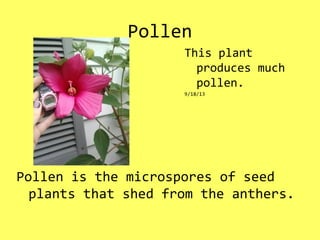
Pollen
Pollen is the microspores of seed
plants that shed from the anthers.
This plant
produces much
pollen.
9/18/13
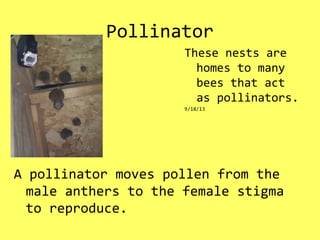
Pollinator
A pollinator moves pollen from the
male anthers to the female stigma
to reproduce.
These nests are
homes to many
bees that act
as pollinators.
9/18/13
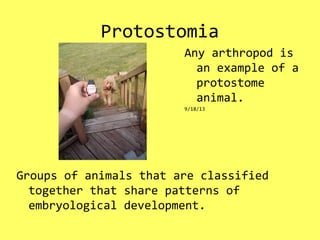
Protostomia
Groups of animals that are classified
together that share patterns of
embryological development.
Any arthropod is
an example of a
protostome
animal.
9/18/13
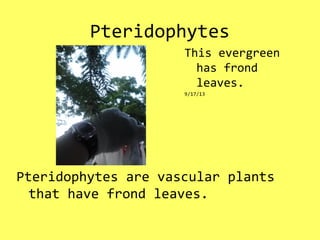
Pteridophytes
Pteridophytes are vascular plants
that have frond leaves.
This evergreen
has frond
leaves.
9/17/13
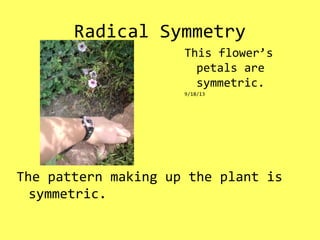
Radical Symmetry
The pattern making up the plant is
symmetric.
This flower’s
petals are
symmetric.
9/18/13
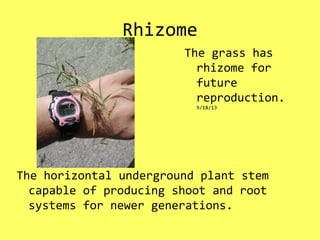
Rhizome
The horizontal underground plant stem
capable of producing shoot and root
systems for newer generations.
The grass has
rhizome for
future
reproduction.
9/18/13
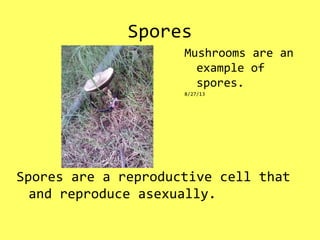
Spores
Spores are a reproductive cell that
and reproduce asexually.
Mushrooms are an
example of
spores.
8/27/13
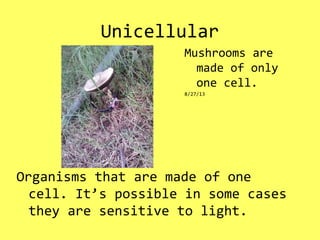
Unicellular
Organisms that are made of one
cell. It’s possible in some cases
they are sensitive to light.
Mushrooms are
made of only
one cell.
8/27/13
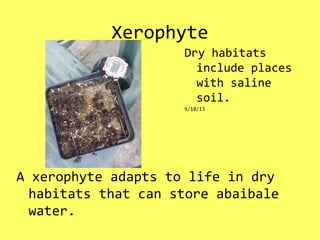
Xerophyte
A xerophyte adapts to life in dry
habitats that can store abaibale
water.
Dry habitats
include places
with saline
soil.
9/18/13
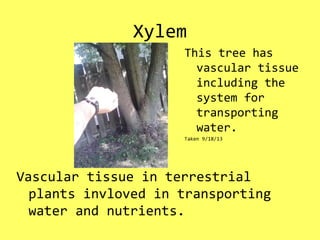
Xylem
Vascular tissue in terrestrial
plants invloved in transporting
water and nutrients.
This tree has
vascular tissue
including the
system for
transporting
water.
Taken 9/18/13

Biology terms

  • 1.
  • 2.
    Adaption of anAnimal Use of physical or behavior characteristics by the animal that will help it survive in its environment. Humans do not have an extention of the tail bone due to adaptation to environment. Taken 9/2/13
  • 3.
    Adaption of anPlant Use of physical or behavior characteristics by the plant that will help it survive in its environment. Since owls are nocturnal, they are born with larger eyes to see. Taken 9/2/13
  • 4.
    Actin A protein thataids in muscle tissue, platelet shape, edocytosis, cell motility, cell division, metastasis, and cell signaling. Muscle, like in an arm, contains actin which functions as a polymer of G-actin. Taken 9/2/13
  • 5.
    Amniotic Egg An eggwith a water-impermeable amniotic membrance made for protection of a fluid-filled cavity. All birds are known to lay amniotic eggs. These are various bird feathers. Taken 9/2/13
  • 6.
    Angiosperm Plants whose seedsare secluded in a fruit. They are also known as Division Adnthophyta. Most garden flowers are examples of angiosperms. Taken 9/2/13
  • 7.
    Animal That Hasa Segmented Body An animal with a series of similar functioning parts usually divided into groups. This is a home to an ant. Since ants do run fast, it was hard to get a recognizable picture, but ants are known to be externally segmented. Taken 9/2/13
  • 8.
    Echinoderm Sea animals withspiny skin that are visually symmetric. These are old fossils from various symmetric animals. Taken 8/30/13
  • 9.
    Anther & Filament Twoparts of the Stamen that produce pollen. The pod-looking part is the anther, where the stem from underneath is the filament. Taken 8/27/13
  • 10.
    Arthropod Segmented bodied animalsincluding insecs, spiders, centipedes, shrimp, and crayfish. Classic example of one of the many arthropods of America! Taken 8/30/13
  • 11.
    Archaebacteria A group ofbacteria divided into three groups: methanogens, halophiles, and thermophiles. Sewage treatment plants contain anaerobic bacteria (methanogens) that produce methane. EW. Taken 9/2/13
  • 12.
    Autotrophs Produce their ownenergy through inorganic materials such as sunlight. Plants are classic examples of autotrophs, grabbing their energy through photosynthesis. Taken 9/2/13
  • 13.
    Auxin Producing Areaof a Plant These include the stem, buds, and root tips. Auxin is a hormone that promotes cell elongation. The bud of a plant that produces auxin. Taken 8/27/13
  • 14.
    Bryophyte Types of plantsthat do not have vascular tissue. Grow in clumps on places such as rocks. Moss is a prime example of a plant that grows in packs. Taken 9/2/13
  • 15.
    Cambium A layer incertain plants that produces callus tissue when injured. The layer before the outer layer of bark is the cambium layer. Taken 8/30/13
  • 16.
    Conifer Leaf Leaves thatare needle shaped from plants of the Pinophyta, gymnospermous plants. Evergreen trees grow conifer leaves. Taken 9/2/13
  • 17.
    Cuticle Layer ofa Plant Covers the epidermis protecting agaisnt dessication, UV radiation, and chemical and biological agents. The visible part of the plant is the cuticle layer. Taken 8/30/13
  • 18.
    Deciduous Leaf A certaintype of leaf that when the maintenance becomes to high for the plant, it will die and drop off. This tree’s leaves are completely deciduous. Taken 9/2/13
  • 19.
    Deutersome One of thetwo groups of Animal Evolution. The cell division occurs differently and the physical formations are different than the other group: protostomes. The dolphin is part of one of the sub categories: Vertebrata. Taken 9/2/13
  • 20.
    Dicot Plant withFlower One group of angiosperms that have characterisitics such as an embryo with two cotyledons, pollen with three pores, flowers in multiplies of four or five, roots that develop from radicle and often showing secondary growth. This lilly is an example of a dicot. Its obvious because the plant flowers five petals. Taken 9/2/13
  • 21.
    Ectotherm A cold bloodedanimal whose homeostasis of body temperature depends on EXTERNAL sources. My 3 neon fishes are a cold blooded example. Taken 9/2/13
  • 22.
    Endosperm A tissue thataids the embryo of angiosperms that requires coming together of one or more nucleui in embryo sac with a sperm nucleus form the pollen grain. Popcorn contains soft and hard endosperm. Taken 9/2/13
  • 23.
    Fruit Dry withSeed UseFruit that has been dried naturally or artificially by a machine. Peanuts have been dried by a machine. Taken 9/2/13
  • 24.
    Fruit Fleshy WithSeed The part of the plant can either come from a single flower or multiple groups. The fleshy part holds the seed. This strawberry contains the fleshy part inside with the seeds around it. Taken 9/2/13
  • 25.
    Eukaryote The basic cellof most living creatures with a nuclei and funcitoning organelles. DNA does not roam freely around the cell. My dog Rocky is completely composed of eukaryotes. Taken 9/2/13
  • 26.
    Fermentation A process thattakes breaks down carbohydrates into energy that can be used by the organism. When the yeast in the grape is fermented, wine becomes the new product. Taken 9/2/13
  • 27.
    Flower Ovary The femaleorgan of a flower containing ovules that develop seeds when fertilized. It is seen as the enlarged portions of the pistil. This fuchsia has the little balls on the ends of the pistils known as the ovaries. 9/18/13
  • 28.
    Frond A leaf thatis shaped with a long shaft in the middle and has lacy parts that stem off of it. They are distinctive because they do not flower but instead contain spores, This leaf is the exact shape of a frond. 9/18/13
  • 29.
    Gastropods Gastropods are agroup of animals from the molluscs that live in water. This snail is an example along with any type of slug, limpets, or sea hares. 9/18/13
  • 30.
    Genetically Modified Organisms GMOs areany plant or animal that has been modified using the DNA from bacteria, viruses, or other plants. Most supplies in corn are genetically modified to yield more crops. 9/18/13
  • 31.
    Gibberellins GA3 is achemical used to promote growth of fruit crops to increase yield in sugarcane and to aid in brewing beer. Most seedless grapes grown in the US are treated with gibberellic acid to substitute for the seeds. 9/18/13
  • 32.
    Gymnosperms Gymnosperms do nothave seeds enclosed by a ripened ovary. They are part of the vascular plants. Pinecones are one of the most classic examples of plants with exposed seeds. 9/18/13
  • 33.
    Heartwood Heartwood is composedof dead cells in the center of wood branches or stems. The inside heartwood areas are darker and harder than the rest due to gums, tannins, or pigments. 9/27/13
  • 34.
    Insect Insects are arthropodorganisms that undergo growth stages. A moth is an insect. 9/18/13
  • 35.
    Keratin Keratins are thefibrous proteins of the epithelial cells in the outer layers of the skin. Keratin is found along on the surface of the nails. 9/18/13
  • 36.
    Gymnosperm A gymnosperm isany type of plant that will reproduce with exposed seeds. The evergreens do not flower reproducing through means of an ovule. 9/18/13
  • 37.
    Lepidopteras Lepidopteras are thelargest part of insects covered in microscopic scales enter many stages throughout life. Moths are examples of lepidoptera, along with butterflies. 9/14/13
  • 38.
    Lichen Lichen are symbioticplants somewhere between fungus and algae. Shelf mushrooms are an example of a type of lichen. 9/18/13
  • 39.
    Long-day Plant Long dayplants flower in the northern hemisphere when the day length exceed their critical photoperiod. Sunflowers are perfect examples. 9/17/13
  • 40.
    Mycelium Mycelium is themass of filaments of fungi. The round circle part of a mushroom is the mycelium. 8/27/13
  • 41.
    Phloems Phloems are inand throughout the entire plant to transport foods for energy. This green leafy plant (pumpkin plant) has many phloems. 9/18/13
  • 42.
    Pollen Pollen is themicrospores of seed plants that shed from the anthers. This plant produces much pollen. 9/18/13
  • 43.
    Pollinator A pollinator movespollen from the male anthers to the female stigma to reproduce. These nests are homes to many bees that act as pollinators. 9/18/13
  • 44.
    Protostomia Groups of animalsthat are classified together that share patterns of embryological development. Any arthropod is an example of a protostome animal. 9/18/13
  • 45.
    Pteridophytes Pteridophytes are vascularplants that have frond leaves. This evergreen has frond leaves. 9/17/13
  • 46.
    Radical Symmetry The patternmaking up the plant is symmetric. This flower’s petals are symmetric. 9/18/13
  • 47.
    Rhizome The horizontal undergroundplant stem capable of producing shoot and root systems for newer generations. The grass has rhizome for future reproduction. 9/18/13
  • 48.
    Spores Spores are areproductive cell that and reproduce asexually. Mushrooms are an example of spores. 8/27/13
  • 49.
    Unicellular Organisms that aremade of one cell. It’s possible in some cases they are sensitive to light. Mushrooms are made of only one cell. 8/27/13
  • 50.
    Xerophyte A xerophyte adaptsto life in dry habitats that can store abaibale water. Dry habitats include places with saline soil. 9/18/13
  • 51.
    Xylem Vascular tissue interrestrial plants invloved in transporting water and nutrients. This tree has vascular tissue including the system for transporting water. Taken 9/18/13