Biology 161 Lab – Brain and VentriclesScott.lehbauer@lethbridgecollege.ab.ca
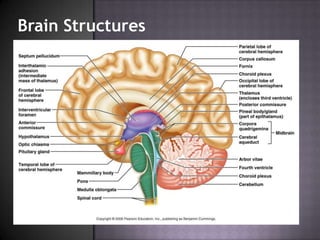
Brain Structures
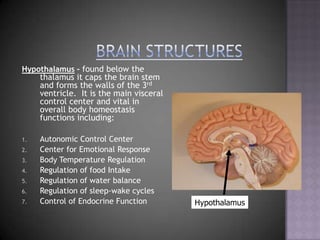
Brain StructuresHypothalamus – found below the thalamus it caps the brain stem and forms the walls of the 3rd ventricle.  It is the main visceral control center and vital in overall body homeostasis functions including:Autonomic Control CenterCenter for Emotional ResponseBody Temperature RegulationRegulation of food IntakeRegulation of water balanceRegulation of sleep-wake cyclesControl of Endocrine FunctionHypothalamus
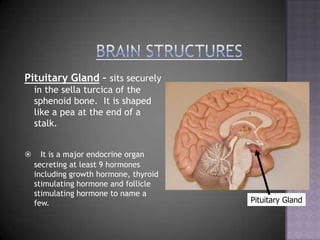
Brain StructuresPituitary Gland – sits securely in the sella turcica of the sphenoid bone.  It is shaped like a pea at the end of a stalk.It is a major endocrine organ secreting at least 9 hormones including growth hormone, thyroid stimulating hormone and follicle stimulating hormone to name a few.Pituitary Gland
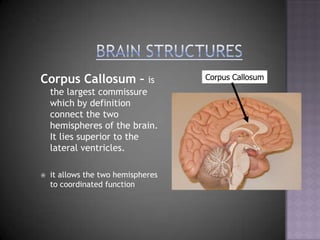
Brain StructuresCorpus Callosum – is the largest commissure which by definition connect the two hemispheres of the brain.  It lies superior to the lateral ventricles.it allows the two hemispheres to coordinated functionCorpus Callosum
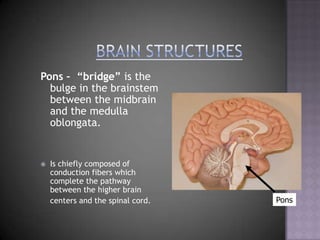
Brain StructuresPons –  “bridge” is the bulge in the brainstem between the midbrain and the medulla oblongata.  Is chiefly composed of conduction fibers which complete the pathway between the higher brain centers and the spinal cord.Pons
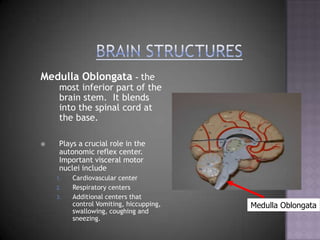
Brain StructuresMedulla Oblongata – the most inferior part of the brain stem.  It blends into the spinal cord at the base.Plays a crucial role in the autonomic reflex center.  Important visceral motor nuclei includeCardiovascular centerRespiratory centersAdditional centers that control Vomiting, hiccupping, swallowing, coughing and sneezing.Medulla Oblongata
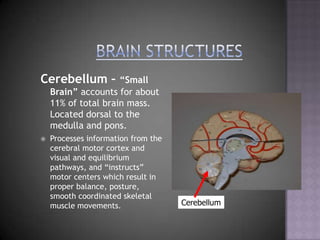
Brain StructuresCerebellum – “Small Brain” accounts for about 11% of total brain mass.  Located dorsal to the medulla and pons.Processes information from the cerebral motor cortex and visual and equilibrium pathways, and “instructs” motor centers which result in proper balance, posture, smooth coordinated skeletal muscle movements.Cerebellum
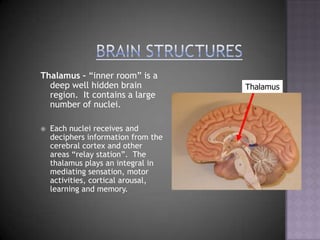
Brain StructuresThalamus – “inner room” is a deep well hidden brain region.  It contains a large number of nuclei.  Each nuclei receives and deciphers information from the cerebral cortex and other areas “relay station”.  The thalamus plays an integral in mediating sensation, motor activities, cortical arousal, learning and memory. Thalamus
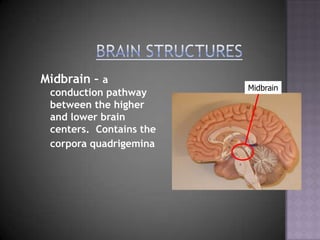
Brain StructuresMidbrain – a conduction pathway between the higher and lower brain centers.  Contains the corpora quadrigeminaMidbrain
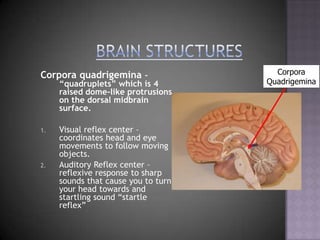
Brain StructuresCorporaQuadrigeminaCorpora quadrigemina – “quadruplets” which is 4 raised dome-like protrusions on the dorsal midbrain surface.Visual reflex center – coordinates head and eye movements to follow moving objects.Auditory Reflex center – reflexive response to sharp sounds that cause you to turn your head towards and startling sound “startle reflex”
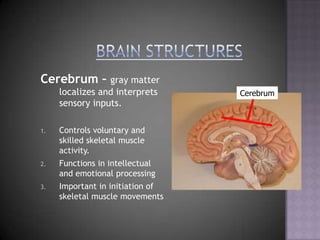
Brain StructuresCerebrum – gray matter localizes and interprets sensory inputs. Controlsvoluntary and skilled skeletal muscle activity.Functions in intellectual and emotional processingImportant in initiation of skeletal muscle movementsCerebrum
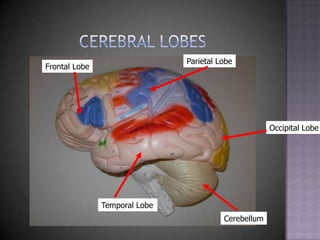
Cerebral LobesParietal LobeFrontal LobeOccipital LobeTemporal LobeCerebellum
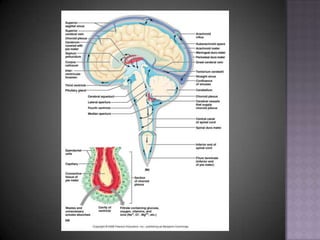
Brain Structures - VentriclesAre continuous spaces which reside inside the tissue of the brainThey are continuous with the central canal of the spinal cord.They are full of Cerebral Spinal Fluid
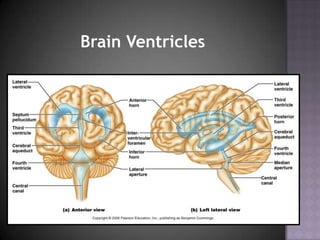
Brain Ventricles
Brain Structures - CSFCSF (Cerebral Spinal Fluid) – is found in and around the brain and spinal cord.  It forms and liquid cushion and gives buoyancy around the CNS.  The CSF reduces the weight of the brain by 97% and prevents the brain from crushing itself.  It also protects the CNS from trauma and helps nourish the brain.
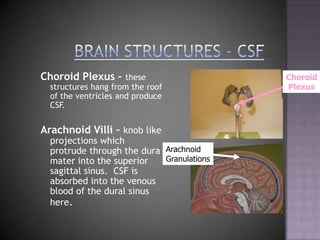
Brain Structures - CSFChoroid Plexus – these structures hang from the roof of the ventricles and produce CSF.Arachnoid Villi – knob like projections which protrude through the dura mater into the superior sagittal sinus.  CSF is absorbed into the venous blood of the dural sinus here.ChoroidPlexusArachnoidGranulations
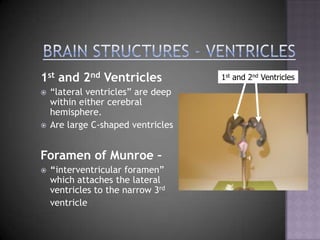
Brain Structures - Ventricles1st and 2nd Ventricles“lateral ventricles” are deep within either cerebral hemisphere.  Are large C-shaped ventriclesForamen of Munroe –“interventricular foramen” which attaches the lateral ventricles to the narrow 3rd ventricle1st and 2nd Ventricles
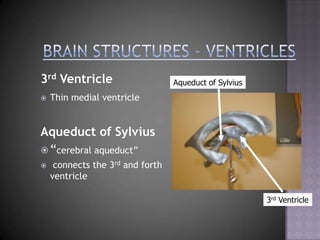
Brain Structures - Ventricles3rd Ventricle Thin medial ventricleAqueduct of Sylvius“cerebral aqueduct” connects the 3rd and forth ventricleAqueduct of Sylvius3rd Ventricle
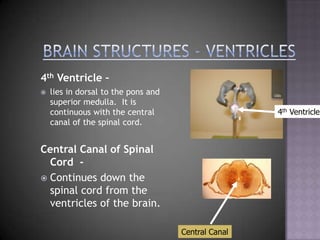
Brain Structures - Ventricles4th Ventricle – lies in dorsal to the pons and superior medulla.  It is continuous with the central canal of the spinal cord.Central Canal of Spinal Cord  - Continues down the spinal cord from the ventricles of the brain.4th VentricleCentral Canal
Hydrocephalus“Water on the brain” is a condition where the CSF cannot be drained or reabsorbed.CSF accumulates and exerts pressure on the brain
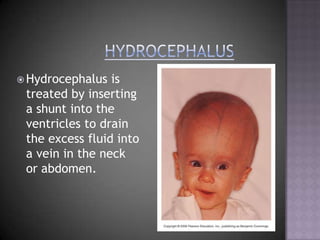
HydrocephalusHydrocephalus is treated by inserting a shunt into the ventricles to drain the excess fluid into a vein in the neck or abdomen.
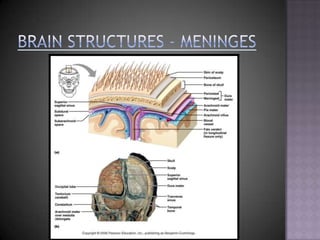
Brain Structures - MeningesMeninges – “membrane” are three connective tissue membranes that lie just outside the CNS (Brain and Spinal Cord).  Their functions include;Cover and protect the CNSProtect blood vessels and enclose the venous sinusesContain CSF Form partitions in the skull
Brain Structures - Meninges
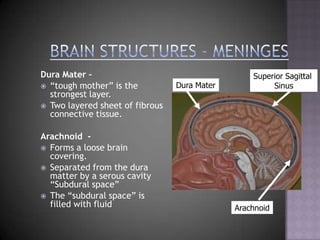
Brain Structures - MeningesDura Mater – “tough mother” is the strongest layer.  Two layered sheet of fibrous connective tissue.Arachnoid  - Forms a loose brain covering.Separated from the dura matter by a serous cavity “Subdural space”The “subdural space” is filled with fluidSuperior Sagittal SinusDura MaterArachnoid
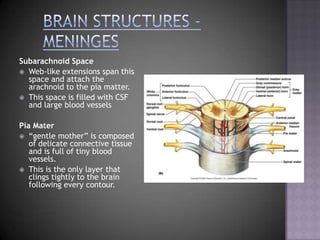
Brain Structures - MeningesSubarachnoid SpaceWeb-like extensions span this space and attach the arachnoid to the pia matter.This space is filled with CSF and large blood vesselsPia Mater“gentle mother” is composed of delicate connective tissue and is full of tiny blood vessels.This is the only layer that clings tightly to the brain following every contour.
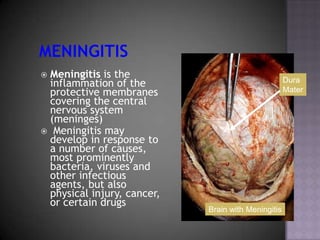
MeningitisMeningitis is the inflammation of the protective membranes covering the central nervous system (meninges)
 Meningitis may develop in response to a number of causes, most prominently bacteria, viruses and other infectious agents, but also physical injury, cancer, or certain drugs DuraMaterBrain with Meningitis
Spina Bifida“forked spine” results from the incomplete formation of the vertebral archesis a developmental birth defect involving the neural tube: incomplete closure of the embryonic neural tube results in an incompletely formed spinal cord. the vertebrae overlying the open portion of the spinal cord do not fully form and remain un fused and open This allows the abnormal portion of the spinal cord to stick out through the opening in the bones
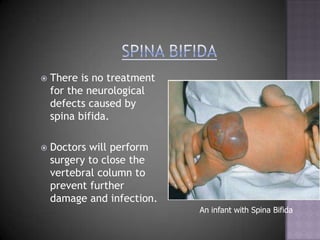
3 TypesSpina bifida occulta – not severe results in a small tuft of hair on the back and has no neurological ramifications.Spina bifida meningocele – more severe, a sac-like cyst protrudes from the child’s spine.  The cyst contains CSF and Meninges.Spina bifida myelomeningocele – similar to above only the cyst contains neural structures.  The more neurological structures the cyst contains the more neurological impairment.

Biology 161 lab_7__brain_and_ventricles2

  • 1.
    Biology 161 Lab– Brain and VentriclesScott.lehbauer@lethbridgecollege.ab.ca
  • 2.
  • 3.
    Brain StructuresHypothalamus –found below the thalamus it caps the brain stem and forms the walls of the 3rd ventricle. It is the main visceral control center and vital in overall body homeostasis functions including:Autonomic Control CenterCenter for Emotional ResponseBody Temperature RegulationRegulation of food IntakeRegulation of water balanceRegulation of sleep-wake cyclesControl of Endocrine FunctionHypothalamus
  • 4.
    Brain StructuresPituitary Gland– sits securely in the sella turcica of the sphenoid bone. It is shaped like a pea at the end of a stalk.It is a major endocrine organ secreting at least 9 hormones including growth hormone, thyroid stimulating hormone and follicle stimulating hormone to name a few.Pituitary Gland
  • 5.
    Brain StructuresCorpus Callosum– is the largest commissure which by definition connect the two hemispheres of the brain. It lies superior to the lateral ventricles.it allows the two hemispheres to coordinated functionCorpus Callosum
  • 6.
    Brain StructuresPons – “bridge” is the bulge in the brainstem between the midbrain and the medulla oblongata. Is chiefly composed of conduction fibers which complete the pathway between the higher brain centers and the spinal cord.Pons
  • 7.
    Brain StructuresMedulla Oblongata– the most inferior part of the brain stem. It blends into the spinal cord at the base.Plays a crucial role in the autonomic reflex center. Important visceral motor nuclei includeCardiovascular centerRespiratory centersAdditional centers that control Vomiting, hiccupping, swallowing, coughing and sneezing.Medulla Oblongata
  • 8.
    Brain StructuresCerebellum –“Small Brain” accounts for about 11% of total brain mass. Located dorsal to the medulla and pons.Processes information from the cerebral motor cortex and visual and equilibrium pathways, and “instructs” motor centers which result in proper balance, posture, smooth coordinated skeletal muscle movements.Cerebellum
  • 9.
    Brain StructuresThalamus –“inner room” is a deep well hidden brain region. It contains a large number of nuclei. Each nuclei receives and deciphers information from the cerebral cortex and other areas “relay station”. The thalamus plays an integral in mediating sensation, motor activities, cortical arousal, learning and memory. Thalamus
  • 10.
    Brain StructuresMidbrain –a conduction pathway between the higher and lower brain centers. Contains the corpora quadrigeminaMidbrain
  • 11.
    Brain StructuresCorporaQuadrigeminaCorpora quadrigemina– “quadruplets” which is 4 raised dome-like protrusions on the dorsal midbrain surface.Visual reflex center – coordinates head and eye movements to follow moving objects.Auditory Reflex center – reflexive response to sharp sounds that cause you to turn your head towards and startling sound “startle reflex”
  • 12.
    Brain StructuresCerebrum –gray matter localizes and interprets sensory inputs. Controlsvoluntary and skilled skeletal muscle activity.Functions in intellectual and emotional processingImportant in initiation of skeletal muscle movementsCerebrum
  • 13.
    Cerebral LobesParietal LobeFrontalLobeOccipital LobeTemporal LobeCerebellum
  • 14.
    Brain Structures -VentriclesAre continuous spaces which reside inside the tissue of the brainThey are continuous with the central canal of the spinal cord.They are full of Cerebral Spinal Fluid
  • 15.
  • 16.
    Brain Structures -CSFCSF (Cerebral Spinal Fluid) – is found in and around the brain and spinal cord. It forms and liquid cushion and gives buoyancy around the CNS. The CSF reduces the weight of the brain by 97% and prevents the brain from crushing itself. It also protects the CNS from trauma and helps nourish the brain.
  • 17.
    Brain Structures -CSFChoroid Plexus – these structures hang from the roof of the ventricles and produce CSF.Arachnoid Villi – knob like projections which protrude through the dura mater into the superior sagittal sinus. CSF is absorbed into the venous blood of the dural sinus here.ChoroidPlexusArachnoidGranulations
  • 18.
    Brain Structures -Ventricles1st and 2nd Ventricles“lateral ventricles” are deep within either cerebral hemisphere. Are large C-shaped ventriclesForamen of Munroe –“interventricular foramen” which attaches the lateral ventricles to the narrow 3rd ventricle1st and 2nd Ventricles
  • 19.
    Brain Structures -Ventricles3rd Ventricle Thin medial ventricleAqueduct of Sylvius“cerebral aqueduct” connects the 3rd and forth ventricleAqueduct of Sylvius3rd Ventricle
  • 20.
    Brain Structures -Ventricles4th Ventricle – lies in dorsal to the pons and superior medulla. It is continuous with the central canal of the spinal cord.Central Canal of Spinal Cord - Continues down the spinal cord from the ventricles of the brain.4th VentricleCentral Canal
  • 22.
    Hydrocephalus“Water on thebrain” is a condition where the CSF cannot be drained or reabsorbed.CSF accumulates and exerts pressure on the brain
  • 23.
    HydrocephalusHydrocephalus is treatedby inserting a shunt into the ventricles to drain the excess fluid into a vein in the neck or abdomen.
  • 24.
    Brain Structures -MeningesMeninges – “membrane” are three connective tissue membranes that lie just outside the CNS (Brain and Spinal Cord). Their functions include;Cover and protect the CNSProtect blood vessels and enclose the venous sinusesContain CSF Form partitions in the skull
  • 25.
  • 26.
    Brain Structures -MeningesDura Mater – “tough mother” is the strongest layer. Two layered sheet of fibrous connective tissue.Arachnoid - Forms a loose brain covering.Separated from the dura matter by a serous cavity “Subdural space”The “subdural space” is filled with fluidSuperior Sagittal SinusDura MaterArachnoid
  • 27.
    Brain Structures -MeningesSubarachnoid SpaceWeb-like extensions span this space and attach the arachnoid to the pia matter.This space is filled with CSF and large blood vesselsPia Mater“gentle mother” is composed of delicate connective tissue and is full of tiny blood vessels.This is the only layer that clings tightly to the brain following every contour.
  • 28.
    MeningitisMeningitis is theinflammation of the protective membranes covering the central nervous system (meninges)
  • 29.
    Meningitis maydevelop in response to a number of causes, most prominently bacteria, viruses and other infectious agents, but also physical injury, cancer, or certain drugs DuraMaterBrain with Meningitis
  • 30.
    Spina Bifida“forked spine”results from the incomplete formation of the vertebral archesis a developmental birth defect involving the neural tube: incomplete closure of the embryonic neural tube results in an incompletely formed spinal cord. the vertebrae overlying the open portion of the spinal cord do not fully form and remain un fused and open This allows the abnormal portion of the spinal cord to stick out through the opening in the bones
  • 31.
    3 TypesSpina bifidaocculta – not severe results in a small tuft of hair on the back and has no neurological ramifications.Spina bifida meningocele – more severe, a sac-like cyst protrudes from the child’s spine. The cyst contains CSF and Meninges.Spina bifida myelomeningocele – similar to above only the cyst contains neural structures. The more neurological structures the cyst contains the more neurological impairment.