By Zia Kara
How to Use This Presentation I hope you enjoy this presentation and learn as much as I did!  This presentation is designed to be interactive and to be used as to how you want to see the information. There is an  at the beginning of the presentation that will begin your discovery of this great man, Benjamin Franklin. Use this  to learn about his life, his inventions and his struggles.  Just click on any text to start your adventure! index index
Benjamin Franklin lived a busy and industrious life spanning 84 years.  1706 -1718 1718 1730 - 1745 1728-1748 1747 - 1752 1757 -  1790 1790 Index Birth and Childhood Apprenticeship  Inventions Vocation Family References Political Life Old Age and Death
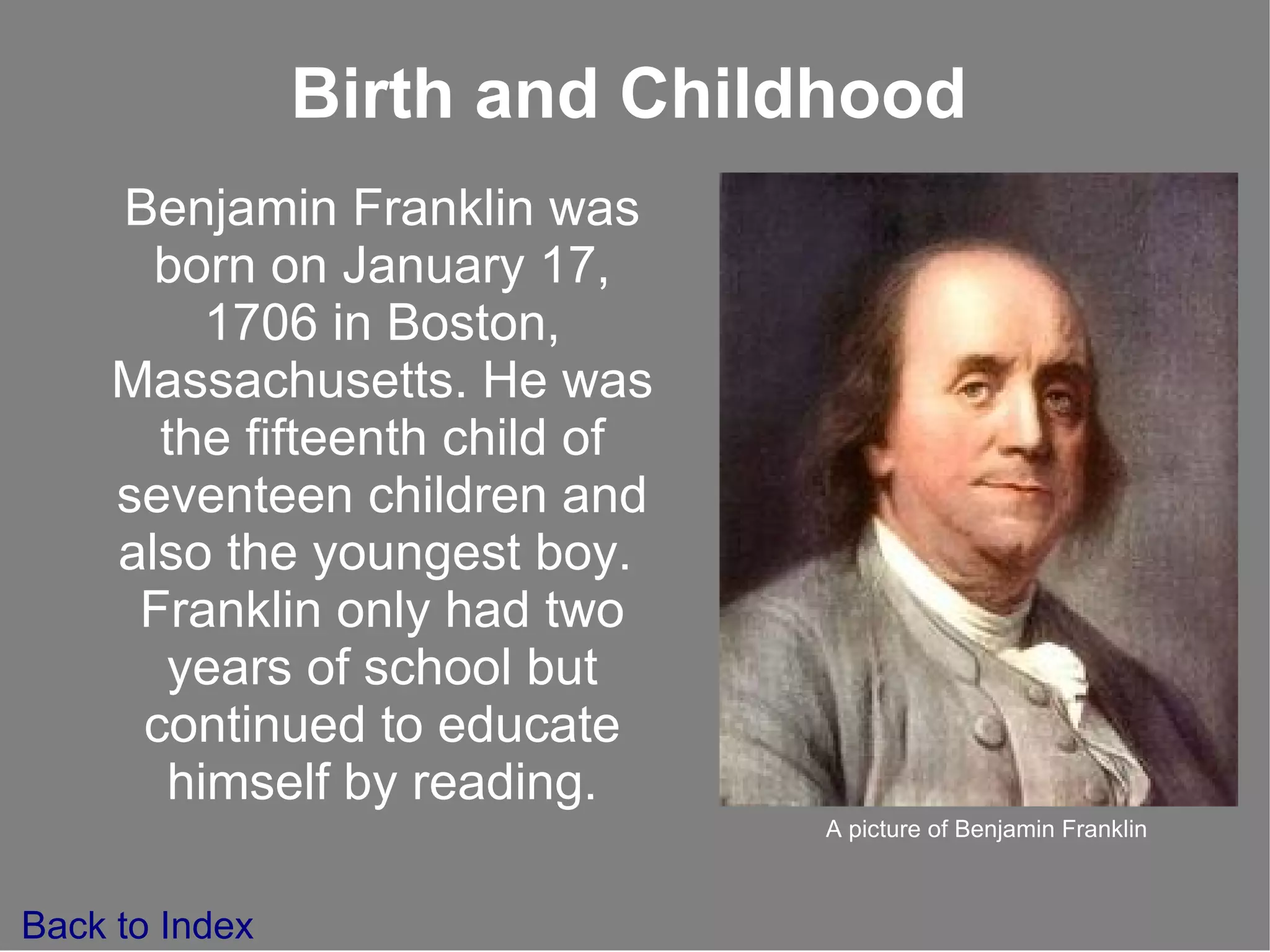
Benjamin Franklin was born on January 17, 1706 in Boston, Massachusetts. He was the fifteenth child of seventeen children and also the youngest boy.  Franklin only had two years of school but continued to educate himself by reading. Birth and Childhood Back to Index A picture of Benjamin Franklin
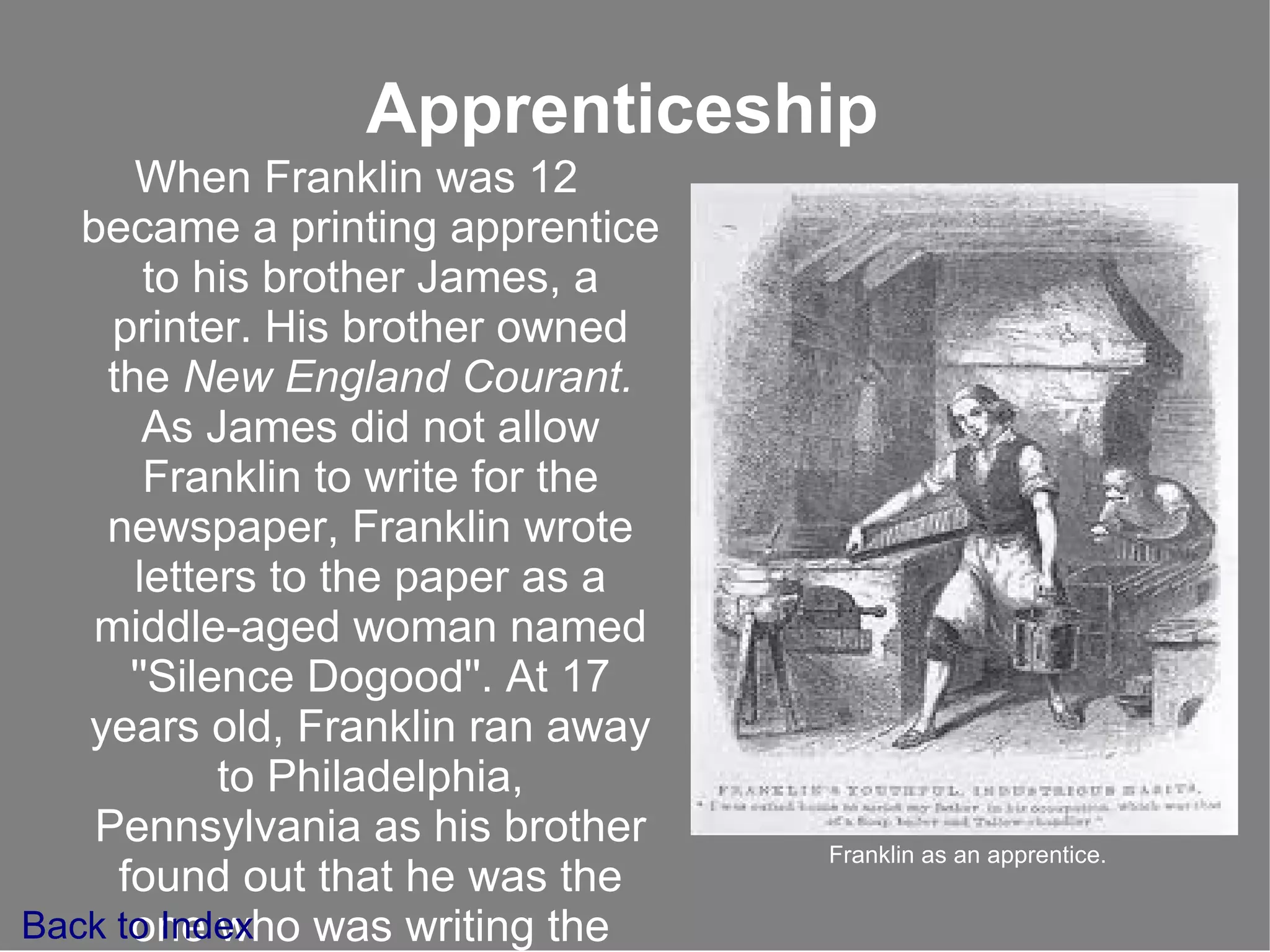
Apprenticeship When Franklin was 12 became a printing apprentice to his brother James, a printer. His brother owned the  New England  Courant.  As James  did not allow Franklin to write for the newspaper, Franklin wrote letters to the paper as a middle-aged woman named ''Silence Dogood''. At 17 years old, Franklin ran away to   Philadelphia, Pennsylvania as his brother found out that he was the one who was writing the letters. Back to Index Franklin as an apprentice.
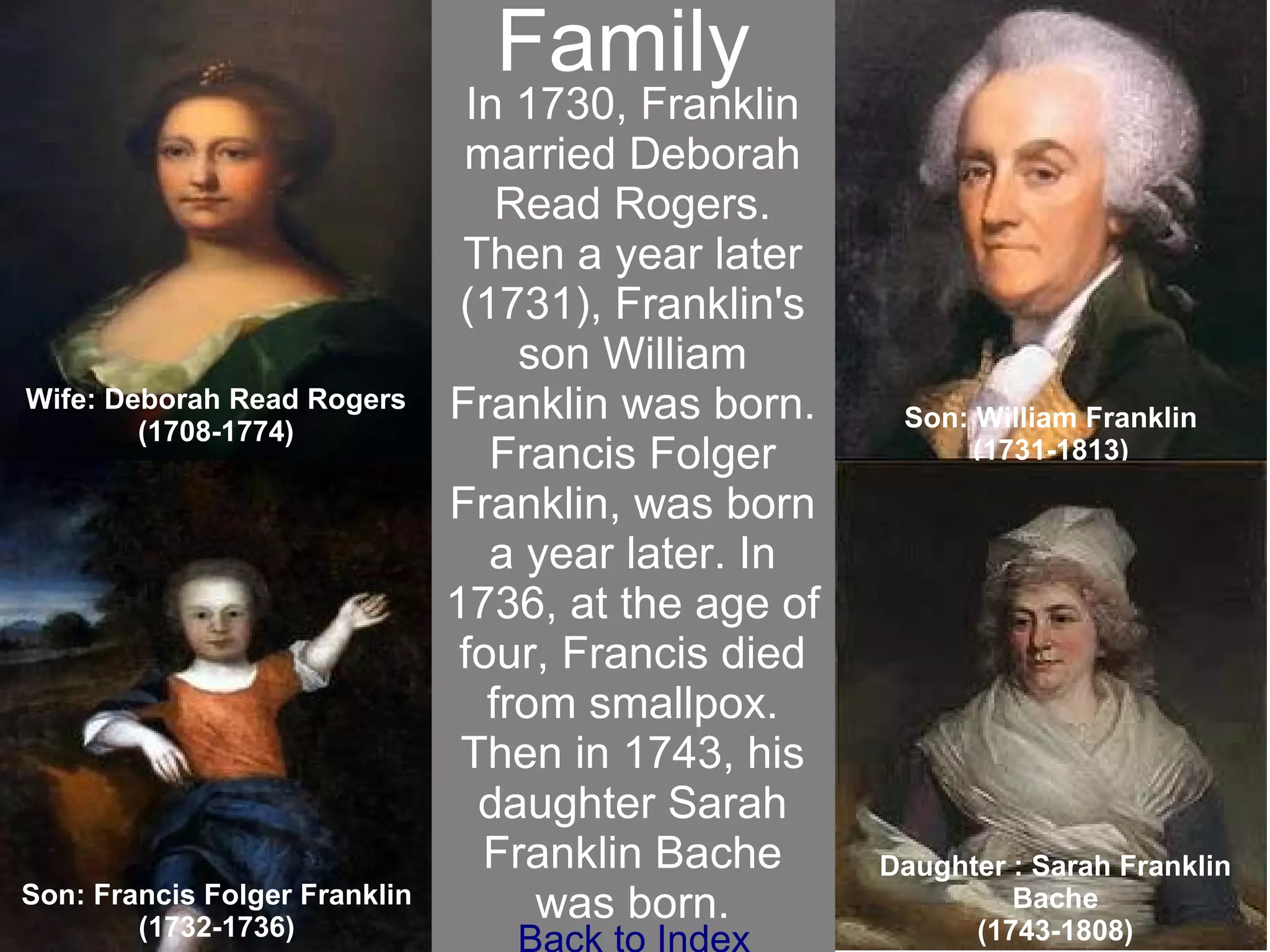
Family Wife: Deborah Read Rogers (1708-1774) Son: William Franklin (1731-1813) Son: Francis Folger Franklin (1732-1736) Daughter : Sarah Franklin Bache (1743-1808) In 1730, Franklin married Deborah Read Rogers. Then a year later (1731), Franklin's son William Franklin was born. Francis Folger Franklin, was born a year later. In 1736, at the age of four, Francis died from smallpox. Then in 1743, his daughter Sarah Franklin Bache was born. Family Back to Index
Inventions Inventions contributing to Earth Science Bifocal Glasses Extension Arm Franklin Stove Library Chair Lightning Rod Swim Fins Odometer Institutions New Words Services Back to Index Flexible Urinary Catheter Glass Armonica Three-Wheel Clock Chart of the Gulf Stream Daylight Savings Time
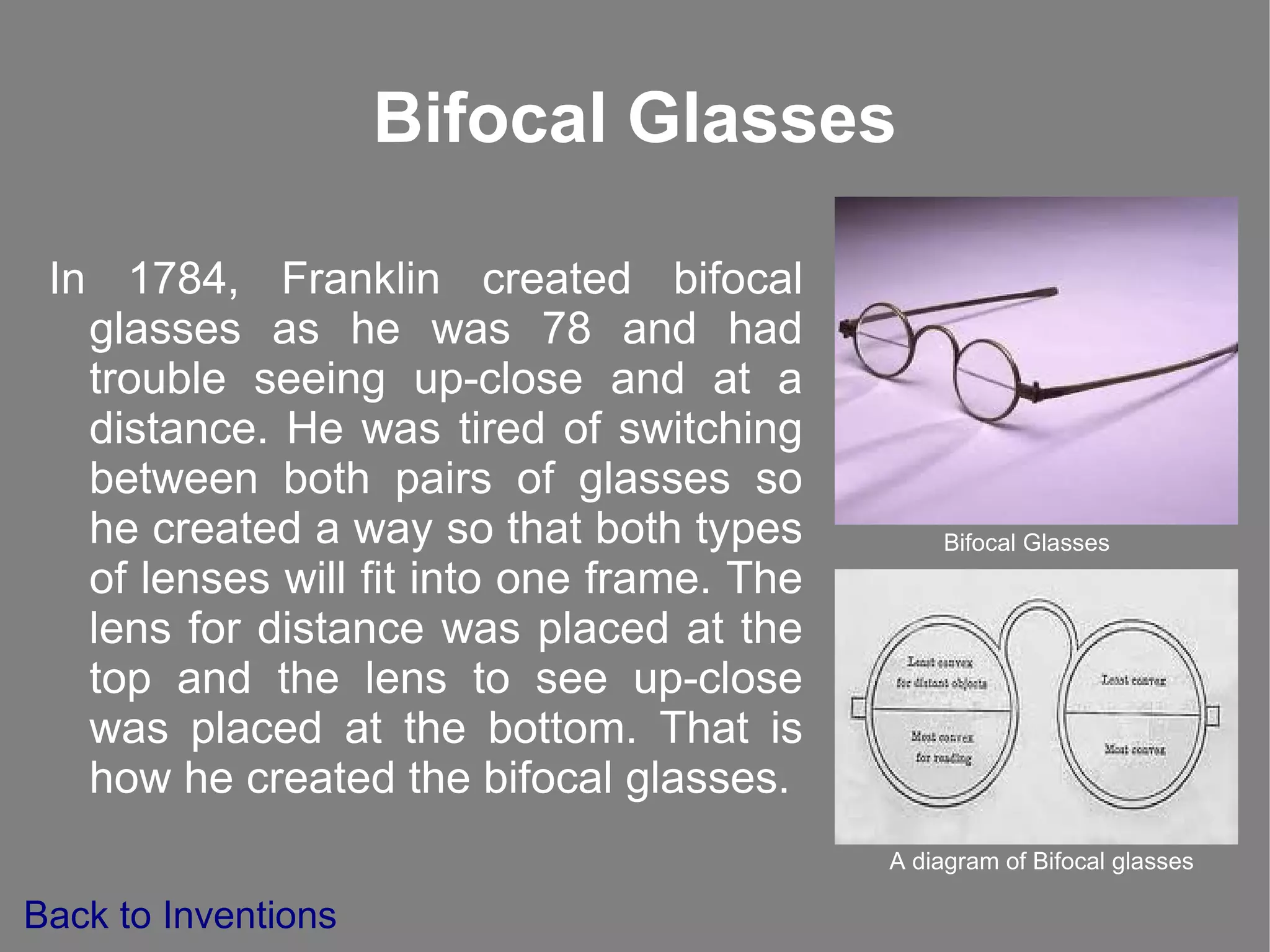
Bifocal Glasses In 1784, Franklin created bifocal glasses as he was 78 and had trouble seeing up-close and at a distance. He was tired of switching between both pairs of glasses so he created a way so that both types of lenses will fit into one frame.  The lens for distance  was placed at the top and the lens to see up-close was placed at the bottom. That is how he created the bifocal glasses. Bifocal Glasses A diagram of Bifocal glasses Back to Inventions
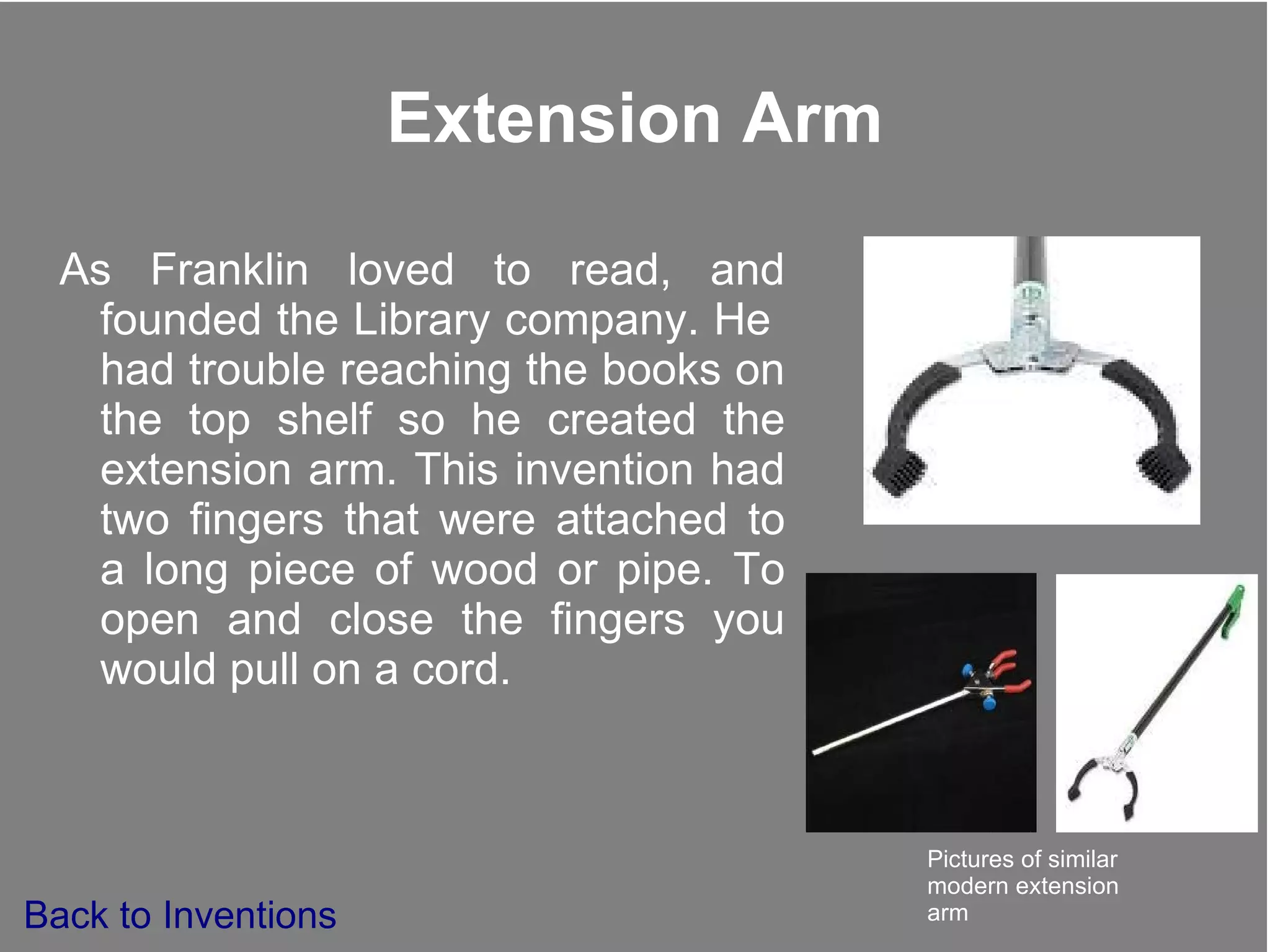
Extension Arm As Franklin loved to read, and founded the Library company. He  had trouble reaching the books on the top shelf so he created the extension arm. This invention had two fingers that were attached to a long piece of wood or pipe. To open and close the fingers you would pull on a cord. Pictures of similar modern extension arm Back to Inventions
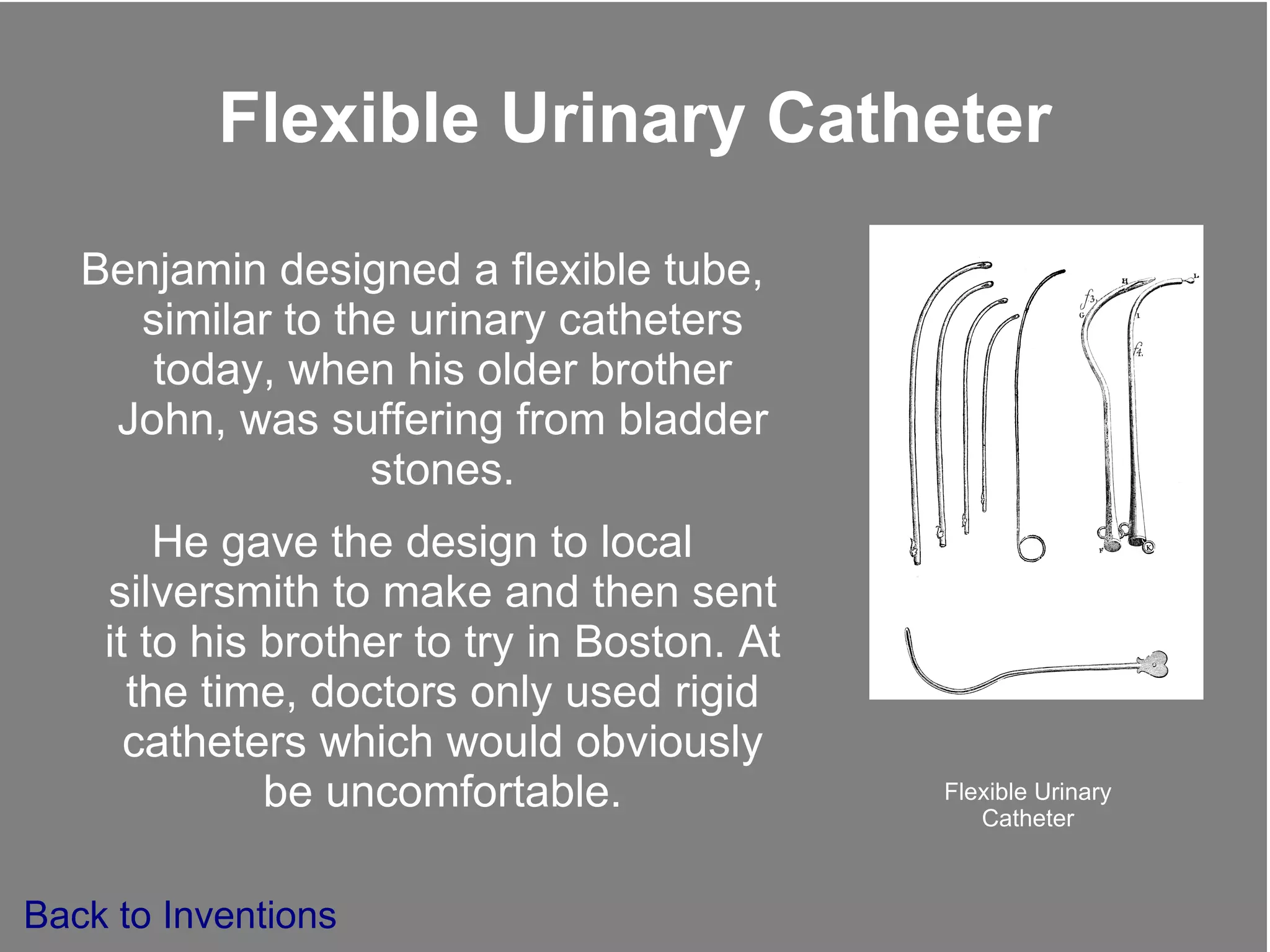
Flexible Urinary Catheter Benjamin designed a flexible tube, similar to the urinary catheters today, when his older brother John, was suffering from bladder stones. He gave the design to local silversmith to make and then sent it to his brother to try in Boston. At the time, doctors only used rigid catheters which would obviously be uncomfortable. Flexible Urinary Catheter Back to Inventions
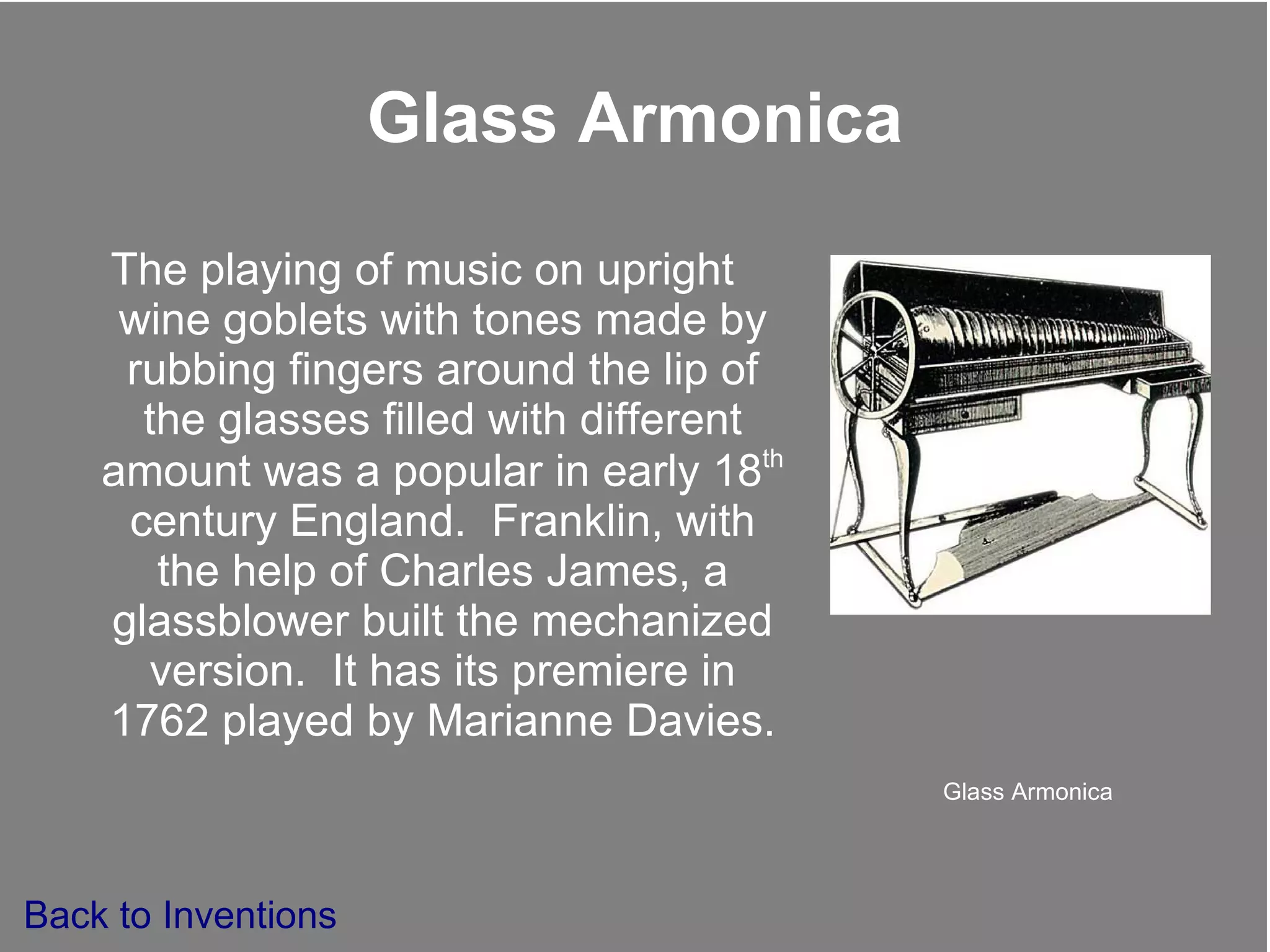
Glass Armonica The playing of music on upright wine goblets with tones made by rubbing fingers around the lip of the glasses filled with different amount was a popular in early 18 th  century England.  Franklin, with the help of Charles James, a glassblower built the mechanized version.  It has its premiere in 1762 played by Marianne Davies. Glass Armonica Back to Inventions
Franklin and Marshall College Institutions The University of Pennsylvania
American Philosophical Society
Pennsylvania Hospital
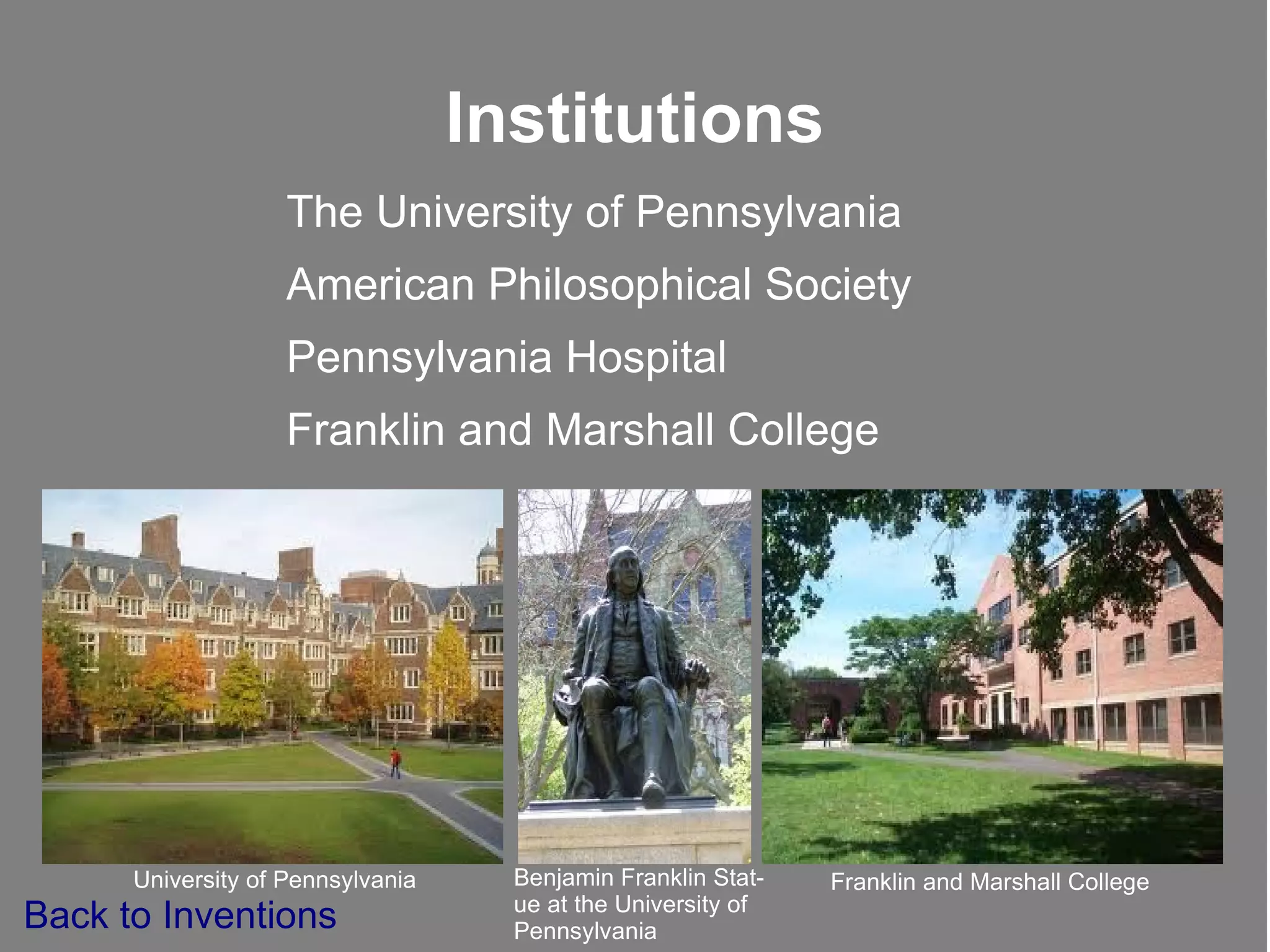
Franklin and Marshall College Benjamin Franklin Statue at the University of Pennsylvania University of Pennsylvania Franklin and Marshall College Back to Inventions
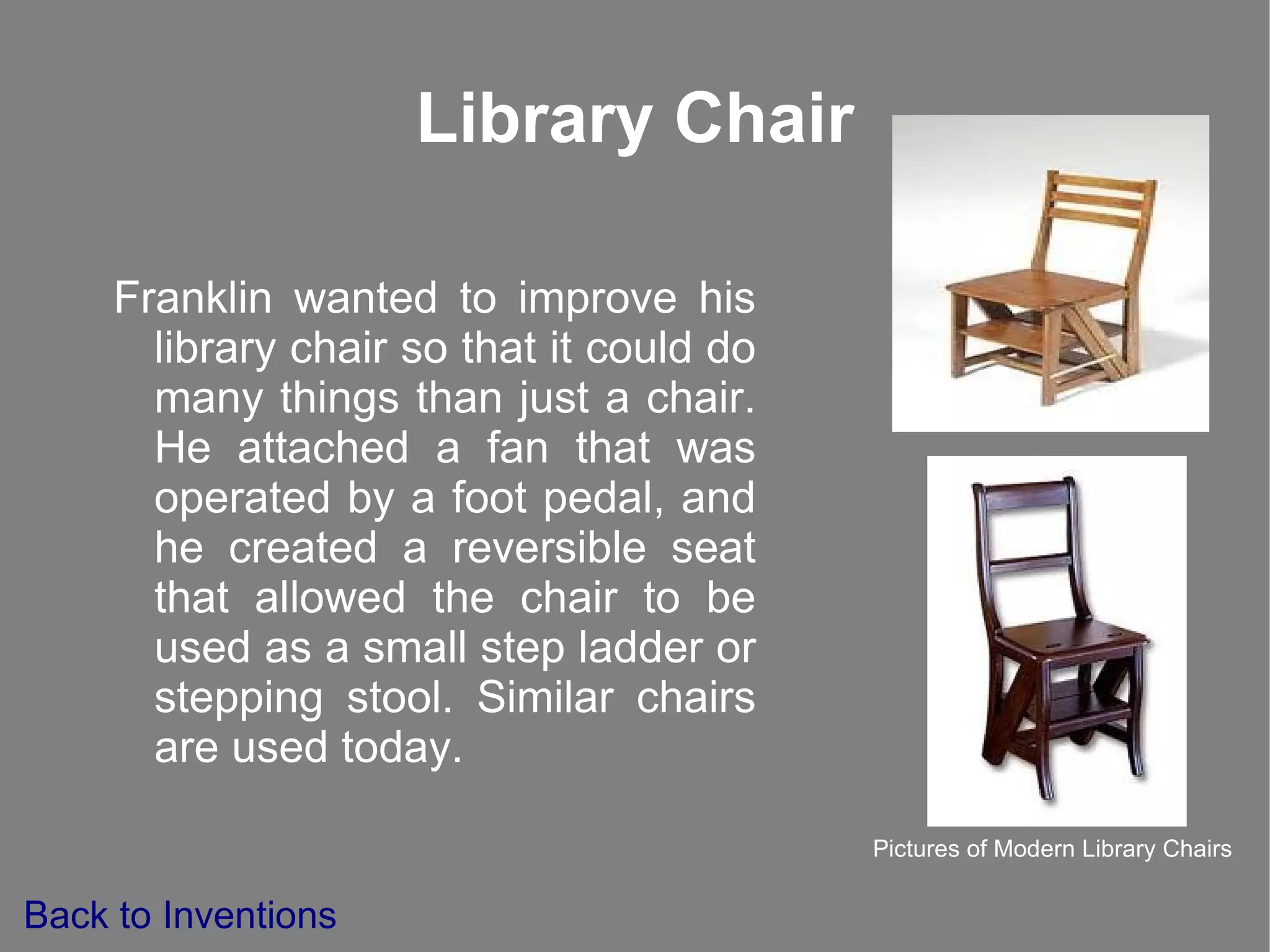
Library Chair Franklin wanted to improve his library chair so that it could do many things than just a chair. He attached a fan that was operated by a foot pedal, and he created a reversible seat that allowed the chair to be used as a small step ladder or stepping stool. Similar chairs are used today. Pictures of Modern Library Chairs Back to Inventions
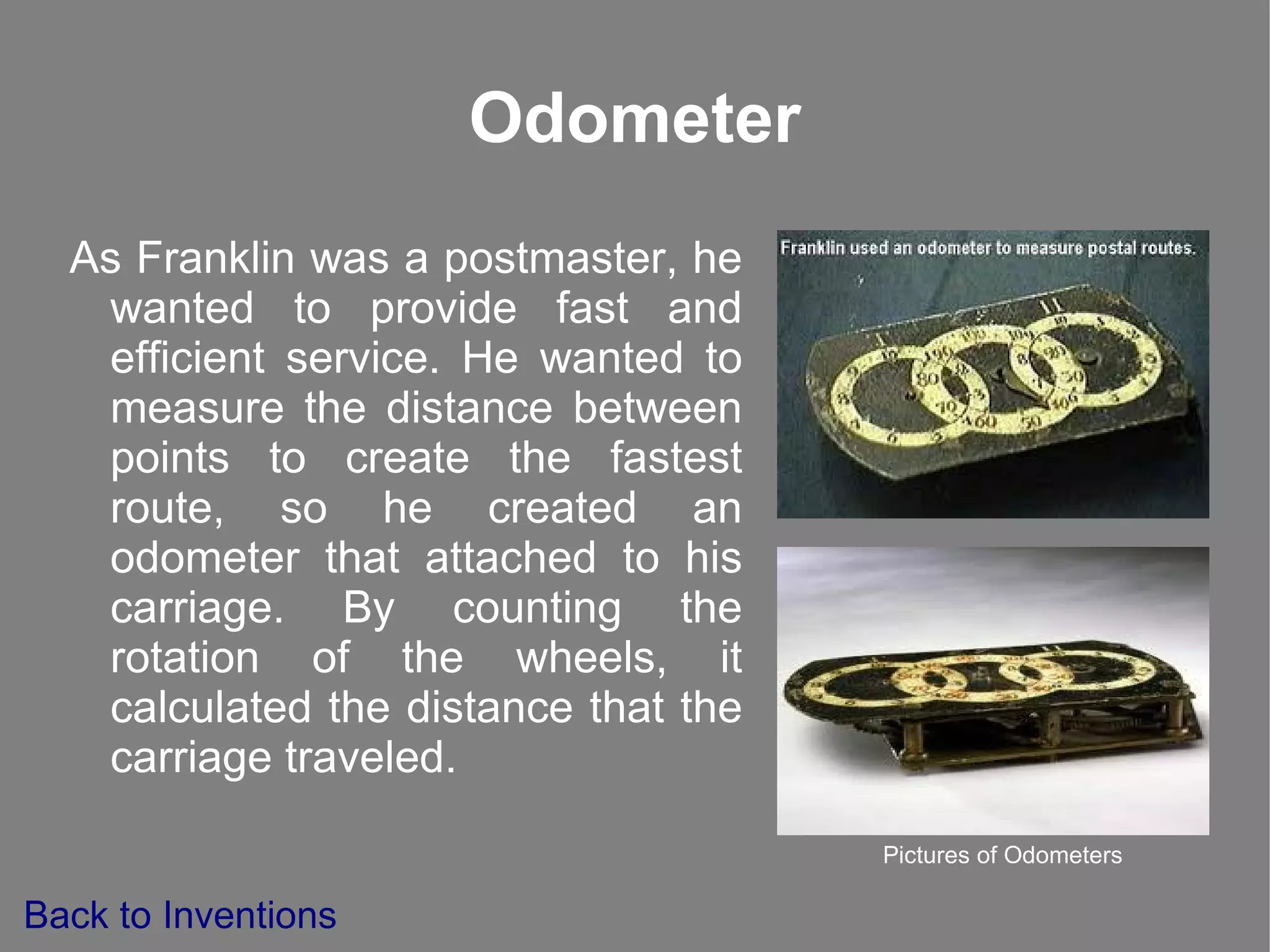
Odometer As Franklin was a postmaster, he wanted to provide fast and efficient service. He wanted to measure the distance between points to create the fastest route, so he created an odometer that attached to his carriage. By counting the rotation of the wheels, it calculated the distance that the carriage traveled. Pictures of Odometers Back to Inventions
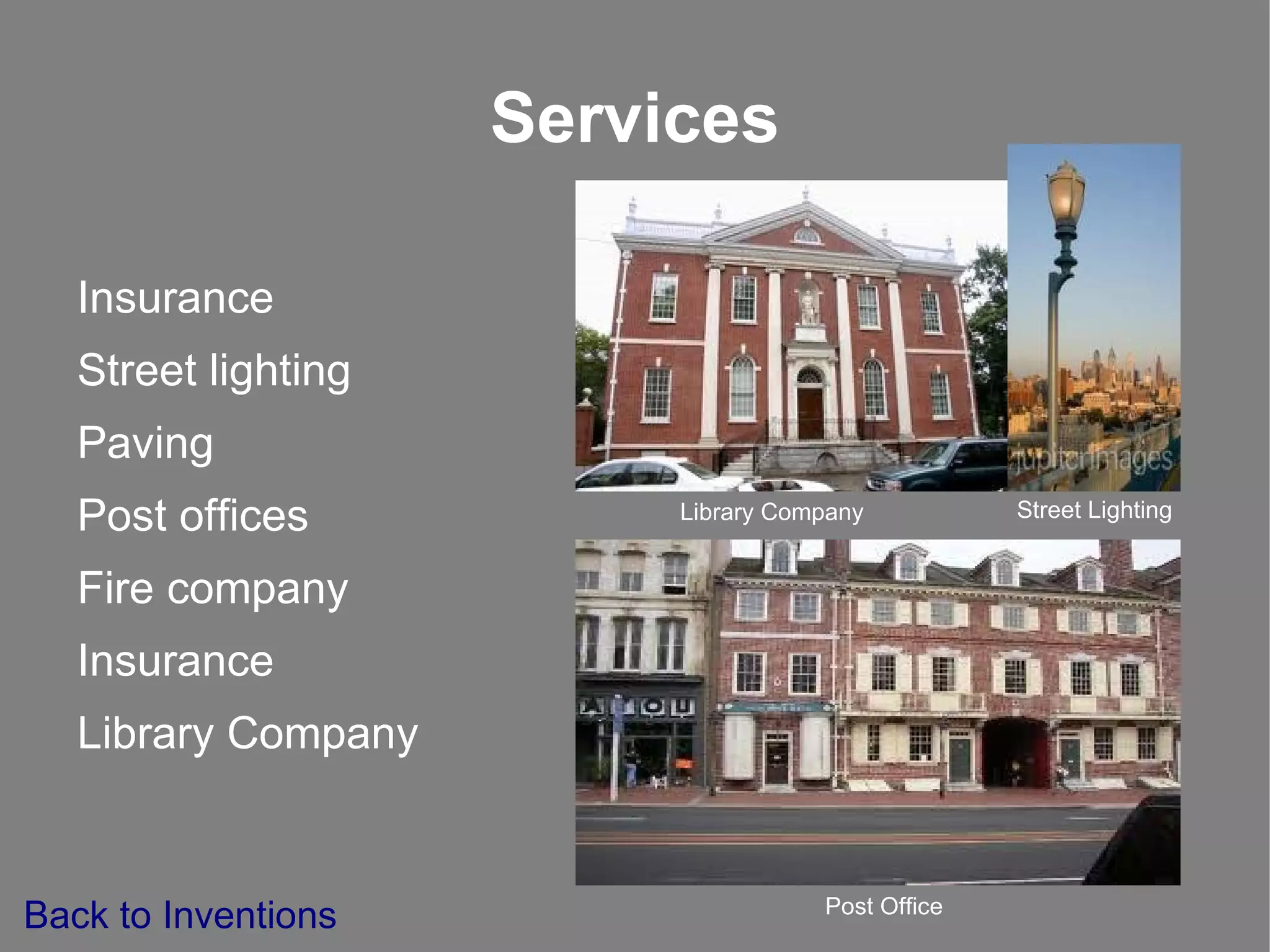
Street Lighting Services Insurance
Street lighting
Paving
Post offices
Fire company
Insurance
Library Company Library Company Post Office Street Lighting Back to Inventions
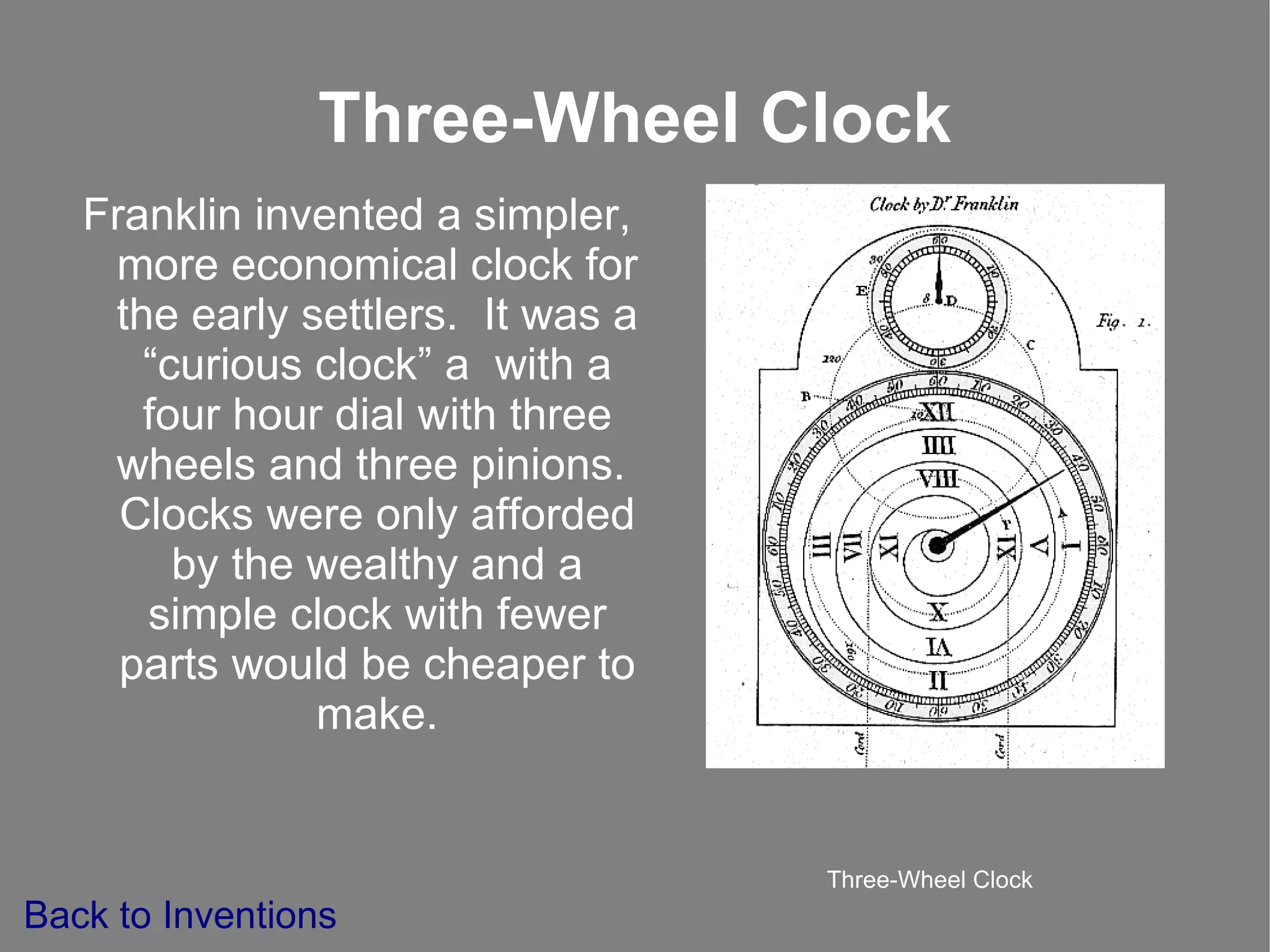
Street Lighting Three-Wheel Clock Franklin invented a simpler, more economical clock for the early settlers.  It was a “curious clock” a  with a four hour dial with three wheels and three pinions.  Clocks were only afforded by the wealthy and a simple clock with fewer parts would be cheaper to make. Three-Wheel Clock Back to Inventions
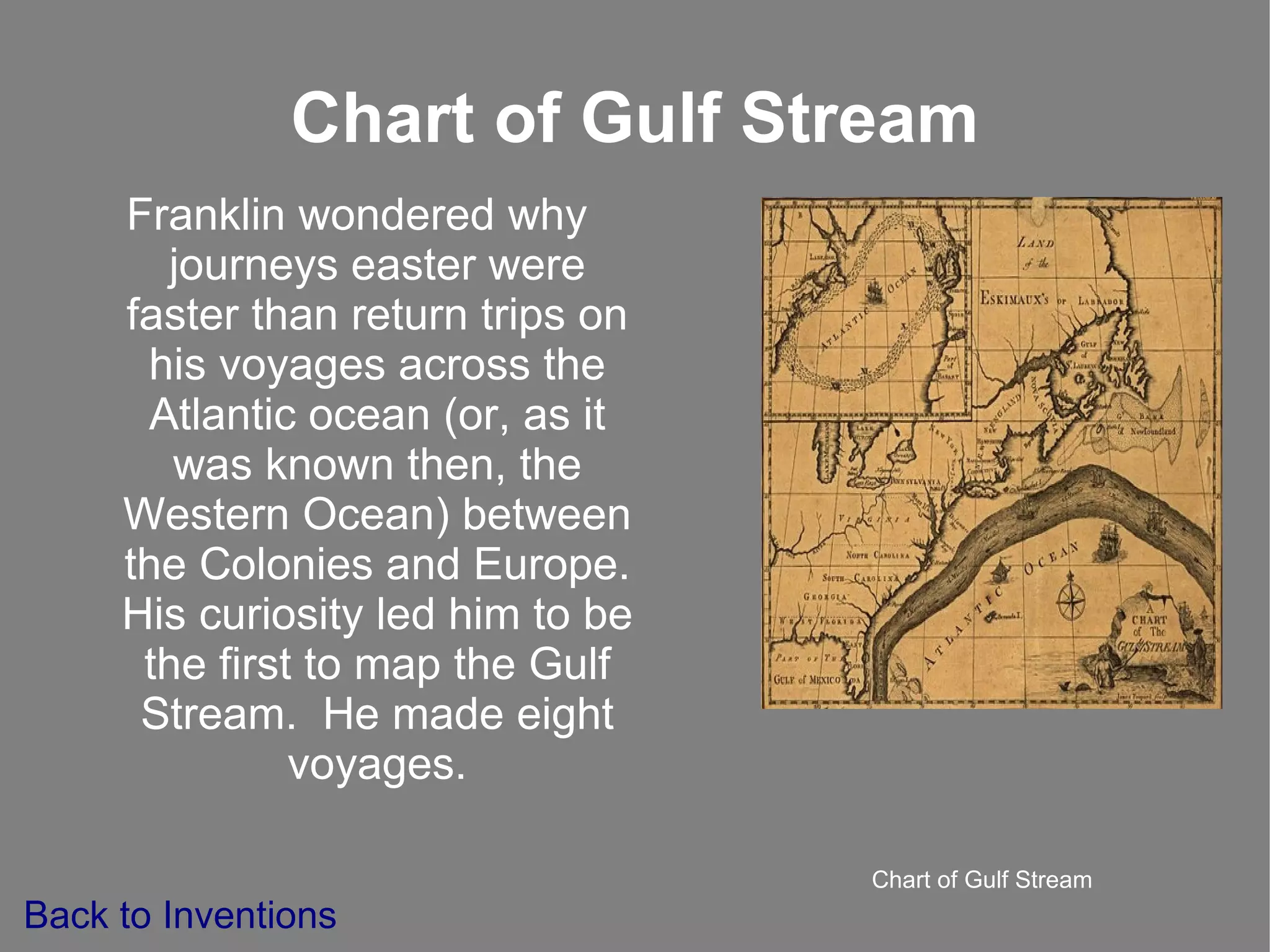
Street Lighting Chart of Gulf Stream Franklin wondered why journeys easter were faster than return trips on his voyages across the Atlantic ocean (or, as it was known then, the Western Ocean) between the Colonies and Europe. His curiosity led him to be the first to map the Gulf Stream.  He made eight voyages. Chart of Gulf Stream Back to Inventions

Biography of Benjamin Franklin

  • 1.
  • 2.
    How to UseThis Presentation I hope you enjoy this presentation and learn as much as I did! This presentation is designed to be interactive and to be used as to how you want to see the information. There is an at the beginning of the presentation that will begin your discovery of this great man, Benjamin Franklin. Use this to learn about his life, his inventions and his struggles. Just click on any text to start your adventure! index index
  • 3.
    Benjamin Franklin liveda busy and industrious life spanning 84 years. 1706 -1718 1718 1730 - 1745 1728-1748 1747 - 1752 1757 - 1790 1790 Index Birth and Childhood Apprenticeship Inventions Vocation Family References Political Life Old Age and Death
  • 4.
    Benjamin Franklin wasborn on January 17, 1706 in Boston, Massachusetts. He was the fifteenth child of seventeen children and also the youngest boy. Franklin only had two years of school but continued to educate himself by reading. Birth and Childhood Back to Index A picture of Benjamin Franklin
  • 5.
    Apprenticeship When Franklinwas 12 became a printing apprentice to his brother James, a printer. His brother owned the New England Courant. As James did not allow Franklin to write for the newspaper, Franklin wrote letters to the paper as a middle-aged woman named ''Silence Dogood''. At 17 years old, Franklin ran away to Philadelphia, Pennsylvania as his brother found out that he was the one who was writing the letters. Back to Index Franklin as an apprentice.
  • 6.
    Family Wife: DeborahRead Rogers (1708-1774) Son: William Franklin (1731-1813) Son: Francis Folger Franklin (1732-1736) Daughter : Sarah Franklin Bache (1743-1808) In 1730, Franklin married Deborah Read Rogers. Then a year later (1731), Franklin's son William Franklin was born. Francis Folger Franklin, was born a year later. In 1736, at the age of four, Francis died from smallpox. Then in 1743, his daughter Sarah Franklin Bache was born. Family Back to Index
  • 7.
    Inventions Inventions contributingto Earth Science Bifocal Glasses Extension Arm Franklin Stove Library Chair Lightning Rod Swim Fins Odometer Institutions New Words Services Back to Index Flexible Urinary Catheter Glass Armonica Three-Wheel Clock Chart of the Gulf Stream Daylight Savings Time
  • 8.
    Bifocal Glasses In1784, Franklin created bifocal glasses as he was 78 and had trouble seeing up-close and at a distance. He was tired of switching between both pairs of glasses so he created a way so that both types of lenses will fit into one frame. The lens for distance was placed at the top and the lens to see up-close was placed at the bottom. That is how he created the bifocal glasses. Bifocal Glasses A diagram of Bifocal glasses Back to Inventions
  • 9.
    Extension Arm AsFranklin loved to read, and founded the Library company. He had trouble reaching the books on the top shelf so he created the extension arm. This invention had two fingers that were attached to a long piece of wood or pipe. To open and close the fingers you would pull on a cord. Pictures of similar modern extension arm Back to Inventions
  • 10.
    Flexible Urinary CatheterBenjamin designed a flexible tube, similar to the urinary catheters today, when his older brother John, was suffering from bladder stones. He gave the design to local silversmith to make and then sent it to his brother to try in Boston. At the time, doctors only used rigid catheters which would obviously be uncomfortable. Flexible Urinary Catheter Back to Inventions
  • 11.
    Glass Armonica Theplaying of music on upright wine goblets with tones made by rubbing fingers around the lip of the glasses filled with different amount was a popular in early 18 th century England. Franklin, with the help of Charles James, a glassblower built the mechanized version. It has its premiere in 1762 played by Marianne Davies. Glass Armonica Back to Inventions
  • 12.
    Franklin and MarshallCollege Institutions The University of Pennsylvania
  • 13.
  • 14.
  • 15.
    Franklin and MarshallCollege Benjamin Franklin Statue at the University of Pennsylvania University of Pennsylvania Franklin and Marshall College Back to Inventions
  • 16.
    Library Chair Franklinwanted to improve his library chair so that it could do many things than just a chair. He attached a fan that was operated by a foot pedal, and he created a reversible seat that allowed the chair to be used as a small step ladder or stepping stool. Similar chairs are used today. Pictures of Modern Library Chairs Back to Inventions
  • 17.
    Odometer As Franklinwas a postmaster, he wanted to provide fast and efficient service. He wanted to measure the distance between points to create the fastest route, so he created an odometer that attached to his carriage. By counting the rotation of the wheels, it calculated the distance that the carriage traveled. Pictures of Odometers Back to Inventions
  • 18.
  • 19.
  • 20.
  • 21.
  • 22.
  • 23.
  • 24.
    Library Company LibraryCompany Post Office Street Lighting Back to Inventions
  • 25.
    Street Lighting Three-WheelClock Franklin invented a simpler, more economical clock for the early settlers. It was a “curious clock” a with a four hour dial with three wheels and three pinions. Clocks were only afforded by the wealthy and a simple clock with fewer parts would be cheaper to make. Three-Wheel Clock Back to Inventions
  • 26.
    Street Lighting Chartof Gulf Stream Franklin wondered why journeys easter were faster than return trips on his voyages across the Atlantic ocean (or, as it was known then, the Western Ocean) between the Colonies and Europe. His curiosity led him to be the first to map the Gulf Stream. He made eight voyages. Chart of Gulf Stream Back to Inventions
  • 27.
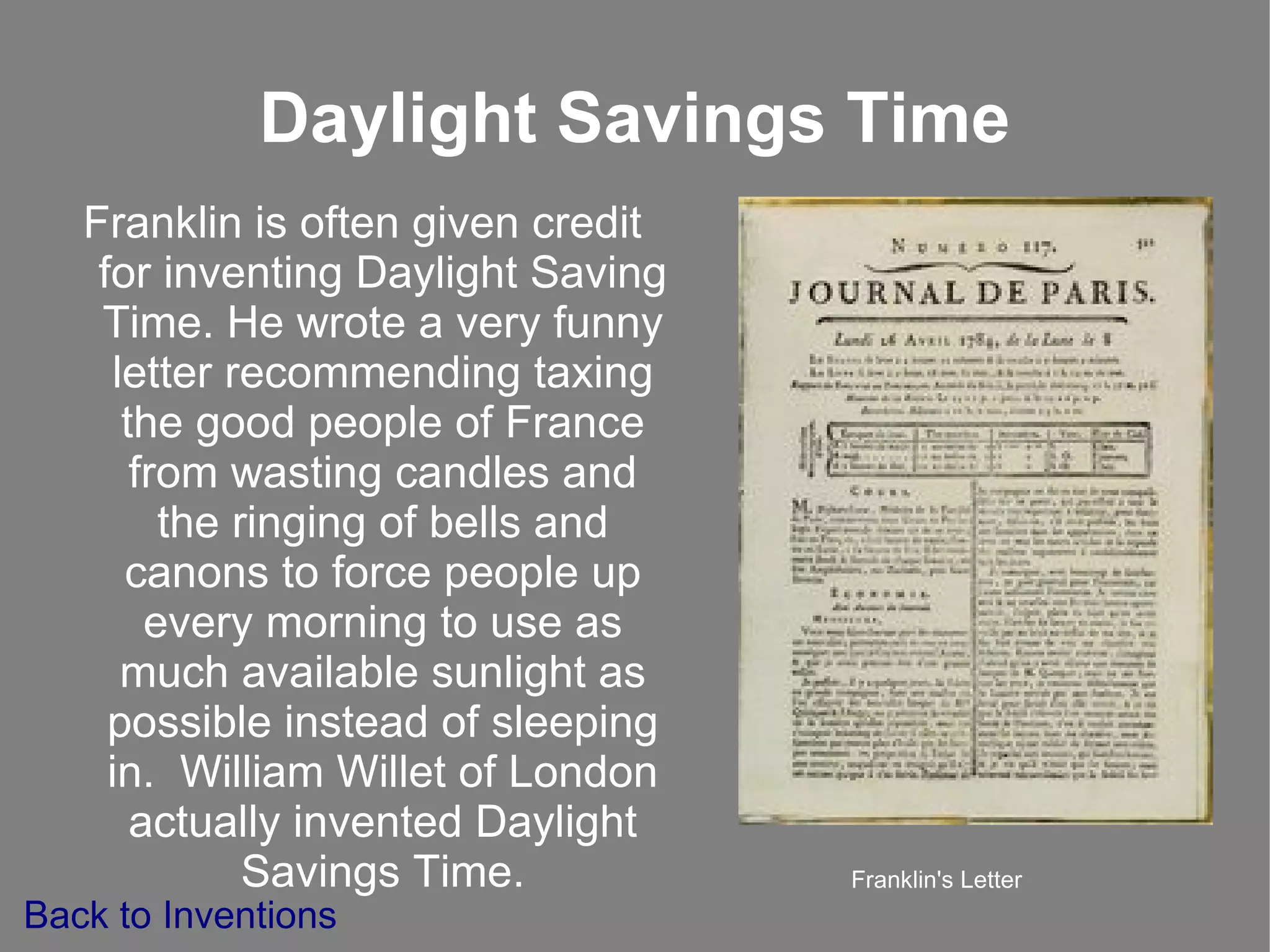
    Street Lighting DaylightSavings Time Franklin is often given credit for inventing Daylight Saving Time. He wrote a very funny letter recommending taxing the good people of France from wasting candles and the ringing of bells and canons to force people up every morning to use as much available sunlight as possible instead of sleeping in. William Willet of London actually invented Daylight Savings Time. Franklin's Letter Back to Inventions
  • 28.
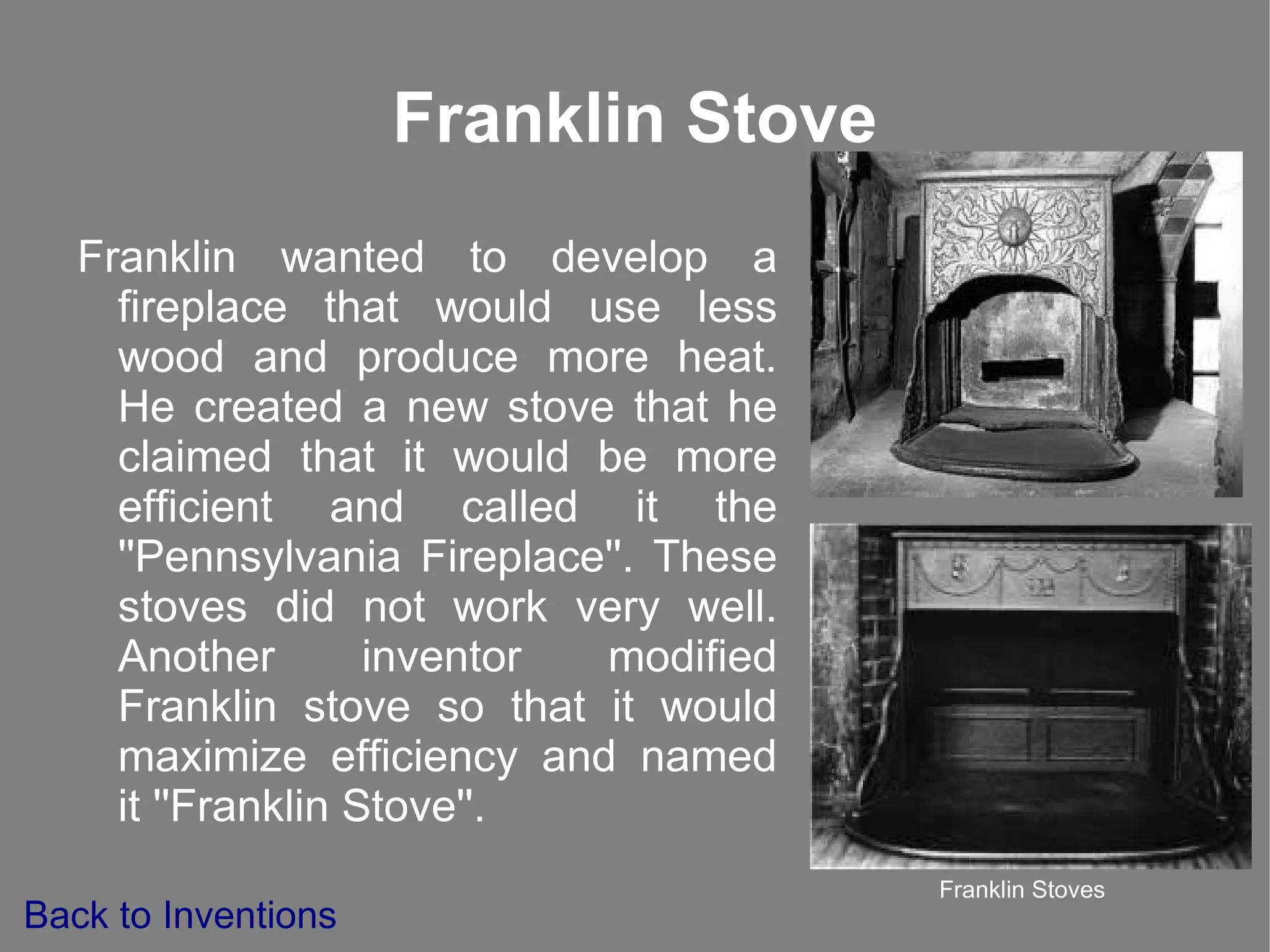
    Franklin Stove Franklinwanted to develop a fireplace that would use less wood and produce more heat. He created a new stove that he claimed that it would be more efficient and called it the '' Pennsylvania Fireplace''. These stoves did not work very well. Another inventor modified Franklin stove so that it would maximize efficiency and named it ''Franklin Stove''. Franklin Stoves Back to Inventions
  • 29.
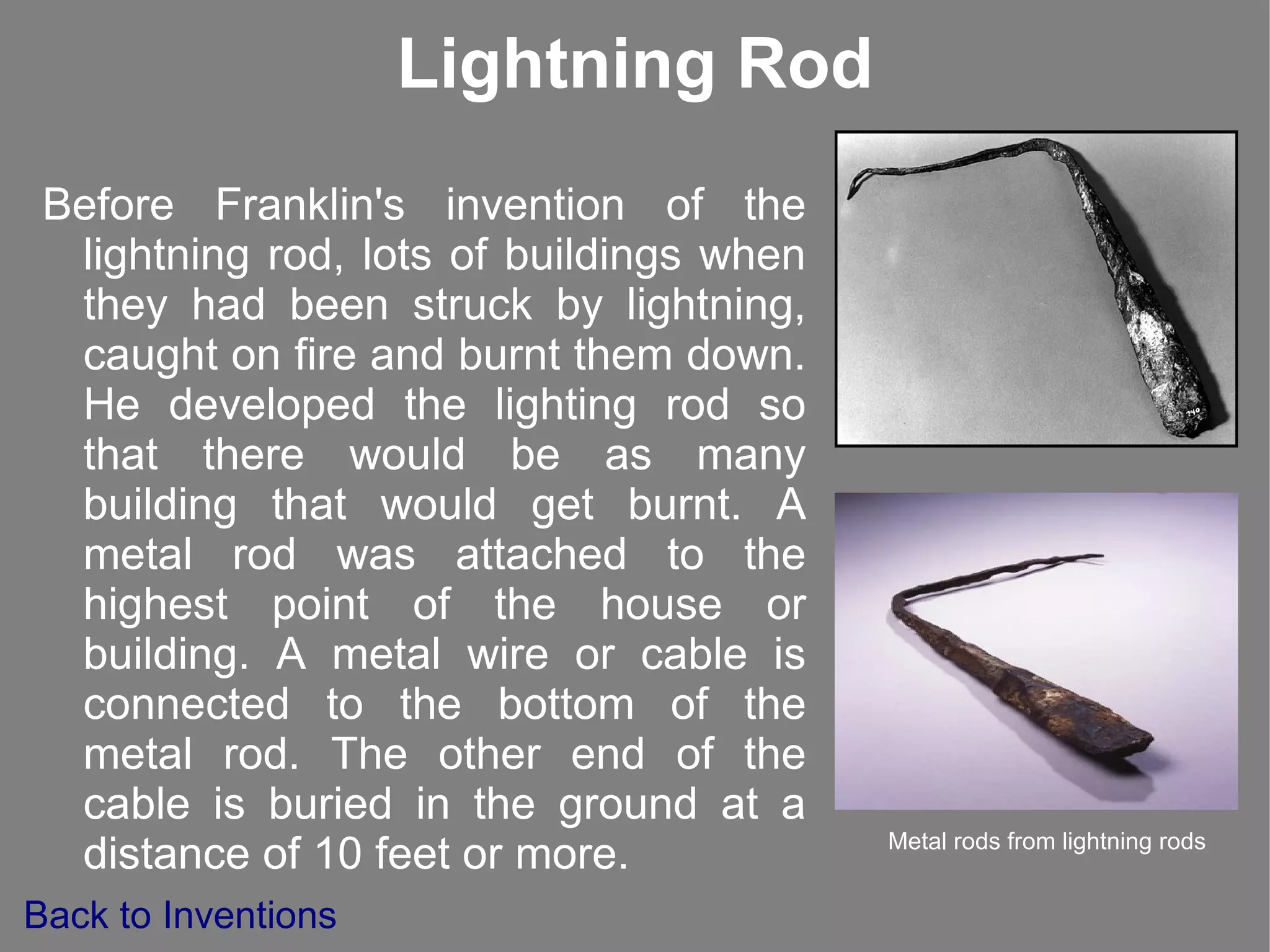
    Lightning Rod BeforeFranklin's invention of the lightning rod, lots of buildings when they had been struck by lightning, caught on fire and burnt them down. He developed the lighting rod so that there would be as many building that would get burnt. A metal rod was attached to the highest point of the house or building. A metal wire or cable is connected to the bottom of the metal rod. The other end of the cable is buried in the ground at a distance of 10 feet or more. Metal rods from lightning rods Back to Inventions
  • 30.
    New Words WhenFranklin was in the middle of studying electricity, he found that English did not have words to explain the wonder that he had just discovered. He created many words that are still used today. They are: battery
  • 31.
  • 32.
  • 33.
  • 34.
  • 35.
  • 36.
  • 37.
    armature Back toInventions
  • 38.
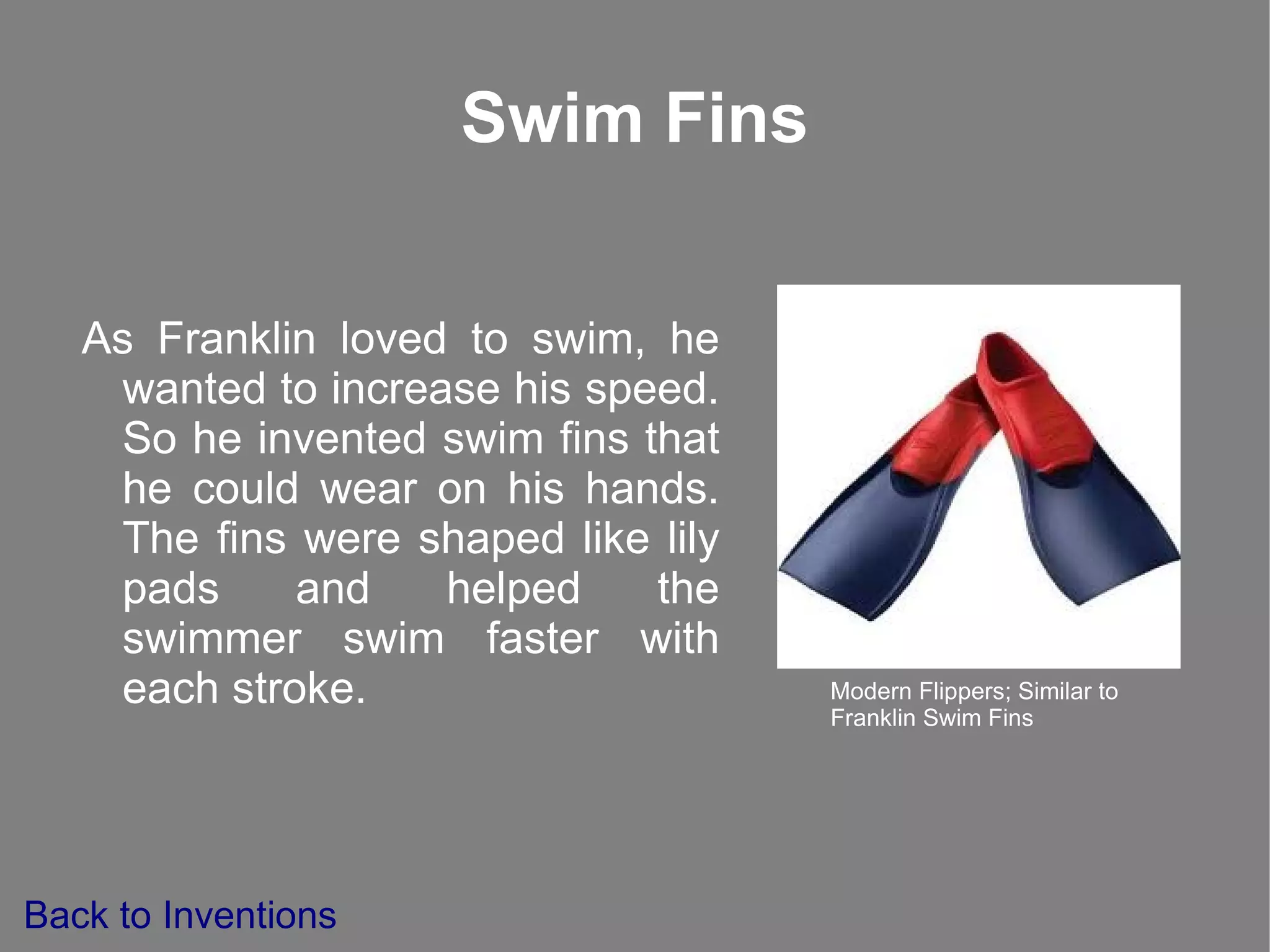
    Swim Fins AsFranklin loved to swim, he wanted to increase his speed. So he invented swim fins that he could wear on his hands. The fins were shaped like lily pads and helped the swimmer swim faster with each stroke. Modern Flippers; Similar to Franklin Swim Fins Back to Inventions
  • 39.
    1732-1758 1737 17421747 1748 1729 1728 Vocation 1728: Franklin opens his own printing office in Philadelphia 1729: Becomes the sole owner and publisher of the Pennsylvania Gazette. 1732-1758: Franklin publishes Poor Richard's Almanack annually. 1742: Suggest the idea for the University of Pennsylvania. 1737: Appointed Postmaster of Philadelphia. 1747: Franklin organizes the first Militia Back to Index
  • 40.
    Political Life 1736- 1751 Clerk, Pennsylvania Assembly
  • 41.
    1751 - 1764Represented Philadelphia at the Pennsylvania Assembly
  • 42.
    1754 Represented Pennsylvaniaat the Albany Congress
  • 43.
    1757 - 1762Political agent of the Pennsylvania Assembly, London, England
  • 44.
    1766 Reappointed asagent for Pennsylvania, London, England
  • 45.
    1775 Left London,England, for Massachusetts: Elected member of the Second Continental Congress Named postmaster general
  • 46.
    1776 Served oncommittee to draft the Declaration of Independence
  • 47.
    Went to Franceas one of three American commissioners to negotiate a treaty
  • 48.
    1778 Negotiated treatiesof commerce and defense with France Appointed sole plenipotentiary in France
  • 49.
    1781 Appointed withJohn Jay and John Adams to negotiate a peace with Great Britain
  • 50.
    1783 Signed Treatyof Paris with Great Britain and asked Congress for his recall
  • 51.
    1785 - 1788President, Supreme Executive Council of Pennsylvania
  • 52.
    1787 Signed memorialto Congress as last official act as president of the Pennsylvania Society for Promoting the Abolition of Slavery1790 Back to Index
  • 53.
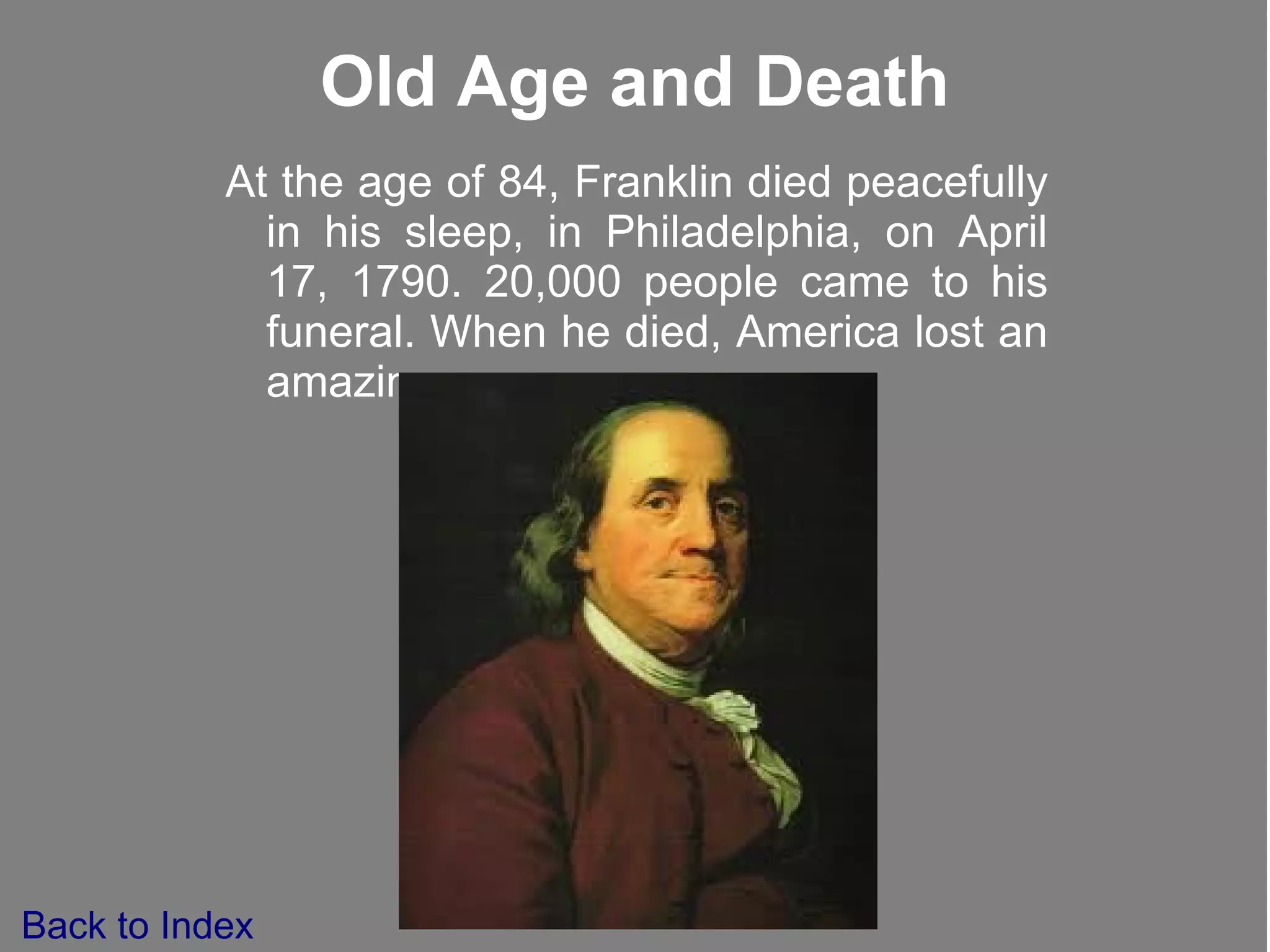
    Old Age andDeath At the age of 84, Franklin died peacefully in his sleep, in Philadelphia, on April 17, 1790. 20,000 people came to his funeral. When he died, America lost an amazing person. Back to Index
  • 54.
    References http://fi.edu/franklin/timeline/timeline.html http://americanhistory.about.com/od/colonialamerica/p/bio_franklin.htmhttp://inventors.about.com/od/fstartinventors/ss/Franklin_invent_4.htm http://www.ehow.com/list_6875821_list-franklin_s-inventions.html Back to Index