Project Title:
Biodiesel production from
waste oil cooking.
Submitted by:
Laith Ismail, Adel Altamre
Under the supervision of:
Dr. Zakaria Alomari
Introduction
• Converting waste cooking oil to biodiesel is an eco-friendly
solution that reduces waste and provides a renewable energy
source. This process involves transforming used cooking oil into a
clean-burning fuel, contributing to a more sustainable future.
• A world where the used cooking oil from our kitchens, instead of
being discarded, becomes a powerful source of clean and
renewable energy. Today, we embark on a journey to unravel the
potential of converting waste cooking oil into biodiesel, a fuel that
not only powers engines but also helps us in our collective pursuit
of a greener planet.
• Biodiesel production is the process of converting waste cooking oil
into a sustainable and eco-friendly alternative to traditional diesel
fuel. It involves a series of steps including collection of waste oil,
transesterification process, and quality control testing.
What is Biodiesel?
1- Renewable Fuel Source ⚡
Biodiesel is a renewable fuel that can be produced
from various organic sources, including waste
cooking oil, animal fats, and vegetable oils.
2- Environmentally Friendly
It is biodegradable, non-toxic, and significantly
reduces harmful emissions, making it a cleaner
alternative to traditional diesel fuel.
3- Energy Independence
By utilizing biodiesel, we can reduce our reliance on
fossil fuels and promote energy independence for a
sustainable future.
Objectives of our project:
• Environmental Sustainability. 🌱
(Reducing the environmental impact by converting waste
into a valuable resource).
• Public Awareness and Education:
(Increase public awareness about the benefits of biodiesel
production from waste cooking oil.).
• Economic Efficiency. 💰
(Creating a cost-effective and sustainable energy source
for various applications).
• Quality Assurance.
(Ensure the produced biodiesel meets established quality
standards).
Benefits of Converting
Waste Cooking Oil to Biodiesel:
• Renewable and Sustainable.
• Improved Air Quality.
• Reduced Dependence on Fossil Fuels.
• Waste Utilization.
• Support for Agriculture.
• Biodegradable and Non-Toxic.
• Potential for Local Production.
• Renewable Job Creation.
• Reduced Greenhouse Gas Emissions.
Methods of Converting Waste
Cooking Oil to Biodiesel:
• Chemical Processes.
(Chemical reactions, such as transesterification, play a
pivotal role in converting waste cooking oil into high-
quality biodiesel).
• Biological Conversion
(Biological methods utilize enzymes or microorganisms to
break down waste cooking oil and produce biodiesel in an
eco-friendly manner).
• Physical Refining Processes
(Physical methods like filtration and distillation are used to
remove impurities and transform waste cooking oil into
biodiesel).
Comparison of Biodiesel
Properties with
Conventional Diesel:
Biodiesel Conventional Diesel
Renewable Non-renewable
Biodegradable Persists in the Environment
Lower Emissions Higher Emissions
Methodology for the
Biodiesel production:
• Oil Collection.
(The first step involves the collection of used cooking oil
from various sources such as restaurants and
households).
• Transformation Process.
(The waste oil undergoes a chemical process called
transesterification, where it is transformed into
biodiesel and glycerin).
• Quality Control.
(The newly formed biodiesel is purified to meet industry
standards and ensure high-quality fuel).
Applications of Biodiesel:
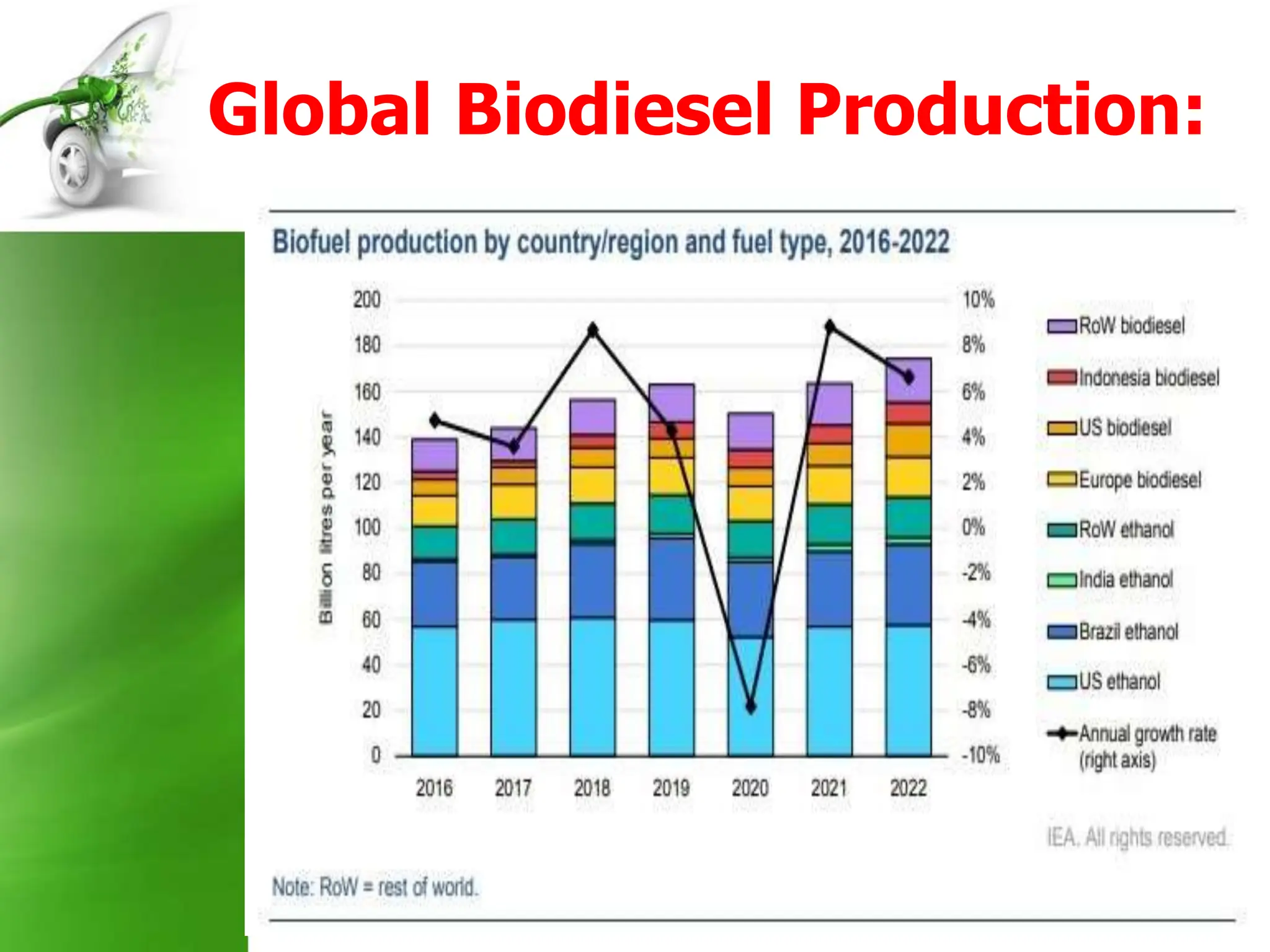
Global Biodiesel Production:
Factors Affecting Biodiesel
Production Efficiency:
1. Oil Quality:
Processed and filtered
waste cooking oil yields
higher quality biodiesel.
2. Catalyst Selection:
The choice of catalyst
greatly influences the
efficiency of the biodiesel
conversion process.
3. Process Parameters:
Temperature, pressure, and
reaction time play vital roles
in the efficiency of biodiesel
production.
Disadvantages and challenges of
biodiesel and suggested solutions:
1. Feedstock Availability and Competition:
– Challenge: The availability and competition for
feedstock, such as vegetable oils and animal fats,
can impact biodiesel production costs.
– Solution: Explore alternative feedstock, such as
algae, waste oils, or non-food crops, to reduce
competition with food production and enhance
feedstock availability.
2. Land Use and Competition with Food Crops:
– Challenge: Biodiesel production may compete
with food crops for arable land, leading to concerns
about land use change and food security.
– Solution: Promote sustainable practices, such as
using marginal or non-agricultural land for
feedstock cultivation, and support the development
of second-generation biofuels from non-food
biomass.
Disadvantages and challenges of
biodiesel and suggested solutions:
3. High Production Costs:
– Challenge: Biodiesel production can be more
expensive than traditional diesel production,
affecting competitiveness.
– Solution: Invest in research and technology to
optimize production processes, explore cost-
effective feedstock, and leverage economies of
scale to reduce production costs.
4. Energy-Intensive Production:
– Challenge: The transesterification process can be
energy-intensive, impacting the overall energy
balance.
– Solution: Implement energy-efficient production
methods, explore innovative catalysts and
processes, and integrate renewable energy sources
into biodiesel production facilities.
Disadvantages and challenges of
biodiesel and suggested solutions:
5. Limited Feedstock Options:
– Challenge: Reliance on specific feedstock may
limit sustainability and availability.
– Solution: Promote research and development of
new feedstock with better environmental profiles
and explore multi-feedstock approaches to enhance
flexibility.
6. Cold Weather Performance:
– Challenge: Biodiesel has higher cloud and gel
points, impacting cold weather performance.
– Solution: Blend biodiesel with traditional diesel or
use additives to improve cold flow properties.
Develop biodiesel formulations optimized for
various climates.
Disadvantages and challenges of
biodiesel and suggested solutions:
7. Storage Stability and Oxidation:
– Challenge: Biodiesel is more prone to oxidation
and has lower storage stability.
– Solution: Implement proper storage and handling
practices, use antioxidants, and explore additives to
enhance biodiesel stability during storage.
8. Engine Compatibility and Modifications:
– Challenge: Older engines may require
modifications to handle biodiesel blends.
– Solution: Promote the use of compatible engines
and support engine manufacturers in developing
engines optimized for biodiesel. Provide clear
guidelines for engine modifications.
Disadvantages and challenges of
biodiesel and suggested solutions:
9. Glycerine By-product Management:
– Challenge: Managing glycerine by-products from
the transesterification process.
– Solution: Explore alternative uses for glycerine,
such as in pharmaceuticals, cosmetics, or industrial
applications. Develop processes for converting
glycerine into value-added products.
10. Infrastructure Compatibility:
– Challenge: Compatibility issues in existing fuel
infrastructure.
– Solution: Upgrade infrastructure components to
be compatible with biodiesel blends. Develop
guidelines and standards for infrastructure
compatibility.
Disadvantages and challenges of
biodiesel and suggested solutions:
11. Land Use Change and Environmental Impact:
– Challenge: The expansion of biodiesel feedstock
cultivation may lead to land use change and
environmental impacts.
– Solution: Promote sustainable land use practices,
adhere to certification standards, and encourage
the use of degraded or marginal lands for feedstock
cultivation.
12. Water Consumption:
– Challenge: Certain biodiesel feedstock may
require significant water resources.
– Solution: Promote water-efficient feedstock
cultivation practices, explore drought-resistant
crops, and prioritize feedstock with lower water
requirements.
Literature Review:
• Biodiesel production from waste cooking oil: A
brief review: sciencedirect
In terms of biodiesel generation from waste cooking oil (WCO),
the following significant factors were emphasized. Biodiesel has
been proven to be the most effective alternative to fossil fuels.
Because it is renewable, biodegradable, and non-toxic, it
outperforms petroleum-based fuels. WCO has a lot of potential
as a biodiesel source material because of how much waste
cooking oil is created around the world. WCO is more likely
than other raw materials to play a larger part in future biodiesel
manufacturing due to its lower cost. WCO, on the other hand,
necessitates a number of pretreatment steps in order to remove
solid impurities and reduce FFA and water content. The
transesterification process is used in biodiesel synthesis under
the influence of many parameters such as temperature,
reaction time, catalyst concentration, and oil molar ratio to
alcohol. Biodiesel has a number of advantages over diesel,
including a higher cetane number, lower ash percentage, and
lower carbon residue. It also features improved engine ignition
and emission performance.
Literature Review:
• Biodiesel feedstock selection strategies based
on economic, technical, and sustainable
aspects sciencedirect
(Studies consistently emphasize the critical role of
feedstock quality in biodiesel production. High-quality
waste cooking oil, free from contaminants and impurities,
is crucial for optimizing yield and maintaining biodiesel
quality).
• Quality Over Quantity ResearchGate
(Researchers emphasize prioritizing high-quality waste
cooking oil to ensure superior biodiesel output).
Future Prospects and
Advancements in Biomass
Recycling:
• Enhanced Production Efficiency
New technologies and methodologies aim to optimize the
efficiency of biodiesel production, making it more cost-
effective and sustainable.
• Integration of Renewable Resources
Advancements will focus on integrating renewable
resources and waste products into the biodiesel
production process, minimizing environmental impact.
• Global Implementation of Standards
Efforts are underway to establish international quality and
sustainability standards for biodiesel derived from waste
cooking oil, driving global adoption.
Conclusion:
Towards Sustainable Biodiesel
• In closing, our exploration of biodiesel
production from waste cooking oil reveals a
promising avenue for sustainable energy.
From feedstock quality to innovative catalysts
and efficient collection systems, the journey is
multifaceted. As we navigate this path,
collaboration, continuous research, and a
commitment to environmental responsibility
stand as cornerstones. Biodiesel from waste
cooking oil holds the potential to be a key
player in our pursuit of cleaner, greener
energy solutions.
Biodiesel production from Waste Cooking Oil powerpoint project.pptx

Biodiesel production from Waste Cooking Oil powerpoint project.pptx

  • 1.
    Project Title: Biodiesel productionfrom waste oil cooking. Submitted by: Laith Ismail, Adel Altamre Under the supervision of: Dr. Zakaria Alomari
  • 2.
    Introduction • Converting wastecooking oil to biodiesel is an eco-friendly solution that reduces waste and provides a renewable energy source. This process involves transforming used cooking oil into a clean-burning fuel, contributing to a more sustainable future. • A world where the used cooking oil from our kitchens, instead of being discarded, becomes a powerful source of clean and renewable energy. Today, we embark on a journey to unravel the potential of converting waste cooking oil into biodiesel, a fuel that not only powers engines but also helps us in our collective pursuit of a greener planet. • Biodiesel production is the process of converting waste cooking oil into a sustainable and eco-friendly alternative to traditional diesel fuel. It involves a series of steps including collection of waste oil, transesterification process, and quality control testing.
  • 3.
    What is Biodiesel? 1-Renewable Fuel Source ⚡ Biodiesel is a renewable fuel that can be produced from various organic sources, including waste cooking oil, animal fats, and vegetable oils. 2- Environmentally Friendly It is biodegradable, non-toxic, and significantly reduces harmful emissions, making it a cleaner alternative to traditional diesel fuel. 3- Energy Independence By utilizing biodiesel, we can reduce our reliance on fossil fuels and promote energy independence for a sustainable future.
  • 4.
    Objectives of ourproject: • Environmental Sustainability. 🌱 (Reducing the environmental impact by converting waste into a valuable resource). • Public Awareness and Education: (Increase public awareness about the benefits of biodiesel production from waste cooking oil.). • Economic Efficiency. 💰 (Creating a cost-effective and sustainable energy source for various applications). • Quality Assurance. (Ensure the produced biodiesel meets established quality standards).
  • 5.
    Benefits of Converting WasteCooking Oil to Biodiesel: • Renewable and Sustainable. • Improved Air Quality. • Reduced Dependence on Fossil Fuels. • Waste Utilization. • Support for Agriculture. • Biodegradable and Non-Toxic. • Potential for Local Production. • Renewable Job Creation. • Reduced Greenhouse Gas Emissions.
  • 6.
    Methods of ConvertingWaste Cooking Oil to Biodiesel: • Chemical Processes. (Chemical reactions, such as transesterification, play a pivotal role in converting waste cooking oil into high- quality biodiesel). • Biological Conversion (Biological methods utilize enzymes or microorganisms to break down waste cooking oil and produce biodiesel in an eco-friendly manner). • Physical Refining Processes (Physical methods like filtration and distillation are used to remove impurities and transform waste cooking oil into biodiesel).
  • 7.
    Comparison of Biodiesel Propertieswith Conventional Diesel: Biodiesel Conventional Diesel Renewable Non-renewable Biodegradable Persists in the Environment Lower Emissions Higher Emissions
  • 8.
    Methodology for the Biodieselproduction: • Oil Collection. (The first step involves the collection of used cooking oil from various sources such as restaurants and households). • Transformation Process. (The waste oil undergoes a chemical process called transesterification, where it is transformed into biodiesel and glycerin). • Quality Control. (The newly formed biodiesel is purified to meet industry standards and ensure high-quality fuel).
  • 9.
  • 10.
  • 11.
    Factors Affecting Biodiesel ProductionEfficiency: 1. Oil Quality: Processed and filtered waste cooking oil yields higher quality biodiesel. 2. Catalyst Selection: The choice of catalyst greatly influences the efficiency of the biodiesel conversion process. 3. Process Parameters: Temperature, pressure, and reaction time play vital roles in the efficiency of biodiesel production.
  • 12.
    Disadvantages and challengesof biodiesel and suggested solutions: 1. Feedstock Availability and Competition: – Challenge: The availability and competition for feedstock, such as vegetable oils and animal fats, can impact biodiesel production costs. – Solution: Explore alternative feedstock, such as algae, waste oils, or non-food crops, to reduce competition with food production and enhance feedstock availability. 2. Land Use and Competition with Food Crops: – Challenge: Biodiesel production may compete with food crops for arable land, leading to concerns about land use change and food security. – Solution: Promote sustainable practices, such as using marginal or non-agricultural land for feedstock cultivation, and support the development of second-generation biofuels from non-food biomass.
  • 13.
    Disadvantages and challengesof biodiesel and suggested solutions: 3. High Production Costs: – Challenge: Biodiesel production can be more expensive than traditional diesel production, affecting competitiveness. – Solution: Invest in research and technology to optimize production processes, explore cost- effective feedstock, and leverage economies of scale to reduce production costs. 4. Energy-Intensive Production: – Challenge: The transesterification process can be energy-intensive, impacting the overall energy balance. – Solution: Implement energy-efficient production methods, explore innovative catalysts and processes, and integrate renewable energy sources into biodiesel production facilities.
  • 14.
    Disadvantages and challengesof biodiesel and suggested solutions: 5. Limited Feedstock Options: – Challenge: Reliance on specific feedstock may limit sustainability and availability. – Solution: Promote research and development of new feedstock with better environmental profiles and explore multi-feedstock approaches to enhance flexibility. 6. Cold Weather Performance: – Challenge: Biodiesel has higher cloud and gel points, impacting cold weather performance. – Solution: Blend biodiesel with traditional diesel or use additives to improve cold flow properties. Develop biodiesel formulations optimized for various climates.
  • 15.
    Disadvantages and challengesof biodiesel and suggested solutions: 7. Storage Stability and Oxidation: – Challenge: Biodiesel is more prone to oxidation and has lower storage stability. – Solution: Implement proper storage and handling practices, use antioxidants, and explore additives to enhance biodiesel stability during storage. 8. Engine Compatibility and Modifications: – Challenge: Older engines may require modifications to handle biodiesel blends. – Solution: Promote the use of compatible engines and support engine manufacturers in developing engines optimized for biodiesel. Provide clear guidelines for engine modifications.
  • 16.
    Disadvantages and challengesof biodiesel and suggested solutions: 9. Glycerine By-product Management: – Challenge: Managing glycerine by-products from the transesterification process. – Solution: Explore alternative uses for glycerine, such as in pharmaceuticals, cosmetics, or industrial applications. Develop processes for converting glycerine into value-added products. 10. Infrastructure Compatibility: – Challenge: Compatibility issues in existing fuel infrastructure. – Solution: Upgrade infrastructure components to be compatible with biodiesel blends. Develop guidelines and standards for infrastructure compatibility.
  • 17.
    Disadvantages and challengesof biodiesel and suggested solutions: 11. Land Use Change and Environmental Impact: – Challenge: The expansion of biodiesel feedstock cultivation may lead to land use change and environmental impacts. – Solution: Promote sustainable land use practices, adhere to certification standards, and encourage the use of degraded or marginal lands for feedstock cultivation. 12. Water Consumption: – Challenge: Certain biodiesel feedstock may require significant water resources. – Solution: Promote water-efficient feedstock cultivation practices, explore drought-resistant crops, and prioritize feedstock with lower water requirements.
  • 18.
    Literature Review: • Biodieselproduction from waste cooking oil: A brief review: sciencedirect In terms of biodiesel generation from waste cooking oil (WCO), the following significant factors were emphasized. Biodiesel has been proven to be the most effective alternative to fossil fuels. Because it is renewable, biodegradable, and non-toxic, it outperforms petroleum-based fuels. WCO has a lot of potential as a biodiesel source material because of how much waste cooking oil is created around the world. WCO is more likely than other raw materials to play a larger part in future biodiesel manufacturing due to its lower cost. WCO, on the other hand, necessitates a number of pretreatment steps in order to remove solid impurities and reduce FFA and water content. The transesterification process is used in biodiesel synthesis under the influence of many parameters such as temperature, reaction time, catalyst concentration, and oil molar ratio to alcohol. Biodiesel has a number of advantages over diesel, including a higher cetane number, lower ash percentage, and lower carbon residue. It also features improved engine ignition and emission performance.
  • 19.
    Literature Review: • Biodieselfeedstock selection strategies based on economic, technical, and sustainable aspects sciencedirect (Studies consistently emphasize the critical role of feedstock quality in biodiesel production. High-quality waste cooking oil, free from contaminants and impurities, is crucial for optimizing yield and maintaining biodiesel quality). • Quality Over Quantity ResearchGate (Researchers emphasize prioritizing high-quality waste cooking oil to ensure superior biodiesel output).
  • 20.
    Future Prospects and Advancementsin Biomass Recycling: • Enhanced Production Efficiency New technologies and methodologies aim to optimize the efficiency of biodiesel production, making it more cost- effective and sustainable. • Integration of Renewable Resources Advancements will focus on integrating renewable resources and waste products into the biodiesel production process, minimizing environmental impact. • Global Implementation of Standards Efforts are underway to establish international quality and sustainability standards for biodiesel derived from waste cooking oil, driving global adoption.
  • 21.
    Conclusion: Towards Sustainable Biodiesel •In closing, our exploration of biodiesel production from waste cooking oil reveals a promising avenue for sustainable energy. From feedstock quality to innovative catalysts and efficient collection systems, the journey is multifaceted. As we navigate this path, collaboration, continuous research, and a commitment to environmental responsibility stand as cornerstones. Biodiesel from waste cooking oil holds the potential to be a key player in our pursuit of cleaner, greener energy solutions.