BIO-TOILETS
By: Shashank Kanavalli
Bio-Toilets & Types
 The bio-toilet is a thermophilic(50 to 700C)
digesting toilet that is becoming
commercially available and basically used in
railway coaches, theme parks, gardens and
other public utilities
 Depending on the type of digestion there are
two types of Bio-Toilets viz Conventional
aerobic dry toilets and anaerobic digester
toilets.
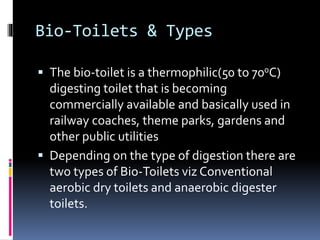
Aerobic dry toilets: A dry toilet is a aerobic type toilet where in a user sits on a
raised pedestal type toilet or he can squat in case of squat toilet. In both the cases the
excreta(urine and feces) falls through a drop hole.These toilets may use little or no
water.
Source: www.sca.nsw.gov.cu
 There are several types of toilets which are
referred to as "dry toilets". All of them work
without flush water and without a connection to
a sewer system or septic tank:
 Aerobic Composting toilets -in most cases without
urine diversion but can also be with urine diversion.
The above figure refers to composting toilets.
 Urine-diverting dry toilet (UDDT) - with urine
diversion, as the name implies
 Arborloo- which is similar to a pit latrine but has a
much shallower pit and is designed for making
compost in the pit.
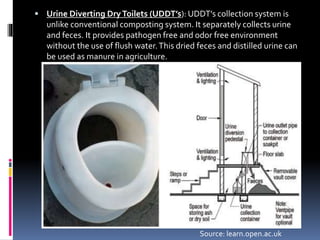
 Urine Diverting DryToilets (UDDT’s): UDDT’s collection system is
unlike conventional composting system. It separately collects urine
and feces. It provides pathogen free and odor free environment
without the use of flush water.This dried feces and distilled urine can
be used as manure in agriculture.
Source: learn.open.ac.uk
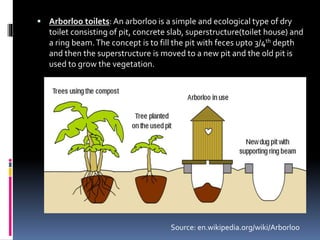
 Arborloo toilets: An arborloo is a simple and ecological type of dry
toilet consisting of pit, concrete slab, superstructure(toilet house) and
a ring beam.The concept is to fill the pit with feces upto 3/4th depth
and then the superstructure is moved to a new pit and the old pit is
used to grow the vegetation.
Source: en.wikipedia.org/wiki/Arborloo
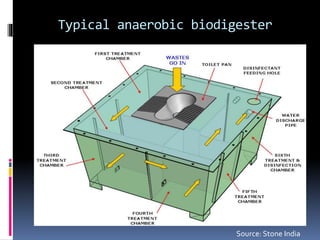
 Anaerobic Bio-Toilets:These are the toilets
where degradation of excreta takes place in
the presence of anaerobic bacterias.This
requires the addition of nutrient medium for
anaerobic degradation.
 These are also available in models that are
available aerobic bio-toilets viz anaerobic dry
composting type, UDDT’s and aborloo.
Typical anaerobic biodigester
Source: Stone India
Need
 Sanitation facilities in India are alarming with over 600
million people (half of India's population) having no access
to toilets. People are forced to defecate in the open.This
poses health hazards, raises environmental concerns and
leads to water contamination.This is coupled with the
Indian Railways’s open-chute toilet system wherein the
human waste drops on the rail tracks. Untreated human
waste or the fecal matter lying in the open is a grave threat
to the well-being and good health of the society and the
environment.
 It is estimated that 10 Million Children die under the age of
5, die Globally yearly due to improper Sanitation. Of
these, 2.4 Million Children belong to India.
 So it is necessary to provide proper sanitation and it has
to be made sure that every citizen has access to toilets.
Advantages of Bio-Toilets
 Decomposes Solid Waste toWater & Bio Gas
 Eco-Friendly
 100% Hazard Free
 Functions efficiently at sub zero – 55 Degrees
Centigrade
 Plays a critical role in Preventable Healthcare as
the BioToilet eliminates disease causing
pathogens completely.
 Eliminates load on existing Sewerage System
 Can be installed in any remote location
Comparison btw Bio-Toilet
System & Septic Tank System
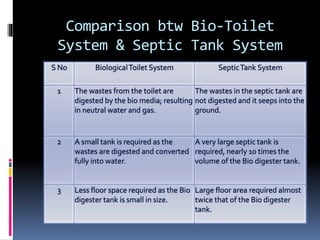
S No BiologicalToilet System SepticTank System
1 The wastes from the toilet are
digested by the bio media; resulting
in neutral water and gas.
The wastes in the septic tank are
not digested and it seeps into the
ground.
2 A small tank is required as the
wastes are digested and converted
fully into water.
A very large septic tank is
required, nearly 10 times the
volume of the Bio digester tank.
3 Less floor space required as the Bio
digester tank is small in size.
Large floor area required almost
twice that of the Bio digester
tank.
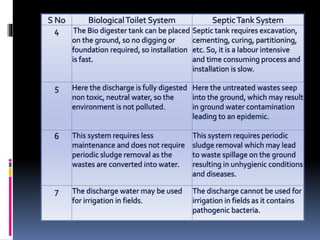
S No BiologicalToilet System SepticTank System
4 The Bio digester tank can be placed
on the ground, so no digging or
foundation required, so installation
is fast.
Septic tank requires excavation,
cementing, curing, partitioning,
etc. So, it is a labour intensive
and time consuming process and
installation is slow.
5 Here the discharge is fully digested
non toxic, neutral water, so the
environment is not polluted.
Here the untreated wastes seep
into the ground, which may result
in ground water contamination
leading to an epidemic.
6 This system requires less
maintenance and does not require
periodic sludge removal as the
wastes are converted into water.
This system requires periodic
sludge removal which may lead
to waste spillage on the ground
resulting in unhygienic conditions
and diseases.
7 The discharge water may be used
for irrigation in fields.
The discharge cannot be used for
irrigation in fields as it contains
pathogenic bacteria.

Bio-Toilets

  • 1.
  • 2.
    Bio-Toilets & Types The bio-toilet is a thermophilic(50 to 700C) digesting toilet that is becoming commercially available and basically used in railway coaches, theme parks, gardens and other public utilities  Depending on the type of digestion there are two types of Bio-Toilets viz Conventional aerobic dry toilets and anaerobic digester toilets.
  • 3.
    Aerobic dry toilets:A dry toilet is a aerobic type toilet where in a user sits on a raised pedestal type toilet or he can squat in case of squat toilet. In both the cases the excreta(urine and feces) falls through a drop hole.These toilets may use little or no water. Source: www.sca.nsw.gov.cu
  • 4.
     There areseveral types of toilets which are referred to as "dry toilets". All of them work without flush water and without a connection to a sewer system or septic tank:  Aerobic Composting toilets -in most cases without urine diversion but can also be with urine diversion. The above figure refers to composting toilets.  Urine-diverting dry toilet (UDDT) - with urine diversion, as the name implies  Arborloo- which is similar to a pit latrine but has a much shallower pit and is designed for making compost in the pit.
  • 5.
     Urine DivertingDryToilets (UDDT’s): UDDT’s collection system is unlike conventional composting system. It separately collects urine and feces. It provides pathogen free and odor free environment without the use of flush water.This dried feces and distilled urine can be used as manure in agriculture. Source: learn.open.ac.uk
  • 6.
     Arborloo toilets:An arborloo is a simple and ecological type of dry toilet consisting of pit, concrete slab, superstructure(toilet house) and a ring beam.The concept is to fill the pit with feces upto 3/4th depth and then the superstructure is moved to a new pit and the old pit is used to grow the vegetation. Source: en.wikipedia.org/wiki/Arborloo
  • 7.
     Anaerobic Bio-Toilets:Theseare the toilets where degradation of excreta takes place in the presence of anaerobic bacterias.This requires the addition of nutrient medium for anaerobic degradation.  These are also available in models that are available aerobic bio-toilets viz anaerobic dry composting type, UDDT’s and aborloo.
  • 8.
  • 9.
    Need  Sanitation facilitiesin India are alarming with over 600 million people (half of India's population) having no access to toilets. People are forced to defecate in the open.This poses health hazards, raises environmental concerns and leads to water contamination.This is coupled with the Indian Railways’s open-chute toilet system wherein the human waste drops on the rail tracks. Untreated human waste or the fecal matter lying in the open is a grave threat to the well-being and good health of the society and the environment.  It is estimated that 10 Million Children die under the age of 5, die Globally yearly due to improper Sanitation. Of these, 2.4 Million Children belong to India.  So it is necessary to provide proper sanitation and it has to be made sure that every citizen has access to toilets.
  • 10.
    Advantages of Bio-Toilets Decomposes Solid Waste toWater & Bio Gas  Eco-Friendly  100% Hazard Free  Functions efficiently at sub zero – 55 Degrees Centigrade  Plays a critical role in Preventable Healthcare as the BioToilet eliminates disease causing pathogens completely.  Eliminates load on existing Sewerage System  Can be installed in any remote location
  • 11.
    Comparison btw Bio-Toilet System& Septic Tank System S No BiologicalToilet System SepticTank System 1 The wastes from the toilet are digested by the bio media; resulting in neutral water and gas. The wastes in the septic tank are not digested and it seeps into the ground. 2 A small tank is required as the wastes are digested and converted fully into water. A very large septic tank is required, nearly 10 times the volume of the Bio digester tank. 3 Less floor space required as the Bio digester tank is small in size. Large floor area required almost twice that of the Bio digester tank.
  • 12.
    S No BiologicalToiletSystem SepticTank System 4 The Bio digester tank can be placed on the ground, so no digging or foundation required, so installation is fast. Septic tank requires excavation, cementing, curing, partitioning, etc. So, it is a labour intensive and time consuming process and installation is slow. 5 Here the discharge is fully digested non toxic, neutral water, so the environment is not polluted. Here the untreated wastes seep into the ground, which may result in ground water contamination leading to an epidemic. 6 This system requires less maintenance and does not require periodic sludge removal as the wastes are converted into water. This system requires periodic sludge removal which may lead to waste spillage on the ground resulting in unhygienic conditions and diseases. 7 The discharge water may be used for irrigation in fields. The discharge cannot be used for irrigation in fields as it contains pathogenic bacteria.