Introduction to Computing
Lecture 7
1
2
Last Lecture Summary I
 Impact Printers and Non Impact Printers
 Impact Printers
 Dot Matrix
 Line Printers
 Band Printers
 Impact Printer Advantages and
disadvantages
 Non Impact Printers
 Ink jet , Laser , All-in-One Peripherals
 Comparing Printers
3
Last Lecture Summary II
 High Quality Printers
 Photo printer
 Thermal printer
 Dye Sublimation
 Solid Ink
 Plotter
 Care and Feeding of Printers
Transforming Data Into Information
 Understands only two states either
On or Off
 Makes different patterns of 0s and 1s
 Data vs Information
 How Computers Represent Data
4
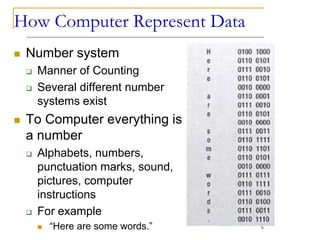
How Computer Represent Data
 Number system
 Manner of Counting
 Several different number
systems exist
 To Computer everything is
a number
 Alphabets, numbers,
punctuation marks, sound,
pictures, computer
instructions
 For example
 “Here are some words.” 5
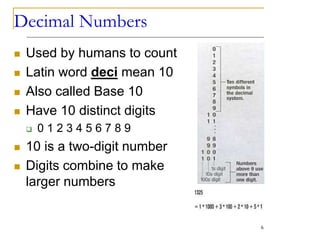
Decimal Numbers
 Used by humans to count
 Latin word deci mean 10
 Also called Base 10
 Have 10 distinct digits
 0 1 2 3 4 5 6 7 8 9
 10 is a two-digit number
 Digits combine to make
larger numbers
6
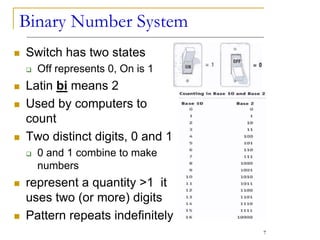
Binary Number System
 Switch has two states
 Off represents 0, On is 1
 Latin bi means 2
 Used by computers to
count
 Two distinct digits, 0 and 1
 0 and 1 combine to make
numbers
 represent a quantity >1 it
uses two (or more) digits
 Pattern repeats indefinitely
7
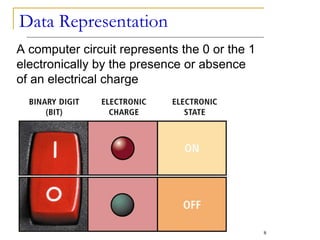
Data Representation
A computer circuit represents the 0 or the 1
electronically by the presence or absence
of an electrical charge
8
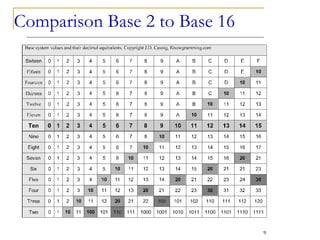
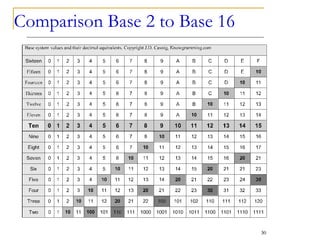
Comparison Base 2 to Base 16
9
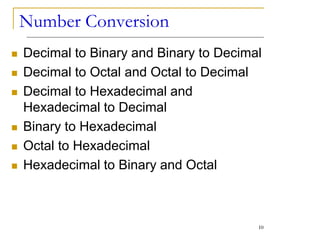
Number Conversion
 Decimal to Binary and Binary to Decimal
 Decimal to Octal and Octal to Decimal
 Decimal to Hexadecimal and
Hexadecimal to Decimal
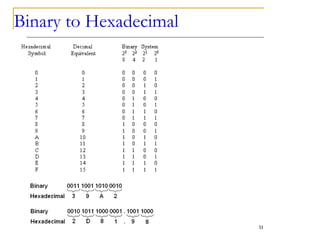
 Binary to Hexadecimal
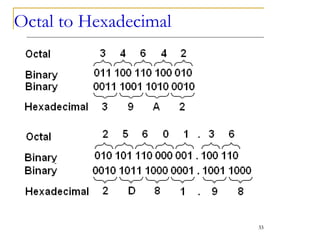
 Octal to Hexadecimal
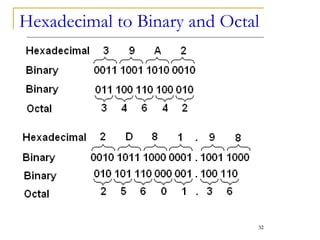
 Hexadecimal to Binary and Octal
10
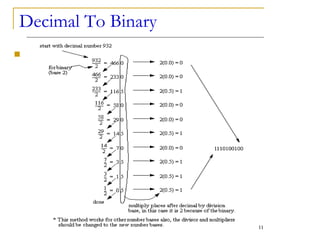
Decimal To Binary
 1
11
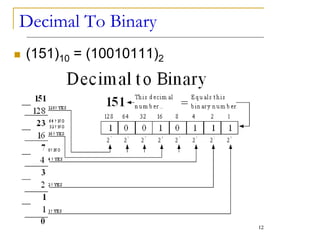
Decimal To Binary
 (151)10 = (10010111)2
12
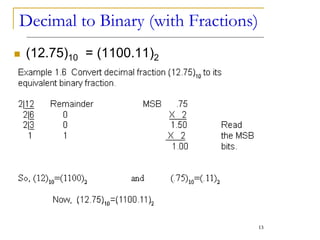
Decimal to Binary (with Fractions)
 (12.75)10 = (1100.11)2
13
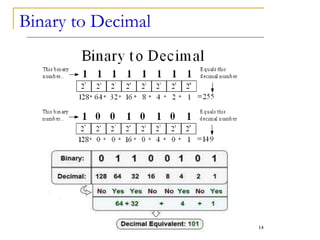
Binary to Decimal
14
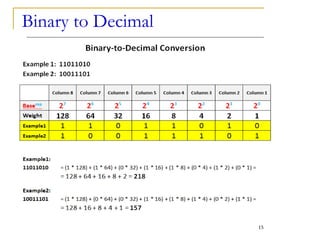
Binary to Decimal
15
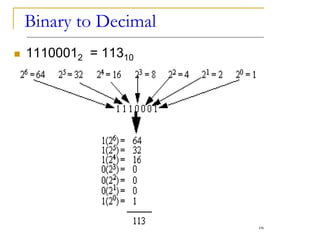
Binary to Decimal
 11100012 = 11310
16
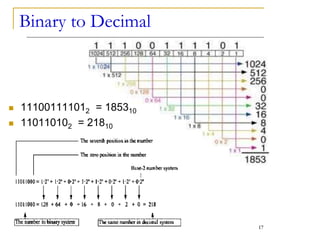
Binary to Decimal
17
 111001111012 = 185310
 110110102 = 21810
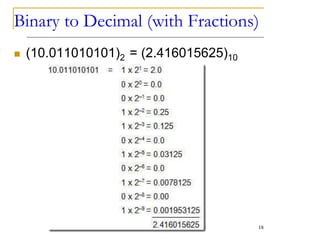
Binary to Decimal (with Fractions)
 (10.011010101)2 = (2.416015625)10
18
Exercise Decimal to Binary
19
Exercise Decimal to Binary
20
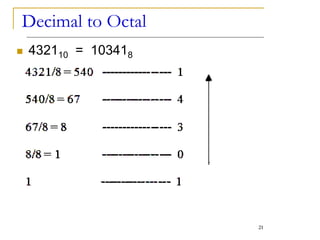
Decimal to Octal
 432110 = 103418
21
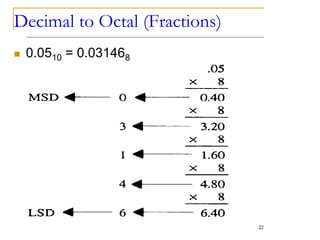
Decimal to Octal (Fractions)
 0.0510 = 0.031468
22
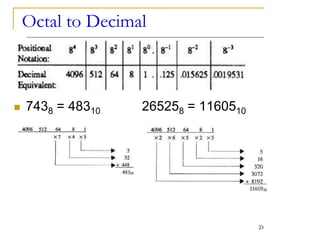
Octal to Decimal
 7438 = 48310 265258 = 1160510
23
Exercise Decimal to Octal
24
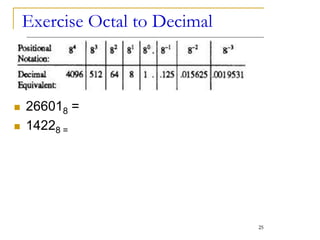
Exercise Octal to Decimal
 266018 =
 14228 =
25
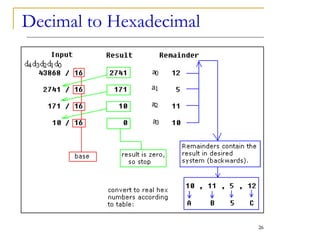
Decimal to Hexadecimal
26
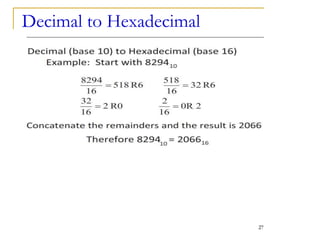
Decimal to Hexadecimal
27
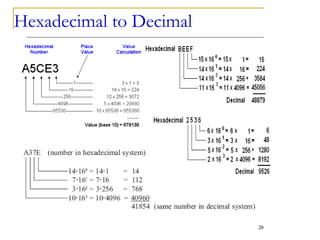
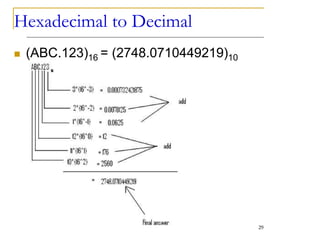
Hexadecimal to Decimal
28
Hexadecimal to Decimal
 (ABC.123)16 = (2748.0710449219)10
29
Comparison Base 2 to Base 16
30
Binary to Hexadecimal
31
Hexadecimal to Binary and Octal
32
Octal to Hexadecimal
33
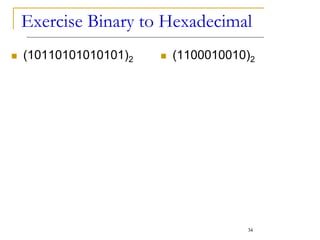
Exercise Binary to Hexadecimal
 (10110101010101)2  (1100010010)2
34
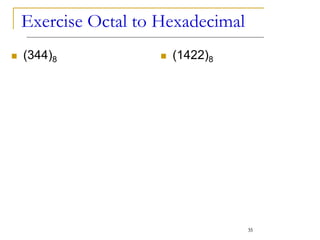
Exercise Octal to Hexadecimal
 (344)8  (1422)8
35
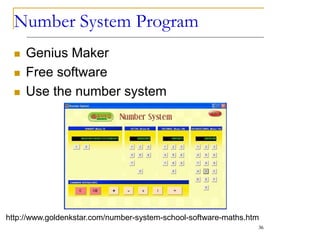
Number System Program
36
http://www.goldenkstar.com/number-system-school-software-maths.htm
 Genius Maker
 Free software
 Use the number system
37
Summary
 Number System
 Decimal
 Binary
 Octal
 Hexadecimal
 Number conversion
Recommended Websites
38
 http://www.cdrummond.qc.ca/cegep/info
rmat/Professeurs/Alain/files/ascii.htm
 http://www.lookuptables.com/ebcdic_sc
ancodes.php
 http://math.comsci.us/radix/hexadecimal
.html
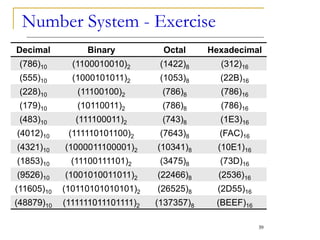
Number System - Exercise
Decimal Binary Octal Hexadecimal
(786)10 (1100010010)2 (1422)8 (312)16
(555)10 (1000101011)2 (1053)8 (22B)16
(228)10 (11100100)2 (786)8 (786)16
(179)10 (10110011)2 (786)8 (786)16
(483)10 (111100011)2 (743)8 (1E3)16
(4012)10 (111110101100)2 (7643)8 (FAC)16
(4321)10 (1000011100001)2 (10341)8 (10E1)16
(1853)10 (11100111101)2 (3475)8 (73D)16
(9526)10 (1001010011011)2 (22466)8 (2536)16
(11605)10 (10110101010101)2 (26525)8 (2D55)16
(48879)10 (111111011101111)2 (137357)8 (BEEF)16
39

Binary ,octa,hexa conversion