BI MAXILLARY SURGERY
PRESENTER: RIJU SATHAR
MAXILLOFACIAL SURGEON
AL BADAR DENTAL COLLEGE KALBURGI
KARNATAKA
PREVIOUSLY ASKED QUESTIONS
 Discuss the combination osteotomy or osteoectomy in maxilla and mandible in orthognathic
surgery.(25m)(1999)
 Cephalometric analysis 10 Marks (2002)
CONTENTS
 Introduction
 Indications
 Contraindications
 Pre operative evaluation
 Planning for bi max surgery
 Cephalometric prediction
 Cast prediction
 Sequence of jaw surgery
 Stabilization and fixation
 Adjunctive cosmetic surgery
INTRODUCTION
 Initially, surgical corrections of problems in both the maxilla and the mandible were performed as
separate or staged procedures because of the complexity of pre surgical planning, the technical difficulty
of the procedures, and the time required to complete each procedure.
 surgeons became more adept at intraoral surgery and surgical instrumentation were improved, leFort 1
osteotomy and surgery in the ramus of the mandible were done in combination, performed under the
same anaesthetic.
 The need for very careful planning before surgery and the proper sequencing of two-jaw procedures in
the operating room became apparent.
INDICATIONS
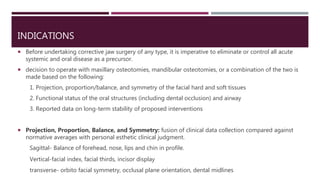
 Before undertaking corrective jaw surgery of any type, it is imperative to eliminate or control all acute
systemic and oral disease as a precursor.
 decision to operate with maxillary osteotomies, mandibular osteotomies, or a combination of the two is
made based on the following:
1. Projection, proportion/balance, and symmetry of the facial hard and soft tissues
2. Functional status of the oral structures (including dental occlusion) and airway
3. Reported data on long-term stability of proposed interventions
 Projection, Proportion, Balance, and Symmetry: fusion of clinical data collection compared against
normative averages with personal esthetic clinical judgment.
Sagittal- Balance of forehead, nose, lips and chin in profile.
Vertical-facial index, facial thirds, incisor display
transverse- orbito facial symmetry, occlusal plane orientation, dental midlines
INDICATIONS
 Functional and Esthetic Considerations: determining appropriateness of
bimaxillary surgery include the need to create a balanced and stable occlusion,
foster a patent airway with minimal obstruction, and support a healthy
temporomandibular joint (TMJ).
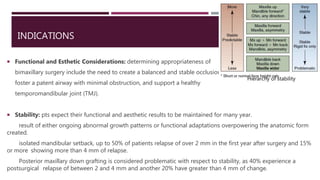
 Stability: pts expect their functional and aesthetic results to be maintained for many year.
result of either ongoing abnormal growth patterns or functional adaptations overpowering the anatomic form
created.
isolated mandibular setback, up to 50% of patients relapse of over 2 mm in the first year after surgery and 15%
or more showing more than 4 mm of relapse.
Posterior maxillary down grafting is considered problematic with respect to stability, as 40% experience a
postsurgical relapse of between 2 and 4 mm and another 20% have greater than 4 mm of change.
Hierarchy of stability
INDICATIONS
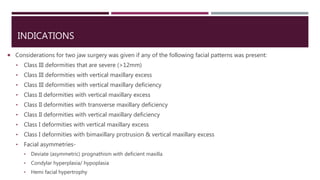
 Considerations for two jaw surgery was given if any of the following facial patterns was present:
• Class III deformities that are severe (>12mm)
• Class III deformities with vertical maxillary excess
• Class III deformities with vertical maxillary deficiency
• Class II deformities with vertical maxillary excess
• Class II deformities with transverse maxillary deficiency
• Class II deformities with vertical maxillary deficiency
• Class I deformities with vertical maxillary excess
• Class I deformities with bimaxillary protrusion & vertical maxillary excess
• Facial asymmetries-
• Deviate (asymmetric) prognathism with deficient maxilla
• Condylar hyperplasia/ hypoplasia
• Hemi facial hypertrophy
ABSOLUTE INDICATIONS
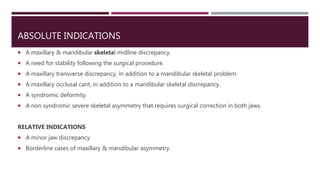
 A maxillary & mandibular skeletal midline discrepancy.
 A need for stability following the surgical procedure.
 A maxillary transverse discrepancy, in addition to a mandibular skeletal problem.
 A maxillary occlusal cant, in addition to a mandibular skeletal discrepancy.
 A syndromic deformity
 A non syndromic severe skeletal asymmetry that requires surgical correction in both jaws.
RELATIVE INDICATIONS
 A minor jaw discrepancy
 Borderline cases of maxillary & mandibular asymmetry.
CONTRAINDICATION
 Intended surgical result with one-jaw surgery.
 Advanced medical & anesthetic risk factors that preclude surgery
 Bleeding disorders, that preclude surgery
 Jehovah’s witness patients, in whom the use of autologous or banked blood is precluded.
 Other medical disorders that preclude surgery under general anesthesia.
PRE OPERATIVE EVALUATION
 Routine preoperative evaluation with indicated investigations and radiographs
 Autologous blood transfusions (10-14 days before)
 Cephalometric evaluation to be completed 14 to 21 days prior surgery
 Model surgery
PLANNING FOR TWO JAW SURGERY
 skeletal deformity in both the mandible and the maxilla- involve simultaneous two-jaw surgery.
 surgeon or the orthodontist must produce cephalometric prediction tracings and computer image
simulations as an initial step in planning treatment.
 presurgical orthodontics is complete, the surgeon must repeat the prediction to simulate jaw
repositioning at surgery
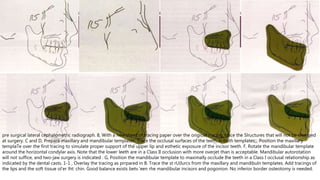
pre surgical lateral cephalometric radiograph. 8, With a new sheet of tracing paper over the origioal rracing, trace the Slructures that will not be changed
at surgery. C and D, Prepare maxillary and mandibular templates. Trace the occlusal surfaces of the teeth in both templates;;, Position the maxillary
templaTe over the first tracing to simulate proper support of the upper lip and esthetic exposure of the incisor teeth. F, Rotate the mandibular template
around the horizontal condylar axis. Note that the lower leeth are in a Class II occlusion with more overjet than is acceptable. Mandibular autorotation
will not suffice, and two-jaw surgery is indicated . G, Position the mandibular template to maximally occlude Ihe teeth in a Class I occlusal relationship as
indicated by the dental casts. 1-1 , Overlay the tracing as prrpared in B. Trace the st rU(lurcs from the maxillary and mandibuln templates. Add tracings of
the lips and the soft tissue ol'er lht: chin. Good balance exists betv.'een rhe mandibular incisors and pogonion. No inferior border osteotomy is needed.
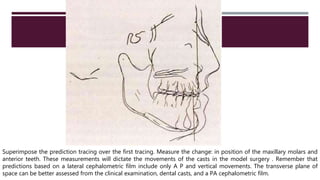
Superimpose the prediction tracing over the first tracing. Measure the change: in position of the maxillary molars and
anterior teeth. These measurements will dictate the movements of the casts in the model surgery . Remember that
predictions based on a lateral cephalometric film include only A P and vertical movements. The transverse plane of
space can be better assessed from the clinical examination, dental casts, and a PA cephalometric film.
CEPHALOMETRIC PREDICTION
 A maxillary template that includes the anterior nasal spine, palate and nasal floor, posterior nasal spine,
and maxillary teeth is produced first.
 anticipated orthodontic correction of maxillary teeth must be incorporated into the maxillary template in
the initial planning stages.
 Pre operatively actual orthodontic tooth movement is represented in the pre surgical lateral
cephalometric radiograph.
 properly position the maxillary template so that the maxillary anterior teeth vertically and horizontally
properly support the patient's upper lip.
 angulation of the maxillary incisors-point A should be within 2 mm of nasion perpendicular, and the
facial surface of the crown of the maxillary incisors should be approximately 4 mm anterior to a line
drawn perpendicular through point A.
CEPHALOMETRIC PREDICTION
 the mandibular template should be developed positioned so that the maxillary and mandibular occlusal
planes are aligned. Autorotation of the mandible rather than mandibular ramus surgery is always a
possibility when a patient presents with skeletal deformity in both jaws.
 The mandibular template should be rotated around the horizontal condylar axis to simulate such a
movement. If the mandibular template can be rotated to an appropriate position maxillary surgery only
might be performed and mandibular surgery avoided.
 The maxillary template could be repositioned slightly in the anteroposterior plane to accommodate the
rotated mandibular template-position of the maxilla and support for the upper lip arc primary, and
surgery in two jaws is preferred to a compromise in the position of the maxilla.
CEPHALOMETRIC PREDICTION
 Mandibular inferior border-the mandibular incisor tip should be about the same distance ahead of a
vertical line through point B as pogonion.
 Variations in the morphology of the soft tissue of the chin may influence the surgeon's decision as to the
final position of pogonion.
 last step, the facial soft tissues are added to produce the final prediction tracing.
CAST PREDICTION
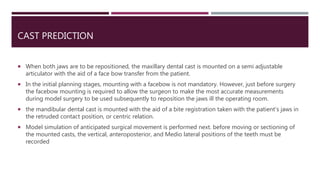
 When both jaws are to be repositioned, the maxillary dental cast is mounted on a semi adjustable
articulator with the aid of a face bow transfer from the patient.
 In the initial planning stages, mounting with a facebow is not mandatory. However, just before surgery
the facebow mounting is required to allow the surgeon to make the most accurate measurements
during model surgery to be used subsequently to reposition the jaws ill the operating room.
 the mandibular dental cast is mounted with the aid of a bite registration taken with the patient's jaws in
the retruded contact position, or centric relation.
 Model simulation of anticipated surgical movement is performed next. before moving or sectioning of
the mounted casts, the vertical, anteroposterior, and Medio lateral positions of the teeth must be
recorded
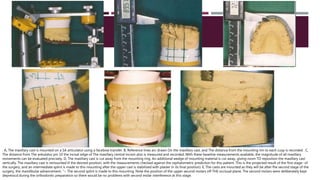
. A, The maxillary cast is mounted on a SA articulator using a facebow transfer. B, Reference lines arc drawn On the maxillary cast, and The distance from the mounting rim to each cusp is recorded . C,
The distance from The ankulator pin 10 the incisal edge of The maxillary central incisor also is measured and recorded. With these baseline measurements available, the magnitude of all maxillary
movements can be evaluated precisely. D, The maxillary cast is cut away from the mounting ring. An additional wedge of mounting material is cut away, giving room TO reposition the maxillary cast
vertically. The maxillary cast is remounted ill the desired position, with the measurements checked against the cephalometric prediction for this patient. This is the projected result of the first stage- of
the surgery, and an intermediate splint is made to this mounting after the upper cast is stabilized with plaster in its final position). E, The casts are mounted as they will be after fhe second stage of the
surgery, the mandibular advancement. "~ The second splint is made to this mounting. Note the position of the upper second molars off THE occlusal plane. The second molars were deliberately kept
depresscd during the orthodontic preparation so there would be no problems with second molar interference at this stage.
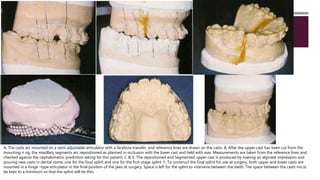
A, The casts arc mounted on a semi adjustable articulator with a facebow transfer, and reference lines are drawn on the casts. B, After the upper cast has been cut from the
mounting ri ng, the maxillary segments arc repositioned as planned in occlusion with the lower cast and held with wax. Measurements are taken from the reference lines and
checked against the cephalometric prediction taking for this patient. C & E, The repositioned and Segmented upper cast is produced by making an alginate impression and
pouring new casts in dental stone, one for the finaI splint and one for the first-stage splint. F, To construct the final splint for use at surgery, both upper and lower casts are
mounted in a hinge –type articulator in the final position of the jaws at surgery. Space is left for the splint to intervene between the teeth. The space between the casts mu.st
be kept to a minimum so that the splint will be thin.
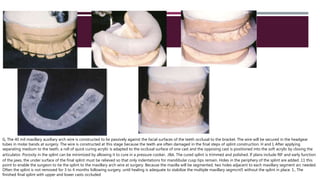
G, The 40 mil maxillary auxiliary arch wire is constructed to lie passively against the facial surfaces of the teeth occlusal to the bracket. The wire will be secured in the headgear
tubes in molar bands at surgery. The wire is constructed at this stage because the teeth are often damaged in the final steps of splint construction. H and I, After applying
separating medium to the teeth, a roll of quick curing acrylic is adapted to the occlusal surface of one cast and the opposing cast is positioned into the soft acrylic by closing the
articulator. Porosity in the splint can be minimized by allowing it to cure in a pressure cooker. J&k. The cured splint is trimmed and polished. If plans include RIF and early function
of the jaws, the under surface of the final splint must be relieved so that only indentations for mandibular cusp tips remain. Holes in the periphery of the splint are added .11 this
point to enable the surgeon to tie the splint to the maxillary arch wire at surgery. Because the maxilla will be segmented, two holes adjacent to each maxillary segment arc needed.
Often the splint is not removed for 3 to 4 months following surgery, until healing is adequate to stabilize the multiple maxillary segmcnt5 without the splint in place. 1., The
finished final splint with upper and lower casts occluded
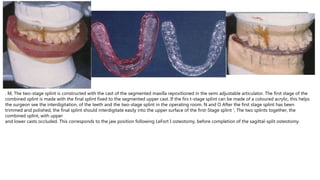
. M, The two-stage splint is constructed with the cast of the segmented maxilla repositioned in the semi adjustable articulator. The first stage of the
combined splint is made with the final splint fixed to the segmented upper cast. If the firs t-stage splint can be made of a coloured acrylic, this helps
the surgeon see the interdigitation, of the teeth and the two-stage splint in the operating room. N and O After the first stage splint has been
trimmed and polished, the final splint should interdigitate easily into the upper surface of the first-Stage splint ', The two splints together, the
combined splint, with upper
and lower casts occluded. This corresponds to the jaw position following LeFort I osteotomy, before completion of the sagittal-split osteotomy.
SEQUENCE OF JAW SURGERY
 Lefort I osteotomy and bilateral sagittal-split osteotomy (BSSO) are the most frequent operations
performed in combination.
 soft tissue incisions and the initial bony cuts are completed bilaterally for mandibular sagittal-split
osteotomy, delaying the separation of the tooth-bearing segment of the jaws from the proximal
condylar segment.
 When leFort I osteotomy also completed, With an intermediate occlusal splint (or the combined two-
stage splint) in place and the jaws held together in maxilla mandibular fixation (MMF), the maxilla is
repositioned and stabilized with RIF
 At this point, the MMF is released. Sagittal-split osteotomies are completed bilaterally in the mandible
with osteotomies. The distal tooth-bearing segment of the mandible is repositioned, with the final
occlusal splint used as a guide. With the patient's teeth again held firmly together in MMI:, The
mandibular osteotomy sites are stabilized and fixed with RIF.
SEQUENCE OF JAW SURGERY
 Buckley, Tucker, and Fredettel have suggested another sequence for two-jaw surgery. The advent of RIF
would allow the mandibular BSSO to be completed before LeFort 1 osteotomy.
 RIF with position or lag screws provides an intact, stable, repositioned mandible. The intermediate splint
in this instance uses the intact maxilla as the guide. With the mandible held in the new position with RIF,
the final occlusal splint properly repositions the maxilla after leFort I osteotomy.
 Minimizes the chance of displacement of maxillary segments once they have been repositioned. Because
LeFort I osteotomy is the last procedure performed, the chance or displacing maxillary segments while
doing other procedures is minimized
SEQUENCE OF JAW SURGERY
 le Fort I osteotomy and mandibular inferior border osteotomy are also combined frequently.
 Usually leFort I osteotomy is performed first. After fixation and stabilization of the maxilla, the inferior
border osteotomy is performed.
 mandible auto rotates around the horizontal condylar axis to occlude with the repositioned maxilla . The
mandibular occlusion serves as a reference to help reposition the maxilla.
 If difficulty in stabilizing the maxilla is anticipated (e.g., in repeat leFort I osteotomy), the mandibular
inferior border osteotomy should be performed first.
SEQUENCE OF JAW SURGERY
 Transoral vertical ramus osteotomy also may be performed with LeFort 1 osteotomy which can be
performed in a manner similar to the combined LeFort I/ BSSO procedures.
 Here ramus is exposed first, and the vertical ramus osteotomy is completed from the sigmoid notch area
to within I cm of the inferior border of the mandible, leaving the mandible intact. The area is then
packed, and the maxillary surgery is completed.
 The inferior portion of the vertical osteotomy can then be completed, repositioned, and fixated in place.
 Some surgeons currently prefer to place the patient in MMF for a very limited time followed by
controlled function guided with elastic traction.
 Two-jaw surgery may involve any combination of surgical procedures in the mandible and maxilla.
 Often mandibular and maxillary subapical osteotomies are performed together, the sequence being
dictated by the final positions of the teeth.
 if anterior maxillary and mandibular subapical osteotomies are planned to correct bimaxillary protrusion,
moving the mandibular segment first is less difficult because the repositioned mandibular segment
allows the maxillary segment to be repositioned more easily at surgery.
SEQUENCE OF JAW SURGERY
MANDIBLE OR MAXILLA FIRST..????
 Not a controversy. It is a preference determined by careful preoperative planning and the surgeon’s
confidence in stabilizing the maxilla or mandible with predictability.
 When simultaneous mobilization of the maxilla and mandible was initially popularized, wire fixation was
the method of choice. Before the availability of bone plates and screws, performing maxillary surgery
first, followed by mandibular surgery, was advocated by the logic that it was more predictable to
stabilize the maxilla. Direct osseous fixation with wire and skeletal fixation (eg, piriform rim, orbital rim,
or circumzygomatic suspension wires) adequately fixed the maxilla in the desired position.
 To minimize the risk of displacing the maxilla during the mandibular sagittal osteotomy, the bone cuts to
the mandible were made before the maxillary surgery; however, the mandible was left intact until
stabilization of the maxilla.
 At present, the sequencing of surgery (maxilla or mandible first) is a decision determined by preference.
Some surgeons believe it more predictable to stabilize the maxilla or that they can more predictably
stabilize the mandible, and the surgery is conducted accordingly.
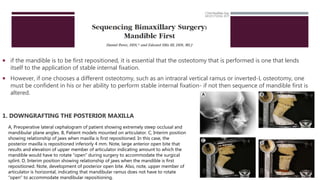
 if the mandible is to be first repositioned, it is essential that the osteotomy that is performed is one that lends
itself to the application of stable internal fixation.
 However, if one chooses a different osteotomy, such as an intraoral vertical ramus or inverted-L osteotomy, one
must be confident in his or her ability to perform stable internal fixation- if not then sequence of mandible first is
altered.
1. DOWNGRAFTING THE POSTERIOR MAXILLA
A, Preoperative lateral cephalogram of patient showing extremely steep occlusal and
mandibular plane angles. B, Patient models mounted on articulator. C, Interim position
showing relationship of jaws when maxilla is first repositioned. In this case, the
posterior maxilla is repositioned inferiorly 4 mm. Note, large anterior open bite that
results and elevation of upper member of articulator indicating amount to which the
mandible would have to rotate “open” during surgery to accommodate the surgical
splint. D, Interim position showing relationship of jaws when the mandible is first
repositioned. Note, development of posterior open bite. Also, note, upper member of
articulator is horizontal, indicating that mandibular ramus does not have to rotate
“open” to accommodate mandibular repositioning.
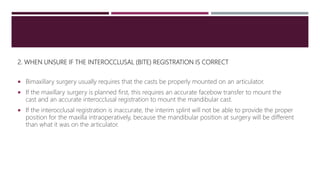
2. WHEN UNSURE IF THE INTEROCCLUSAL (BITE) REGISTRATION IS CORRECT
 Bimaxillary surgery usually requires that the casts be properly mounted on an articulator.
 If the maxillary surgery is planned first, this requires an accurate facebow transfer to mount the
cast and an accurate interocclusal registration to mount the mandibular cast.
 If the interocclusal registration is inaccurate, the interim splint will not be able to provide the proper
position for the maxilla intraoperatively, because the mandibular position at surgery will be different
than what it was on the articulator.
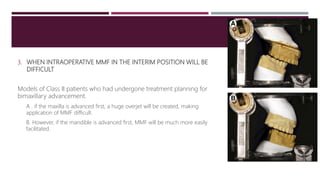
3. WHEN INTRAOPERATIVE MMF IN THE INTERIM POSITION WILL BE
DIFFICULT
Models of Class II patients who had undergone treatment planning for
bimaxillary advancement.
A . if the maxilla is advanced first, a huge overjet will be created, making
application of MMF difficult.
B. However, if the mandible is advanced first, MMF will be much more easily
facilitated.
4.WHEN FIXATION OF THE MAXILLA MAY NOT BE RIGID
 When first repositioning the maxilla during bimaxillary surgery, the maxilla is plated in its new position
before mandibular osteotomy.
 After the mandible undergoes osteotomy, it is placed into final occlusion with the maxilla by way of
MMF wires.
 With large mandibular movements, considerable force can be required to hold the mandible in its
position while undergoing osteosynthesis of the mandibular fragments.
 If the maxillary bone is extremely thin and fragile, the screws holding the maxillary bone plates can
out, creating an intraoperative dilemma, because all reference to stable structures are then lost.
 If it can be anticipated that considerable force will be required to maintain MMF during the
osteosynthesis, performing surgery in the mandible first might be prudent.
5. WHEN PERFORMING CONCOMITANT TMJ SURGERY
 When performing concomitant TMJ and bimaxillary orthognathic surgery - TMJ surgery must be
performed before mandibular osteotomy.
 The position of the condyle within the TMJ will be altered by the TMJ surgery.
 if one first performed TMJ surgery, maxillary repositioning, and then mandibular osteotomy, the
could be malpositioned - the position of the condyles in the TMJ would be altered after the TMJ
surgery, and, then when the mandible is used to help position the maxilla using an interim splint, the
maxilla would be malpositioned.
SEQUENCE
first reposition the maxilla, then to perform the TMJ surgery, and then the mandibular osteotomy.
first perform the TMJ surgery, then the mandibular osteotomy, and then to reposition the maxilla.
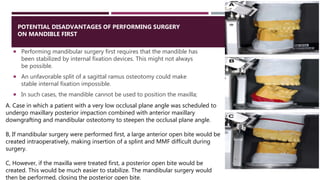
 Performing mandibular surgery first requires that the mandible has
been stabilized by internal fixation devices. This might not always
be possible.
 An unfavorable split of a sagittal ramus osteotomy could make
stable internal fixation impossible.
 In such cases, the mandible cannot be used to position the maxilla;
POTENTIAL DISADVANTAGES OF PERFORMING SURGERY
ON MANDIBLE FIRST
A. Case in which a patient with a very low occlusal plane angle was scheduled to
undergo maxillary posterior impaction combined with anterior maxillary
downgrafting and mandibular osteotomy to steepen the occlusal plane angle.
B, If mandibular surgery were performed first, a large anterior open bite would be
created intraoperatively, making insertion of a splint and MMF difficult during
surgery.
C, However, if the maxilla were treated first, a posterior open bite would be
created. This would be much easier to stabilize. The mandibular surgery would
then be performed, closing the posterior open bite.
CONCLUSION
 Whether a surgeon chooses to routinely perform mandibular surgery first during bimaxillary surgery will
depend on a host of factors, including her or his ability to predictably perform mandibular osteotomy
that can be stabilized, her or his ability to take and trust her or his inter occlusal registrations, and her or
his bias
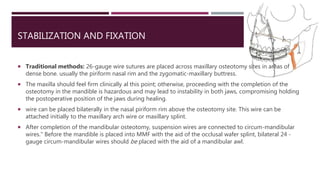
STABILIZATION AND FIXATION
 Traditional methods: 26-gauge wire sutures are placed across maxillary osteotomy sites in areas of
dense bone. usually the piriform nasal rim and the zygomatic-maxillary buttress.
 The maxilla should feel firm clinically al this point; otherwise, proceeding with the completion of the
osteotomy in the mandible is hazardous and may lead to instability in both jaws, compromising holding
the postoperative position of the jaws during healing.
 wire can be placed bilaterally in the nasal piriform rim above the osteotomy site. This wire can be
attached initially to the maxillary arch wire or maxillary splint.
 After completion of the mandibular osteotomy, suspension wires are connected to circum-mandibular
wires." Before the mandible is placed into MMF with the aid of the occlusal wafer splint, bilateral 24 -
gauge circum-mandibular wires should be placed with the aid of a mandibular awl.
RIGID INTERNAL FIXATION
 Most surgeons use the same sequence of surgical steps in two jaw surgery, making the mandibular cuts
without splitting the mandible as the first step, followed by completion of leFort I osteotomy.
 Following repositioning of the maxilla, the surgeon must ensure that bone plates stabilize the maxilla
well before proceeding to complete the mandibular osteotomy.
 A minimum of one bone plate on either side of the maxilla usually is required for adequate stabilization
and fixation; two on each side are preferred. With multiple maxillary segments, al least one bone plate
must stabilize each segment.
 Once the maxilla appears clinically firm , the mandibular osteotomy may be completed and the tooth-
bearing segment of the mandible placed in MMF with the intervening occlusal wafer splint.
 After the mandibular osteotomy sites have been adequately stabilized with RlF, MMF must be released
and the occlusion checked. Any deviation in the occlusion must he corrected before the completion of
surgery even if it means removing the rigid fixation devices to correct the jaw position.
 With RIF in both jaws, the period of MMF can be greatly reduced or eliminated.
 remove firm MMF within the first week after surgery and allow the patient some Jaw function using light
elastics to guide the patient into the planned new occlusion. Patients should regain jaw function with RIF
in about the same time frame as with one-jaw surgery, usually 4 to 6 weeks after MMF release.
 For bilateral sagittal split osteotomy setback surgery with rigid internal fixation (RIF), part of the problem
was posterior rotation of the condylar segment at surgery that produced relapse when the mandible was
allowed to function and the musculature repositioned the ramus, and stability seemed to be better with
2-jaw Class III surgery than with isolated mandibular setback.
 The purpose of this study was to directly compare the stability of 2-jaw versus mandible-only setback
procedures performed with modern setback techniques with RIF.
Patients and methods
 83 patients who had 2-jaw surgery and 17 who had mandibular setback alone.
 Lateral cephalogram - To evaluate the relationship between postoperative changes in the position of
the chin and ramus inclination or AP position of the gonion.
RESULTS
CHANGES AT SURGERY
Changes immediately after surgery in selected landmark positions
 Adjusted mean setback distance (change in AP position of pogonion) was the same in both groups (4.7
mm), and in the 2-jaw group the mean maxillary advancement (at point A) was 4.9 mm; total correction
in jaw position for the 2-jaw group was considerably larger.
 The mean overjet reduction was 8.7 mm for the 2-jaw group and 5.4 mm for the mandible-only group.
 No significant changes in maxillary dimensions were noted for the mandible-only group.
 The maxillary changes for the 2-jaw group were statistically significant.
 For both surgery groups, tendency to push the ramus segment back at surgery (posterior movement of
gonion )
 Gonion moved posteriorly by more than 4 mm in 8 of the mandible-only patients (47%) but in only 1 of
the 2-jaw patients (1%);
 Change in ramus inclination were found in 8 of the mandible-only patients (47%) but only 1 of the 2-jaw
patients (1%).
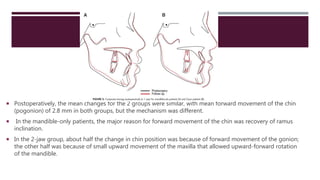
 Postoperatively, the mean changes for the 2 groups were similar, with mean forward movement of the chin
(pogonion) of 2.8 mm in both groups, but the mechanism was different.
 In the mandible-only patients, the major reason for forward movement of the chin was recovery of ramus
inclination.
 In the 2-jaw group, about half the change in chin position was because of forward movement of the gonion;
the other half was because of small upward movement of the maxilla that allowed upward-forward rotation
of the mandible.
 In 2-jaw Class III surgery , the chance of clinically significant posterior movement of the gonion is much
smaller, and the component of relapse due to this also is smaller.
 Control of ramus position apparently is easier for the surgeons when repositioning of both jaws is being
carried out.
 There is a relationship between the amount of mandibular setback and postoperative stability:
 Patients requiring a large change in jaw relationships, restricting the amount of mandibular setback by
simultaneously advancing the maxilla contributes to stability,
 Although this appears to be balanced out by upward movement of the maxilla that allows upward and
forward rotation of the mandible.
CONCLUSION
 The gonial angle is likely to be pushed posteriorly when the mandible is set back, and recovery of the
ramus inclination change is the major component of forward movement of the chin after mandible-only
surgery.
 In 2-jaw surgery, there is better control of ramus inclination and less relapse related to this, but upward
movement of the maxilla that allows the chin to rotate upward and forward brings its total forward
movement to about the same level as with mandible-only surgery.
SUMMARY :
PREMOLAR EXTRACTION WITH ANT SEGMENTAL OSTEOTOMY AND
RETRACTION IS A POWERFUL APPROACH FOR TREATING PATINETS WHO
HAS HORIZONATAL MAXILLARY EXCESS
LEFORT 1 OSTEOTOMY WITH AMO IS EFFECTIVE IN TREATING PATIENTS
WHO ALSO HAVE SIGNIFICANT VERTICAL MAXILLARY EXCESS
ISOLATED LEFORT I WITH SETBACK IS USEFUL ALTERNATIVE TO AND
SOMETIMES MORE DESIRABLE THAN AMO FOR CORRECTION OF
MAXILLARY EXCESS
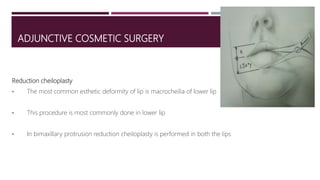
ADJUNCTIVE COSMETIC SURGERY
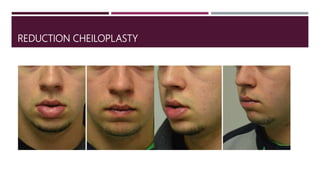
Reduction cheiloplasty
• The most common esthetic deformity of lip is macrocheilia of lower lip
• This procedure is most commonly done in lower lip
• In bimaxillary protrusion reduction cheiloplasty is performed in both the lips
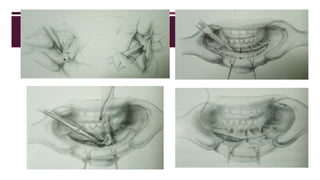
REDUCTION CHEILOPLASTY
 Thank you..

bimaxillary surgery.pptx

  • 1.
    BI MAXILLARY SURGERY PRESENTER:RIJU SATHAR MAXILLOFACIAL SURGEON AL BADAR DENTAL COLLEGE KALBURGI KARNATAKA
  • 2.
    PREVIOUSLY ASKED QUESTIONS Discuss the combination osteotomy or osteoectomy in maxilla and mandible in orthognathic surgery.(25m)(1999)  Cephalometric analysis 10 Marks (2002)
  • 3.
    CONTENTS  Introduction  Indications Contraindications  Pre operative evaluation  Planning for bi max surgery  Cephalometric prediction  Cast prediction  Sequence of jaw surgery  Stabilization and fixation  Adjunctive cosmetic surgery
  • 4.
    INTRODUCTION  Initially, surgicalcorrections of problems in both the maxilla and the mandible were performed as separate or staged procedures because of the complexity of pre surgical planning, the technical difficulty of the procedures, and the time required to complete each procedure.  surgeons became more adept at intraoral surgery and surgical instrumentation were improved, leFort 1 osteotomy and surgery in the ramus of the mandible were done in combination, performed under the same anaesthetic.  The need for very careful planning before surgery and the proper sequencing of two-jaw procedures in the operating room became apparent.
  • 5.
    INDICATIONS  Before undertakingcorrective jaw surgery of any type, it is imperative to eliminate or control all acute systemic and oral disease as a precursor.  decision to operate with maxillary osteotomies, mandibular osteotomies, or a combination of the two is made based on the following: 1. Projection, proportion/balance, and symmetry of the facial hard and soft tissues 2. Functional status of the oral structures (including dental occlusion) and airway 3. Reported data on long-term stability of proposed interventions  Projection, Proportion, Balance, and Symmetry: fusion of clinical data collection compared against normative averages with personal esthetic clinical judgment. Sagittal- Balance of forehead, nose, lips and chin in profile. Vertical-facial index, facial thirds, incisor display transverse- orbito facial symmetry, occlusal plane orientation, dental midlines
  • 6.
    INDICATIONS  Functional andEsthetic Considerations: determining appropriateness of bimaxillary surgery include the need to create a balanced and stable occlusion, foster a patent airway with minimal obstruction, and support a healthy temporomandibular joint (TMJ).  Stability: pts expect their functional and aesthetic results to be maintained for many year. result of either ongoing abnormal growth patterns or functional adaptations overpowering the anatomic form created. isolated mandibular setback, up to 50% of patients relapse of over 2 mm in the first year after surgery and 15% or more showing more than 4 mm of relapse. Posterior maxillary down grafting is considered problematic with respect to stability, as 40% experience a postsurgical relapse of between 2 and 4 mm and another 20% have greater than 4 mm of change. Hierarchy of stability
  • 7.
    INDICATIONS  Considerations fortwo jaw surgery was given if any of the following facial patterns was present: • Class III deformities that are severe (>12mm) • Class III deformities with vertical maxillary excess • Class III deformities with vertical maxillary deficiency • Class II deformities with vertical maxillary excess • Class II deformities with transverse maxillary deficiency • Class II deformities with vertical maxillary deficiency • Class I deformities with vertical maxillary excess • Class I deformities with bimaxillary protrusion & vertical maxillary excess • Facial asymmetries- • Deviate (asymmetric) prognathism with deficient maxilla • Condylar hyperplasia/ hypoplasia • Hemi facial hypertrophy
  • 8.
    ABSOLUTE INDICATIONS  Amaxillary & mandibular skeletal midline discrepancy.  A need for stability following the surgical procedure.  A maxillary transverse discrepancy, in addition to a mandibular skeletal problem.  A maxillary occlusal cant, in addition to a mandibular skeletal discrepancy.  A syndromic deformity  A non syndromic severe skeletal asymmetry that requires surgical correction in both jaws. RELATIVE INDICATIONS  A minor jaw discrepancy  Borderline cases of maxillary & mandibular asymmetry.
  • 9.
    CONTRAINDICATION  Intended surgicalresult with one-jaw surgery.  Advanced medical & anesthetic risk factors that preclude surgery  Bleeding disorders, that preclude surgery  Jehovah’s witness patients, in whom the use of autologous or banked blood is precluded.  Other medical disorders that preclude surgery under general anesthesia.
  • 10.
    PRE OPERATIVE EVALUATION Routine preoperative evaluation with indicated investigations and radiographs  Autologous blood transfusions (10-14 days before)  Cephalometric evaluation to be completed 14 to 21 days prior surgery  Model surgery
  • 11.
    PLANNING FOR TWOJAW SURGERY  skeletal deformity in both the mandible and the maxilla- involve simultaneous two-jaw surgery.  surgeon or the orthodontist must produce cephalometric prediction tracings and computer image simulations as an initial step in planning treatment.  presurgical orthodontics is complete, the surgeon must repeat the prediction to simulate jaw repositioning at surgery
  • 12.
    pre surgical lateralcephalometric radiograph. 8, With a new sheet of tracing paper over the origioal rracing, trace the Slructures that will not be changed at surgery. C and D, Prepare maxillary and mandibular templates. Trace the occlusal surfaces of the teeth in both templates;;, Position the maxillary templaTe over the first tracing to simulate proper support of the upper lip and esthetic exposure of the incisor teeth. F, Rotate the mandibular template around the horizontal condylar axis. Note that the lower leeth are in a Class II occlusion with more overjet than is acceptable. Mandibular autorotation will not suffice, and two-jaw surgery is indicated . G, Position the mandibular template to maximally occlude Ihe teeth in a Class I occlusal relationship as indicated by the dental casts. 1-1 , Overlay the tracing as prrpared in B. Trace the st rU(lurcs from the maxillary and mandibuln templates. Add tracings of the lips and the soft tissue ol'er lht: chin. Good balance exists betv.'een rhe mandibular incisors and pogonion. No inferior border osteotomy is needed.
  • 13.
    Superimpose the predictiontracing over the first tracing. Measure the change: in position of the maxillary molars and anterior teeth. These measurements will dictate the movements of the casts in the model surgery . Remember that predictions based on a lateral cephalometric film include only A P and vertical movements. The transverse plane of space can be better assessed from the clinical examination, dental casts, and a PA cephalometric film.
  • 14.
    CEPHALOMETRIC PREDICTION  Amaxillary template that includes the anterior nasal spine, palate and nasal floor, posterior nasal spine, and maxillary teeth is produced first.  anticipated orthodontic correction of maxillary teeth must be incorporated into the maxillary template in the initial planning stages.  Pre operatively actual orthodontic tooth movement is represented in the pre surgical lateral cephalometric radiograph.  properly position the maxillary template so that the maxillary anterior teeth vertically and horizontally properly support the patient's upper lip.  angulation of the maxillary incisors-point A should be within 2 mm of nasion perpendicular, and the facial surface of the crown of the maxillary incisors should be approximately 4 mm anterior to a line drawn perpendicular through point A.
  • 15.
    CEPHALOMETRIC PREDICTION  themandibular template should be developed positioned so that the maxillary and mandibular occlusal planes are aligned. Autorotation of the mandible rather than mandibular ramus surgery is always a possibility when a patient presents with skeletal deformity in both jaws.  The mandibular template should be rotated around the horizontal condylar axis to simulate such a movement. If the mandibular template can be rotated to an appropriate position maxillary surgery only might be performed and mandibular surgery avoided.  The maxillary template could be repositioned slightly in the anteroposterior plane to accommodate the rotated mandibular template-position of the maxilla and support for the upper lip arc primary, and surgery in two jaws is preferred to a compromise in the position of the maxilla.
  • 16.
    CEPHALOMETRIC PREDICTION  Mandibularinferior border-the mandibular incisor tip should be about the same distance ahead of a vertical line through point B as pogonion.  Variations in the morphology of the soft tissue of the chin may influence the surgeon's decision as to the final position of pogonion.  last step, the facial soft tissues are added to produce the final prediction tracing.
  • 17.
    CAST PREDICTION  Whenboth jaws are to be repositioned, the maxillary dental cast is mounted on a semi adjustable articulator with the aid of a face bow transfer from the patient.  In the initial planning stages, mounting with a facebow is not mandatory. However, just before surgery the facebow mounting is required to allow the surgeon to make the most accurate measurements during model surgery to be used subsequently to reposition the jaws ill the operating room.  the mandibular dental cast is mounted with the aid of a bite registration taken with the patient's jaws in the retruded contact position, or centric relation.  Model simulation of anticipated surgical movement is performed next. before moving or sectioning of the mounted casts, the vertical, anteroposterior, and Medio lateral positions of the teeth must be recorded
  • 18.
    . A, Themaxillary cast is mounted on a SA articulator using a facebow transfer. B, Reference lines arc drawn On the maxillary cast, and The distance from the mounting rim to each cusp is recorded . C, The distance from The ankulator pin 10 the incisal edge of The maxillary central incisor also is measured and recorded. With these baseline measurements available, the magnitude of all maxillary movements can be evaluated precisely. D, The maxillary cast is cut away from the mounting ring. An additional wedge of mounting material is cut away, giving room TO reposition the maxillary cast vertically. The maxillary cast is remounted ill the desired position, with the measurements checked against the cephalometric prediction for this patient. This is the projected result of the first stage- of the surgery, and an intermediate splint is made to this mounting after the upper cast is stabilized with plaster in its final position). E, The casts are mounted as they will be after fhe second stage of the surgery, the mandibular advancement. "~ The second splint is made to this mounting. Note the position of the upper second molars off THE occlusal plane. The second molars were deliberately kept depresscd during the orthodontic preparation so there would be no problems with second molar interference at this stage.
  • 19.
    A, The castsarc mounted on a semi adjustable articulator with a facebow transfer, and reference lines are drawn on the casts. B, After the upper cast has been cut from the mounting ri ng, the maxillary segments arc repositioned as planned in occlusion with the lower cast and held with wax. Measurements are taken from the reference lines and checked against the cephalometric prediction taking for this patient. C & E, The repositioned and Segmented upper cast is produced by making an alginate impression and pouring new casts in dental stone, one for the finaI splint and one for the first-stage splint. F, To construct the final splint for use at surgery, both upper and lower casts are mounted in a hinge –type articulator in the final position of the jaws at surgery. Space is left for the splint to intervene between the teeth. The space between the casts mu.st be kept to a minimum so that the splint will be thin.
  • 20.
    G, The 40mil maxillary auxiliary arch wire is constructed to lie passively against the facial surfaces of the teeth occlusal to the bracket. The wire will be secured in the headgear tubes in molar bands at surgery. The wire is constructed at this stage because the teeth are often damaged in the final steps of splint construction. H and I, After applying separating medium to the teeth, a roll of quick curing acrylic is adapted to the occlusal surface of one cast and the opposing cast is positioned into the soft acrylic by closing the articulator. Porosity in the splint can be minimized by allowing it to cure in a pressure cooker. J&k. The cured splint is trimmed and polished. If plans include RIF and early function of the jaws, the under surface of the final splint must be relieved so that only indentations for mandibular cusp tips remain. Holes in the periphery of the splint are added .11 this point to enable the surgeon to tie the splint to the maxillary arch wire at surgery. Because the maxilla will be segmented, two holes adjacent to each maxillary segment arc needed. Often the splint is not removed for 3 to 4 months following surgery, until healing is adequate to stabilize the multiple maxillary segmcnt5 without the splint in place. 1., The finished final splint with upper and lower casts occluded
  • 21.
    . M, Thetwo-stage splint is constructed with the cast of the segmented maxilla repositioned in the semi adjustable articulator. The first stage of the combined splint is made with the final splint fixed to the segmented upper cast. If the firs t-stage splint can be made of a coloured acrylic, this helps the surgeon see the interdigitation, of the teeth and the two-stage splint in the operating room. N and O After the first stage splint has been trimmed and polished, the final splint should interdigitate easily into the upper surface of the first-Stage splint ', The two splints together, the combined splint, with upper and lower casts occluded. This corresponds to the jaw position following LeFort I osteotomy, before completion of the sagittal-split osteotomy.
  • 22.
    SEQUENCE OF JAWSURGERY  Lefort I osteotomy and bilateral sagittal-split osteotomy (BSSO) are the most frequent operations performed in combination.  soft tissue incisions and the initial bony cuts are completed bilaterally for mandibular sagittal-split osteotomy, delaying the separation of the tooth-bearing segment of the jaws from the proximal condylar segment.  When leFort I osteotomy also completed, With an intermediate occlusal splint (or the combined two- stage splint) in place and the jaws held together in maxilla mandibular fixation (MMF), the maxilla is repositioned and stabilized with RIF  At this point, the MMF is released. Sagittal-split osteotomies are completed bilaterally in the mandible with osteotomies. The distal tooth-bearing segment of the mandible is repositioned, with the final occlusal splint used as a guide. With the patient's teeth again held firmly together in MMI:, The mandibular osteotomy sites are stabilized and fixed with RIF.
  • 23.
    SEQUENCE OF JAWSURGERY  Buckley, Tucker, and Fredettel have suggested another sequence for two-jaw surgery. The advent of RIF would allow the mandibular BSSO to be completed before LeFort 1 osteotomy.  RIF with position or lag screws provides an intact, stable, repositioned mandible. The intermediate splint in this instance uses the intact maxilla as the guide. With the mandible held in the new position with RIF, the final occlusal splint properly repositions the maxilla after leFort I osteotomy.  Minimizes the chance of displacement of maxillary segments once they have been repositioned. Because LeFort I osteotomy is the last procedure performed, the chance or displacing maxillary segments while doing other procedures is minimized
  • 24.
    SEQUENCE OF JAWSURGERY  le Fort I osteotomy and mandibular inferior border osteotomy are also combined frequently.  Usually leFort I osteotomy is performed first. After fixation and stabilization of the maxilla, the inferior border osteotomy is performed.  mandible auto rotates around the horizontal condylar axis to occlude with the repositioned maxilla . The mandibular occlusion serves as a reference to help reposition the maxilla.  If difficulty in stabilizing the maxilla is anticipated (e.g., in repeat leFort I osteotomy), the mandibular inferior border osteotomy should be performed first.
  • 25.
    SEQUENCE OF JAWSURGERY  Transoral vertical ramus osteotomy also may be performed with LeFort 1 osteotomy which can be performed in a manner similar to the combined LeFort I/ BSSO procedures.  Here ramus is exposed first, and the vertical ramus osteotomy is completed from the sigmoid notch area to within I cm of the inferior border of the mandible, leaving the mandible intact. The area is then packed, and the maxillary surgery is completed.  The inferior portion of the vertical osteotomy can then be completed, repositioned, and fixated in place.  Some surgeons currently prefer to place the patient in MMF for a very limited time followed by controlled function guided with elastic traction.
  • 26.
     Two-jaw surgerymay involve any combination of surgical procedures in the mandible and maxilla.  Often mandibular and maxillary subapical osteotomies are performed together, the sequence being dictated by the final positions of the teeth.  if anterior maxillary and mandibular subapical osteotomies are planned to correct bimaxillary protrusion, moving the mandibular segment first is less difficult because the repositioned mandibular segment allows the maxillary segment to be repositioned more easily at surgery. SEQUENCE OF JAW SURGERY
  • 27.
    MANDIBLE OR MAXILLAFIRST..????  Not a controversy. It is a preference determined by careful preoperative planning and the surgeon’s confidence in stabilizing the maxilla or mandible with predictability.  When simultaneous mobilization of the maxilla and mandible was initially popularized, wire fixation was the method of choice. Before the availability of bone plates and screws, performing maxillary surgery first, followed by mandibular surgery, was advocated by the logic that it was more predictable to stabilize the maxilla. Direct osseous fixation with wire and skeletal fixation (eg, piriform rim, orbital rim, or circumzygomatic suspension wires) adequately fixed the maxilla in the desired position.  To minimize the risk of displacing the maxilla during the mandibular sagittal osteotomy, the bone cuts to the mandible were made before the maxillary surgery; however, the mandible was left intact until stabilization of the maxilla.  At present, the sequencing of surgery (maxilla or mandible first) is a decision determined by preference. Some surgeons believe it more predictable to stabilize the maxilla or that they can more predictably stabilize the mandible, and the surgery is conducted accordingly.
  • 28.
     if themandible is to be first repositioned, it is essential that the osteotomy that is performed is one that lends itself to the application of stable internal fixation.  However, if one chooses a different osteotomy, such as an intraoral vertical ramus or inverted-L osteotomy, one must be confident in his or her ability to perform stable internal fixation- if not then sequence of mandible first is altered. 1. DOWNGRAFTING THE POSTERIOR MAXILLA A, Preoperative lateral cephalogram of patient showing extremely steep occlusal and mandibular plane angles. B, Patient models mounted on articulator. C, Interim position showing relationship of jaws when maxilla is first repositioned. In this case, the posterior maxilla is repositioned inferiorly 4 mm. Note, large anterior open bite that results and elevation of upper member of articulator indicating amount to which the mandible would have to rotate “open” during surgery to accommodate the surgical splint. D, Interim position showing relationship of jaws when the mandible is first repositioned. Note, development of posterior open bite. Also, note, upper member of articulator is horizontal, indicating that mandibular ramus does not have to rotate “open” to accommodate mandibular repositioning.
  • 29.
    2. WHEN UNSUREIF THE INTEROCCLUSAL (BITE) REGISTRATION IS CORRECT  Bimaxillary surgery usually requires that the casts be properly mounted on an articulator.  If the maxillary surgery is planned first, this requires an accurate facebow transfer to mount the cast and an accurate interocclusal registration to mount the mandibular cast.  If the interocclusal registration is inaccurate, the interim splint will not be able to provide the proper position for the maxilla intraoperatively, because the mandibular position at surgery will be different than what it was on the articulator.
  • 30.
    3. WHEN INTRAOPERATIVEMMF IN THE INTERIM POSITION WILL BE DIFFICULT Models of Class II patients who had undergone treatment planning for bimaxillary advancement. A . if the maxilla is advanced first, a huge overjet will be created, making application of MMF difficult. B. However, if the mandible is advanced first, MMF will be much more easily facilitated.
  • 31.
    4.WHEN FIXATION OFTHE MAXILLA MAY NOT BE RIGID  When first repositioning the maxilla during bimaxillary surgery, the maxilla is plated in its new position before mandibular osteotomy.  After the mandible undergoes osteotomy, it is placed into final occlusion with the maxilla by way of MMF wires.  With large mandibular movements, considerable force can be required to hold the mandible in its position while undergoing osteosynthesis of the mandibular fragments.  If the maxillary bone is extremely thin and fragile, the screws holding the maxillary bone plates can out, creating an intraoperative dilemma, because all reference to stable structures are then lost.  If it can be anticipated that considerable force will be required to maintain MMF during the osteosynthesis, performing surgery in the mandible first might be prudent.
  • 32.
    5. WHEN PERFORMINGCONCOMITANT TMJ SURGERY  When performing concomitant TMJ and bimaxillary orthognathic surgery - TMJ surgery must be performed before mandibular osteotomy.  The position of the condyle within the TMJ will be altered by the TMJ surgery.  if one first performed TMJ surgery, maxillary repositioning, and then mandibular osteotomy, the could be malpositioned - the position of the condyles in the TMJ would be altered after the TMJ surgery, and, then when the mandible is used to help position the maxilla using an interim splint, the maxilla would be malpositioned. SEQUENCE first reposition the maxilla, then to perform the TMJ surgery, and then the mandibular osteotomy. first perform the TMJ surgery, then the mandibular osteotomy, and then to reposition the maxilla.
  • 33.
     Performing mandibularsurgery first requires that the mandible has been stabilized by internal fixation devices. This might not always be possible.  An unfavorable split of a sagittal ramus osteotomy could make stable internal fixation impossible.  In such cases, the mandible cannot be used to position the maxilla; POTENTIAL DISADVANTAGES OF PERFORMING SURGERY ON MANDIBLE FIRST A. Case in which a patient with a very low occlusal plane angle was scheduled to undergo maxillary posterior impaction combined with anterior maxillary downgrafting and mandibular osteotomy to steepen the occlusal plane angle. B, If mandibular surgery were performed first, a large anterior open bite would be created intraoperatively, making insertion of a splint and MMF difficult during surgery. C, However, if the maxilla were treated first, a posterior open bite would be created. This would be much easier to stabilize. The mandibular surgery would then be performed, closing the posterior open bite.
  • 34.
    CONCLUSION  Whether asurgeon chooses to routinely perform mandibular surgery first during bimaxillary surgery will depend on a host of factors, including her or his ability to predictably perform mandibular osteotomy that can be stabilized, her or his ability to take and trust her or his inter occlusal registrations, and her or his bias
  • 35.
    STABILIZATION AND FIXATION Traditional methods: 26-gauge wire sutures are placed across maxillary osteotomy sites in areas of dense bone. usually the piriform nasal rim and the zygomatic-maxillary buttress.  The maxilla should feel firm clinically al this point; otherwise, proceeding with the completion of the osteotomy in the mandible is hazardous and may lead to instability in both jaws, compromising holding the postoperative position of the jaws during healing.  wire can be placed bilaterally in the nasal piriform rim above the osteotomy site. This wire can be attached initially to the maxillary arch wire or maxillary splint.  After completion of the mandibular osteotomy, suspension wires are connected to circum-mandibular wires." Before the mandible is placed into MMF with the aid of the occlusal wafer splint, bilateral 24 - gauge circum-mandibular wires should be placed with the aid of a mandibular awl.
  • 36.
    RIGID INTERNAL FIXATION Most surgeons use the same sequence of surgical steps in two jaw surgery, making the mandibular cuts without splitting the mandible as the first step, followed by completion of leFort I osteotomy.  Following repositioning of the maxilla, the surgeon must ensure that bone plates stabilize the maxilla well before proceeding to complete the mandibular osteotomy.  A minimum of one bone plate on either side of the maxilla usually is required for adequate stabilization and fixation; two on each side are preferred. With multiple maxillary segments, al least one bone plate must stabilize each segment.  Once the maxilla appears clinically firm , the mandibular osteotomy may be completed and the tooth- bearing segment of the mandible placed in MMF with the intervening occlusal wafer splint.  After the mandibular osteotomy sites have been adequately stabilized with RlF, MMF must be released and the occlusion checked. Any deviation in the occlusion must he corrected before the completion of surgery even if it means removing the rigid fixation devices to correct the jaw position.
  • 37.
     With RIFin both jaws, the period of MMF can be greatly reduced or eliminated.  remove firm MMF within the first week after surgery and allow the patient some Jaw function using light elastics to guide the patient into the planned new occlusion. Patients should regain jaw function with RIF in about the same time frame as with one-jaw surgery, usually 4 to 6 weeks after MMF release.
  • 38.
     For bilateralsagittal split osteotomy setback surgery with rigid internal fixation (RIF), part of the problem was posterior rotation of the condylar segment at surgery that produced relapse when the mandible was allowed to function and the musculature repositioned the ramus, and stability seemed to be better with 2-jaw Class III surgery than with isolated mandibular setback.  The purpose of this study was to directly compare the stability of 2-jaw versus mandible-only setback procedures performed with modern setback techniques with RIF. Patients and methods  83 patients who had 2-jaw surgery and 17 who had mandibular setback alone.  Lateral cephalogram - To evaluate the relationship between postoperative changes in the position of the chin and ramus inclination or AP position of the gonion.
  • 39.
    RESULTS CHANGES AT SURGERY Changesimmediately after surgery in selected landmark positions  Adjusted mean setback distance (change in AP position of pogonion) was the same in both groups (4.7 mm), and in the 2-jaw group the mean maxillary advancement (at point A) was 4.9 mm; total correction in jaw position for the 2-jaw group was considerably larger.  The mean overjet reduction was 8.7 mm for the 2-jaw group and 5.4 mm for the mandible-only group.  No significant changes in maxillary dimensions were noted for the mandible-only group.  The maxillary changes for the 2-jaw group were statistically significant.  For both surgery groups, tendency to push the ramus segment back at surgery (posterior movement of gonion )  Gonion moved posteriorly by more than 4 mm in 8 of the mandible-only patients (47%) but in only 1 of the 2-jaw patients (1%);  Change in ramus inclination were found in 8 of the mandible-only patients (47%) but only 1 of the 2-jaw patients (1%).
  • 40.
     Postoperatively, themean changes for the 2 groups were similar, with mean forward movement of the chin (pogonion) of 2.8 mm in both groups, but the mechanism was different.  In the mandible-only patients, the major reason for forward movement of the chin was recovery of ramus inclination.  In the 2-jaw group, about half the change in chin position was because of forward movement of the gonion; the other half was because of small upward movement of the maxilla that allowed upward-forward rotation of the mandible.
  • 41.
     In 2-jawClass III surgery , the chance of clinically significant posterior movement of the gonion is much smaller, and the component of relapse due to this also is smaller.  Control of ramus position apparently is easier for the surgeons when repositioning of both jaws is being carried out.  There is a relationship between the amount of mandibular setback and postoperative stability:  Patients requiring a large change in jaw relationships, restricting the amount of mandibular setback by simultaneously advancing the maxilla contributes to stability,  Although this appears to be balanced out by upward movement of the maxilla that allows upward and forward rotation of the mandible.
  • 42.
    CONCLUSION  The gonialangle is likely to be pushed posteriorly when the mandible is set back, and recovery of the ramus inclination change is the major component of forward movement of the chin after mandible-only surgery.  In 2-jaw surgery, there is better control of ramus inclination and less relapse related to this, but upward movement of the maxilla that allows the chin to rotate upward and forward brings its total forward movement to about the same level as with mandible-only surgery.
  • 44.
    SUMMARY : PREMOLAR EXTRACTIONWITH ANT SEGMENTAL OSTEOTOMY AND RETRACTION IS A POWERFUL APPROACH FOR TREATING PATINETS WHO HAS HORIZONATAL MAXILLARY EXCESS LEFORT 1 OSTEOTOMY WITH AMO IS EFFECTIVE IN TREATING PATIENTS WHO ALSO HAVE SIGNIFICANT VERTICAL MAXILLARY EXCESS ISOLATED LEFORT I WITH SETBACK IS USEFUL ALTERNATIVE TO AND SOMETIMES MORE DESIRABLE THAN AMO FOR CORRECTION OF MAXILLARY EXCESS
  • 45.
    ADJUNCTIVE COSMETIC SURGERY Reductioncheiloplasty • The most common esthetic deformity of lip is macrocheilia of lower lip • This procedure is most commonly done in lower lip • In bimaxillary protrusion reduction cheiloplasty is performed in both the lips
  • 47.
  • 48.