The Bill of Rights
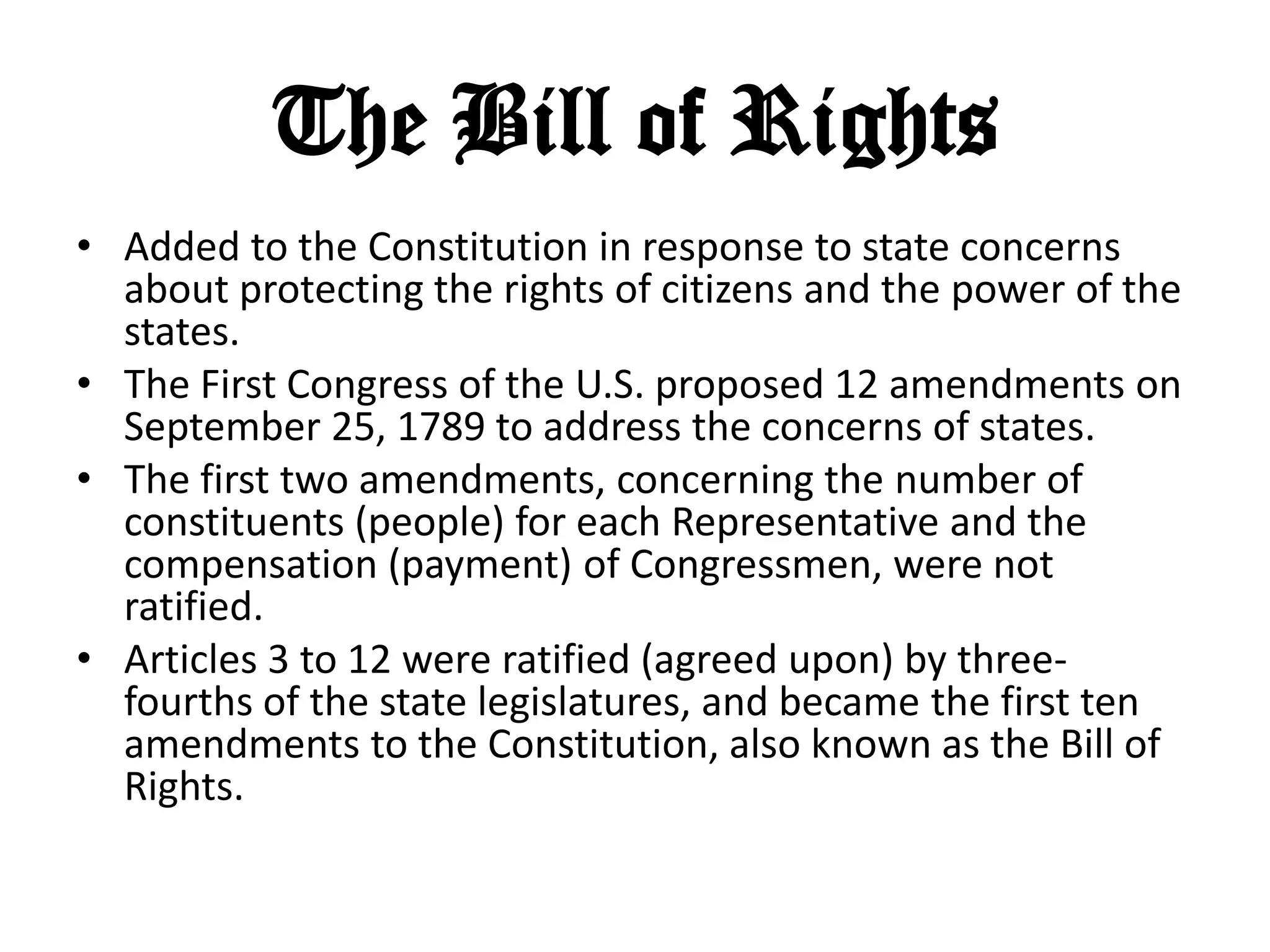
• Added to the Constitution in response to state concerns
about protecting the rights of citizens and the power of the
states.
• The First Congress of the U.S. proposed 12 amendments on
September 25, 1789 to address the concerns of states.
• The first two amendments, concerning the number of
constituents (people) for each Representative and the
compensation (payment) of Congressmen, were not
ratified.
• Articles 3 to 12 were ratified (agreed upon) by threefourths of the state legislatures, and became the first ten
amendments to the Constitution, also known as the Bill of
Rights.
The Bill of Rights
Amendment I

Congress shall make no law respecting an
establishment of religion, or prohibiting the
free exercise thereof; or abridging the freedom
of speech, or of the press; or the right of the
people peaceably to assemble, and to petition
the Government for a redress of grievances.

Freedoms
granted by this
amendment?

1. Freedom of religion 2. Freedom of speech
3. Freedom of the press 4. Freedom to assemble
5. Freedom to petition government for grievances

Summary

Guarantees our freedom of
speech, religion, press, and to assemble
peaceably.
The Bill of Rights
Amendment II

A well regulated Militia, being necessary to the
security of a free State, the right of the people to
keep and bear Arms, shall not be infringed.

Questions:

What are “arms”?

What does infringe mean?
What is a militia? Why did we need one?
How is this Amendment being discussed today?

Summary

Guarantees the right to bear arms
The Bill of Rights
Amendment III

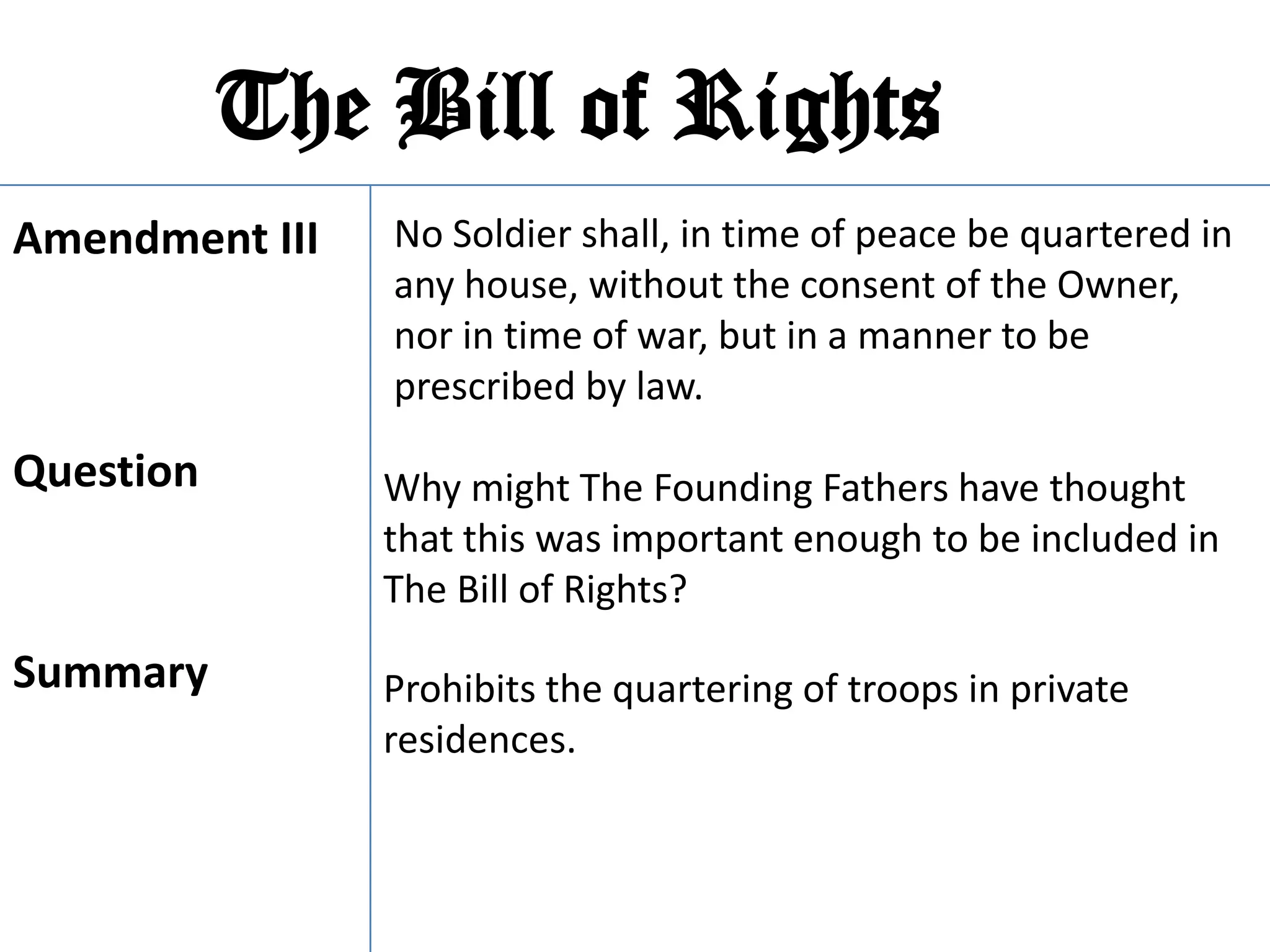
No Soldier shall, in time of peace be quartered in
any house, without the consent of the Owner,
nor in time of war, but in a manner to be
prescribed by law.

Question

Why might The Founding Fathers have thought
that this was important enough to be included in
The Bill of Rights?

Summary

Prohibits the quartering of troops in private
residences.
The Bill of Rights
Amendment IV

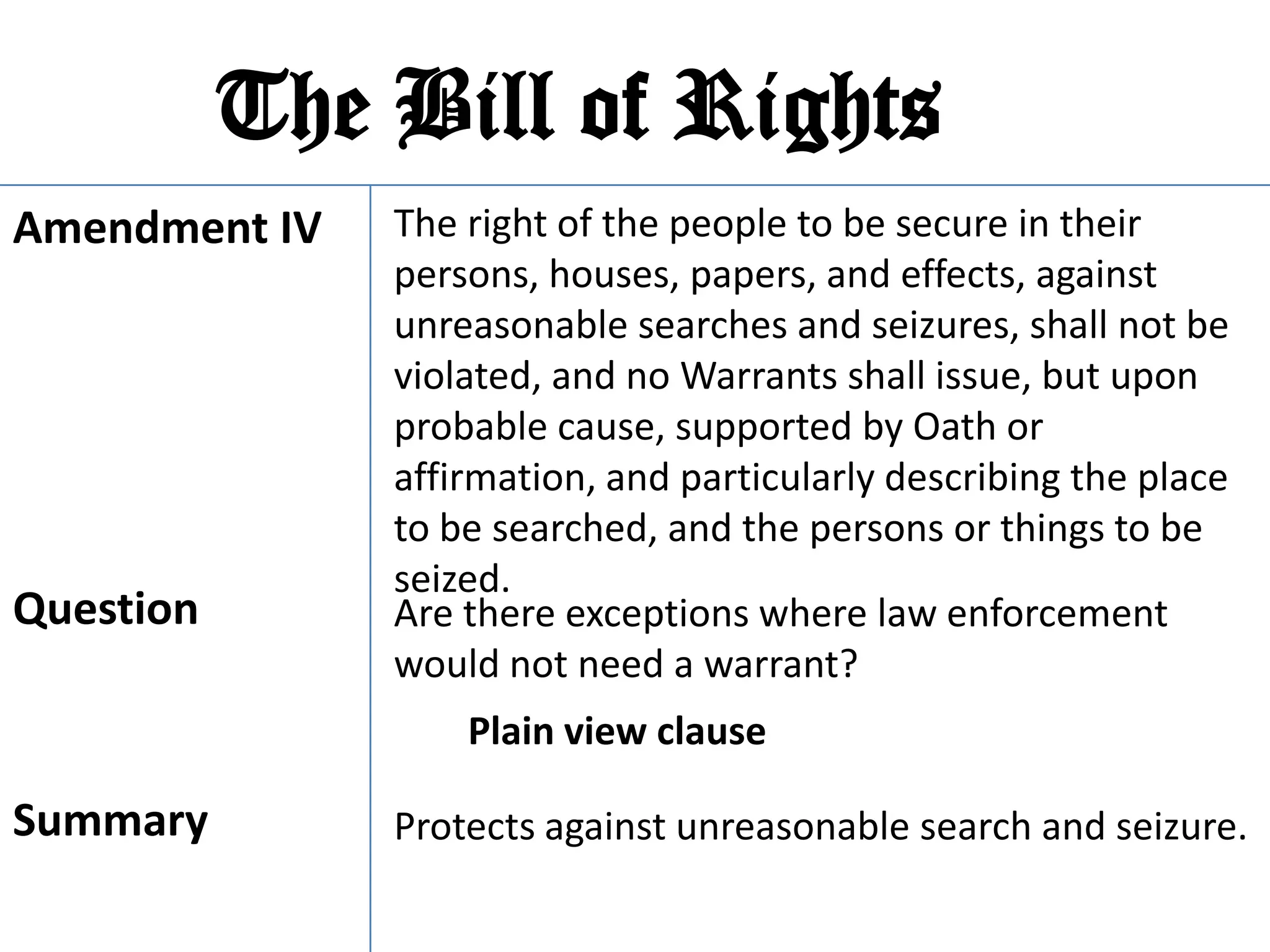
Question

The right of the people to be secure in their
persons, houses, papers, and effects, against
unreasonable searches and seizures, shall not be
violated, and no Warrants shall issue, but upon
probable cause, supported by Oath or
affirmation, and particularly describing the place
to be searched, and the persons or things to be
seized.
Are there exceptions where law enforcement
would not need a warrant?
Plain view clause

Summary

Protects against unreasonable search and seizure.
The Bill of Rights
Amendment V

No person shall be held to answer for a capital, or
otherwise infamous crime, unless on a
presentment or indictment* of a Grand
Jury, except in cases arising in the land or naval
forces, or in the Militia, when in actual service in
time of War or public danger; nor shall any person
be subject for the same offence to be twice put in
jeopardy of life or limb; nor shall be compelled in
any criminal case to be a witness against
himself, nor be deprived of life, liberty, or
property, without due process of law; nor shall
private property be taken for public use, without
just compensation.

Indictment: (n)

a formal accusation initiating a criminal case
The Bill of Rights
Questions for
Amendment V:

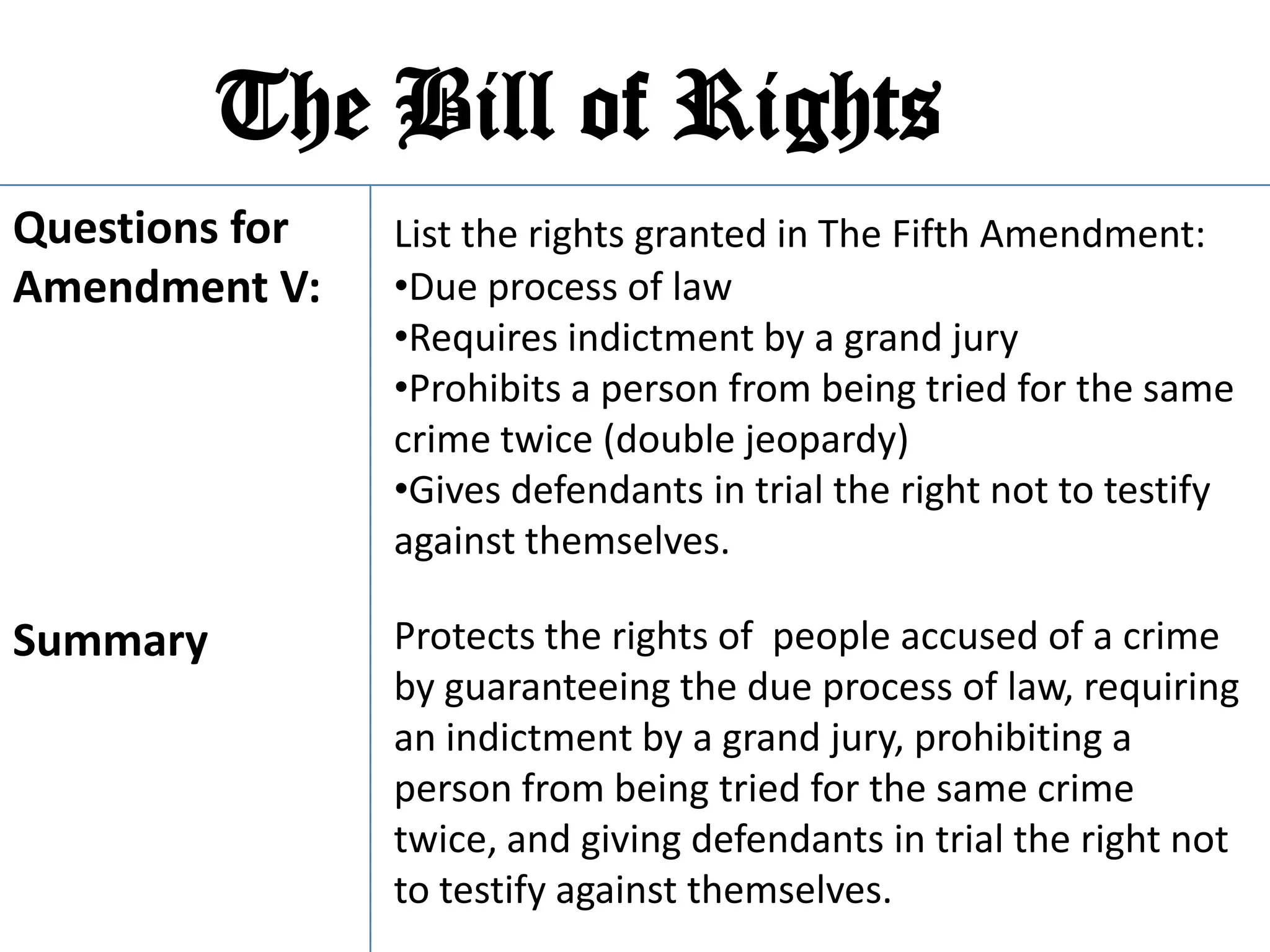
List the rights granted in The Fifth Amendment:
•Due process of law
•Requires indictment by a grand jury
•Prohibits a person from being tried for the same
crime twice (double jeopardy)
•Gives defendants in trial the right not to testify
against themselves.

Summary

Protects the rights of people accused of a crime
by guaranteeing the due process of law, requiring
an indictment by a grand jury, prohibiting a
person from being tried for the same crime
twice, and giving defendants in trial the right not
to testify against themselves.
The Bill of Rights
Amendment VI

In all criminal prosecutions, the accused shall
enjoy the right to a speedy and public trial, by an
impartial jury of the State and district wherein the
crime shall have been committed; which district
shall have been previously ascertained by law, and
to be informed of the nature and cause of the
accusation; to be confronted with the witnesses
against him; to have compulsory process for
obtaining witnesses in his favor, and to have the
Assistance of Counsel for his defense.

Summary

Guarantees the right to a speedy and public trial
before an impartial jury, right to an attorney and
the right to cross-examine the witnesses.
The Bill of Rights
Amendment VII

In Suits at common law, where the value in
controversy shall exceed twenty dollars, the right
of trial by jury shall be preserved, and no fact
tried by a jury shall be otherwise reexamined in
any Court of the United States, than according to
the rules of the common law.

Question:

How does a criminal trial differ from a civil one?

Summary

Guarantees the right to trial by jury in a civil case.
The Bill of Rights
Amendment VIII Excessive bail shall not be required, nor excessive
fines imposed, nor cruel and unusual punishment
inflicted.
"No cruel and unusual punishment is to be inflicted; it is
sometimes necessary to hang a man, villains often deserve
whipping, and perhaps having their ears cut off; but are we in the
future to be prevented from inflicting these punishments because
they are cruel?" Senator Samuel Livermore (New Hampshire) 1
Annals of Congress 754 (1789)

Question:

How should we define what is "cruel and
unusual"?

Summary

Prohibits excess bail and the use of cruel and
unusual punishment.
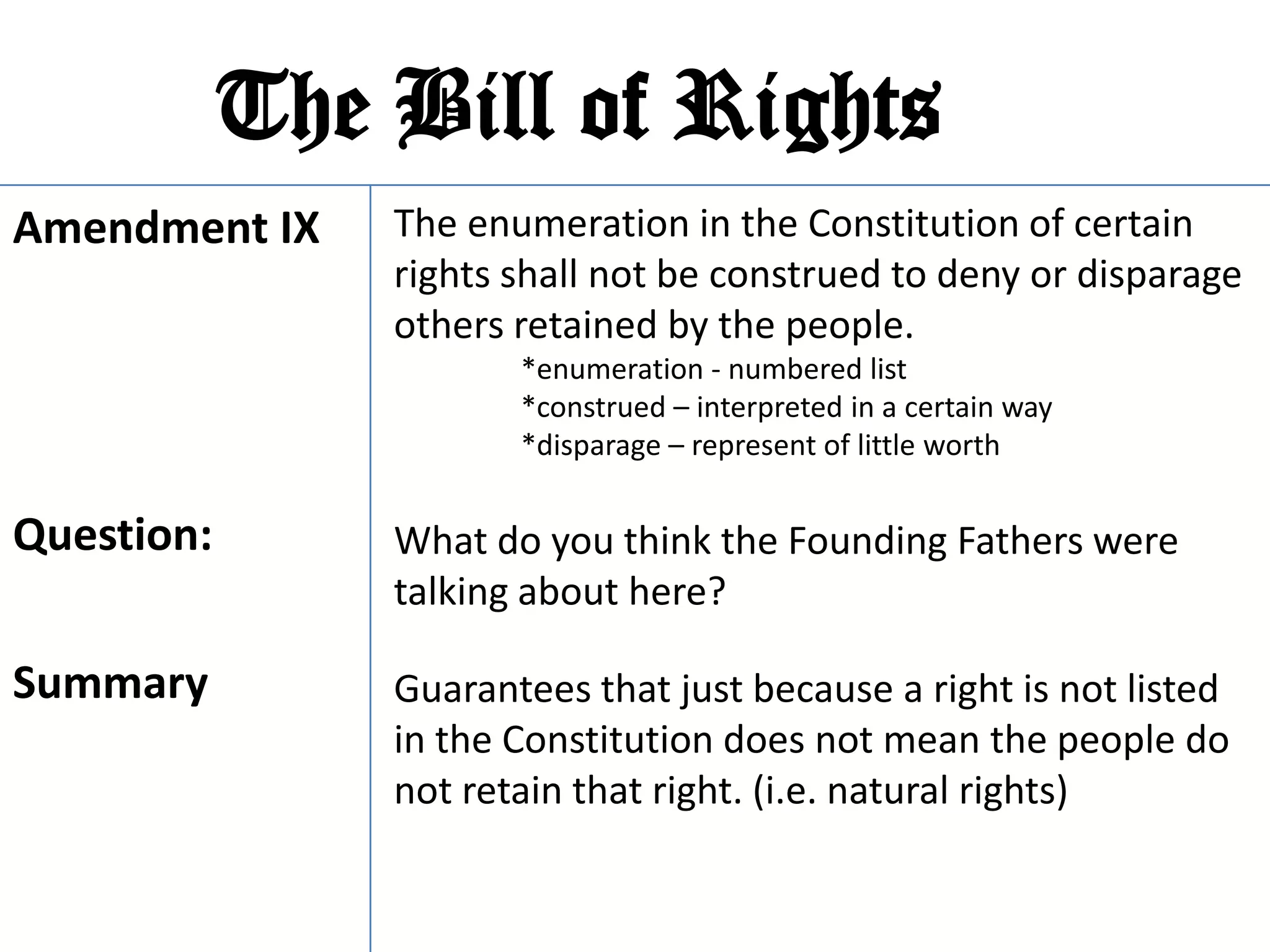
The Bill of Rights
Amendment IX

The enumeration in the Constitution of certain
rights shall not be construed to deny or disparage
others retained by the people.
*enumeration - numbered list
*construed – interpreted in a certain way
*disparage – represent of little worth

Question:

What do you think the Founding Fathers were
talking about here?

Summary

Guarantees that just because a right is not listed
in the Constitution does not mean the people do
not retain that right. (i.e. natural rights)
The Bill of Rights
Amendment X

The powers not delegated to the United States by
the Constitution, nor prohibited by it to the
States, are reserved to the States respectively, or
to the people.

Questions:

Can States make laws in additional to the laws of
the federal government?
Can the States make laws that are in opposition to
laws created by the federal government.?

Summary

Means that all rights not given to the Federal
government in the Constitution are given to the
states and the people.

Examples

Education requirements, rules for marriage, state
taxes.

Bill of rights_lesson

  • 1.
    The Bill ofRights • Added to the Constitution in response to state concerns about protecting the rights of citizens and the power of the states. • The First Congress of the U.S. proposed 12 amendments on September 25, 1789 to address the concerns of states. • The first two amendments, concerning the number of constituents (people) for each Representative and the compensation (payment) of Congressmen, were not ratified. • Articles 3 to 12 were ratified (agreed upon) by threefourths of the state legislatures, and became the first ten amendments to the Constitution, also known as the Bill of Rights.
  • 2.
    The Bill ofRights Amendment I Congress shall make no law respecting an establishment of religion, or prohibiting the free exercise thereof; or abridging the freedom of speech, or of the press; or the right of the people peaceably to assemble, and to petition the Government for a redress of grievances. Freedoms granted by this amendment? 1. Freedom of religion 2. Freedom of speech 3. Freedom of the press 4. Freedom to assemble 5. Freedom to petition government for grievances Summary Guarantees our freedom of speech, religion, press, and to assemble peaceably.
  • 3.
    The Bill ofRights Amendment II A well regulated Militia, being necessary to the security of a free State, the right of the people to keep and bear Arms, shall not be infringed. Questions: What are “arms”? What does infringe mean? What is a militia? Why did we need one? How is this Amendment being discussed today? Summary Guarantees the right to bear arms
  • 4.
    The Bill ofRights Amendment III No Soldier shall, in time of peace be quartered in any house, without the consent of the Owner, nor in time of war, but in a manner to be prescribed by law. Question Why might The Founding Fathers have thought that this was important enough to be included in The Bill of Rights? Summary Prohibits the quartering of troops in private residences.
  • 5.
    The Bill ofRights Amendment IV Question The right of the people to be secure in their persons, houses, papers, and effects, against unreasonable searches and seizures, shall not be violated, and no Warrants shall issue, but upon probable cause, supported by Oath or affirmation, and particularly describing the place to be searched, and the persons or things to be seized. Are there exceptions where law enforcement would not need a warrant? Plain view clause Summary Protects against unreasonable search and seizure.
  • 6.
    The Bill ofRights Amendment V No person shall be held to answer for a capital, or otherwise infamous crime, unless on a presentment or indictment* of a Grand Jury, except in cases arising in the land or naval forces, or in the Militia, when in actual service in time of War or public danger; nor shall any person be subject for the same offence to be twice put in jeopardy of life or limb; nor shall be compelled in any criminal case to be a witness against himself, nor be deprived of life, liberty, or property, without due process of law; nor shall private property be taken for public use, without just compensation. Indictment: (n) a formal accusation initiating a criminal case
  • 7.
    The Bill ofRights Questions for Amendment V: List the rights granted in The Fifth Amendment: •Due process of law •Requires indictment by a grand jury •Prohibits a person from being tried for the same crime twice (double jeopardy) •Gives defendants in trial the right not to testify against themselves. Summary Protects the rights of people accused of a crime by guaranteeing the due process of law, requiring an indictment by a grand jury, prohibiting a person from being tried for the same crime twice, and giving defendants in trial the right not to testify against themselves.
  • 8.
    The Bill ofRights Amendment VI In all criminal prosecutions, the accused shall enjoy the right to a speedy and public trial, by an impartial jury of the State and district wherein the crime shall have been committed; which district shall have been previously ascertained by law, and to be informed of the nature and cause of the accusation; to be confronted with the witnesses against him; to have compulsory process for obtaining witnesses in his favor, and to have the Assistance of Counsel for his defense. Summary Guarantees the right to a speedy and public trial before an impartial jury, right to an attorney and the right to cross-examine the witnesses.
  • 9.
    The Bill ofRights Amendment VII In Suits at common law, where the value in controversy shall exceed twenty dollars, the right of trial by jury shall be preserved, and no fact tried by a jury shall be otherwise reexamined in any Court of the United States, than according to the rules of the common law. Question: How does a criminal trial differ from a civil one? Summary Guarantees the right to trial by jury in a civil case.
  • 10.
    The Bill ofRights Amendment VIII Excessive bail shall not be required, nor excessive fines imposed, nor cruel and unusual punishment inflicted. "No cruel and unusual punishment is to be inflicted; it is sometimes necessary to hang a man, villains often deserve whipping, and perhaps having their ears cut off; but are we in the future to be prevented from inflicting these punishments because they are cruel?" Senator Samuel Livermore (New Hampshire) 1 Annals of Congress 754 (1789) Question: How should we define what is "cruel and unusual"? Summary Prohibits excess bail and the use of cruel and unusual punishment.
  • 11.
    The Bill ofRights Amendment IX The enumeration in the Constitution of certain rights shall not be construed to deny or disparage others retained by the people. *enumeration - numbered list *construed – interpreted in a certain way *disparage – represent of little worth Question: What do you think the Founding Fathers were talking about here? Summary Guarantees that just because a right is not listed in the Constitution does not mean the people do not retain that right. (i.e. natural rights)
  • 12.
    The Bill ofRights Amendment X The powers not delegated to the United States by the Constitution, nor prohibited by it to the States, are reserved to the States respectively, or to the people. Questions: Can States make laws in additional to the laws of the federal government? Can the States make laws that are in opposition to laws created by the federal government.? Summary Means that all rights not given to the Federal government in the Constitution are given to the states and the people. Examples Education requirements, rules for marriage, state taxes.

Editor's Notes

  • #9 Miranda Rights - Established by the U.S. Supreme Court in 1966 as a response to Miranda V. Arizona where a defendant incriminated himself to police. The statements were used in trial and he was convicted.