Different
Between Bill of
 exchange and
    cheque by
     Presentation
The Negotiable Instruments
         Act, 1881
 Act                -   Act No.26 of 1881
 Enacted by         -   Parliament of india
 Date enacted       -   9 December 1881
 Date commenced -       1 March 1882

The Act extends to the whole of India.

The Act is to regulate commercial transactions
Background to development of
    negotiable instruments
 Merchants had to pay for purchases with precious
  metals – this was burdensome, there was always a
  risk of theft or destruction (eg. Shipwreck).
 Merchants began writing orders to each other.
  Legal rules impeded them, e.g. the nemo dat rule
  —’lit you cannot give what you do not have’, you
  cannot transfer better title to goods than you have.
 To overcome nemo dat, an exception developed for
  negotiable instruments—these can be transferred
  from one person to another and the transferee
  receives good title (in fact the transferee can receive
  better title than the transferor.)
Negotiable Instruments
 Definition:
 The word negotiable means ‘transferable by
 delivery,’ and the word instrument means ‘a
 written document by which a right is created
 in favour of some person.’

 So negotiable instrument is a piece of paper
 which entitles a person to a certain sum of
 money and which is transferable from one to
 another person by a delivery or by
 endorsement and delivery.
Types of Negotiable Instruments
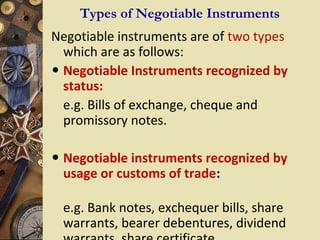
Negotiable instruments are of two types
  which are as follows:
• Negotiable Instruments recognized by
  status:
  e.g. Bills of exchange, cheque and
  promissory notes.

• Negotiable instruments recognized by
 usage or customs of trade:

 e.g. Bank notes, exchequer bills, share
 warrants, bearer debentures, dividend
Bill of Exchange
 Definition:
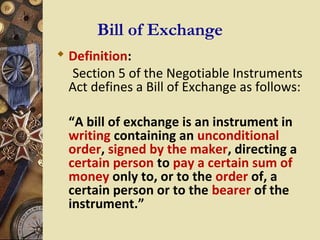
  Section 5 of the Negotiable Instruments
  Act defines a Bill of Exchange as follows:

  “A bill of exchange is an instrument in
  writing containing an unconditional
  order, signed by the maker, directing a
  certain person to pay a certain sum of
  money only to, or to the order of, a
  certain person or to the bearer of the
  instrument.”
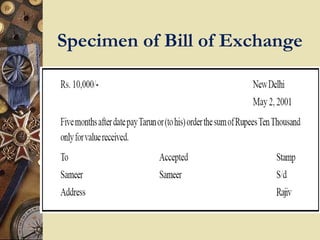
Specimen of Bill of Exchange
Parties to a Bill of Exchange
There are three parties involved in a bill of
   exchange
(i) The Drawer – The person who makes the
   order for making payment. In the above
   specimen, Rajiv is the drawer.
(ii) The Drawee – The person to whom the
   order to pay is made. He is generally a
   debtor of the drawer. It is Sameer in this
   case.
(iii) The Payee – The person to whom the
   payment is to be made. In this case it is
   Tarun.
The drawer can also draw a bill in his own
  name thereby he himself becomes the
  payee. Here the words in the bill would be
  Pay to us or order.
In a bill where a time period is mentioned,
  just like the above specimen, is called a
  Time Bill.
But a bill may be made payable on demand
  also. This is called a Demand Bill.
Essentials of a Bill of Exchange
1. It must be in writing
2. It must contain an order to pay. A mere
   request to pay on account, will not amount to
   an order
3. The order to pay must be unconditional
4. It must be signed by the drawer
5. The drawer, drawee and payee must be
   certain. A bill cannot be drawn on two or more
   drawees but may be made payable in the
   alternative to one of two or more payees
6. The sum payable must be certain
7. The bill must contain an order to pay money
   only
8. It must comply with the formalities as regards
   date, consideration, stamps, etc
Cheque
A cheque is the means by which a person
  who has fund in the hand of a bank
  withdraws the same or some part of it.
A cheque is a kind of bill of exchange but it
  has additional qualification namely-
1- it is always drawn on a specified banker
  and
2-it is always payble on demand without any
  days of grace.
Definition

 A “cheque” is a bill of exchange drawn on
  a specified banker and not expressed to be
  payable otherwise than on demand.
  ‘Cheque’ includes electronic image of a
  truncated cheque and a cheque in
  electronic form. [section 6].
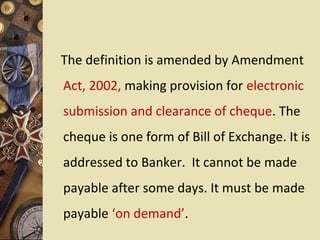
The definition is amended by Amendment
Act, 2002, making provision for electronic
submission and clearance of cheque. The
cheque is one form of Bill of Exchange. It is
addressed to Banker. It cannot be made
payable after some days. It must be made
payable ‘on demand’.
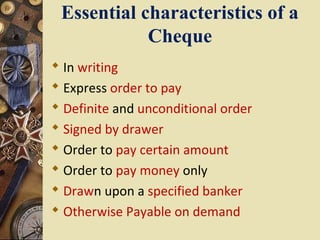
Essential characteristics of a
            Cheque
 In writing
 Express order to pay
 Definite and unconditional order
 Signed by drawer
 Order to pay certain amount
 Order to pay money only
 Drawn upon a specified banker
 Otherwise Payable on demand
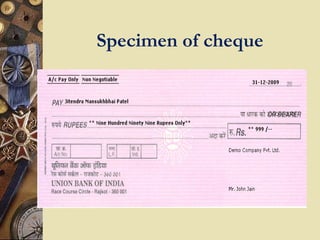
Specimen of cheque
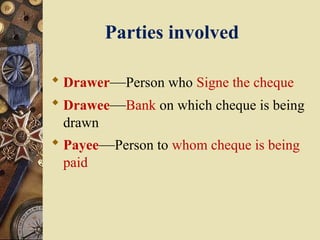
Parties involved

 Drawer—Person who Signe the cheque
 Drawee—Bank on which cheque is being
  drawn
 Payee—Person to whom cheque is being
  paid
Types of cheque
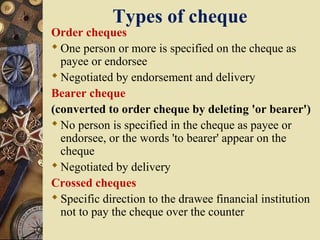
Order cheques
 One person or more is specified on the cheque as
  payee or endorsee
 Negotiated by endorsement and delivery
Bearer cheque
(converted to order cheque by deleting 'or bearer')
 No person is specified in the cheque as payee or
  endorsee, or the words 'to bearer' appear on the
  cheque
 Negotiated by delivery
Crossed cheques
 Specific direction to the drawee financial institution
  not to pay the cheque over the counter
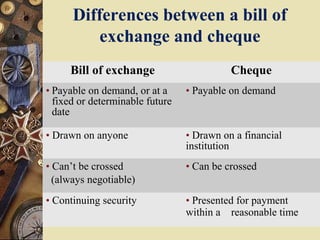
Differences between a bill of
          exchange and cheque
     Bill of exchange                      Cheque
• Payable on demand, or at a     • Payable on demand
  fixed or determinable future
  date

• Drawn on anyone                • Drawn on a financial
                                 institution
• Can’t be crossed               • Can be crossed
  (always negotiable)
• Continuing security            • Presented for payment
                                 within a reasonable time
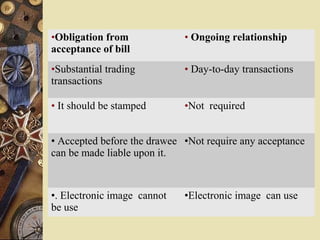
•Obligation from             • Ongoing relationship
acceptance of bill
•Substantial trading         • Day-to-day transactions
transactions

• It should be stamped       •Not required


• Accepted before the drawee •Not require any acceptance
can be made liable upon it.


•. Electronic image cannot   •Electronic image can use
be use
Thank you

Bill and cheque

  • 1.
    Different Between Bill of exchange and cheque by Presentation
  • 2.
    The Negotiable Instruments Act, 1881  Act - Act No.26 of 1881  Enacted by - Parliament of india  Date enacted - 9 December 1881  Date commenced - 1 March 1882 The Act extends to the whole of India. The Act is to regulate commercial transactions
  • 3.
    Background to developmentof negotiable instruments  Merchants had to pay for purchases with precious metals – this was burdensome, there was always a risk of theft or destruction (eg. Shipwreck).  Merchants began writing orders to each other. Legal rules impeded them, e.g. the nemo dat rule —’lit you cannot give what you do not have’, you cannot transfer better title to goods than you have.  To overcome nemo dat, an exception developed for negotiable instruments—these can be transferred from one person to another and the transferee receives good title (in fact the transferee can receive better title than the transferor.)
  • 4.
    Negotiable Instruments  Definition: The word negotiable means ‘transferable by delivery,’ and the word instrument means ‘a written document by which a right is created in favour of some person.’ So negotiable instrument is a piece of paper which entitles a person to a certain sum of money and which is transferable from one to another person by a delivery or by endorsement and delivery.
  • 5.
    Types of NegotiableInstruments Negotiable instruments are of two types which are as follows: • Negotiable Instruments recognized by status: e.g. Bills of exchange, cheque and promissory notes. • Negotiable instruments recognized by usage or customs of trade: e.g. Bank notes, exchequer bills, share warrants, bearer debentures, dividend
  • 6.
    Bill of Exchange Definition: Section 5 of the Negotiable Instruments Act defines a Bill of Exchange as follows: “A bill of exchange is an instrument in writing containing an unconditional order, signed by the maker, directing a certain person to pay a certain sum of money only to, or to the order of, a certain person or to the bearer of the instrument.”
  • 7.
    Specimen of Billof Exchange
  • 8.
    Parties to aBill of Exchange There are three parties involved in a bill of exchange (i) The Drawer – The person who makes the order for making payment. In the above specimen, Rajiv is the drawer. (ii) The Drawee – The person to whom the order to pay is made. He is generally a debtor of the drawer. It is Sameer in this case. (iii) The Payee – The person to whom the payment is to be made. In this case it is Tarun.
  • 9.
    The drawer canalso draw a bill in his own name thereby he himself becomes the payee. Here the words in the bill would be Pay to us or order. In a bill where a time period is mentioned, just like the above specimen, is called a Time Bill. But a bill may be made payable on demand also. This is called a Demand Bill.
  • 10.
    Essentials of aBill of Exchange 1. It must be in writing 2. It must contain an order to pay. A mere request to pay on account, will not amount to an order 3. The order to pay must be unconditional 4. It must be signed by the drawer 5. The drawer, drawee and payee must be certain. A bill cannot be drawn on two or more drawees but may be made payable in the alternative to one of two or more payees 6. The sum payable must be certain 7. The bill must contain an order to pay money only 8. It must comply with the formalities as regards date, consideration, stamps, etc
  • 11.
    Cheque A cheque isthe means by which a person who has fund in the hand of a bank withdraws the same or some part of it. A cheque is a kind of bill of exchange but it has additional qualification namely- 1- it is always drawn on a specified banker and 2-it is always payble on demand without any days of grace.
  • 12.
    Definition  A “cheque”is a bill of exchange drawn on a specified banker and not expressed to be payable otherwise than on demand. ‘Cheque’ includes electronic image of a truncated cheque and a cheque in electronic form. [section 6].
  • 13.
    The definition isamended by Amendment Act, 2002, making provision for electronic submission and clearance of cheque. The cheque is one form of Bill of Exchange. It is addressed to Banker. It cannot be made payable after some days. It must be made payable ‘on demand’.
  • 14.
    Essential characteristics ofa Cheque  In writing  Express order to pay  Definite and unconditional order  Signed by drawer  Order to pay certain amount  Order to pay money only  Drawn upon a specified banker  Otherwise Payable on demand
  • 15.
  • 16.
    Parties involved  Drawer—Personwho Signe the cheque  Drawee—Bank on which cheque is being drawn  Payee—Person to whom cheque is being paid
  • 17.
    Types of cheque Ordercheques  One person or more is specified on the cheque as payee or endorsee  Negotiated by endorsement and delivery Bearer cheque (converted to order cheque by deleting 'or bearer')  No person is specified in the cheque as payee or endorsee, or the words 'to bearer' appear on the cheque  Negotiated by delivery Crossed cheques  Specific direction to the drawee financial institution not to pay the cheque over the counter
  • 18.
    Differences between abill of exchange and cheque Bill of exchange Cheque • Payable on demand, or at a • Payable on demand fixed or determinable future date • Drawn on anyone • Drawn on a financial institution • Can’t be crossed • Can be crossed (always negotiable) • Continuing security • Presented for payment within a reasonable time
  • 19.
    •Obligation from • Ongoing relationship acceptance of bill •Substantial trading • Day-to-day transactions transactions • It should be stamped •Not required • Accepted before the drawee •Not require any acceptance can be made liable upon it. •. Electronic image cannot •Electronic image can use be use
  • 20.