THE MANAGEMENT OF BILATERAL PROXIMAL HAMSTRING
TENDINOPATHY IN ULTRAMARATHON RUNNER
WITH ISOINERTIAL FUNCTIONAL EXERCISES:
A CASE REPORT
Giacomo Quaglia, Luca Stefanini, Maurizio Giacchino, Stefano Ventura, Angelo Cacchio, Davide Dardanello
Giacomo Quaglia PT
info@giacomoquaglia.it
INTRODUCTION
INJURY
Semimembranosus and biceps femuris muscles combine
to create a common tendon that insert medially in the
ischial tuberosity.
Overuse
Poor lumbo-pelvic motor control
Weakness in hamstring muscles
What the proximal hamstring tendinopathy (PHT) is?
Goom TS, et Al., J Orthop Sports Phys Ther. 2016
Rio E. et Al., Br J Sports Med 2015
Cook JL, et Al., Br J Sports Med 2016
Cook JL, et Al., Br J Sports Med 2015
Isoinertial machine
Huge load for tendons
Eccentric strengthening
Tendons are highly responsive to increased mechanical loading and adapt
through changes of their mechanical, material, and morphological
properties.
Bohm S. et Al. , Sports Medicine Open. 2015
INTRODUCTION
Tesch Per A. et Al., Frontiers in physiologhy, 2017
INTRODUCTION
Research supporting the use of
isoinertial technology is lacking
Present researches have
low level of evidence
OBJECTIVES
Find a way to increase mechanical loading in common
tendon
Present exercices which functionally reproduce the
running act
CASE PRESENTATION
•41 year-old healthy male, who had been partecipating in ultra-
endurance runs for 10 years
•Insidious onset of bilateral deep buttock pain which started 7 months
(March 2016) prior our clinical evaluation (December 2016)
•Pain exacerbated with:
Running: his pain prevents him from running from August 2016
Sitting on hard surfaces
Analytical hamstring contraction
Forward bending on the trunk with extended knees
•Musculoskeletal ultrasound showed «bilateral insertional enthesopathy
of hamstring with focal lesion on right leg».
CASE PRESENTATION
•Physical examination (day 0)
Pain in palpation of the tendons and bellies hamstring’s muscle
Pain with all the maneuvers that put stress in hamstrings’ structures
(bent-knee test, Puranen-Orava test).
NPRS left = 2,5/10
right = 7/10
NPRS left = 2,5/10
right = 7/10
CASE PRESENTATION
Pain in execution of MVIC of hamstring in prone position
SLR test left/right -, Slump test left/right -
No pain-relation with lumbar motion
MVIC in 90° knee flexion
NPRS left = 3/10
right = 5/10
MVIC first evaluation’ values aren’t available because of
the patient pain.
METHODS
Musculoskeletal ultrasound report
NRPS during the MVIC
NPRS during running
Running distance without pain
VISA-H questionnaire values
Cacchio A, et Al., Development and validation of a new VISA questionnaire (VISA-H) for patients with proximal
hamstring tendinopathy. Br J Sports Med. 2014.
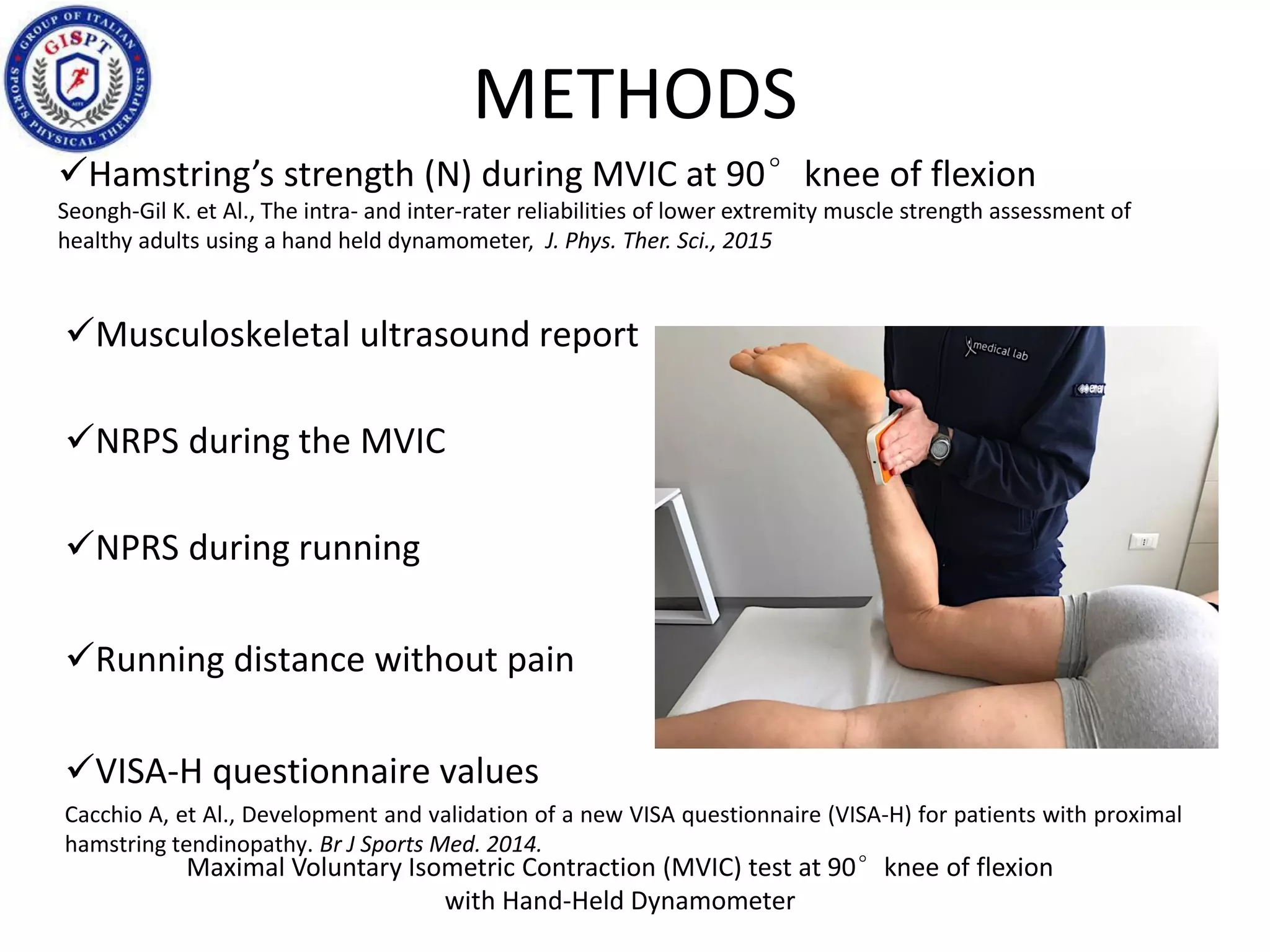
Maximal Voluntary Isometric Contraction (MVIC) test at 90°knee of flexion
with Hand-Held Dynamometer
Hamstring’s strength (N) during MVIC at 90°knee of flexion
Seongh-Gil K. et Al., The intra- and inter-rater reliabilities of lower extremity muscle strength assessment of
healthy adults using a hand held dynamometer, J. Phys. Ther. Sci., 2015
INTERVENTION
In upright running, which can be a key aggravating factor in athletic
populations, the hamstrings eccentrically decelerate knee extension in
terminal swing phase.
Goom TS et Al., J Orthop Sports Phys Ther. 2016
Ascertained this, we use isoinertial machine for the possibilities to join:
1. Eccentric training reproducing the swing phase of run
2. Increase mechanical loading to common tendon
INTERVENTION
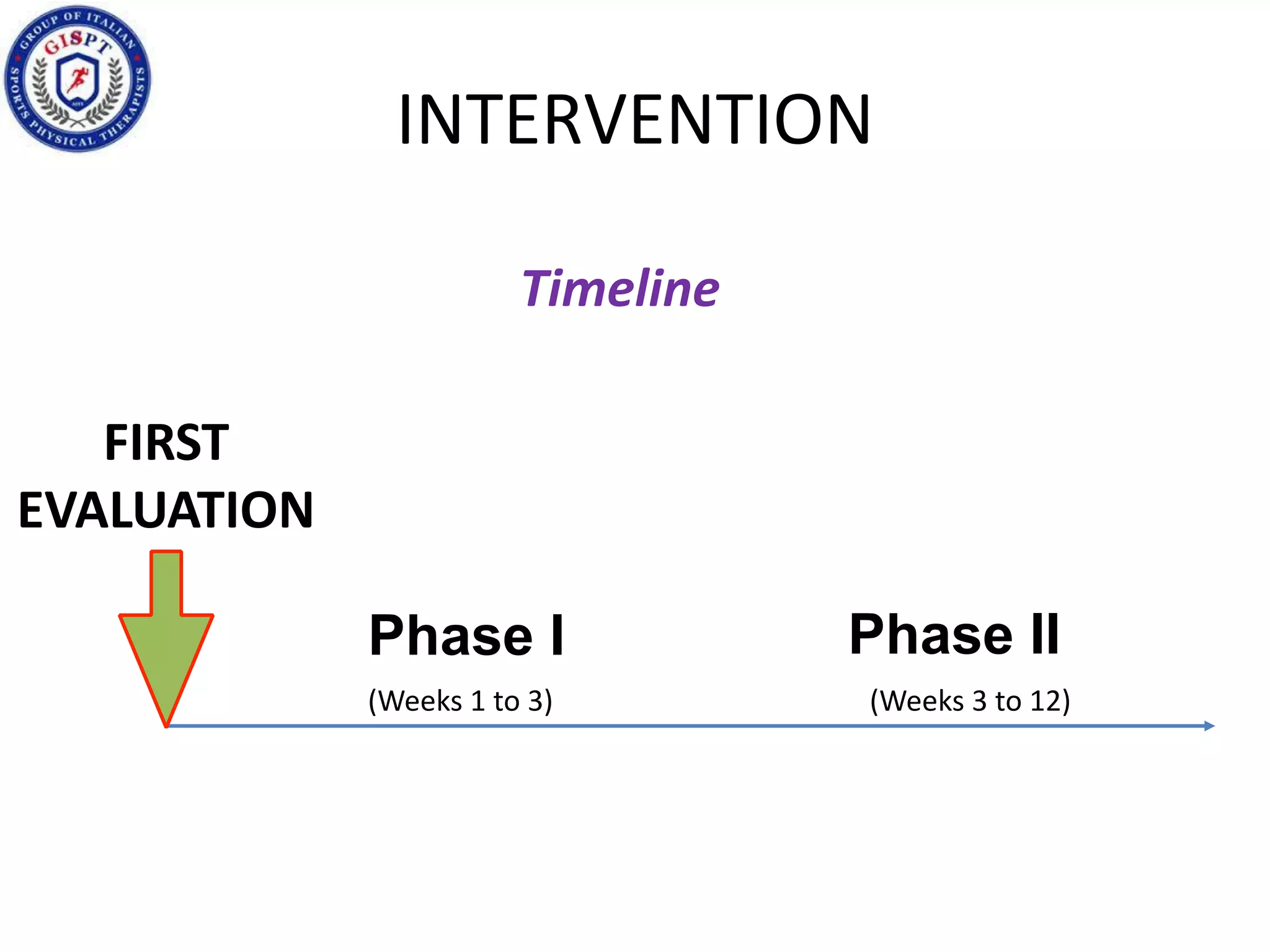
Timeline
FIRST
EVALUATION
(Weeks 1 to 3) (Weeks 3 to 12)
Phase I Phase II
INTERVENTION
(Weeks 1 to 3)
(Weeks 3 to 12)
Education of patient, respect of pain, progressive
trunk stabilty exercices, lumbo-pelvic motor control
exercices.
Introduction of eccentric exercices performed by
isoinertial machine
Phase I
Phase II
INTERVENTION
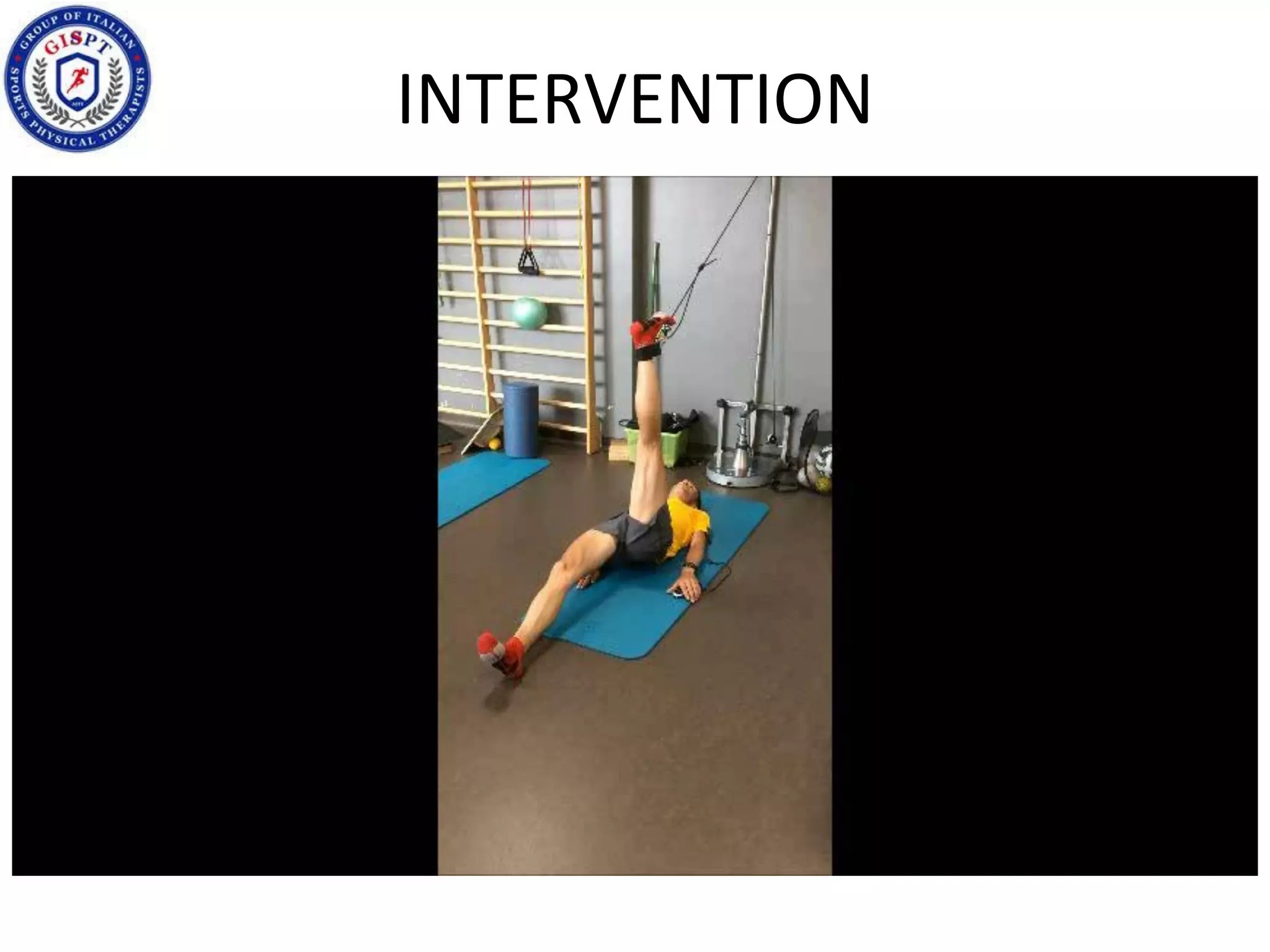
We proposed eccentric exercises which reproduce faithfully the functional
act of running, with the purpose of acting mainly in the proximal hamstring
segment.
1. 2.
Figure 1.,2. – Progression of an exercise performed by isoinertial machine in supine position
INTERVENTION
RESULTS
LIMITATIONS
«The major advantage
of case reporting is
probably its ability to
detect novities»
Trygve Nissen and Rolf Wynn, BMC Research Notes, 2014
CONCLUSIONS
Body functions & structures
(impairment)
Activities
(limitations)
Participation
(restriction)
&
 Tendons healing shown by ultrasound
 Reduction of pain in hamstrings’
strenght evaluation
 Significative amelioration of
hamstrings’ strenght values (N)
 Significative reduction of pain in run
 Increasment of running distance
without any pain
 Significative amilioration of VISA-H
values
 Return to high-level competions
31/10/2017
Thanks

BILATERAL PROXIMAL HAMSTRING TENDINOPATHY IN ULTRAMARATHON RUNNER

  • 1.
    THE MANAGEMENT OFBILATERAL PROXIMAL HAMSTRING TENDINOPATHY IN ULTRAMARATHON RUNNER WITH ISOINERTIAL FUNCTIONAL EXERCISES: A CASE REPORT Giacomo Quaglia, Luca Stefanini, Maurizio Giacchino, Stefano Ventura, Angelo Cacchio, Davide Dardanello Giacomo Quaglia PT info@giacomoquaglia.it
  • 2.
    INTRODUCTION INJURY Semimembranosus and bicepsfemuris muscles combine to create a common tendon that insert medially in the ischial tuberosity. Overuse Poor lumbo-pelvic motor control Weakness in hamstring muscles What the proximal hamstring tendinopathy (PHT) is? Goom TS, et Al., J Orthop Sports Phys Ther. 2016 Rio E. et Al., Br J Sports Med 2015 Cook JL, et Al., Br J Sports Med 2016 Cook JL, et Al., Br J Sports Med 2015
  • 3.
    Isoinertial machine Huge loadfor tendons Eccentric strengthening Tendons are highly responsive to increased mechanical loading and adapt through changes of their mechanical, material, and morphological properties. Bohm S. et Al. , Sports Medicine Open. 2015 INTRODUCTION Tesch Per A. et Al., Frontiers in physiologhy, 2017
  • 4.
    INTRODUCTION Research supporting theuse of isoinertial technology is lacking Present researches have low level of evidence
  • 5.
    OBJECTIVES Find a wayto increase mechanical loading in common tendon Present exercices which functionally reproduce the running act
  • 6.
    CASE PRESENTATION •41 year-oldhealthy male, who had been partecipating in ultra- endurance runs for 10 years •Insidious onset of bilateral deep buttock pain which started 7 months (March 2016) prior our clinical evaluation (December 2016) •Pain exacerbated with: Running: his pain prevents him from running from August 2016 Sitting on hard surfaces Analytical hamstring contraction Forward bending on the trunk with extended knees •Musculoskeletal ultrasound showed «bilateral insertional enthesopathy of hamstring with focal lesion on right leg».
  • 7.
    CASE PRESENTATION •Physical examination(day 0) Pain in palpation of the tendons and bellies hamstring’s muscle Pain with all the maneuvers that put stress in hamstrings’ structures (bent-knee test, Puranen-Orava test). NPRS left = 2,5/10 right = 7/10 NPRS left = 2,5/10 right = 7/10
  • 8.
    CASE PRESENTATION Pain inexecution of MVIC of hamstring in prone position SLR test left/right -, Slump test left/right - No pain-relation with lumbar motion MVIC in 90° knee flexion NPRS left = 3/10 right = 5/10 MVIC first evaluation’ values aren’t available because of the patient pain.
  • 9.
    METHODS Musculoskeletal ultrasound report NRPSduring the MVIC NPRS during running Running distance without pain VISA-H questionnaire values Cacchio A, et Al., Development and validation of a new VISA questionnaire (VISA-H) for patients with proximal hamstring tendinopathy. Br J Sports Med. 2014. Maximal Voluntary Isometric Contraction (MVIC) test at 90°knee of flexion with Hand-Held Dynamometer Hamstring’s strength (N) during MVIC at 90°knee of flexion Seongh-Gil K. et Al., The intra- and inter-rater reliabilities of lower extremity muscle strength assessment of healthy adults using a hand held dynamometer, J. Phys. Ther. Sci., 2015
  • 10.
    INTERVENTION In upright running,which can be a key aggravating factor in athletic populations, the hamstrings eccentrically decelerate knee extension in terminal swing phase. Goom TS et Al., J Orthop Sports Phys Ther. 2016 Ascertained this, we use isoinertial machine for the possibilities to join: 1. Eccentric training reproducing the swing phase of run 2. Increase mechanical loading to common tendon
  • 11.
    INTERVENTION Timeline FIRST EVALUATION (Weeks 1 to3) (Weeks 3 to 12) Phase I Phase II
  • 12.
    INTERVENTION (Weeks 1 to3) (Weeks 3 to 12) Education of patient, respect of pain, progressive trunk stabilty exercices, lumbo-pelvic motor control exercices. Introduction of eccentric exercices performed by isoinertial machine Phase I Phase II
  • 13.
    INTERVENTION We proposed eccentricexercises which reproduce faithfully the functional act of running, with the purpose of acting mainly in the proximal hamstring segment. 1. 2. Figure 1.,2. – Progression of an exercise performed by isoinertial machine in supine position
  • 14.
  • 15.
  • 16.
    LIMITATIONS «The major advantage ofcase reporting is probably its ability to detect novities» Trygve Nissen and Rolf Wynn, BMC Research Notes, 2014
  • 17.
    CONCLUSIONS Body functions &structures (impairment) Activities (limitations) Participation (restriction) &  Tendons healing shown by ultrasound  Reduction of pain in hamstrings’ strenght evaluation  Significative amelioration of hamstrings’ strenght values (N)  Significative reduction of pain in run  Increasment of running distance without any pain  Significative amilioration of VISA-H values  Return to high-level competions
  • 18.
  • 19.