Storytelling: BigQuery - past, present and future
Mobile Campaign Analytics | Retargeting | Unbiased Attribution
Nir Rubinstein - Chief Architect. nir@appsflyer.com
State of the union – 2012
Tech stack:
• Small, semi-isolated python services
• Communication via Redis' pub/sub
• Main DB is CouchDB
• Not a whole lot going on...
State of the union – 2012, cont'd
The problem:
• A really big raw(!) report is being served by CouchDB
• Data in CouchDB is being generated via a View
• The entire DB is on hold while a view is generated
• Pissed off client
What do we do???
The Quick Solution
Google Bigquery
• Hosted solution – we don't have to manage it
• Based on Google's BigTable whitepaper
• Columnar storage DB
• Really easy to start working with...
The Modeling Problem
Is there one?
• Data in Bigquery is divided into:
●
Projects
●
Datasets
●
Tables
How to split the data?
Is performance constant?
How am I charged?
The Modeling Problem
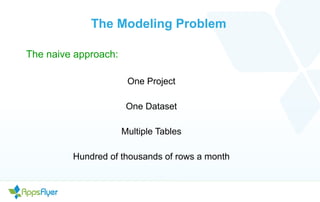
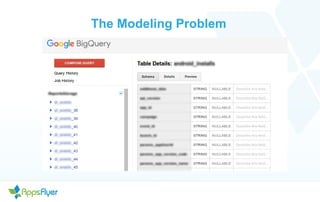
The naive approach:
One Project
One Dataset
Multiple Tables
Hundred of thousands of rows a month
The Modeling Problem
What are the limitations?
• Cannot change the schema of a table once created
• Cannot update table data
• Cannot delete table data
Essentially – forward writing only!
The Modeling Problem
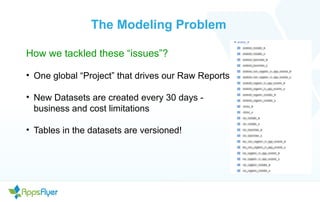
How we tackled these “issues”?
• One global “Project” that drives our Raw Reports
• New Datasets are created every 30 days -
business and cost limitations
• Tables in the datasets are versioned!
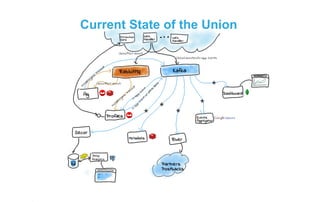
Current State of the Union
The Cost Problem
Is there a problem?
• Storage is very cheap, querying is expansive
• Querying is billed by the amount of data scanned.
Bigquery is a columnar DB which means that every
column that participates in the query is read from
beginning to end
• Once tables start storing a lot of data, even simple queries
with very few columns will be expensive
Cost Optimizations
• We're processing 8B daily events. Out of those, a few
hundred millions are written into Bigquery – only
meaningful data.
• We've created a unified schema to prevent table version
issues
• Tables can be query optimized via Table Decorators to
limit the time range of queried data
• Tables will be named with dates in them in order to
support Table Wildcard queries in order to reduce the cost
The “Cost” of Cost Optimizations
• Performance (querying multiple tables)
• Over engineering (inserting to and maintaining multiple
tables)
• Storage is cheap, but querying is costly. Since querying
does a full column scan, there's a debate whether we
should store the entire data or parts of it.
The Future
What are we waiting for?
Custom partitioning functions!!!
Thank You!
(We're hiring)

BigQuery at AppsFlyer - past, present and future

  • 1.
    Storytelling: BigQuery -past, present and future Mobile Campaign Analytics | Retargeting | Unbiased Attribution Nir Rubinstein - Chief Architect. nir@appsflyer.com
  • 2.
    State of theunion – 2012 Tech stack: • Small, semi-isolated python services • Communication via Redis' pub/sub • Main DB is CouchDB • Not a whole lot going on...
  • 3.
    State of theunion – 2012, cont'd The problem: • A really big raw(!) report is being served by CouchDB • Data in CouchDB is being generated via a View • The entire DB is on hold while a view is generated • Pissed off client What do we do???
  • 4.
    The Quick Solution GoogleBigquery • Hosted solution – we don't have to manage it • Based on Google's BigTable whitepaper • Columnar storage DB • Really easy to start working with...
  • 5.
    The Modeling Problem Isthere one? • Data in Bigquery is divided into: ● Projects ● Datasets ● Tables How to split the data? Is performance constant? How am I charged?
  • 6.
    The Modeling Problem Thenaive approach: One Project One Dataset Multiple Tables Hundred of thousands of rows a month
  • 7.
  • 8.
    The Modeling Problem Whatare the limitations? • Cannot change the schema of a table once created • Cannot update table data • Cannot delete table data Essentially – forward writing only!
  • 9.
    The Modeling Problem Howwe tackled these “issues”? • One global “Project” that drives our Raw Reports • New Datasets are created every 30 days - business and cost limitations • Tables in the datasets are versioned!
  • 10.
  • 11.
    The Cost Problem Isthere a problem? • Storage is very cheap, querying is expansive • Querying is billed by the amount of data scanned. Bigquery is a columnar DB which means that every column that participates in the query is read from beginning to end • Once tables start storing a lot of data, even simple queries with very few columns will be expensive
  • 12.
    Cost Optimizations • We'reprocessing 8B daily events. Out of those, a few hundred millions are written into Bigquery – only meaningful data. • We've created a unified schema to prevent table version issues • Tables can be query optimized via Table Decorators to limit the time range of queried data • Tables will be named with dates in them in order to support Table Wildcard queries in order to reduce the cost
  • 13.
    The “Cost” ofCost Optimizations • Performance (querying multiple tables) • Over engineering (inserting to and maintaining multiple tables) • Storage is cheap, but querying is costly. Since querying does a full column scan, there's a debate whether we should store the entire data or parts of it.
  • 14.
    The Future What arewe waiting for? Custom partitioning functions!!!
  • 15.

Editor's Notes

  • #3 <number>
  • #4 <number>
  • #5 <number>
  • #6 <number>
  • #7 <number>
  • #8 <number>
  • #9 <number>
  • #10 <number>
  • #11 <number>
  • #12 <number>
  • #13 <number>
  • #14 <number>
  • #15 <number>
  • #16 <number>