20CS5904
Fundamental of Big Data
COURSE OUTCOMES
Students will be able to
CO1- Identify the characteristics and challenges of big data
analytics
CO2- Implement the Hadoop and MapReduce framework for
processing massive volume of data
CO3- Analyze the structured and semi structured data using
Hive and Pig
CO4- Implement CRUD operations effectively using MongoDB
and Report generation using Jaspersoft studio
C05- Explore the usage of Hadoop and its integration tools to
manage Big Data and Use Visualization Techniques
UNIT-1
Classification of Digital Data - Introduction to Big
Data: Characteristics – Evolution – Definition -
Challenges with Big Data - Other Characteristics of
Data - Why Big Data - Traditional Business Intelligence
versus Big Data - Data Warehouse and Hadoop
Environment.
Total Periods :9
UNIT-1
Introduction to Big Data
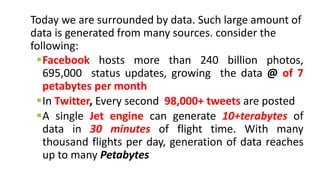
Today we are surrounded by data. Such large amount of
data is generated from many sources. consider the
following:
Facebook hosts more than 240 billion photos,
695,000 status updates, growing the data @ of 7
petabytes per month
In Twitter, Every second 98,000+ tweets are posted
A single Jet engine can generate 10+terabytes of
data in 30 minutes of flight time. With many
thousand flights per day, generation of data reaches
up to many Petabytes
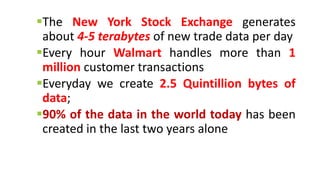
The New York Stock Exchange generates
about 4-5 terabytes of new trade data per day
Every hour Walmart handles more than 1
million customer transactions
Everyday we create 2.5 Quintillion bytes of
data;
90% of the data in the world today has been
created in the last two years alone
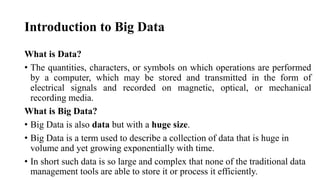
Introduction to Big Data
What is Data?
• The quantities, characters, or symbols on which operations are performed
by a computer, which may be stored and transmitted in the form of
electrical signals and recorded on magnetic, optical, or mechanical
recording media.
What is Big Data?
• Big Data is also data but with a huge size.
• Big Data is a term used to describe a collection of data that is huge in
volume and yet growing exponentially with time.
• In short such data is so large and complex that none of the traditional data
management tools are able to store it or process it efficiently.
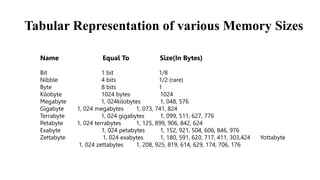
Tabular Representation of various Memory Sizes
Name Equal To Size(In Bytes)
Bit 1 bit 1/8
Nibble 4 bits 1/2 (rare)
Byte 8 bits 1
Kilobyte 1024 bytes 1024
Megabyte 1, 024kilobytes 1, 048, 576
Gigabyte 1, 024 megabytes 1, 073, 741, 824
Terrabyte 1, 024 gigabytes 1, 099, 511, 627, 776
Petabyte 1, 024 terrabytes 1, 125, 899, 906, 842, 624
Exabyte 1, 024 petabytes 1, 152, 921, 504, 606, 846, 976
Zettabyte 1, 024 exabytes 1, 180, 591, 620, 717, 411, 303,424 Yottabyte
1, 024 zettabytes 1, 208, 925, 819, 614, 629, 174, 706, 176
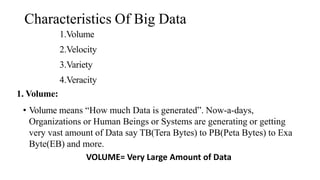
Characteristics Of Big Data
1.Volume
2.Velocity
3.Variety
4.Veracity
1. Volume:
• Volume means “How much Data is generated”. Now-a-days,
Organizations or Human Beings or Systems are generating or getting
very vast amount of Data say TB(Tera Bytes) to PB(Peta Bytes) to Exa
Byte(EB) and more.
VOLUME= Very Large Amount of Data
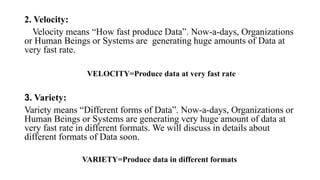
2. Velocity:
Velocity means “How fast produce Data”. Now-a-days, Organizations
or Human Beings or Systems are generating huge amounts of Data at
very fast rate.
VELOCITY=Produce data at very fast rate
3. Variety:
Variety means “Different forms of Data”. Now-a-days, Organizations or
Human Beings or Systems are generating very huge amount of data at
very fast rate in different formats. We will discuss in details about
different formats of Data soon.
VARIETY=Produce data in different formats
4.Veracity
• Veracity means “The Quality or Correctness or Accuracy of Captured
Data”.
• Out of 4Vs, it is most important V for any Big Data Solutions.
• without Correct Information or Data, there is no use of storing large
amount of data at fast rate and different formats. That data should give
correct business value.
Types of Digital Data
1.Structured
2.Unstructured
3.Semi-structured
Structured
 Any data that can be stored, accessed and processed in the
form of fixed format is termed as a 'structured' data.
 we are foreseeing issues when a size of such data grows to a huge
extent, typical sizes are being in the range of multiple zettabytes.
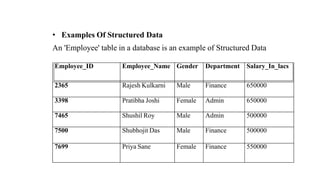
• Examples Of Structured Data
An 'Employee' table in a database is an example of Structured Data
Employee_ID Employee_Name Gender Department Salary_In_lacs
2365 Rajesh Kulkarni Male Finance 650000
3398 Pratibha Joshi Female Admin 650000
7465 Shushil Roy Male Admin 500000
7500 Shubhojit Das Male Finance 500000
7699 Priya Sane Female Finance 550000
 Unstructured
 Any data with unknown form or the structure is classified as unstructured data.
 In addition to the size being huge, un-structured data poses multiple challenges in terms
of its processing for deriving value out of it.
 A typical example of unstructured data is a heterogeneous data source containing a
combination of simple text files, images, videos etc.
 Now day organizations have wealth of data available with them but unfortunately, they
don't know how to derive value out of it since this data is in its raw form or unstructured
format.
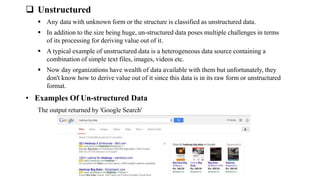
• Examples Of Un-structured Data
The output returned by 'Google Search'
Semi-structured
 Semi-structured data can contain both the forms of data.
 We can see semi-structured data as a structured in form but it is actually not
defined with e.g. a table definition in relational DBMS.
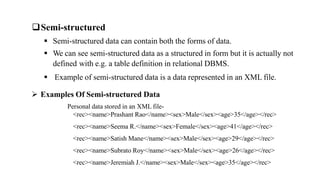
 Example of semi-structured data is a data represented in an XML file.
 Examples Of Semi-structured Data
Personal data stored in an XML file-
<rec><name>Prashant Rao</name><sex>Male</sex><age>35</age></rec>
<rec><name>Seema R.</name><sex>Female</sex><age>41</age></rec>
<rec><name>Satish Mane</name><sex>Male</sex><age>29</age></rec>
<rec><name>Subrato Roy</name><sex>Male</sex><age>26</age></rec>
<rec><name>Jeremiah J.</name><sex>Male</sex><age>35</age></rec>
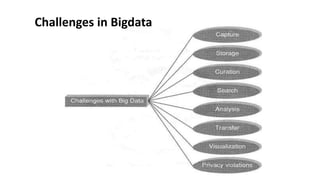
Challenges in Bigdata
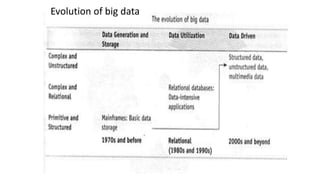
Evolution of big data
Business Intelligence vs Big Data
• Traditional BI methodology is based on the principle of
grouping all business data into a central server.
• A Big Data solution differs in many aspects to BI to use.
These are the main differences between
Big Data and Business Intelligence:
• In a Big Data environment, information is stored on a
distributed file system, rather than on a central server.
• It is a much safer and more flexible space.
• Big Data solutions carry the processing functions to the data,
rather than the data to the functions.
• Big Data can analyze data in different formats, both structured
and unstructured.
• Big Data solutions solve them by allowing a global analysis of
various sources of information.
• Data processed by Big Data solutions can be historical or come
from real-time sources.
• Big Data technology uses parallel mass processing (MPP)
concepts, which improves the speed of analysis.
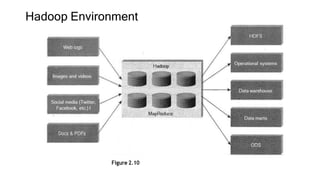
Hadoop Environment

Bigdata Unit1.pptx

  • 1.
  • 2.
    COURSE OUTCOMES Students willbe able to CO1- Identify the characteristics and challenges of big data analytics CO2- Implement the Hadoop and MapReduce framework for processing massive volume of data CO3- Analyze the structured and semi structured data using Hive and Pig CO4- Implement CRUD operations effectively using MongoDB and Report generation using Jaspersoft studio C05- Explore the usage of Hadoop and its integration tools to manage Big Data and Use Visualization Techniques
  • 3.
    UNIT-1 Classification of DigitalData - Introduction to Big Data: Characteristics – Evolution – Definition - Challenges with Big Data - Other Characteristics of Data - Why Big Data - Traditional Business Intelligence versus Big Data - Data Warehouse and Hadoop Environment. Total Periods :9
  • 4.
  • 5.
    Today we aresurrounded by data. Such large amount of data is generated from many sources. consider the following: Facebook hosts more than 240 billion photos, 695,000 status updates, growing the data @ of 7 petabytes per month In Twitter, Every second 98,000+ tweets are posted A single Jet engine can generate 10+terabytes of data in 30 minutes of flight time. With many thousand flights per day, generation of data reaches up to many Petabytes
  • 6.
    The New YorkStock Exchange generates about 4-5 terabytes of new trade data per day Every hour Walmart handles more than 1 million customer transactions Everyday we create 2.5 Quintillion bytes of data; 90% of the data in the world today has been created in the last two years alone
  • 7.
    Introduction to BigData What is Data? • The quantities, characters, or symbols on which operations are performed by a computer, which may be stored and transmitted in the form of electrical signals and recorded on magnetic, optical, or mechanical recording media. What is Big Data? • Big Data is also data but with a huge size. • Big Data is a term used to describe a collection of data that is huge in volume and yet growing exponentially with time. • In short such data is so large and complex that none of the traditional data management tools are able to store it or process it efficiently.
  • 8.
    Tabular Representation ofvarious Memory Sizes Name Equal To Size(In Bytes) Bit 1 bit 1/8 Nibble 4 bits 1/2 (rare) Byte 8 bits 1 Kilobyte 1024 bytes 1024 Megabyte 1, 024kilobytes 1, 048, 576 Gigabyte 1, 024 megabytes 1, 073, 741, 824 Terrabyte 1, 024 gigabytes 1, 099, 511, 627, 776 Petabyte 1, 024 terrabytes 1, 125, 899, 906, 842, 624 Exabyte 1, 024 petabytes 1, 152, 921, 504, 606, 846, 976 Zettabyte 1, 024 exabytes 1, 180, 591, 620, 717, 411, 303,424 Yottabyte 1, 024 zettabytes 1, 208, 925, 819, 614, 629, 174, 706, 176
  • 9.
    Characteristics Of BigData 1.Volume 2.Velocity 3.Variety 4.Veracity 1. Volume: • Volume means “How much Data is generated”. Now-a-days, Organizations or Human Beings or Systems are generating or getting very vast amount of Data say TB(Tera Bytes) to PB(Peta Bytes) to Exa Byte(EB) and more. VOLUME= Very Large Amount of Data
  • 10.
    2. Velocity: Velocity means“How fast produce Data”. Now-a-days, Organizations or Human Beings or Systems are generating huge amounts of Data at very fast rate. VELOCITY=Produce data at very fast rate 3. Variety: Variety means “Different forms of Data”. Now-a-days, Organizations or Human Beings or Systems are generating very huge amount of data at very fast rate in different formats. We will discuss in details about different formats of Data soon. VARIETY=Produce data in different formats
  • 11.
    4.Veracity • Veracity means“The Quality or Correctness or Accuracy of Captured Data”. • Out of 4Vs, it is most important V for any Big Data Solutions. • without Correct Information or Data, there is no use of storing large amount of data at fast rate and different formats. That data should give correct business value.
  • 12.
    Types of DigitalData 1.Structured 2.Unstructured 3.Semi-structured Structured  Any data that can be stored, accessed and processed in the form of fixed format is termed as a 'structured' data.  we are foreseeing issues when a size of such data grows to a huge extent, typical sizes are being in the range of multiple zettabytes.
  • 13.
    • Examples OfStructured Data An 'Employee' table in a database is an example of Structured Data Employee_ID Employee_Name Gender Department Salary_In_lacs 2365 Rajesh Kulkarni Male Finance 650000 3398 Pratibha Joshi Female Admin 650000 7465 Shushil Roy Male Admin 500000 7500 Shubhojit Das Male Finance 500000 7699 Priya Sane Female Finance 550000
  • 14.
     Unstructured  Anydata with unknown form or the structure is classified as unstructured data.  In addition to the size being huge, un-structured data poses multiple challenges in terms of its processing for deriving value out of it.  A typical example of unstructured data is a heterogeneous data source containing a combination of simple text files, images, videos etc.  Now day organizations have wealth of data available with them but unfortunately, they don't know how to derive value out of it since this data is in its raw form or unstructured format. • Examples Of Un-structured Data The output returned by 'Google Search'
  • 15.
    Semi-structured  Semi-structured datacan contain both the forms of data.  We can see semi-structured data as a structured in form but it is actually not defined with e.g. a table definition in relational DBMS.  Example of semi-structured data is a data represented in an XML file.  Examples Of Semi-structured Data Personal data stored in an XML file- <rec><name>Prashant Rao</name><sex>Male</sex><age>35</age></rec> <rec><name>Seema R.</name><sex>Female</sex><age>41</age></rec> <rec><name>Satish Mane</name><sex>Male</sex><age>29</age></rec> <rec><name>Subrato Roy</name><sex>Male</sex><age>26</age></rec> <rec><name>Jeremiah J.</name><sex>Male</sex><age>35</age></rec>
  • 16.
  • 17.
  • 18.
    Business Intelligence vsBig Data • Traditional BI methodology is based on the principle of grouping all business data into a central server. • A Big Data solution differs in many aspects to BI to use. These are the main differences between Big Data and Business Intelligence: • In a Big Data environment, information is stored on a distributed file system, rather than on a central server. • It is a much safer and more flexible space. • Big Data solutions carry the processing functions to the data, rather than the data to the functions.
  • 19.
    • Big Datacan analyze data in different formats, both structured and unstructured. • Big Data solutions solve them by allowing a global analysis of various sources of information. • Data processed by Big Data solutions can be historical or come from real-time sources. • Big Data technology uses parallel mass processing (MPP) concepts, which improves the speed of analysis.
  • 20.