Making Sense out of Big Data
Peter Morgan - July 2013
Table of Contents
1. Definition and Overview
2. Data Sources
3. Databases
4. Data Analytics
Glossary
References
2
1. Definition and Overview
3
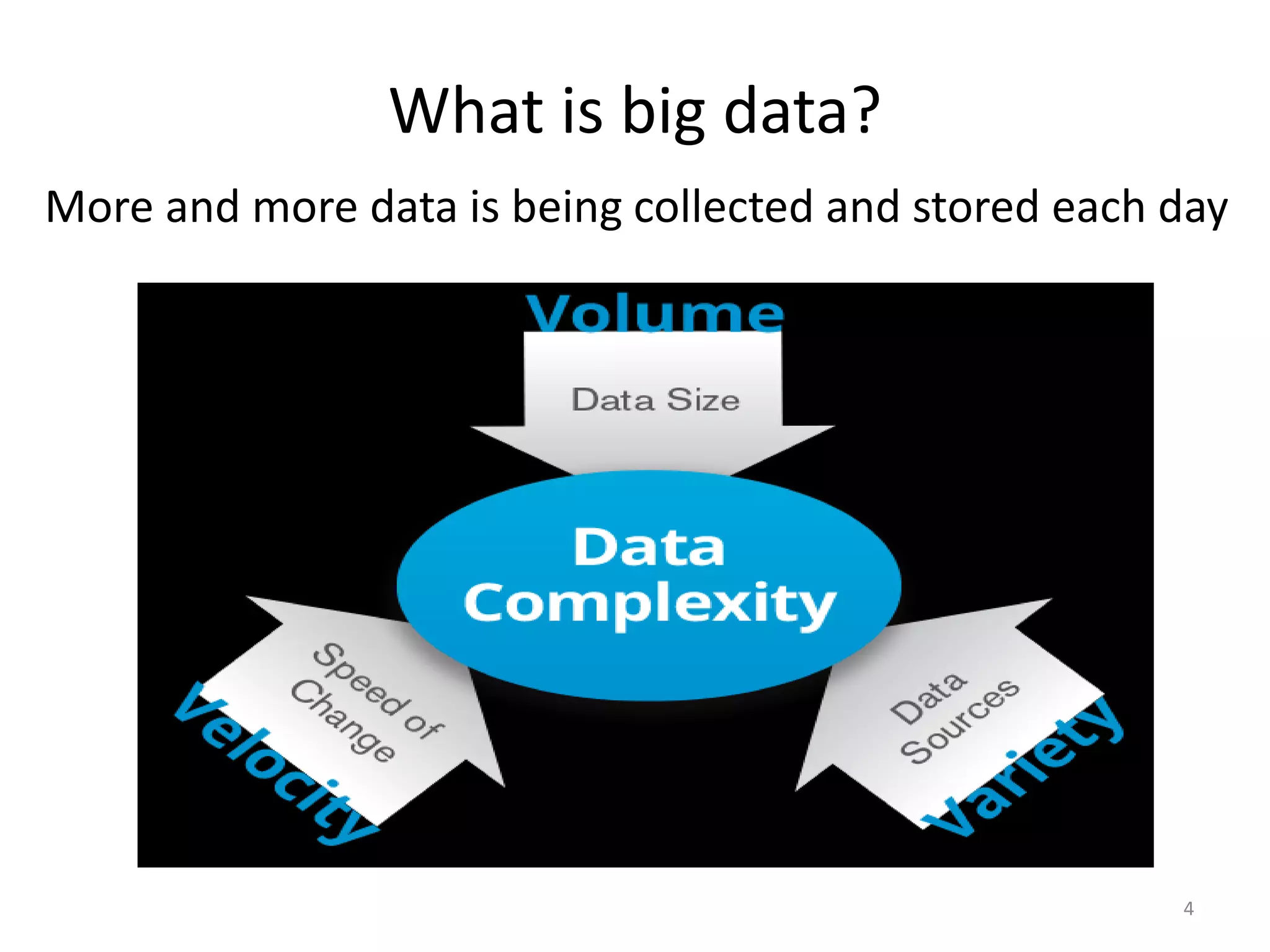
What is big data?
More and more data is being collected and stored each day
4
Four main components
• Data
– Structured and unstructured
• Databases
– Proprietary and open source
• Query language
– Querying the database
• Analytics
– Analysing the data
5
How big is big?
• Large data sets
– Greater than 1,000 Terabytes? (1 Petabyte)
– 1,000,000 Terabytes? (1 Exabyte)
• Excel 2013 can have 1,048,576 rows by 16,384 columns
– About 10 Gigabyte of data
• Only going to get bigger
– 90% of all data produced in the past two years !
– Rate is increasing
• Recall
– Giga = 10⁹
– Tera = 10¹²
– Peta = 10¹⁵
– Exa = 10¹⁸
6
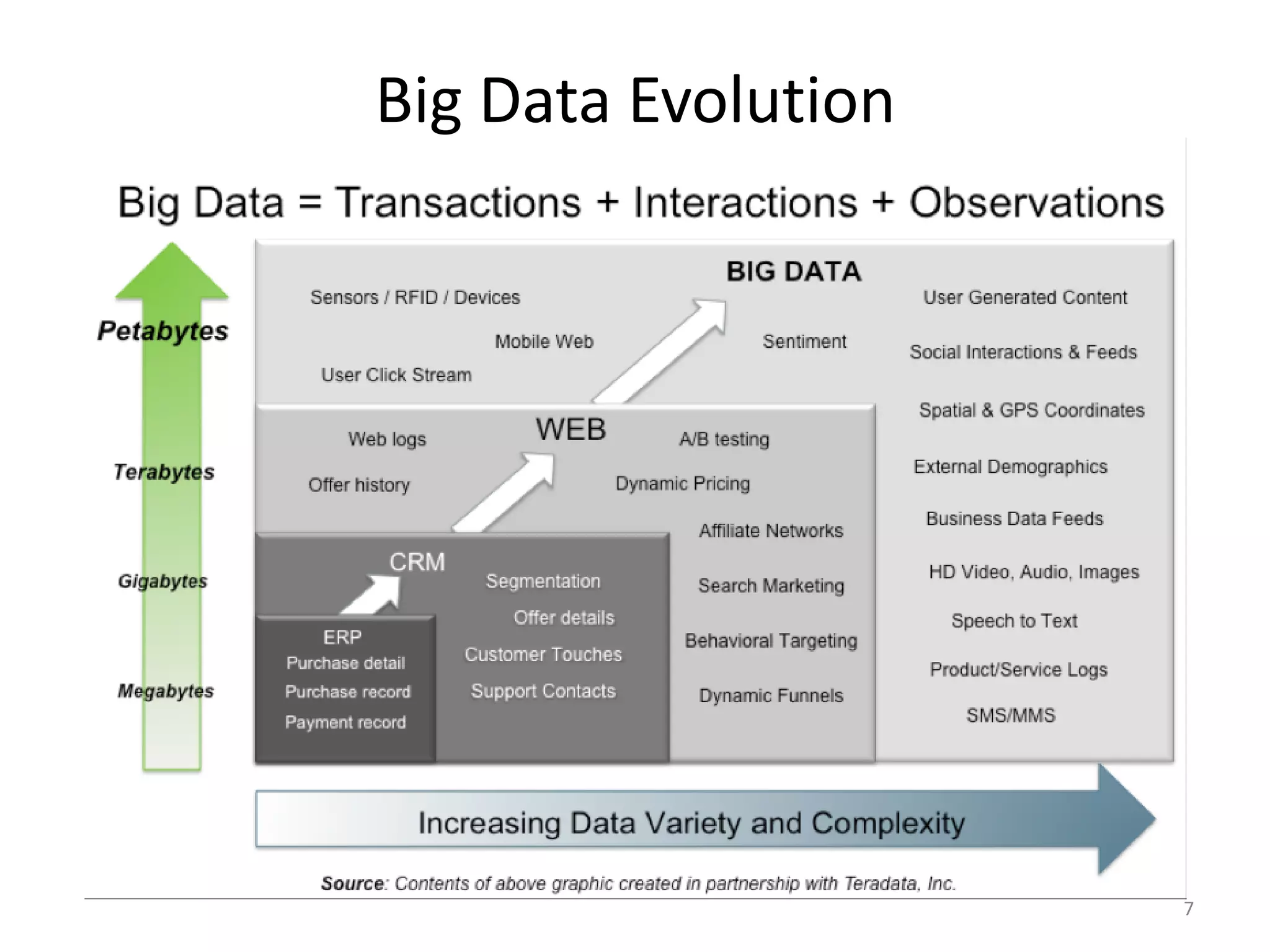
Big Data Evolution
7
2. Data Sources
8
Where does the data come from?
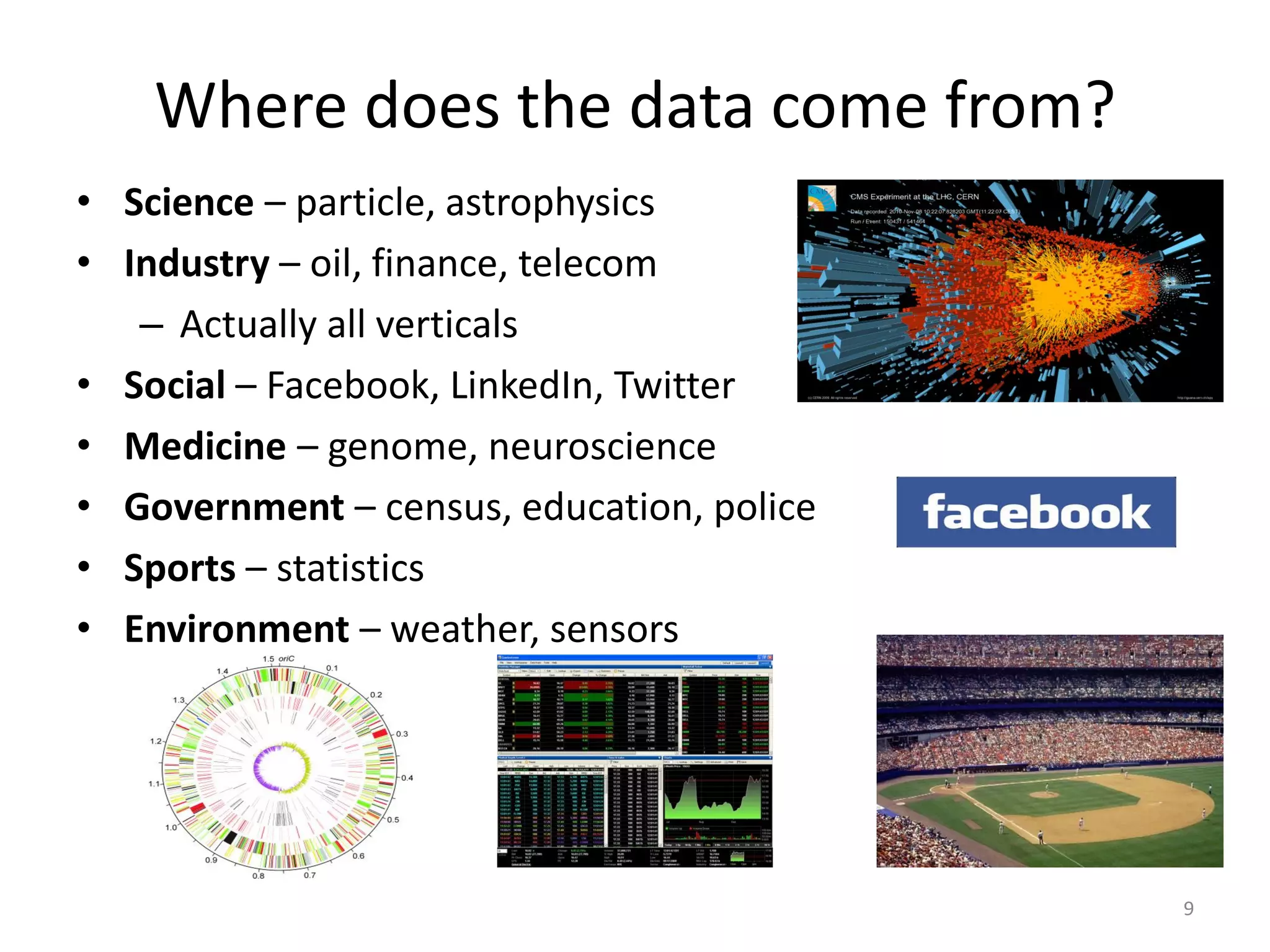
• Science – particle, astrophysics
• Industry – oil, finance, telecom
– Actually all verticals
• Social – Facebook, LinkedIn, Twitter
• Medicine – genome, neuroscience
• Government – census, education, police
• Sports – statistics
• Environment – weather, sensors
9
Unstructured Data
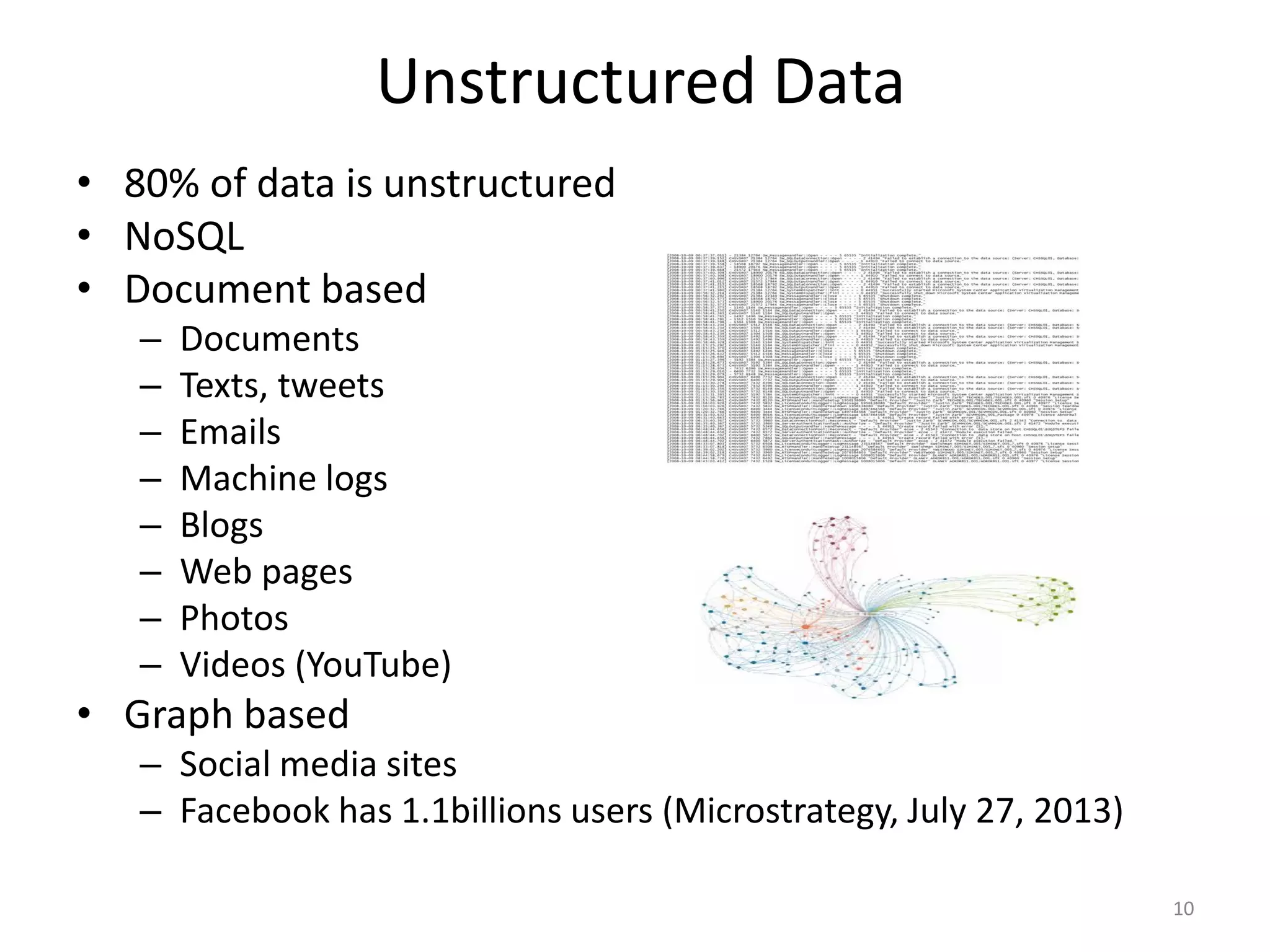
• 80% of data is unstructured
• NoSQL
• Document based
– Documents
– Texts, tweets
– Emails
– Machine logs
– Blogs
– Web pages
– Photos
– Videos (YouTube)
• Graph based
– Social media sites
– Facebook has 1.1billions users (Microstrategy, July 27, 2013)
10
Why do we need to use big data?
Use in public and private sector to:
• Make faster and more accurate business decisions
• Make accurate predictions
• Gain competitive advantage
• Implement smarter marketing – CRM
• Discover new opportunities
• Enhance Business Intelligence
• Enable fraud detection
• Reduce crime
• Improve scientific research
• Quicken analysis (up to real time)
– Weeks, days  minutes, seconds
11
Big Data Startup - Case Study
• Rocket Fuel
• No. 4 on Forbes' 2013 Most Promising Companies In
America list
• Digital advertising startup
• Screens over 26 billion ads per day
• “Advertising that learns” big data platform
• Distributed planet-scale computing engine
• Hadoop implementation
• Founders from Yahoo!, Salesforce.com, DoubleClick
• Targeting algorithms use lifestyle, purchase intent and
social data
12
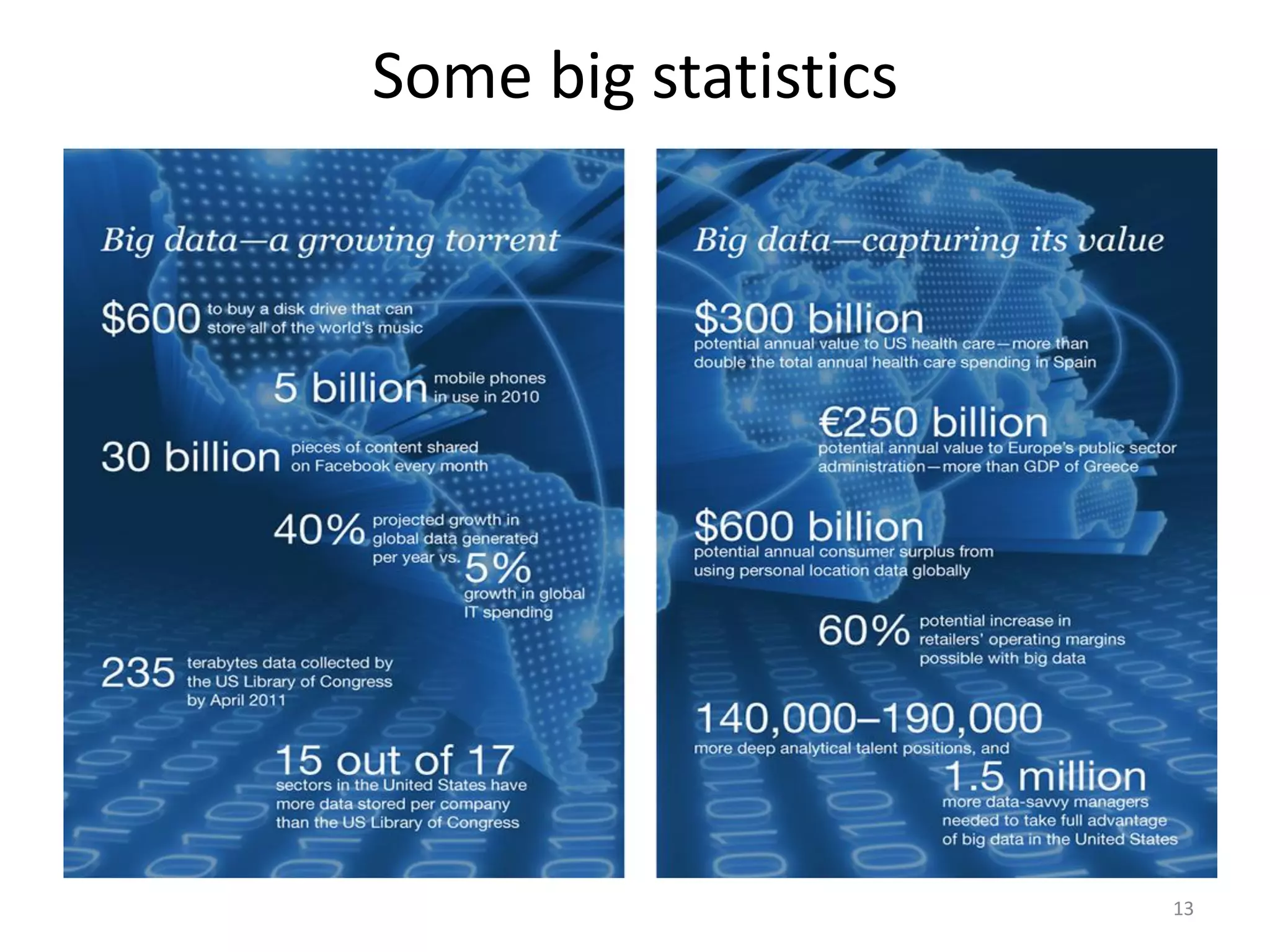
Some big statistics
13
3. Databases
14
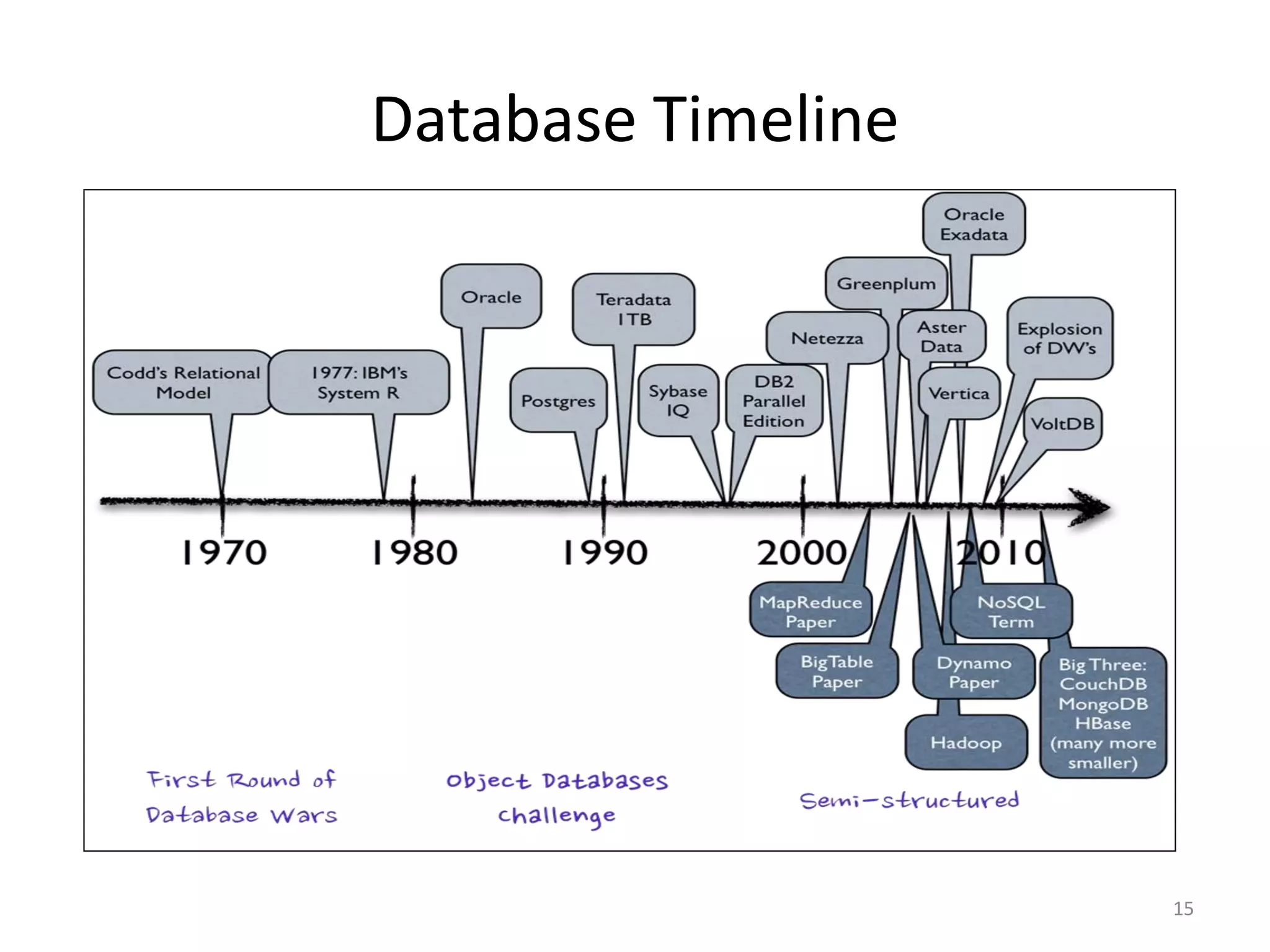
Database Timeline
15
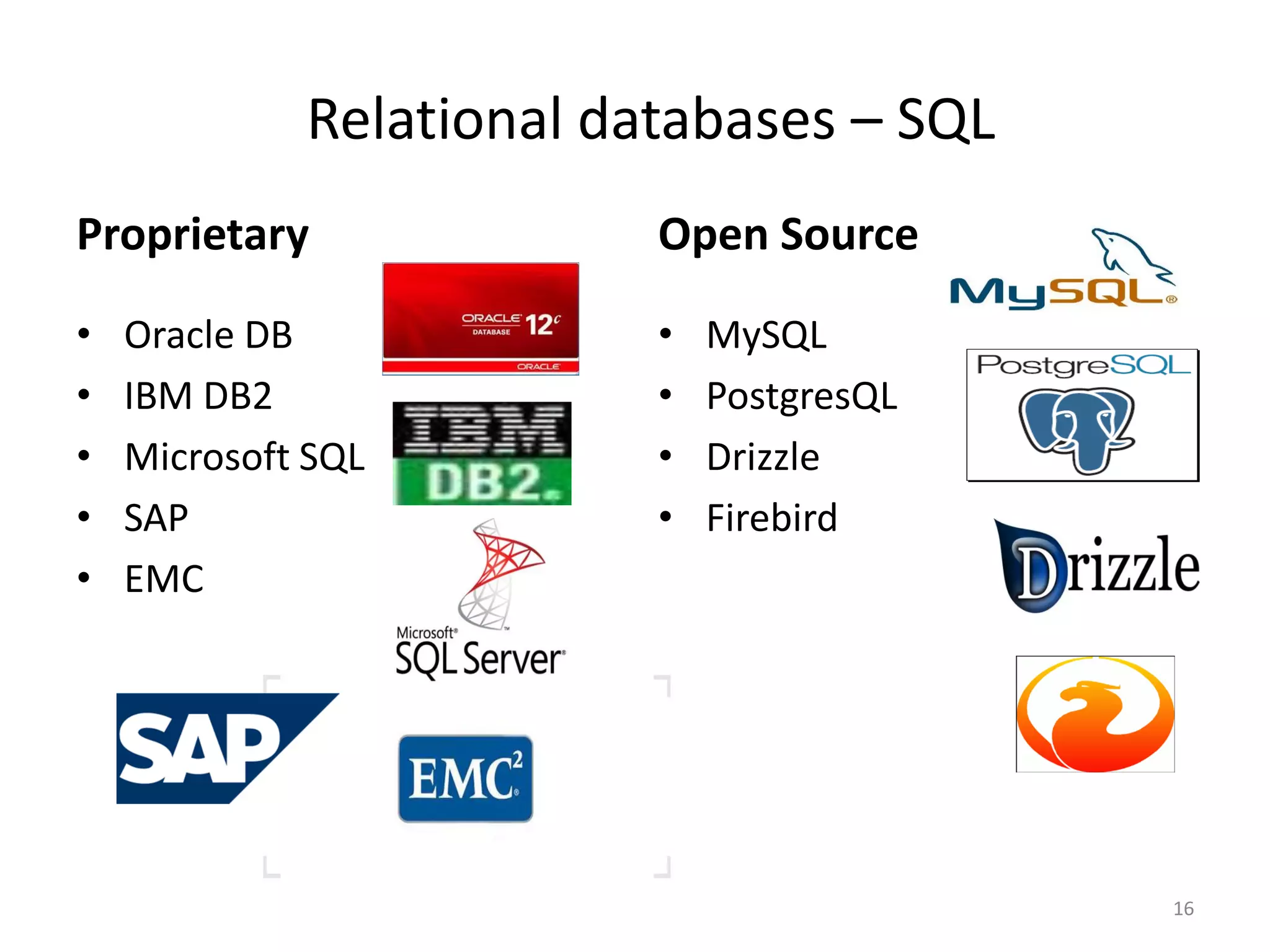
Relational databases – SQL
Proprietary
• Oracle DB
• IBM DB2
• Microsoft SQL
• SAP
• EMC
Open Source
• MySQL
• PostgresQL
• Drizzle
• Firebird
16
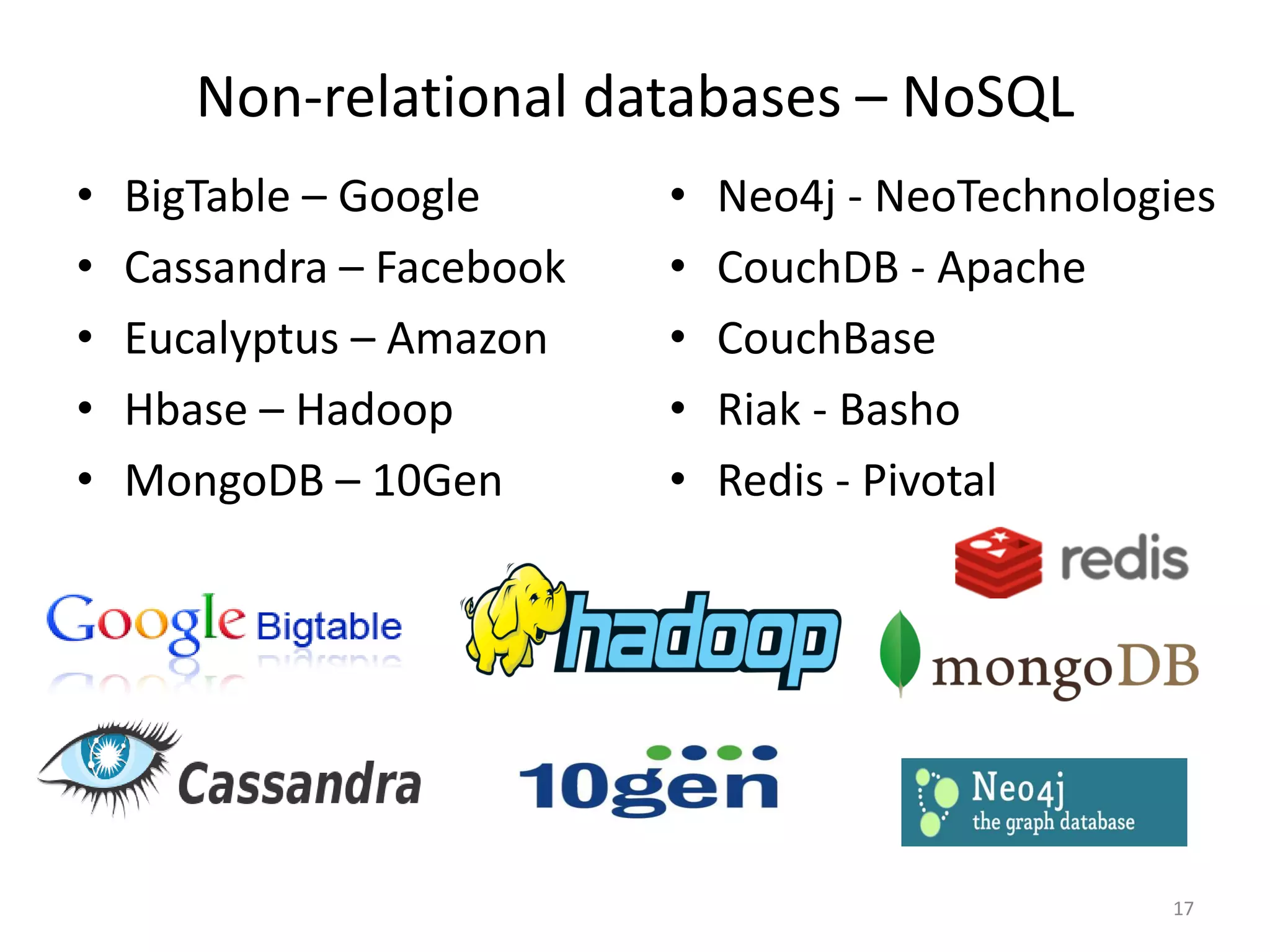
Non-relational databases – NoSQL
• BigTable – Google
• Cassandra – Facebook
• Eucalyptus – Amazon
• Hbase – Hadoop
• MongoDB – 10Gen
• Neo4j - NeoTechnologies
• CouchDB - Apache
• CouchBase
• Riak - Basho
• Redis - Pivotal
17
4. Big Data Analytics
18
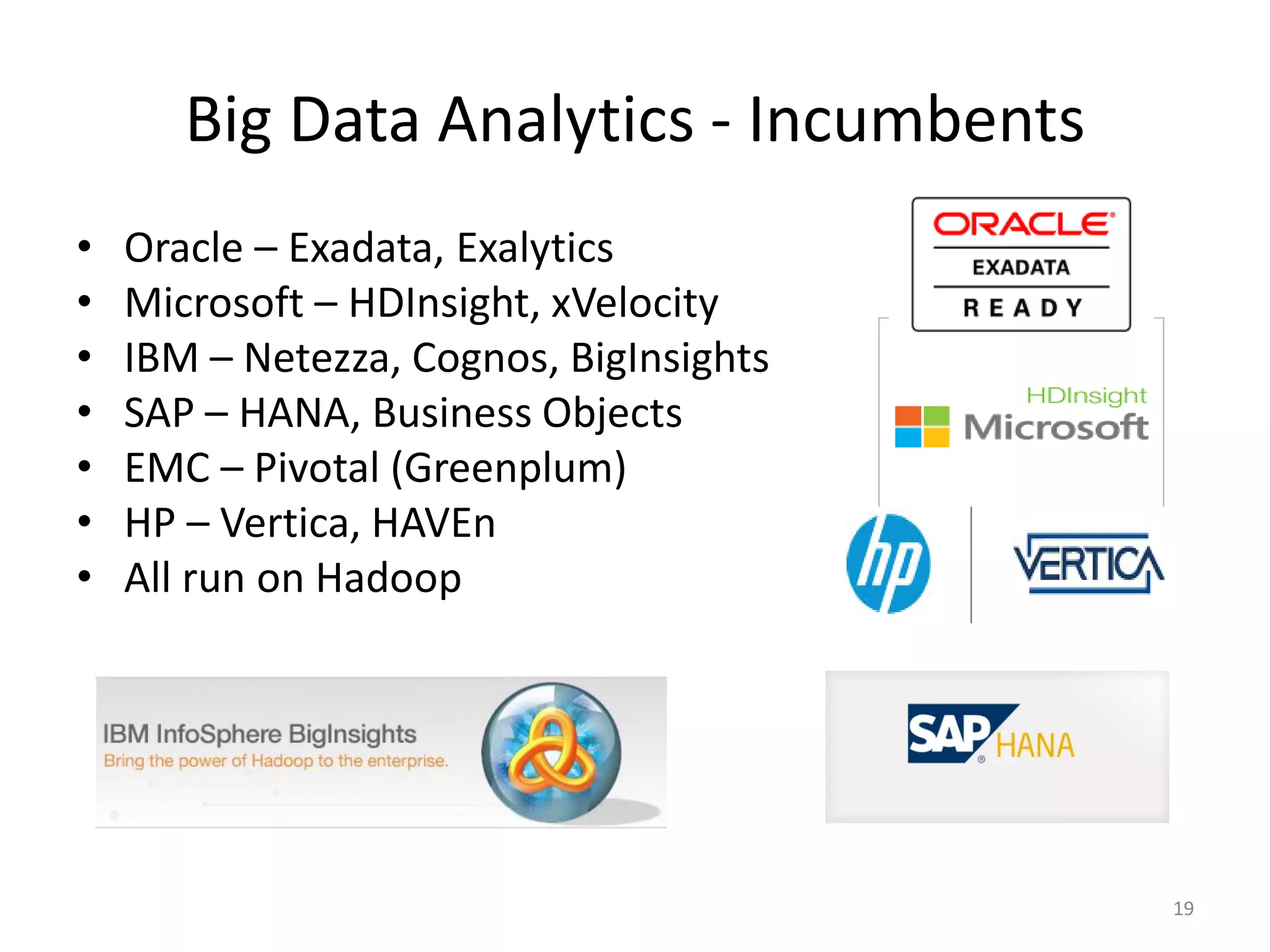
Big Data Analytics - Incumbents
• Oracle – Exadata, Exalytics
• Microsoft – HDInsight, xVelocity
• IBM – Netezza, Cognos, BigInsights
• SAP – HANA, Business Objects
• EMC – Pivotal (Greenplum)
• HP – Vertica, HAVEn
• All run on Hadoop
19
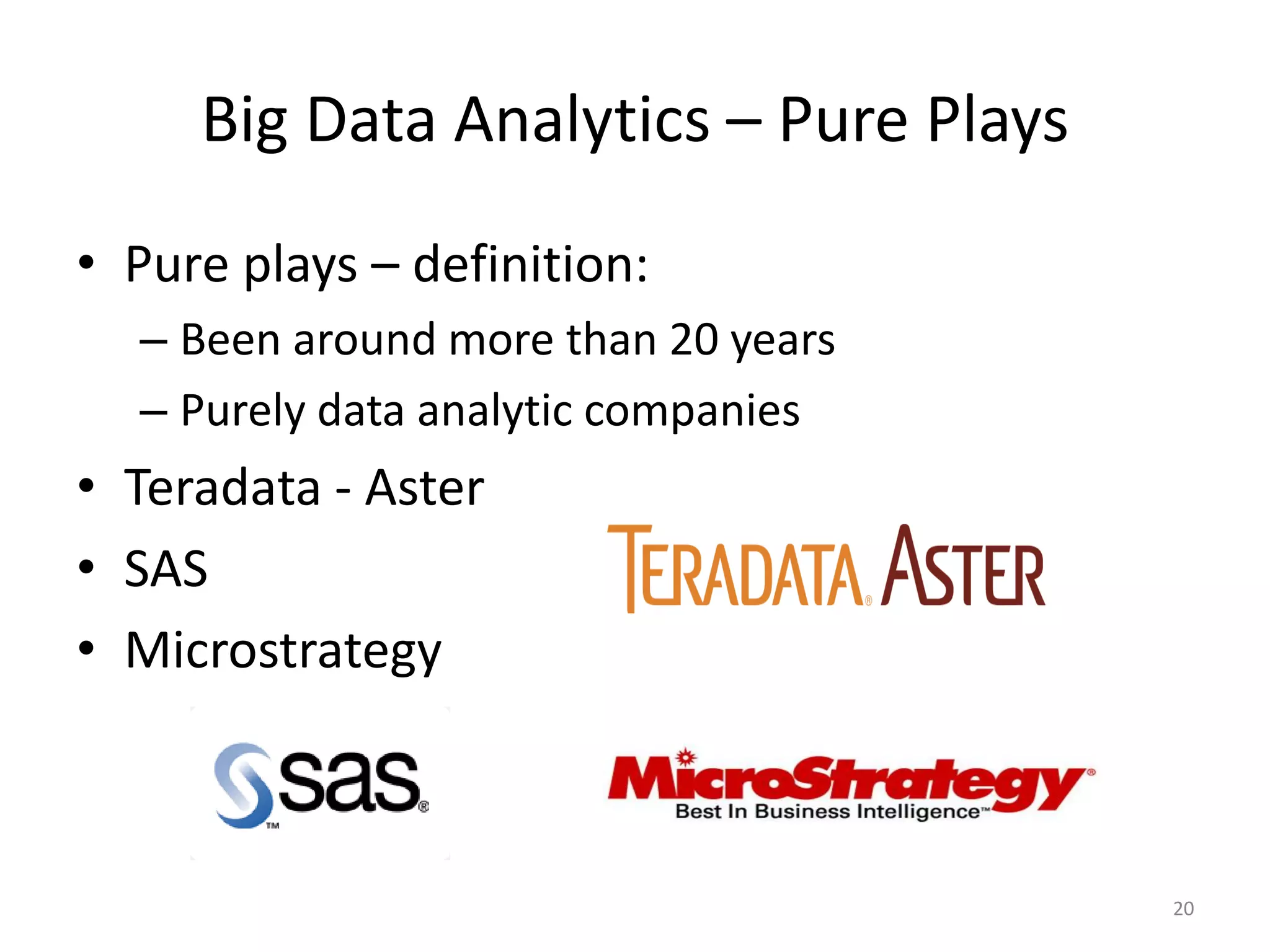
Big Data Analytics – Pure Plays
• Pure plays – definition:
– Been around more than 20 years
– Purely data analytic companies
• Teradata - Aster
• SAS
• Microstrategy
20
Big Data Analytics – New Entrants
• Hortonworks
• Cloudera
• MapR
• Acunu
• Pentaho
• Tableau
• Talend
• Splunk
21
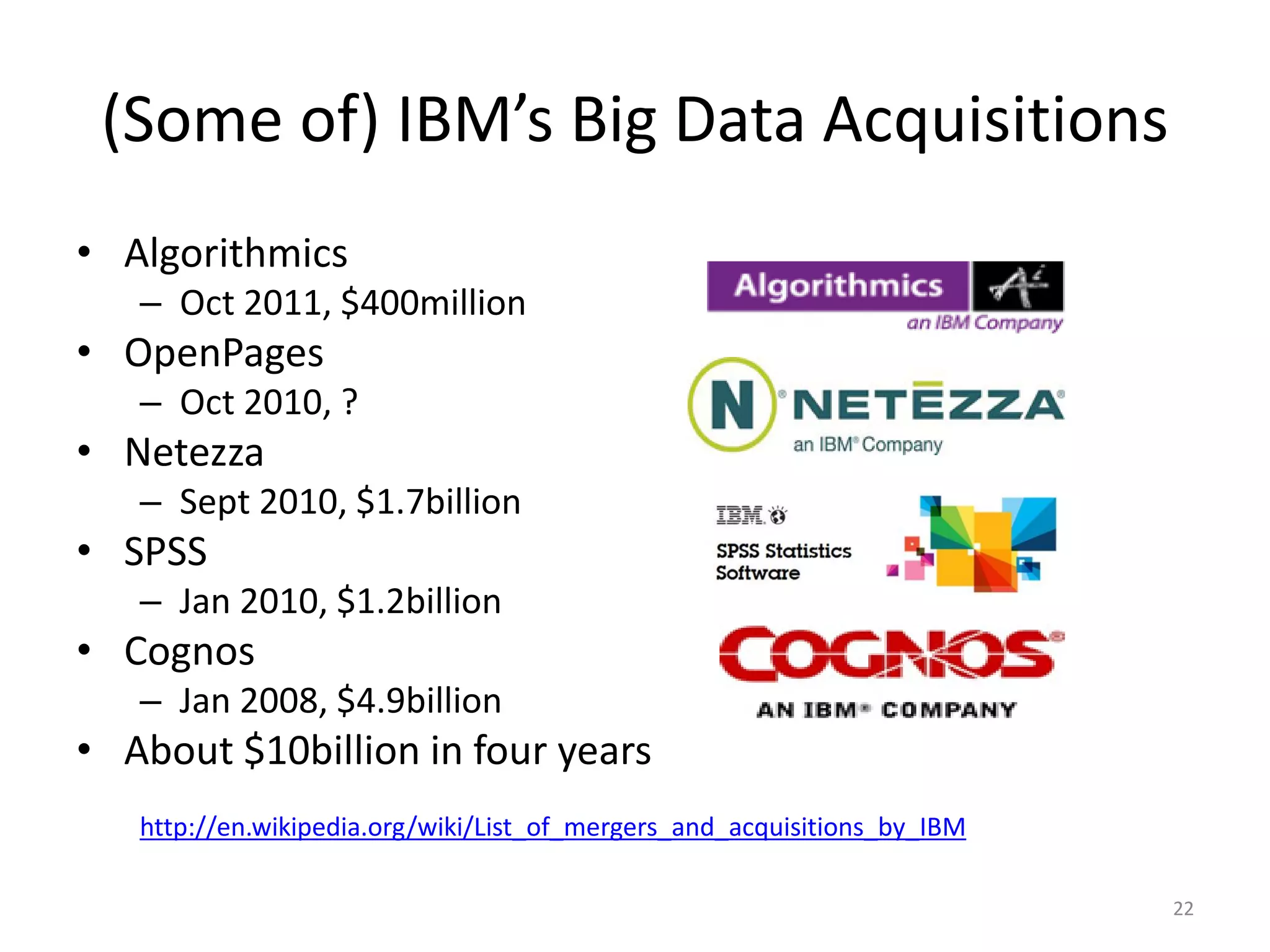
(Some of) IBM’s Big Data Acquisitions
• Algorithmics
– Oct 2011, $400million
• OpenPages
– Oct 2010, ?
• Netezza
– Sept 2010, $1.7billion
• SPSS
– Jan 2010, $1.2billion
• Cognos
– Jan 2008, $4.9billion
• About $10billion in four years
http://en.wikipedia.org/wiki/List_of_mergers_and_acquisitions_by_IBM
22
Big Data Science Tools
• Hadoop
• NoSQL
• MapReduce
• R
• Matlab
• Python
• Statistics
23
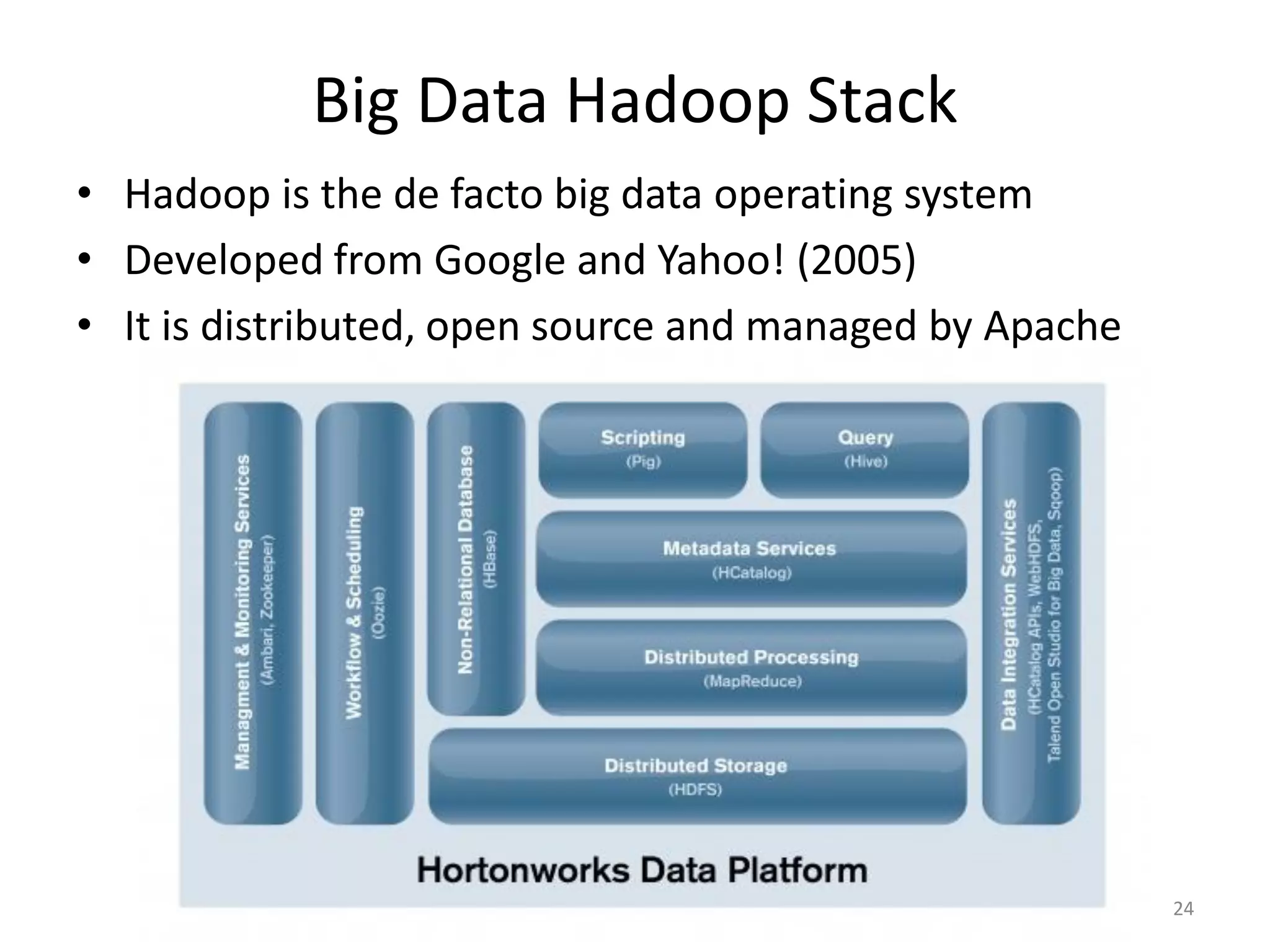
Big Data Hadoop Stack
• Hadoop is the de facto big data operating system
• Developed from Google and Yahoo! (2005)
• It is distributed, open source and managed by Apache
24
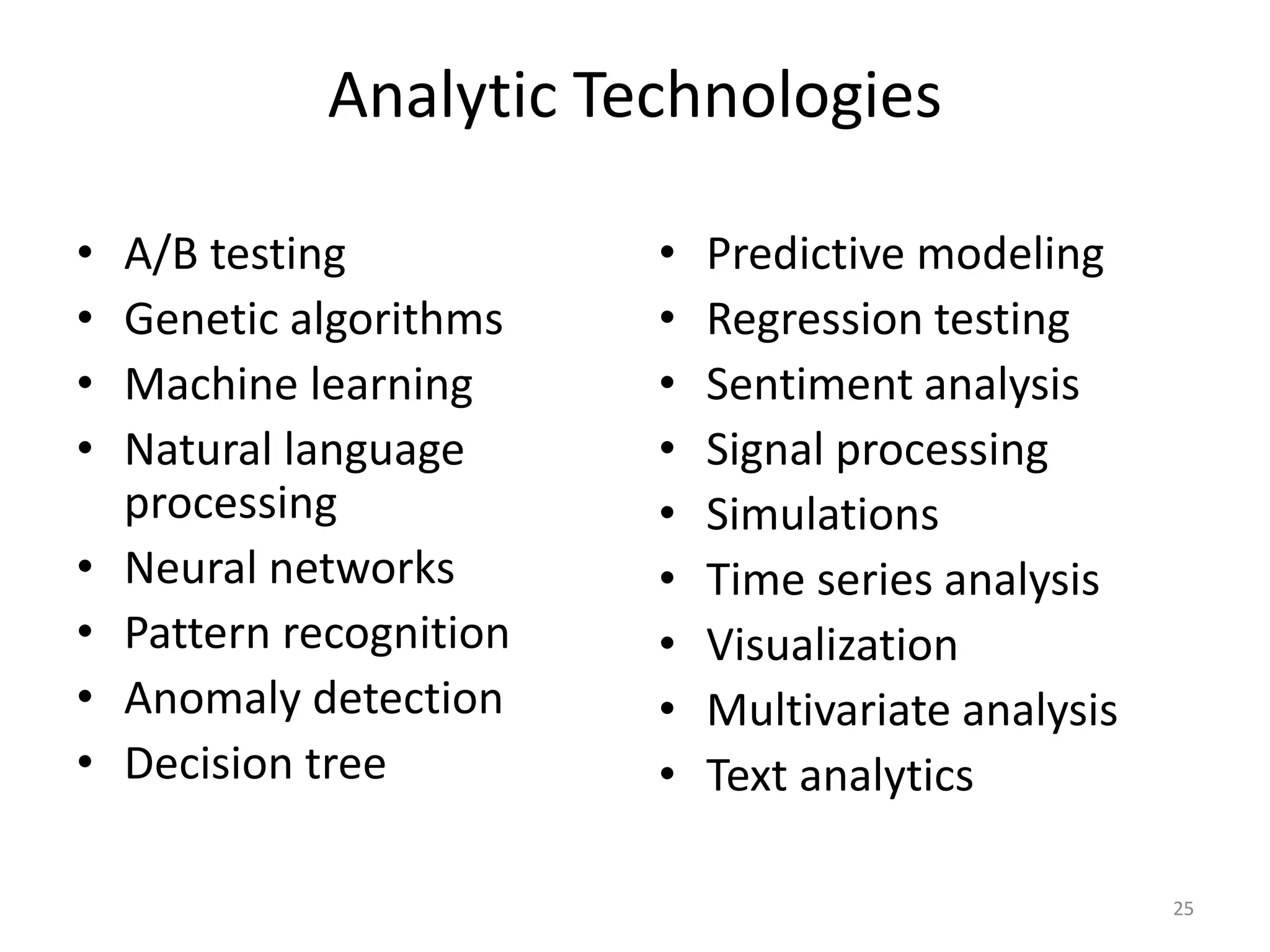
Analytic Technologies
• A/B testing
• Genetic algorithms
• Machine learning
• Natural language
processing
• Neural networks
• Pattern recognition
• Anomaly detection
• Decision tree
• Predictive modeling
• Regression testing
• Sentiment analysis
• Signal processing
• Simulations
• Time series analysis
• Visualization
• Multivariate analysis
• Text analytics
25
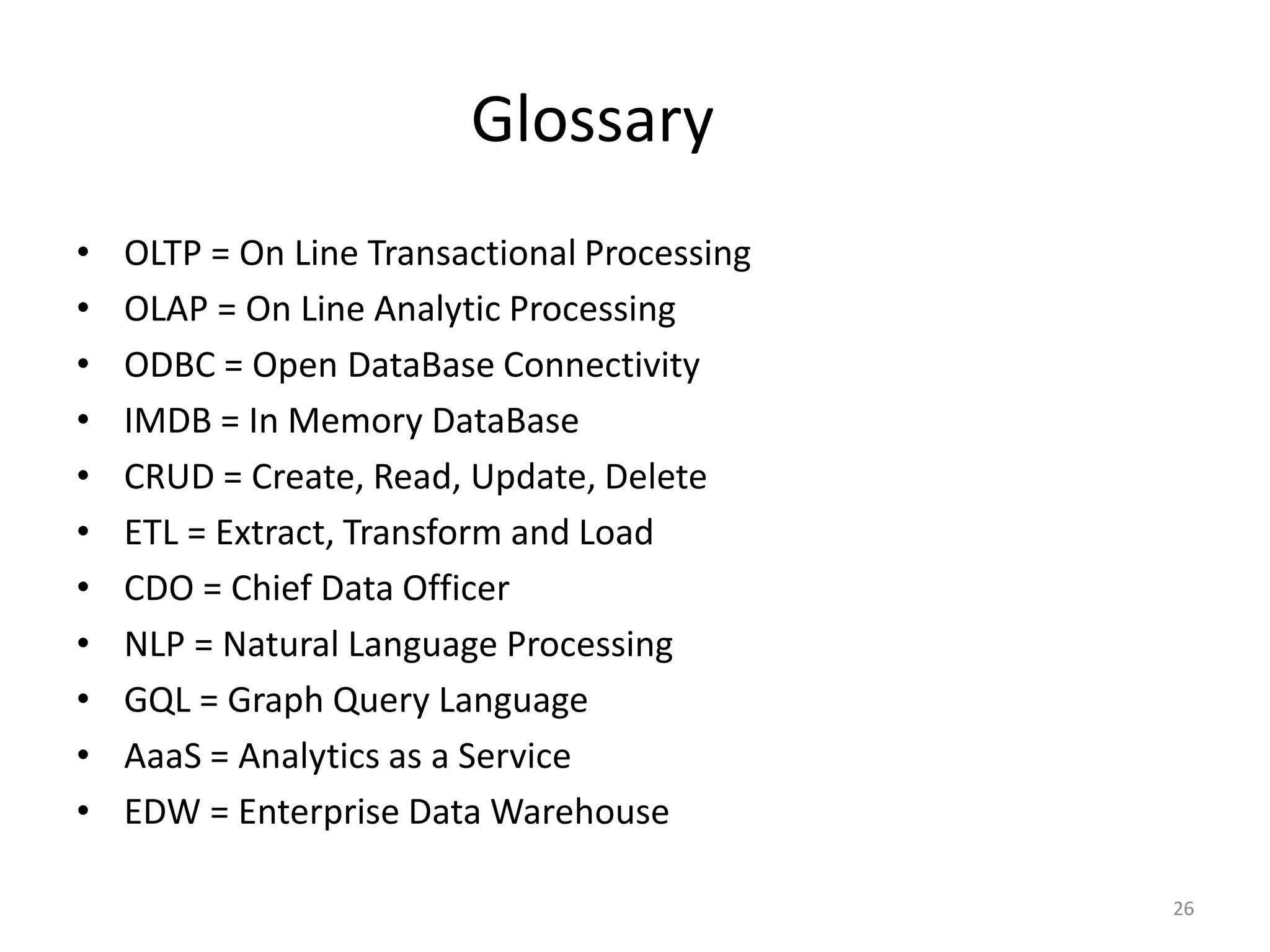
Glossary
• OLTP = On Line Transactional Processing
• OLAP = On Line Analytic Processing
• ODBC = Open DataBase Connectivity
• IMDB = In Memory DataBase
• CRUD = Create, Read, Update, Delete
• ETL = Extract, Transform and Load
• CDO = Chief Data Officer
• NLP = Natural Language Processing
• GQL = Graph Query Language
• AaaS = Analytics as a Service
• EDW = Enterprise Data Warehouse
26
References
• Microstrategy website, 27 July, 2013, Michael Saylor
Presentation at Microstrategy World 2013,
http://www.microstrategy.com/
• Teradata website www.teradata.com
• Wikipedia http://en.wikipedia.org/wiki/
• Google images www.google.co.uk
• IBM website www.ibm.com
• Youtube www.youtube.com
• Hadoop www.hortonworks.com
27
Any Questions?
28

Big data – An Introduction, July 2013

  • 1.
    Making Sense outof Big Data Peter Morgan - July 2013
  • 2.
    Table of Contents 1.Definition and Overview 2. Data Sources 3. Databases 4. Data Analytics Glossary References 2
  • 3.
  • 4.
    What is bigdata? More and more data is being collected and stored each day 4
  • 5.
    Four main components •Data – Structured and unstructured • Databases – Proprietary and open source • Query language – Querying the database • Analytics – Analysing the data 5
  • 6.
    How big isbig? • Large data sets – Greater than 1,000 Terabytes? (1 Petabyte) – 1,000,000 Terabytes? (1 Exabyte) • Excel 2013 can have 1,048,576 rows by 16,384 columns – About 10 Gigabyte of data • Only going to get bigger – 90% of all data produced in the past two years ! – Rate is increasing • Recall – Giga = 10⁹ – Tera = 10¹² – Peta = 10¹⁵ – Exa = 10¹⁸ 6
  • 7.
  • 8.
  • 9.
    Where does thedata come from? • Science – particle, astrophysics • Industry – oil, finance, telecom – Actually all verticals • Social – Facebook, LinkedIn, Twitter • Medicine – genome, neuroscience • Government – census, education, police • Sports – statistics • Environment – weather, sensors 9
  • 10.
    Unstructured Data • 80%of data is unstructured • NoSQL • Document based – Documents – Texts, tweets – Emails – Machine logs – Blogs – Web pages – Photos – Videos (YouTube) • Graph based – Social media sites – Facebook has 1.1billions users (Microstrategy, July 27, 2013) 10
  • 11.
    Why do weneed to use big data? Use in public and private sector to: • Make faster and more accurate business decisions • Make accurate predictions • Gain competitive advantage • Implement smarter marketing – CRM • Discover new opportunities • Enhance Business Intelligence • Enable fraud detection • Reduce crime • Improve scientific research • Quicken analysis (up to real time) – Weeks, days  minutes, seconds 11
  • 12.
    Big Data Startup- Case Study • Rocket Fuel • No. 4 on Forbes' 2013 Most Promising Companies In America list • Digital advertising startup • Screens over 26 billion ads per day • “Advertising that learns” big data platform • Distributed planet-scale computing engine • Hadoop implementation • Founders from Yahoo!, Salesforce.com, DoubleClick • Targeting algorithms use lifestyle, purchase intent and social data 12
  • 13.
  • 14.
  • 15.
  • 16.
    Relational databases –SQL Proprietary • Oracle DB • IBM DB2 • Microsoft SQL • SAP • EMC Open Source • MySQL • PostgresQL • Drizzle • Firebird 16
  • 17.
    Non-relational databases –NoSQL • BigTable – Google • Cassandra – Facebook • Eucalyptus – Amazon • Hbase – Hadoop • MongoDB – 10Gen • Neo4j - NeoTechnologies • CouchDB - Apache • CouchBase • Riak - Basho • Redis - Pivotal 17
  • 18.
    4. Big DataAnalytics 18
  • 19.
    Big Data Analytics- Incumbents • Oracle – Exadata, Exalytics • Microsoft – HDInsight, xVelocity • IBM – Netezza, Cognos, BigInsights • SAP – HANA, Business Objects • EMC – Pivotal (Greenplum) • HP – Vertica, HAVEn • All run on Hadoop 19
  • 20.
    Big Data Analytics– Pure Plays • Pure plays – definition: – Been around more than 20 years – Purely data analytic companies • Teradata - Aster • SAS • Microstrategy 20
  • 21.
    Big Data Analytics– New Entrants • Hortonworks • Cloudera • MapR • Acunu • Pentaho • Tableau • Talend • Splunk 21
  • 22.
    (Some of) IBM’sBig Data Acquisitions • Algorithmics – Oct 2011, $400million • OpenPages – Oct 2010, ? • Netezza – Sept 2010, $1.7billion • SPSS – Jan 2010, $1.2billion • Cognos – Jan 2008, $4.9billion • About $10billion in four years http://en.wikipedia.org/wiki/List_of_mergers_and_acquisitions_by_IBM 22
  • 23.
    Big Data ScienceTools • Hadoop • NoSQL • MapReduce • R • Matlab • Python • Statistics 23
  • 24.
    Big Data HadoopStack • Hadoop is the de facto big data operating system • Developed from Google and Yahoo! (2005) • It is distributed, open source and managed by Apache 24
  • 25.
    Analytic Technologies • A/Btesting • Genetic algorithms • Machine learning • Natural language processing • Neural networks • Pattern recognition • Anomaly detection • Decision tree • Predictive modeling • Regression testing • Sentiment analysis • Signal processing • Simulations • Time series analysis • Visualization • Multivariate analysis • Text analytics 25
  • 26.
    Glossary • OLTP =On Line Transactional Processing • OLAP = On Line Analytic Processing • ODBC = Open DataBase Connectivity • IMDB = In Memory DataBase • CRUD = Create, Read, Update, Delete • ETL = Extract, Transform and Load • CDO = Chief Data Officer • NLP = Natural Language Processing • GQL = Graph Query Language • AaaS = Analytics as a Service • EDW = Enterprise Data Warehouse 26
  • 27.
    References • Microstrategy website,27 July, 2013, Michael Saylor Presentation at Microstrategy World 2013, http://www.microstrategy.com/ • Teradata website www.teradata.com • Wikipedia http://en.wikipedia.org/wiki/ • Google images www.google.co.uk • IBM website www.ibm.com • Youtube www.youtube.com • Hadoop www.hortonworks.com 27
  • 28.