Understanding the Bible
Session 2: Cannon and Translations
Mark E. Hardgrove, PhD, DMin, MDiv
2019
Grace Baptist Church
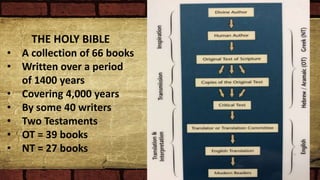
THE HOLY BIBLE
• A collection of 66 books
• Written over a period
of 1400 years
• Covering 4,000 years
• By some 40 writers
• Two Testaments
• OT = 39 books
• NT = 27 books
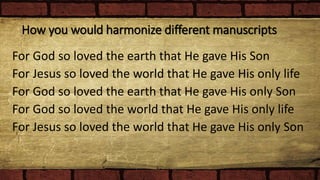
How you would harmonize different manuscripts
For God so loved the earth that He gave His Son
For Jesus so loved the world that He gave His only life
For God so loved the earth that He gave His only Son
For God so loved the world that He gave His only life
For Jesus so loved the world that He gave His only Son
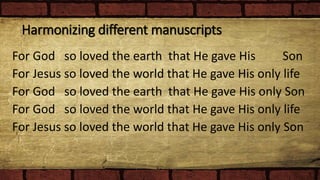
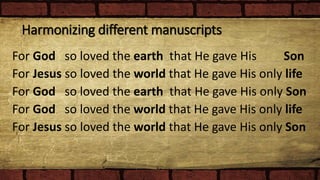
Harmonizing different manuscripts
For God so loved the earth that He gave His Son
For Jesus so loved the world that He gave His only life
For God so loved the earth that He gave His only Son
For God so loved the world that He gave His only life
For Jesus so loved the world that He gave His only Son
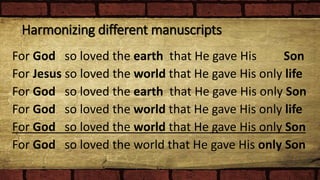
Harmonizing different manuscripts
For God so loved the earth that He gave His Son
For Jesus so loved the world that He gave His only life
For God so loved the earth that He gave His only Son
For God so loved the world that He gave His only life
For Jesus so loved the world that He gave His only Son
Harmonizing different manuscripts
For God so loved the earth that He gave His Son
For Jesus so loved the world that He gave His only life
For God so loved the earth that He gave His only Son
For God so loved the world that He gave His only life
For God so loved the world that He gave His only Son
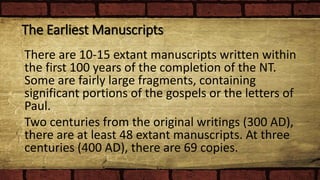
The Earliest Manuscripts
There are 10-15 extant manuscripts written within
the first 100 years of the completion of the NT.
Some are fairly large fragments, containing
significant portions of the gospels or the letters of
Paul.
Two centuries from the original writings (300 AD),
there are at least 48 extant manuscripts. At three
centuries (400 AD), there are 69 copies.
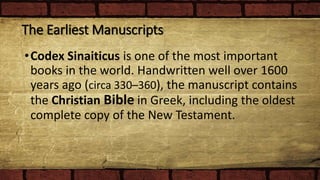
The Earliest Manuscripts
•Codex Sinaiticus is one of the most important
books in the world. Handwritten well over 1600
years ago (circa 330–360), the manuscript contains
the Christian Bible in Greek, including the oldest
complete copy of the New Testament.
The Earliest Manuscripts
There are 10-15 extant manuscripts written within
the first 100 years of the completion of the NT.
Some are fairly large fragments, containing
significant portions of the gospels or the letters of
Paul.
Two centuries from the original writings (300 AD),
there are at least 48 extant manuscripts. At three
centuries (400 AD), there are 69 copies.
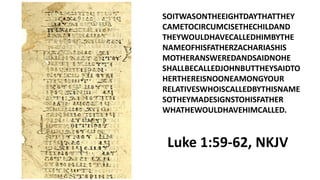
SOITWASONTHEEIGHTDAYTHATTHEY
CAMETOCIRCUMCISETHECHILDAND
THEYWOULDHAVECALLEDHIMBYTHE
NAMEOFHISFATHERZACHARIASHIS
MOTHERANSWEREDANDSAIDNOHE
SHALLBECALLEDJOHNBUTTHEYSAIDTO
HERTHEREISNOONEAMONGYOUR
RELATIVESWHOISCALLEDBYTHISNAME
SOTHEYMADESIGNSTOHISFATHER
WHATHEWOULDHAVEHIMCALLED.
Luke 1:59-62, NKJV
Why a canon of Scripture?
A biblical canon or canon of scripture is a set of texts
(or "books") which a particular religious community
regards as authoritative scripture. The English word
"canon" comes from the Greek κανών, meaning
"rule" or "measuring stick".
en.wikipedia.org/wiki/Biblical_canon
Why a canon of Scripture?
• Marcion b. AD 110
•Rejected the God of the OT and thus the OT
•Created a list of NT books – cannon – that he
believed were authoritative.
•Marcion canon included only Luke’s Gospel, and
Paul’s writings, minus any OT references.
•The church responded by identifying Christian texts
When was the canon completed?
• Muratorian Canon, was compiled in AD 170 - included all of
the New Testament books except Hebrews, James, and 3
John.
• In AD 363, the Council of Laodicea stated that everything but
Revelation were canonical and to be read in the churches.
• The Council of Hippo (AD 393) and the Council of Carthage
(AD 397) also affirmed the current 27 books of the NT as
authoritative.
https://www.gotquestions.org/canon-Bible.html
How was the canon of Scripture determined?
1. Written by a recognized prophet or apostle
2. Written by those associated with a recognized prophet
or apostle
3. Truthfulness (Deut. 18:20-22)
4. Faithfulness to previously accepted canonical writings
5. Confirmed by Christ, prophet, apostle
6. Church usage and Recognition
www.bibletraining.org
Earliest Bibles
•First manuscripts were in Greek
•Mid-200 too to early 300s A.D. – Syria Peshitta (Aramaic)
•200 A.D. Old Latin – widely used in North Africa by
Tertullian Cyprian (3rd cent.)
•405 A.D. The Latin Vulgate, translated by Jerome. It was
the standard Bible of Christiandom for over 1000 years! It
was written in the common (vulgar) Latin of the people.
www.bibletraining.org
English Translations
•1380 – Wycliffe Bible translated by hand by John Wycliff,
from the Latin before the printing press.
•1525 – Tyndale’s New Testament was produced by
William Tyndale in Europe and smuggled in sacks of flour.
Tyndale was burned at the stake for producing this
version. (Some 80% of it was adopted by the KJV.)
•1535 – Coverdale’s Bible, was first complete Bible in
English and first Bible to circulate freely in England.
English Translations
•1560 – The Geneva Bible was the Reformer’s Bible
produced in Switzerland under John Knox. It was used by
Puritans, Shakespeare, Milton and was carried to America
on the Mayflower.
•1611 – King James Version was the most famous English
Bible of all time. Its translation is litteral and word for
word. It is still read by many, but language is not static,
and newer translations have been offered to bridge the
language gap.
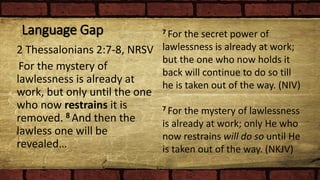
Language Gap
2 Thessalonians 2:7-8, NRSV
For the mystery of
lawlessness is already at
work, but only until the one
who now restrains it is
removed. 8 And then the
lawless one will be
revealed…
7 For the secret power of
lawlessness is already at work;
but the one who now holds it
back will continue to do so till
he is taken out of the way. (NIV)
7 For the mystery of lawlessness
is already at work; only He who
now restrains will do so until He
is taken out of the way. (NKJV)
Language Gap
2 Thessalonians 2:7-8
7 For the mystery of iniquity
doth already work: only he
who now letteth will let,
until he be taken out of the
way. 8 And then shall that
Wicked be revealed …
What does “letteth” mean?
It is an archaic third-person
singular simple present indicative
form of let. Let means, “to allow”
But context shows that Paul is not
talking about a force that allows
the wicked one to be revealed,
but is hindering the Wicked.
The Greek is katechon, which
means “to hold down.”
Modern Translations
•1881 – Revised Version, was revision of the KJV, but never
really caught on in America.
•1901 – American Standard Version was an American
project with text very similar to RV. It’s translation was
literal but not very literary.
•1946 – Revised Standard Version was a literal translation,
but was more literary, but was rejected of liberal bias,
such as changing “virgin” to “maiden” in Isa. 7:14
Modern Translations
• 1971 - The New America Standard Version was the result of
an evangelical desire to have a modern translation they
could trust. It was very accurate, but lacked literary beauty
of the KJV
• 1975 - Commissioned by Thomas Nelson Publishers, 130
Bible scholars, church leaders, and lay Christians worked for
7 years to create a new, modern translation of Scripture,
yet one that would retain the purity and stylistic beauty of
the King James Version.
Modern Translations
•1978 – New International Version began with evangelical
dissatisfaction with the RSV, and became the most widely
used translation by Evangelicals.
•2006 – Today’s New International Version was a failure
out of the gate. It attempted to employ widespread
usage of gender inclusive language such as “Our Heavenly
Parent,” rather than “our Heavenly Father.”
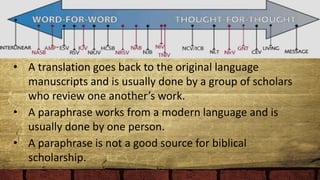
• A translation goes back to the original language
manuscripts and is usually done by a group of scholars
who review one another’s work.
• A paraphrase works from a modern language and is
usually done by one person.
• A paraphrase is not a good source for biblical
scholarship.
Criteria of a Good Translation
1. It is accurate
2. It is clear
3. It is vivid
4. It is orthodox
5. It preserves ambiguities of the original
6. It expects the best from its readers
7. It retains the poetic form of the original
8. It has beauty and dignity
Leland Ryken, The Word of God in English, 2002, Crossway Publisherw
Sad Statistics
•There are over 1200 English Versions of the Bible
•Only 1/3 of all language groups have the Bible translated
into their language
•Only 429 language groups in the world have the whole
Bible.
•While Christians in the West argue over which translation
is the best, the world is starving for one translation of the
Bible.
Norman Geisler
Chapters and Verses
The Bible was not originally written in chapters and
verses. The chapter divisions used today were
developed by the Archbishop of Canterbury, Stephen
Langton, in around A.D. 1227. The Wycliffe English
Bible of 1382 was the first Bible to use this chapter
pattern. Since then nearly all Bible translations have
followed Langton's chapter divisions.
Chapters and Verses
The Hebrew Old Testament was divided into verses a
little over 200 years later by a Jewish rabbi by the
name of Nathan in A.D. 1448. Robert Estienne, who
was also known as Stephanus, was the first to divide
the New Testament into standard numbered verses,
in 1555.
Chapters and Verses
Stephanus used Nathan's verse divisions for the Old
Testament. Since that time, beginning with the
Geneva Bible, the chapter and verse divisions
employed by Stephanus have been accepted into
nearly all the Bible versions.
Study Helps: Parallel Bible
A parallel Bible has several translations side-by-side.
The benefit is that it gives you nuances of meanings, and
when you see significant differences it tells you the
translators were struggling with a difficult text or with
variations in the Greek, or were trying to interpret a hapax
legomena – a word only used once and the context does
not give any solid hints to the meaning.
Example of Variant Readings: Numbers 12:12
KJV NIV NASB NKJV
12 And they shall take
all the instruments of
ministry, wherewith
they minister in the
sanctuary, and put
them in a cloth of
blue, and cover them
with a covering of
badgers' skins, and
shall put them on a
bar:
12 “They are to take
all the articles used
for ministering in the
sanctuary, wrap them
in a blue cloth, cover
that with the [NIV
originally had “sea
cows”] durable
leather and put them
on a carrying frame.
12 and they shall take
all the utensils of
service, with which
they serve in the
sanctuary, and put
them in a blue cloth
and cover them with a
covering of porpoise
skin, and put them on
the carrying bars.
12 Then they shall
take all the utensils
of service with which
they minister in the
sanctuary, put them
in a blue cloth, cover
them with a covering
of badger skins, and
put them on a
carrying beam.
Definitions
Greek manuscripts are the primary documents that
determine the wording of the New Testament.
•Papyri – these manuscripts are identified by the
material they are made of. The papyri are the
earliest “direct witness to the New Testament
autographs” (Comfort & Barret, 2001). Today, most
are in fragments.
Definitions
Greek manuscripts are the primary documents that
determine the wording of the New Testament.
•Uncials and Minuscules – these are the writing
styles of the documents. Uncials were written in all
capital letters. Minuscules were written in a type of
cursive.
Definitions
Greek manuscripts are the primary documents that
determine the wording of the New Testament.
•Lectionaries – these are manuscripts that are
arranged for daily study and meditation.
•Codex – pages in book form, bound at the back.

Understanding the bible session 2

  • 1.
    Understanding the Bible Session2: Cannon and Translations Mark E. Hardgrove, PhD, DMin, MDiv 2019 Grace Baptist Church
  • 2.
    THE HOLY BIBLE •A collection of 66 books • Written over a period of 1400 years • Covering 4,000 years • By some 40 writers • Two Testaments • OT = 39 books • NT = 27 books
  • 3.
    How you wouldharmonize different manuscripts For God so loved the earth that He gave His Son For Jesus so loved the world that He gave His only life For God so loved the earth that He gave His only Son For God so loved the world that He gave His only life For Jesus so loved the world that He gave His only Son
  • 4.
    Harmonizing different manuscripts ForGod so loved the earth that He gave His Son For Jesus so loved the world that He gave His only life For God so loved the earth that He gave His only Son For God so loved the world that He gave His only life For Jesus so loved the world that He gave His only Son
  • 5.
    Harmonizing different manuscripts ForGod so loved the earth that He gave His Son For Jesus so loved the world that He gave His only life For God so loved the earth that He gave His only Son For God so loved the world that He gave His only life For Jesus so loved the world that He gave His only Son
  • 6.
    Harmonizing different manuscripts ForGod so loved the earth that He gave His Son For Jesus so loved the world that He gave His only life For God so loved the earth that He gave His only Son For God so loved the world that He gave His only life For God so loved the world that He gave His only Son For God so loved the world that He gave His only Son
  • 7.
    The Earliest Manuscripts Thereare 10-15 extant manuscripts written within the first 100 years of the completion of the NT. Some are fairly large fragments, containing significant portions of the gospels or the letters of Paul. Two centuries from the original writings (300 AD), there are at least 48 extant manuscripts. At three centuries (400 AD), there are 69 copies.
  • 8.
    The Earliest Manuscripts •CodexSinaiticus is one of the most important books in the world. Handwritten well over 1600 years ago (circa 330–360), the manuscript contains the Christian Bible in Greek, including the oldest complete copy of the New Testament.
  • 9.
    The Earliest Manuscripts Thereare 10-15 extant manuscripts written within the first 100 years of the completion of the NT. Some are fairly large fragments, containing significant portions of the gospels or the letters of Paul. Two centuries from the original writings (300 AD), there are at least 48 extant manuscripts. At three centuries (400 AD), there are 69 copies.
  • 10.
  • 11.
    Why a canonof Scripture? A biblical canon or canon of scripture is a set of texts (or "books") which a particular religious community regards as authoritative scripture. The English word "canon" comes from the Greek κανών, meaning "rule" or "measuring stick". en.wikipedia.org/wiki/Biblical_canon
  • 12.
    Why a canonof Scripture? • Marcion b. AD 110 •Rejected the God of the OT and thus the OT •Created a list of NT books – cannon – that he believed were authoritative. •Marcion canon included only Luke’s Gospel, and Paul’s writings, minus any OT references. •The church responded by identifying Christian texts
  • 13.
    When was thecanon completed? • Muratorian Canon, was compiled in AD 170 - included all of the New Testament books except Hebrews, James, and 3 John. • In AD 363, the Council of Laodicea stated that everything but Revelation were canonical and to be read in the churches. • The Council of Hippo (AD 393) and the Council of Carthage (AD 397) also affirmed the current 27 books of the NT as authoritative. https://www.gotquestions.org/canon-Bible.html
  • 14.
    How was thecanon of Scripture determined? 1. Written by a recognized prophet or apostle 2. Written by those associated with a recognized prophet or apostle 3. Truthfulness (Deut. 18:20-22) 4. Faithfulness to previously accepted canonical writings 5. Confirmed by Christ, prophet, apostle 6. Church usage and Recognition www.bibletraining.org
  • 15.
    Earliest Bibles •First manuscriptswere in Greek •Mid-200 too to early 300s A.D. – Syria Peshitta (Aramaic) •200 A.D. Old Latin – widely used in North Africa by Tertullian Cyprian (3rd cent.) •405 A.D. The Latin Vulgate, translated by Jerome. It was the standard Bible of Christiandom for over 1000 years! It was written in the common (vulgar) Latin of the people. www.bibletraining.org
  • 16.
    English Translations •1380 –Wycliffe Bible translated by hand by John Wycliff, from the Latin before the printing press. •1525 – Tyndale’s New Testament was produced by William Tyndale in Europe and smuggled in sacks of flour. Tyndale was burned at the stake for producing this version. (Some 80% of it was adopted by the KJV.) •1535 – Coverdale’s Bible, was first complete Bible in English and first Bible to circulate freely in England.
  • 17.
    English Translations •1560 –The Geneva Bible was the Reformer’s Bible produced in Switzerland under John Knox. It was used by Puritans, Shakespeare, Milton and was carried to America on the Mayflower. •1611 – King James Version was the most famous English Bible of all time. Its translation is litteral and word for word. It is still read by many, but language is not static, and newer translations have been offered to bridge the language gap.
  • 18.
    Language Gap 2 Thessalonians2:7-8, NRSV For the mystery of lawlessness is already at work, but only until the one who now restrains it is removed. 8 And then the lawless one will be revealed… 7 For the secret power of lawlessness is already at work; but the one who now holds it back will continue to do so till he is taken out of the way. (NIV) 7 For the mystery of lawlessness is already at work; only He who now restrains will do so until He is taken out of the way. (NKJV)
  • 19.
    Language Gap 2 Thessalonians2:7-8 7 For the mystery of iniquity doth already work: only he who now letteth will let, until he be taken out of the way. 8 And then shall that Wicked be revealed … What does “letteth” mean? It is an archaic third-person singular simple present indicative form of let. Let means, “to allow” But context shows that Paul is not talking about a force that allows the wicked one to be revealed, but is hindering the Wicked. The Greek is katechon, which means “to hold down.”
  • 20.
    Modern Translations •1881 –Revised Version, was revision of the KJV, but never really caught on in America. •1901 – American Standard Version was an American project with text very similar to RV. It’s translation was literal but not very literary. •1946 – Revised Standard Version was a literal translation, but was more literary, but was rejected of liberal bias, such as changing “virgin” to “maiden” in Isa. 7:14
  • 21.
    Modern Translations • 1971- The New America Standard Version was the result of an evangelical desire to have a modern translation they could trust. It was very accurate, but lacked literary beauty of the KJV • 1975 - Commissioned by Thomas Nelson Publishers, 130 Bible scholars, church leaders, and lay Christians worked for 7 years to create a new, modern translation of Scripture, yet one that would retain the purity and stylistic beauty of the King James Version.
  • 22.
    Modern Translations •1978 –New International Version began with evangelical dissatisfaction with the RSV, and became the most widely used translation by Evangelicals. •2006 – Today’s New International Version was a failure out of the gate. It attempted to employ widespread usage of gender inclusive language such as “Our Heavenly Parent,” rather than “our Heavenly Father.”
  • 23.
    • A translationgoes back to the original language manuscripts and is usually done by a group of scholars who review one another’s work. • A paraphrase works from a modern language and is usually done by one person. • A paraphrase is not a good source for biblical scholarship.
  • 24.
    Criteria of aGood Translation 1. It is accurate 2. It is clear 3. It is vivid 4. It is orthodox 5. It preserves ambiguities of the original 6. It expects the best from its readers 7. It retains the poetic form of the original 8. It has beauty and dignity Leland Ryken, The Word of God in English, 2002, Crossway Publisherw
  • 25.
    Sad Statistics •There areover 1200 English Versions of the Bible •Only 1/3 of all language groups have the Bible translated into their language •Only 429 language groups in the world have the whole Bible. •While Christians in the West argue over which translation is the best, the world is starving for one translation of the Bible. Norman Geisler
  • 26.
    Chapters and Verses TheBible was not originally written in chapters and verses. The chapter divisions used today were developed by the Archbishop of Canterbury, Stephen Langton, in around A.D. 1227. The Wycliffe English Bible of 1382 was the first Bible to use this chapter pattern. Since then nearly all Bible translations have followed Langton's chapter divisions.
  • 27.
    Chapters and Verses TheHebrew Old Testament was divided into verses a little over 200 years later by a Jewish rabbi by the name of Nathan in A.D. 1448. Robert Estienne, who was also known as Stephanus, was the first to divide the New Testament into standard numbered verses, in 1555.
  • 28.
    Chapters and Verses Stephanusused Nathan's verse divisions for the Old Testament. Since that time, beginning with the Geneva Bible, the chapter and verse divisions employed by Stephanus have been accepted into nearly all the Bible versions.
  • 29.
    Study Helps: ParallelBible A parallel Bible has several translations side-by-side. The benefit is that it gives you nuances of meanings, and when you see significant differences it tells you the translators were struggling with a difficult text or with variations in the Greek, or were trying to interpret a hapax legomena – a word only used once and the context does not give any solid hints to the meaning.
  • 30.
    Example of VariantReadings: Numbers 12:12 KJV NIV NASB NKJV 12 And they shall take all the instruments of ministry, wherewith they minister in the sanctuary, and put them in a cloth of blue, and cover them with a covering of badgers' skins, and shall put them on a bar: 12 “They are to take all the articles used for ministering in the sanctuary, wrap them in a blue cloth, cover that with the [NIV originally had “sea cows”] durable leather and put them on a carrying frame. 12 and they shall take all the utensils of service, with which they serve in the sanctuary, and put them in a blue cloth and cover them with a covering of porpoise skin, and put them on the carrying bars. 12 Then they shall take all the utensils of service with which they minister in the sanctuary, put them in a blue cloth, cover them with a covering of badger skins, and put them on a carrying beam.
  • 31.
    Definitions Greek manuscripts arethe primary documents that determine the wording of the New Testament. •Papyri – these manuscripts are identified by the material they are made of. The papyri are the earliest “direct witness to the New Testament autographs” (Comfort & Barret, 2001). Today, most are in fragments.
  • 32.
    Definitions Greek manuscripts arethe primary documents that determine the wording of the New Testament. •Uncials and Minuscules – these are the writing styles of the documents. Uncials were written in all capital letters. Minuscules were written in a type of cursive.
  • 33.
    Definitions Greek manuscripts arethe primary documents that determine the wording of the New Testament. •Lectionaries – these are manuscripts that are arranged for daily study and meditation. •Codex – pages in book form, bound at the back.