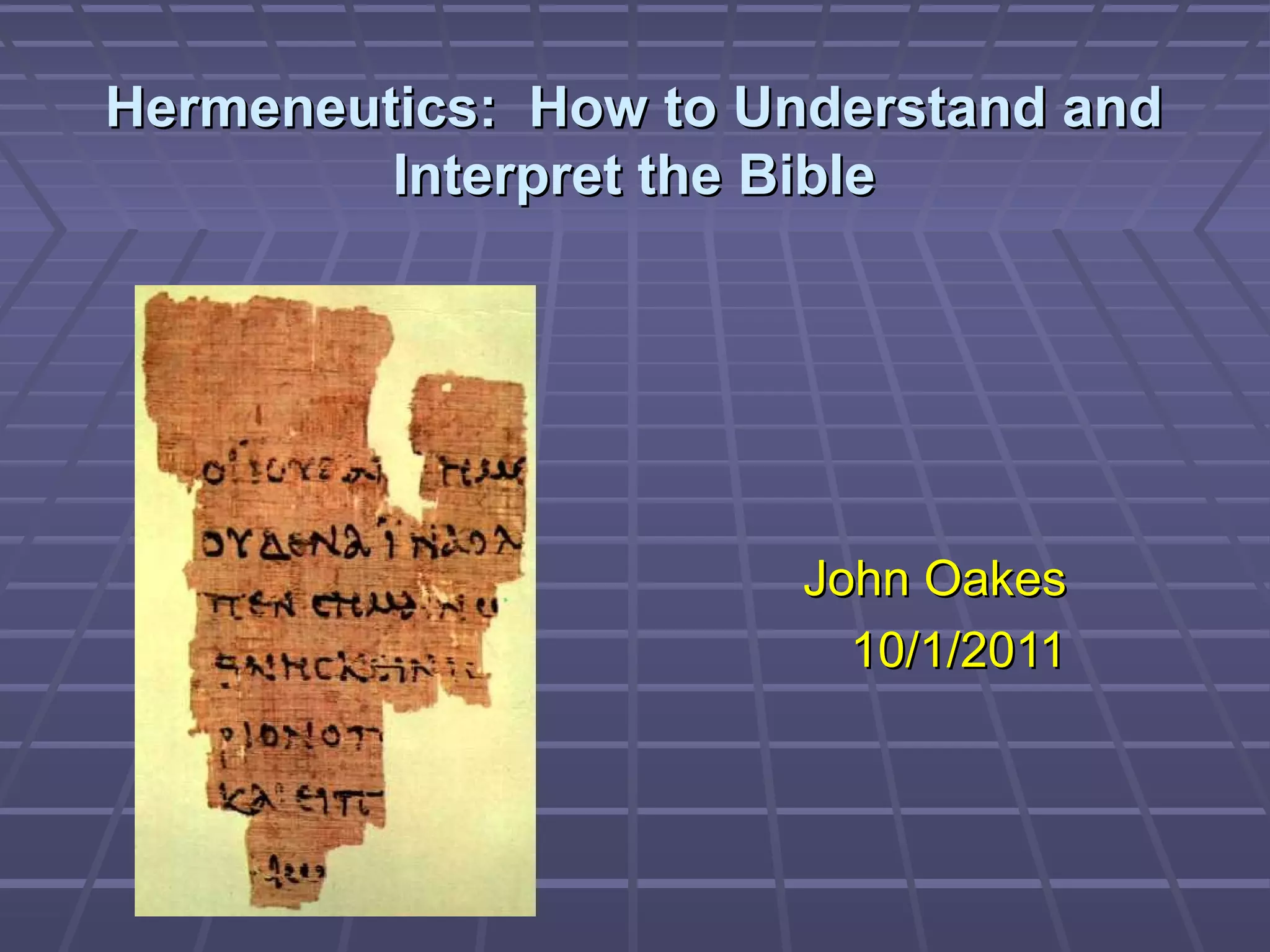
Hermeneutics: How to Understand andHermeneutics: How to Understand and
Interpret the BibleInterpret the Bible
John OakesJohn Oakes
10/1/201110/1/2011
DefinitionsDefinitions
 Hermeneutics: The systematic study of the principles and methods
of interpretation (of the Bible). The meaning in the greater sense..
 Exegesis: Explaining the meaning of the text; i.e. what the author
meant when he wrote to the people of his day.
 Homiletics: Practical application of the meaning of the text for us
today.
 Eisegesis: Reading a meaning into the text which was not in the
original (because of a bias of the interpreter)
Exegesis → Hermeneutics → Homiletics
The Problem of MisinterpretationThe Problem of Misinterpretation
 Using the Bible to say something it does not say.Using the Bible to say something it does not say.
 Prov 29:18 KJV For lack of vision…Prov 29:18 KJV For lack of vision…
 Matthew 11:12 Matt 11:12Matthew 11:12 Matt 11:12
 Using the Bible in an unbalanced way.Using the Bible in an unbalanced way.
 faith/worksfaith/works
 righteousness/asceticismrighteousness/asceticism
 Confusing command and principle.Confusing command and principle.
 2 Cor 6:14 unequally yoked2 Cor 6:14 unequally yoked
 Is gambling wrong? 1 Cor 4:2, Rom 14:19-21 1 Cor 6:12Is gambling wrong? 1 Cor 4:2, Rom 14:19-21 1 Cor 6:12
Why Good Hermeneutics?Why Good Hermeneutics?
 Get more out of your personal Bible studyGet more out of your personal Bible study
 1 Tim 4:13 Save yourself and your hearers1 Tim 4:13 Save yourself and your hearers
Why Hermeneutics WorksWhy Hermeneutics Works
 In the Bible, God speaks.In the Bible, God speaks.
 2 Peter2 Peter 1:19-21, 2 Tim 3:16, 1 Thess 2:13.
 The Bible has been accurately transmitted and weThe Bible has been accurately transmitted and we
have relatively good translations.have relatively good translations.
 The Bible is perfect—it is infallible.The Bible is perfect—it is infallible.
 Ps 19:7, Ps 119:160.
 With work, the Bible is understandable. Deut 29:29With work, the Bible is understandable. Deut 29:29
Why Hermeneutics Works (cont.)Why Hermeneutics Works (cont.)
 The Bible is complete. 2 Tim 3:17, Rev 22:18The Bible is complete. 2 Tim 3:17, Rev 22:18
 God has chosen to use written words toGod has chosen to use written words to
communicate with his people. Verbal inspiration.communicate with his people. Verbal inspiration.
 Matthew 22:31-33. Argument from tense (Exodus 3:6).
 Gal 3:16 Argument from singular vs. plural.
 Matthew 5:17-18 Not a jot or a tittle will disappear.
Hindrances to Good HermeneuticsHindrances to Good Hermeneutics
 Prejudice/Preconceived IdeasPrejudice/Preconceived Ideas
 PridePride
 LazinessLaziness
 Wishful ThinkingWishful Thinking
 Clergy/Laity AttitudeClergy/Laity Attitude
 Desire to Be Like (and liked by) the WorldDesire to Be Like (and liked by) the World
 Proof-text ApproachProof-text Approach
 Appeal to AuthorityAppeal to Authority
 Assuming what is popularly believed is trueAssuming what is popularly believed is true
 Lack of a planLack of a plan
 Schismatic AttitudeSchismatic Attitude
Helps to Good InterpretationHelps to Good Interpretation
 The opposite of the preceding list.The opposite of the preceding list.
 Common senseCommon sense
 Sincere desire to know the truthSincere desire to know the truth
 Faith in GodFaith in God
 EducationEducation
 Good toolsGood tools
ToolsTools
 Complete, exhaustive or analytical concordance.
 Bible dictionary.
 Topical Bible.
 Expository dictionary of NT words (Vine’s).
 Greek and/or Hebrew interlinear Bible.
 Greek and/or Hebrew lexicon.
 Commentaries: homiletic and analytic.
 History, and especially Church History books
 Other good translations.
English TranslationsEnglish Translations
 Word for WordWord for Word
 Phrase for PhrasePhrase for Phrase
 Thought for Thought (ie paraphrased)Thought for Thought (ie paraphrased)
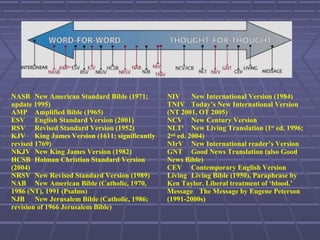
NASB New American Standard Bible (1971;
update 1995)
AMP Amplified Bible (1965)
ESV English Standard Version (2001)
RSV Revised Standard Version (1952)
KJV King James Version (1611; significantly
revised 1769)
NKJV New King James Version (1982)
HCSB Holman Christian Standard Version
(2004)
NRSV New Revised Standard Version (1989)
NAB New American Bible (Catholic, 1970,
1986 (NT), 1991 (Psalms)
NJB New Jerusalem Bible (Catholic, 1986;
revision of 1966 Jerusalem Bible)
NIV New International Version (1984)
TNIV Today’s New International Version
(NT 2001, OT 2005)
NCV New Century Version
NLT1
New Living Translation (1st
ed. 1996;
2nd
ed. 2004)
NIrV New International reader’s Version
GNT Good News Translation (also Good
News Bible)
CEV Contemporary English Version
Living Living Bible (1950). Paraphrase by
Ken Taylor. Liberal treatment of ‘blood.’
Message The Message by Eugene Peterson
(1991-2000s)
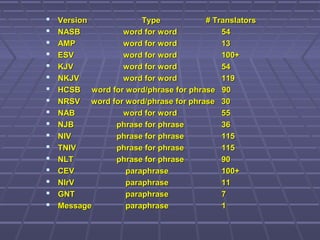
 VersionVersion TypeType # Translators# Translators
 NASBNASB word for wordword for word 5454
 AMPAMP word for wordword for word 1313
 ESVESV word for wordword for word 100+100+
 KJVKJV word for wordword for word 5454
 NKJVNKJV word for wordword for word 119119
 HCSB word for word/phrase for phrase 90HCSB word for word/phrase for phrase 90
 NRSV word for word/phrase for phrase 30NRSV word for word/phrase for phrase 30
 NABNAB word for wordword for word 5555
 NJBNJB phrase for phrasephrase for phrase 3636
 NIVNIV phrase for phrasephrase for phrase 115115
 TNIVTNIV phrase for phrasephrase for phrase 115115
 NLTNLT phrase for phrasephrase for phrase 9090
 CEVCEV paraphraseparaphrase 100+100+
 NIrVNIrV paraphraseparaphrase 1111
 GNTGNT paraphraseparaphrase 77
 MessageMessage paraphraseparaphrase 11
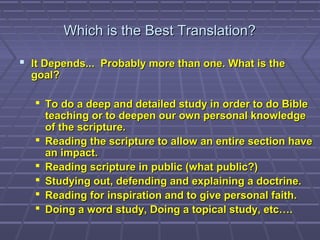
Which is the Best Translation?Which is the Best Translation?
 It Depends... Probably more than one. What is theIt Depends... Probably more than one. What is the
goal?goal?
 To do a deep and detailed study in order to do BibleTo do a deep and detailed study in order to do Bible
teaching or to deepen our own personal knowledgeteaching or to deepen our own personal knowledge
of the scripture.of the scripture.
 Reading the scripture to allow an entire section haveReading the scripture to allow an entire section have
an impact.an impact.
 Reading scripture in public (what public?)Reading scripture in public (what public?)
 Studying out, defending and explaining a doctrine.Studying out, defending and explaining a doctrine.
 Reading for inspiration and to give personal faith.Reading for inspiration and to give personal faith.
 Doing a word study, Doing a topical study, etc….Doing a word study, Doing a topical study, etc….
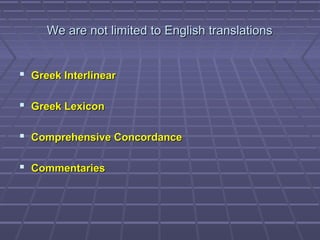
We are not limited to English translationsWe are not limited to English translations
 Greek InterlinearGreek Interlinear
 Greek LexiconGreek Lexicon
 Comprehensive ConcordanceComprehensive Concordance
 CommentariesCommentaries
Should We Stick to the NIV?Should We Stick to the NIV?
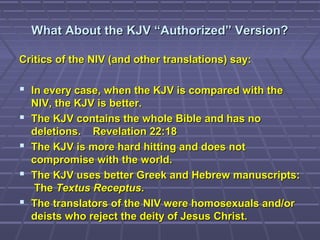
What About the KJV “Authorized” Version?What About the KJV “Authorized” Version?
Critics of the NIV (and other translations) say:Critics of the NIV (and other translations) say:
 In every case, when the KJV is compared with theIn every case, when the KJV is compared with the
NIV, the KJV is better.NIV, the KJV is better.
 The KJV contains the whole Bible and has noThe KJV contains the whole Bible and has no
deletions. Revelation 22:18deletions. Revelation 22:18
 The KJV is more hard hitting and does notThe KJV is more hard hitting and does not
compromise with the world.compromise with the world.
 The KJV uses better Greek and Hebrew manuscripts:The KJV uses better Greek and Hebrew manuscripts:
TheThe Textus ReceptusTextus Receptus..
 The translators of the NIV were homosexuals and/orThe translators of the NIV were homosexuals and/or
deists who reject the deity of Jesus Christ.deists who reject the deity of Jesus Christ.
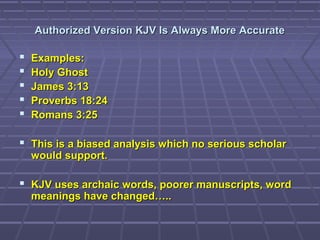
Authorized Version KJV Is Always More AccurateAuthorized Version KJV Is Always More Accurate
 Examples:Examples:
 Holy GhostHoly Ghost
 James 3:13James 3:13
 Proverbs 18:24Proverbs 18:24
 Romans 3:25Romans 3:25
 This is a biased analysis which no serious scholarThis is a biased analysis which no serious scholar
would support.would support.
 KJV uses archaic words, poorer manuscripts, wordKJV uses archaic words, poorer manuscripts, word
meanings have changed…..meanings have changed…..
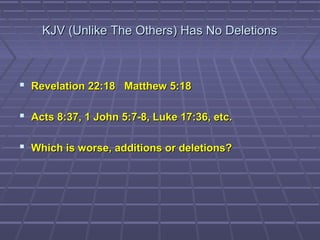
KJV (Unlike The Others) Has No DeletionsKJV (Unlike The Others) Has No Deletions
 Revelation 22:18 Matthew 5:18Revelation 22:18 Matthew 5:18
 Acts 8:37, 1 John 5:7-8, Luke 17:36, etc.Acts 8:37, 1 John 5:7-8, Luke 17:36, etc.
 Which is worse, additions or deletions?Which is worse, additions or deletions?
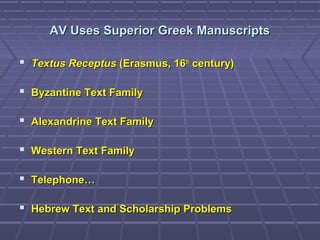
AV Uses Superior Greek ManuscriptsAV Uses Superior Greek Manuscripts
 Textus ReceptusTextus Receptus (Erasmus, 16(Erasmus, 16thth
century)century)
 Byzantine Text FamilyByzantine Text Family
 Alexandrine Text FamilyAlexandrine Text Family
 Western Text FamilyWestern Text Family
 Telephone…Telephone…
 Hebrew Text and Scholarship ProblemsHebrew Text and Scholarship Problems
ConclusionConclusion
 The debate over the “right” English translation is not a usefulThe debate over the “right” English translation is not a useful
one. A student of the scriptures who does not have a deepone. A student of the scriptures who does not have a deep
knowledge of the original languages will use more than oneknowledge of the original languages will use more than one
translation, as well as other resources to arrive at a goodtranslation, as well as other resources to arrive at a good
understanding of the meaning of the text.understanding of the meaning of the text.
 Arguments that the King James Version is the only acceptable,Arguments that the King James Version is the only acceptable,
inspired translation and that others are demonic are biased, fullinspired translation and that others are demonic are biased, full
of logical fallacies and simply not valid.of logical fallacies and simply not valid.
A Brief History of Hermeneutical StylesA Brief History of Hermeneutical Styles
 Jewish ApproachesJewish Approaches
 Allegorical Interpretation: AlexandriaAllegorical Interpretation: Alexandria
 Historical/Grammatical: AntiochHistorical/Grammatical: Antioch
 Mystical: GnosticsMystical: Gnostics
 Authoritative: RomeAuthoritative: Rome
 Dogmatic: JWsDogmatic: JWs
 Literalism: PremillenialismLiteralism: Premillenialism
 Inductive/Analytical: Alexander Campbell and CoCInductive/Analytical: Alexander Campbell and CoC
 Command, Example, Necessary Demonstration.Command, Example, Necessary Demonstration.
 Speak where the Bible speaks, be silent where the Bible is silentSpeak where the Bible speaks, be silent where the Bible is silent
 ICOCICOC
 Where the Bible speaks we are silent, where it is silent we speakWhere the Bible speaks we are silent, where it is silent we speak
A Better Approach?A Better Approach?
 William of Ockham: What is true? What is knownWilliam of Ockham: What is true? What is known
per se, evident from experience or proved byper se, evident from experience or proved by
authority of scripture.authority of scripture.
 Revelation, Deduction, InductionRevelation, Deduction, Induction
 Revelation: Direct CommandRevelation: Direct Command
 Deduction: PrincipleDeduction: Principle
 Induction: Wisdom, ExperienceInduction: Wisdom, Experience
AssignmentAssignment
1. Pray about the hindrances to good Bible interpretation. Make it
personal.
2. For the book of Galatians;
Read it.
Find a theme verse.
Discover an overall theme for the book.
Create an outline for the book.
Use a Bible dictionary or commentary or other resource to
determine the historical and cultural context of the writing of the
book.
3. Come up with a single scripture, a section of a book or an
entire (small) book you want to analyze using the principles of
hermeneutics.
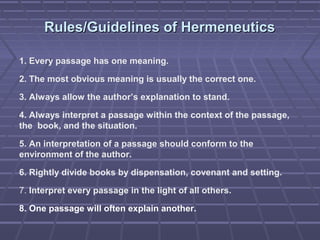
Rules/Guidelines of HermeneuticsRules/Guidelines of Hermeneutics
1. Every passage has one meaning.
2. The most obvious meaning is usually the correct one.
3. Always allow the author’s explanation to stand.
4. Always interpret a passage within the context of the passage,
the book, and the situation.
5. An interpretation of a passage should conform to the
environment of the author.
6. Rightly divide books by dispensation, covenant and setting.
7. Interpret every passage in the light of all others.
8. One passage will often explain another.
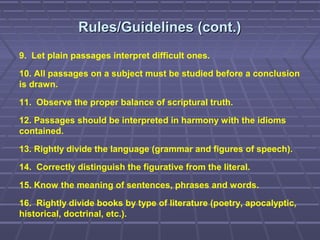
Rules/Guidelines (cont.)Rules/Guidelines (cont.)
9. Let plain passages interpret difficult ones.
10. All passages on a subject must be studied before a conclusion
is drawn.
11. Observe the proper balance of scriptural truth.
12. Passages should be interpreted in harmony with the idioms
contained.
13. Rightly divide the language (grammar and figures of speech).
14. Correctly distinguish the figurative from the literal.
15. Know the meaning of sentences, phrases and words.
16. Rightly divide books by type of literature (poetry, apocalyptic,
historical, doctrinal, etc.).
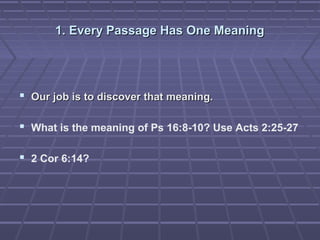
1. Every Passage Has One Meaning1. Every Passage Has One Meaning
 Our job is to discover that meaning.Our job is to discover that meaning.
 What is the meaning of Ps 16:8-10? Use Acts 2:25-27
 2 Cor 6:14?
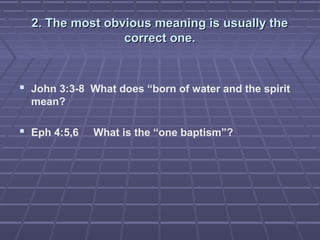
2. The most obvious meaning is usually the2. The most obvious meaning is usually the
correct one.correct one.
 John 3:3-8 What does “born of water and the spirit
mean?
 Eph 4:5,6 What is the “one baptism”?
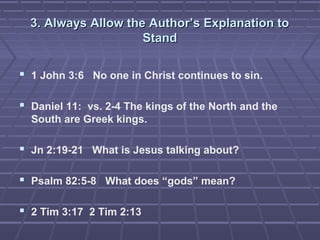
3. Always Allow the Author’s Explanation to3. Always Allow the Author’s Explanation to
StandStand
 1 John 3:6 No one in Christ continues to sin.
 Daniel 11: vs. 2-4 The kings of the North and the
South are Greek kings.
 Jn 2:19-21 What is Jesus talking about?
 Psalm 82:5-8 What does “gods” mean?
 2 Tim 3:17 2 Tim 2:13
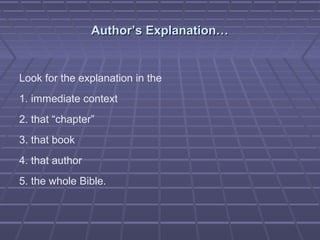
Author’s Explanation…Author’s Explanation…
Look for the explanation in the
1. immediate context
2. that “chapter”
3. that book
4. that author
5. the whole Bible.
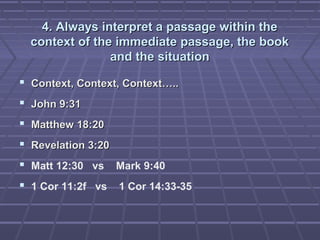
4. Always interpret a passage within the4. Always interpret a passage within the
context of the immediate passage, the bookcontext of the immediate passage, the book
and the situationand the situation
 Context, Context, Context…..Context, Context, Context…..
 John 9:31John 9:31
 Matthew 18:20Matthew 18:20
 Revelation 3:20Revelation 3:20
 Matt 12:30 vs Mark 9:40
 1 Cor 11:2f vs 1 Cor 14:33-35
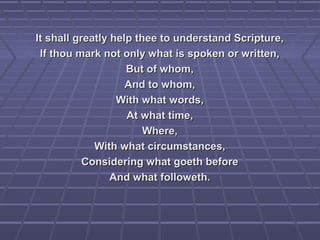
It shall greatly help thee to understand Scripture,It shall greatly help thee to understand Scripture,
If thou mark not only what is spoken or written,If thou mark not only what is spoken or written,
But of whom,But of whom,
And to whom,And to whom,
With what words,With what words,
At what time,At what time,
Where,Where,
With what circumstances,With what circumstances,
Considering what goeth beforeConsidering what goeth before
And what followeth.And what followeth.
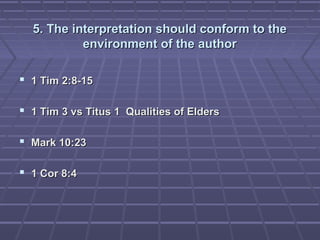
5. The interpretation should conform to the5. The interpretation should conform to the
environment of the authorenvironment of the author
 1 Tim 2:8-151 Tim 2:8-15
 1 Tim 3 vs Titus 1 Qualities of Elders1 Tim 3 vs Titus 1 Qualities of Elders
 Mark 10:23Mark 10:23
 1 Cor 8:41 Cor 8:4
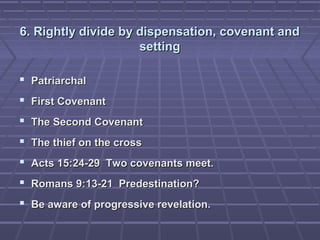
6. Rightly divide by dispensation, covenant and6. Rightly divide by dispensation, covenant and
settingsetting
 PatriarchalPatriarchal
 First CovenantFirst Covenant
 The Second CovenantThe Second Covenant
 The thief on the crossThe thief on the cross
 Acts 15:24-29 Two covenants meet.Acts 15:24-29 Two covenants meet.
 Romans 9:13-21 Predestination?Romans 9:13-21 Predestination?
 Be aware of progressive revelation.Be aware of progressive revelation.
7. Interpret every passage in light of all others7. Interpret every passage in light of all others
 Acts 2:21 explained by Rom 10:9, 2 Tim 2:19
8. One passage will often explain another8. One passage will often explain another
1 Thess 4:15-17 Is there room for a rapture here?
2 Pet 3:11-13
Harmonize Prov 26:4 and Prov 26:5
Harmonize Ex 20:5-6 with Ezek 18:20
Harmonize Prov 13:25 with Psalm 73:1-5
9. Let plain passages interpret difficult ones.9. Let plain passages interpret difficult ones.
1 Cor 15:29 Q: What does it not mean?
Romans 8:28-30 Does this justify a strict
predestination? See Hebrews 6:4-6, 10:19-32
Ezekiel 18:25-29 Rev 20:13,14
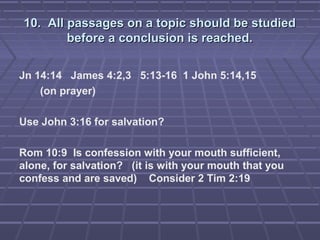
10. All passages on a topic should be studied10. All passages on a topic should be studied
before a conclusion is reached.before a conclusion is reached.
Jn 14:14 James 4:2,3 5:13-16 1 John 5:14,15
(on prayer)
Use John 3:16 for salvation?
Rom 10:9 Is confession with your mouth sufficient,
alone, for salvation? (it is with your mouth that you
confess and are saved) Consider 2 Tim 2:19
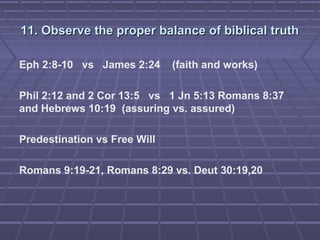
11. Observe the proper balance of biblical truth11. Observe the proper balance of biblical truth
Eph 2:8-10 vs James 2:24 (faith and works)
Phil 2:12 and 2 Cor 13:5 vs 1 Jn 5:13 Romans 8:37
and Hebrews 10:19 (assuring vs. assured)
Predestination vs Free Will
Romans 9:19-21, Romans 8:29 vs. Deut 30:19,20
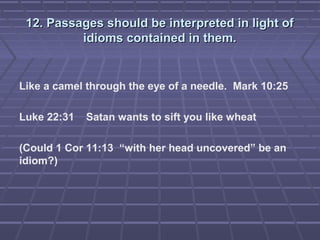
12. Passages should be interpreted in light of12. Passages should be interpreted in light of
idioms contained in them.idioms contained in them.
Like a camel through the eye of a needle. Mark 10:25
Luke 22:31 Satan wants to sift you like wheat
(Could 1 Cor 11:13 “with her head uncovered” be an
idiom?)
13. Rightly Divide the Language (grammar,13. Rightly Divide the Language (grammar,
figures of speech)figures of speech)
 Anthropomorphisms Psalm 44:3Anthropomorphisms Psalm 44:3
 Personification Psalm 114:3Personification Psalm 114:3
 Hyperbole Psalm 51:5 Matthew 9:47 Psalm 22:6Hyperbole Psalm 51:5 Matthew 9:47 Psalm 22:6
 Irony, sarcasm Galatians 5:12Irony, sarcasm Galatians 5:12
 Simile Matthew 3:16 Isaiah 53:6Simile Matthew 3:16 Isaiah 53:6
 Metaphor Matt 26:26 Luke 13:32Metaphor Matt 26:26 Luke 13:32
 Allegory Ephesians 6:11-17Allegory Ephesians 6:11-17
 Metonymy 1 Cor 11:25Metonymy 1 Cor 11:25
 Synecdoche Deut 8:3Synecdoche Deut 8:3
GrammarGrammar
 1 Cor 11:27 Unworthy or unworthily?1 Cor 11:27 Unworthy or unworthily?
 Matthew 16:18 masculine vs feminineMatthew 16:18 masculine vs feminine
14. Correctly Distinguish the Figurative from14. Correctly Distinguish the Figurative from
the Literalthe Literal
 How do we know a passage is figurative?How do we know a passage is figurative?
 An implied absurdity Luke 9:60 Mal 1:2-3An implied absurdity Luke 9:60 Mal 1:2-3
 When literal interpretation implies a contradiction orWhen literal interpretation implies a contradiction or
inconsistency. John 11:25-26inconsistency. John 11:25-26
 When it requires a clearly immoral conclusion Matt 18:9When it requires a clearly immoral conclusion Matt 18:9
 When the context implies it or the author says so.When the context implies it or the author says so.
Jn 2:18-20Jn 2:18-20
 Common sense. John 4:10-15Common sense. John 4:10-15
 Apocalyptic literature works very differentlyApocalyptic literature works very differently
15. Know the meaning of words, phrases and15. Know the meaning of words, phrases and
sentences.sentences.
 Websters vs Greek vs Biblical definition.Websters vs Greek vs Biblical definition.
 ChurchChurch
 FleshFlesh
 SoulSoul
 BreadBread
 SpiritSpirit
 In interpreting passages, look for key words andIn interpreting passages, look for key words and
define them carefullydefine them carefully
 1 Cor 11:2-16 head (v. 3) authority (v. 10)1 Cor 11:2-16 head (v. 3) authority (v. 10)
 Rom 8:5-11Rom 8:5-11
16. Rightly divide books by type of literature.16. Rightly divide books by type of literature.
 PoetryPoetry
 Loaded with metaphor, hyperbole, etc. Look for the feeling,Loaded with metaphor, hyperbole, etc. Look for the feeling,
not the doctrine. Ps 51:5not the doctrine. Ps 51:5
 ProverbProverb
 Principle, not promise or command. Prov 13:24, Prov 22:6Principle, not promise or command. Prov 13:24, Prov 22:6
 HistoricalHistorical
 Look for the practical application Acts 6:3Look for the practical application Acts 6:3
 DoctrinalDoctrinal
 Can be most carefully analyzedCan be most carefully analyzed
 ApocalypticApocalyptic
 Assume figurative unless the context demands literalAssume figurative unless the context demands literal
 Type/AntitypeType/Antitype
Type/Antitype InterpretationType/Antitype Interpretation
 1. If a NT writer says a particular passage in the Old Testament
is a foreshadow/prophecy/prefigure/type, then it is. Jn 3:14
 2. If an Old Testament passage works as a
foreshadow/prophecy/prefigure/type both in the general sense
and in the specifics, then it is probably legitimate.
 3. If one already knows that a general event in the Old
Testament is a foreshadow/prophecy/prefigure/type, then it is
safer to assume that the details are foreshadows as well. Gen
22:1-11.

Class on Hermeneutics: How to Interpret the Bible

  • 1.
    Hermeneutics: How toUnderstand andHermeneutics: How to Understand and Interpret the BibleInterpret the Bible John OakesJohn Oakes 10/1/201110/1/2011
  • 2.
    DefinitionsDefinitions  Hermeneutics: Thesystematic study of the principles and methods of interpretation (of the Bible). The meaning in the greater sense..  Exegesis: Explaining the meaning of the text; i.e. what the author meant when he wrote to the people of his day.  Homiletics: Practical application of the meaning of the text for us today.  Eisegesis: Reading a meaning into the text which was not in the original (because of a bias of the interpreter) Exegesis → Hermeneutics → Homiletics
  • 3.
    The Problem ofMisinterpretationThe Problem of Misinterpretation  Using the Bible to say something it does not say.Using the Bible to say something it does not say.  Prov 29:18 KJV For lack of vision…Prov 29:18 KJV For lack of vision…  Matthew 11:12 Matt 11:12Matthew 11:12 Matt 11:12  Using the Bible in an unbalanced way.Using the Bible in an unbalanced way.  faith/worksfaith/works  righteousness/asceticismrighteousness/asceticism  Confusing command and principle.Confusing command and principle.  2 Cor 6:14 unequally yoked2 Cor 6:14 unequally yoked  Is gambling wrong? 1 Cor 4:2, Rom 14:19-21 1 Cor 6:12Is gambling wrong? 1 Cor 4:2, Rom 14:19-21 1 Cor 6:12
  • 4.
    Why Good Hermeneutics?WhyGood Hermeneutics?  Get more out of your personal Bible studyGet more out of your personal Bible study  1 Tim 4:13 Save yourself and your hearers1 Tim 4:13 Save yourself and your hearers
  • 5.
    Why Hermeneutics WorksWhyHermeneutics Works  In the Bible, God speaks.In the Bible, God speaks.  2 Peter2 Peter 1:19-21, 2 Tim 3:16, 1 Thess 2:13.  The Bible has been accurately transmitted and weThe Bible has been accurately transmitted and we have relatively good translations.have relatively good translations.  The Bible is perfect—it is infallible.The Bible is perfect—it is infallible.  Ps 19:7, Ps 119:160.  With work, the Bible is understandable. Deut 29:29With work, the Bible is understandable. Deut 29:29
  • 6.
    Why Hermeneutics Works(cont.)Why Hermeneutics Works (cont.)  The Bible is complete. 2 Tim 3:17, Rev 22:18The Bible is complete. 2 Tim 3:17, Rev 22:18  God has chosen to use written words toGod has chosen to use written words to communicate with his people. Verbal inspiration.communicate with his people. Verbal inspiration.  Matthew 22:31-33. Argument from tense (Exodus 3:6).  Gal 3:16 Argument from singular vs. plural.  Matthew 5:17-18 Not a jot or a tittle will disappear.
  • 7.
    Hindrances to GoodHermeneuticsHindrances to Good Hermeneutics  Prejudice/Preconceived IdeasPrejudice/Preconceived Ideas  PridePride  LazinessLaziness  Wishful ThinkingWishful Thinking  Clergy/Laity AttitudeClergy/Laity Attitude  Desire to Be Like (and liked by) the WorldDesire to Be Like (and liked by) the World  Proof-text ApproachProof-text Approach  Appeal to AuthorityAppeal to Authority  Assuming what is popularly believed is trueAssuming what is popularly believed is true  Lack of a planLack of a plan  Schismatic AttitudeSchismatic Attitude
  • 8.
    Helps to GoodInterpretationHelps to Good Interpretation  The opposite of the preceding list.The opposite of the preceding list.  Common senseCommon sense  Sincere desire to know the truthSincere desire to know the truth  Faith in GodFaith in God  EducationEducation  Good toolsGood tools
  • 9.
    ToolsTools  Complete, exhaustiveor analytical concordance.  Bible dictionary.  Topical Bible.  Expository dictionary of NT words (Vine’s).  Greek and/or Hebrew interlinear Bible.  Greek and/or Hebrew lexicon.  Commentaries: homiletic and analytic.  History, and especially Church History books  Other good translations.
  • 10.
    English TranslationsEnglish Translations Word for WordWord for Word  Phrase for PhrasePhrase for Phrase  Thought for Thought (ie paraphrased)Thought for Thought (ie paraphrased)
  • 11.
    NASB New AmericanStandard Bible (1971; update 1995) AMP Amplified Bible (1965) ESV English Standard Version (2001) RSV Revised Standard Version (1952) KJV King James Version (1611; significantly revised 1769) NKJV New King James Version (1982) HCSB Holman Christian Standard Version (2004) NRSV New Revised Standard Version (1989) NAB New American Bible (Catholic, 1970, 1986 (NT), 1991 (Psalms) NJB New Jerusalem Bible (Catholic, 1986; revision of 1966 Jerusalem Bible) NIV New International Version (1984) TNIV Today’s New International Version (NT 2001, OT 2005) NCV New Century Version NLT1 New Living Translation (1st ed. 1996; 2nd ed. 2004) NIrV New International reader’s Version GNT Good News Translation (also Good News Bible) CEV Contemporary English Version Living Living Bible (1950). Paraphrase by Ken Taylor. Liberal treatment of ‘blood.’ Message The Message by Eugene Peterson (1991-2000s)
  • 12.
     VersionVersion TypeType# Translators# Translators  NASBNASB word for wordword for word 5454  AMPAMP word for wordword for word 1313  ESVESV word for wordword for word 100+100+  KJVKJV word for wordword for word 5454  NKJVNKJV word for wordword for word 119119  HCSB word for word/phrase for phrase 90HCSB word for word/phrase for phrase 90  NRSV word for word/phrase for phrase 30NRSV word for word/phrase for phrase 30  NABNAB word for wordword for word 5555  NJBNJB phrase for phrasephrase for phrase 3636  NIVNIV phrase for phrasephrase for phrase 115115  TNIVTNIV phrase for phrasephrase for phrase 115115  NLTNLT phrase for phrasephrase for phrase 9090  CEVCEV paraphraseparaphrase 100+100+  NIrVNIrV paraphraseparaphrase 1111  GNTGNT paraphraseparaphrase 77  MessageMessage paraphraseparaphrase 11
  • 13.
    Which is theBest Translation?Which is the Best Translation?  It Depends... Probably more than one. What is theIt Depends... Probably more than one. What is the goal?goal?  To do a deep and detailed study in order to do BibleTo do a deep and detailed study in order to do Bible teaching or to deepen our own personal knowledgeteaching or to deepen our own personal knowledge of the scripture.of the scripture.  Reading the scripture to allow an entire section haveReading the scripture to allow an entire section have an impact.an impact.  Reading scripture in public (what public?)Reading scripture in public (what public?)  Studying out, defending and explaining a doctrine.Studying out, defending and explaining a doctrine.  Reading for inspiration and to give personal faith.Reading for inspiration and to give personal faith.  Doing a word study, Doing a topical study, etc….Doing a word study, Doing a topical study, etc….
  • 14.
    We are notlimited to English translationsWe are not limited to English translations  Greek InterlinearGreek Interlinear  Greek LexiconGreek Lexicon  Comprehensive ConcordanceComprehensive Concordance  CommentariesCommentaries
  • 15.
    Should We Stickto the NIV?Should We Stick to the NIV?
  • 16.
    What About theKJV “Authorized” Version?What About the KJV “Authorized” Version? Critics of the NIV (and other translations) say:Critics of the NIV (and other translations) say:  In every case, when the KJV is compared with theIn every case, when the KJV is compared with the NIV, the KJV is better.NIV, the KJV is better.  The KJV contains the whole Bible and has noThe KJV contains the whole Bible and has no deletions. Revelation 22:18deletions. Revelation 22:18  The KJV is more hard hitting and does notThe KJV is more hard hitting and does not compromise with the world.compromise with the world.  The KJV uses better Greek and Hebrew manuscripts:The KJV uses better Greek and Hebrew manuscripts: TheThe Textus ReceptusTextus Receptus..  The translators of the NIV were homosexuals and/orThe translators of the NIV were homosexuals and/or deists who reject the deity of Jesus Christ.deists who reject the deity of Jesus Christ.
  • 17.
    Authorized Version KJVIs Always More AccurateAuthorized Version KJV Is Always More Accurate  Examples:Examples:  Holy GhostHoly Ghost  James 3:13James 3:13  Proverbs 18:24Proverbs 18:24  Romans 3:25Romans 3:25  This is a biased analysis which no serious scholarThis is a biased analysis which no serious scholar would support.would support.  KJV uses archaic words, poorer manuscripts, wordKJV uses archaic words, poorer manuscripts, word meanings have changed…..meanings have changed…..
  • 18.
    KJV (Unlike TheOthers) Has No DeletionsKJV (Unlike The Others) Has No Deletions  Revelation 22:18 Matthew 5:18Revelation 22:18 Matthew 5:18  Acts 8:37, 1 John 5:7-8, Luke 17:36, etc.Acts 8:37, 1 John 5:7-8, Luke 17:36, etc.  Which is worse, additions or deletions?Which is worse, additions or deletions?
  • 19.
    AV Uses SuperiorGreek ManuscriptsAV Uses Superior Greek Manuscripts  Textus ReceptusTextus Receptus (Erasmus, 16(Erasmus, 16thth century)century)  Byzantine Text FamilyByzantine Text Family  Alexandrine Text FamilyAlexandrine Text Family  Western Text FamilyWestern Text Family  Telephone…Telephone…  Hebrew Text and Scholarship ProblemsHebrew Text and Scholarship Problems
  • 20.
    ConclusionConclusion  The debateover the “right” English translation is not a usefulThe debate over the “right” English translation is not a useful one. A student of the scriptures who does not have a deepone. A student of the scriptures who does not have a deep knowledge of the original languages will use more than oneknowledge of the original languages will use more than one translation, as well as other resources to arrive at a goodtranslation, as well as other resources to arrive at a good understanding of the meaning of the text.understanding of the meaning of the text.  Arguments that the King James Version is the only acceptable,Arguments that the King James Version is the only acceptable, inspired translation and that others are demonic are biased, fullinspired translation and that others are demonic are biased, full of logical fallacies and simply not valid.of logical fallacies and simply not valid.
  • 21.
    A Brief Historyof Hermeneutical StylesA Brief History of Hermeneutical Styles  Jewish ApproachesJewish Approaches  Allegorical Interpretation: AlexandriaAllegorical Interpretation: Alexandria  Historical/Grammatical: AntiochHistorical/Grammatical: Antioch  Mystical: GnosticsMystical: Gnostics  Authoritative: RomeAuthoritative: Rome  Dogmatic: JWsDogmatic: JWs  Literalism: PremillenialismLiteralism: Premillenialism  Inductive/Analytical: Alexander Campbell and CoCInductive/Analytical: Alexander Campbell and CoC  Command, Example, Necessary Demonstration.Command, Example, Necessary Demonstration.  Speak where the Bible speaks, be silent where the Bible is silentSpeak where the Bible speaks, be silent where the Bible is silent  ICOCICOC  Where the Bible speaks we are silent, where it is silent we speakWhere the Bible speaks we are silent, where it is silent we speak
  • 22.
    A Better Approach?ABetter Approach?  William of Ockham: What is true? What is knownWilliam of Ockham: What is true? What is known per se, evident from experience or proved byper se, evident from experience or proved by authority of scripture.authority of scripture.  Revelation, Deduction, InductionRevelation, Deduction, Induction  Revelation: Direct CommandRevelation: Direct Command  Deduction: PrincipleDeduction: Principle  Induction: Wisdom, ExperienceInduction: Wisdom, Experience
  • 23.
    AssignmentAssignment 1. Pray aboutthe hindrances to good Bible interpretation. Make it personal. 2. For the book of Galatians; Read it. Find a theme verse. Discover an overall theme for the book. Create an outline for the book. Use a Bible dictionary or commentary or other resource to determine the historical and cultural context of the writing of the book. 3. Come up with a single scripture, a section of a book or an entire (small) book you want to analyze using the principles of hermeneutics.
  • 24.
    Rules/Guidelines of HermeneuticsRules/Guidelinesof Hermeneutics 1. Every passage has one meaning. 2. The most obvious meaning is usually the correct one. 3. Always allow the author’s explanation to stand. 4. Always interpret a passage within the context of the passage, the book, and the situation. 5. An interpretation of a passage should conform to the environment of the author. 6. Rightly divide books by dispensation, covenant and setting. 7. Interpret every passage in the light of all others. 8. One passage will often explain another.
  • 25.
    Rules/Guidelines (cont.)Rules/Guidelines (cont.) 9.Let plain passages interpret difficult ones. 10. All passages on a subject must be studied before a conclusion is drawn. 11. Observe the proper balance of scriptural truth. 12. Passages should be interpreted in harmony with the idioms contained. 13. Rightly divide the language (grammar and figures of speech). 14. Correctly distinguish the figurative from the literal. 15. Know the meaning of sentences, phrases and words. 16. Rightly divide books by type of literature (poetry, apocalyptic, historical, doctrinal, etc.).
  • 26.
    1. Every PassageHas One Meaning1. Every Passage Has One Meaning  Our job is to discover that meaning.Our job is to discover that meaning.  What is the meaning of Ps 16:8-10? Use Acts 2:25-27  2 Cor 6:14?
  • 27.
    2. The mostobvious meaning is usually the2. The most obvious meaning is usually the correct one.correct one.  John 3:3-8 What does “born of water and the spirit mean?  Eph 4:5,6 What is the “one baptism”?
  • 28.
    3. Always Allowthe Author’s Explanation to3. Always Allow the Author’s Explanation to StandStand  1 John 3:6 No one in Christ continues to sin.  Daniel 11: vs. 2-4 The kings of the North and the South are Greek kings.  Jn 2:19-21 What is Jesus talking about?  Psalm 82:5-8 What does “gods” mean?  2 Tim 3:17 2 Tim 2:13
  • 29.
    Author’s Explanation…Author’s Explanation… Lookfor the explanation in the 1. immediate context 2. that “chapter” 3. that book 4. that author 5. the whole Bible.
  • 30.
    4. Always interpreta passage within the4. Always interpret a passage within the context of the immediate passage, the bookcontext of the immediate passage, the book and the situationand the situation  Context, Context, Context…..Context, Context, Context…..  John 9:31John 9:31  Matthew 18:20Matthew 18:20  Revelation 3:20Revelation 3:20  Matt 12:30 vs Mark 9:40  1 Cor 11:2f vs 1 Cor 14:33-35
  • 31.
    It shall greatlyhelp thee to understand Scripture,It shall greatly help thee to understand Scripture, If thou mark not only what is spoken or written,If thou mark not only what is spoken or written, But of whom,But of whom, And to whom,And to whom, With what words,With what words, At what time,At what time, Where,Where, With what circumstances,With what circumstances, Considering what goeth beforeConsidering what goeth before And what followeth.And what followeth.
  • 32.
    5. The interpretationshould conform to the5. The interpretation should conform to the environment of the authorenvironment of the author  1 Tim 2:8-151 Tim 2:8-15  1 Tim 3 vs Titus 1 Qualities of Elders1 Tim 3 vs Titus 1 Qualities of Elders  Mark 10:23Mark 10:23  1 Cor 8:41 Cor 8:4
  • 33.
    6. Rightly divideby dispensation, covenant and6. Rightly divide by dispensation, covenant and settingsetting  PatriarchalPatriarchal  First CovenantFirst Covenant  The Second CovenantThe Second Covenant  The thief on the crossThe thief on the cross  Acts 15:24-29 Two covenants meet.Acts 15:24-29 Two covenants meet.  Romans 9:13-21 Predestination?Romans 9:13-21 Predestination?  Be aware of progressive revelation.Be aware of progressive revelation.
  • 34.
    7. Interpret everypassage in light of all others7. Interpret every passage in light of all others  Acts 2:21 explained by Rom 10:9, 2 Tim 2:19
  • 35.
    8. One passagewill often explain another8. One passage will often explain another 1 Thess 4:15-17 Is there room for a rapture here? 2 Pet 3:11-13 Harmonize Prov 26:4 and Prov 26:5 Harmonize Ex 20:5-6 with Ezek 18:20 Harmonize Prov 13:25 with Psalm 73:1-5
  • 36.
    9. Let plainpassages interpret difficult ones.9. Let plain passages interpret difficult ones. 1 Cor 15:29 Q: What does it not mean? Romans 8:28-30 Does this justify a strict predestination? See Hebrews 6:4-6, 10:19-32 Ezekiel 18:25-29 Rev 20:13,14
  • 37.
    10. All passageson a topic should be studied10. All passages on a topic should be studied before a conclusion is reached.before a conclusion is reached. Jn 14:14 James 4:2,3 5:13-16 1 John 5:14,15 (on prayer) Use John 3:16 for salvation? Rom 10:9 Is confession with your mouth sufficient, alone, for salvation? (it is with your mouth that you confess and are saved) Consider 2 Tim 2:19
  • 38.
    11. Observe theproper balance of biblical truth11. Observe the proper balance of biblical truth Eph 2:8-10 vs James 2:24 (faith and works) Phil 2:12 and 2 Cor 13:5 vs 1 Jn 5:13 Romans 8:37 and Hebrews 10:19 (assuring vs. assured) Predestination vs Free Will Romans 9:19-21, Romans 8:29 vs. Deut 30:19,20
  • 39.
    12. Passages shouldbe interpreted in light of12. Passages should be interpreted in light of idioms contained in them.idioms contained in them. Like a camel through the eye of a needle. Mark 10:25 Luke 22:31 Satan wants to sift you like wheat (Could 1 Cor 11:13 “with her head uncovered” be an idiom?)
  • 40.
    13. Rightly Dividethe Language (grammar,13. Rightly Divide the Language (grammar, figures of speech)figures of speech)  Anthropomorphisms Psalm 44:3Anthropomorphisms Psalm 44:3  Personification Psalm 114:3Personification Psalm 114:3  Hyperbole Psalm 51:5 Matthew 9:47 Psalm 22:6Hyperbole Psalm 51:5 Matthew 9:47 Psalm 22:6  Irony, sarcasm Galatians 5:12Irony, sarcasm Galatians 5:12  Simile Matthew 3:16 Isaiah 53:6Simile Matthew 3:16 Isaiah 53:6  Metaphor Matt 26:26 Luke 13:32Metaphor Matt 26:26 Luke 13:32  Allegory Ephesians 6:11-17Allegory Ephesians 6:11-17  Metonymy 1 Cor 11:25Metonymy 1 Cor 11:25  Synecdoche Deut 8:3Synecdoche Deut 8:3
  • 41.
    GrammarGrammar  1 Cor11:27 Unworthy or unworthily?1 Cor 11:27 Unworthy or unworthily?  Matthew 16:18 masculine vs feminineMatthew 16:18 masculine vs feminine
  • 42.
    14. Correctly Distinguishthe Figurative from14. Correctly Distinguish the Figurative from the Literalthe Literal  How do we know a passage is figurative?How do we know a passage is figurative?  An implied absurdity Luke 9:60 Mal 1:2-3An implied absurdity Luke 9:60 Mal 1:2-3  When literal interpretation implies a contradiction orWhen literal interpretation implies a contradiction or inconsistency. John 11:25-26inconsistency. John 11:25-26  When it requires a clearly immoral conclusion Matt 18:9When it requires a clearly immoral conclusion Matt 18:9  When the context implies it or the author says so.When the context implies it or the author says so. Jn 2:18-20Jn 2:18-20  Common sense. John 4:10-15Common sense. John 4:10-15  Apocalyptic literature works very differentlyApocalyptic literature works very differently
  • 43.
    15. Know themeaning of words, phrases and15. Know the meaning of words, phrases and sentences.sentences.  Websters vs Greek vs Biblical definition.Websters vs Greek vs Biblical definition.  ChurchChurch  FleshFlesh  SoulSoul  BreadBread  SpiritSpirit  In interpreting passages, look for key words andIn interpreting passages, look for key words and define them carefullydefine them carefully  1 Cor 11:2-16 head (v. 3) authority (v. 10)1 Cor 11:2-16 head (v. 3) authority (v. 10)  Rom 8:5-11Rom 8:5-11
  • 44.
    16. Rightly dividebooks by type of literature.16. Rightly divide books by type of literature.  PoetryPoetry  Loaded with metaphor, hyperbole, etc. Look for the feeling,Loaded with metaphor, hyperbole, etc. Look for the feeling, not the doctrine. Ps 51:5not the doctrine. Ps 51:5  ProverbProverb  Principle, not promise or command. Prov 13:24, Prov 22:6Principle, not promise or command. Prov 13:24, Prov 22:6  HistoricalHistorical  Look for the practical application Acts 6:3Look for the practical application Acts 6:3  DoctrinalDoctrinal  Can be most carefully analyzedCan be most carefully analyzed  ApocalypticApocalyptic  Assume figurative unless the context demands literalAssume figurative unless the context demands literal  Type/AntitypeType/Antitype
  • 45.
    Type/Antitype InterpretationType/Antitype Interpretation 1. If a NT writer says a particular passage in the Old Testament is a foreshadow/prophecy/prefigure/type, then it is. Jn 3:14  2. If an Old Testament passage works as a foreshadow/prophecy/prefigure/type both in the general sense and in the specifics, then it is probably legitimate.  3. If one already knows that a general event in the Old Testament is a foreshadow/prophecy/prefigure/type, then it is safer to assume that the details are foreshadows as well. Gen 22:1-11.