Finding the Optimum Setup for
Shielding External Magnetic Field
to Trap the BEC Atoms

Shouvik Bhattacharya
PHY791 | 10.30.2013
Problem


We are surrounded by a geomagnetic field.
In addition, there are various factors that
can potentially fluctuate the field
strength, which is undesired for the BEC
study. Some of those factors are: power
source and equipment used in the
laboratory, charged particles (Cosmic
Rays), and the Space Weather.

Bhattacharya

2
Thesis


To find the optimum set-up that will
screen fluctuations in external magnetic
field. Two coils of same size are separated
by a varying distance configuration was
mainly focused for this instance.

Bhattacharya

3
Theory
Faraday’s law of Induction
 Lenz’s Law
 Properties of superconductor


Bhattacharya

4
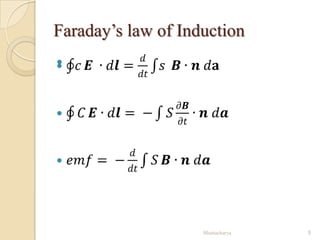
Faraday’s law of Induction


Bhattacharya

5
Lenz’s Law

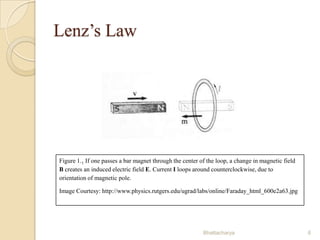
Figure 1.1 If one passes a bar magnet through the center of the loop, a change in magnetic field
B creates an induced electric field E. Current I loops around counterclockwise, due to
orientation of magnetic pole.

Image Courtesy: http://www.physics.rutgers.edu/ugrad/labs/online/Faraday_html_600e2a63.jpg

Bhattacharya

6
Inductance



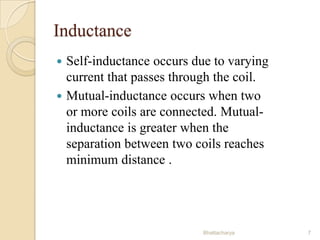
Self-inductance occurs due to varying
current that passes through the coil.
Mutual-inductance occurs when two
or more coils are connected. Mutualinductance is greater when the
separation between two coils reaches
minimum distance .

Bhattacharya

7
Properties of Superconductor
Resistance is zero at the superconducting
transition temperature.
 Superconductor atoms attain the BEC
(Bose-Einstein Condensate) at a very low
temperature.
 Atoms at BEC behave like magnets.


Bhattacharya

8
Methods
Review the Helmholtz configuration.
 Talk about the Radia package to evaluate
the field strength for different
configuration.


Bhattacharya

9
Helmholtz Coil

1

2

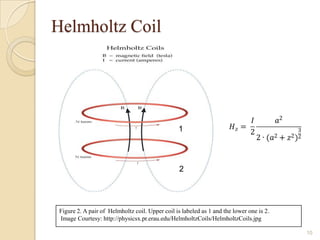
Figure 2. A pair of Helmholtz coil. Upper coil is labeled as 1 and the lower one is 2.
Image Courtesy: http://physicsx.pr.erau.edu/HelmholtzCoils/HelmholtzCoils.jpg
10
Radia

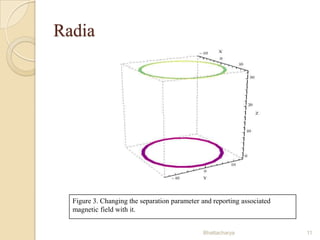
Figure 3. Changing the separation parameter and reporting associated
magnetic field with it.
Bhattacharya

11
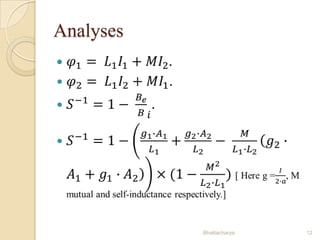
Analyses


Bhattacharya

12
Preliminary Results
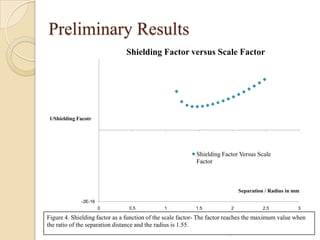
Shielding Factor versus Scale Factor

1/Shielding Facotr

Shielding Factor Versus Scale
Factor

Separation / Radius in mm
-2E-16
0

0.5

1

1.5

2

2.5

3

Figure 4. Shielding factor as a function of the scale factor- The factor reaches the maximum value when
the ratio of the separation distance and the radius is 1.55.
Bhattacharya

13
Future Work
Would like to analyze the function for
finding inverse shielding factor
analytically.
 Will develop a research proposal to do the
experiment in spring 2014.


Bhattacharya

14
Acknowledgements


I would like to thank Dr. Jonathan Wrubel
for his continuous help and support to
make progress in this problem.

Bhattacharya

15
References
Dyck, R S Van, Moore, Jr. F
L, Farnham, D. L, Schwinberg, P. B.
1986. Rev. Sci Instrun 57 (593).
 Gabrielse G. and Tan. J. 15 May, 1988.
Self-shielding superconducting solenoid
systems. Journal of Applied Physics 10 .
 Grivich Matthew I. Jackson David P. May
2000. The magnetic field of currentcarryingpolygons: An application of
vector field rotations. Ameircan Journal
of Physics 68 (5): 469-74.


Bhattacharya

16
Questions

Figure 5. Faraday Medal, front side: Image Courtesy:
http://royalsociety.org/awards/michael-faraday-prize/

Bhattacharya

17

Finding the Optimum Setup for Shielding External Magnetic Field to Trap the BEC Atoms

  • 1.
    Finding the OptimumSetup for Shielding External Magnetic Field to Trap the BEC Atoms Shouvik Bhattacharya PHY791 | 10.30.2013
  • 2.
    Problem  We are surroundedby a geomagnetic field. In addition, there are various factors that can potentially fluctuate the field strength, which is undesired for the BEC study. Some of those factors are: power source and equipment used in the laboratory, charged particles (Cosmic Rays), and the Space Weather. Bhattacharya 2
  • 3.
    Thesis  To find theoptimum set-up that will screen fluctuations in external magnetic field. Two coils of same size are separated by a varying distance configuration was mainly focused for this instance. Bhattacharya 3
  • 4.
    Theory Faraday’s law ofInduction  Lenz’s Law  Properties of superconductor  Bhattacharya 4
  • 5.
    Faraday’s law ofInduction  Bhattacharya 5
  • 6.
    Lenz’s Law Figure 1.1If one passes a bar magnet through the center of the loop, a change in magnetic field B creates an induced electric field E. Current I loops around counterclockwise, due to orientation of magnetic pole. Image Courtesy: http://www.physics.rutgers.edu/ugrad/labs/online/Faraday_html_600e2a63.jpg Bhattacharya 6
  • 7.
    Inductance   Self-inductance occurs dueto varying current that passes through the coil. Mutual-inductance occurs when two or more coils are connected. Mutualinductance is greater when the separation between two coils reaches minimum distance . Bhattacharya 7
  • 8.
    Properties of Superconductor Resistanceis zero at the superconducting transition temperature.  Superconductor atoms attain the BEC (Bose-Einstein Condensate) at a very low temperature.  Atoms at BEC behave like magnets.  Bhattacharya 8
  • 9.
    Methods Review the Helmholtzconfiguration.  Talk about the Radia package to evaluate the field strength for different configuration.  Bhattacharya 9
  • 10.
    Helmholtz Coil 1 2 Figure 2.A pair of Helmholtz coil. Upper coil is labeled as 1 and the lower one is 2. Image Courtesy: http://physicsx.pr.erau.edu/HelmholtzCoils/HelmholtzCoils.jpg 10
  • 11.
    Radia Figure 3. Changingthe separation parameter and reporting associated magnetic field with it. Bhattacharya 11
  • 12.
  • 13.
    Preliminary Results Shielding Factorversus Scale Factor 1/Shielding Facotr Shielding Factor Versus Scale Factor Separation / Radius in mm -2E-16 0 0.5 1 1.5 2 2.5 3 Figure 4. Shielding factor as a function of the scale factor- The factor reaches the maximum value when the ratio of the separation distance and the radius is 1.55. Bhattacharya 13
  • 14.
    Future Work Would liketo analyze the function for finding inverse shielding factor analytically.  Will develop a research proposal to do the experiment in spring 2014.  Bhattacharya 14
  • 15.
    Acknowledgements  I would liketo thank Dr. Jonathan Wrubel for his continuous help and support to make progress in this problem. Bhattacharya 15
  • 16.
    References Dyck, R SVan, Moore, Jr. F L, Farnham, D. L, Schwinberg, P. B. 1986. Rev. Sci Instrun 57 (593).  Gabrielse G. and Tan. J. 15 May, 1988. Self-shielding superconducting solenoid systems. Journal of Applied Physics 10 .  Grivich Matthew I. Jackson David P. May 2000. The magnetic field of currentcarryingpolygons: An application of vector field rotations. Ameircan Journal of Physics 68 (5): 469-74.  Bhattacharya 16
  • 17.
    Questions Figure 5. FaradayMedal, front side: Image Courtesy: http://royalsociety.org/awards/michael-faraday-prize/ Bhattacharya 17