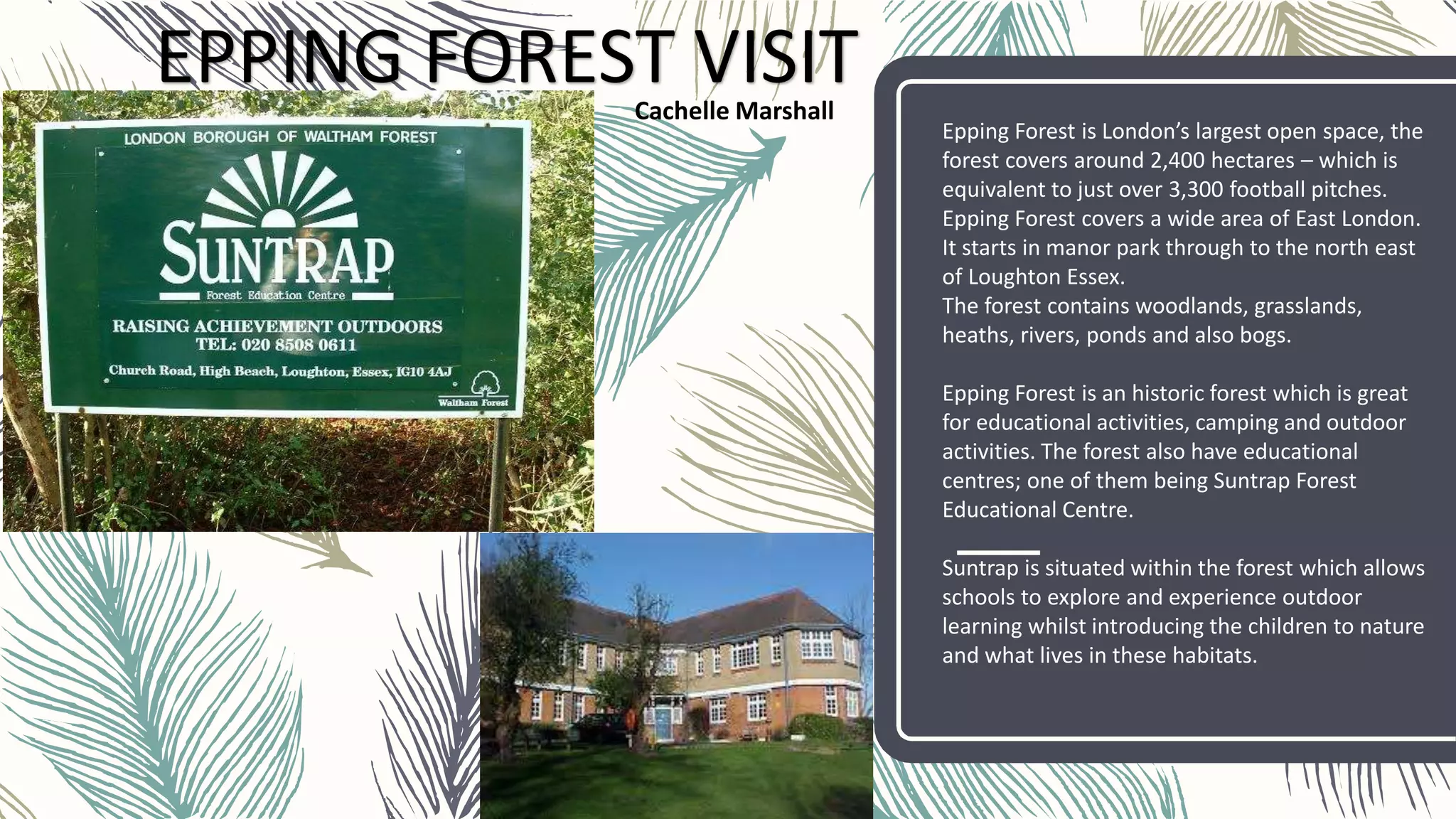
EPPING FOREST VISIT
Epping Forest is London’s largest open space, the
forest covers around 2,400 hectares – which is
equivalent to just over 3,300 football pitches.
Epping Forest covers a wide area of East London.
It starts in manor park through to the north east
of Loughton Essex.
The forest contains woodlands, grasslands,
heaths, rivers, ponds and also bogs.
Epping Forest is an historic forest which is great
for educational activities, camping and outdoor
activities. The forest also have educational
centres; one of them being Suntrap Forest
Educational Centre.
Suntrap is situated within the forest which allows
schools to explore and experience outdoor
learning whilst introducing the children to nature
and what lives in these habitats.
Cachelle Marshall
Jones, T (n.d.) Visit Essex.
http://www.visitessex.com/epping.aspx [Accessed on 1st
November 2016]
HOW DOES THIS
ENVIRONMENT FACILITATE
ENGAGING LEARNINGCamryn Mattushek
INCLUSION & FACILITATING ALL
CHILDREN
Facilities
Public toilets (both in the Visitor Centre and in the car park)
Refreshments at the King's Oak pub and nearby kiosks
Easy access path suitable for wheelchairs and pushchairs
Gift shop
Access for all
Epping Forest Visitor Centre is a fully-accessible ground floor building, with:
Fully accessible toilet inside the Visitor Centre
Hearing loop available
Outdoor learning such as the experience learnt from Suntrap centre are
engaging because the children are physically involved within lessons.
It becomes engaging due to the professionals asking the learners
questions so that they can self-speculate and answer.
The learners have a hands on experience where they themselves have
to participate in the activities that they are involved and learning from.
They use their senses as professionals ask them to feel different
textures, smell the air if there is a particular smell they can smell. What
they can see around them or what the object in front of them.
PROGRAMMES AVAILABLE
KS1
– Exploring different animals in
the forest and comparing
their habitats
– Learn to identify different
animal groups
– Understand how to treat
animals and the environment
they live in with respect, care
and delicacy
– Learn to appreciate nature
and the environment through
the forest trail
– Indoor activities include
reading and children are
encouraged to find enjoyment
in reading through different
activities such as; role play,
creating story boards, creating
their own adventure and
more
KS2
• Appreciate nature by analysing
different plants
• Examine and describe a range of
rocks they can find in the forest
• Compare what they have found in
the forest to what they can find at
school
KS3
• Collect animals and plants in the pond
within the Suntrap forest district
• Study rivers
• Students are given the opportunity to
plan and build shelters using natural
materials in groups
• Children are
given maps
and
compasses
for
orienteering
Shutterstock, 2003-2016, [Accessed: 1st November 2016,
http://www.shutterstock.com/pic-125983457/stock-photo-
low-angle-view-of-two-young-boys-closely-examining-a-glass-
jar-with-insects-which-they-have-cought.html]
[Accessed: 1st November 2016
suntrapcentre.weebly.com]
THEORISTS
Montessori:
– “Never help a child with a task at which he feels
he can succeed.” – Maria Montessori
Montessori focuses on the significance of children
being able to develop independent skills and
interact with each other and the environment. This
supports our visit as Epping Forest richly facilitates
children with opportunities in an environment that
allows them to explore the boundaries of their
learning independently and with their peers.
Chanushka Perera
Forest School:
– “Forest School is an inspirational process, that offers ALL
learners regular opportunities to achieve and develop
confidence and self-esteem through hands-on learning
experiences in a woodland or natural environment with
trees.” – Forest School Association
Although Epping Forest is not a Forest school, it is supported
by the theory of children interacting with the outdoor and
natural environment, encouraging children to explore their
senses through nature. Allowing children to overcome
challenges and fears and to take risks.
John Dewey
- "education must engage with and enlarge
experience" (Dewey, 1997)
Dewey's philosophical belief on the impact that
experience has supports the exploration that takes
place at suntrap and the opportunities that children
have within there experience to explore outdoors and
develop their imagination.
Smith, M (2001) Infed, John Dewey on education, experience and community. Available online:
http://infed.org/mobi/john-dewey-on-education-experience-and-community/ Accessed on 07/12/2016]
NATIONAL CURRICULUM
– The importance of helping learners to build meaningful connections between different aspects of
their educational experiences is widely recognised. This issue is particularly pertinent in the context
of outdoor education, where a lack of connection with what happens in the school is a potential
problem, not only for the achievement of longer-term educational benefits, but also for maximising
the impacts of outdoor experiences themselves. (National Foundation for Education)
– Although the current national curriculum does not exclusively state that outdoor learning is a
necessity it does state that practitioners should aim to teach children the importance of leading a
healthy and active life.
– Scotland on the other hand has an entire section of its National Curriculum dedicated to
– It is important to accept combining outdoor learning opportunities with the classroom-based
curriculum can involve (although not always) connections of a curricular, cross-curricular and/or
extra-curricular nature. This is well illustrated by the recent statement from the House of Commons
Education and Skills Select Committee: (House of Commons Education and Skills Committee, 2005)
Melba Torgbor
THE IMPORTANCE OF
OUTDOOR PLAY
– Children can physically be active
– Cognitively be engaged
– Experiencing emotions
– Increase their independence – making their own choices
– Promote their self-confidence
– Assess their own risks and the consequences of their actions
– Allows children to develop their knowledge, skills and understanding
– Process to be more creative
– It provides different challenges and opportunities in which the pupils can display
– It is the captivating nature of direct experience, where physical experiences can be directly related to cognitive thinking
– Without opportunities to explore outdoor play, the child will have a limited knowledge of the materials, properties and
possibilities of use. They learn through touching, smelling, hearing and seeing.
– It is visual learning which makes it, especially, for some children much easier to learn rather than being sat in the
classroom through the duration of the lesson
Zilan Demiroglu
Austin, R. (2007).
Letting the outside
in. 1st ed. Stoke-on-
Trent: Trentham.
Beames, S., Higgins,
P. and Nicol, R.
(2012). Learning
outside the
classroom. 1st ed.
New York, NY:
Routledge
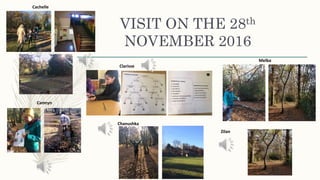
VISIT ON THE 28th
NOVEMBER 2016
Cachelle
Camryn
Clarisse
Chanushka
Melba
Zilan
HOW THE OUTDOOR’S ENGAGES
CHILDREN LEARNING
“Outdoor learning makes a major
contribution to children’s development.
Young children will be missing out on
important learning opportunities if quality
outdoor provision is not available to them
regularly.” (Edington 2002, cited in Gould
2012)
“Seasonal and weather changes
help develop children
holistically and encourages
specific areas of learning, such
as knowledge and
understanding of the world.”
(Gould 2012)
CRITICAL ANALYSIS SECTION
“Seasonality and weather conditions have been relatively overlooked as
determinants of physical activity” (Tucker P & Gilland J (2007) Public Health ‘The
effect of season and weather on physical activity: A systematic view’, Volume
121, Issue 12, Pages 909-922’). This shows that wet and cold conditions can
have an affect on children’s physical activity due to their health being at risk.
Parents/guardians who prevent their children from being outside in all seasons
may cause lack of environmental exposure.
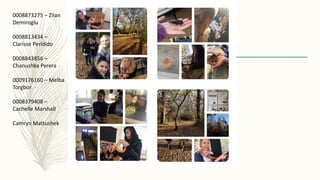
0008873275 – Zilan
Demiroglu
0008813434 –
Clarisse Peridido
0008843856 –
Chanushka Perera
0009176160 – Melba
Torgbor
0008379408 –
Cachelle Marshall
Camryn Mattushek

Engaging learning 2 (group)

  • 1.
    EPPING FOREST VISIT EppingForest is London’s largest open space, the forest covers around 2,400 hectares – which is equivalent to just over 3,300 football pitches. Epping Forest covers a wide area of East London. It starts in manor park through to the north east of Loughton Essex. The forest contains woodlands, grasslands, heaths, rivers, ponds and also bogs. Epping Forest is an historic forest which is great for educational activities, camping and outdoor activities. The forest also have educational centres; one of them being Suntrap Forest Educational Centre. Suntrap is situated within the forest which allows schools to explore and experience outdoor learning whilst introducing the children to nature and what lives in these habitats. Cachelle Marshall
  • 2.
    Jones, T (n.d.)Visit Essex. http://www.visitessex.com/epping.aspx [Accessed on 1st November 2016]
  • 3.
    HOW DOES THIS ENVIRONMENTFACILITATE ENGAGING LEARNINGCamryn Mattushek INCLUSION & FACILITATING ALL CHILDREN Facilities Public toilets (both in the Visitor Centre and in the car park) Refreshments at the King's Oak pub and nearby kiosks Easy access path suitable for wheelchairs and pushchairs Gift shop Access for all Epping Forest Visitor Centre is a fully-accessible ground floor building, with: Fully accessible toilet inside the Visitor Centre Hearing loop available Outdoor learning such as the experience learnt from Suntrap centre are engaging because the children are physically involved within lessons. It becomes engaging due to the professionals asking the learners questions so that they can self-speculate and answer. The learners have a hands on experience where they themselves have to participate in the activities that they are involved and learning from. They use their senses as professionals ask them to feel different textures, smell the air if there is a particular smell they can smell. What they can see around them or what the object in front of them.
  • 4.
    PROGRAMMES AVAILABLE KS1 – Exploringdifferent animals in the forest and comparing their habitats – Learn to identify different animal groups – Understand how to treat animals and the environment they live in with respect, care and delicacy – Learn to appreciate nature and the environment through the forest trail – Indoor activities include reading and children are encouraged to find enjoyment in reading through different activities such as; role play, creating story boards, creating their own adventure and more KS2 • Appreciate nature by analysing different plants • Examine and describe a range of rocks they can find in the forest • Compare what they have found in the forest to what they can find at school KS3 • Collect animals and plants in the pond within the Suntrap forest district • Study rivers • Students are given the opportunity to plan and build shelters using natural materials in groups • Children are given maps and compasses for orienteering Shutterstock, 2003-2016, [Accessed: 1st November 2016, http://www.shutterstock.com/pic-125983457/stock-photo- low-angle-view-of-two-young-boys-closely-examining-a-glass- jar-with-insects-which-they-have-cought.html] [Accessed: 1st November 2016 suntrapcentre.weebly.com]
  • 5.
    THEORISTS Montessori: – “Never helpa child with a task at which he feels he can succeed.” – Maria Montessori Montessori focuses on the significance of children being able to develop independent skills and interact with each other and the environment. This supports our visit as Epping Forest richly facilitates children with opportunities in an environment that allows them to explore the boundaries of their learning independently and with their peers. Chanushka Perera Forest School: – “Forest School is an inspirational process, that offers ALL learners regular opportunities to achieve and develop confidence and self-esteem through hands-on learning experiences in a woodland or natural environment with trees.” – Forest School Association Although Epping Forest is not a Forest school, it is supported by the theory of children interacting with the outdoor and natural environment, encouraging children to explore their senses through nature. Allowing children to overcome challenges and fears and to take risks. John Dewey - "education must engage with and enlarge experience" (Dewey, 1997) Dewey's philosophical belief on the impact that experience has supports the exploration that takes place at suntrap and the opportunities that children have within there experience to explore outdoors and develop their imagination. Smith, M (2001) Infed, John Dewey on education, experience and community. Available online: http://infed.org/mobi/john-dewey-on-education-experience-and-community/ Accessed on 07/12/2016]
  • 6.
    NATIONAL CURRICULUM – Theimportance of helping learners to build meaningful connections between different aspects of their educational experiences is widely recognised. This issue is particularly pertinent in the context of outdoor education, where a lack of connection with what happens in the school is a potential problem, not only for the achievement of longer-term educational benefits, but also for maximising the impacts of outdoor experiences themselves. (National Foundation for Education) – Although the current national curriculum does not exclusively state that outdoor learning is a necessity it does state that practitioners should aim to teach children the importance of leading a healthy and active life. – Scotland on the other hand has an entire section of its National Curriculum dedicated to – It is important to accept combining outdoor learning opportunities with the classroom-based curriculum can involve (although not always) connections of a curricular, cross-curricular and/or extra-curricular nature. This is well illustrated by the recent statement from the House of Commons Education and Skills Select Committee: (House of Commons Education and Skills Committee, 2005) Melba Torgbor
  • 7.
    THE IMPORTANCE OF OUTDOORPLAY – Children can physically be active – Cognitively be engaged – Experiencing emotions – Increase their independence – making their own choices – Promote their self-confidence – Assess their own risks and the consequences of their actions – Allows children to develop their knowledge, skills and understanding – Process to be more creative – It provides different challenges and opportunities in which the pupils can display – It is the captivating nature of direct experience, where physical experiences can be directly related to cognitive thinking – Without opportunities to explore outdoor play, the child will have a limited knowledge of the materials, properties and possibilities of use. They learn through touching, smelling, hearing and seeing. – It is visual learning which makes it, especially, for some children much easier to learn rather than being sat in the classroom through the duration of the lesson Zilan Demiroglu Austin, R. (2007). Letting the outside in. 1st ed. Stoke-on- Trent: Trentham. Beames, S., Higgins, P. and Nicol, R. (2012). Learning outside the classroom. 1st ed. New York, NY: Routledge
  • 8.
    VISIT ON THE28th NOVEMBER 2016 Cachelle Camryn Clarisse Chanushka Melba Zilan
  • 9.
    HOW THE OUTDOOR’SENGAGES CHILDREN LEARNING “Outdoor learning makes a major contribution to children’s development. Young children will be missing out on important learning opportunities if quality outdoor provision is not available to them regularly.” (Edington 2002, cited in Gould 2012) “Seasonal and weather changes help develop children holistically and encourages specific areas of learning, such as knowledge and understanding of the world.” (Gould 2012) CRITICAL ANALYSIS SECTION “Seasonality and weather conditions have been relatively overlooked as determinants of physical activity” (Tucker P & Gilland J (2007) Public Health ‘The effect of season and weather on physical activity: A systematic view’, Volume 121, Issue 12, Pages 909-922’). This shows that wet and cold conditions can have an affect on children’s physical activity due to their health being at risk. Parents/guardians who prevent their children from being outside in all seasons may cause lack of environmental exposure.
  • 10.
    0008873275 – Zilan Demiroglu 0008813434– Clarisse Peridido 0008843856 – Chanushka Perera 0009176160 – Melba Torgbor 0008379408 – Cachelle Marshall Camryn Mattushek