Advancing the way
the world uses the cloud
Beyond EBS – Storage Alternatives in the Cloud
Dave Wright – Founder & CEO
Slides @ http://www.slideshare.net/SolidFireInc
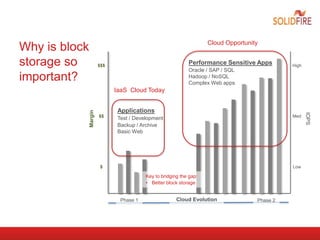
Margin
High
Med
Low
IOPS
Applications
Test / Development
Backup / Archive
Basic Web
Cloud Opportunity
Why is block
storage so
important?
Phase 1 Phase 2
Performance Sensitive Apps
Oracle / SAP / SQL
Hadoop / NoSQL
Complex Web apps
Cloud Evolution
$$$
$$
$
IaaS Cloud Today
Key to bridging the gap:
• Better block storage
Better block storage offerings critical
to migrating high-margin apps from
on-premises, managed, and
dedicated environments to the cloud
A Brief History of Amazon EC2 & EBS
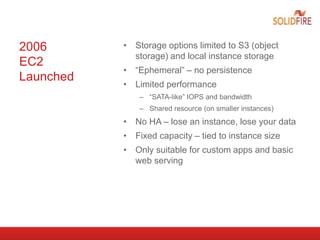
2006
EC2
Launched
• Storage options limited to S3 (object
storage) and local instance storage
• “Ephemeral” – no persistence
• Limited performance
– “SATA-like” IOPS and bandwidth
– Shared resource (on smaller instances)
• No HA – lose an instance, lose your data
• Fixed capacity – tied to instance size
• Only suitable for custom apps and basic
web serving
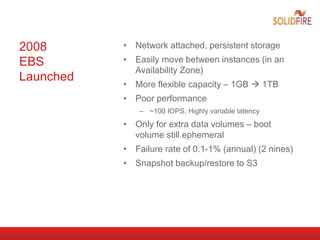
2008
EBS
Launched
• Network attached, persistent storage
• Easily move between instances (in an
Availability Zone)
• More flexible capacity – 1GB  1TB
• Poor performance
– ~100 IOPS, Highly variable latency
• Only for extra data volumes – boot
volume still ephemeral
• Failure rate of 0.1-1% (annual) (2 nines)
• Snapshot backup/restore to S3
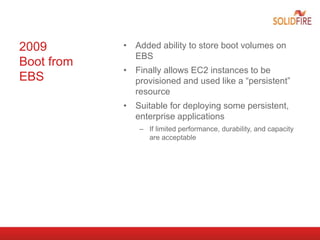
2009
Boot from
EBS
• Added ability to store boot volumes on
EBS
• Finally allows EC2 instances to be
provisioned and used like a “persistent”
resource
• Suitable for deploying some persistent,
enterprise applications
– If limited performance, durability, and capacity
are acceptable
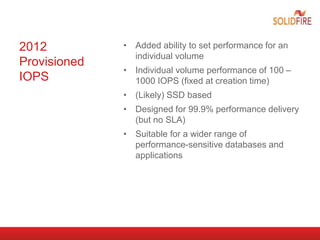
2012
Provisioned
IOPS
• Added ability to set performance for an
individual volume
• Individual volume performance of 100 –
1000 IOPS (fixed at creation time)
• (Likely) SSD based
• Designed for 99.9% performance delivery
(but no SLA)
• Suitable for a wider range of
performance-sensitive databases and
applications
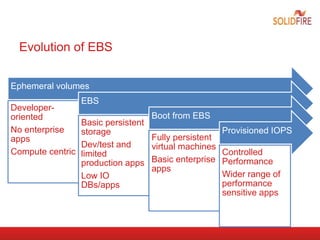
Evolution of EBS
Ephemeral volumes
Developer-
oriented
No enterprise
apps
Compute centric
EBS
Basic persistent
storage
Dev/test and
limited
production apps
Low IO
DBs/apps
Boot from EBS
Fully persistent
virtual machines
Basic enterprise
apps
Provisioned IOPS
Controlled
Performance
Wider range of
performance
sensitive apps
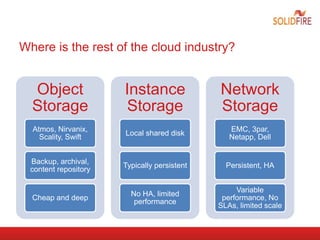
Where is the rest of the cloud industry?
Object
Storage
Atmos, Nirvanix,
Scality, Swift
Backup, archival,
content repository
Cheap and deep
Instance
Storage
Local shared disk
Typically persistent
No HA, limited
performance
Network
Storage
EMC, 3par,
Netapp, Dell
Persistent, HA
Variable
performance, No
SLAs, limited scale
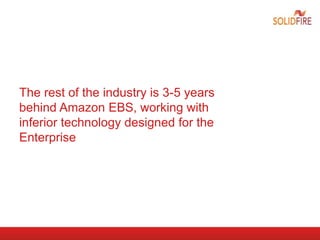
The rest of the industry is 3-5 years
behind Amazon EBS, working with
inferior technology designed for the
Enterprise
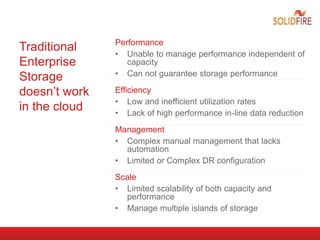
Traditional
Enterprise
Storage
doesn’t work
in the cloud
Performance
• Unable to manage performance independent of
capacity
• Can not guarantee storage performance
Efficiency
• Low and inefficient utilization rates
• Lack of high performance in-line data reduction
Management
• Complex manual management that lacks
automation
• Limited or Complex DR configuration
Scale
• Limited scalability of both capacity and
performance
• Manage multiple islands of storage
Catching up
(and passing)
EBS
• More control over performance
• Higher durability & availability
• Greater efficiency (profit ↑, prices ↓)
• Complete storage automation
• Cloud scalability
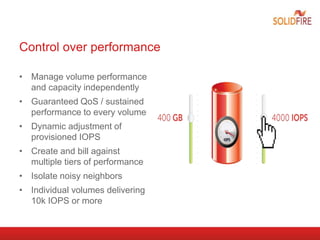
Control over performance
• Manage volume performance
and capacity independently
• Guaranteed QoS / sustained
performance to every volume
• Dynamic adjustment of
provisioned IOPS
• Create and bill against
multiple tiers of performance
• Isolate noisy neighbors
• Individual volumes delivering
10k IOPS or more
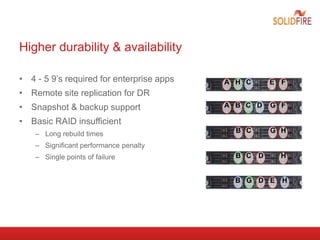
Higher durability & availability
• 4 - 5 9’s required for enterprise apps
• Remote site replication for DR
• Snapshot & backup support
• Basic RAID insufficient
– Long rebuild times
– Significant performance penalty
– Single points of failure
G
A
A B
B C
C D
D
C
B
E
E
F
FH C
H
D
G
G
H
H
B
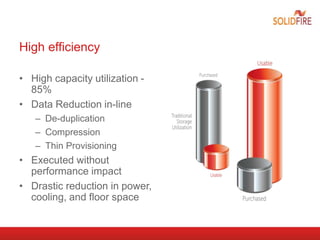
High efficiency
• High capacity utilization -
85%
• Data Reduction in-line
– De-duplication
– Compression
– Thin Provisioning
• Executed without
performance impact
• Drastic reduction in power,
cooling, and floor space
Complete management automation
• Simple REST-based APIs for storage
• Multi-tenant provisioning, reporting, and
performance isolation
• Full feature set – backup, DR, snapshots,
etc.
• Comprehensive reporting support & billing
integration
• Cloud platform integration
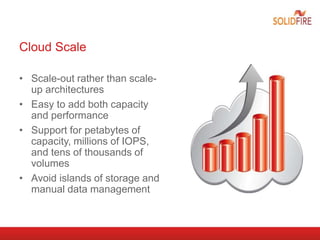
Cloud Scale
• Scale-out rather than scale-
up architectures
• Easy to add both capacity
and performance
• Support for petabytes of
capacity, millions of IOPS,
and tens of thousands of
volumes
• Avoid islands of storage and
manual data management
What role can Flash (SSD) play in
improving block storage in the cloud?
Flash Benefits
for Block
Storage
• Performance
– Restore balance between IOPS and Capacity
– Better performance with varied workloads
• Efficiency
– Remove performance as a limiter on utilization
– Reduce storage space, power, and cooling
• Management
– Better reliability
– Easier to isolate workloads on shared media
What’s the
downside?
• Cost
– Partially a perception issue
– Can’t be ignored – cloud all about value
• Existing Storage Architectures
– Ability to get full performance from flash
– Write amplification & endurance issues
– Inconsistent performance in tiered storage
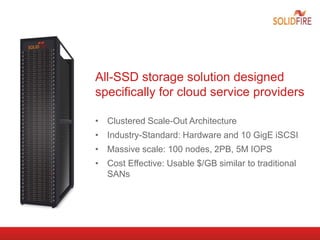
All-SSD storage solution designed
specifically for cloud service providers
• Clustered Scale-Out Architecture
• Industry-Standard: Hardware and 10 GigE iSCSI
• Massive scale: 100 nodes, 2PB, 5M IOPS
• Cost Effective: Usable $/GB similar to traditional
SANs
1620 Pearl Street,
Boulder, Colorado 80302
Phone: 720.523.3278
Email: info@solidfire.com
www.solidfire.com
Questions?

Beyond EBS Stroage Alternatives in the Cloud

  • 1.
    Advancing the way theworld uses the cloud Beyond EBS – Storage Alternatives in the Cloud Dave Wright – Founder & CEO Slides @ http://www.slideshare.net/SolidFireInc
  • 2.
    Margin High Med Low IOPS Applications Test / Development Backup/ Archive Basic Web Cloud Opportunity Why is block storage so important? Phase 1 Phase 2 Performance Sensitive Apps Oracle / SAP / SQL Hadoop / NoSQL Complex Web apps Cloud Evolution $$$ $$ $ IaaS Cloud Today Key to bridging the gap: • Better block storage
  • 3.
    Better block storageofferings critical to migrating high-margin apps from on-premises, managed, and dedicated environments to the cloud
  • 4.
    A Brief Historyof Amazon EC2 & EBS
  • 5.
    2006 EC2 Launched • Storage optionslimited to S3 (object storage) and local instance storage • “Ephemeral” – no persistence • Limited performance – “SATA-like” IOPS and bandwidth – Shared resource (on smaller instances) • No HA – lose an instance, lose your data • Fixed capacity – tied to instance size • Only suitable for custom apps and basic web serving
  • 6.
    2008 EBS Launched • Network attached,persistent storage • Easily move between instances (in an Availability Zone) • More flexible capacity – 1GB  1TB • Poor performance – ~100 IOPS, Highly variable latency • Only for extra data volumes – boot volume still ephemeral • Failure rate of 0.1-1% (annual) (2 nines) • Snapshot backup/restore to S3
  • 7.
    2009 Boot from EBS • Addedability to store boot volumes on EBS • Finally allows EC2 instances to be provisioned and used like a “persistent” resource • Suitable for deploying some persistent, enterprise applications – If limited performance, durability, and capacity are acceptable
  • 8.
    2012 Provisioned IOPS • Added abilityto set performance for an individual volume • Individual volume performance of 100 – 1000 IOPS (fixed at creation time) • (Likely) SSD based • Designed for 99.9% performance delivery (but no SLA) • Suitable for a wider range of performance-sensitive databases and applications
  • 9.
    Evolution of EBS Ephemeralvolumes Developer- oriented No enterprise apps Compute centric EBS Basic persistent storage Dev/test and limited production apps Low IO DBs/apps Boot from EBS Fully persistent virtual machines Basic enterprise apps Provisioned IOPS Controlled Performance Wider range of performance sensitive apps
  • 10.
    Where is therest of the cloud industry? Object Storage Atmos, Nirvanix, Scality, Swift Backup, archival, content repository Cheap and deep Instance Storage Local shared disk Typically persistent No HA, limited performance Network Storage EMC, 3par, Netapp, Dell Persistent, HA Variable performance, No SLAs, limited scale
  • 11.
    The rest ofthe industry is 3-5 years behind Amazon EBS, working with inferior technology designed for the Enterprise
  • 12.
    Traditional Enterprise Storage doesn’t work in thecloud Performance • Unable to manage performance independent of capacity • Can not guarantee storage performance Efficiency • Low and inefficient utilization rates • Lack of high performance in-line data reduction Management • Complex manual management that lacks automation • Limited or Complex DR configuration Scale • Limited scalability of both capacity and performance • Manage multiple islands of storage
  • 13.
    Catching up (and passing) EBS •More control over performance • Higher durability & availability • Greater efficiency (profit ↑, prices ↓) • Complete storage automation • Cloud scalability
  • 14.
    Control over performance •Manage volume performance and capacity independently • Guaranteed QoS / sustained performance to every volume • Dynamic adjustment of provisioned IOPS • Create and bill against multiple tiers of performance • Isolate noisy neighbors • Individual volumes delivering 10k IOPS or more
  • 15.
    Higher durability &availability • 4 - 5 9’s required for enterprise apps • Remote site replication for DR • Snapshot & backup support • Basic RAID insufficient – Long rebuild times – Significant performance penalty – Single points of failure G A A B B C C D D C B E E F FH C H D G G H H B
  • 16.
    High efficiency • Highcapacity utilization - 85% • Data Reduction in-line – De-duplication – Compression – Thin Provisioning • Executed without performance impact • Drastic reduction in power, cooling, and floor space
  • 17.
    Complete management automation •Simple REST-based APIs for storage • Multi-tenant provisioning, reporting, and performance isolation • Full feature set – backup, DR, snapshots, etc. • Comprehensive reporting support & billing integration • Cloud platform integration
  • 18.
    Cloud Scale • Scale-outrather than scale- up architectures • Easy to add both capacity and performance • Support for petabytes of capacity, millions of IOPS, and tens of thousands of volumes • Avoid islands of storage and manual data management
  • 19.
    What role canFlash (SSD) play in improving block storage in the cloud?
  • 20.
    Flash Benefits for Block Storage •Performance – Restore balance between IOPS and Capacity – Better performance with varied workloads • Efficiency – Remove performance as a limiter on utilization – Reduce storage space, power, and cooling • Management – Better reliability – Easier to isolate workloads on shared media
  • 21.
    What’s the downside? • Cost –Partially a perception issue – Can’t be ignored – cloud all about value • Existing Storage Architectures – Ability to get full performance from flash – Write amplification & endurance issues – Inconsistent performance in tiered storage
  • 22.
    All-SSD storage solutiondesigned specifically for cloud service providers • Clustered Scale-Out Architecture • Industry-Standard: Hardware and 10 GigE iSCSI • Massive scale: 100 nodes, 2PB, 5M IOPS • Cost Effective: Usable $/GB similar to traditional SANs
  • 23.
    1620 Pearl Street, Boulder,Colorado 80302 Phone: 720.523.3278 Email: info@solidfire.com www.solidfire.com Questions?

Editor's Notes

  • #7 Test & throw away volumes