Better the devil you know
Alexandra Deschamps-Sonsino
alex@designswarm.com
@iotwatch
About me
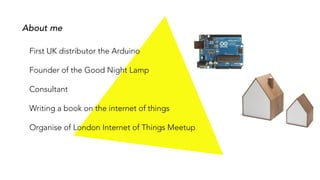
First UK distributor the Arduino
Founder of the Good Night Lamp
Consultant
Writing a book on the internet of things
Organise of London Internet of Things Meetup
Clients
What I’d like to talk about today
The practicalities of data
The politics of data
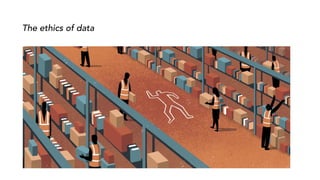
The ethics of data
The practicalities of obtaining data
The promise of the internet of things is a world fully connected.
But which world are we connecting and how?
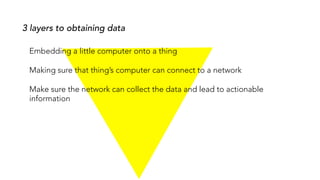
Embedding a little computer onto a thing
Making sure that thing’s computer can connect to a network
Make sure the network can collect the data and lead to actionable
information
3 layers to obtaining data
Embedding a little computer onto a thing
3 layers to obtaining data
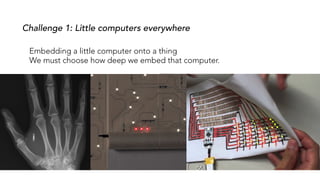
Embedding a little computer onto a thing
We must choose how deep we embed that computer.
Challenge 1: Little computers everywhere
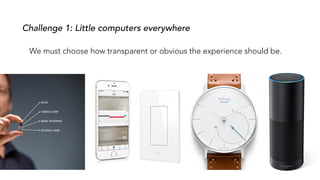
We must choose how transparent or obvious the experience should be.
Challenge 1: Little computers everywhere
We must choose how much we’re willing to invest in manufacturing:
Partnerships or manufacturing from scratch?
Marketing?
Internal or external investment?
R&D or spinoff?
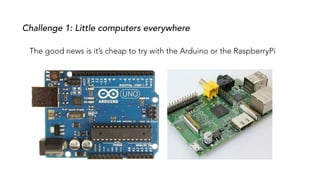
The good news is it’s cheap to try with the Arduino or the RaspberryPi
Challenge 1: Little computers everywhere
Embedding a little computer onto a thing
Making sure that thing’s computer can connect to a network
3 layers to obtaining data
Challenge 2: Connecting things
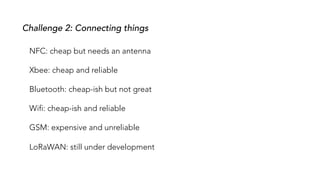
NFC: cheap but needs an antenna
Xbee: cheap and reliable
Bluetooth: cheap-ish but not great
Wifi: cheap-ish and reliable
GSM: expensive and unreliable
LoRaWAN: still under development
Challenge 2: Connecting things
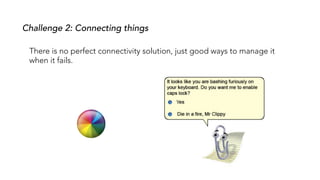
There is no perfect connectivity solution, just good ways to manage it
when it fails.
Challenge 2: Connecting things
The minimum viable team for you to do this yourself:
Electronics engineer
Embedded software engineer
User experience designer
Testing on site, with real users is essential.
Embedding a little computer onto a thing
Making sure that thing’s computer can connect to a network
Make sure the network can collect the data and lead to actionable
information
3 layers to obtaining data
What do I need to capture and what will it tell me?
How do I know when things have gone wrong?
How do I know when I’ve been hacked?
Challenge 3: Data collection & management
What do I need to capture and what will it tell me?
How do I know when things have gone wrong?
How do I know when I’ve been hacked?
Do I build my own thing or do I use someone else’s platform?
Challenge 3: Data collection & management
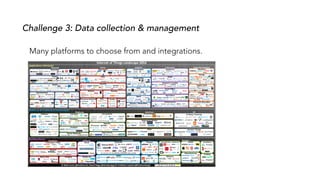
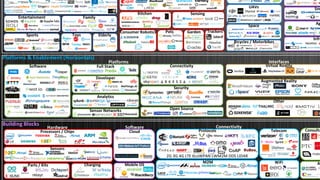
Many platforms to choose from and integrations.
Challenge 3: Data collection & management
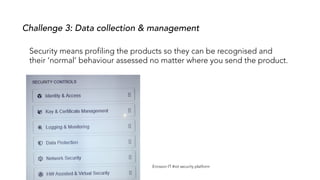
Security means profiling the products so they can be recognised and
their ‘normal’ behaviour assessed no matter where you send the product.
Challenge 3: Data collection & management
Ericsson IT #iot security platform
What I’d like to talk about today
The practicalities of data
The politics of data
The ethics of data
If this is over your head don’t worry, just hire a CTO.
Someone who will decide the best way to deal with these 3 challenges.
It doesn’t have to be a large cost centre, but you must realise you
are now a tech company, not a textiles one.
The politics of data
Litmus test for whether you are a tech company or not?
You need to track the use of a product (texiles?)
You need to track a complex supply chain process (cars/vans?)
You need to understand where you can make savings (fuel/staff?)
You are thinking of using technology for one or all of the above
How do you turn into a tech company?
You start building a diverse tech team.
You start to adapt to agile methods of product development.
You trust your tech team to tell you things you couldn’t tell even with
all your experience.
You engage with digital products to help you understand that team’s
culture, documentation, knowledge sharing and output.
(Github,Slack, etc.)
You finance this properly.
What I’d like to talk about today
The practicalities of data
The politics of data
The ethics of data
The ethics of data
Think about the work environment you’re creating.
What unintended consequences will this create for you, for your staff?
Is that creating a positive workplace?
Are you recycling the devices or just creating e-waste?
Are you holding your partners responsible for good practices?
Is that creating a fair workplace?
If you’re planning on managing people with the #iot
Think about it before the government thinks about it for you.
What I’ve talked about today
The practicalities of data
The politics of data
The ethics of data
Merci & bonne chance.
Alexandra Deschamps-Sonsino
designswarm.com
Get in touch at: alex@designswarm.com
@iotwatch on twitter and instagram

Better the devil you know

  • 1.
    Better the devilyou know Alexandra Deschamps-Sonsino alex@designswarm.com @iotwatch
  • 2.
    About me First UKdistributor the Arduino Founder of the Good Night Lamp Consultant Writing a book on the internet of things Organise of London Internet of Things Meetup
  • 3.
  • 4.
    What I’d liketo talk about today The practicalities of data The politics of data The ethics of data
  • 5.
    The practicalities ofobtaining data The promise of the internet of things is a world fully connected. But which world are we connecting and how?
  • 6.
    Embedding a littlecomputer onto a thing Making sure that thing’s computer can connect to a network Make sure the network can collect the data and lead to actionable information 3 layers to obtaining data
  • 7.
    Embedding a littlecomputer onto a thing 3 layers to obtaining data
  • 8.
    Embedding a littlecomputer onto a thing We must choose how deep we embed that computer. Challenge 1: Little computers everywhere
  • 9.
    We must choosehow transparent or obvious the experience should be. Challenge 1: Little computers everywhere
  • 10.
    Challenge 1: Littlecomputers everywhere We must choose how much we’re willing to invest in manufacturing: Partnerships or manufacturing from scratch? Marketing? Internal or external investment? R&D or spinoff?
  • 11.
    The good newsis it’s cheap to try with the Arduino or the RaspberryPi Challenge 1: Little computers everywhere
  • 12.
    Embedding a littlecomputer onto a thing Making sure that thing’s computer can connect to a network 3 layers to obtaining data
  • 13.
    Challenge 2: Connectingthings NFC: cheap but needs an antenna Xbee: cheap and reliable Bluetooth: cheap-ish but not great Wifi: cheap-ish and reliable GSM: expensive and unreliable LoRaWAN: still under development
  • 14.
    Challenge 2: Connectingthings There is no perfect connectivity solution, just good ways to manage it when it fails.
  • 15.
    Challenge 2: Connectingthings The minimum viable team for you to do this yourself: Electronics engineer Embedded software engineer User experience designer Testing on site, with real users is essential.
  • 16.
    Embedding a littlecomputer onto a thing Making sure that thing’s computer can connect to a network Make sure the network can collect the data and lead to actionable information 3 layers to obtaining data
  • 17.
    What do Ineed to capture and what will it tell me? How do I know when things have gone wrong? How do I know when I’ve been hacked? Challenge 3: Data collection & management
  • 18.
    What do Ineed to capture and what will it tell me? How do I know when things have gone wrong? How do I know when I’ve been hacked? Do I build my own thing or do I use someone else’s platform? Challenge 3: Data collection & management
  • 19.
    Many platforms tochoose from and integrations. Challenge 3: Data collection & management
  • 21.
    Security means profilingthe products so they can be recognised and their ‘normal’ behaviour assessed no matter where you send the product. Challenge 3: Data collection & management Ericsson IT #iot security platform
  • 22.
    What I’d liketo talk about today The practicalities of data The politics of data The ethics of data
  • 23.
    If this isover your head don’t worry, just hire a CTO. Someone who will decide the best way to deal with these 3 challenges. It doesn’t have to be a large cost centre, but you must realise you are now a tech company, not a textiles one. The politics of data
  • 24.
    Litmus test forwhether you are a tech company or not? You need to track the use of a product (texiles?) You need to track a complex supply chain process (cars/vans?) You need to understand where you can make savings (fuel/staff?) You are thinking of using technology for one or all of the above
  • 25.
    How do youturn into a tech company? You start building a diverse tech team. You start to adapt to agile methods of product development. You trust your tech team to tell you things you couldn’t tell even with all your experience. You engage with digital products to help you understand that team’s culture, documentation, knowledge sharing and output. (Github,Slack, etc.) You finance this properly.
  • 26.
    What I’d liketo talk about today The practicalities of data The politics of data The ethics of data
  • 27.
  • 28.
    Think about thework environment you’re creating. What unintended consequences will this create for you, for your staff? Is that creating a positive workplace? Are you recycling the devices or just creating e-waste? Are you holding your partners responsible for good practices? Is that creating a fair workplace? If you’re planning on managing people with the #iot
  • 29.
    If you’re planningon managing people with the #iot Think about it before the government thinks about it for you.
  • 30.
    What I’ve talkedabout today The practicalities of data The politics of data The ethics of data
  • 31.
    Merci & bonnechance. Alexandra Deschamps-Sonsino designswarm.com Get in touch at: alex@designswarm.com @iotwatch on twitter and instagram