GROUP MEMBERS:
AQSA MUSHTAQ
MARYAM KHALID
NOOR FAIZA
OMAMA AZIZ
WHAT IS LOVE?
LOVE IS DRUG
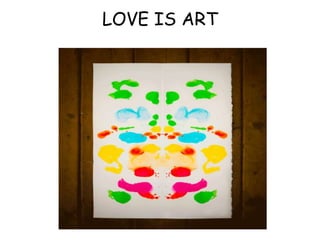
LOVE IS ART
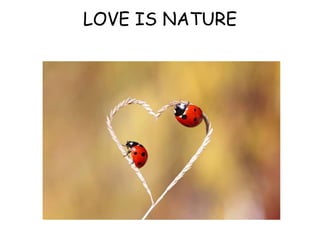
LOVE IS NATURE
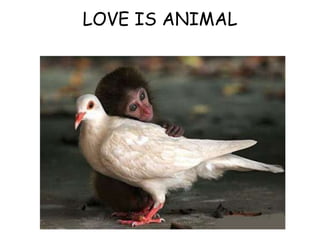
LOVE IS ANIMAL
LOVE IS FAMILY
LOVE IS GOD
LOVE IS AN INTENSE F
LOVE IS CHILDREN
LOVE IS COLOUR
LOVE IS BEAUTY
LOVE IS FRIENDSHIP
The English word "love" can refer to a variety
of different feelings, states, and attitudes that
ranges from interpersonal affection ("I love my
mother") to pleasure ("I loved that meal").
It can refer to an emotion of a strong attraction
and personal attachment. It can also be a
virtue representing human kindness,
compassion, and affection—"the unselfish
loyal and benevolent concern for the good of
another".
As well, it may describe compassionate and
affectionate actions towards other humans,
one's self or animals.
IMPERSONAL LOVE
A person can be said to love an object, principle,
or goal to which they are deeply committed and
greatly value. People can also "love" material
objects, animals, or activities if they invest
themselves in bonding or otherwise identifying
with those things.
If sexual passion is also involved, then this
feeling is called paraphilia.
INTERPERSONAL LOVE
Interpersonal love refers to love between human
beings. It is a more potent sentiment than a simple
liking for another.
Unrequited love refers to those feelings of love that
are not reciprocated.
Interpersonal love is most closely associated with
interpersonal relationships.
Such love might exist between family members,
friends, and couples.
There are also a number of psychological disorders
related to love, such as erotomania.
Erotomania is a type of delusional
disorder where the affected person
believes that another person is in love
with him or her. This belief is usually
applied to someone with higher status or
a famous person, but can also be applied
to a complete stranger.
TYPES OF LOVE
• Some people have categorized four forms
interpersonal love based on ancient Greek
preceden
TYPES OF LOVE HISTORICALLY
The ancient Greeks defined following types of love that
exist in human relationships:
oPhilia
oEros
oAgape
oStorge
oXenia
oLudus
oPragma
oPhilautia
EROS
EROS is a affectionate love that
tends to be possessive and
intimate
It is far more inclusive than just
sexual love, an example is Romeo
and Juliet
Philia
Philia is about special
friendships; they may be
mates team members,
Sisterhood brotherhood,
fellowship or the like where
people share
Intimacy and equality with
trust and respect for each
other.
Storge is the love found in
families: the love of
parent for child and child
for parent.
Storge
XENIA
Xenia is LOVE that manifests as
hospitality.
Through hospitality XENIA,
strangers become grateful
friends in a world that is not
always friendly.
Agape
Agape is a non-possessive love and concern for
the well being of others;
a selfless love for humanity and the will of the
self in ‘devotion to neighbour’.
This is a therapeutic attitude to be developed,
what Carl Rogers encourages in his client-
centred therapy.
Nygren sees Agape “as spontaneous,
unmotivated, indifferent to value, creative,
unlimited, unconditioned, and un-calculating.”
Ludus
Ludus is playful or uncommitted love. It can
involve activities such as teasing and
dancing, or more overt flirting, seducing,
and conjugating.
The focus is on fun, and sometimes on
conquest, with no strings attached.
Ludus relationships are casual,
undemanding, and uncomplicated but,
for all that, can be very long-lasting.
Pragma
Pragma is a kind of practical love
founded on reason or duty and
one’s longer-term interests. Sexual
attraction takes a back seat in favor of
personal qualities and compatibilities,
shared goals, and making it work.
In the days of arranged marriages,
pragma must have been very common
Philautia is self-love, which
can be healthy or unhealthy.
Philautia
The Psychology of Love
psychology depicts love as a
cognitive and social phenomenon.
Psychologist Robert Sternberg
argued that love has three different
components: intimacy, commitment,
and passion.

PSYCHOLOGICAL BASIS
Intimacy is a form in which two people share
confidences and various details of their
personal lives, and is usually shown in
friendships and romantic love affairs.
Commitment, on the other hand, is the
expectation that the relationship is permanent.
The last and most common form of love is
sexual attraction and passion.
Passionate love is shown in infatuation as well
as romantic love.
best presentation on ''love''

best presentation on ''love''

  • 2.
    GROUP MEMBERS: AQSA MUSHTAQ MARYAMKHALID NOOR FAIZA OMAMA AZIZ
  • 5.
  • 6.
  • 7.
  • 8.
  • 9.
  • 10.
  • 11.
  • 12.
    LOVE IS ANINTENSE F
  • 13.
  • 14.
  • 15.
  • 16.
  • 17.
    The English word"love" can refer to a variety of different feelings, states, and attitudes that ranges from interpersonal affection ("I love my mother") to pleasure ("I loved that meal"). It can refer to an emotion of a strong attraction and personal attachment. It can also be a virtue representing human kindness, compassion, and affection—"the unselfish loyal and benevolent concern for the good of another". As well, it may describe compassionate and affectionate actions towards other humans, one's self or animals.
  • 18.
    IMPERSONAL LOVE A personcan be said to love an object, principle, or goal to which they are deeply committed and greatly value. People can also "love" material objects, animals, or activities if they invest themselves in bonding or otherwise identifying with those things. If sexual passion is also involved, then this feeling is called paraphilia.
  • 19.
    INTERPERSONAL LOVE Interpersonal loverefers to love between human beings. It is a more potent sentiment than a simple liking for another. Unrequited love refers to those feelings of love that are not reciprocated. Interpersonal love is most closely associated with interpersonal relationships. Such love might exist between family members, friends, and couples. There are also a number of psychological disorders related to love, such as erotomania.
  • 20.
    Erotomania is atype of delusional disorder where the affected person believes that another person is in love with him or her. This belief is usually applied to someone with higher status or a famous person, but can also be applied to a complete stranger.
  • 21.
  • 22.
    • Some peoplehave categorized four forms interpersonal love based on ancient Greek preceden
  • 23.
    TYPES OF LOVEHISTORICALLY The ancient Greeks defined following types of love that exist in human relationships: oPhilia oEros oAgape oStorge oXenia oLudus oPragma oPhilautia
  • 24.
    EROS EROS is aaffectionate love that tends to be possessive and intimate It is far more inclusive than just sexual love, an example is Romeo and Juliet
  • 25.
    Philia Philia is aboutspecial friendships; they may be mates team members, Sisterhood brotherhood, fellowship or the like where people share Intimacy and equality with trust and respect for each other.
  • 26.
    Storge is thelove found in families: the love of parent for child and child for parent. Storge
  • 27.
    XENIA Xenia is LOVEthat manifests as hospitality. Through hospitality XENIA, strangers become grateful friends in a world that is not always friendly.
  • 28.
    Agape Agape is anon-possessive love and concern for the well being of others; a selfless love for humanity and the will of the self in ‘devotion to neighbour’. This is a therapeutic attitude to be developed, what Carl Rogers encourages in his client- centred therapy. Nygren sees Agape “as spontaneous, unmotivated, indifferent to value, creative, unlimited, unconditioned, and un-calculating.”
  • 29.
    Ludus Ludus is playfulor uncommitted love. It can involve activities such as teasing and dancing, or more overt flirting, seducing, and conjugating. The focus is on fun, and sometimes on conquest, with no strings attached. Ludus relationships are casual, undemanding, and uncomplicated but, for all that, can be very long-lasting.
  • 30.
    Pragma Pragma is akind of practical love founded on reason or duty and one’s longer-term interests. Sexual attraction takes a back seat in favor of personal qualities and compatibilities, shared goals, and making it work. In the days of arranged marriages, pragma must have been very common
  • 31.
    Philautia is self-love,which can be healthy or unhealthy. Philautia
  • 32.
  • 33.
    psychology depicts loveas a cognitive and social phenomenon. Psychologist Robert Sternberg argued that love has three different components: intimacy, commitment, and passion. PSYCHOLOGICAL BASIS
  • 34.
    Intimacy is aform in which two people share confidences and various details of their personal lives, and is usually shown in friendships and romantic love affairs. Commitment, on the other hand, is the expectation that the relationship is permanent. The last and most common form of love is sexual attraction and passion. Passionate love is shown in infatuation as well as romantic love.