TO BE REPLACED
Forward-Looking Statement
Statement under the Private Securities Litigation Reform Act of 1995:
This presentation may contain forward-looking statements that involve risks, uncertainties, and assumptions. If any such uncertainties materialize or if any of
the assumptions proves incorrect, the results of salesforce.com, inc. could differ materially from the results expressed or implied by the forward-looking
statements we make. All statements other than statements of historical fact could be deemed forward-looking, including any projections of product or service
availability, subscriber growth, earnings, revenues, or other financial items and any statements regarding strategies or plans of management for future
operations, statements of belief, any statements concerning new, planned, or upgraded services or technology developments and customer contracts or use
of our services.
The risks and uncertainties referred to above include – but are not limited to – risks associated with developing and delivering new functionality for our
service, new products and services, our new business model, our past operating losses, possible fluctuations in our operating results and rate of growth,
interruptions or delays in our Web hosting, breach of our security measures, the outcome of any litigation, risks associated with completed and any possible
mergers and acquisitions, the immature market in which we operate, our relatively limited operating history, our ability to expand, retain, and motivate our
employees and manage our growth, new releases of our service and successful customer deployment, our limited history reselling non-salesforce.com
products, and utilization and selling to larger enterprise customers. Further information on potential factors that could affect the financial results of
salesforce.com, inc. is included in our annual report on Form 10-K for the most recent fiscal year and in our quarterly report on Form 10-Q for the most
recent fiscal quarter. These documents and others containing important disclosures are available on the SEC Filings section of the Investor Information
section of our Web site.
Any unreleased services or features referenced in this or other presentations, press releases or public statements are not currently available and may not be
delivered on time or at all. Customers who purchase our services should make the purchase decisions based upon features that are currently available.
Salesforce.com, inc. assumes no obligation and does not intend to update these forward-looking statements.
Go Social!
Salesforce Developers
The video will be posted to YouTube & the
webinar recap page (same URL as registration).This webinar is being recorded!
@salesforcedevs / #forcewebinar
▪ Don’t wait until the end to ask your question!
– Technical support will answer questions starting now.
▪ Respect Q&A etiquette
– Please don’t repeat questions. The support team is working their way
down the queue.
▪ Stick around for live Q&A at the end
– Speakers will tackle more questions at the end, time-allowing.
▪ Head to Developer Forums
– More questions? Visit developer.salesforce.com/forums
Have Questions?
Agenda
1. Advanced Apps for Lightning Experience
2. Lightning Component Architecture
3. Lightning Utility Bar
4. Designing for Performance
Advanced Apps for Lightning
Experience
Let’s define the scope…
 Native, built from the ground-up for Lightning Experience
 Some functionality exposed in Salesforce1
 Combines declarative and programmatic elements
 Does not conform to 80% declarative / 20% programmatic
 UX driven mostly by custom Lightning Components
 Customised using declarative tools (e.g. App Builder, Metadata, Utility Bar)
 Examples:
 Significant customisation of Sales Cloud
 Horizontal apps such as HR, Accounting
 Vertical apps such as Insurance, Retail, Public Sector
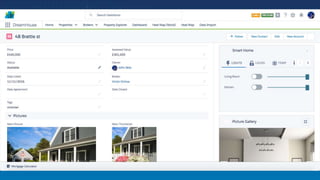
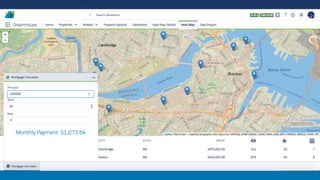
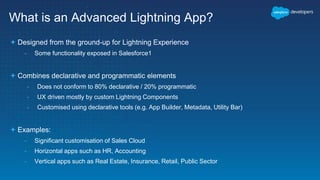
What is an Advanced Lightning App?
 Designed from the ground-up for Lightning Experience
- Some functionality exposed in Salesforce1
 Combines declarative and programmatic elements
- Does not conform to 80% declarative / 20% programmatic
- UX driven mostly by custom Lightning Components
- Customised using declarative tools (e.g. App Builder, Metadata, Utility Bar)
 Examples:
- Significant customisation of Sales Cloud
- Horizontal apps such as HR, Accounting
- Vertical apps such as Real Estate, Insurance, Retail, Public Sector
How can I design
this app?
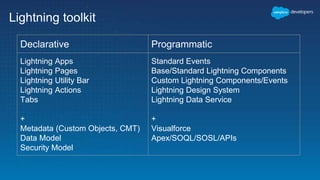
Lightning toolkit
Declarative Programmatic
Lightning Apps
Lightning Pages
Lightning Utility Bar
Lightning Actions
Tabs
+
Metadata (Custom Objects, CMT)
Data Model
Security Model
Standard Events
Base/Standard Lightning Components
Custom Lightning Components/Events
Lightning Design System
Lightning Data Service
+
Visualforce
Apex/SOQL/SOSL/APIs
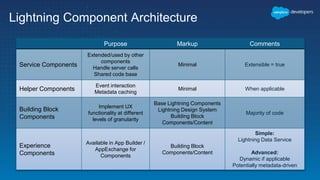
Lightning Component Architecture
Purpose Markup Comments
Service Components
Extended/used by other
components
Handle server calls
Shared code base
Minimal Extensible = true
Helper Components
Event interaction
Metadata caching
Minimal When applicable
Building Block
Components
Implement UX
functionality at different
levels of granularity
Base Lightning Components
Lightning Design System
Building Block
Components/Content
Majority of code
Experience
Components
Available in App Builder /
AppExchange for
Components
Building Block
Components/Content
Simple:
Lightning Data Service
Advanced:
Dynamic if applicable
Potentially metadata-driven
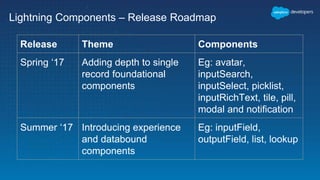
Lightning Components – Release Roadmap
Release Theme Components
Spring ‘17 Adding depth to single
record foundational
components
Eg: avatar,
inputSearch,
inputSelect, picklist,
inputRichText, tile, pill,
modal and notification
Summer ‘17 Introducing experience
and databound
components
Eg: inputField,
outputField, list, lookup
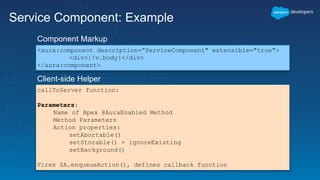
Service Component: Example
<aura:component description=”ServiceComponent" extensible="true">
<div>{!v.body}</div>
</aura:component>
callToServer function:
Parameters:
Name of Apex @AuraEnabled Method
Method Parameters
Action properties:
setAbortable()
setStorable() + ignoreExisting
setBackground()
Fires $A.enqueueAction(), defines callback function
Component Markup
Client-side Helper
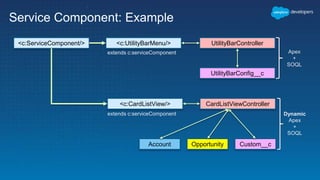
Service Component: Example
<c:ServiceComponent/> <c:UtilityBarMenu/> UtilityBarController
UtilityBarConfig__c
<c:CardListView/> CardListViewController
Account Opportunity Custom__c
Apex
+
SOQL
Dynamic
Apex
+
SOQL
extends c:serviceComponent
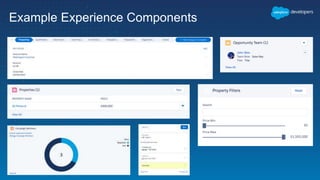
Example Experience Components
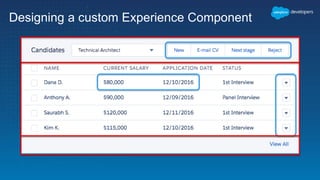
Designing a custom Experience Component
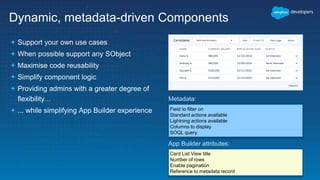
Dynamic, metadata-driven Components
 Support your own use cases
 When possible support any SObject
 Maximise code reusability
 Simplify component logic
 Providing admins with a greater degree of
flexibility…
 ... while simplifying App Builder experience Field to filter on
Standard actions available
Lightning actions available
Columns to display
SOQL query
Card List View title
Number of rows
Enable pagination
Reference to metadata record
Metadata:
App Builder attributes:
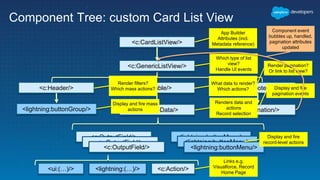
Component Tree: custom Card List View
<c:CardListView/>
<c:Header/> <c:Table/> <c:Footer/>
<c:GenericListView/>
<c:TableData/>
<c:OutputField/>
<c:OutputField/>
<c:OutputField/>
<lightning:buttonMenu/>
<lightning:(…)/><ui:(…)/> <c:Action/>
<lightning:buttonGroup/> <c:Pagination/>
App Builder
Attributes (incl.
Metadata reference)
Which type of list
view?
Handle UI events
What data to render?
Which actions?
Renders data and
actions
Record selection
Render filters?
Which mass actions?
Display and fire mass
actions
Display and fire
record-level actions
Links e.g.
Visualforce, Record
Home Page
Render pagination?
Or link to list view?
Display and fire
pagination events
Component event
bubbles up, handled,
pagination attributes
updated
How do I fire
platform actions?
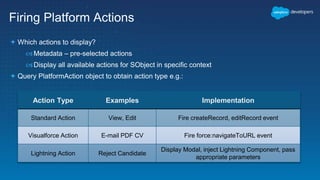
Firing Platform Actions
 Which actions to display?
Metadata – pre-selected actions
Display all available actions for SObject in specific context
 Query PlatformAction object to obtain action type e.g.:
Action Type Examples Implementation
Standard Action View, Edit Fire createRecord, editRecord event
Visualforce Action E-mail PDF CV Fire force:navigateToURL event
Lightning Action Reject Candidate
Display Modal, inject Lightning Component, pass
appropriate parameters
Lightning Utility Bar
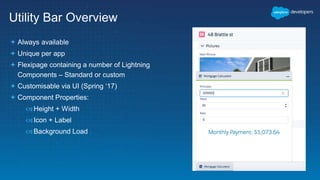
Utility Bar Overview
 Always available
 Unique per app
 Flexipage containing a number of Lightning
Components – Standard or custom
 Customisable via UI (Spring ‘17)
 Component Properties:
Height + Width
Icon + Label
Background Load
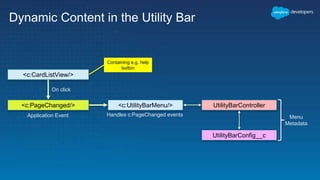
Dynamic Content in the Utility Bar
<c:UtilityBarMenu/> UtilityBarController
UtilityBarConfig__c
Menu
Metadata
Handles c:PageChanged events
<c:CardListView/>
<c:PageChanged/>
Application Event
On click
Containing e.g. help
button
Designing for Performance
SOQL Queries Limit
 Typical of chatty custom Experience Components
 Cause:
Calls to server on init are aggregated into same Apex transaction
 Mitigation:
Use Lightning Data Service when possible
Use cached data (for static data/metadata)
Leverage Custom Metadata Types
 Do not count against SOQL Limits
Use setBackground() on calls to server
 Calls processed separately, designed for lower priority calls but generally processed quickly
Chain component loading by groups
 Last component to load in a group fires application event to load 2nd group – and so on
Performance Best Practices
 Enable Secure Cache and LockerService
 Disable Lightning Components debugging
 Use Lightning Data Service when possible
 Lazy load when appropriate
 Load data upon user intervention (e.g. click)
 Pre-load when possible
 Load data in background (especially static data)
 Use setStorable() on calls to server
 Local cache provides recent copy of data. Separate call to server takes place to obtain refreshed
copy
 Implement data store for metadata/data that remains static
Demo
New York City
December 15, 2016
Join us at the
Salesforce World Tour
http://www.salesforce.com/events/worldtour/nyc/
Survey
Your feedback is crucial to the success
of our webinar programs. Thank you!
http://bit.ly/BestLightning
Q & A
Try Trailhead: trailhead.salesforce.com
Join the conversation: @salesforcedevs
Thank You

Best Practices for Lightning Apps

  • 1.
  • 2.
    Forward-Looking Statement Statement underthe Private Securities Litigation Reform Act of 1995: This presentation may contain forward-looking statements that involve risks, uncertainties, and assumptions. If any such uncertainties materialize or if any of the assumptions proves incorrect, the results of salesforce.com, inc. could differ materially from the results expressed or implied by the forward-looking statements we make. All statements other than statements of historical fact could be deemed forward-looking, including any projections of product or service availability, subscriber growth, earnings, revenues, or other financial items and any statements regarding strategies or plans of management for future operations, statements of belief, any statements concerning new, planned, or upgraded services or technology developments and customer contracts or use of our services. The risks and uncertainties referred to above include – but are not limited to – risks associated with developing and delivering new functionality for our service, new products and services, our new business model, our past operating losses, possible fluctuations in our operating results and rate of growth, interruptions or delays in our Web hosting, breach of our security measures, the outcome of any litigation, risks associated with completed and any possible mergers and acquisitions, the immature market in which we operate, our relatively limited operating history, our ability to expand, retain, and motivate our employees and manage our growth, new releases of our service and successful customer deployment, our limited history reselling non-salesforce.com products, and utilization and selling to larger enterprise customers. Further information on potential factors that could affect the financial results of salesforce.com, inc. is included in our annual report on Form 10-K for the most recent fiscal year and in our quarterly report on Form 10-Q for the most recent fiscal quarter. These documents and others containing important disclosures are available on the SEC Filings section of the Investor Information section of our Web site. Any unreleased services or features referenced in this or other presentations, press releases or public statements are not currently available and may not be delivered on time or at all. Customers who purchase our services should make the purchase decisions based upon features that are currently available. Salesforce.com, inc. assumes no obligation and does not intend to update these forward-looking statements.
  • 3.
    Go Social! Salesforce Developers SalesforceDevelopers Salesforce Developers The video will be posted to YouTube & the webinar recap page (same URL as registration).This webinar is being recorded! @salesforcedevs / #forcewebinar
  • 4.
    ▪ Don’t waituntil the end to ask your question! – Technical support will answer questions starting now. ▪ Respect Q&A etiquette – Please don’t repeat questions. The support team is working their way down the queue. ▪ Stick around for live Q&A at the end – Speakers will tackle more questions at the end, time-allowing. ▪ Head to Developer Forums – More questions? Visit developer.salesforce.com/forums Have Questions?
  • 5.
    Agenda 1. Advanced Appsfor Lightning Experience 2. Lightning Component Architecture 3. Lightning Utility Bar 4. Designing for Performance
  • 6.
    Advanced Apps forLightning Experience
  • 8.
    Let’s define thescope…  Native, built from the ground-up for Lightning Experience  Some functionality exposed in Salesforce1  Combines declarative and programmatic elements  Does not conform to 80% declarative / 20% programmatic  UX driven mostly by custom Lightning Components  Customised using declarative tools (e.g. App Builder, Metadata, Utility Bar)  Examples:  Significant customisation of Sales Cloud  Horizontal apps such as HR, Accounting  Vertical apps such as Insurance, Retail, Public Sector
  • 9.
    What is anAdvanced Lightning App?  Designed from the ground-up for Lightning Experience - Some functionality exposed in Salesforce1  Combines declarative and programmatic elements - Does not conform to 80% declarative / 20% programmatic - UX driven mostly by custom Lightning Components - Customised using declarative tools (e.g. App Builder, Metadata, Utility Bar)  Examples: - Significant customisation of Sales Cloud - Horizontal apps such as HR, Accounting - Vertical apps such as Real Estate, Insurance, Retail, Public Sector
  • 10.
    How can Idesign this app?
  • 11.
    Lightning toolkit Declarative Programmatic LightningApps Lightning Pages Lightning Utility Bar Lightning Actions Tabs + Metadata (Custom Objects, CMT) Data Model Security Model Standard Events Base/Standard Lightning Components Custom Lightning Components/Events Lightning Design System Lightning Data Service + Visualforce Apex/SOQL/SOSL/APIs
  • 12.
  • 13.
    Lightning Component Architecture PurposeMarkup Comments Service Components Extended/used by other components Handle server calls Shared code base Minimal Extensible = true Helper Components Event interaction Metadata caching Minimal When applicable Building Block Components Implement UX functionality at different levels of granularity Base Lightning Components Lightning Design System Building Block Components/Content Majority of code Experience Components Available in App Builder / AppExchange for Components Building Block Components/Content Simple: Lightning Data Service Advanced: Dynamic if applicable Potentially metadata-driven
  • 14.
    Lightning Components –Release Roadmap Release Theme Components Spring ‘17 Adding depth to single record foundational components Eg: avatar, inputSearch, inputSelect, picklist, inputRichText, tile, pill, modal and notification Summer ‘17 Introducing experience and databound components Eg: inputField, outputField, list, lookup
  • 15.
    Service Component: Example <aura:componentdescription=”ServiceComponent" extensible="true"> <div>{!v.body}</div> </aura:component> callToServer function: Parameters: Name of Apex @AuraEnabled Method Method Parameters Action properties: setAbortable() setStorable() + ignoreExisting setBackground() Fires $A.enqueueAction(), defines callback function Component Markup Client-side Helper
  • 16.
    Service Component: Example <c:ServiceComponent/><c:UtilityBarMenu/> UtilityBarController UtilityBarConfig__c <c:CardListView/> CardListViewController Account Opportunity Custom__c Apex + SOQL Dynamic Apex + SOQL extends c:serviceComponent extends c:serviceComponent
  • 17.
  • 18.
    Designing a customExperience Component
  • 19.
    Dynamic, metadata-driven Components Support your own use cases  When possible support any SObject  Maximise code reusability  Simplify component logic  Providing admins with a greater degree of flexibility…  ... while simplifying App Builder experience Field to filter on Standard actions available Lightning actions available Columns to display SOQL query Card List View title Number of rows Enable pagination Reference to metadata record Metadata: App Builder attributes:
  • 20.
    Component Tree: customCard List View <c:CardListView/> <c:Header/> <c:Table/> <c:Footer/> <c:GenericListView/> <c:TableData/> <c:OutputField/> <c:OutputField/> <c:OutputField/> <lightning:buttonMenu/> <lightning:buttonMenu/> <lightning:buttonMenu/> <lightning:(…)/><ui:(…)/> <c:Action/> <lightning:buttonGroup/> <c:Pagination/> App Builder Attributes (incl. Metadata reference) Which type of list view? Handle UI events What data to render? Which actions? Renders data and actions Record selection Render filters? Which mass actions? Display and fire mass actions Display and fire record-level actions Links e.g. Visualforce, Record Home Page Render pagination? Or link to list view? Display and fire pagination events Component event bubbles up, handled, pagination attributes updated
  • 21.
    How do Ifire platform actions?
  • 22.
    Firing Platform Actions Which actions to display? Metadata – pre-selected actions Display all available actions for SObject in specific context  Query PlatformAction object to obtain action type e.g.: Action Type Examples Implementation Standard Action View, Edit Fire createRecord, editRecord event Visualforce Action E-mail PDF CV Fire force:navigateToURL event Lightning Action Reject Candidate Display Modal, inject Lightning Component, pass appropriate parameters
  • 23.
  • 24.
    Utility Bar Overview Always available  Unique per app  Flexipage containing a number of Lightning Components – Standard or custom  Customisable via UI (Spring ‘17)  Component Properties: Height + Width Icon + Label Background Load
  • 25.
    Dynamic Content inthe Utility Bar <c:UtilityBarMenu/> UtilityBarController UtilityBarConfig__c Menu Metadata Handles c:PageChanged events <c:CardListView/> <c:PageChanged/> Application Event On click Containing e.g. help button
  • 26.
  • 27.
    SOQL Queries Limit Typical of chatty custom Experience Components  Cause: Calls to server on init are aggregated into same Apex transaction  Mitigation: Use Lightning Data Service when possible Use cached data (for static data/metadata) Leverage Custom Metadata Types  Do not count against SOQL Limits Use setBackground() on calls to server  Calls processed separately, designed for lower priority calls but generally processed quickly Chain component loading by groups  Last component to load in a group fires application event to load 2nd group – and so on
  • 28.
    Performance Best Practices Enable Secure Cache and LockerService  Disable Lightning Components debugging  Use Lightning Data Service when possible  Lazy load when appropriate  Load data upon user intervention (e.g. click)  Pre-load when possible  Load data in background (especially static data)  Use setStorable() on calls to server  Local cache provides recent copy of data. Separate call to server takes place to obtain refreshed copy  Implement data store for metadata/data that remains static
  • 29.
  • 30.
    New York City December15, 2016 Join us at the Salesforce World Tour http://www.salesforce.com/events/worldtour/nyc/
  • 31.
    Survey Your feedback iscrucial to the success of our webinar programs. Thank you! http://bit.ly/BestLightning
  • 32.
    Q & A TryTrailhead: trailhead.salesforce.com Join the conversation: @salesforcedevs
  • 33.