“Best Practices” and
                     “Context-Driven:
                      Building a Bridge
                         Neil Thompson            © 2003
                         www.TiSCL.com            Thompson
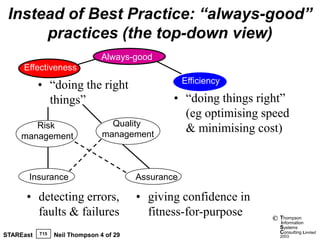
                        +44 (0)7000 NeilTh        information
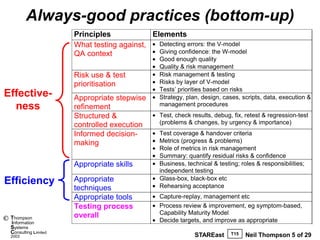
Test Management     track presentation (634584)   Systems
STAREast   T15   Neil Thompson slide 0 of 29      Consulting Limited
Presentation contents

 •   Theme: what to bridge, and how.................
 •   Learning objectives
 •   Instead of Best Practice: “always-good” practices
 •   How deep is the schism, how strong the bridge supports?
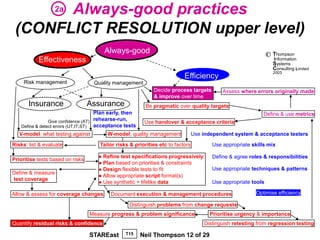
 •   Goldratt’s Theory of Constraints
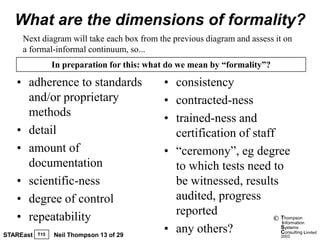
 •   The thinking tools and how to apply them
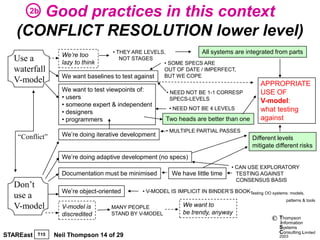
 •   Relationship to process improvement
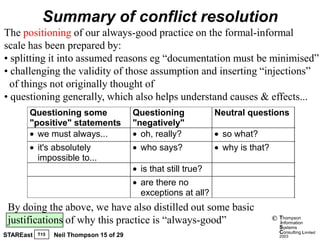
 •   Conclusions & key references
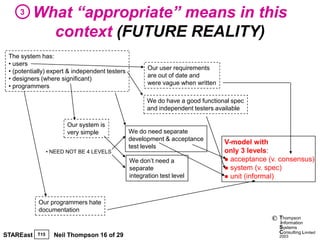
 •   Lessons learned, and way forward
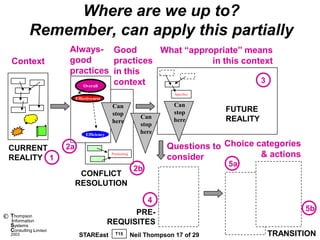
                                                     ©   Thompson
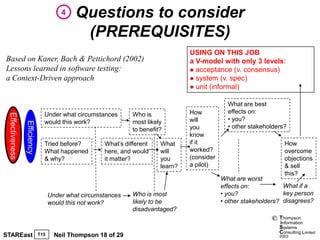
                                                         information
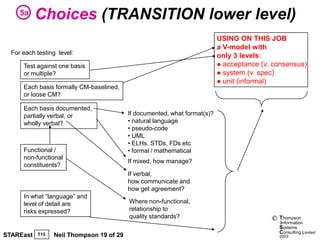
                                                         Systems
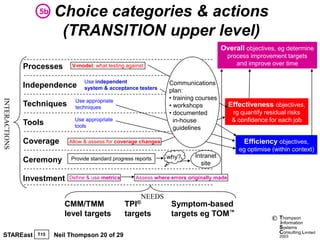
           T15                                           Consulting Limited
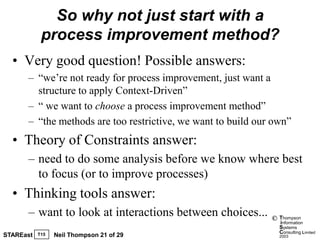
STAREast         Neil Thompson 1 of 29                   2003
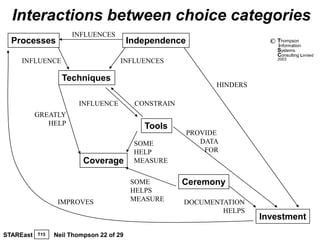
Theme: from conflict to integrated
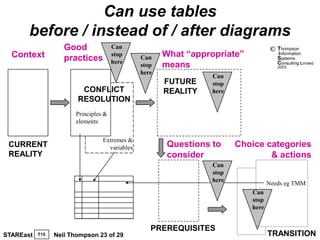
                       framework
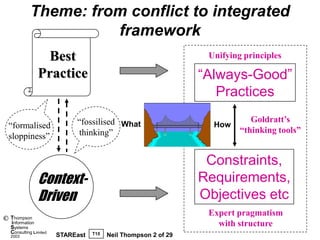
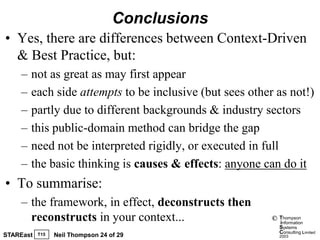
                  Best                                             Unifying principles

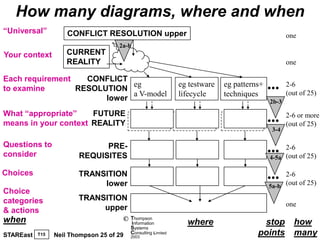
                 Practice                                         “Always-Good”
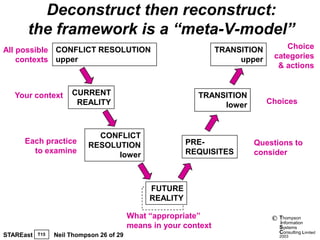
                                                                     Practices
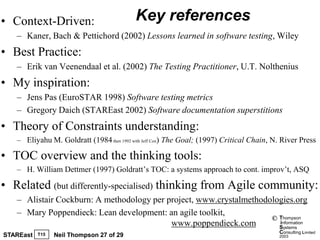
                              “fossilised What                                Goldratt’s
    “formalised                                                     How
                              thinking”                                    “thinking tools”
    sloppiness”

                                                                   Constraints,
                 Context-                                         Requirements,
                 Driven                                           Objectives etc
    Thompson
                                                                   Expert pragmatism
©
    information
    Systems
                                                                     with structure
    Consulting Limited              T15
    2003                 STAREast         Neil Thompson 2 of 29
Learning objectives
• Understand the Best Practice v. Context-Driven debate
• If your allegiance is already fixed, please un-fix at least for
  now: consider “always-good” principles & practices
• Gain knowledge on Goldratt’s Theory of Constraints
  (like it or not, it’s widely used)
• Appreciate the subtleties of extending its use beyond
  manufacturing etc
• Learn enough about the thinking tools to use them
• Understand enough of my examples to determine if, and
  how, you can use some or all of this framework
                                                        ©   Thompson
                                                            information
                                                            Systems
           T15                                              Consulting Limited
STAREast         Neil Thompson 3 of 29                      2003
Instead of Best Practice: “always-good”
      practices (the top-down view)
                                Always-good
     Effectiveness
                                                     Efficiency
           • “doing the right
             things”                             • “doing things right”
                                                   (eg optimising speed
       Risk                       Quality
                                management
                                                   & minimising cost)
    management


       Insurance                         Assurance

      • detecting errors,                • giving confidence in
        faults & failures                  fitness-for-purpose     ©   Thompson
                                                                       information
                                                                       Systems
           T15                                                         Consulting Limited
STAREast         Neil Thompson 4 of 29                                 2003
Always-good practices (bottom-up)
                         Principles            Elements
                         What testing against,   Detecting errors: the V-model
                         QA context              Giving confidence: the W-model
                                                   Good enough quality
                                                   Quality & risk management
                         Risk use & test           Risk management & testing
                         prioritisation            Risks by layer of V-model
                                                   Tests’ priorities based on risks
Effective-               Appropriate stepwise      Strategy, plan, design, cases, scripts, data, execution &
  ness                   refinement                management procedures
                         Structured &              Test, check results, debug, fix, retest & regression-test
                         controlled execution      (problems & changes, by urgency & importance)
                         Informed decision-        Test coverage & handover criteria
                         making                    Metrics (progress & problems)
                                                   Role of metrics in risk management
                                                   Summary: quantify residual risks & confidence
                         Appropriate skills        Business, technical & testing; roles & responsibilities;
                                                   independent testing
Efficiency               Appropriate               Glass-box, black-box etc
                         techniques                Rehearsing acceptance
                         Appropriate tools         Capture-replay, management etc
                         Testing process           Process review & improvement, eg symptom-based,
                         overall                   Capability Maturity Model
©   Thompson
    information                                    Decide targets, and improve as appropriate
    Systems
    Consulting Limited                                                        T15
    2003                                                        STAREast            Neil Thompson 5 of 29
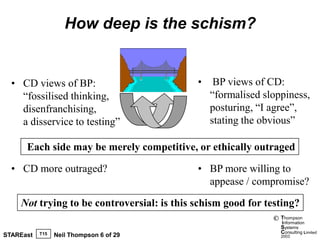
How deep is the schism?


  • CD views of BP:                         •    BP views of CD:
    “fossilised thinking,                       “formalised sloppiness,
    disenfranchising,                           posturing, “I agree”,
    a disservice to testing”                    stating the obvious”

      Each side may be merely competitive, or ethically outraged

  • CD more outraged?                       • BP more willing to
                                              appease / compromise?

    Not trying to be controversial: is this schism good for testing?
                                                              ©   Thompson
                                                                  information
                                                                  Systems
           T15                                                    Consulting Limited
STAREast         Neil Thompson 6 of 29                            2003
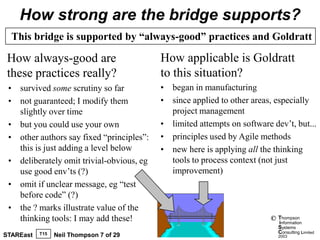
How strong are the bridge supports?
  This bridge is supported by “always-good” practices and Goldratt

 How always-good are                       How applicable is Goldratt
 these practices really?                   to this situation?
 • survived some scrutiny so far           • began in manufacturing
 • not guaranteed; I modify them           • since applied to other areas, especially
   slightly over time                        project management
 • but you could use your own              • limited attempts on software dev’t, but...
 • other authors say fixed “principles”:   • principles used by Agile methods
   this is just adding a level below       • new here is applying all the thinking
 • deliberately omit trivial-obvious, eg     tools to process context (not just
   use good env’ts (?)                       improvement)
 • omit if unclear message, eg “test
   before code” (?)
 • the ? marks illustrate value of the
   thinking tools: I may add these!                                       ©   Thompson
                                                                              information
                                                                              Systems
           T15                                                                Consulting Limited
STAREast         Neil Thompson 7 of 29                                        2003
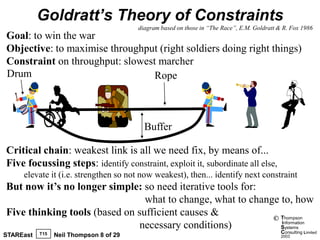
Goldratt’s Theory of Constraints
                                         diagram based on those in “The Race”, E.M. Goldratt & R. Fox 1986
Goal: to win the war
Objective: to maximise throughput (right soldiers doing right things)
Constraint on throughput: slowest marcher
Drum                             Rope


                                           Buffer

Critical chain: weakest link is all we need fix, by means of...
Five focussing steps: identify constraint, exploit it, subordinate all else,
     elevate it (i.e. strengthen so not now weakest), then... identify next constraint
But now it’s no longer simple: so need iterative tools for:
                                what to change, what to change to, how
Five thinking tools (based on sufficient causes &            © Thompson
                                                               information
                               necessary conditions)           Systems
           T15                                                                                Consulting Limited
STAREast         Neil Thompson 8 of 29                                                        2003
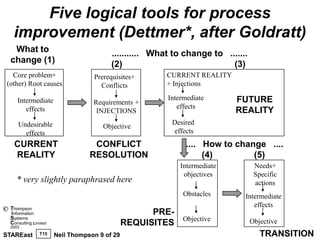
Five logical tools for process
     improvement (Dettmer*, after Goldratt)
     What to                               ........... What to change to .......
    change (1)                             (2)                             (3)
   Core problem+                     Prerequisites+       CURRENT REALITY
 (other) Root causes                   Conflicts          + Injections

       Intermediate                                       Intermediate       FUTURE
                                     Requirements +
          effects                                            effects
                                      INJECTIONS                             REALITY
       Undesirable                                         Desired
                                        Objective
         effects                                           effects
     CURRENT                         CONFLICT                  .... How to change ....
     REALITY                        RESOLUTION                      (4)        (5)
                                                              Intermediate          Needs+
                                                               objectives           Specific
       * very slightly paraphrased here                                             actions
                                                               Obstacles       Intermediate
    Thompson
                                                                                  effects
©                                                      PRE-
    information
    Systems                                                    Objective
    Consulting Limited                           REQUISITES                        Objective
    2003

STAREast          T15    Neil Thompson 9 of 29                                        TRANSITION
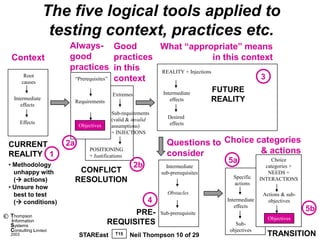
The five logical tools applied to
                      testing context, practices etc.
                         Always- Good               What “appropriate” means
    Context              good             practices                      in this context
                         practices in this          REALITY + Injections
            Root
                          “Prerequisites” context                                    3
           causes

                                                                   Intermediate
                                                                                      FUTURE
                                              Extremes
     Intermediate
                              Requirements                            effects         REALITY
        effects
                                             Sub-requirements
                                             (valid & invalid        Desired
           Effects                                                   effects
                               Objectives    assumptions)
                                             + INJECTIONS

    CURRENT              2a                                         Questions to Choice categories
    REALITY 1
                                   POSITIONING
                                   + Justifications                 consider             & actions
                                                                                         5a                  Choice
    • Methodology                                        2b         Intermediate                          categories +
      unhappy with             CONFLICT                           sub-prerequisites                        NEEDS +
                                                                                           Specific
      ( actions)             RESOLUTION                                                   actions
                                                                                                        INTERACTIONS
    • Unsure how
      best to test                                                   Obstacles                           Actions & sub-
      ( conditions)                                          4                          Intermediate      objectives
                                                                                            effects
                                                   PRE-           Sub-prerequisite
                                                                                                                          5b
©   Thompson                                                                                               Objectives
    information                              REQUISITES
    Systems                                                                                 Sub-
    Consulting Limited                                                                    objectives
    2003                       STAREast        T15    Neil Thompson 10 of 29                              TRANSITION
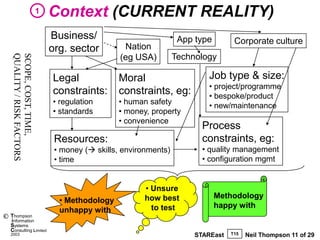
1   Context (CURRENT REALITY)
                                 Business/                            App type        Corporate culture
                                 org. sector         Nation
    QUALITY / RISK FACTORS
    SCOPE, COST, TIME,


                                                    (eg USA)         Technology

                                 Legal             Moral                     Job type & size:
                                                                             • project/programme
                                 constraints:      constraints, eg:          • bespoke/product
                                 • regulation      • human safety            • new/maintenance
                                 • standards       • money, property
                                                   • convenience
                                                                            Process
                                  Resources:                                constraints, eg:
                                  • money ( skills, environments)          • quality management
                                  • time                                    • configuration mgmt


                                                          • Unsure
                                                          how best               Methodology
                                   • Methodology
                                                            to test              happy with
                                   unhappy with
©   Thompson
    information
    Systems
    Consulting Limited
    2003                                                                  STAREast   T15   Neil Thompson 11 of 29
Always-good practices
                  2a

 (CONFLICT RESOLUTION upper level)
                                         Always-good                                                            ©   Thompson
           Effectiveness                                                                                            information
                                                                                                                    Systems
                                                                                                                    Consulting Limited
                                                                                                                    2003
                                                                           Efficiency
     Risk management               Quality management
                                                             Decide process targets         Assess where errors originally made
                                                             & improve over time
       Insurance                  Assurance               Be pragmatic over quality targets
                                      Plan early, then                                                       Define & use metrics
                 Give confidence (AT) rehearse-run,       Use handover & acceptance criteria
    Define & detect errors (UT,IT,ST) acceptance tests
   V-model: what testing against         W-model: quality management             Use independent system & acceptance testers

Risks: list & evaluate                Tailor risks & priorities etc to factors          Use appropriate skills mix

                                      Refine test specifications progressively:        Define & agree roles & responsibilities
Prioritise tests based on risks
                                      Plan based on priorities & constraints
                                      Design flexible tests to fit                     Use appropriate techniques & patterns
Define & measure
                                      Allow appropriate script format(s)
test coverage
                                      Use synthetic + lifelike data                    Use appropriate tools

Allow & assess for coverage changes        Document execution & management procedures                     Optimise efficiency

                                                   Distinguish problems from change requests
                                  Measure progress & problem significance              Prioritise urgency & importance
Quantify residual risks & confidence                                                 Distinguish retesting from regression testing

                                  STAREast       T15     Neil Thompson 12 of 29
What are the dimensions of formality?
     Next diagram will take each box from the previous diagram and assess it on
     a formal-informal continuum, so...
                 In preparation for this: what do we mean by “formality”?

   • adherence to standards                  • consistency
     and/or proprietary                      • contracted-ness
     methods                                 • trained-ness and
   • detail                                    certification of staff
   • amount of                               • “ceremony”, eg degree
     documentation                             to which tests need to
   • scientific-ness                           be witnessed, results
   • degree of control                         audited, progress
   • repeatability                             reported              ©T      hompson
                                                                      i      nformation

STAREast   T15   Neil Thompson 13 of 29
                                             • any others?            S
                                                                      C
                                                                             ystems
                                                                              onsulting Limited
                                                                            2003
Good practices in this context
       2b

   (CONFLICT RESOLUTION lower level)
                                    • THEY ARE LEVELS,           All systems are integrated from parts
                   We’re too
  Use a            lazy to think
                                       NOT STAGES
                                                     • SOME SPECS ARE
  waterfall                                          OUT OF DATE / IMPERFECT,
                   We want baselines to test against BUT WE COPE
  V-model                                                                                     APPROPRIATE
                   We want to test viewpoints of:       • NEED NOT BE 1-1 CORRESP             USE OF
                   • users                                SPECS-LEVELS                        V-model:
                   • someone expert & independent
                                                         • NEED NOT BE 4 LEVELS               what testing
                   • designers
                   • programmers                        Two heads are better than one         against
                                                        • MULTIPLE PARTIAL PASSES
   “Conflict”      We’re doing iterative development
                                                                                           Different levels
                                                                                           mitigate different risks
                   We’re doing adaptive development (no specs)
                                                                                  • CAN USE EXPLORATORY
                   Documentation must be minimised        We have little time       TESTING AGAINST
                                                                                    CONSENSUS BASIS
  Don’t
                   We’re object-oriented       • V-MODEL IS IMPLICIT IN BINDER’S BOOKTesting OO systems: models,
  use a                                                                                                  patterns & tools
  V-model          V-model is       MANY PEOPLE                We want to
                   discredited      STAND BY V-MODEL           be trendy, anyway
                                                                                                  ©   Thompson
                                                                                                      information
                                                                                                      Systems
                                                                                                      Consulting Limited
STAREast   T15   Neil Thompson 14 of 29                                                               2003
Summary of conflict resolution
The positioning of our always-good practice on the formal-informal
scale has been prepared by:
• splitting it into assumed reasons eg “documentation must be minimised”
• challenging the validity of those assumption and inserting “injections”
  of things not originally thought of
• questioning generally, which also helps understand causes & effects...
       Questioning some                   Questioning             Neutral questions
       "positive" statements              "negatively"
         we must always...                  oh, really?            so what?
           it's absolutely                  who says?              why is that?
           impossible to...
                                            is that still true?
                                            are there no
                                            exceptions at all?
 By doing the above, we have also distilled out some basic
 justifications of why this practice is “always-good”                             ©   Thompson
                                                                                      information
                                                                                      Systems
                                                                                      Consulting Limited
STAREast   T15   Neil Thompson 15 of 29                                               2003
3     What “appropriate” means in this
             context (FUTURE REALITY)
 The system has:
 • users
                                                       Our user requirements
 • (potentially) expert & independent testers
                                                       are out of date and
 • designers (where significant)
                                                       were vague when written
 • programmers

                                                       We do have a good functional spec
                                                       and independent testers available

                        Our system is
                        very simple             We do need separate
                                                development & acceptance
                                                                                 V-model with
                                                test levels
                 • NEED NOT BE 4 LEVELS                                          only 3 levels:
                                                We don’t need a                   acceptance (v. consensus)
                                                separate                          system (v. spec)
                                                integration test level            unit (informal)


            Our programmers hate
            documentation
                                                                                               ©   Thompson
                                                                                                   information
                                                                                                   Systems
                                                                                                   Consulting Limited
STAREast   T15     Neil Thompson 16 of 29                                                          2003
Where are we up to?
             Remember, can apply this partially
                         Always- Good         What “appropriate” means
    Context              good       practices            in this context
                         practices in this
                                    context                          3
                            Overall
                                                                            Specifics
                              Effectiveness
                                                 Can                       Can
                                                 stop                      stop         FUTURE
                                                                 Can       here         REALITY
                                                 here
                                                                 stop
                                   Efficiency
                                                                 here

    CURRENT              2a                                              Questions to Choice categories
    REALITY 1
                                                Positioning
                                                                         consider             & actions
                                                                                        5a
                                                               2b
                               CONFLICT
                              RESOLUTION

                                                                    4
                                                      PRE-                                                5b
©   Thompson
    information                                 REQUISITES
    Systems
    Consulting Limited
    2003                       STAREast           T15         Neil Thompson 17 of 29              TRANSITION
4    Questions to consider
                                              (PREREQUISITES)
                                                                                   USING ON THIS JOB
Based on Kaner, Bach & Pettichord (2002)                                           a V-model with only 3 levels:
Lessons learned in software testing:                                                acceptance (v. consensus)
a Context-Driven approach                                                           system (v. spec)
                                                                                    unit (informal)


                                                                                                 What are best
                                Under what circumstances        Who is             How           effects on:
 Effectiveness


                                would this work?                most likely        will          • you?
                 Efficiency


                                                                to benefit?        you           • other stakeholders?
                                                                                   know
                                Tried before?         What’s different    What     if it                              How
                                What happened         here, and would     will     worked?                            overcome
                                & why?                it matter?          you      (consider                          objections
                                                                          learn?   a pilot)                           & sell
                                                                                                                      this?
                                                                                               What are worst
                                                                                               effects on:           What if a
                                    Under what circumstances    Who is most                    • you?                key person
                                    would this not work?        likely to be                   • other stakeholders? disagrees?
                                                                disadvantaged?
                                                                                                                ©   Thompson
                                                                                                                    information
                                                                                                                    Systems
                                                                                                                    Consulting Limited
STAREast                      T15     Neil Thompson 18 of 29                                                        2003
5a    Choices (TRANSITION lower level)
                                                                           USING ON THIS JOB
                                                                           a V-model with
  For each testing level:                                                  only 3 levels:
      Test against one basis                                                acceptance (v. consensus)
      or multiple?                                                          system (v. spec)
                                                                            unit (informal)
      Each basis formally CM-baselined,
      or loose CM?

      Each basis documented,
      partially verbal, or                If documented, what format(s)?
      wholly verbal?                      • natural language
                                          • pseudo-code
                                          • UML
                                          • ELHs, STDs, FDs etc
      Functional /                        • formal / mathematical
      non-functional
                                          If mixed, how manage?
      constituents?
                                          If verbal,
                                          how communicate and
                                          how get agreement?
      In what “language” and
      level of detail are                 Where non-functional,
      risks expressed?                    relationship to
                                          quality standards?                               ©   Thompson
                                                                                               information
                                                                                               Systems
                                                                                               Consulting Limited
STAREast   T15   Neil Thompson 19 of 29                                                        2003
5b    Choice categories & actions
                         (TRANSITION upper level)
                                                                                        Overall objectives, eg determine
                                                                                             process improvement targets
                                                                                                and improve over time
               Processes     V-model: what testing against


                                  Use independent                  Communications
               Independence       system & acceptance testers
                                                                   plan:
                                                                   • training courses
INTERACTIONS


                              Use appropriate
               Techniques     techniques                           • workshops               Effectiveness objectives,
                                                                   • documented               rg quantify residual risks
               Tools          Use appropriate                        in-house                 & confidence for each job
                              tools                                  guidelines

               Coverage     Allow & assess for coverage changes                                   Efficiency objectives,
                                                                                                eg optimise (within context)
                                                                  why?       Intranet
               Ceremony      Provide standard progress reports
                                                                               site

               Investment   Define & use metrics       Assess where errors originally made


                                                         NEEDS
                           CMM/TMM                 TPI®             Symptom-based
                           level targets           targets          targets eg TOM™                             Thompson
                                                                                                            ©
                                                                                                                information
                                                                                                                Systems
                                                                                                                Consulting Limited
STAREast          T15   Neil Thompson 20 of 29                                                                  2003
So why not just start with a
            process improvement method?
  • Very good question! Possible answers:
      – “we’re not ready for process improvement, just want a
        structure to apply Context-Driven”
      – “ we want to choose a process improvement method”
      – “the methods are too restrictive, we want to build our own”
  • Theory of Constraints answer:
      – need to do some analysis before we know where best
        to focus (or to improve processes)
  • Thinking tools answer:
      – want to look at interactions between choices...       ©   Thompson
                                                                  information
                                                                  Systems
                                                                  Consulting Limited
STAREast   T15   Neil Thompson 21 of 29                           2003
Interactions between choice categories
                      INFLUENCES
  Processes                               Independence                     ©   Thompson
                                                                               information
                                                                               Systems
                                                                               Consulting Limited
                                                                               2003
     INFLUENCE                        INFLUENCES

                   Techniques
                                                               HINDERS

                        INFLUENCE          CONSTRAIN
           GREATLY
              HELP                           Tools
                                                         PROVIDE
                                           SOME             DATA
                                           HELP              FOR
                          Coverage         MEASURE


                                          SOME         Ceremony
                                          HELPS
                  IMPROVES                MEASURE      DOCUMENTATION
                                                               HELPS
                                                                         Investment
STAREast   T15   Neil Thompson 22 of 29
Can use tables
       before / instead of / after diagrams
                    Good              Can                                          ©   Thompson
  Context           practices         stop
                                               Can    What “appropriate”               information
                                                                                       Systems
                                      here                                             Consulting Limited
                                               stop   means                            2003
                                               here
                                                                 Can
                                                      FUTURE     stop
                         CONFLICT                     REALITY    here
                        RESOLUTION
                       Principles &
                       elements

                                 Extremes &
 CURRENT                           variables           Questions to     Choice categories
 REALITY                                               consider                 & actions
                                                                 Can
                                                                 stop
                                                                 here
                                                                                  Needs eg TMM
                                                                           Can
                                                                           stop
                                                                           here


                                                  PREREQUISITES
STAREast   T15   Neil Thompson 23 of 29                                           TRANSITION
Conclusions
• Yes, there are differences between Context-Driven
  & Best Practice, but:
    –   not as great as may first appear
    –   each side attempts to be inclusive (but sees other as not!)
    –   partly due to different backgrounds & industry sectors
    –   this public-domain method can bridge the gap
    –   need not be interpreted rigidly, or executed in full
    –   the basic thinking is causes & effects: anyone can do it
• To summarise:
    – the framework, in effect, deconstructs then
      reconstructs in your context...                     ©   Thompson
                                                              information
                                                              Systems
                                                              Consulting Limited
STAREast   T15   Neil Thompson 24 of 29                       2003
How many diagrams, where and when
“Universal”          CONFLICT RESOLUTION upper                                                     one
                                     2a-b
Your context         CURRENT
                     REALITY                                                                       one

Each requirement   CONFLICT
to examine       RESOLUTION
                             eg
                             a V-model
                                                               eg testware
                                                               lifecycle
                                                                             eg patterns+
                                                                             techniques
                                                                                            ...    2-6
                                                                                                   (out of 25)
                       lower                                                                2b-3
What “appropriate”    FUTURE
means in your context REALITY                                                               ...    2-6 or more
                                                                                                   (out of 25)
                                                                                             3-4

Questions to
consider
                              PRE-
                        REQUISITES
                                                                                            ...  2-6
                                                                                            4-5a (out of 25)

Choices                 TRANSITION                                                          ...  2-6
                             lower                                                          5a-b (out of 25)
Choice
categories              TRANSITION
                                                                                                   one
& actions                    upper
when                                  ©   Thompson
                                          information            where                  stop         how
                                          Systems
STAREast   T15   Neil Thompson 25 of 29   Consulting Limited
                                          2003
                                                                                       points        many
Deconstruct then reconstruct:
      the framework is a “meta-V-model”
All possible CONFLICT RESOLUTION                                  TRANSITION       Choice
    contexts upper                                                     upper    categories
                                                                                 & actions


   Your context       CURRENT                              TRANSITION
                       REALITY                                  lower          Choices


                             CONFLICT
     Each practice                                       PRE-             Questions to
                           RESOLUTION
       to examine                                        REQUISITES       consider
                                 lower


                                               FUTURE
                                              FUTURE
                                               REALITY
                                              REALITY
                                          What “appropriate”                    ©   Thompson
                                                                                    information
                                          means in your context                     Systems
                                                                                    Consulting Limited
STAREast   T15   Neil Thompson 26 of 29                                             2003
• Context-Driven:                         Key references
   – Kaner, Bach & Pettichord (2002) Lessons learned in software testing, Wiley
• Best Practice:
   – Erik van Veenendaal et al. (2002) The Testing Practitioner, U.T. Nolthenius
• My inspiration:
   – Jens Pas (EuroSTAR 1998) Software testing metrics
   – Gregory Daich (STAREast 2002) Software documentation superstitions
• Theory of Constraints understanding:
   – Eliyahu M. Goldratt (1984 then 1992 with Jeff Cox) The Goal; (1997) Critical Chain, N. River Press

• TOC overview and the thinking tools:
   – H. William Dettmer (1997) Goldratt’s TOC: a systems approach to cont. improv’t, ASQ

• Related (but differently-specialised) thinking from Agile community:
   – Alistair Cockburn: A methodology per project, www.crystalmethodologies.org
   – Mary Poppendieck: Lean development: an agile toolkit,
                                                                     © Thompson
                                           www.poppendieck.com         information
                                                                       Systems
                                                                                          Consulting Limited
STAREast   T15   Neil Thompson 27 of 29                                                   2003
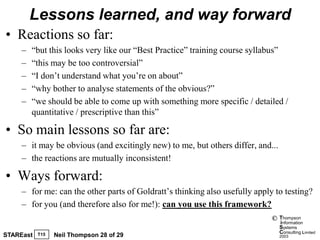
Lessons learned, and way forward
• Reactions so far:
     –   “but this looks very like our “Best Practice” training course syllabus”
     –   “this may be too controversial”
     –   “I don’t understand what you’re on about”
     –   “why bother to analyse statements of the obvious?”
     –   “we should be able to come up with something more specific / detailed /
         quantitative / prescriptive than this”

• So main lessons so far are:
     – it may be obvious (and excitingly new) to me, but others differ, and...
     – the reactions are mutually inconsistent!

• Ways forward:
     – for me: can the other parts of Goldratt’s thinking also usefully apply to testing?
     – for you (and therefore also for me!): can you use this framework?
                                                                             ©   Thompson
                                                                                 information
                                                                                 Systems
                                                                                 Consulting Limited
STAREast   T15   Neil Thompson 28 of 29                                          2003
• Questions please?
                     • Thank you!
Neil Thompson
NeilT@TiSCL.com
                                      • Contact details...
+44 (0)7000 NeilTh (634584)                     www.TiSCL.com
23 Oast House Crescent                          © 2003
Farnham, Surrey, England                        Thompson
GU9 0NP, United Kingdom                         information
Test Management track presentation              Systems
STAREast   T15   Neil Thompson slide 29 of 29   Consulting Limited

'Best Practices' & 'Context-Driven' - Building a bridge (2003)

  • 1.
    “Best Practices” and “Context-Driven: Building a Bridge Neil Thompson © 2003 www.TiSCL.com Thompson +44 (0)7000 NeilTh information Test Management track presentation (634584) Systems STAREast T15 Neil Thompson slide 0 of 29 Consulting Limited
  • 2.
    Presentation contents • Theme: what to bridge, and how................. • Learning objectives • Instead of Best Practice: “always-good” practices • How deep is the schism, how strong the bridge supports? • Goldratt’s Theory of Constraints • The thinking tools and how to apply them • Relationship to process improvement • Conclusions & key references • Lessons learned, and way forward © Thompson information Systems T15 Consulting Limited STAREast Neil Thompson 1 of 29 2003
  • 3.
    Theme: from conflictto integrated framework Best Unifying principles Practice “Always-Good” Practices “fossilised What Goldratt’s “formalised How thinking” “thinking tools” sloppiness” Constraints, Context- Requirements, Driven Objectives etc Thompson Expert pragmatism © information Systems with structure Consulting Limited T15 2003 STAREast Neil Thompson 2 of 29
  • 4.
    Learning objectives • Understandthe Best Practice v. Context-Driven debate • If your allegiance is already fixed, please un-fix at least for now: consider “always-good” principles & practices • Gain knowledge on Goldratt’s Theory of Constraints (like it or not, it’s widely used) • Appreciate the subtleties of extending its use beyond manufacturing etc • Learn enough about the thinking tools to use them • Understand enough of my examples to determine if, and how, you can use some or all of this framework © Thompson information Systems T15 Consulting Limited STAREast Neil Thompson 3 of 29 2003
  • 5.
    Instead of BestPractice: “always-good” practices (the top-down view) Always-good Effectiveness Efficiency • “doing the right things” • “doing things right” (eg optimising speed Risk Quality management & minimising cost) management Insurance Assurance • detecting errors, • giving confidence in faults & failures fitness-for-purpose © Thompson information Systems T15 Consulting Limited STAREast Neil Thompson 4 of 29 2003
  • 6.
    Always-good practices (bottom-up) Principles Elements What testing against, Detecting errors: the V-model QA context Giving confidence: the W-model Good enough quality Quality & risk management Risk use & test Risk management & testing prioritisation Risks by layer of V-model Tests’ priorities based on risks Effective- Appropriate stepwise Strategy, plan, design, cases, scripts, data, execution & ness refinement management procedures Structured & Test, check results, debug, fix, retest & regression-test controlled execution (problems & changes, by urgency & importance) Informed decision- Test coverage & handover criteria making Metrics (progress & problems) Role of metrics in risk management Summary: quantify residual risks & confidence Appropriate skills Business, technical & testing; roles & responsibilities; independent testing Efficiency Appropriate Glass-box, black-box etc techniques Rehearsing acceptance Appropriate tools Capture-replay, management etc Testing process Process review & improvement, eg symptom-based, overall Capability Maturity Model © Thompson information Decide targets, and improve as appropriate Systems Consulting Limited T15 2003 STAREast Neil Thompson 5 of 29
  • 7.
    How deep isthe schism? • CD views of BP: • BP views of CD: “fossilised thinking, “formalised sloppiness, disenfranchising, posturing, “I agree”, a disservice to testing” stating the obvious” Each side may be merely competitive, or ethically outraged • CD more outraged? • BP more willing to appease / compromise? Not trying to be controversial: is this schism good for testing? © Thompson information Systems T15 Consulting Limited STAREast Neil Thompson 6 of 29 2003
  • 8.
    How strong arethe bridge supports? This bridge is supported by “always-good” practices and Goldratt How always-good are How applicable is Goldratt these practices really? to this situation? • survived some scrutiny so far • began in manufacturing • not guaranteed; I modify them • since applied to other areas, especially slightly over time project management • but you could use your own • limited attempts on software dev’t, but... • other authors say fixed “principles”: • principles used by Agile methods this is just adding a level below • new here is applying all the thinking • deliberately omit trivial-obvious, eg tools to process context (not just use good env’ts (?) improvement) • omit if unclear message, eg “test before code” (?) • the ? marks illustrate value of the thinking tools: I may add these! © Thompson information Systems T15 Consulting Limited STAREast Neil Thompson 7 of 29 2003
  • 9.
    Goldratt’s Theory ofConstraints diagram based on those in “The Race”, E.M. Goldratt & R. Fox 1986 Goal: to win the war Objective: to maximise throughput (right soldiers doing right things) Constraint on throughput: slowest marcher Drum Rope Buffer Critical chain: weakest link is all we need fix, by means of... Five focussing steps: identify constraint, exploit it, subordinate all else, elevate it (i.e. strengthen so not now weakest), then... identify next constraint But now it’s no longer simple: so need iterative tools for: what to change, what to change to, how Five thinking tools (based on sufficient causes & © Thompson information necessary conditions) Systems T15 Consulting Limited STAREast Neil Thompson 8 of 29 2003
  • 10.
    Five logical toolsfor process improvement (Dettmer*, after Goldratt) What to ........... What to change to ....... change (1) (2) (3) Core problem+ Prerequisites+ CURRENT REALITY (other) Root causes Conflicts + Injections Intermediate Intermediate FUTURE Requirements + effects effects INJECTIONS REALITY Undesirable Desired Objective effects effects CURRENT CONFLICT .... How to change .... REALITY RESOLUTION (4) (5) Intermediate Needs+ objectives Specific * very slightly paraphrased here actions Obstacles Intermediate Thompson effects © PRE- information Systems Objective Consulting Limited REQUISITES Objective 2003 STAREast T15 Neil Thompson 9 of 29 TRANSITION
  • 11.
    The five logicaltools applied to testing context, practices etc. Always- Good What “appropriate” means Context good practices in this context practices in this REALITY + Injections Root “Prerequisites” context 3 causes Intermediate FUTURE Extremes Intermediate Requirements effects REALITY effects Sub-requirements (valid & invalid Desired Effects effects Objectives assumptions) + INJECTIONS CURRENT 2a Questions to Choice categories REALITY 1 POSITIONING + Justifications consider & actions 5a Choice • Methodology 2b Intermediate categories + unhappy with CONFLICT sub-prerequisites NEEDS + Specific ( actions) RESOLUTION actions INTERACTIONS • Unsure how best to test Obstacles Actions & sub- ( conditions) 4 Intermediate objectives effects PRE- Sub-prerequisite 5b © Thompson Objectives information REQUISITES Systems Sub- Consulting Limited objectives 2003 STAREast T15 Neil Thompson 10 of 29 TRANSITION
  • 12.
    1 Context (CURRENT REALITY) Business/ App type Corporate culture org. sector Nation QUALITY / RISK FACTORS SCOPE, COST, TIME, (eg USA) Technology Legal Moral Job type & size: • project/programme constraints: constraints, eg: • bespoke/product • regulation • human safety • new/maintenance • standards • money, property • convenience Process Resources: constraints, eg: • money ( skills, environments) • quality management • time • configuration mgmt • Unsure how best Methodology • Methodology to test happy with unhappy with © Thompson information Systems Consulting Limited 2003 STAREast T15 Neil Thompson 11 of 29
  • 13.
    Always-good practices 2a (CONFLICT RESOLUTION upper level) Always-good © Thompson Effectiveness information Systems Consulting Limited 2003 Efficiency Risk management Quality management Decide process targets Assess where errors originally made & improve over time Insurance Assurance Be pragmatic over quality targets Plan early, then Define & use metrics Give confidence (AT) rehearse-run, Use handover & acceptance criteria Define & detect errors (UT,IT,ST) acceptance tests V-model: what testing against W-model: quality management Use independent system & acceptance testers Risks: list & evaluate Tailor risks & priorities etc to factors Use appropriate skills mix  Refine test specifications progressively: Define & agree roles & responsibilities Prioritise tests based on risks  Plan based on priorities & constraints  Design flexible tests to fit Use appropriate techniques & patterns Define & measure  Allow appropriate script format(s) test coverage  Use synthetic + lifelike data Use appropriate tools Allow & assess for coverage changes Document execution & management procedures Optimise efficiency Distinguish problems from change requests Measure progress & problem significance Prioritise urgency & importance Quantify residual risks & confidence Distinguish retesting from regression testing STAREast T15 Neil Thompson 12 of 29
  • 14.
    What are thedimensions of formality? Next diagram will take each box from the previous diagram and assess it on a formal-informal continuum, so... In preparation for this: what do we mean by “formality”? • adherence to standards • consistency and/or proprietary • contracted-ness methods • trained-ness and • detail certification of staff • amount of • “ceremony”, eg degree documentation to which tests need to • scientific-ness be witnessed, results • degree of control audited, progress • repeatability reported ©T hompson i nformation STAREast T15 Neil Thompson 13 of 29 • any others? S C ystems onsulting Limited 2003
  • 15.
    Good practices inthis context 2b (CONFLICT RESOLUTION lower level) • THEY ARE LEVELS, All systems are integrated from parts We’re too Use a lazy to think NOT STAGES • SOME SPECS ARE waterfall OUT OF DATE / IMPERFECT, We want baselines to test against BUT WE COPE V-model APPROPRIATE We want to test viewpoints of: • NEED NOT BE 1-1 CORRESP USE OF • users SPECS-LEVELS V-model: • someone expert & independent • NEED NOT BE 4 LEVELS what testing • designers • programmers Two heads are better than one against • MULTIPLE PARTIAL PASSES “Conflict” We’re doing iterative development Different levels mitigate different risks We’re doing adaptive development (no specs) • CAN USE EXPLORATORY Documentation must be minimised We have little time TESTING AGAINST CONSENSUS BASIS Don’t We’re object-oriented • V-MODEL IS IMPLICIT IN BINDER’S BOOKTesting OO systems: models, use a patterns & tools V-model V-model is MANY PEOPLE We want to discredited STAND BY V-MODEL be trendy, anyway © Thompson information Systems Consulting Limited STAREast T15 Neil Thompson 14 of 29 2003
  • 16.
    Summary of conflictresolution The positioning of our always-good practice on the formal-informal scale has been prepared by: • splitting it into assumed reasons eg “documentation must be minimised” • challenging the validity of those assumption and inserting “injections” of things not originally thought of • questioning generally, which also helps understand causes & effects... Questioning some Questioning Neutral questions "positive" statements "negatively" we must always... oh, really? so what? it's absolutely who says? why is that? impossible to... is that still true? are there no exceptions at all? By doing the above, we have also distilled out some basic justifications of why this practice is “always-good” © Thompson information Systems Consulting Limited STAREast T15 Neil Thompson 15 of 29 2003
  • 17.
    3 What “appropriate” means in this context (FUTURE REALITY) The system has: • users Our user requirements • (potentially) expert & independent testers are out of date and • designers (where significant) were vague when written • programmers We do have a good functional spec and independent testers available Our system is very simple We do need separate development & acceptance V-model with test levels • NEED NOT BE 4 LEVELS only 3 levels: We don’t need a  acceptance (v. consensus) separate  system (v. spec) integration test level  unit (informal) Our programmers hate documentation © Thompson information Systems Consulting Limited STAREast T15 Neil Thompson 16 of 29 2003
  • 18.
    Where are weup to? Remember, can apply this partially Always- Good What “appropriate” means Context good practices in this context practices in this context 3 Overall Specifics Effectiveness Can Can stop stop FUTURE Can here REALITY here stop Efficiency here CURRENT 2a Questions to Choice categories REALITY 1 Positioning consider & actions 5a 2b CONFLICT RESOLUTION 4 PRE- 5b © Thompson information REQUISITES Systems Consulting Limited 2003 STAREast T15 Neil Thompson 17 of 29 TRANSITION
  • 19.
    4 Questions to consider (PREREQUISITES) USING ON THIS JOB Based on Kaner, Bach & Pettichord (2002) a V-model with only 3 levels: Lessons learned in software testing:  acceptance (v. consensus) a Context-Driven approach  system (v. spec)  unit (informal) What are best Under what circumstances Who is How effects on: Effectiveness would this work? most likely will • you? Efficiency to benefit? you • other stakeholders? know Tried before? What’s different What if it How What happened here, and would will worked? overcome & why? it matter? you (consider objections learn? a pilot) & sell this? What are worst effects on: What if a Under what circumstances Who is most • you? key person would this not work? likely to be • other stakeholders? disagrees? disadvantaged? © Thompson information Systems Consulting Limited STAREast T15 Neil Thompson 18 of 29 2003
  • 20.
    5a Choices (TRANSITION lower level) USING ON THIS JOB a V-model with For each testing level: only 3 levels: Test against one basis  acceptance (v. consensus) or multiple?  system (v. spec)  unit (informal) Each basis formally CM-baselined, or loose CM? Each basis documented, partially verbal, or If documented, what format(s)? wholly verbal? • natural language • pseudo-code • UML • ELHs, STDs, FDs etc Functional / • formal / mathematical non-functional If mixed, how manage? constituents? If verbal, how communicate and how get agreement? In what “language” and level of detail are Where non-functional, risks expressed? relationship to quality standards? © Thompson information Systems Consulting Limited STAREast T15 Neil Thompson 19 of 29 2003
  • 21.
    5b Choice categories & actions (TRANSITION upper level) Overall objectives, eg determine process improvement targets and improve over time Processes V-model: what testing against Use independent Communications Independence system & acceptance testers plan: • training courses INTERACTIONS Use appropriate Techniques techniques • workshops Effectiveness objectives, • documented rg quantify residual risks Tools Use appropriate in-house & confidence for each job tools guidelines Coverage Allow & assess for coverage changes Efficiency objectives, eg optimise (within context) why? Intranet Ceremony Provide standard progress reports site Investment Define & use metrics Assess where errors originally made NEEDS CMM/TMM TPI® Symptom-based level targets targets targets eg TOM™ Thompson © information Systems Consulting Limited STAREast T15 Neil Thompson 20 of 29 2003
  • 22.
    So why notjust start with a process improvement method? • Very good question! Possible answers: – “we’re not ready for process improvement, just want a structure to apply Context-Driven” – “ we want to choose a process improvement method” – “the methods are too restrictive, we want to build our own” • Theory of Constraints answer: – need to do some analysis before we know where best to focus (or to improve processes) • Thinking tools answer: – want to look at interactions between choices... © Thompson information Systems Consulting Limited STAREast T15 Neil Thompson 21 of 29 2003
  • 23.
    Interactions between choicecategories INFLUENCES Processes Independence © Thompson information Systems Consulting Limited 2003 INFLUENCE INFLUENCES Techniques HINDERS INFLUENCE CONSTRAIN GREATLY HELP Tools PROVIDE SOME DATA HELP FOR Coverage MEASURE SOME Ceremony HELPS IMPROVES MEASURE DOCUMENTATION HELPS Investment STAREast T15 Neil Thompson 22 of 29
  • 24.
    Can use tables before / instead of / after diagrams Good Can © Thompson Context practices stop Can What “appropriate” information Systems here Consulting Limited stop means 2003 here Can FUTURE stop CONFLICT REALITY here RESOLUTION Principles & elements Extremes & CURRENT variables Questions to Choice categories REALITY consider & actions Can stop here Needs eg TMM Can stop here PREREQUISITES STAREast T15 Neil Thompson 23 of 29 TRANSITION
  • 25.
    Conclusions • Yes, thereare differences between Context-Driven & Best Practice, but: – not as great as may first appear – each side attempts to be inclusive (but sees other as not!) – partly due to different backgrounds & industry sectors – this public-domain method can bridge the gap – need not be interpreted rigidly, or executed in full – the basic thinking is causes & effects: anyone can do it • To summarise: – the framework, in effect, deconstructs then reconstructs in your context... © Thompson information Systems Consulting Limited STAREast T15 Neil Thompson 24 of 29 2003
  • 26.
    How many diagrams,where and when “Universal” CONFLICT RESOLUTION upper one 2a-b Your context CURRENT REALITY one Each requirement CONFLICT to examine RESOLUTION eg a V-model eg testware lifecycle eg patterns+ techniques ... 2-6 (out of 25) lower 2b-3 What “appropriate” FUTURE means in your context REALITY ... 2-6 or more (out of 25) 3-4 Questions to consider PRE- REQUISITES ... 2-6 4-5a (out of 25) Choices TRANSITION ... 2-6 lower 5a-b (out of 25) Choice categories TRANSITION one & actions upper when © Thompson information where stop how Systems STAREast T15 Neil Thompson 25 of 29 Consulting Limited 2003 points many
  • 27.
    Deconstruct then reconstruct: the framework is a “meta-V-model” All possible CONFLICT RESOLUTION TRANSITION Choice contexts upper upper categories & actions Your context CURRENT TRANSITION REALITY lower Choices CONFLICT Each practice PRE- Questions to RESOLUTION to examine REQUISITES consider lower FUTURE FUTURE REALITY REALITY What “appropriate” © Thompson information means in your context Systems Consulting Limited STAREast T15 Neil Thompson 26 of 29 2003
  • 28.
    • Context-Driven: Key references – Kaner, Bach & Pettichord (2002) Lessons learned in software testing, Wiley • Best Practice: – Erik van Veenendaal et al. (2002) The Testing Practitioner, U.T. Nolthenius • My inspiration: – Jens Pas (EuroSTAR 1998) Software testing metrics – Gregory Daich (STAREast 2002) Software documentation superstitions • Theory of Constraints understanding: – Eliyahu M. Goldratt (1984 then 1992 with Jeff Cox) The Goal; (1997) Critical Chain, N. River Press • TOC overview and the thinking tools: – H. William Dettmer (1997) Goldratt’s TOC: a systems approach to cont. improv’t, ASQ • Related (but differently-specialised) thinking from Agile community: – Alistair Cockburn: A methodology per project, www.crystalmethodologies.org – Mary Poppendieck: Lean development: an agile toolkit, © Thompson www.poppendieck.com information Systems Consulting Limited STAREast T15 Neil Thompson 27 of 29 2003
  • 29.
    Lessons learned, andway forward • Reactions so far: – “but this looks very like our “Best Practice” training course syllabus” – “this may be too controversial” – “I don’t understand what you’re on about” – “why bother to analyse statements of the obvious?” – “we should be able to come up with something more specific / detailed / quantitative / prescriptive than this” • So main lessons so far are: – it may be obvious (and excitingly new) to me, but others differ, and... – the reactions are mutually inconsistent! • Ways forward: – for me: can the other parts of Goldratt’s thinking also usefully apply to testing? – for you (and therefore also for me!): can you use this framework? © Thompson information Systems Consulting Limited STAREast T15 Neil Thompson 28 of 29 2003
  • 30.
    • Questions please? • Thank you! Neil Thompson NeilT@TiSCL.com • Contact details... +44 (0)7000 NeilTh (634584) www.TiSCL.com 23 Oast House Crescent © 2003 Farnham, Surrey, England Thompson GU9 0NP, United Kingdom information Test Management track presentation Systems STAREast T15 Neil Thompson slide 29 of 29 Consulting Limited