Division Orientation on
Identification, Documentation, and
Confirmation of Best Practices
DR. ZOREN PEPITO GUBALANE
Senior Education Program Specialist
DepEd, SDO Muntinlupa City
Section 1
Best Practices: Concepts and
Issues
What is practice?
• A way of doing something to achieve a purpose.
• A methodology, approach, process, or activity.
• A group of steps that is logically sequenced to attain an
objective (TQM).
• A set of meaningfully organized activities used to
achieve desired results. Has related steps that are
followed sequentially, with consistency (SEDIP).
Activity…
• Grouping (at least 4 groups)
• Each group thinks of remarkable practices in school and
label them according to the following segments:
 Practice mandated by DepED
 Practice initiated by Practitioners
 Scientific practices (teaching & learning processes)
 Matured educational technologies, being used 5 years
& above
• Group presentations
How do practice vary?
(1) By source of origin
• Some practices are mandated: hence their observance
is system wide and uniform (E.g.: Practice of reporting
student performance-MPS after every grading period).
• Practitioners themselves initiate some practices in
order to address on-the-job problems (E.g.: Use of
volunteer Senior students to coach
freshmen/sophomores in mathematics.
• Practices developed using experimental techniques.
How do practice vary?
(2) By level of development
• Mature technologies - practices which have already
demonstrated their effectiveness and acceptability and
being used by a considerable number of people.
• Practices that are still in the development or testing
stage. Efficiency is still being assessed; effectiveness is
not yet conclusive.
How do practice vary?
• Practices are at “incubation stage”, having been
transferred to new environment and replicated in parts
still undergoing adjustments.
• Practices that prevail mainly because of tradition,
custom, usage or convenience. Never been evaluation
and their effectiveness is often questioned,
nevertheless, many people are already using them in
the system.
What is a best practice?
• A process that represents the most effective way of
achieving a specific objective (Jan Duffy, 2001).
• A method or techniques that have been recognized by
qualified sources of information like centers of
excellence, recognize organizations, higher authorities,
and subject area experts (Inter-American Agency for
Cooperation and Development-IACD).
What is a best practice?
• A success story (UNAIDS).
• BP emerges to be the most effective, efficient and
sustainable after a rigorous comparison with other
practices with similar objectives (National Consultant
for SEDIP).
What are the common elements of BP?
• A compelling purpose directed at solving or alleviating a
problem;
• A well designed innovative solution that includes a conceptual
framework;
• A method that specifies the steps, processes and activities to
implement solution;
• Materials for advocacy, instruction, assessment and evaluation;
• Quantitative and qualitative evidence supporting the practice;
• Full documentation of the practice;
• An owner, developer or champion of the practice; and
• Confirmation or certification by recognized authorities.
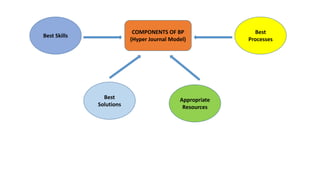
COMPONENTS OF BP
(Hyper Journal Model)
Best
Processes
Best Skills
Best
Solutions
Appropriate
Resources
Best process
• The ISO list of standards consists of statements of processes
rather than competencies…
Best skills
• Skills are specific steps to perform a process…
Best solution
• Unique way of solving or ameliorating a problem…
Best resources
• The personnel, materials, equipment, time, and money needed
to implement the practice and to maintain its effectiveness
should be specified.
What are conditions foster the development of a BP in
education?
• School leadership that is transformational
• A teacher knowledge base
• A working milieu
• An incentive/reward system
• A community of practices
• High expectancy levels
• A culture of CI
What are some sources of BP?
1. High Performing Schools. What practices differentiate them from the
other schools?
2. Teacher Awardees. An analysis of the factors that make the awardees
outstanding?
3. Centers of Excellence. Highly respected/demonstrated excellence in the
field.
4. Subject Area Specialist. Most of these people are industry practitioners
and are also based in colleges and universities.
5. Special Schools. Schools in the Division with highly specialized curriculum
programs with a state of the art teaching methods.
6. Local sages. They are considered as the “wise men of the tribe” (E.g.:
remarkable involvement of the senior citizens in the development of the
school).
What motivates the development of BP?
1. To support the SIP
2. To improve learning outcomes
3. To enhance achievement of project
goals
4. Replication/adoption of superior ones
What strategies were used to encourage the development and
dissemination of BP?
1. Tangible and intangible support
2. Empowerment and trainings
3. Monitoring system
4. Celebration of the Best (Acknowledgement)
5. Documentation of the BP.
What are some issues and questions for further development of BP
programs?
1. The term BEST denotes. How many practices be covered? Is
this a competition?
2. Who confirms a BP?
3. What if owners of BP refuse to share, or others use it without
permission?
4. Considering the rapid advances in science and technology, how
long can a BP maintains its usefulness?
5. The effectiveness and validity of a practice is contingent on the
competencies of the users, resources and conditions in physical
and social environment but not in all.
End of Section 1 of 4
(Thanks)
Section 2
Documenting Best Practices
Why document a BP?
1. For replicability
2. For strong advocacy
3. For fidelity of implementation
4. For credibility
5. To facilitate Benchmarking
6. For informed decision-making
• BP promotes a culture of excellence wherein the best are held as models
for others to emulate. It encourages the establishment of a community of
practitioners who continuously seek to improve what they are doing by
learning from the best. A best practice keeps schools acquainted with
what the best among them are doing, thus lessening he quality gap
among schools.
• Moreover, knowing about a BP prevents the reinvention of something
that already exists, thus saving scarce resources for solving other
problems.
• BP studies encourage teachers to enrich, improve, and reconstruct their
own practices by learning from the experiences of their more successful
colleagues.
Process and Progress Documentation:
1. Identify the main steps in developing the BP using the ff.
headings: a) Statement of the problem; b) Analysis of the
nature and causes of the effects of the problem; c)
Brainstorming potential solution; d) Designing and developing
the solution; e) Testing the solution
2. Assigning, training the Process Analyst, and
Documenters to each process.
3. Recording in print or non-print that works and doesn’t
work at each step and the corrective action taken.
4. Recording how the data obtained are used to close the
gap between planned and actual activities and tio
What principles shall guide the identification and confirmation of a BP?
1. Be designed on the basis of the purpose of the end users who after
all, have the final say on the arrangement that best meets their
nees, resources and conditions;
2. Be indicative rather than selective. The procedure shall indicative in
strength as well as the limitations of the practice in relation to its
scope of application. The search criteria shall make clear to the
potential end users what the practice can and connot do;
3. Enhance rather than restrict initiatives. The identification,
confirmation and certification processes should be friendly,
delighting, collaborative experience for both the developers and the
evaluators;
What principles shall guide the identification and confirmation of a BP?
4) Provide for the continuous improvement of a confirmed BP to
prevent obsolescence. Certification is not permanent, it has to be
renewed after a specific period.
5) Include a preliminary analysis to determine whether the solution
can be adopted to the current situation of the potential users and
whether it has been achieving the intended results and impact.
6) Look into such attributes of the practice as effectiveness, efficiency,
acceptability, and transterability.
What are some guidelines for documenting a BP?
1. Gathering and recording information about a selected or preferred
solution should not be done only at the closure stage…
2. Recorders should be assigned then oriented to their tasks and
provided with the necessary materials…
3. Documentation should planned.
4. Utilization of teachers journals and diaries (if necessary)
5. The documentation should highlight the strengths and limitations of
BP.
How is a BP documented?
 The Qualitative Approach
 Often used to document a classroom-based BP developed through
action research.
 A template is provided for this purpose.
How is a BP documented?
 The Quantitative Approach
 Requires numerical analysis or statistical treatment
 There are two (2) Basic Models to be shown in the next slides
Model 1: Traditional Problem Solving
1. Problem Statement
2. Data Collection process
3. Hypothesis
4. Results and discussion
5. Recommendations
Model 2: Reverse Approach
1. Presentation of Results
2. Discuss backward to recount how the results are produced
3 Ways in Reporting Qualitative and Quantitative Research:
1. An Executive Summary – in 2 or 3 pages that highlights the main
results and recommendation. This report is for top decision-makers.
2. A Detailed Technical Report – explains how the study was done. The
report is intended for researchers and the academic community.
3. A Non-technical Report – in 1 or 2 pages for practitioners, mass
media, and the public.
End of Section 2 of 4
(Thanks)
Section 3
The SEDIP Criteria on Best
Practice
What steps were followed in setting up and validating criteria for BP?
1. SETTING UP THE CRITERIA
• From Delphi questionnaire surveys, interviews and consultations
with local, national and foreign SEDIP consultants, division and
school implementation officers and from information obtained from
the internet and related literature, four criteria for identifying Best
Practice together with their descriptors were identified.
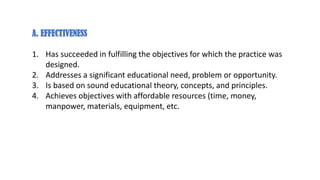
A. EFFECTIVENESS
1. Has succeeded in fulfilling the objectives for which the practice was
designed.
2. Addresses a significant educational need, problem or opportunity.
3. Is based on sound educational theory, concepts, and principles.
4. Achieves objectives with affordable resources (time, money,
manpower, materials, equipment, etc.
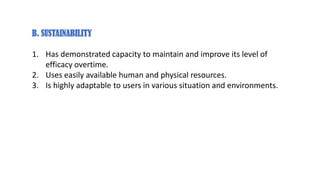
B. SUSTAINABILITY
1. Has demonstrated capacity to maintain and improve its level of
efficacy overtime.
2. Uses easily available human and physical resources.
3. Is highly adaptable to users in various situation and environments.
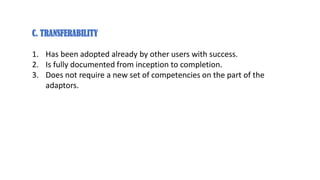
C. TRANSFERABILITY
1. Has been adopted already by other users with success.
2. Is fully documented from inception to completion.
3. Does not require a new set of competencies on the part of the
adaptors.
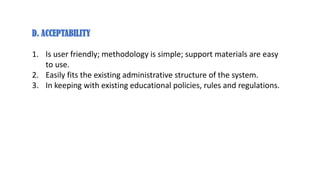
D. ACCEPTABILITY
1. Is user friendly; methodology is simple; support materials are easy
to use.
2. Easily fits the existing administrative structure of the system.
3. In keeping with existing educational policies, rules and regulations.
2. VALIDATION OF CRITERIA
• A rating scale was constructed on the basis of the four criteria and
administered to two groups of potential users, who rated the
acceptability of each criterion.
• The first group of raters was composed of eight project national
consultants and six Division Implementation Advisers (DIA); the
second group was composed of eight Education Program Specialists
(EPS) of the Bureau of Secondary Education (BSE).
• The scale also asked the respondents to present other criteria, give
additional indicators for the criteria, and to point out overlaps or
shortcomings in the indicators.
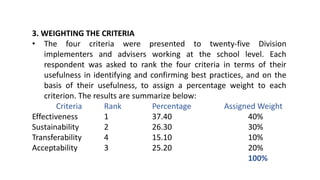
3. WEIGHTING THE CRITERIA
• The four criteria were presented to twenty-five Division
implementers and advisers working at the school level. Each
respondent was asked to rank the four criteria in terms of their
usefulness in identifying and confirming best practices, and on the
basis of their usefulness, to assign a percentage weight to each
criterion. The results are summarize below:
Criteria Rank Percentage Assigned Weight
Effectiveness 1 37.40 40%
Sustainability 2 26.30 30%
Transferability 4 15.10 10%
Acceptability 3 25.20 20%
100%
4. OPERATIONAL FIELD TEST OF THE SEDIP BEST PRACTICE SCALE (BPS)
• The BPS in its final form is a scale for rating a practice on the four
criteria. Each criterion was rated on three indicators, except
effectiveness, which was rate on four.
5. USING THE CRITERIA
• The criteria may be used by the school or the division as a guide in
identifying, developing, confirming or benchmarking Best Practices.
The criteria, especially their indicators, may be modified or
augmented to suit the needs of the end users of the Best Practice.
• The scale was presented to SEDIP consultants for expert validation
and was revised on the basis of the feedback received.
What procedures may be used in searching for a BP?
(See the Flowchart)
How does the quest for a Best Practice start?
• It starts with advocacy. The search process starts with the
endorsement by the DepEd of the SEDIP Best Practices Handbook to
the Division, which then recommends to the schools for utilization.
• Upon receipt, the Schools Division are enjoined to organized a
committee that shall take charge of the search, evaluation, and
certification of Best Practice.
• The committee shall be the advocate of the Best Practices program.
It shall initiate activities to develop awareness of, heighten interest
in, and disseminate information about the program.
• A BP may come from two sources: (1) Proposed by the school for
evaluation and confirmation, and (2) Identified by the Division
Supervisors.
How can school-based practice be confirmed?
• The SBPC prepares a request for the DBPC to conduct validation.
• The DBPC conducts the actual validation (Using DOD with artifacts),
confirms the practice, and recommends to the SDS issuance of best
practice certificate.
• *In case a practice is not confirmed, the DBPC shares the findings
with the developer of the practice in order to help them improve it.
What is the role of the Division Supervisors in the quest for a BP?
• Supervisor’s frequent visitation to schools are opportunities of
looking out promising practices.
• Once best practice is identified, supervisors should immediately
initiate the nomination process.
• Provide technical assistance needed
• Recommend to DBPC for assessment , confirmation and
certification.
• Supervisors play active role in the production of a Best Practice in
schools through active collaboration towards designing and
developing innovations to address pressing school problems.
What steps may be used to establish and operate a school-based system for
the development and confirmation of a BP?
(See Flowchart)
What should be done with the practices that have been certified as Best?
• The certified practice should be packaged so that it can be made
accessible to interested users. The package should include basic
information about the practice, its methods and procedures, as well
as print and non-print support materials for implementing and
assessing the practice.
• Best practice may be publicized through monographs or other
published means so that wider audience may have access to them.
End of Section 3 of 4
(Thanks)
Section 4
Benchmarking of Best Practice
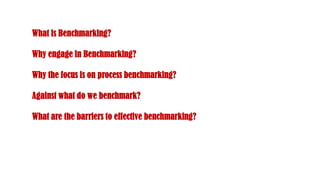
What is Benchmarking?
Why engage in Benchmarking?
Why the focus is on process benchmarking?
Against what do we benchmark?
What are the barriers to effective benchmarking?
PROCESSES & TEMPLATES
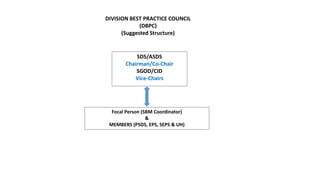
SDS/ASDS
Chairman/Co-Chair
SGOD/CID
Vice-Chairs
Focal Person (SBM Coordinator)
&
MEMBERS (PSDS, EPS, SEPS & UH)
DIVISION BEST PRACTICE COUNCIL
(DBPC)
(Suggested Structure)
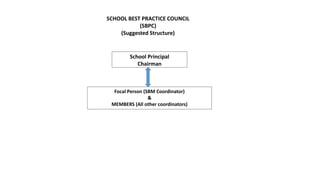
School Principal
Chairman
Focal Person (SBM Coordinator)
&
MEMBERS (All other coordinators)
SCHOOL BEST PRACTICE COUNCIL
(SBPC)
(Suggested Structure)
BEST PRACTICE AS A PROCESS
A.REQUEST FOR THE ASSESSMENT OF A BEST PRACTICE
 School letterhead
 Letter addressed to the Schools Division Superintendent
 Sample content:
Sir/Madam:
I am pleased to inform you that our school has developed an innovative practice
of making Makabayan a laboratory of life by students of Araling Panlipunan, TLE,
MAPEH and Values Education. Attached is a brief description of the practice.
I am recommending the practice for certification as a Best Practice.
Kindly send us the Division Best Practice representatives to assess the practice.
Very truly yours,
SCHOOL PRINCIPAL
B. DOCUMENTING A BEST PRACTICE (GENERIC)
1. Preliminary
Title
Owner/Developer: (Name and Position)
School
School Head
Date started
Date completed
2. The Problem, Causes and Effects (Discussions)
3. The Solution/Intervention
Objectives (What the intervention aims to do or produce?)
Research Questions (What data are needed?)
Strategies
Materials/Equipment
Procedure
4. Methods and Evaluation
 Criteria
 Evaluation (How it was evaluated
5. Findings (Evidences)
6. Recommendations
7. Comments of the School Head
C. DOCUMENTING A BEST PRACTICE DEVELOPED THROUGH
QUALITATIVE RESEARCH
1. Preliminary
 Title
 Owner/Developer: (Name and Position)
 School
 School Head
 Date started
 Date completed
2. The Problem (What problem does the practice seeks to address?
Who are the target groups?), (E.g: There are 8 recorded student
bullying in school in the previous school year); (E.g.: The average
drop-out rate for the 3 consecutive school years is 11.2%).
3. Subjects (What features make the practice unique?); (What
evidence shows that the practice is the best in achieving a particular
objective.
4. Methods of Inquiry
5. Duration
6. Procedures
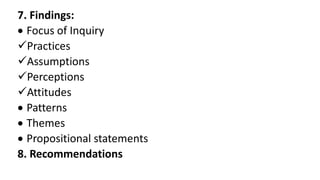
7. Findings:
 Focus of Inquiry
Practices
Assumptions
Perceptions
Attitudes
 Patterns
 Themes
 Propositional statements
8. Recommendations
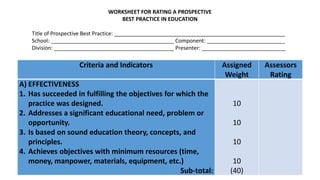
Criteria and Indicators Assigned
Weight
Assessors
Rating
A) EFFECTIVENESS
1. Has succeeded in fulfilling the objectives for which the
practice was designed.
2. Addresses a significant educational need, problem or
opportunity.
3. Is based on sound education theory, concepts, and
principles.
4. Achieves objectives with minimum resources (time,
money, manpower, materials, equipment, etc.)
Sub-total:
10
10
10
10
(40)
WORKSHEET FOR RATING A PROSPECTIVE
BEST PRACTICE IN EDUCATION
Title of Prospective Best Practice: _________________________________________________________
School: _________________________________________ Component: __________________________
Division: ________________________________________ Presenter: ____________________________
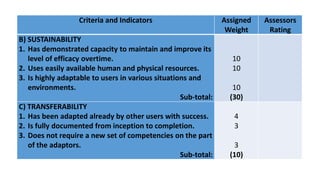
Criteria and Indicators Assigned
Weight
Assessors
Rating
B) SUSTAINABILITY
1. Has demonstrated capacity to maintain and improve its
level of efficacy overtime.
2. Uses easily available human and physical resources.
3. Is highly adaptable to users in various situations and
environments.
Sub-total:
10
10
10
(30)
C) TRANSFERABILITY
1. Has been adapted already by other users with success.
2. Is fully documented from inception to completion.
3. Does not require a new set of competencies on the part
of the adaptors.
Sub-total:
4
3
3
(10)
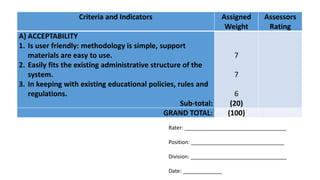
Criteria and Indicators Assigned
Weight
Assessors
Rating
A) ACCEPTABILITY
1. Is user friendly: methodology is simple, support
materials are easy to use.
2. Easily fits the existing administrative structure of the
system.
3. In keeping with existing educational policies, rules and
regulations.
Sub-total:
7
7
6
(20)
GRAND TOTAL: (100)
Rater: __________________________________
Position: _______________________________
Division: ________________________________
Date: _____________
References:
1Best Practice: The SEDIP Handbook
2DepEd NCR-FTAD Handouts
Thank you.

BEST PRACTICE: Identification, Documentation, and Confirmation

  • 1.
    Division Orientation on Identification,Documentation, and Confirmation of Best Practices DR. ZOREN PEPITO GUBALANE Senior Education Program Specialist DepEd, SDO Muntinlupa City
  • 2.
    Section 1 Best Practices:Concepts and Issues
  • 3.
    What is practice? •A way of doing something to achieve a purpose. • A methodology, approach, process, or activity. • A group of steps that is logically sequenced to attain an objective (TQM). • A set of meaningfully organized activities used to achieve desired results. Has related steps that are followed sequentially, with consistency (SEDIP).
  • 4.
    Activity… • Grouping (atleast 4 groups) • Each group thinks of remarkable practices in school and label them according to the following segments:  Practice mandated by DepED  Practice initiated by Practitioners  Scientific practices (teaching & learning processes)  Matured educational technologies, being used 5 years & above • Group presentations
  • 5.
    How do practicevary? (1) By source of origin • Some practices are mandated: hence their observance is system wide and uniform (E.g.: Practice of reporting student performance-MPS after every grading period). • Practitioners themselves initiate some practices in order to address on-the-job problems (E.g.: Use of volunteer Senior students to coach freshmen/sophomores in mathematics. • Practices developed using experimental techniques.
  • 6.
    How do practicevary? (2) By level of development • Mature technologies - practices which have already demonstrated their effectiveness and acceptability and being used by a considerable number of people. • Practices that are still in the development or testing stage. Efficiency is still being assessed; effectiveness is not yet conclusive.
  • 7.
    How do practicevary? • Practices are at “incubation stage”, having been transferred to new environment and replicated in parts still undergoing adjustments. • Practices that prevail mainly because of tradition, custom, usage or convenience. Never been evaluation and their effectiveness is often questioned, nevertheless, many people are already using them in the system.
  • 8.
    What is abest practice? • A process that represents the most effective way of achieving a specific objective (Jan Duffy, 2001). • A method or techniques that have been recognized by qualified sources of information like centers of excellence, recognize organizations, higher authorities, and subject area experts (Inter-American Agency for Cooperation and Development-IACD).
  • 9.
    What is abest practice? • A success story (UNAIDS). • BP emerges to be the most effective, efficient and sustainable after a rigorous comparison with other practices with similar objectives (National Consultant for SEDIP).
  • 10.
    What are thecommon elements of BP? • A compelling purpose directed at solving or alleviating a problem; • A well designed innovative solution that includes a conceptual framework; • A method that specifies the steps, processes and activities to implement solution; • Materials for advocacy, instruction, assessment and evaluation; • Quantitative and qualitative evidence supporting the practice; • Full documentation of the practice; • An owner, developer or champion of the practice; and • Confirmation or certification by recognized authorities.
  • 11.
    COMPONENTS OF BP (HyperJournal Model) Best Processes Best Skills Best Solutions Appropriate Resources
  • 12.
    Best process • TheISO list of standards consists of statements of processes rather than competencies… Best skills • Skills are specific steps to perform a process… Best solution • Unique way of solving or ameliorating a problem… Best resources • The personnel, materials, equipment, time, and money needed to implement the practice and to maintain its effectiveness should be specified.
  • 13.
    What are conditionsfoster the development of a BP in education? • School leadership that is transformational • A teacher knowledge base • A working milieu • An incentive/reward system • A community of practices • High expectancy levels • A culture of CI
  • 14.
    What are somesources of BP? 1. High Performing Schools. What practices differentiate them from the other schools? 2. Teacher Awardees. An analysis of the factors that make the awardees outstanding? 3. Centers of Excellence. Highly respected/demonstrated excellence in the field. 4. Subject Area Specialist. Most of these people are industry practitioners and are also based in colleges and universities. 5. Special Schools. Schools in the Division with highly specialized curriculum programs with a state of the art teaching methods. 6. Local sages. They are considered as the “wise men of the tribe” (E.g.: remarkable involvement of the senior citizens in the development of the school).
  • 15.
    What motivates thedevelopment of BP? 1. To support the SIP 2. To improve learning outcomes 3. To enhance achievement of project goals 4. Replication/adoption of superior ones
  • 16.
    What strategies wereused to encourage the development and dissemination of BP? 1. Tangible and intangible support 2. Empowerment and trainings 3. Monitoring system 4. Celebration of the Best (Acknowledgement) 5. Documentation of the BP.
  • 17.
    What are someissues and questions for further development of BP programs? 1. The term BEST denotes. How many practices be covered? Is this a competition? 2. Who confirms a BP? 3. What if owners of BP refuse to share, or others use it without permission? 4. Considering the rapid advances in science and technology, how long can a BP maintains its usefulness? 5. The effectiveness and validity of a practice is contingent on the competencies of the users, resources and conditions in physical and social environment but not in all.
  • 18.
    End of Section1 of 4 (Thanks)
  • 19.
  • 20.
    Why document aBP? 1. For replicability 2. For strong advocacy 3. For fidelity of implementation 4. For credibility 5. To facilitate Benchmarking 6. For informed decision-making
  • 21.
    • BP promotesa culture of excellence wherein the best are held as models for others to emulate. It encourages the establishment of a community of practitioners who continuously seek to improve what they are doing by learning from the best. A best practice keeps schools acquainted with what the best among them are doing, thus lessening he quality gap among schools. • Moreover, knowing about a BP prevents the reinvention of something that already exists, thus saving scarce resources for solving other problems. • BP studies encourage teachers to enrich, improve, and reconstruct their own practices by learning from the experiences of their more successful colleagues.
  • 22.
    Process and ProgressDocumentation: 1. Identify the main steps in developing the BP using the ff. headings: a) Statement of the problem; b) Analysis of the nature and causes of the effects of the problem; c) Brainstorming potential solution; d) Designing and developing the solution; e) Testing the solution 2. Assigning, training the Process Analyst, and Documenters to each process. 3. Recording in print or non-print that works and doesn’t work at each step and the corrective action taken. 4. Recording how the data obtained are used to close the gap between planned and actual activities and tio
  • 23.
    What principles shallguide the identification and confirmation of a BP? 1. Be designed on the basis of the purpose of the end users who after all, have the final say on the arrangement that best meets their nees, resources and conditions; 2. Be indicative rather than selective. The procedure shall indicative in strength as well as the limitations of the practice in relation to its scope of application. The search criteria shall make clear to the potential end users what the practice can and connot do; 3. Enhance rather than restrict initiatives. The identification, confirmation and certification processes should be friendly, delighting, collaborative experience for both the developers and the evaluators;
  • 24.
    What principles shallguide the identification and confirmation of a BP? 4) Provide for the continuous improvement of a confirmed BP to prevent obsolescence. Certification is not permanent, it has to be renewed after a specific period. 5) Include a preliminary analysis to determine whether the solution can be adopted to the current situation of the potential users and whether it has been achieving the intended results and impact. 6) Look into such attributes of the practice as effectiveness, efficiency, acceptability, and transterability.
  • 25.
    What are someguidelines for documenting a BP? 1. Gathering and recording information about a selected or preferred solution should not be done only at the closure stage… 2. Recorders should be assigned then oriented to their tasks and provided with the necessary materials… 3. Documentation should planned. 4. Utilization of teachers journals and diaries (if necessary) 5. The documentation should highlight the strengths and limitations of BP.
  • 26.
    How is aBP documented?  The Qualitative Approach  Often used to document a classroom-based BP developed through action research.  A template is provided for this purpose.
  • 27.
    How is aBP documented?  The Quantitative Approach  Requires numerical analysis or statistical treatment  There are two (2) Basic Models to be shown in the next slides
  • 28.
    Model 1: TraditionalProblem Solving 1. Problem Statement 2. Data Collection process 3. Hypothesis 4. Results and discussion 5. Recommendations Model 2: Reverse Approach 1. Presentation of Results 2. Discuss backward to recount how the results are produced
  • 29.
    3 Ways inReporting Qualitative and Quantitative Research: 1. An Executive Summary – in 2 or 3 pages that highlights the main results and recommendation. This report is for top decision-makers. 2. A Detailed Technical Report – explains how the study was done. The report is intended for researchers and the academic community. 3. A Non-technical Report – in 1 or 2 pages for practitioners, mass media, and the public.
  • 30.
    End of Section2 of 4 (Thanks)
  • 31.
    Section 3 The SEDIPCriteria on Best Practice
  • 32.
    What steps werefollowed in setting up and validating criteria for BP? 1. SETTING UP THE CRITERIA • From Delphi questionnaire surveys, interviews and consultations with local, national and foreign SEDIP consultants, division and school implementation officers and from information obtained from the internet and related literature, four criteria for identifying Best Practice together with their descriptors were identified.
  • 33.
    A. EFFECTIVENESS 1. Hassucceeded in fulfilling the objectives for which the practice was designed. 2. Addresses a significant educational need, problem or opportunity. 3. Is based on sound educational theory, concepts, and principles. 4. Achieves objectives with affordable resources (time, money, manpower, materials, equipment, etc.
  • 34.
    B. SUSTAINABILITY 1. Hasdemonstrated capacity to maintain and improve its level of efficacy overtime. 2. Uses easily available human and physical resources. 3. Is highly adaptable to users in various situation and environments.
  • 35.
    C. TRANSFERABILITY 1. Hasbeen adopted already by other users with success. 2. Is fully documented from inception to completion. 3. Does not require a new set of competencies on the part of the adaptors.
  • 36.
    D. ACCEPTABILITY 1. Isuser friendly; methodology is simple; support materials are easy to use. 2. Easily fits the existing administrative structure of the system. 3. In keeping with existing educational policies, rules and regulations.
  • 37.
    2. VALIDATION OFCRITERIA • A rating scale was constructed on the basis of the four criteria and administered to two groups of potential users, who rated the acceptability of each criterion. • The first group of raters was composed of eight project national consultants and six Division Implementation Advisers (DIA); the second group was composed of eight Education Program Specialists (EPS) of the Bureau of Secondary Education (BSE). • The scale also asked the respondents to present other criteria, give additional indicators for the criteria, and to point out overlaps or shortcomings in the indicators.
  • 38.
    3. WEIGHTING THECRITERIA • The four criteria were presented to twenty-five Division implementers and advisers working at the school level. Each respondent was asked to rank the four criteria in terms of their usefulness in identifying and confirming best practices, and on the basis of their usefulness, to assign a percentage weight to each criterion. The results are summarize below: Criteria Rank Percentage Assigned Weight Effectiveness 1 37.40 40% Sustainability 2 26.30 30% Transferability 4 15.10 10% Acceptability 3 25.20 20% 100%
  • 39.
    4. OPERATIONAL FIELDTEST OF THE SEDIP BEST PRACTICE SCALE (BPS) • The BPS in its final form is a scale for rating a practice on the four criteria. Each criterion was rated on three indicators, except effectiveness, which was rate on four. 5. USING THE CRITERIA • The criteria may be used by the school or the division as a guide in identifying, developing, confirming or benchmarking Best Practices. The criteria, especially their indicators, may be modified or augmented to suit the needs of the end users of the Best Practice. • The scale was presented to SEDIP consultants for expert validation and was revised on the basis of the feedback received.
  • 40.
    What procedures maybe used in searching for a BP? (See the Flowchart)
  • 41.
    How does thequest for a Best Practice start? • It starts with advocacy. The search process starts with the endorsement by the DepEd of the SEDIP Best Practices Handbook to the Division, which then recommends to the schools for utilization. • Upon receipt, the Schools Division are enjoined to organized a committee that shall take charge of the search, evaluation, and certification of Best Practice. • The committee shall be the advocate of the Best Practices program. It shall initiate activities to develop awareness of, heighten interest in, and disseminate information about the program. • A BP may come from two sources: (1) Proposed by the school for evaluation and confirmation, and (2) Identified by the Division Supervisors.
  • 42.
    How can school-basedpractice be confirmed? • The SBPC prepares a request for the DBPC to conduct validation. • The DBPC conducts the actual validation (Using DOD with artifacts), confirms the practice, and recommends to the SDS issuance of best practice certificate. • *In case a practice is not confirmed, the DBPC shares the findings with the developer of the practice in order to help them improve it.
  • 43.
    What is therole of the Division Supervisors in the quest for a BP? • Supervisor’s frequent visitation to schools are opportunities of looking out promising practices. • Once best practice is identified, supervisors should immediately initiate the nomination process. • Provide technical assistance needed • Recommend to DBPC for assessment , confirmation and certification. • Supervisors play active role in the production of a Best Practice in schools through active collaboration towards designing and developing innovations to address pressing school problems.
  • 44.
    What steps maybe used to establish and operate a school-based system for the development and confirmation of a BP? (See Flowchart)
  • 45.
    What should bedone with the practices that have been certified as Best? • The certified practice should be packaged so that it can be made accessible to interested users. The package should include basic information about the practice, its methods and procedures, as well as print and non-print support materials for implementing and assessing the practice. • Best practice may be publicized through monographs or other published means so that wider audience may have access to them.
  • 46.
    End of Section3 of 4 (Thanks)
  • 47.
  • 48.
    What is Benchmarking? Whyengage in Benchmarking? Why the focus is on process benchmarking? Against what do we benchmark? What are the barriers to effective benchmarking?
  • 49.
  • 50.
    SDS/ASDS Chairman/Co-Chair SGOD/CID Vice-Chairs Focal Person (SBMCoordinator) & MEMBERS (PSDS, EPS, SEPS & UH) DIVISION BEST PRACTICE COUNCIL (DBPC) (Suggested Structure)
  • 51.
    School Principal Chairman Focal Person(SBM Coordinator) & MEMBERS (All other coordinators) SCHOOL BEST PRACTICE COUNCIL (SBPC) (Suggested Structure)
  • 52.
    BEST PRACTICE ASA PROCESS A.REQUEST FOR THE ASSESSMENT OF A BEST PRACTICE  School letterhead  Letter addressed to the Schools Division Superintendent  Sample content: Sir/Madam: I am pleased to inform you that our school has developed an innovative practice of making Makabayan a laboratory of life by students of Araling Panlipunan, TLE, MAPEH and Values Education. Attached is a brief description of the practice. I am recommending the practice for certification as a Best Practice. Kindly send us the Division Best Practice representatives to assess the practice. Very truly yours, SCHOOL PRINCIPAL
  • 53.
    B. DOCUMENTING ABEST PRACTICE (GENERIC) 1. Preliminary Title Owner/Developer: (Name and Position) School School Head Date started Date completed 2. The Problem, Causes and Effects (Discussions)
  • 54.
    3. The Solution/Intervention Objectives(What the intervention aims to do or produce?) Research Questions (What data are needed?) Strategies Materials/Equipment Procedure 4. Methods and Evaluation  Criteria  Evaluation (How it was evaluated 5. Findings (Evidences) 6. Recommendations 7. Comments of the School Head
  • 55.
    C. DOCUMENTING ABEST PRACTICE DEVELOPED THROUGH QUALITATIVE RESEARCH 1. Preliminary  Title  Owner/Developer: (Name and Position)  School  School Head  Date started  Date completed
  • 56.
    2. The Problem(What problem does the practice seeks to address? Who are the target groups?), (E.g: There are 8 recorded student bullying in school in the previous school year); (E.g.: The average drop-out rate for the 3 consecutive school years is 11.2%). 3. Subjects (What features make the practice unique?); (What evidence shows that the practice is the best in achieving a particular objective. 4. Methods of Inquiry 5. Duration 6. Procedures
  • 57.
    7. Findings:  Focusof Inquiry Practices Assumptions Perceptions Attitudes  Patterns  Themes  Propositional statements 8. Recommendations
  • 58.
    Criteria and IndicatorsAssigned Weight Assessors Rating A) EFFECTIVENESS 1. Has succeeded in fulfilling the objectives for which the practice was designed. 2. Addresses a significant educational need, problem or opportunity. 3. Is based on sound education theory, concepts, and principles. 4. Achieves objectives with minimum resources (time, money, manpower, materials, equipment, etc.) Sub-total: 10 10 10 10 (40) WORKSHEET FOR RATING A PROSPECTIVE BEST PRACTICE IN EDUCATION Title of Prospective Best Practice: _________________________________________________________ School: _________________________________________ Component: __________________________ Division: ________________________________________ Presenter: ____________________________
  • 59.
    Criteria and IndicatorsAssigned Weight Assessors Rating B) SUSTAINABILITY 1. Has demonstrated capacity to maintain and improve its level of efficacy overtime. 2. Uses easily available human and physical resources. 3. Is highly adaptable to users in various situations and environments. Sub-total: 10 10 10 (30) C) TRANSFERABILITY 1. Has been adapted already by other users with success. 2. Is fully documented from inception to completion. 3. Does not require a new set of competencies on the part of the adaptors. Sub-total: 4 3 3 (10)
  • 60.
    Criteria and IndicatorsAssigned Weight Assessors Rating A) ACCEPTABILITY 1. Is user friendly: methodology is simple, support materials are easy to use. 2. Easily fits the existing administrative structure of the system. 3. In keeping with existing educational policies, rules and regulations. Sub-total: 7 7 6 (20) GRAND TOTAL: (100) Rater: __________________________________ Position: _______________________________ Division: ________________________________ Date: _____________
  • 61.
    References: 1Best Practice: TheSEDIP Handbook 2DepEd NCR-FTAD Handouts Thank you.