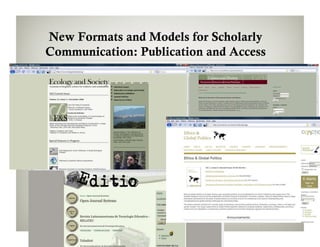
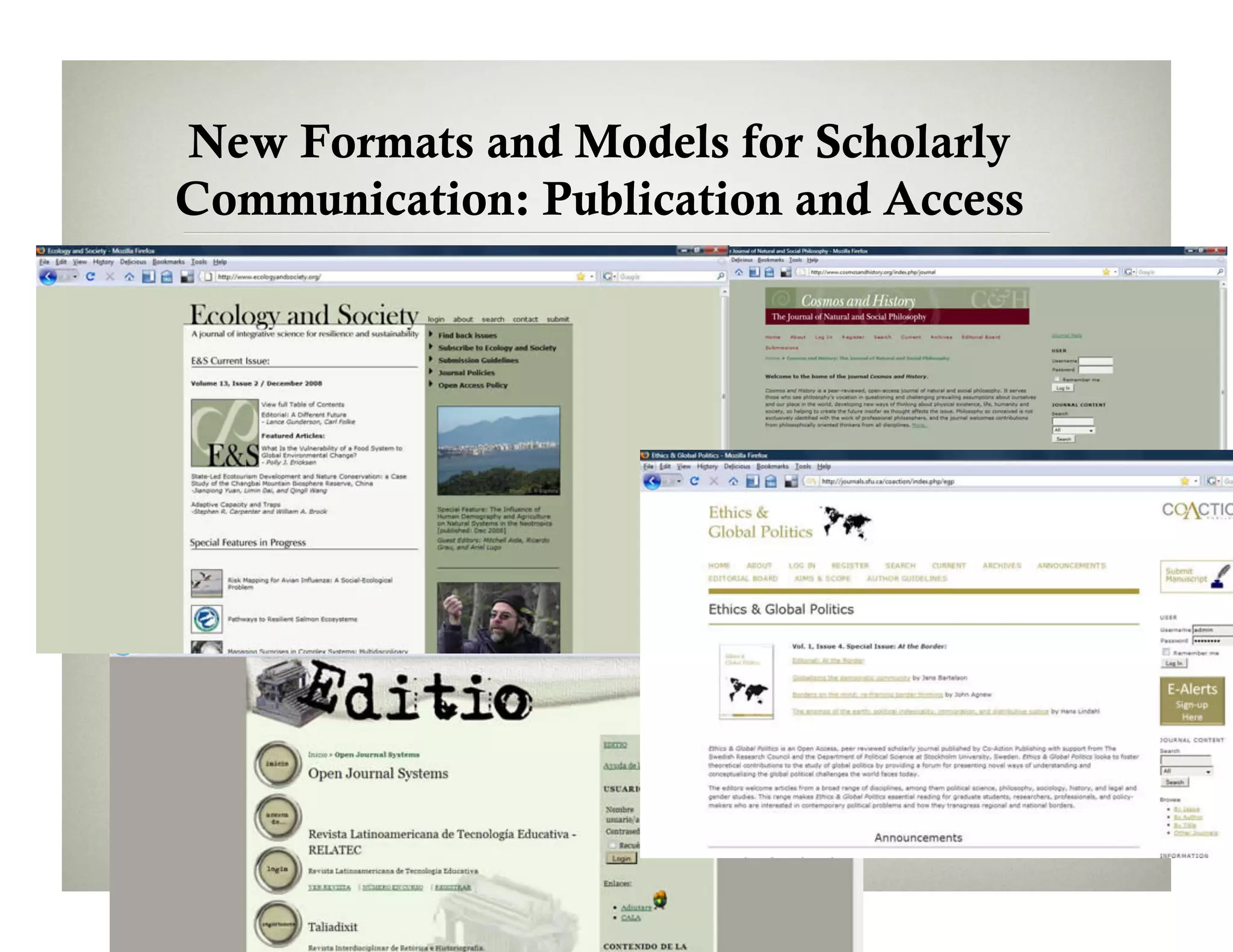

New Formats and Models for Scholarly
Communication: Publication and Access
Scope Note:

For the purposes of discussion today we primarily
                     refer to:
    publication of scholarship, in electronic formats,
                available on the internet
  And on these, we merely scratch the surface
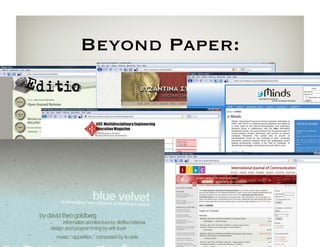
Beyond Paper:
.. and More

Less Obvious Benefits
! you work is more likely to be actually discovered
   
! and cited (and reused)
   
! permits metrics of usage
   
! extends paper bibliography into a “knowledge network” (linking content,
   
citations, scholars & readers to be come an exchange)
"We're living through—in our historical
  generation—the largest increase in
human expressive capability in history."
       - Clay Shirky, Here Comes Everybody: The Power of
        Organizing Without Organizations. Penguin, 2008.
...	
  “but	
  is	
  not	
  without	
  its	
  issues”	
  ...	


    !     access, cost and distribution models
    !     preservation
    !     intellectual property and rights management
    !     media/medium literacy
    !     impact on teaching, learning  the research process
    !     implications for authors  institutions
    !     evaluation  the peer review process
    !     promotion  tenure
Same Old Wine 
           Brand New Bottle
!   Retained traditional distribution/economic model: (subscriptions,
   memberships, pay per article, bundled titles)

!   Scholar writes, the publisher “prints”  the user pays
!   Transition works without disruption  is familiar
!   Electronic copy became a “value-added” product or “new” pay
   service
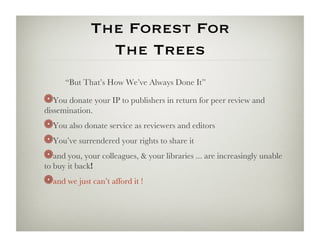
The Forest For 
                The Trees
      “But That’s How We’ve Always Done It”

! You donate your IP to publishers in return for peer review and
   
dissemination.
! You also donate service as reviewers and editors
    
!  You’ve surrendered your rights to share it
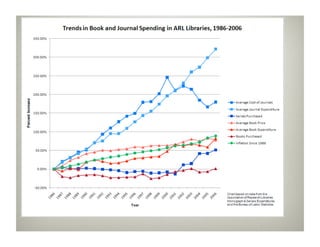
!  and you, your colleagues,  your libraries ... are increasingly unable
to buy it back! 
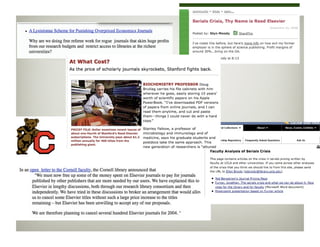
! and we just can’t afford it !
   
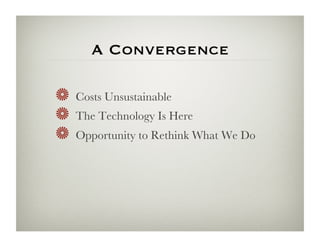
A Convergence

!   Costs Unsustainable 
!   The Technology Is Here
!   Opportunity to Rethink What We Do
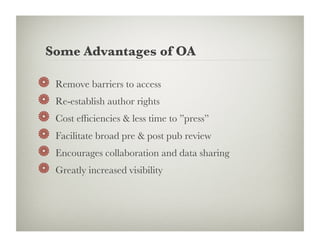
Some Advantages of OA

!     Remove barriers to access
!     Re-establish author rights
!     Cost efficiencies  less time to ”press”
!     Facilitate broad pre  post pub review
!     Encourages collaboration and data sharing 
!     Greatly increased visibility
Unfortunate
       Misconceptions

!   OA is incompatible with peer review.
!   Retaining rights is a reflection of lack of
    quality
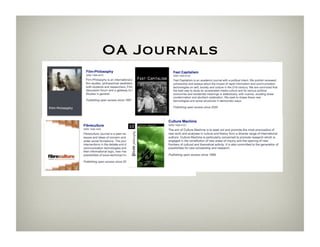
OA Journals
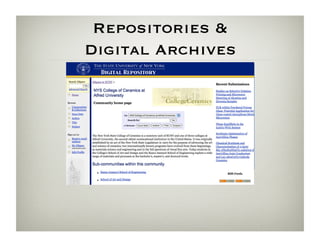
Repositories  
Digital Archives
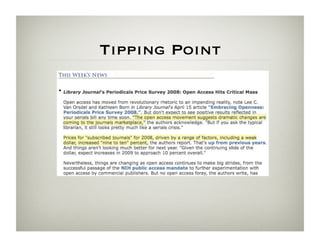
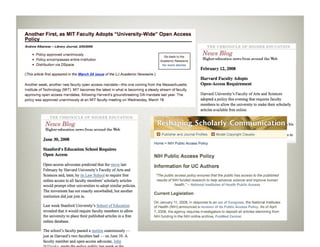
Tipping Point
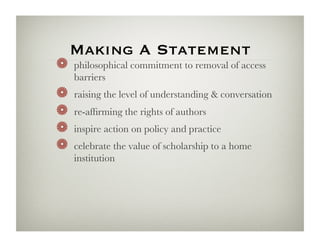
Making A Statement
!   philosophical commitment to removal of access
     barriers
!     raising the level of understanding  conversation
!     re-affirming the rights of authors
!     inspire action on policy and practice
!     celebrate the value of scholarship to a home
     institution
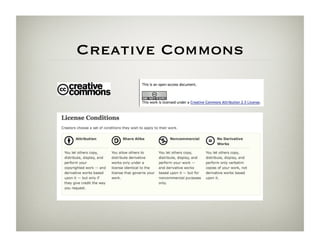
Creative Commons
Recap


!    New formats = new communication opportunities
!    Legacy publ. models ill-suited  unsustainable
!    Opportunities to assert author rights, re-use rights  remove
     access barriers
!    Your work, which you gladly donate, is the currency we will
     use to buy advances in scholarly communication ... where/
     how will you spend it?
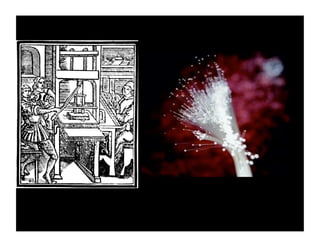
An old tradition and a new technology have converged to make
 possible an unprecedented public good. The old tradition is the
 willingness of scientists and scholars to publish the fruits of their
  research in scholarly journals without payment, for the sake of
   inquiry and knowledge. The new technology is the internet. 

 The public good they make possible is the world-wide electronic
distribution of the peer-reviewed journal literature and completely
     free and unrestricted access to it by all scientists, scholars,
   teachers, students, and other curious minds. Removing access
      barriers to this literature will accelerate research, enrich
       education, ... uniting humanity in a common intellectual
               conversation and quest for knowledge. 

             ---From the Budapest Open Access Initiative

New Formats & Models for Scholarly Communication

  • 1.
    New Formats andModels for Scholarly Communication: Publication and Access
  • 2.
    Scope Note: For thepurposes of discussion today we primarily refer to: publication of scholarship, in electronic formats, available on the internet And on these, we merely scratch the surface
  • 3.
  • 4.
    .. and More LessObvious Benefits ! you work is more likely to be actually discovered   ! and cited (and reused)   ! permits metrics of usage   ! extends paper bibliography into a “knowledge network” (linking content,   citations, scholars & readers to be come an exchange)
  • 5.
    "We're living through—inour historical generation—the largest increase in human expressive capability in history." - Clay Shirky, Here Comes Everybody: The Power of Organizing Without Organizations. Penguin, 2008.
  • 6.
    ...  “but  is  not  without  its  issues”  ...     !   access, cost and distribution models !   preservation !   intellectual property and rights management !   media/medium literacy !   impact on teaching, learning the research process !   implications for authors institutions !   evaluation the peer review process !   promotion tenure
  • 7.
    Same Old Wine Brand New Bottle !   Retained traditional distribution/economic model: (subscriptions, memberships, pay per article, bundled titles) !   Scholar writes, the publisher “prints” the user pays !   Transition works without disruption is familiar !   Electronic copy became a “value-added” product or “new” pay service
  • 8.
    The Forest For The Trees “But That’s How We’ve Always Done It” ! You donate your IP to publishers in return for peer review and   dissemination. ! You also donate service as reviewers and editors   !  You’ve surrendered your rights to share it !  and you, your colleagues, your libraries ... are increasingly unable to buy it back! ! and we just can’t afford it !  
  • 12.
    A Convergence !  Costs Unsustainable !   The Technology Is Here !   Opportunity to Rethink What We Do
  • 13.
    Some Advantages ofOA !   Remove barriers to access !   Re-establish author rights !   Cost efficiencies less time to ”press” !   Facilitate broad pre post pub review !   Encourages collaboration and data sharing !   Greatly increased visibility
  • 14.
    Unfortunate Misconceptions !   OA is incompatible with peer review. !   Retaining rights is a reflection of lack of quality
  • 15.
  • 16.
  • 17.
  • 19.
    Making A Statement !  philosophical commitment to removal of access barriers !   raising the level of understanding conversation !   re-affirming the rights of authors !   inspire action on policy and practice !   celebrate the value of scholarship to a home institution
  • 20.
  • 21.
    Recap !  New formats = new communication opportunities !  Legacy publ. models ill-suited unsustainable !  Opportunities to assert author rights, re-use rights remove access barriers !  Your work, which you gladly donate, is the currency we will use to buy advances in scholarly communication ... where/ how will you spend it?
  • 23.
    An old traditionand a new technology have converged to make possible an unprecedented public good. The old tradition is the willingness of scientists and scholars to publish the fruits of their research in scholarly journals without payment, for the sake of inquiry and knowledge. The new technology is the internet. The public good they make possible is the world-wide electronic distribution of the peer-reviewed journal literature and completely free and unrestricted access to it by all scientists, scholars, teachers, students, and other curious minds. Removing access barriers to this literature will accelerate research, enrich education, ... uniting humanity in a common intellectual conversation and quest for knowledge. ---From the Budapest Open Access Initiative