BERGEY’S MANUAL
CLASSIFICATION
MOHD ARSHAN
MSC IN MICROBIOLOGY
INTRODUCTION
 .A DUAL-PURPOSE MANUAL:
 SYSTEMATIC BACTERIOLOGY:
FOR TAXONOMY AND
PHYLOGENY.
 DETERMINATIVE
BACTERIOLOGY: FOR
IDENTIFICATION IN
LABORATORIES.
Bergey’s manual classification is a manual
referring to the taxonomy of prokaryotic
bacteria .It was prepared by the American
bacteriologist , “DAVID HENDRICKS BERGEY”
in 1923 . It is a manual that deals with the
identification of bacteria
CLASSIFICATION CRITERIA
Key Characteristics for Classification:
 Morphology: Shape, size, and arrangement of cells (e.g., cocci, bacilli).
 Gram Staining: Gram-positive vs. Gram-negative bacteria.
 Oxygen Requirements: Aerobes, anaerobes, facultative anaerobes.
 Biochemical Properties: Enzyme production, fermentation patterns, etc.
 Genetic Relationships: 16S rRNA sequencing and other molecular markers.
PRODUCT OVERVIEW
(gram positive bacteria)
(Large group of gram negative bacteria )
VOLUME 1: THE ARCHAEA AND
THE DEEPLY BRANCHING AND
PHOTOTROPHIC BACTERIA
• Key Features :
• Focuses on evolutionarily ancient bacteria and archaea.
• Includes extremophiles and phototrophic bacteria.
• Major Groups:
• 1. Archaea
• Thermophiles ( Thermoplasma ), halophiles (Halobacterium),
• methanogens ( Methanococcus )
• 2. Deeply Branching Bacteria
• Hyperthermophilic bacteria like Aquifex and Thermotoga .
• 3. Phototrophic Bacteria
• Green sulfur bacteria (Chlorobium) .
• Green non-sulfur bacteria (Chloroflexus).
• Ecological Roles : Thrive in extreme environments .
• Early ancestors of modern prokaryotes.
VOLUME 2: THE PROTEOBACTERIA
(GRAM-NEGATIVE BACTERIA)
• Key Features:
• Largest and most diverse phylum.
• Comprises five classes of Gram-negative bacteria.
• Subgroups (Classes):
• 1 Alpha- proteobacteria
• Includes nitrogen-fixing bacteria (Rhizobium) , rickettsias
• 2. Beta- proteobacteria
• Examples: Neisseria ( causes gonorrhea ) , Bordetella (causes
pertussis).
• 3. Gamma- proteobacteria
• Includes Escherichia coli, Pseudomonas, Salmonella.
• 4. Delta- proteobacteria
• Sulfate -reducing bacteria, predatory bacteria like Bdellovibrio .
• 5. Epsilon- proteobacteria
• Pathogens like Helicobacter pylori, Campylobacter.
• Ecological Roles:
VOLUME 3: THE FIRMICUTES (LOW G+C
GRAM-POSITIVE BACTERIA)
• Key Features :
• Gram-positive bacteria with low G+C content in their DNA
• Includes both spore-forming and non-spore-forming bacteria
• Major Groups:
• 1 .Bacillus and Clostridium (Spore-formers)
• Bacillus anthracis (anthrax), Clostridium botulinum (botulism).
• 2. Lactic Acid Bacteria
• Lactobacillus, Streptococcus.
• 3. Non-Spore Formers
• Staphylococcus (skin infections), Listeria (foodborne
pathogens)
• .Ecological and Industrial Importance :
VOLUME 4: THE PLANCTOMYCETES, SPIROCHAETES,
FIBROBACTERES, BACTEROIDETES, AND OTHERS
KEY FEATURES:
Covers diverse phyla that do not fit neatly into previous categories.
MAJOR GROUPS:
SPIROCHAETES
Spiral -shaped bacteria like Treponema pallidum (syphilis) and Borrelia (Lyme disease).
2. BACTEROIDETES
Includes gut microbiota like Bacteroides (important for digestion).
3. PLANCTOMYCETES
Bacteria with unusual cell walls and internal compartments.
4. CHLAMYDIAE
Obligate intracellular pathogens like Chlamydia trachomatis.
5. OTHER PHYLA:
Fusobacteria, Verrucomicrobia, Acidobacteria, and others.
ECOLOGICAL AND MEDICAL IMPORTANCE:
Pathogens, commensals, symbionts.
Click icon to add picture
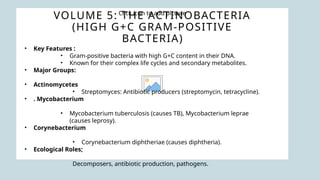
VOLUME 5: THE ACTINOBACTERIA
(HIGH G+C GRAM-POSITIVE
BACTERIA)
• Key Features :
• Gram-positive bacteria with high G+C content in their DNA.
• Known for their complex life cycles and secondary metabolites.
• Major Groups:
• Actinomycetes
• Streptomyces: Antibiotic producers (streptomycin, tetracycline).
• . Mycobacterium
• Mycobacterium tuberculosis (causes TB), Mycobacterium leprae
(causes leprosy).
• Corynebacterium
• Corynebacterium diphtheriae (causes diphtheria).
• Ecological Roles;
Decomposers, antibiotic production, pathogens.
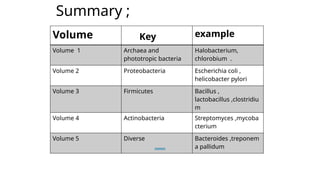
Volume Key example
Volume 1 Archaea and
phototropic bacteria
Halobacterium,
chlorobium .
Volume 2 Proteobacteria Escherichia coli ,
helicobacter pylori
Volume 3 Firmicutes Bacillus ,
lactobacillus ,clostridiu
m
Volume 4 Actinobacteria Streptomyces ,mycoba
cterium
Volume 5 Diverse Bacteroides ,treponem
a pallidum
Summary ;
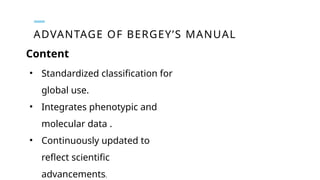
ADVANTAGE OF BERGEY’S MANUAL
• Standardized classification for
global use.
• Integrates phenotypic and
molecular data .
• Continuously updated to
reflect scientific
advancements.
Content
APPLICATION OF BERGEY’S MANUAL
• 1 .Research Applications:
• Framework for studying microbial
diversity
• .Reference for phylogenetic and
taxonomic studies
• .2. Clinical Diagnostics:
• Identifying bacterial pathogens.
• Guides in antibiotic sensitivity
testing
• .3. Industrial Uses:
• Identifying microbes for
biotechnology (e.g., fermentation,
enzyme production).
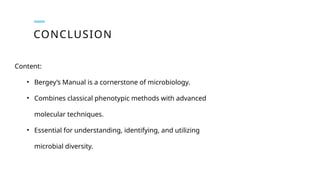
CONCLUSION
Content:
• Bergey’s Manual is a cornerstone of microbiology.
• Combines classical phenotypic methods with advanced
molecular techniques.
• Essential for understanding, identifying, and utilizing
microbial diversity.
THANK YOU
MOHD. ARSHAN

Bergey’s manual classificationBergey’s manual classification.pptx

  • 1.
  • 2.
    INTRODUCTION  .A DUAL-PURPOSEMANUAL:  SYSTEMATIC BACTERIOLOGY: FOR TAXONOMY AND PHYLOGENY.  DETERMINATIVE BACTERIOLOGY: FOR IDENTIFICATION IN LABORATORIES. Bergey’s manual classification is a manual referring to the taxonomy of prokaryotic bacteria .It was prepared by the American bacteriologist , “DAVID HENDRICKS BERGEY” in 1923 . It is a manual that deals with the identification of bacteria
  • 3.
    CLASSIFICATION CRITERIA Key Characteristicsfor Classification:  Morphology: Shape, size, and arrangement of cells (e.g., cocci, bacilli).  Gram Staining: Gram-positive vs. Gram-negative bacteria.  Oxygen Requirements: Aerobes, anaerobes, facultative anaerobes.  Biochemical Properties: Enzyme production, fermentation patterns, etc.  Genetic Relationships: 16S rRNA sequencing and other molecular markers.
  • 4.
  • 6.
    (gram positive bacteria) (Largegroup of gram negative bacteria )
  • 7.
    VOLUME 1: THEARCHAEA AND THE DEEPLY BRANCHING AND PHOTOTROPHIC BACTERIA • Key Features : • Focuses on evolutionarily ancient bacteria and archaea. • Includes extremophiles and phototrophic bacteria. • Major Groups: • 1. Archaea • Thermophiles ( Thermoplasma ), halophiles (Halobacterium), • methanogens ( Methanococcus ) • 2. Deeply Branching Bacteria • Hyperthermophilic bacteria like Aquifex and Thermotoga . • 3. Phototrophic Bacteria • Green sulfur bacteria (Chlorobium) . • Green non-sulfur bacteria (Chloroflexus). • Ecological Roles : Thrive in extreme environments . • Early ancestors of modern prokaryotes.
  • 8.
    VOLUME 2: THEPROTEOBACTERIA (GRAM-NEGATIVE BACTERIA) • Key Features: • Largest and most diverse phylum. • Comprises five classes of Gram-negative bacteria. • Subgroups (Classes): • 1 Alpha- proteobacteria • Includes nitrogen-fixing bacteria (Rhizobium) , rickettsias • 2. Beta- proteobacteria • Examples: Neisseria ( causes gonorrhea ) , Bordetella (causes pertussis). • 3. Gamma- proteobacteria • Includes Escherichia coli, Pseudomonas, Salmonella. • 4. Delta- proteobacteria • Sulfate -reducing bacteria, predatory bacteria like Bdellovibrio . • 5. Epsilon- proteobacteria • Pathogens like Helicobacter pylori, Campylobacter. • Ecological Roles:
  • 9.
    VOLUME 3: THEFIRMICUTES (LOW G+C GRAM-POSITIVE BACTERIA) • Key Features : • Gram-positive bacteria with low G+C content in their DNA • Includes both spore-forming and non-spore-forming bacteria • Major Groups: • 1 .Bacillus and Clostridium (Spore-formers) • Bacillus anthracis (anthrax), Clostridium botulinum (botulism). • 2. Lactic Acid Bacteria • Lactobacillus, Streptococcus. • 3. Non-Spore Formers • Staphylococcus (skin infections), Listeria (foodborne pathogens) • .Ecological and Industrial Importance :
  • 10.
    VOLUME 4: THEPLANCTOMYCETES, SPIROCHAETES, FIBROBACTERES, BACTEROIDETES, AND OTHERS KEY FEATURES: Covers diverse phyla that do not fit neatly into previous categories. MAJOR GROUPS: SPIROCHAETES Spiral -shaped bacteria like Treponema pallidum (syphilis) and Borrelia (Lyme disease). 2. BACTEROIDETES Includes gut microbiota like Bacteroides (important for digestion). 3. PLANCTOMYCETES Bacteria with unusual cell walls and internal compartments. 4. CHLAMYDIAE Obligate intracellular pathogens like Chlamydia trachomatis. 5. OTHER PHYLA: Fusobacteria, Verrucomicrobia, Acidobacteria, and others. ECOLOGICAL AND MEDICAL IMPORTANCE: Pathogens, commensals, symbionts.
  • 11.
    Click icon toadd picture VOLUME 5: THE ACTINOBACTERIA (HIGH G+C GRAM-POSITIVE BACTERIA) • Key Features : • Gram-positive bacteria with high G+C content in their DNA. • Known for their complex life cycles and secondary metabolites. • Major Groups: • Actinomycetes • Streptomyces: Antibiotic producers (streptomycin, tetracycline). • . Mycobacterium • Mycobacterium tuberculosis (causes TB), Mycobacterium leprae (causes leprosy). • Corynebacterium • Corynebacterium diphtheriae (causes diphtheria). • Ecological Roles; Decomposers, antibiotic production, pathogens.
  • 12.
    Volume Key example Volume1 Archaea and phototropic bacteria Halobacterium, chlorobium . Volume 2 Proteobacteria Escherichia coli , helicobacter pylori Volume 3 Firmicutes Bacillus , lactobacillus ,clostridiu m Volume 4 Actinobacteria Streptomyces ,mycoba cterium Volume 5 Diverse Bacteroides ,treponem a pallidum Summary ;
  • 13.
    ADVANTAGE OF BERGEY’SMANUAL • Standardized classification for global use. • Integrates phenotypic and molecular data . • Continuously updated to reflect scientific advancements. Content
  • 14.
    APPLICATION OF BERGEY’SMANUAL • 1 .Research Applications: • Framework for studying microbial diversity • .Reference for phylogenetic and taxonomic studies • .2. Clinical Diagnostics: • Identifying bacterial pathogens. • Guides in antibiotic sensitivity testing • .3. Industrial Uses: • Identifying microbes for biotechnology (e.g., fermentation, enzyme production).
  • 15.
    CONCLUSION Content: • Bergey’s Manualis a cornerstone of microbiology. • Combines classical phenotypic methods with advanced molecular techniques. • Essential for understanding, identifying, and utilizing microbial diversity.
  • 16.