Strengthening Capacity for Strategic
Agricultural Policy and Investment Planning
       and Implementation in Africa:
             Training Workshop

       Background, Goal and Objectives


                 Samuel Benin

            Safari Park Hotel, Nairobi
                11-13 April 2012
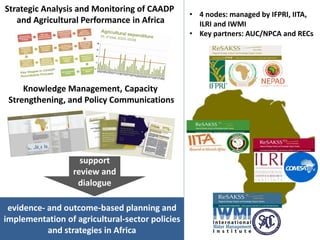
Strategic Analysis and Monitoring of CAADP
                                                 • 4 nodes: managed by IFPRI, IITA,
   and Agricultural Performance in Africa          ILRI and IWMI
                                                 • Key partners: AUC/NPCA and RECs


     Knowledge Management, Capacity
 Strengthening, and Policy Communications


                    support
                  review and
                   dialogue

 evidence- and outcome-based planning and
implementation of agricultural-sector policies
           and strategies in Africa
ReSAKSS Phase I (2007-2010)
• Website (www.resakss.org), e-newsletter/blog (www.resakss.wordpress.com), and
   other social media (Facebook, twitter, Flickr): data, tools, analysis, news,
   knowledge products, and links to resources on CAADP implementation
• Developed CAADP M&E framework and conduct data collection and
  analysis to monitor progress towards CAADP benchmark targets—
  published annually in a continental and three sub-regional flagship annual
  trends and outlook reports
• Growth and investment analysis for the country CAADP compacts and
  technical reviews of the national agricultural investment plans
• Provided technical assistance to establish country SAKSS nodes in Malawi,
  Mozambique, Rwanda, and Uganda.
• Established a Working Paper and an Issue Brief series that analyzes key
  growth and poverty reduction issues in Africa
• Trained several researchers, policy analysts, and development
  professionals on data collection and different topics related to agricultural
  policy analysis
Objective of ReSAKSS Phase II
             (2011-2015)

• Establish and operationalize or strengthen
  country SAKSS nodes; depending on the
  country’s state in the CAADP process and
  readiness in setting a SAKSS
Approach
• Depends strongly on the readiness of a country
  determined by the stage of the country in the CADDP
  process in addition to having funds allocated for the
  operations of the SAKSS
   – SAKSS-ready for those countries that have a functional
     SAKSS or have a NAIP and there is potential funding to
     cover or expand the operations of the SAKSS
   – SAKSS-sensitized for those countries that have advanced
     in the CAADP process (have a NAIP or signed a compact)
   – SAKSS-beginning for countries where the CAADP process is
     in the pre-compact stages or is yet to be launched.
Objective of Regional Workshops
• Training on SAKSS concepts
• Agricultural policy analysis and monitoring
  and evaluation
• Launch capacity needs assessment work
Topics (see agenda)
• Strategic analysis and research methods
• Project management and M&E
• Communications
• Capacity (systems, human and institutional)
  needs assessment
• Transformational leadership
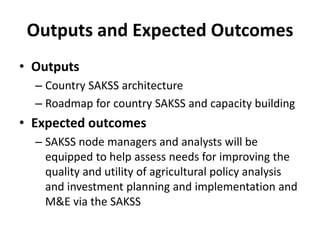
Outputs and Expected Outcomes
• Outputs
  – Country SAKSS architecture
  – Roadmap for country SAKSS and capacity building
• Expected outcomes
  – SAKSS node managers and analysts will be
    equipped to help assess needs for improving the
    quality and utility of agricultural policy analysis
    and investment planning and implementation and
    M&E via the SAKSS
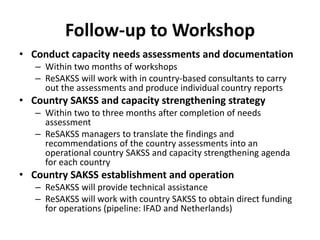
Follow-up to Workshop
• Conduct capacity needs assessments and documentation
   – Within two months of workshops
   – ReSAKSS will work with in country-based consultants to carry
     out the assessments and produce individual country reports
• Country SAKSS and capacity strengthening strategy
   – Within two to three months after completion of needs
     assessment
   – ReSAKSS managers to translate the findings and
     recommendations of the country assessments into an
     operational country SAKSS and capacity strengthening agenda
     for each country
• Country SAKSS establishment and operation
   – ReSAKSS will provide technical assistance
   – ReSAKSS will work with country SAKSS to obtain direct funding
     for operations (pipeline: IFAD and Netherlands)

Benin nairobi

  • 1.
    Strengthening Capacity forStrategic Agricultural Policy and Investment Planning and Implementation in Africa: Training Workshop Background, Goal and Objectives Samuel Benin Safari Park Hotel, Nairobi 11-13 April 2012
  • 2.
    Strategic Analysis andMonitoring of CAADP • 4 nodes: managed by IFPRI, IITA, and Agricultural Performance in Africa ILRI and IWMI • Key partners: AUC/NPCA and RECs Knowledge Management, Capacity Strengthening, and Policy Communications support review and dialogue evidence- and outcome-based planning and implementation of agricultural-sector policies and strategies in Africa
  • 3.
    ReSAKSS Phase I(2007-2010) • Website (www.resakss.org), e-newsletter/blog (www.resakss.wordpress.com), and other social media (Facebook, twitter, Flickr): data, tools, analysis, news, knowledge products, and links to resources on CAADP implementation • Developed CAADP M&E framework and conduct data collection and analysis to monitor progress towards CAADP benchmark targets— published annually in a continental and three sub-regional flagship annual trends and outlook reports • Growth and investment analysis for the country CAADP compacts and technical reviews of the national agricultural investment plans • Provided technical assistance to establish country SAKSS nodes in Malawi, Mozambique, Rwanda, and Uganda. • Established a Working Paper and an Issue Brief series that analyzes key growth and poverty reduction issues in Africa • Trained several researchers, policy analysts, and development professionals on data collection and different topics related to agricultural policy analysis
  • 4.
    Objective of ReSAKSSPhase II (2011-2015) • Establish and operationalize or strengthen country SAKSS nodes; depending on the country’s state in the CAADP process and readiness in setting a SAKSS
  • 5.
    Approach • Depends stronglyon the readiness of a country determined by the stage of the country in the CADDP process in addition to having funds allocated for the operations of the SAKSS – SAKSS-ready for those countries that have a functional SAKSS or have a NAIP and there is potential funding to cover or expand the operations of the SAKSS – SAKSS-sensitized for those countries that have advanced in the CAADP process (have a NAIP or signed a compact) – SAKSS-beginning for countries where the CAADP process is in the pre-compact stages or is yet to be launched.
  • 6.
    Objective of RegionalWorkshops • Training on SAKSS concepts • Agricultural policy analysis and monitoring and evaluation • Launch capacity needs assessment work
  • 7.
    Topics (see agenda) •Strategic analysis and research methods • Project management and M&E • Communications • Capacity (systems, human and institutional) needs assessment • Transformational leadership
  • 8.
    Outputs and ExpectedOutcomes • Outputs – Country SAKSS architecture – Roadmap for country SAKSS and capacity building • Expected outcomes – SAKSS node managers and analysts will be equipped to help assess needs for improving the quality and utility of agricultural policy analysis and investment planning and implementation and M&E via the SAKSS
  • 9.
    Follow-up to Workshop •Conduct capacity needs assessments and documentation – Within two months of workshops – ReSAKSS will work with in country-based consultants to carry out the assessments and produce individual country reports • Country SAKSS and capacity strengthening strategy – Within two to three months after completion of needs assessment – ReSAKSS managers to translate the findings and recommendations of the country assessments into an operational country SAKSS and capacity strengthening agenda for each country • Country SAKSS establishment and operation – ReSAKSS will provide technical assistance – ReSAKSS will work with country SAKSS to obtain direct funding for operations (pipeline: IFAD and Netherlands)