ALTERNATE
ALTERNATE
ALTERNATE
CONSTRUCTION
CONSTRUCTION
CONSTRUCTION
MATERIAL AND TECHNIQUES
UNIT - 4
UNIT - 4
UNIT - 4
BUILDING CONSTRUCTION & MATERIALS VII
SUBMITTED BY -
ABDURRAB ANSARI
SUBMITTED TO -
AR. TARIQUL ISLAM
AR. SHRIYA AGRAWAL
YEAR - 4TH
SEMESTER - 7TH
SESSION - 2023-24
STUDIO - 4
FOAPD, INTEGRAL UNIVERSITY
Revolutionizing Construction
Materials:
The Power of Graphene
Discover the key advantages of graphene in construction materials,
including enhanced strength, conductivity, and durability, paving the
way for a new era in modern architecture.
Advantages of the Use of Graphene in Construction :
Strength and weight: Graphene is strong and lightweight.
Energy efficiency: Graphene has good thermal and electrical
conductivity.
Environmental impact: Graphene can help reduce the
environmental impact of construction.
Cost: Graphene can reduce costs.
Carbon emissions: Graphene can reduce carbon emissions.
Cement
Anti-corrosion coatings
Thermal and acoustic insulators
Asphalt
Firefighting materials
Graphene is a carbon material that is the thinnest and strongest
known material. It is made up of a single layer of carbon atoms.
Graphene has many potential advantages for construction materials,
including:
Graphene can be used in many construction materials, including:
Graphene can also improve the following properties of building
materials: Durability, Mechanical strength, Hardness, Flexibility
Construction Projects based on Graphene :
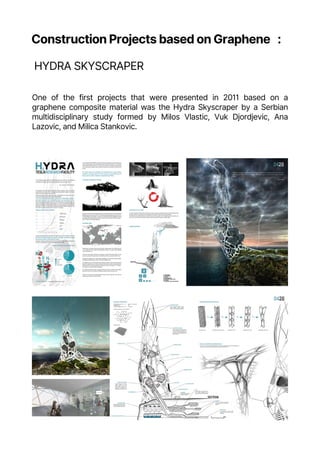
HYDRA SKYSCRAPER
One of the first projects that were presented in 2011 based on a
graphene composite material was the Hydra Skyscraper by a Serbian
multidisciplinary study formed by Milos Vlastic, Vuk Djordjevic, Ana
Lazovic, and Milica Stankovic.
Unleashing the Potential of Self-
Compacting Concrete (SCC)
1 Efficiency🏗️
Explore the significance of SCC and how it eliminates the need
for manual compaction, resulting in faster construction
processes and improved productivity.
2 Enhanced Quality💯
Uncover the potential benefits of SCC, such as improved
surface finish, better formwork quality, and reduced noise
pollution.
3 Sustainability♻️
Discover how SCC reduces material waste and enables more
effective use of resources, aligning with sustainable
construction practices.
Cost-efficiency
Aesthetic excellence
Enhanced structural durability
Versatility with complex formwork
Reduced construction time and labor cost
Improved surface finishing
Ensured compaction especially in the confined zones
Saved the cost of compaction
Other advantages of SCC include:
SCC is made up of a high proportion of fine aggregate, such as sand,
combined with superplasticizers and viscosity-enhancing admixtures.
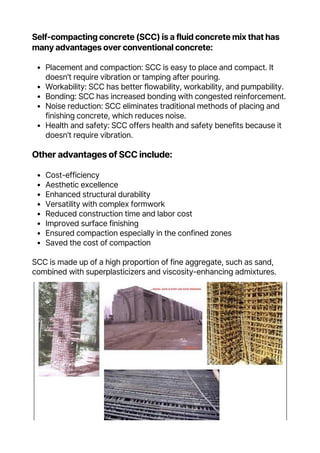
Placement and compaction: SCC is easy to place and compact. It
doesn't require vibration or tamping after pouring.
Workability: SCC has better flowability, workability, and pumpability.
Bonding: SCC has increased bonding with congested reinforcement.
Noise reduction: SCC eliminates traditional methods of placing and
finishing concrete, which reduces noise.
Health and safety: SCC offers health and safety benefits because it
doesn't require vibration.
Self-compacting concrete (SCC) is a fluid concrete mix that has
many advantages over conventional concrete:
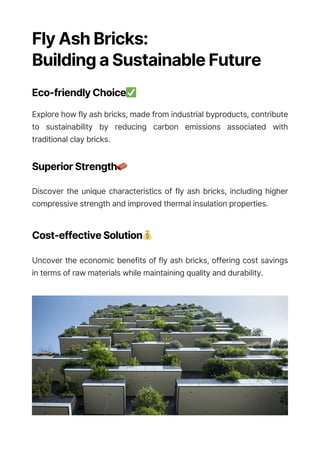
Fly Ash Bricks:
Building a Sustainable Future
Eco-friendly Choice✅
Explore how fly ash bricks, made from industrial byproducts, contribute
to sustainability by reducing carbon emissions associated with
traditional clay bricks.
Superior Strength🧱
Discover the unique characteristics of fly ash bricks, including higher
compressive strength and improved thermal insulation properties.
Cost-effective Solution💰
Uncover the economic benefits of fly ash bricks, offering cost savings
in terms of raw materials while maintaining quality and durability.
Low density
Micro porosity
High surface hardness
Negligible shrinkage
Thermal stability
Fire and chemical resistance
Fly ash bricks also have the following characteristics:
Fly ash is a by-product or waste product. Using fly ash concrete reduces
CO2 and is environmentally friendly.
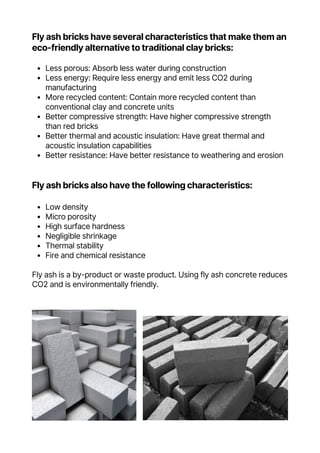
Less porous: Absorb less water during construction
Less energy: Require less energy and emit less CO2 during
manufacturing
More recycled content: Contain more recycled content than
conventional clay and concrete units
Better compressive strength: Have higher compressive strength
than red bricks
Better thermal and acoustic insulation: Have great thermal and
acoustic insulation capabilities
Better resistance: Have better resistance to weathering and erosion
Fly ash bricks have several characteristics that make them an
eco-friendly alternative to traditional clay bricks:
The Translucent Marvel:
Reinventing Concrete with Light
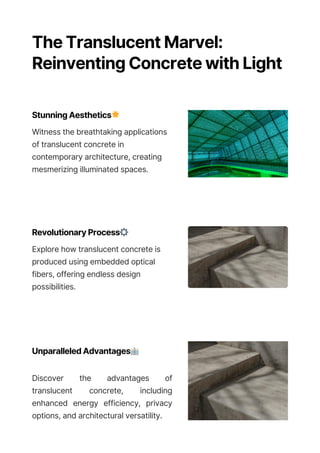
Stunning Aesthetics🌟
Witness the breathtaking applications
of translucent concrete in
contemporary architecture, creating
mesmerizing illuminated spaces.
Revolutionary Process⚙️
Explore how translucent concrete is
produced using embedded optical
fibers, offering endless design
possibilities.
Unparalleled Advantages🏢
Discover the advantages of
translucent concrete, including
enhanced energy efficiency, privacy
options, and architectural versatility.
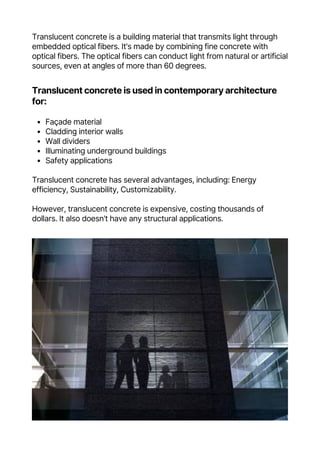
Translucent concrete is a building material that transmits light through
embedded optical fibers. It's made by combining fine concrete with
optical fibers. The optical fibers can conduct light from natural or artificial
sources, even at angles of more than 60 degrees.
Façade material
Cladding interior walls
Wall dividers
Illuminating underground buildings
Safety applications
Translucent concrete is used in contemporary architecture
for:
Translucent concrete has several advantages, including: Energy
efficiency, Sustainability, Customizability.
However, translucent concrete is expensive, costing thousands of
dollars. It also doesn't have any structural applications.
Energy-saving: Translucent concrete can transmit light from natural
and artificial sources, so buildings can have fewer lights. This can
save a lot of energy.
Environmentally friendly: Translucent concrete is environmentally
friendly because it reduces energy consumption.
Good aesthetics: Translucent concrete can give buildings a good
aesthetic view.
Weather-insensitive: Translucent concrete is weather-insensitive, so
it's durable.
Green and sustainable buildings: Translucent concrete encourages
the construction of green and sustainable buildings.
Translucent concrete has several advantages over standard
concrete:
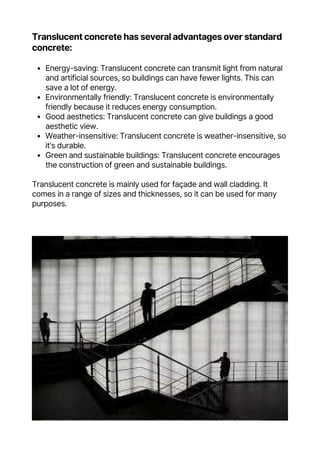
Translucent concrete is mainly used for façade and wall cladding. It
comes in a range of sizes and thicknesses, so it can be used for many
purposes.
Ferrocement: A Breakthrough in
Modern Infrastructure
Ferrocement is a versatile construction material that has the potential
to revolutionize modern infrastructure. While it faces some challenges,
the advantages and breakthroughs in technology make ferrocement a
promising contender as a mainstream material in construction projects.
Advantages of Ferrocement :
Durability and Strength
Ferrocement has a high tensile
strength and is resistant to
cracks and deformation. Its low
permeability also makes it ideal
for structures that face
exposure to extreme weathering
and high water pressure.
Cost-Effectiveness and
Flexibility
Ferrocement can be produced
using simple and affordable
materials, reducing its overall
costs compared to other
conventional construction
materials. It's also flexible,
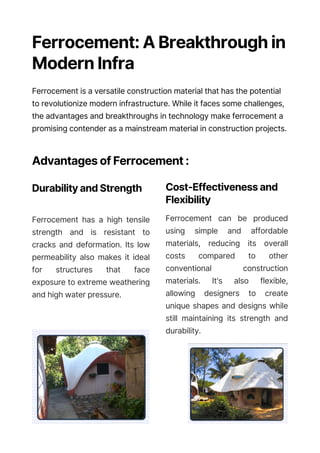
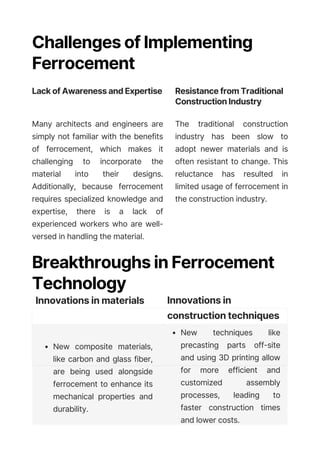
allowing designers to create
unique shapes and designs while
still maintaining its strength and
durability.
Challenges of Implementing
Ferrocement
Lack of Awareness and Expertise
Many architects and engineers are
simply not familiar with the benefits
of ferrocement, which makes it
challenging to incorporate the
material into their designs.
Additionally, because ferrocement
requires specialized knowledge and
expertise, there is a lack of
experienced workers who are well-
versed in handling the material.
Resistance from Traditional
Construction Industry
The traditional construction
industry has been slow to
adopt newer materials and is
often resistant to change. This
reluctance has resulted in
limited usage of ferrocement in
the construction industry.
Breakthroughs in Ferrocement
Technology
Innovations in materials Innovations in
construction techniques
New composite materials,
like carbon and glass fiber,
are being used alongside
ferrocement to enhance its
mechanical properties and
durability.
New techniques like
precasting parts off-site
and using 3D printing allow
for more efficient and
customized assembly
processes, leading to
faster construction times
and lower costs.
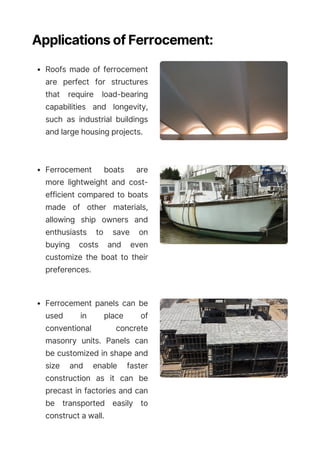
Applications of Ferrocement:
Roofs made of ferrocement
are perfect for structures
that require load-bearing
capabilities and longevity,
such as industrial buildings
and large housing projects.
Ferrocement boats are
more lightweight and cost-
efficient compared to boats
made of other materials,
allowing ship owners and
enthusiasts to save on
buying costs and even
customize the boat to their
preferences.
Ferrocement panels can be
used in place of
conventional concrete
masonry units. Panels can
be customized in shape and
size and enable faster
construction as it can be
precast in factories and can
be transported easily to
construct a wall.
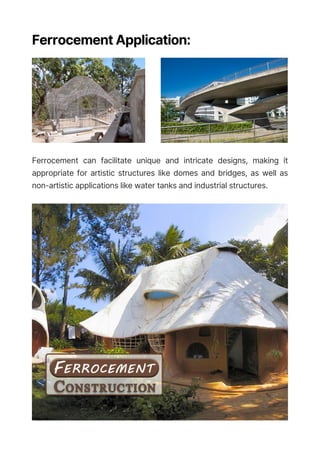
Ferrocement Application:
Ferrocement can facilitate unique and intricate designs, making it
appropriate for artistic structures like domes and bridges, as well as
non-artistic applications like water tanks and industrial structures.

Alternate Construction Material & Techniques

  • 1.
    ALTERNATE ALTERNATE ALTERNATE CONSTRUCTION CONSTRUCTION CONSTRUCTION MATERIAL AND TECHNIQUES MATERIALAND TECHNIQUES MATERIAL AND TECHNIQUES UNIT - 4 UNIT - 4 UNIT - 4 BUILDING CONSTRUCTION & MATERIALS VII SUBMITTED BY - ABDURRAB ANSARI SUBMITTED TO - AR. TARIQUL ISLAM AR. SHRIYA AGRAWAL YEAR - 4TH SEMESTER - 7TH SESSION - 2023-24 STUDIO - 4 FOAPD, INTEGRAL UNIVERSITY
  • 2.
    Revolutionizing Construction Materials: The Powerof Graphene Discover the key advantages of graphene in construction materials, including enhanced strength, conductivity, and durability, paving the way for a new era in modern architecture. Advantages of the Use of Graphene in Construction : Strength and weight: Graphene is strong and lightweight. Energy efficiency: Graphene has good thermal and electrical conductivity. Environmental impact: Graphene can help reduce the environmental impact of construction. Cost: Graphene can reduce costs. Carbon emissions: Graphene can reduce carbon emissions. Cement Anti-corrosion coatings Thermal and acoustic insulators Asphalt Firefighting materials Graphene is a carbon material that is the thinnest and strongest known material. It is made up of a single layer of carbon atoms. Graphene has many potential advantages for construction materials, including: Graphene can be used in many construction materials, including: Graphene can also improve the following properties of building materials: Durability, Mechanical strength, Hardness, Flexibility
  • 3.
    Construction Projects basedon Graphene : HYDRA SKYSCRAPER One of the first projects that were presented in 2011 based on a graphene composite material was the Hydra Skyscraper by a Serbian multidisciplinary study formed by Milos Vlastic, Vuk Djordjevic, Ana Lazovic, and Milica Stankovic.
  • 4.
    Unleashing the Potentialof Self- Compacting Concrete (SCC) 1 Efficiency🏗️ Explore the significance of SCC and how it eliminates the need for manual compaction, resulting in faster construction processes and improved productivity. 2 Enhanced Quality💯 Uncover the potential benefits of SCC, such as improved surface finish, better formwork quality, and reduced noise pollution. 3 Sustainability♻️ Discover how SCC reduces material waste and enables more effective use of resources, aligning with sustainable construction practices.
  • 5.
    Cost-efficiency Aesthetic excellence Enhanced structuraldurability Versatility with complex formwork Reduced construction time and labor cost Improved surface finishing Ensured compaction especially in the confined zones Saved the cost of compaction Other advantages of SCC include: SCC is made up of a high proportion of fine aggregate, such as sand, combined with superplasticizers and viscosity-enhancing admixtures. Placement and compaction: SCC is easy to place and compact. It doesn't require vibration or tamping after pouring. Workability: SCC has better flowability, workability, and pumpability. Bonding: SCC has increased bonding with congested reinforcement. Noise reduction: SCC eliminates traditional methods of placing and finishing concrete, which reduces noise. Health and safety: SCC offers health and safety benefits because it doesn't require vibration. Self-compacting concrete (SCC) is a fluid concrete mix that has many advantages over conventional concrete:
  • 6.
    Fly Ash Bricks: Buildinga Sustainable Future Eco-friendly Choice✅ Explore how fly ash bricks, made from industrial byproducts, contribute to sustainability by reducing carbon emissions associated with traditional clay bricks. Superior Strength🧱 Discover the unique characteristics of fly ash bricks, including higher compressive strength and improved thermal insulation properties. Cost-effective Solution💰 Uncover the economic benefits of fly ash bricks, offering cost savings in terms of raw materials while maintaining quality and durability.
  • 7.
    Low density Micro porosity Highsurface hardness Negligible shrinkage Thermal stability Fire and chemical resistance Fly ash bricks also have the following characteristics: Fly ash is a by-product or waste product. Using fly ash concrete reduces CO2 and is environmentally friendly. Less porous: Absorb less water during construction Less energy: Require less energy and emit less CO2 during manufacturing More recycled content: Contain more recycled content than conventional clay and concrete units Better compressive strength: Have higher compressive strength than red bricks Better thermal and acoustic insulation: Have great thermal and acoustic insulation capabilities Better resistance: Have better resistance to weathering and erosion Fly ash bricks have several characteristics that make them an eco-friendly alternative to traditional clay bricks:
  • 8.
    The Translucent Marvel: ReinventingConcrete with Light Stunning Aesthetics🌟 Witness the breathtaking applications of translucent concrete in contemporary architecture, creating mesmerizing illuminated spaces. Revolutionary Process⚙️ Explore how translucent concrete is produced using embedded optical fibers, offering endless design possibilities. Unparalleled Advantages🏢 Discover the advantages of translucent concrete, including enhanced energy efficiency, privacy options, and architectural versatility.
  • 9.
    Translucent concrete isa building material that transmits light through embedded optical fibers. It's made by combining fine concrete with optical fibers. The optical fibers can conduct light from natural or artificial sources, even at angles of more than 60 degrees. Façade material Cladding interior walls Wall dividers Illuminating underground buildings Safety applications Translucent concrete is used in contemporary architecture for: Translucent concrete has several advantages, including: Energy efficiency, Sustainability, Customizability. However, translucent concrete is expensive, costing thousands of dollars. It also doesn't have any structural applications.
  • 10.
    Energy-saving: Translucent concretecan transmit light from natural and artificial sources, so buildings can have fewer lights. This can save a lot of energy. Environmentally friendly: Translucent concrete is environmentally friendly because it reduces energy consumption. Good aesthetics: Translucent concrete can give buildings a good aesthetic view. Weather-insensitive: Translucent concrete is weather-insensitive, so it's durable. Green and sustainable buildings: Translucent concrete encourages the construction of green and sustainable buildings. Translucent concrete has several advantages over standard concrete: Translucent concrete is mainly used for façade and wall cladding. It comes in a range of sizes and thicknesses, so it can be used for many purposes.
  • 11.
    Ferrocement: A Breakthroughin Modern Infrastructure Ferrocement is a versatile construction material that has the potential to revolutionize modern infrastructure. While it faces some challenges, the advantages and breakthroughs in technology make ferrocement a promising contender as a mainstream material in construction projects. Advantages of Ferrocement : Durability and Strength Ferrocement has a high tensile strength and is resistant to cracks and deformation. Its low permeability also makes it ideal for structures that face exposure to extreme weathering and high water pressure. Cost-Effectiveness and Flexibility Ferrocement can be produced using simple and affordable materials, reducing its overall costs compared to other conventional construction materials. It's also flexible, allowing designers to create unique shapes and designs while still maintaining its strength and durability.
  • 12.
    Challenges of Implementing Ferrocement Lackof Awareness and Expertise Many architects and engineers are simply not familiar with the benefits of ferrocement, which makes it challenging to incorporate the material into their designs. Additionally, because ferrocement requires specialized knowledge and expertise, there is a lack of experienced workers who are well- versed in handling the material. Resistance from Traditional Construction Industry The traditional construction industry has been slow to adopt newer materials and is often resistant to change. This reluctance has resulted in limited usage of ferrocement in the construction industry. Breakthroughs in Ferrocement Technology Innovations in materials Innovations in construction techniques New composite materials, like carbon and glass fiber, are being used alongside ferrocement to enhance its mechanical properties and durability. New techniques like precasting parts off-site and using 3D printing allow for more efficient and customized assembly processes, leading to faster construction times and lower costs.
  • 13.
    Applications of Ferrocement: Roofsmade of ferrocement are perfect for structures that require load-bearing capabilities and longevity, such as industrial buildings and large housing projects. Ferrocement boats are more lightweight and cost- efficient compared to boats made of other materials, allowing ship owners and enthusiasts to save on buying costs and even customize the boat to their preferences. Ferrocement panels can be used in place of conventional concrete masonry units. Panels can be customized in shape and size and enable faster construction as it can be precast in factories and can be transported easily to construct a wall.
  • 14.
    Ferrocement Application: Ferrocement canfacilitate unique and intricate designs, making it appropriate for artistic structures like domes and bridges, as well as non-artistic applications like water tanks and industrial structures.