Benchmarking
• Benchmarking as a way to compare key metrics to
other businesses in the industry. This allows
companies to see how well they are performing and
identify ways they can become more competitive in
the industry.
• Companies use benchmarking as a way to help
become more competitive. By looking at how other
companies are doing, they can identify areas where
they are underperforming. Companies are also able
to identify ways they can improve their own
operations without having to recreate the wheel.
They are able to accelerate the process of change
because they have models from other companies in
their industry to help guide their changes.
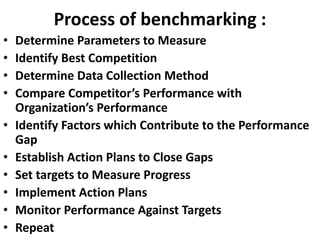
Process of benchmarking :
• Determine Parameters to Measure
• Identify Best Competition
• Determine Data Collection Method
• Compare Competitor’s Performance with
Organization’s Performance
• Identify Factors which Contribute to the Performance
Gap
• Establish Action Plans to Close Gaps
• Set targets to Measure Progress
• Implement Action Plans
• Monitor Performance Against Targets
• Repeat
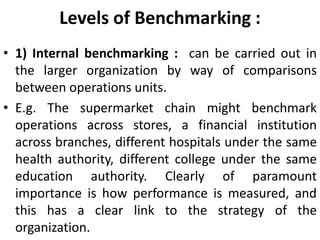
Levels of Benchmarking :
• 1) Internal benchmarking : can be carried out in
the larger organization by way of comparisons
between operations units.
• E.g. The supermarket chain might benchmark
operations across stores, a financial institution
across branches, different hospitals under the same
health authority, different college under the same
education authority. Clearly of paramount
importance is how performance is measured, and
this has a clear link to the strategy of the
organization.
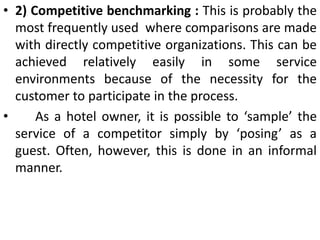
• 2) Competitive benchmarking : This is probably the
most frequently used where comparisons are made
with directly competitive organizations. This can be
achieved relatively easily in some service
environments because of the necessity for the
customer to participate in the process.
• As a hotel owner, it is possible to ‘sample’ the
service of a competitor simply by ‘posing’ as a
guest. Often, however, this is done in an informal
manner.
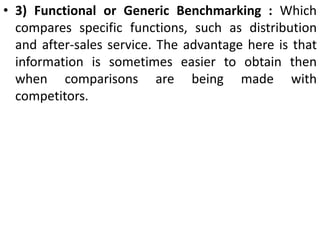
• 3) Functional or Generic Benchmarking : Which
compares specific functions, such as distribution
and after-sales service. The advantage here is that
information is sometimes easier to obtain then
when comparisons are being made with
competitors.
Marketing challenges in services business
• INTRODUCTION : Marketing is not only applicable for
physical tangible goods. It is equally useful to intangible
offers like services. Marketing fundamentals, like
concepts, functions, strategies, processes, etc., can be
applied in service sectors to achieve goals. All service
providers – individuals, institute, or industry – need to
market their services.
From marketing viewpoint, they can apply all marketing
tactics and techniques for better consumer satisfaction.
Banking, insurance, transportation (roadways, railway,
pipe ways, and airways) hotels, resorts, postal, phone,
consultancy, etc., rigorously apply marketing theory
and philosophy to offer maximum satisfaction to their
customers.
Problems in Marketing Services :
• 1. A service cannot be demonstrated.
• 2. Sale, production and consumption of services
takes place simultaneously.
• 3. A service cannot be stored. It cannot be produced
in anticipation of demand.
• 4. Services cannot be protected through patents.
• 5. Services cannot be separated from the service
provider.
• 6. Services are not standardized and are inconsistent.
• 7. Service providers appointing franchisees may face
problems of quality of services.
• 8. The customer perception of service quality is
more directly linked to the morale, motivation and
skill of the frontline staff of any service
organization.
Benchmarking.ppt

Benchmarking.ppt

  • 1.
  • 2.
    • Benchmarking asa way to compare key metrics to other businesses in the industry. This allows companies to see how well they are performing and identify ways they can become more competitive in the industry. • Companies use benchmarking as a way to help become more competitive. By looking at how other companies are doing, they can identify areas where they are underperforming. Companies are also able to identify ways they can improve their own operations without having to recreate the wheel. They are able to accelerate the process of change because they have models from other companies in their industry to help guide their changes.
  • 3.
    Process of benchmarking: • Determine Parameters to Measure • Identify Best Competition • Determine Data Collection Method • Compare Competitor’s Performance with Organization’s Performance • Identify Factors which Contribute to the Performance Gap • Establish Action Plans to Close Gaps • Set targets to Measure Progress • Implement Action Plans • Monitor Performance Against Targets • Repeat
  • 4.
    Levels of Benchmarking: • 1) Internal benchmarking : can be carried out in the larger organization by way of comparisons between operations units. • E.g. The supermarket chain might benchmark operations across stores, a financial institution across branches, different hospitals under the same health authority, different college under the same education authority. Clearly of paramount importance is how performance is measured, and this has a clear link to the strategy of the organization.
  • 5.
    • 2) Competitivebenchmarking : This is probably the most frequently used where comparisons are made with directly competitive organizations. This can be achieved relatively easily in some service environments because of the necessity for the customer to participate in the process. • As a hotel owner, it is possible to ‘sample’ the service of a competitor simply by ‘posing’ as a guest. Often, however, this is done in an informal manner.
  • 6.
    • 3) Functionalor Generic Benchmarking : Which compares specific functions, such as distribution and after-sales service. The advantage here is that information is sometimes easier to obtain then when comparisons are being made with competitors.
  • 7.
    Marketing challenges inservices business • INTRODUCTION : Marketing is not only applicable for physical tangible goods. It is equally useful to intangible offers like services. Marketing fundamentals, like concepts, functions, strategies, processes, etc., can be applied in service sectors to achieve goals. All service providers – individuals, institute, or industry – need to market their services. From marketing viewpoint, they can apply all marketing tactics and techniques for better consumer satisfaction. Banking, insurance, transportation (roadways, railway, pipe ways, and airways) hotels, resorts, postal, phone, consultancy, etc., rigorously apply marketing theory and philosophy to offer maximum satisfaction to their customers.
  • 8.
    Problems in MarketingServices : • 1. A service cannot be demonstrated. • 2. Sale, production and consumption of services takes place simultaneously. • 3. A service cannot be stored. It cannot be produced in anticipation of demand. • 4. Services cannot be protected through patents.
  • 9.
    • 5. Servicescannot be separated from the service provider. • 6. Services are not standardized and are inconsistent. • 7. Service providers appointing franchisees may face problems of quality of services. • 8. The customer perception of service quality is more directly linked to the morale, motivation and skill of the frontline staff of any service organization.