European memory bank
project
Contents
1. European memory bank project
2. Benchmark
a. 7 Billions Others
b. Soundcities by Stanza
c. The Whitney Museum
3. Suggestions
a. Two Scenarios
b. Modeling Tools
c. Use Cases
d. Data Model
European memory bank
project
What is it ?
This project looks into the five senses and the memory. It includes seven
European countries. The overall goal of the European Memory Bank project
is to collect traditions, practices, items, which would disappear with the
changing society. It would introduce these traditions through the five
senses and would set up a data bank in order to prevent the loss of memory.
The project must tell stories and arouse curiosity.
Both countries and the five senses have to be highlighted. Throughout the
project, each country must show its cultural heritage. The interface could
show a geography card that would lead to the information. The users could
possibly consult the content either by country, sense or document.
7 billions others
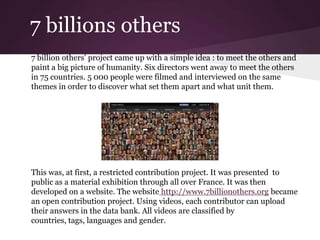
7 billion others’ project came up with a simple idea : to meet the others and
paint a big picture of humanity. Six directors went away to meet the others
in 75 countries. 5 000 people were filmed and interviewed on the same
themes in order to discover what set them apart and what unit them.
This was, at first, a restricted contribution project. It was presented to
public as a material exhibition through all over France. It was then
developed on a website. The website http://www.7billionothers.org became
an open contribution project. Using videos, each contributor can upload
their answers in the data bank. All videos are classified by
countries, tags, languages and gender.
Soundcities by Stanza
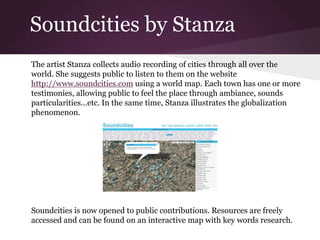
The artist Stanza collects audio recording of cities through all over the
world. She suggests public to listen to them on the website
http://www.soundcities.com using a world map. Each town has one or more
testimonies, allowing public to feel the place through ambiance, sounds
particularities…etc. In the same time, Stanza illustrates the globalization
phenomenon.
Soundcities is now opened to public contributions. Resources are freely
accessed and can be found on an interactive map with key words research.
The Whitney Museum
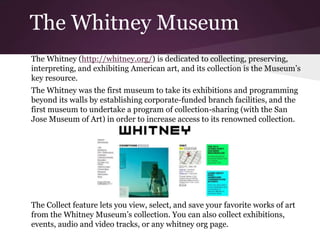
The Whitney (http://whitney.org/) is dedicated to collecting, preserving,
interpreting, and exhibiting American art, and its collection is the Museum’s
key resource.
The Whitney was the first museum to take its exhibitions and programming
beyond its walls by establishing corporate-funded branch facilities, and the
first museum to undertake a program of collection-sharing (with the San
Jose Museum of Art) in order to increase access to its renowned collection.
The Collect feature lets you view, select, and save your favorite works of art
from the Whitney Museum’s collection. You can also collect exhibitions,
events, audio and video tracks, or any whitney org page.
Suggestions – Two scenarios
Two compatible and modular projects:
1. A Web platform, in which documentary
evidence is collected and published by editor
teams.
2.The same Web platform, enhanced by user
generated content.
Suggestions – Modeling
Tools
Below schemas show an abstracted preview of
the platform.It uses UML
(https://duckduckgo.com/Unified_Modeling_Language).
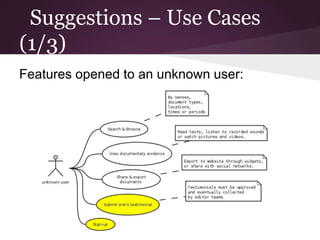
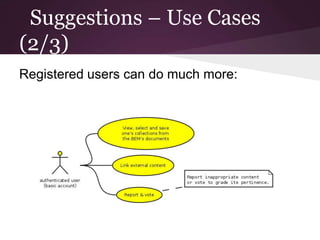
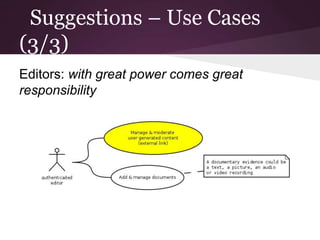
The first one represents use cases, with three
actors (unknown user, basic registered and
editor user) and their related use cases.
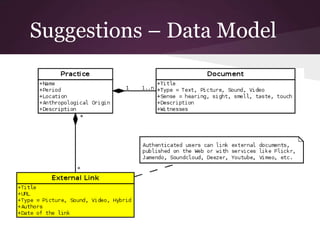
The second one is a first (and draft) data
model.
Suggestions – Use Cases
(1/3)
Features opened to an unknown user:
Suggestions – Use Cases
(2/3)
Registered users can do much more:
Suggestions – Use Cases
(3/3)
Editors: with great power comes great
responsibility
Suggestions – Data Model

Bem presentation

  • 1.
  • 2.
    Contents 1. European memorybank project 2. Benchmark a. 7 Billions Others b. Soundcities by Stanza c. The Whitney Museum 3. Suggestions a. Two Scenarios b. Modeling Tools c. Use Cases d. Data Model
  • 3.
    European memory bank project Whatis it ? This project looks into the five senses and the memory. It includes seven European countries. The overall goal of the European Memory Bank project is to collect traditions, practices, items, which would disappear with the changing society. It would introduce these traditions through the five senses and would set up a data bank in order to prevent the loss of memory. The project must tell stories and arouse curiosity. Both countries and the five senses have to be highlighted. Throughout the project, each country must show its cultural heritage. The interface could show a geography card that would lead to the information. The users could possibly consult the content either by country, sense or document.
  • 4.
    7 billions others 7billion others’ project came up with a simple idea : to meet the others and paint a big picture of humanity. Six directors went away to meet the others in 75 countries. 5 000 people were filmed and interviewed on the same themes in order to discover what set them apart and what unit them. This was, at first, a restricted contribution project. It was presented to public as a material exhibition through all over France. It was then developed on a website. The website http://www.7billionothers.org became an open contribution project. Using videos, each contributor can upload their answers in the data bank. All videos are classified by countries, tags, languages and gender.
  • 5.
    Soundcities by Stanza Theartist Stanza collects audio recording of cities through all over the world. She suggests public to listen to them on the website http://www.soundcities.com using a world map. Each town has one or more testimonies, allowing public to feel the place through ambiance, sounds particularities…etc. In the same time, Stanza illustrates the globalization phenomenon. Soundcities is now opened to public contributions. Resources are freely accessed and can be found on an interactive map with key words research.
  • 6.
    The Whitney Museum TheWhitney (http://whitney.org/) is dedicated to collecting, preserving, interpreting, and exhibiting American art, and its collection is the Museum’s key resource. The Whitney was the first museum to take its exhibitions and programming beyond its walls by establishing corporate-funded branch facilities, and the first museum to undertake a program of collection-sharing (with the San Jose Museum of Art) in order to increase access to its renowned collection. The Collect feature lets you view, select, and save your favorite works of art from the Whitney Museum’s collection. You can also collect exhibitions, events, audio and video tracks, or any whitney org page.
  • 7.
    Suggestions – Twoscenarios Two compatible and modular projects: 1. A Web platform, in which documentary evidence is collected and published by editor teams. 2.The same Web platform, enhanced by user generated content.
  • 8.
    Suggestions – Modeling Tools Belowschemas show an abstracted preview of the platform.It uses UML (https://duckduckgo.com/Unified_Modeling_Language). The first one represents use cases, with three actors (unknown user, basic registered and editor user) and their related use cases. The second one is a first (and draft) data model.
  • 9.
    Suggestions – UseCases (1/3) Features opened to an unknown user:
  • 10.
    Suggestions – UseCases (2/3) Registered users can do much more:
  • 11.
    Suggestions – UseCases (3/3) Editors: with great power comes great responsibility
  • 12.